RADIO NETWORK PLANNING AND OPTIMIZATION IN MOBILE WiMAX (IEEE 802.16e)
SYED AMMAR BIN SYED KAMARUDDIN
ELECTRICAL & ELECTRONIC ENGINEERING UNIVERSITI TEKNOLOGI PETRONAS
SEPTEMBER 2012 SYED AMMAR BIN SYED KAMARUDDINB. ENG. (HONS) ELECTRICAL & ELECTRONICSEPTEMBER 2012
RADIO NETWORK PLANNING & OPTIMIZATION IN MOBILE WIMAX (IEEE 802.16e)
By
SYED AMMAR BIN SYED KAMARUDDIN
Dissertation
Submitted to the Electrical & Electronic Engineering Department in Partial Fulfillment of the Requirements
for the Degree
Bachelor of Engineering (Hons) (Electrical & Electronic Engineering)
Universiti Teknologi Petronas Bandar Seri Iskandar 31750 Tronoh
Perak Darul Ridzuan
iii
CERTIFICATION OF APPROVAL
RADIO NETWORK PLANNING & OPTIMIZATION IN MOBILE WIMAX (IEEE 802.16e)
by
Syed Ammar bin Syed Kamaruddin
Dissertation submitted to the
Electrical & Electronic Engineering Department Universiti Teknologi PETRONAS in partial fulfilment of the requirement for the
Bachelor of Engineering (Hons) (Electrical & Electronic Engineering)
Approved:
__________________________
Dr Mohd Zuki Yusoff Project Supervisor
UNIVERSITI TEKNOLOGI PETRONAS TRONOH, PERAK
September 2012
CERTIFICATION OF ORIGINALITY
This is to certify that I am responsible for the work submitted in this project, that the original work is my own except as specified in the references and acknowledgements, and that the original work contained herein have not been undertaken or done by unspecified sources or persons.
__________________________
Syed Ammar bin Syed Kamaruddin
v ABSTRACT
The project is mainly about the radio network design in Worldwide interoperability for Microwave Access (WiMAX) system. Being an IP based, wireless broadband technology WiMAX (IEEE 802.16) is able to provide performance-wise like 802.11/Wi-Fi networks while at same time possess cellular network-like performance in terms of coverage and QOS (quality of service). Its acronym has meaning of "Worldwide Interoperability for Microwave Access (WiMAX). WiMAX is introduced by IEEE to handle metropolitan area. Fixed WiMAX do provide coverage up to 50 km while its variant, Mobile WiMAX can cover up to 5-15 km distance. This is in contrast to WiFi technology which covers wireless local area network with radius of 100m at most. WiMAX can operates on both licensed and non-licensed frequencies, providing a regulated environment and viable economic model for wireless carriers. WiMAX’s purpose is to verify interoperability wireless broadband radios between vendors. Testings of WiMAX equipments are done by WiMAX Forum, mainly to confirm interoperability. This is contrast to its 4G counterpart- the more recent Long Term Evolution (LTE) standard.
LTE can be a parallel technology to WiMAX but LTE meant to provide controlled environment of Internet. LTE devices are hesitant to give free access while WiMAX is ready to serve metropolitan area unanimously. Residents of urban area or any densely populated area will have serious triple-play (voice, video, data) traffic congestion in terms of Internet connectivity when the physical link is in wired form.
To elevate from congested to a much-less congested traffic, a wireless medium is proposed as an alternative to wired counterpart, that is WiMAX platform. WiMAX further divides into two category, Fixed WiMAX and Mobile WiMAX. For mobility advantages, Mobile WiMAX will be thouroughly discussed as the proposed solution for this problem.
Ultimately, we will be able to verify performance of WiMAX network via simulator ArcMap running Cellular Expert interface, verify deployment of Base Station and verify optimized coverage pattern on the network.
ACKNOWLEDGEMENTS
First and foremost, special thanks to Allah Almighty for giving me strength and patience to complete the extended proposal. Thanks to FYP Supervisor, Dr Mohd Zuki Yusoff for guiding and mentoring as well as direct supervision for final year project. Special thanks to GA Mr Firas for tutoring experience, expose tools and supports in order to realize the project. Thanks to family members for continuous support and last but not least, thanks to all those involved directly or indirectly.
vii
TABLE OF CONTENTS
LIST OF TABLES ... viii
LIST OF FIGURES ... ix
LIST OF ABBREVIATIONS ... x
CHAPTER 1 INTRODUCTION ...1
1.1 Background of Study ... 1
1.2 Problem Statement ... 1
1.3 Objective and Scope of Study ... 2
1.4 Relevancy and Feasibility ... 2
CHAPTER 2 LITERATURE REVIEW ...3
CHAPTER 3 RESEARCH METHODOLOGY ...8
3.1 Research Methodology ... 8
3.1.1 Prepare Master plan of network: ... 8
3.1.2 Prepare Preliminary Design Review: ... 8
3.1.3 Prepare Critical Design Review: ... 9
3.1.4 Commisioning Design & Documentation: ... 9
3.2 Flow Chart ... 10
3.3 Project Milestone ... 11
3.4 Gantt Chart ... 12
3.5 Computer Aided Tools... 13
CHAPTER 4 RESULT AND DISCUSSION ...14
CHAPTER 5 CONCLUSION AND RECOMMENDATION ...24
APPENDICES ...25
REFERENCE ...27
LIST OF TABLES
Table 1 Telecommunication market segmentation ... 3 Table 2 Different mode of SUI Model ... 9
ix
LIST OF FIGURES
Figure 1 WiMAX specification areas ... 4
Figure 2 Mobile WiMAX end-to-end networking ... 5
Figure 3 Network reference points ... 6
Figure 4 Authorized use of Cellular Expert software running on ArcMap ... 13
Figure 5 Select SUI Propagation Model in ArcMap ... 14
Figure 6 Antenna configuration on ArcMap ... 15
Figure 7 Traffic demand ... 16
Figure 8 User density ... 16
Figure 9 Plain map with Trial BS ready to deploy ... 17
Figure 10 Trial BS parameter ... 17
Figure 11 Parameter sectors to Trial BS ... 18
Figure 12 Predicted field strength related to sectors in Trial BS ... 18
Figure 13 Predicted field strength on top of user density layer ... 19
Figure 14 RSSI broadcasted by BS01, BS02, BS03 and BS04 ... 20
Figure 15 Layer RSSI BS01 through BS04 on top of layer User Density ... 20
Figure 16 RSSI coverage for Trial 2 BS with h=10 m ... 21
Figure 17 RSSI coverage for Trial 2 BS with h=15 m ... 21
Figure 18 RSSI coverage for Trial 2 BS with h=30 m ... 22
Figure 19 RSSI coverage contributed by BS01-BS04 and Trial 2 BS ... 23
Figure 20 RSSI coverage with high user density included as well ... 23
LIST OF ABBREVIATIONS
AAA Authentication, Authorization and Accounting ASN Access Serving Network
ASN-GW ASN Gateway
ATM Asynchronous Transfer Mode B-ISDN Broadband ISDN
BS Base Station
CSN Connectivity Serving Network GIS Geographical Information System GSM Groupe Speciale Mobile
HSPA High Speed Packet Access
ISDN Integrated Services Digital Network
MCMC Malaysian Communications and Multimedia Commision NAP Network Access Provider
NSP Network Service Provider POTS Plain Old Telephone System
SUI Stanford University Interim Propagation Model UMTS Universal Mobile Telecommunication System WCDMA Wideband Code Division Multiple Access
WiMAX Worldwide interoperability for Microwave Access WRX WiMAX Roaming Exchange
1
CHAPTER 1 INTRODUCTION
1.1 Background of Study
Being an IP based, wireless broadband technology WiMAX (IEEE 802.16) is able to provide performance-wise like 802.11/Wi-Fi networks while at same time possess cellular network-like performance in terms of coverage and QOS (quality of service). Its acronym has meaning of "Worldwide Interoperability for Microwave Access (WiMAX). WiMAX is introduced by IEEE to handle metropolitan area.
Fixed WiMAX do provide coverage up to 50 km while its variant, Mobile WiMAX can cover up to 5-15 km distance. This is in contrast to WiFi technology which covers wireless local area network with radius of 100m at most.
WiMAX can operates on both licensed and non-licensed frequencies, providing a regulated environment and viable economic model for wireless carriers.
WiMAX’s purpose is to verify interoperability wireless broadband radios between vendors. Testings of WiMAX equipments are done by WiMAX Forum, mainly to confirm interoperability. This is contrast to its 4G counterpart- the more recent Long Term Evolution (LTE) standard. LTE can be a parallel technology to WiMAX but LTE meant to provide controlled environment of Internet. LTE devices are hesitant to give free access while WiMAX is ready to serve metropolitan area unanimously.
1.2 Problem Statement
Residents of urban area or any densely populated area will have serious triple-play (voice, video, data) traffic congestion in terms of Internet connectivity when the physical link is in wired form. To elevate from congested to a much-less congested traffic, a wireless medium is proposed as an alternative to wired counterpart, that is WiMAX platform. WiMAX further divides into two category, Fixed WiMAX and Mobile WiMAX. For mobility advantages, Mobile WiMAX will be thouroughly discussed as the proposed solution for this problem. In nutshell, we will have to
investigate the connection performance in Base Station for sufficient coverage, as primary problem to be tackled. In future works, it is anticipated that more design parameters which can be optimized as higher level of problem.
1.3 Objective and Scope of Study
The project is to study the radio network design involved in Mobile WiMAX IEEE 802.16e. Further, to investigate the requirements and considerations related to Mobile WiMAX coverage aspect in planning procedure. The network planning aims to decide coverage prediction in a network. During the planning and optimization procedures, different design criteria such as antenna configurations, coverage threshold levels, appropriate propagation models and appropriate channel strategies will be addressed. Among the scopes covered in the project is the proposal of WiMAX network architecture and how to optimize the resources given in the network.
1.4 Relevancy and Feasibility
Since the world is experiencing the growing demand in electronic industry such as smartphones, tablet PCs and other electronic gadjet, Mobile WiMAX technology is relevant and prevalent to be installed to cater the current demand. This relevancy follows the objective stated before that is to mitigate traffic congested into a less- congested platform and thus, a verified connection-oriented in Base Station to be investigated. It is assumed that smooth operation for whole system as fixed variable while the Base Station factor is the manipulative variable. This will visualize the theoretical values of WiMAX system and appreciate it as potential technology in near future.
3 CHAPTER 2 LITERATURE REVIEW
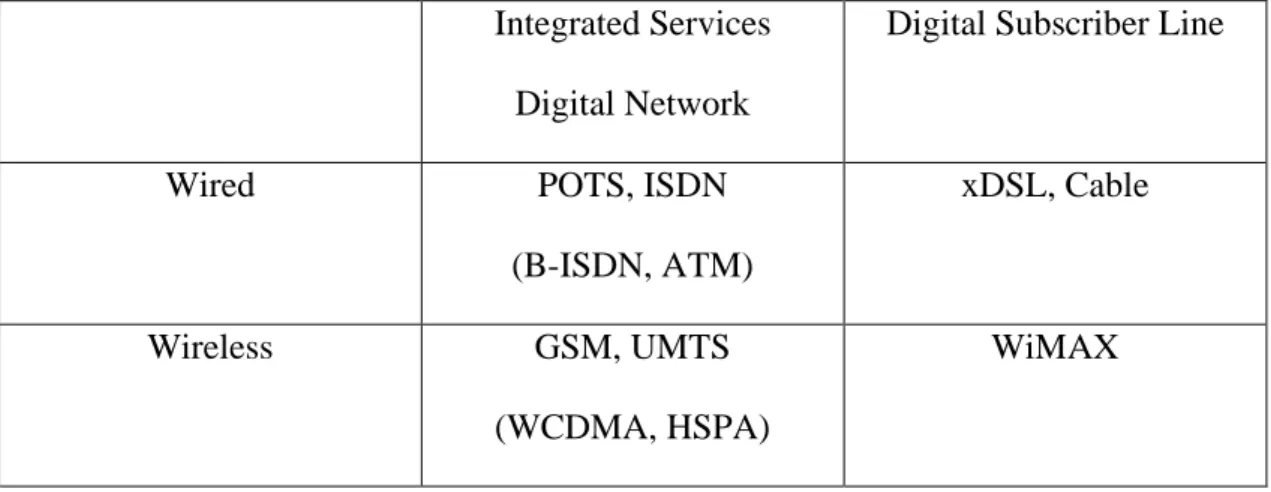
Worldwide interoperability for Microwave Access (WiMAX) is synonymous with the IEEE 802.16 air interface standard. Many believed that WiMAX would become the preferred fourth generation (4G) radio technology superseding all the CDMA-based 3G technologies of the UMTS [1]. Despite the similarities of radio interface, Mobile WiMAX follows a different paradigm of telecommunication as in Table 1. From the beginning, Mobile WiMAX aims a unique deployment model which is analogues to ‘Digital Subscriber Line’ model in terms of functionality but differs in physical link.
Table 1 Telecommunication market segmentation Integrated Services
Digital Network
Digital Subscriber Line
Wired POTS, ISDN
(B-ISDN, ATM)
xDSL, Cable
Wireless GSM, UMTS
(WCDMA, HSPA)
WiMAX
The drive of Mobile WiMAX is to provide broadband internet connection wirelessly over a much wider ranger that a couple of meters provided by Wi-Fi access point. It is intended to be a wireless counterpart for the Cable and DSL technology which further broadens telecommunications via Internet access through mobile terminals and for new kinds of mobile applications. Perhaps, the most challenging for operation of Mobile WiMAX is the congestion volume of data experienced by wired DSL will become prevalent in Mobile WiMAX also. The Mobile WiMAX station deployment, the support of mobility function such as network detection and selection, handover, roaming among others have allow for nomadic and mobile service offerings.
IEEE 802.16 as well as WiMAX Forum create the technical specifications of Mobile WiMAX, is a working group of the IEEE 802 LMSC, which is in charge of the PHY and MAC specifications of the radio interface. The remaining parts of the access network are beyond scope of Mobile WiMAX. In addition to the technical specification, WiMAX Forum also develops certificate for Mobile WiMAX equipments which ensures interoperability of the devices between different implementation. WiMAX Forum also ensures that Mobile WiMAX deployed is conforming to regulations in supporting worldwide acceptance [2] [3].
Figure 1 WiMAX specification areas
5
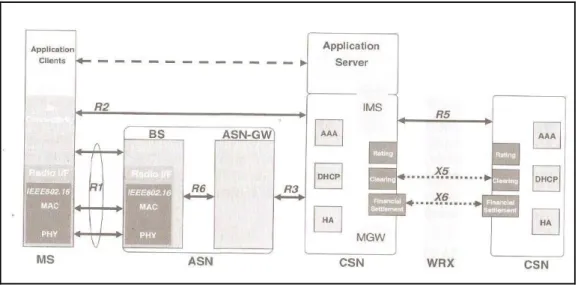
Figure 2 Mobile WiMAX end-to-end networking
There are three main areas in Mobile WiMAX : radio, network and roaming. Each of the areas will have reference point for interoperability.[4] [5]
• Radio interface: Denoted by R1, it defines the interface between mobile terminal or subscriber equipment and BS of access network.
The interface consists of PHY layer, MAC layer and network layer.
The data are included in the certificate process.
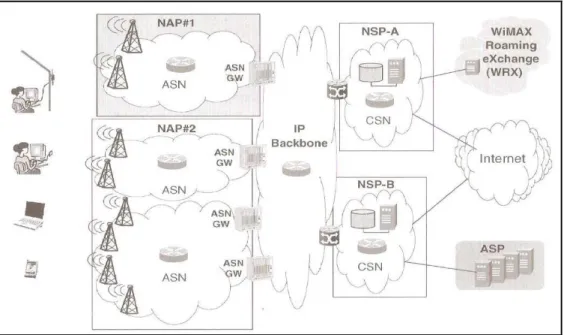
• Network interface: Mobile WiMAX defines distinct logical network entities for ASN and for CSN. The ASN consists of a numbers of BSs connected in some manner to at least a ASN-GW, which anchors the interface to CSN. Standardized interfaces between CSNs are used for roaming purposes. R2, R3, R5 are interfaces denoted as in Figure 1, used in network interoperability test.
• Roaming interface: Mobile WiMAX supports roaming interfaces fo facilitate worldwide roaming support among WiMAX operators.
Roaming is achieved in WRX network which standardized procedures and messages between WiMAX operators. This allows subscribers of operator to have access or connectivity to other operator in foreign network. Roaming architecture is depicted as X5, X6 and R5, which
passes WRX interface. These points are used for interoperability testing for verifying the normal operation of WRX.
Figure 3 Network reference points
7
• R3: interface between ASN of Mobile WiMAX access provider and the CSN of NSP. R3 contains AAA function, including IP configuration and policy control function, for dynamic establishment and relocation of user data path to realize network sharing and wide area mobility. The latter two functions are optional for R3 and can be omitted for small network and Fixed WiMAX.
• R5: interface between CSNs but different NSP for enabling roaming subscription. Depending on the contract between NSPs, either roaming subscriber will get Internet connectivity directly from visited NSP, or services from home NSP are provided over the optional R5 interface.
• R2: direct interface between subscriber to home NSP, used for secure line when exchanging credentials is necessary. R2 can carry control information only.
CHAPTER 3
RESEARCH METHODOLOGY
3.1 Research Methodology
3.1.1 Prepare Master plan of network:
Define area of interest to deploy WiMAX network. Area of study can be limited to certain area and discontinuous to the neighbor area. Another planning can be added for future without affecting to previous area.
Determine appropriate Geographical Information System GIS simulator to be used throughout study period. A formal request for trial, project version license for simulator is drafted. Simulator selection is assessed to fit objective, which are able to generate coverage aspect of WiMAX network. A basemap is needed for the simulator. Satellite image of World Map ensures practical view of landscape in the network. Topography are digitized accordingly by ArcMap. Roads, city, buildings, hills among factors to be included in network planning, only to be introduced later for optimization procedure. WiMAX challenges are investigated. Signal impairment factors are determined like fading due to multipath and due to shadowing (Fresnel Zone). On top of impairment, signal can also degrade in certain conditions such as rain attenuation, sudden change in weather, Line of Sight and Non- LoS deployment, so network planning may waived these limitations to get general coverage on WiMAX system alone. That is, ideally WiMAX can penetrate a metropolitan-wide area easily. Once firm understanding of WiMAX system is established, certain assumptions will take place.
9
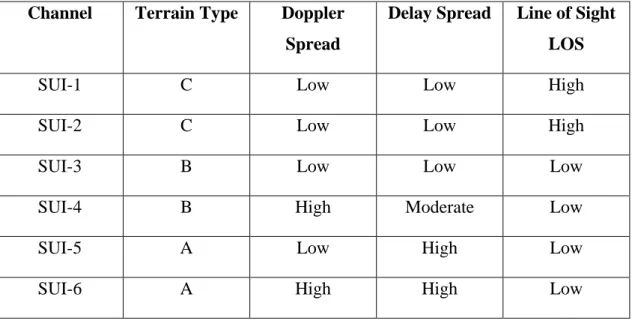
marketing requirements are defined. Suitable propagation model are proposed, that is SUI Model.
Channel Terrain Type Doppler Spread
Delay Spread Line of Sight LOS
SUI-1 C Low Low High
SUI-2 C Low Low High
SUI-3 B Low Low Low
SUI-4 B High Moderate Low
SUI-5 A Low High Low
SUI-6 A High High Low
Table 2 Different mode of SUI Model
3.1.3 Prepare Critical Design Review:
Several critical parameters in ArcNet WiMAX simulation, proper antenna MIMO mode are tested and delay effect to overall performance are investigated, and advanced design criteria such as multi-hop relays, femtocells, low power Base Stations are also considered.
3.1.4 Commisioning Design & Documentation:
Side requirement are determined. Performance of WiMAX network are verified using ArcMap. Deployment of Base Station are verified and the optimized coverage pattern on network are verified.
3.2 Flow Chart
Start
Prepare master plan of radio network
• Theory on 802.16e
• Study on radio characteristics
• Study on WiMAX impairment
Prepare preliminary design review
• Develop WiMAX network
• Benchmark parameters to fit according to objective
Prepare critical design review
• Test run WiMAX network via simulator ArcMap
• Set optimum deployment of Base Station
• Optimize predicted coverage pattern on network
Is optimization satisfy the benchmark?
Yes
No
11 3.3 Project Milestone
Week 6
Preliminary Design Review
FYP1 Timeline
Week 1 Master plan Design Criteria
Week 14 Critical Design Review Week 9
FYP2 Timeline
Week 8
Critical Design Review (continued) New progress from FYP 1
Week 14 Final Report
Week 15 VIVA Week 11
Commissioning & Documentation
•More progress than previous reports
•Final results / findings
3.4 Gantt Chart
WeekFYP II escription12345678910111213141234567891011121314 he radio network X IEEE802.16e teristics ulator in market irments y design review rk architecture er esign review simulator ent Base Station nd documentation f parameter f Base Station age in the network
13 3.5 Computer Aided Tools
CAD used throughout this project is ArcMap with installed extension of Cellular Expert tools. ArcMap is a network simulation tool which is able to simulate wireless and wired packet mode communication networks. It is discrete event simulator used in simulation for WiMAX networks and utilized models for common network protocols that are provided in source form and organized in manner of OSI Stack. ArcMap uses real mapping data and this can be considered as scalable simulator. In contrast to other simulator in the market, an evaluation license is retrieved instead of limited functionality of education license.
Figure 4 Authorized use of Cellular Expert software running on ArcMap ArcMap is able to test several typical functions, namely :
• Demographical view of network planning
• Graphical coverage analysis
• Investigations of performance bottlenecks
• Optimization of network performance and resource configurations Considering the vast functionality of ArcMap in serving telecommunication problems, future works will utilize ArcMap with much broader scale to achieve higher level and broad understanding WiMAX system.
CHAPTER 4
RESULT AND DISCUSSION
SUI Propagation Model
Using ArcMap, one has option to use several models such as AdvancedHata, Macro Adaptive, Walfish-Ikegami, SUI models so we will use SUI Model to perform WiMAX Mobile simulation. Settings available are frequency and radius coverage.
This is to ensure that for certain range, data obtained are accurate to certain degree.
In this case, we choose frequency of 2.4 GHz which is in permissible spectrum. The use of SUI Propagation Model is because it closely approximates the terrain condition for normal case study.
15 Antenna System
One can set configuration of antenna system according to requirement. Under the Equipment Manager tab, we can select antenna best to our situation. Factors to be considered are sectorial type, gain of 24dBi, with frequency 2400 MHz and has mechanical-tilt type. The horizontal pattern and vertical pattern are also useful for intuitively positioning the Base Station on the map.
Figure 6 Antenna configuration on ArcMap
Omni-directional is used in point-to-multipoint configuration. It has weakness in terms of energy radiated is greatly diffused for broadcasting in 360° area. This effectively limit the range coverage and signal signal strength are greatly dropped.
So, one optimized characteristics is the use of several sectorial antennas. Sectorial antenna is used instead of omni-directional. This way, energy radiated in directional, sectorial area and are not wasted. By using two or three sectorial antennas in a single Base Station will yields better performance instead of using single onmi-directional antenna to cover broad area. Refer Appendix 1 for different antenna used ideally in specific application. If one were to broadcast WiFi which is much smaller scale, then omni antenna is suffice. By utilizing sector antenna, we can provide greater ranger and throughput with lesser energy.
Workspace is assumed as following. Firstly traffic demand are analyzed. We have 2 spots high demand while others are distributed randomly.
Figure 7 Traffic demand
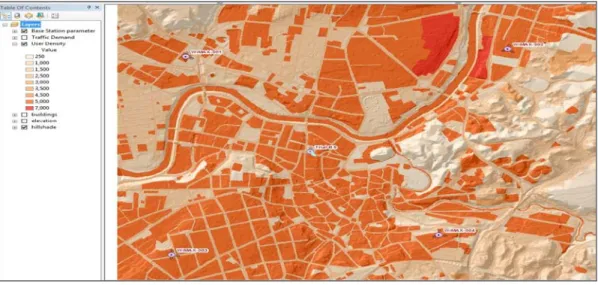
Secondly, user density is analyzed. The distribution of high dense and low dense are map accordingly. At final phase of optimization, we expect each users will obtained proper coverage with good RSSI strength at their premise.
Figure 8 User density
17
An arbitrary Base Station named Trial BS are configured to WiMAX components and placed on the map while parameters of BS are adjusted.
Figure 9 Plain map with Trial BS ready to deploy
Parameters of Trial BS are having base height of 100m above ground. For comparison, the above Figure 9 showing the landscape has elevation of hill area of almost 200m.
Figure 10 Trial BS parameter
In the Trial BS itself, 3 different sectors are set with following parameters:
Figure 11 Parameter sectors to Trial BS
In short, we are setting the sector to use SUI MODEL and antenna sector we defined earlier, with 40 m height from ground and radio power is 35dBm. Sector 1, 2, and 3 have direction pointing 0°, 147° and 247° respectively. This 3 sectors are responsible to broadcast WiMAX in broad area comparable to omni. But we mainly focus on high dense area. Having setup the parameters, ArcMap is ready to run. Calculating time is quite long since we run ArcMap on small computer whereas enterprise version expects super computer for fast computing purposes.
First time running is about viewing general field strength as predicted by ArcMap.
Keeping in mind that the result is yet to be optimized.
19
From Figure 12, the transparency will be reduced 50% and be overlapped with Figure 8. The idea is to match field strength on top of user density map.
Figure 13 Predicted field strength on top of user density layer
Analysis on highly dense area shown that good signal strength RSSI are not achieved by this Trial BS alone. And coverage pattern are randomly spread. At this stage, poor radio network planning is achieved, but not optimized. Prior to this, we modify several parameters that are enough to plan a WiMAX Network by theoretical value alone. However, in this case, it is clear that more strategic approach should be deployed to get the best coverage of WiMAX network.
Therefore, we are to proceed with new strategy, that is to deploy several Base Stations with low power settings and this will make each sector size much smaller.
To pinpoint the sector with having low RSSI is much easier task now.
Next case is there are four BSs pre-deployed to same Figure 8 and data are shown below, depicting RSSI coverage due to these 4 BS. At this stage, we see good network planning. Since most buildings are covered in majority but we still see a high dense area under-optimized. So a Trial 2 BS is introduced to tackle specifically this non-covered area.
Highly Dense
First, the existing RSSI pattern should be known so that we can estimate which area are weak RSSI, shown in Figure 14. While Figure 15 showing the non- covered/weak RSSI even in high user density area. So, a Trial 2 BS is deployed nearby.
Figure 14 RSSI broadcasted by BS01, BS02, BS03 and BS04
Highly Dense
21
Trial 2 BS is introduced now. Trial 2 BS will have low power 20 dBm as compared to BS01 – BS04 high power 40dBm. We will see the RSSI coverage whether such low power can achieve current objective - to provide strong RSSI to high user density area as in Figure 15. Sector 1, 2, and 3 azimuth of 90°, 180° and 270°.
With respect to ground, RSSI signal of Trial 2 BS with height from ground of 10 meter, 15 meter and 30 meter are determined.
Figure 16 RSSI coverage for Trial 2 BS with h=10 m
Figure 17 RSSI coverage for Trial 2 BS with h=15 m
Highly Dense Highly Dense
Figure 18 RSSI coverage for Trial 2 BS with h=30 m
From Figure 16, 17, and 18, it is observed that with increasing height, good RSSI coverage gets increased. Since the power is halved than that of BS01 to BS04, we have successfully deployed low power BS to provide good RSSI signal to high user density area. Upon successful optimization, we obtained a strategic BS placement Trial 2 BS which uses low power but gives significant improvement to current WiMAX network. Had we skipped this new placement, the performance of radio network is underutilized. So, objective accomplished where we have confirmed good RSSI coverage and strategic deployment of BS is verified.
Highly Dense
23
Figure 19 RSSI coverage contributed by BS01-BS04 and Trial 2 BS
Figure 20 RSSI coverage with high user density included as well
Radio network must have two component for successful network, that is good planning procedure and strategy in optimization procedure. Both elements are important for meaningful radio network. Ultimately, the network will be deployed in real field while we can anticipate the performance of network beforehand.
Documentation is prepared which can reach thousands of pages so that any engineer able to understand the topic. WiMAX aims interoperability after all.
Highly Dense
CHAPTER 5
CONCLUSION AND RECOMMENDATION
The design procedure of WiMAX network is lengthy, cumbersome and complex, due to trade-off that the benefits belong to WiMAX only. Where can we find such system that offer metropolitan area with quality performance on-par with cellular network. Technology nowadays has successfully develops such a balance solution while the deployment network will always be on our shoulder. Human has intuitive and unique among each other and this uniqueness gives many possibilities regarding planning strategically. Network planning has no short cuts as doing so may gives undesired cost in later stages. Simulator selection is assessed to fit objective, which are able to generate coverage aspect of WiMAX network. WiMAX challenges are properly managed. Signal impairment factors are determined like fading due to multipath and due to shadowing (Fresnel Zone). On top of impairment, signal can also degrade in certain conditions such as rain attenuation, sudden change in weather, Line of Sight and Non-LoS deployment, so network planning may waived these limitations to get general coverage on WiMAX system alone. Ideally WiMAX can can serve a metropolitan-wide area easily. Being a data-centric application means that WiMAX is best candidate to reduce data load from current 3G network and utilizing WiMAX network to its fullest potential (ie efficient connetivity). Being a vendor neutral means that every global player in telecommunications industry are having equal chance to participate in WiMAX world. So, even current demand of WiMAX is low, WiMAX should not be left out as this also can reduce congested traffic as faced by telecommunication industry. Integrating existing system with WiMAX system can be done and should be brought forward attention to public.
Of course, findings in FYP may not fully applicable for all situations in real world, but we will gain insight view of overall performance in real demographic area.
25 APPENDICES
Different type of antenna for different purposes
Omni antenna ideal to broadcast small area
Sectorial antenna is good to cover at large area
Panel antenna is used point-to-point application like between Base Station to another Base Station separated very far (approximately 70km) apart. Microwave link\ is used
27 REFERENCE
Book
[1] R. Max, K. Dirk and C. Aik, Deploying Mobile WiMAX. Chichester:
John Wiley & Sons Ltd, 2009.
[2] N. Loutfi, WiMAX Technology for Broadband Wireless Access.
Chichester: John Wiley & Sons Ltd, 2007.
[3] Z. Yan and C. Hsiao-Hwa, Mobile WiMAX Toward Broadband Wireless Metropolitan Area Networks. Boca Raton: Aurbach Publications, 2008.
[4] C. Kwang-Cheng and J. R. Marca, Mobile WiMAX. Chichester: John Wiley & Sons Ltd, 2008.
[5] S. Clint and M. John, 3G Wireless with WiMAX and Wi-Fi: 802.16 and 802.11. New York: McGraw Hill, 2004.
[6] X. Yang, WiMAX/MobileFi. Boca Raton: Aurbach Publications, 2008.
[7] H. Chris, G. Dylan and B. Truman, Broadband Network Architectures Designing and Deploying Triple-Play Services. Boston: Pearson Education, 2007.
[8] A. Zerihun, WiMAX RF Systems Engineering. Norwood: Artech House, 2009.
[9] T. George, MIMO System Technology for Wireless Communications.
Boca Raton: Taylor & Francis Group, 2006.
[10] D. K. Marcos and H. P. F. Frank, WiMAX Evolution Emerging Technologies and Applications. Chichester: John Wiley & Sons Ltd, 2009.
Article
[11] P. Chutima and W. Chitapong, “WiMAX Network Design for Cost Minimization and Access Data Rate Guarantee Using Multi-hop
Relay Stations,” in International Journal of Communications, vol 4 2010.
[12] B. Upase et al, “Radio Network Dimensioning and Planning for WiMAX Networks” in Fujitsu Sci. Tech. J, 43, 4, October 2007.
[13] A. S. Khaled, “A Performance Evaluation Study of WiMAX Using QualNet” in Proc. World Congress on Engineering 2009, July 1-3, 2009.
[14] B. Krishna et al, “Design and Analysis of an IEEE 802.16e-Based OFDMA Communication System” in Bell Labs Technical Journal, 11(4), 53-73, 2007.