STATUS OF THESIS
Title of thesis Usage of Structural Equation Modeling and Analytical Hierarchy Process Approach to Select Information Technology
I SARIT MAITRA
hereby- allow my thesis to be placed at the Information Resource Center (IRC) of University technology PETRONAS (UTP) with the following conditions:
1. The thesis becomes the property of UTP
2. The IRC of UTP may make copies of the thesis for academic purpose only
3. The thesis classified as
Confidential
Non-confidential v
If the thesis is confidential, please state the reason:
The contents of the thesis will remain confidential for Remarks on disclosure:
years.
O
u*
Signature of Author
Permanent Address:
A 401. Vinayak Apartment
Malad Link Road. Mumbai 400064 India
•M &4/ Oo a
Date
Endorsed by
Signature of Supervisor
Name of Supervisor:
Assoc. Prof. Dr. Dhanapal
Durai Dominic P
Date:
^
DR. P. U. D. DOMINIC Associate Professor
'"•?mm 'Jer &information Sciences Department
UNIVERSITY TEKNOLOGY PETRONAS
USAGE OF STRUCTURAL EQUATION MODELING AND ANALYTIACL
HIERARCHY PROCESS APPROACH TO SELECT INFORMATION TECHNOLOGY VENDOR
by
S ARIT MAITRA
The undersigned certify that they have read, and recommend to the Postgraduate Studies Programme for acceptance this thesis for fulfillment of the requirements for the degree stated.
Signature
Main Supervisor
Signature
Head of Department
Date
DR. P. D. D. r . Associate Profsssof
•"crmwier* Information -• * -v^;siti7e;knologlPETi
•-.• .\HirSeri Iskandar, T !t>:> • ;ti
;-erakDarulRid/uan. fAL*'-iA
Assoc. Prof. Dr. Dhanapal Durai Dominic P
mmmws seoasjog uc#euuojuj ? tejndufog
Dr. Mohd Fadzil Hassan
**hl
;<irtm«nt
USAGE OF STRUCTURAL EQUATION MODELEsfG AND ANALYTICAL
HIERARCHY PROCESS APPROACH TO SELECT INFORMATION TECHNOLOGY VENDOR
by
SARIT MAITRA
A Thesis
Submitted to the Postgraduate Studies Programme as a Requirement for the Degree of
MASTER OF SCIENCE
COMPUTER AND INFORMATON SCIENCES
UNVERSITI TEKNOLOGI PETRONAS
BANDER SERIISKANDAR
PERAK
September 2011
DECLARTION OF THESIS
Title of thesis
Usage of Structural Equation Modeling and Analytical Hierarchy Process Approach to Select Information
Technology Vendor
I SARIT MAITRA
hereby declare that the thesis is based on my original work except for quotations and citations which, have been duly acknowledged. I also declare that it has not been previously or concurrently submitted for any other degree at UTP or other institutions.
Witnessed by
r
&v> g£_
Signature of Author
Permanent Address:
A 410. Malad Link Road Mumbai 400064. India
Date:
^7
Signature of Supervisor
Name of Supervisor:
Assoc. Prof. Dr. Dhanapal
Durai Dominic P
Date:
D'.v. 9.Q, D. r/OMIN(C
Assrvjiate Profe
Co'opjjwr&Information Sciences Deport u-v^fe Teknotogt PCTRONAS
<-i;.>v.i-:• Scl Iskandar, 31750 Tron-V;
?m\ Oaml Rkfcuan, MaU^A
ACKNOWLEDGEMENT
I would like to express my sincere gratitude to my advisor Dr. P D D Dominic for his advice, guidance and revisions in improving this thesis.
I would like to thank to my brother for his support and my fiancee for endless and unconditional support to complete this thesis.
ABSTRACT
Progressive change is an accurate way to describe the advancement of information technology (IT) throughout the 1990s. As IT continues to evolve, the ways in which companies do business are also changing. The emergence of the Internet as a business venue, the growing percentage of consumers accessing the Web, and the increasing number of households equipped with a PC or other Web-access device are speeding IT's rate of change. The industries especially banking and financial services industries (BFSI) are heavily supported by IT and technology vendor for their service oriented
business. It indicates that choosing the right vendor remains a critical success factor for every enterprise's business success. Selection of the best possible set of vendors not only allow organisations to downsize and utilise resources more effectively, but
also allows them to take advantage of the capabilities and technologies of the vendors.
The vendor selection process can be a very complicated and emotional undertaking if the approach from the very beginning is not known. The purpose of this research is to identify the required criteria for selecting the best vendor for information technology (IT) process and provide a vendor selection model including these criteria by using the structural equation modeling (SEM) and analytic hierarchy process (AHP). To demonstrate the above model and also, to arrive at vendor selection scores, the vendor selection for mobile banking application was considered as an example. The developed model is a generic one considering the global economic turmoil and the amount ofpressure on banking & financial services industries (BFSI), where IT is the backbone of the BFSI; In any future studies the model could be applied in making other strategic decisions like IT outsourcing, ERP (enterprise resource planning)
implementation vendor selection etc.
ABSTRAK
Perubahan progresif adalah satu cara yang tepat untuk menggambarkan kemajuan teknologi maklumat (IT) di seluruh tahun 1990-an. Sebagai IT terus berkembang, cara-cara di mana syarikat menjalankan perniagaan juga berubah. Kemunculan Internet sebagai tempat perniagaan, peratusan pengguna yang mengakses web yang semakin meningkat, dan peningkatan bilangan isi rumah yang dilengkapi dengan PC atau peranti akses Web-lain mempercepatkan kadar IT perubahan. industri perkhidmatan terutamanya perbankan dan kewangan industri (BFSI) banyak disokong oleh IT dan vendor teknologi untuk perniagaan berorientasikan perkhidmatan mereka.
la menunjukkan bahawa memilih vendor yang tepat terus menjadi faktor kejayaan yang kritikal bagi setiap kejayaan perniagaan perusahaan. Pemilihan set yang terbaik mungkin vendor bukan sahaja membolehkan organisasi untuk mengecilkan dan menggunakan sumber dengan lebih berkesan, tetapi juga membolehkan mereka untuk mengambil kesempatan daripada keupayaan dan teknologi vendor. Proses pemilihan vendor boleh menjadi satu usaha yang sangat rumit dan emosi jika pendekatan dari awal-awal lagi tidak diketahui. Tujuan kajian ini adalah untuk mengenal pasti kriteria yang diperlukan untuk memilih penjual terbaik untuk proses teknologi maklumat (IT) dan menyediakan model pemilihan vendor termasuk kriteria ini dengan menggunakan pemodelan persamaan struktur (SEM) dan proses hierarki analitik (AHP). Untuk menunjukkan model di atas dan juga, untuk tiba di skor pemilihan vendor, pemilihan vendor untuk permohonan perbankan mudah alih adalah dianggap sebagai contoh.
Model yang dibangunkan adalah satu generik mengingati kegawatan ekonomi global dan jumlah tekanan pada perbankan & kewangan industri perkhidmatan (BFSI), di mana IT adalah tulang belakang yang BFSI; Dalam mana-mana kajian masa depan model yang boleh digunakan dalam membuat keputusan strategik yang lain seperti penyumberan luar IT, pelaksanaan pemilihan vendor ERP (perancangan sumber perusahaan) dan Iain-lain.
COPYRIGHT PAGE
In compliance with the terms of the Copyright Act 1987 and the IP Policy of the University, the copyright of this thesis has been reassigned by the author to the legal
entity of the University,
Institute of Technology PETRONAS Sdn Bhd
Due acknowledgement shall always be made of the use of any material contained
in, or derived from, this thesis.© Sarit Maitra, 2011
Institute of Technology PETRONAS Sdn Bhd All rights reserved
TABLE OF CONTENTS
CHAPTER 1: INTRODUCTION 1
1.1 Overview 1
1.2 Background 1
1.2.1 Importance of information technology & vendor selection 2
1.2.2 Brief history 3
1.3 Identification of research gap 6
1.4 Objectives of the research 7
1.5 Problem statement 10
1.6 Scope of research 11
1.7 Research contributions 13
1.7 Outline of thesis 14
CHAPTER 2: LITERATURE REVIEW 15
2.1 Overview 15
2.2 Introduction 15
2.3 Literature review on decision criteria 17
2.4 Vendor selection methodologies 24
2.5 Issues & challenges of vendor selection 38
2.7 Summary of literature review 40
CHAPTER 3: RESEARCH METHODOLOGY 43
3.1 Overview 43
3.2 Introduction 43
3.3 Criteria and sub criteria for vendor selection 44
3.4 Measures of vendor selection & hypotheses development 48
3.4.1 Vendor credibility 48
3.4.2 Management & organisation 49
3.4.3 Technical elements 50
3.4.4 Product stability 50
3.4.5 Processes. 51
3.4.6 Quality 51
3.4.7 Financial & commercials , 52
3.4.8 Vendor culture 52
3.4.9 Services & support.... 53
3.4.10 Cost 53
3.5 SEM and AHP approach: Theoretical framework 54
3.5.1 Structural Equation Modeling 54
3.5.2 Justification for the usage of SEM 55
3.5.3 Analytical Hierarchy Process (AHP) 56
3.5.4 Justification of usage of AHP 57
3.6 Conceptual model for vendor selection using SEM and AHP 57
3.7 Vendors considered for study 67
3.7.1 Jack Henry & Associates, Inc. ->Vendor 1 67
3.7.2 Temenos-> Vendor 2 68
3.7.3 Sybase365-> Vendor 3 68
3.7.4 Gemalto-> Vendor 4 68
3.7.5 Finnacle-> Vendor 5 69
3.8 Summary 69
CHAPTER 4: VENDOR SELECTION MODEL USING SEM & AHP 71
4.1. Chapter overview 71
4.2 Data collection 71
4.3 Variable and measurement 74
4.3.1 Reliability 74
4.3.2 Convergent validity 75
4.3.3 Coefficient of determinaton 76
4.4 Empirical results 88.
4.4.1 Goodness of fit model test 89
4.4.2 Hypotheses testing 90
4.5 Calculation of Relative Weightage of criteria (Xj) 91
4.6 Relative weightage of vendor 93
4.6.1 Calculation of Vendor's Relative Weightage 94
4.6.2 Vendor relative weightage in Management & Organisation 95
4.7 Consistency ratio 99
CHAPTER 5: RESULTS & DISCUSSIONS 103
5.1 Sensitivity analysis of the data 103
5.2 Conclusion , 104
5.3 Study limitations 105
5.4 Recommendations 106
5.7 Direction for future work 107
References 108
List of publications 129
Appendix 1 130
Appendix II 133
Appendix III 136
TABLE OF CONTENTS
1.1 Rank of vendor selection criteria 4
2.1 Study on vendor selection criteria 19
2.2 Dickson's vendor selection criteria & rank 21
2.3 List and summary of papers related to selection criteria 22
2.4 Vendor evaluation methodologies 26
2.5 List and classification of vendor selection methods 28
2.6 Literature review on vendor selection methods 31
3.1 Criteria & sub criteria for vendor selection 46
3.2 Hypothesis for vendor selection 54
3.3 Sample pair wise comparison matrix 66
4.1 Seven point scale 72
4.2 Survey response rate 73
4.3 Results of constructs 75
4.4 Fit indices table of SEM 89
4.5 Results of hypotheses 90
4.6 Relative weightage of all the criteria 93
4.7 Saaty's scale 94
4.8 Pair wise comparison matrix for MNO 95
4.9 Paired comparison 96
4.10 Summation of reciprocal matrix 97
4.12 Priority venstor for the vendors with respect to MNO 98
4.13 Relative weightage of vendor vis-a-vis criteria 98
4.14 Random consistency index (RI) 99
4.15 Consistency ratio calculation 100
4.16 Vendor score 101
4.17 Vendor score for all the vendors 102
5.1 Sensitivity analysis 104
LIST OF FIGURES
Figure 1.1 Research framework 8
Figure 3.1 Graphical representation of SEM 55
Figure 3.2 Generic model for measuring supplier selection 58 Figure 3.3 Conceptual SEM Model (a) for measuring vendor selection....60
Figure 3.4 Conceptual SEM Model (b) 63
Figure 4.1 Amos model (a) gi 77
Figure 4.2 Amos model (a) g2 78
Figure 4.3 Amos model (a) g3 79
Figure 4.4 Amos model (a) g4 80
Figure 4.5 Amos model (a) gs 81
Figure 4.6 Amos model (a) g6 82
Figure 4.7 Amos model (a) g7 83
Figure 4.8 Amos model (a) gs 84
Figure 4.9 Amos model (a) gg 85
Figure 4.10 Amos model (a) gio 86
Figure 4.11 Relative weightage of each criteria 87
LIST OF ABBREVIATIONS
AHP Analytical Hierarchy Process
ANN Artificial Neural Network
ANP Analytic Network Process
BFSI Banking & financial services industries CFA Conformity Factor Analysis
CFI Comparative Fit Index CMM Capability Maturity Model DEA Data envelope Analysis
DF Degrees of Freedom
ERP Enterprise Resource Planning
GFI Goodness-of-Fit
IFI Incremental Fit Index
ISO International Standards Organisation IT Information Technology
MAUT Multiple Attribute Utility Theory MCDM Multiple Criteria Decision Making
NASDAQ National association of securities and dealers automated quotation R&D Research and Development
RFI Request for information RFP Request for proposal
RMSEA Root mean square error of approximation SEM Structural Equation Modeling
SA Sensitivity Analysis
TQM Total Quality Management
USA United States of America
CHAPTER 1
INTRODUCTION
1.1 Overview
This chapter represents background in the first section wherein the importance IT and IT vendor has been discussed followed by brief history which is a brief background of this research and which addresses the research motivation as well. The second section
provides the identification of research gap and scope of research. The subsequent sections discuss about objectives, research questions, problem statement and contributions; finally the structure of the thesis. The researcher has frequently used the reference of BFSI (banking & financial services industry), IT (information technology) and outsourcing in the whole research, as this research has considered the case of vendor selection for mobile banking application, which is based, on information technology.
1.2 Background
This section discusses about the importance of information technology and technology vendor; it also discusses about the importance of vendor selection method and discusses about the history of vendor selection and different criteria for vendor selection, which are popular and have been studied in various literature related to
vendor selection.
1.2.1 Importance of information technology & vendor seiection
Information technology is considered extremely important for the revenue generating operations of divisions of the organizations. Technology has transformed the way people obtain financial services today. Telephone banking, debit and credit cards, and automatic teller machines are commonplace, and electronic money and banking are evolving. This shows that technology is clearly shifting away from support and administrative function to the more mainstream and strategic functions. The search for new vendors is a continuous priority because of not only to run the operation, but also to upgrade the variety and type of their service offerings. Information technology has opened up new markets, new products, new services and efficient delivery channels for banking industry. However, the expected professionalism of vendor selection in BFSI is far from common practice. A majority of the relatively few models that have been developed for vendor selection are based on rather simplistic perceptions of decision making processes and do not seem to address the complex and unstructured nature and context of many present-day IT vendor selection. Several issues that may complicate the selection process such as incomplete information, additional qualitative criteria and imprecise preferences are often not taken into account.
Moreover, considering banking application is a very complex; involve several applications integrations and technologies a right vendor is not just a vendor but a strategic business partner in long run.
Whilst considering all the above, it is evident that need of a technology vendor is eminent and thereby vendor selection is an important activity in BFSI; but unfortunately this is a semi-structured management problem today. Vendor selection has always been a complex process as various criteria, known and half known are involved in making a decision (Jitender and Nirjhar, 2010). The BFSI is going through the biggest ever challenges today and during this phase the right selection of technology vendor will not only help them to turnaround the business but will reduce the operating cost.
Especially mobile banking, which is considerably new technology, and gaining popularity day-by-day, but still has not appealed the mass mobile users population because of several reasons and one among that is lack of confidence on online transaction, which can be addressed by selecting the right technology vendor. This has motivated the researcher to develop a model involving multi-criteria decision making for vendor selection for a specialized banking application.
1.2.2 Brief history
The banking industry which started with a simple form of banking was once practiced by the ancient temples of Egypt, Babylonia, and Greece, which loaned at high rates of interest the gold and silver deposited for safekeeping to today's sophisticated financial transactions where information technology is the spine. Through the introduction of IT related products in internet banking, electronic payments, security investments, information exchanges (Berger, 2003, Shirley and Sushanta, 2006), banks now can provide more diverse services to customers with less manpower. The banks are for all good reasons thereby very careful in selecting their technology vendors, who help them in developing the IT applications and customize the applications to the various
needs of the banks.
Thus selection of a vendor is a critical and complex multi-objective, multi criteria decision making problem. Even though, quite a few vendor selection models are available in the literature, in this research, an attempt has been made to develop a composite model using SEM and AHP to attain the vendor selection score. This
research focuses on the criteria that influence vendor selection and the model has been built based on those criteria.
An extensive study of literature, white paper, j ournals, discussion with professional in the related field has provided the researcher an insight about various
methods and selection criteria have been studied so far for vendor evaluation. This has
become the starting point of this research.
There are several criteria that affect the vendor selection process. In regard to vendor selection for BFSI, the technical elements and past experience or reference clients may affect the vendor selection process. The number of vendors to be selected depends on the sourcing strategy that a firm follows. If the firm is in favour of single sourcing, a single vendor is to be selected. If, on the other hand, the firm follows a multiple sourcing strategy, then more than one vendor is selected. The initial observation was that 29 major criteria listed in table 1.1 based on their rank in the selection process, which was discussed in most of the journals and literature studied.
The * marked in the table are the criteria that appeared in Dickson's (1966) research.
Table 1.1 Rank of vendor selection criteria
No. Criteria
01
Quality n
02
Delivery r)
03 Cost <*»
04 Production facility and
capacity ( '
05 Flexibility and reciprocal
arrangement (*J
06 Technical capacity and
support c*)
07 Technical services and
follow up ()
08 Information technology and
communication system (*}
09 Financial status n
10 Innovation and R&D 11
Operating controls (*)
12 Quality system
13 Management and
organization (*}
14 Personnel training and
development (*J
15 Product reliability/stability
16 Packaging & handling ability
17 Customer relationship
18 Warranties and claim
policies (**
19
Procedural compliance ^
20 Customer satisfaction and
impressions ^
21 Attitude and strategic fitn
22 Labour relations record r)
23 Economical aspect
24 Desire for business1*-1
25 Environmental and social responsibility
26 Data security
27 Domestic political stability
28 Vendor culture 29 Terrorism risk
It was observed through different study and interaction with the professionals in the relevant field and through researcher own work experience that most of the banks follow the traditional evaluation process of selection vendor which consists of:
• Response to a Request for Information (RFI) or Request for Proposal (RFP)
• A product demonstration
• A Proof-of-Concept
• A list of customer references
• Product documentation
• Evaluation software
• Product roadmap information
• Competitive comparison documents
• A live, telephone, or web-based meeting to have a discussion and ask questions
Tanmoy et al, (2011) has stated that in vendor selection procedure, there is a need for developing a systematic vendor selection process of identifying and prioritising relevant criteria and evaluating the trade-offs between technical, economic and performance. In this research, the researcher has reviewed some important criteria based on white paper, journal and literature study and also though discussions with professional related to technology industry and relevant to technology vendor selection, to compare one vendor over others during the vendor selection;
• Professional Technical Support, with service level commitments, escalation processes, and 24 X 7 availability if required
• High-quality product documentation
• Professional training, including customized training and onsite training at
customer facilities if so desired
• A professional development team and development methodology, to ensure sound technology architecture and enterprise deploy ability
e Product management to continually align product direction and priorities to customer requirements and market needs
• Intellectual property indemnification, to avoid any perceived risks associated with the use of open source software.
However, this has been discussed in details in literature review chapter.
1.3 Identification of research gap
One of the most critical gaps related to baking vendor selection is to what criteria of the vendor will influence the selection decision. However, the gaps which have been found in different research and journals are stated as below:
• Most of the studies are available pertaining to technology vendor for banking industry is subjective in nature and based on human judgment. It has been discussed in the previous section that a lot of banks in South East Asia still follow the traditional method of vendor evaluation through RFP (request for proposal) and human judgment method.
• Though the importance of vendor selection and its strategies have been studied in conceptual models by earlier researchers, the relationship between various
criteria in vendor selection and the effect of one over the other has not been carried out so far systematically.
• There are not many research papers are available which quantitatively weighs and measures potential vendors against key criteria in respect to banking industry for successful vendor selection. Most of the available research targets the supply chain related work.
• There is no research available on using SEM and AHP model to select a technology vendor.
The problem provides an opportunity to work on BFSI and develop a generic model using SEM-Approach and AHP for vendor selection. Through this research, the researcher has developed a model to measure the vendor selection. The measure will be composed in such a way, that it represents multiple dimensions. The vendor selection score will be derived from the developed composite model for any number of vendors and will facilitate suitable suggestions to enable more effective decision
processes.
1.4 Objectives of the research
The reason for vendor selection is to determine the optimal vendor who offers the best all-round package of products and services for the customer (Swift & Gruben 2000) and the greater use of advanced vendor selection and monitoring practices tends to increase profitability and product quality (Ittner et al 1999).
A qualified IT vendor is the key element in reducing organisations' cost; facilitate the organisation to focus on core activities and provide business intelligence to increase their market share. In the light of the importance and the growing complexity of vendor selection, the overall objective of this research is:
I. Identify and comprehend the various criteria and the sub criteria that will
influence vendor selection to be more effective.
II. Developing a vendor selection score model by using SEM and AHP.
III. Applying the developed model to arrive at vendor selection final score in a real life example.
The above objectives are illustrated in below figure 1.1, which is the framework of
this research.
Stepl
Step 2
Step 3
Step 4
IT Industry
Initial Model
Literature review
•Identify the vendor evaluation criteria Identify the snh criteria
*Tflentrfvffirre1afih^^
1Modify model
Develop questionaires & dam collection
Develop "scoring and rating N/^
of each sub criteria based on data collection
Hybrid Model ISEM
Lower order model
higher order model Criteria 1 . Critera 2 Critera 3 Criteria 4
Figure 1.1
pairwise analysis
Una! vendor selection
Research Framework
Based on the relevant gaps identified in various literatures, this thesis is oriented towards the response to the following central research questions:
I. What is mobile banking and how does mobile banking can add value to retail banking?
II. What is the purpose of vendor selection in retail banking?
III. How to identify the various criteria and the sub criteria that will influence vendor selection in BFSI related to information technology?
IV. How to develop an effective vendor selection score model?
V. How the developed model will work in a real life scenario?
In order to address these research questions, the following immediate objectives were
formulated.
S First, an understanding of internet and mobile banking and its contribution to banking industry. This understanding requires case studies and study on mobile banking implementation method and technology involved.
•S Secondly, the need of a vendor of and a comprehensive understanding of the existing different conceptual framework governing to vendor selection processes. This understanding is required in order to properly design the associated empirical research project, and to identify a vendor selection process that will help banks to identify their right vendor for IT application development.
S Third, to identify and consolidate different criteria and sub criteria associated with vendor selection and more relevant to mobile banking application. In this process the researcher has collected information about different banks deal with vendor selection processes related to IT vendors.
Pursuing this goal should contribute to uncover the underpinning principles of the procurement system and complete the necessary inputs to answer the first research question.
S Fourth, based on the gaps and casual relationships identified through empirical research, formulate the new model to effectively manage vendor
selection.
S Finally, the developed model will be applied to arrive at vendor selection final score in a real life example.
1.5 Problem statement
Vendor selection is a multi-criteria problem since implementing a new solution or eliminating inferior solutions from the feasible set to upgrade a modern version, require considering all possible settings for the criteria selected. The more number of criteria included in the selection, the harder it gets to obtain a solution. Although the selection and evaluation criteria usually vary from company to company, it is not surprising to observe commonality of some of the criteria like organisation size, reference clients, delivery, cost etc. which are generic and applicable to all industries. The number and the nature of the criteria employed in the vendor selection process vary with the type of the business, type of the product and the strategic approach employed by the company. All these compel the buyer (e.g. banks) to collaborate with vendor (e.g. IT vendors) from the early phase of technology development, and it begins with the correct choice of vendors (Wagner 2010), and there are not a lot of efficient techniques or algorithms address this problem. The conventional methods that are being used for vendor selection like categorical or key factoring rating model, cost ratio model, weighted cost methods etc. are very subjective in nature. They are subjective because buyer assigns values to various criteria that are involved in vendor selection and the value varies from one buyer to another for the same vendor. Selection is based on a broad comparison of vendors using a common set of criteria and measures. However, the level of detail applied in examining potential vendors may vary depending on firm needs.
The ultimate goal of selection is to identify the optimal vendors, which will not necessarily the vendor offering the best technical service, or that with the lowest price, or that with the shortest delivery time. Thus, firms must consider various criteria in
However, the assessment criteria frequently conflict, and it is often impossible to identify a vendor that excels in all areas. Additionally, some of the criteria are quantitative and some are qualitative. So the need for methods / algorithms that are more objective in nature and that involve assigning common set of values to selection criteria, to be used. Thus, obviously there is a need for a method that can capture both subjective and objective evaluation measures.
1.6 Scope of research
To investigate the problem discussed in earlier section, the researcher has considered the selection of mobile banking application vendor for retail banking sector. In order to understand the mobile banking application and its advantages and growth, the researcher has done thorough study of different journals related to mobile banking application and discussed with IT managers and professionals, who are directly involved in developing or maintaining such application for different banks. This has helped the researcher to understand the importance of mobile banking vendor and to a great extent to identify the relevant criteria for this technology vendor selection.
The use of mobile technology has been heralded as a potential revolution in the retail banking sector, enabling bank customers to manage their financial affairs regardless of their location. The ubiquitous nature of mobile devices and services, and the ability of mobile banking services to reduce overall operational costs, streamline operations, and expand customer base are expected to boost prospects in the industry.
Increasing adoption of mobile phones among general consumers, particularly among the younger generation in the 18-34 years age group and rapid rise in demand for mobile payments are expected fuel demand for mobile banking services. Global mobile banking customer base are expected to reach 1.5 billion by 2015 (Mobile payment magazine, 2010). Mobile usage has seen an explosive growth in most of the Asian economies like India, China and Korea.
For several years, commercial banks in Malaysia have tried to introduce mobile banking systems to improve their operations and reduce transaction costs (Hanudin et al. 2008, Amin & Muhammad 2007). Apple's initial success with iPhone and the rapid growth of phones based on Google's Android (operating system) have led to increasing use of special client programs, called apps, downloaded to the mobile
device.
The following case studies on Malaysian banks have helped the researcher to have more insight about the practical effect of mobile banking; the case studies were discussed with the relevant application vendor to understand their view on mobile banking and refining the above criteria.
• Agro Bank is a local Development Bank in Malaysia has the responsibility of servicing its customers within agrarian communities, which are typically located in rural and remote areas. They have to be able to provide basic banking facilities and services so as to meet the financial needs of their constituents. With such customers, the Bank realized that a Mobile Banking solution was required so that they are able to deliver a banking experience that is approximate to what can be obtained from the conventional bank branch.
Bearing in mind the lack of communications infrastructure in these areas, such a solution faced daunting challenges. Tricubes, a system integrator provided a mobile computer with banking applications akin to that of a Branch Delivery System. It is able to undertake operations such as opening of bank accounts, accepting monies for deposits, loan repayments and facilitate merchant bill payments. There is also a barcode scanner to allow for automatic data reading of the bills. With Mobile Banking, the bank has improved on its customer service and is now able to facilitate clients beyond the confines of the bank branch (Reference: http://www.tricubes.com)
• BIMB (Bank Islam Malaysia Berhard) was introduced in 1983 in order to provide Shariah compliant financial products and services to Malaysians, regardless their religion. Mobile banking was introduced by BIMB in July
First, it offers better banking products and services by providing the bank customers with an added convenience, flexibility and cost-saving option in conducting their banking transactions. Second, this new service complements the purpose of BIMB existing e-banking channels, namely ATM network and Internet banking services. Third, BIMB also believes that mobile banking services will contribute towards cost-saving in its operations by diverting the bank customers from banking halls to this new service, thus enabling to save the operating cost or opening new service outlets.
1.7 Research contributions
The main contributions of this research are discussed in the following points:
• The main focus of this research is to address two issues, vendor selection criteria relevant to mobile banking application, and development of a unique model for vendor selection. The technology vendors are the strategic partners of the bank, and thereby a proper methodology to select the right vendor, will not only help the banks secure the proper service, but will form a long term
business alliance with the vendor.
• The proposed model is a unique one as it combines the all the advantages approach of SEM and AHP. The researcher has not come across to any study, which combines the two said model to determine the technology vendor.
• Vendor selection though a very important aspect in banking industry, but spreadsheet or human judgment based. Thus the proposed model represents a sufficient tool which will strongly accelerate the vendor selection as well as improving business process within the organisation.
• What if analysis is used as a common and beneficial technique that helps pointing out the reliability and effectiveness of the proposed model, what-if- analysis allows managers/decision makers to change a decision variable and then immediately get a new result for an outcome variable.
The proposed model has shown high degree of sensitivity towards any changes in the input variables. Considering the case study of the new hybrid model, which has been proposed in this research, it can obviously emphasise its reliability and sensitivity.
1.8 Outline of thesis
This thesis is structured in five chapters.
• Chapter one gives an introduction this research paper; this covers a brief background wherein the importance of vendor selection and a brief history of vendor selection have been discussed; the problem statement was discussed where case studies on mobile banking on two Malaysian banks have been studied. The identification of research gaps, objectives and the research contribution were also explored in this chapter.
© Chapter two provides a review of literature in relation to this subject area. This contains critical evaluation and discussions of other related research. Along with discussions of what has been studied previously in line with the subject of vendor selection, the issues and challenges faced by the other researchers and a summary
literature review.
• Chapter three is the method of investigation. This chapter describes the general framework of the vendor selection It also discusses the research methods, and the justification of using SEM and AHP.
• Chapter four is the analysis of the data and a discussion of the results. This chapter includes a detailed description of the results obtained followed by discussions, analysis and interpretation of the data obtained.
• Chapter five is the final chapter in the thesis, which is the result & discussions.
This chapter summarises the results and findings and recap the main contributions of the work completed. This also includes the suggestion for future work and possible improvement.
CHAPTER 2
LITERATURE REVIEW
2.1 Chapter overview
This chapter provides a broad study of the vendor selection criteria; various methods and models in vendor selection are discussed too. This chapter discusses the
complexity of the selection process. The different criteria and sub criteria have been
studied and discussed in this chapter, which determine the vendor selection. This chapter provides a critical evaluation and discussions of other related research studies;that include, discussions of what has been done, the issues and challenges faced by other researchers and the summary of the knowledge from the literature review.
2.2 Introduction
The review was done on the literatures and journals published after Dickson's (1966) classic research. This was necessary to understand the changing scenarios of vendor selection and the different methodologies been adopted by earlier researchers in last four decades. There are several keywords associated with the vendor selection. The
terms "supplier selection", "vendor selection" and "technology vendor selection", "IT
outsourcing" is frequently and interchangeably used in the literature. A number of criteria have been selected, which constitute the basis of the literature review.These are generally grouped in accordance with whether they relate to the vendor, the product or the purchasing organisation (Wagner et al 1989; Ghodsypour & O'Brien 1998: Verma & Pullman 1998; Ittner at al. 1999; Stoddard & Fern 1999; Lamming et al 2000: Petroni and Braglia 2000; Swift & Gruben 2000; Kotabe & Murray 2001;
Tracey & Tan 2001; Bhutta & Huq 2002; Kannan & Tan 2003, Shahadat 2003).
The different literatures were reviewed related to vendor selections which, were published in different refereed academic journals, which are listed below.
•S International Journal of Electronics Business
S Industrial Marketing Management
S Emerald-International journal of Bank Marketing
•/ Technological and Economic Development of Economy
•/ International Journal of Purchasing & Materials Management
S Supply Chain Management
•S Emerald-Industrial Management
& Data Systems
S Expert Systems with
Applications
S Journal of International Business Studies
S International Journal of Physical Distribution & Logistics Management
S Journal of Business studies
S Purchasing
S International Operations and Management
S Journal of Business Research S Journal of Information
Technology
International
Journal of Production
"S European Journal of Purchasing
& Supply Management
S Journal of Operations Management and
•/ Journal of Purchasing and Supply Management.
S Science Direct
• NESLI
S Proquest (ABI/INFORM) S Ingenta
S Blackwell
S Wiley Science
•f Emerald
• USTOR
S Web of Science S Swetsnet
• EBSCO
•f Inderscience
The review was done keeping the three primary objectives in mind; (1) to understand the existing research in vendor selection, especially in IT related to banking &
financial sectors since most ofthe banks are heavily dependent ofIT and technology vendor, and are entering into a long-term relationship (Npower, 2006, Forrester,
2011), (2) to understand the various criteria and sub criteria which have been assessed
by earlier researcher and (3) to understand the different methodologies have been
researched over the years to evaluate the right vendor. The researcher has used tabular format wherever possible for the ease of understanding for the readers.
There are several articles were reviewed that focused on international vendor
selection. Outsourcing has opened up the opportunities in terms of lower production and labour costs that other countries can offer. Then, it becomes necessary to understand and analyse these countries' political, legal, economic, socio-cultural and technological features as well as how to go about doing business in these countries.
The selection of vendors in foreign countries may then become complicated due to the uncertainties caused by lack of information and/or risks (such as safety and security
related) associated with these countries' business environment. It was observed from
the review that the papers reporting the various aspects of vendor selection process in a particular country is limited to mainly developed (technologically advanced) countries. The USA is the most widely studied country. Other countries included Canada (Bowman et al. 2000), Germany (Bowman et al. 2000; Buskens et al. 2003) The Netherlands (Buskens et al 2003), Switzerland (Quayie 2002), Sweden (Olhager
& Selldin 2004), China (Choy et al. 2005; Kaynak 1989; Murray et al. 2005; Qu &
Brocklehurst 2003), Japan (Dyer & Chu 2000; Iskander et al. 2001) and Korea (Dyer
& Chu 2000, Park & Krishnan 2001).
2.3 Literature review on decision criteria
The articles are initially categorised based on keywords under two broad groups:
decision criteria used; decision making methods and tools
The first broad category includes the papers on vendor selection (decision) criteria that examine several issues. The most common issue is how to find industry specific criteria and assign weights to the each criterion. Once the criteria are identified, and then is the categorisation of decision criteria, which is in general into three broad areas: critical, objective, and subjective criteria (Houshyar et al 1992). A few papers addressed the use or preferences towards different set of decision criteria by individual buyers' demographic differences. Decision criteria used for vendor selection can be different depending on the size of the buyer organisation. Large companies use a different set of criteria and a formal approach when selecting vendors compared to small and medium sized enterprises (Pearson and Ellram 1995). In order
to understand about different criteria that have been studied in different countries and
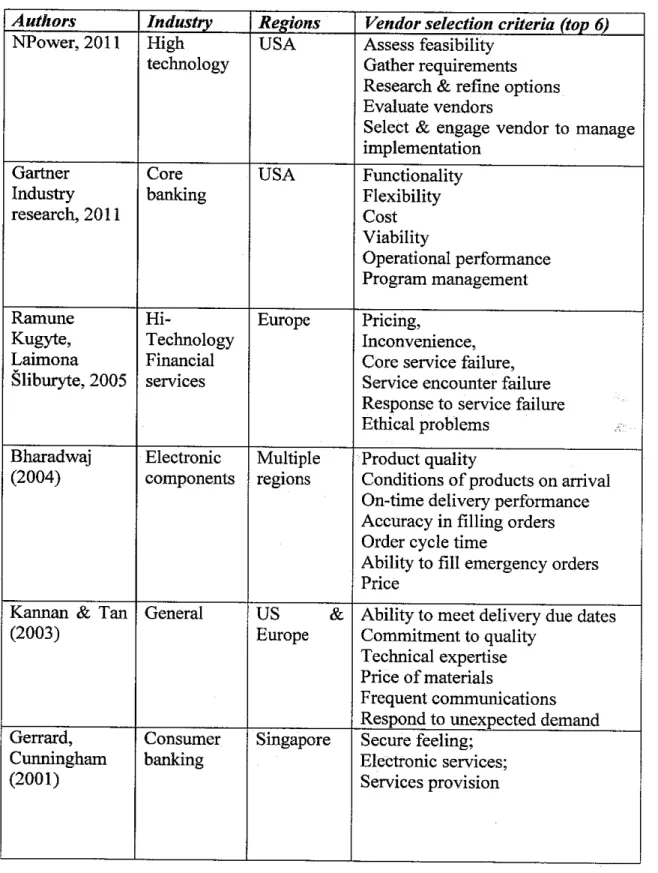
in different industries, the researcher has reviewed different articles, literatures etc, which have been listed in tabular format as in table 2.1, which listed the top criteria discussed by different authors based on different industry and different geography.
The objective of this is to consolidate all the top criteria which was discussed by
different researcher over last few decades and later on find the relevance of these
criteria on this research matter i.e. technology vendor selection.
Authors NPower,2011
Gartner
Industry research, 2011
Ramune
Kugyte,
Laimona
Sliburyte, 2005
Bharadwaj (2004)
Kannan & Tan
(2003)
Gerrard, Cunningham (2001)
Table 2.1 Study on vendor selection criteria
Industry High technology
Core
banking
Hi-
Technology
Financial services
Electronic components
General
Consumer
banking
Regions
USA
USA
Europe
Multiple regions
US &
Europe
Singapore
Vendor selection criteria (top 6) Assess feasibility
Gather requirements Research & refine options
Evaluate vendors
Select & engage vendor to manage implementation
Functionality Flexibility
Cost
Viability
Operational performance Program management Pricing,
Inconvenience, Core service failure, Service encounter failure Response to service failure Ethical problems
Product quality
Conditions of products on arrival On-time delivery performance Accuracy in filling orders Order cycle time
Ability to fill emergency orders
Price
Ability to meet delivery due dates Commitment to quality
Technical expertise
Price of materials
Frequent communications Respond to unexpected demand Secure feeling;
Electronic services;
Services provision
Hirakubo & Electronic Price
Kublin & office Japan Delivery
(1998) equipments Quality
Capability
Technical
Manufacturing
Mummalaneni General China Quality
etal. (1996) On-time delivery
Responsiveness to customer needs
Price/cost
Quality of relationship with vendor Professionalism of salesperson Haron, Ahmad, Consumer Malaysia Fast and efficient services;
Planisek, 1994 banking Speed of transactions;
Friendliness of bank personnel.
Reputation and image of bank Billesbach et JIT Multiple Delivery reliability
al. (1991) companies regions Quality conformance Response flexibility
Price
Technical support JIT capability
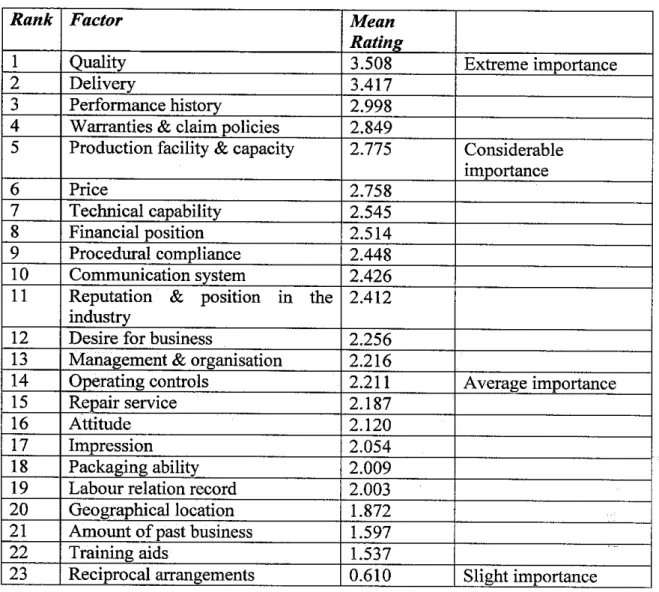
The purchasing processes of vendor throughout the history have been selected according to the criteria. The most common criteria ever used in vendor selection are mentioned by (Dickson, 1966), he ranked a number of various criteria taking the relative importance of each criterion into consideration. Overall 23 criteria were presented by Dickson as shown in table 2.2, still cover the majority of the criteria presented in the literature until today. The evolution of technological importance modified the degrees of the relative importance of these criteria.
Table 2.2 Dickson's vendor selection criteria & rank
Rank Factor Mean
Rating
1 Quality 3.508 Extreme importance
2 Delivery 3.417
3 Performance history 2.998
4 Warranties & claim policies 2.849
5 Production facility & capacity 2.775 Considerable
importance
6 Price 2.758
7 Technical capability 2.545
8 Financial position 2.514
9 Procedural compliance 2.448
10 Communication system 2.426
11 Reputation & position in the industry
2.412
12 Desire for business 2.256
13 Management & organisation 2.216
14 Operating controls 2.211 Average importance
15 Repair service 2.187
16 Attitude 2.120
17 Impression 2.054
18 Packaging ability 2.009
19 Labour relation record 2.003
20 Geographical location 1.872
21 Amount of past business 1.597
22 Training aids 1.537
23 Reciprocal arrangements 0.610 Slight importance
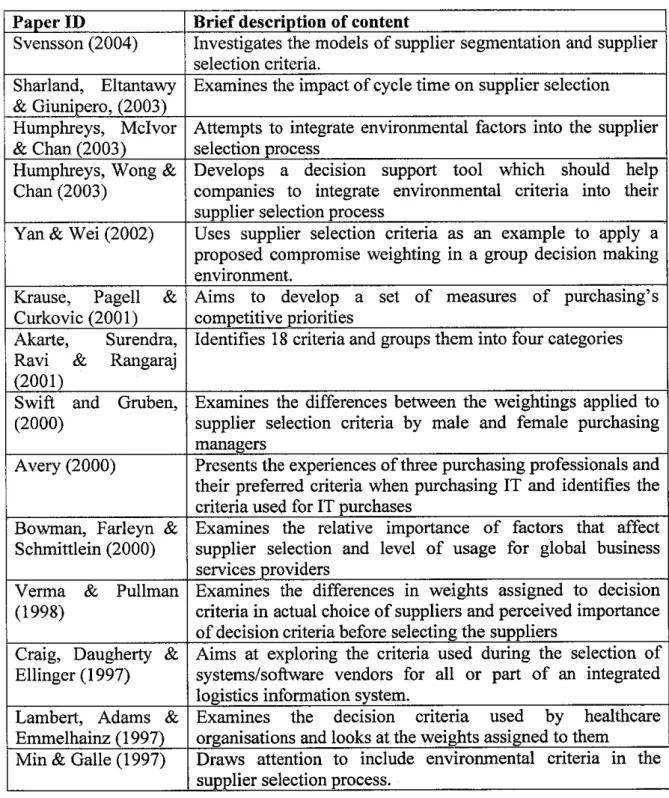
Most papers attempted to identify and determine the relative importance of criteria for vendor selection in various industries; more reviews have been done by the researcher to understand the different criteria were studied for vendor selection in different
industries; these are listed in table 2.3. This has helped the researcher to identify
different criteria and sub criteria which can be considered for vendor selection in this
research.
Table 2.3 List and summary of papers related to selection criteria
Paper ID Brief description of content
Svensson (2004) Investigates the models of supplier segmentation and supplier
selection criteria.
Sharland, Eltantawy
& Giunipero, (2003)
Examines the impact of cycle time on supplier selection Humphreys, Mclvor
& Chan (2003)
Attempts to integrate environmental factors into the supplier selection process
Humphreys, Wong &
Chan (2003)
Develops a decision support tool which should help companies to integrate environmental criteria into their supplier selection process
Yan & Wei (2002) Uses supplier selection criteria as an example to apply a proposed compromise weighting in a group decision making
environment.
Krause, Pagell &
Curkovic(2001)
Aims to develop a set of measures of purchasing's competitive priorities
Akarte, Surendra, Ravi & Rangaraj (2001)
Identifies 18 criteria and groups them into four categories
Swift and Gruben, (2000)
Examines the differences between the weightings applied to supplier selection criteria by male and female purchasing
managers
Avery (2000) Presents the experiences of three purchasing professionals and their preferred criteria when purchasing IT and identifies the criteria used for IT purchases
Bowman, Farleyn &
Schmittlein (2000)
Examines the relative importance of factors that affect supplier selection and level of usage for global business services providers
Verma & Pullman
(1998)
Examines the differences in weights assigned to decision criteria in actual choice of suppliers and perceived importance of decision criteria before selecting the suppliers
Craig, Daugherty &
Ellinger(1997)
Aims at exploring the criteria used during the selection of systems/software vendors for all or part of an integrated logistics information system.
Lambert, Adams &
Emmelhainz(1997)
Examines the decision criteria used by healthcare organisations and looks at the weights assigned to them
Min&Galle(1997) Draws attention to include environmental criteria in the supplier selection process.
Table 2.2 continued.
Paper ID Brief description of content Choi & Hartley
(1996)
Aims to identify supplier selection practices based on a firm's position on supply chain and to provide recent supplier selection practices that incorporate contemporary supplier management issues.
Patton (1996) Attempts to find out what criteria and which methods purchasing professionals use in practice.
Swift (1995) Aims to determine whether there are differences in supplier selection criteria between purchasing managers who have a preference for single sourcing and those who prefer multiple sourcing.
Thorelli &
Glowacka(1995)
Reports on factors thought to have an impact on decisions of purchasing professionals to source internationally.
Pearson & Ellram
(1995)
Examines and explores the differences in decision criteria used for supplier selection in small and large organisations.
Wilson (1994) Compares the relative importance of supplier selection criteria of late seventies and eighties with those of nineties.
Shipley, Egan &
Edgett(1991)
Compares the performance of two channel designs in meeting customer sourcing criteria for industrial re-buy products.
Weber, Current &
Benton (1991)
Looks at the criteria and analytical methods used in the vendor selection process.
The decision criteria used for vendor selection and the weight assigned to them are
different due to a number of factors as described below;• The demographic characteristics of the purchasing managers (Hirakubo and Kublin 1998, Kannan and Bakker, 2004, Mummaleneni et al. 1996, Patton 1996, Pearson and Ellaram 1995, Swift and Gruben 2000, Verma
and Pullman 1998, Weberetal. 1991, Wilson 1994, Yan and Wei 2002),
• The size of the buyer organisation (i.e. small vs. large) (Pearson, Ellaram 1995), the preferred sourcing strategy (i.e. single vs. multiple).
• The type of products and/or services purchased (Abratt 1986, Akarte et al.
2001, Avery 2000, Bowman et al. 2000, Craig et al. 1997, Deng &
Wortzel 1995, Gonzalez et al. 2004, Kannan and K C Tan 2002, Katsikeas et al. 2004, Lambert et al. 1997, Sharland et al. 2003, Shilpey et al. 1991, Svensson 2004).
* Some scholars emphasised the need for integrating environmental criteria into the vendor selection process as more and more end users (customers) become aware and concerned about the environmental issues (Humphreys et al. 2003, Min and Galle 1997, Noci 1997). However, environment seems more related to discrete manufacturing industry.
The findings of the previous researches indicate that while price, quality, delivery reliability and service are typical determinants of vendor selection, the specific criteria
used and their relative importance are highly dependent on the type of product, thetype of purchase being made and circumstances surrounding the decision to engage a
vendor. As it was found from the literature survey that price to cost though important to select a vendor but is not a deciding factor to select IT vendor. A long term returnon investment is a strategic decision in regard to select IT vendor. Quality
deliverables, technical offer, service, business process understanding etc are importantto select technology vendor. However, more reviews have been done to know the
various methodological approach and the complexities of vendor selection. The discussions about different methodology are exemplified in the following section.2.4 Vendor selection methodologies
A number of papers reported the use of mathematical programming methods such as
goal programming, integer goal programming, total cost based approach and data
envelopment analysis. There are also some papers on the use of artificial intelligence
and expert systems, which included the techniques such as case, based reasoning and
knowledge based systems supported by computer software. A fresh approach for
effective vendor selection processes in electronic marketplaces was introduced by Chamodrakas et al. (2010). It comprises of an evaluation method in two stages: initialscreening of the vendor through the enforcement of hard constraints on the selection
criteria and final vendor evaluation through the application of a modified variant of the Fuzzy Preference Programming (FPP) method.Chan et al. (2007) implemented a fuzzy extended method using critical decision criteria to determine critical factors such as the risk factors, cost, quality, service performance for selecting efficient global supplier in present business scenario. Chin et al. (2011) used ANP and TOPSIS to calculate weight of criteria and rank of the vendors. Pooniyamoorthy et al. (2011), proposed a composite model of structural equation modeling and fuzzy AHP. Yuh-jen (2011), utilized SWOT to identify company's competitive strategy. DEA is then applied to screen potential vendors, after which TOPSIS is used to rank the vendors. Saman et al. (2011) applied quantified SWOT in context of vendor selection, since SWOT analysis is one of the most well known strategic decision making technique. Chamodrakas et al. (2010), employed for initial screening of vendors and AHP is employed for the final selection.
Amy (2009) had applied fuzzy AHP for vendor selection. Demirtas et al. (2008), applied ANP - multi-objective programming. Ismail et al. (2003) proposed a methodology for selecting alternatives from a finite set with multiple, conflicting objectives, both qualitative and quantitative in nature. William et al. (2010) in their review paper concluded that individual approaches were slightly more popular, than integrated approaches; DEA is employed frequently for its ability to handle both qualitative and quantitative data. As for the integrated approaches, integrated AHP approaches are fairly popular for their simplicity and ease of use. Tseng et al. (2009), proposed a structure for vendor selection, considering various conflicting criteria, which facilitates in selecting suitable vendors from finite alternative set.
The Analytical Hierarchy Process (AHP), Multiple Attribute Utility Theory (MAUT), Outranking methods are well known and typical multiple criteria decision making methods suggested for vendor selection as Patton (1996) claimed there is still not much evidence which methods are actually used by individual buyers. The use of multivariate statistical analysis such as Structural Equation Modeling, principal component analysis and factor analysis for vendor selection practice has also been reported in the literature. More than half of the papers reviewed reported and/or introduced the use of different selection making methods and tools for vendor
selection.
The methods reported for vendor selection can be clustered into several broad categories: traditional (conventional) multiple criteria decision making (MCDM) techniques, mathematical programming, artificial intelligence and expert systems, and
multivariate statistical analysis. In addition, there are two more categories that are somewhat different from the categories mentioned earlier: group decision-making andmultiple methods. Some the available models reviewed from journals & literatures on
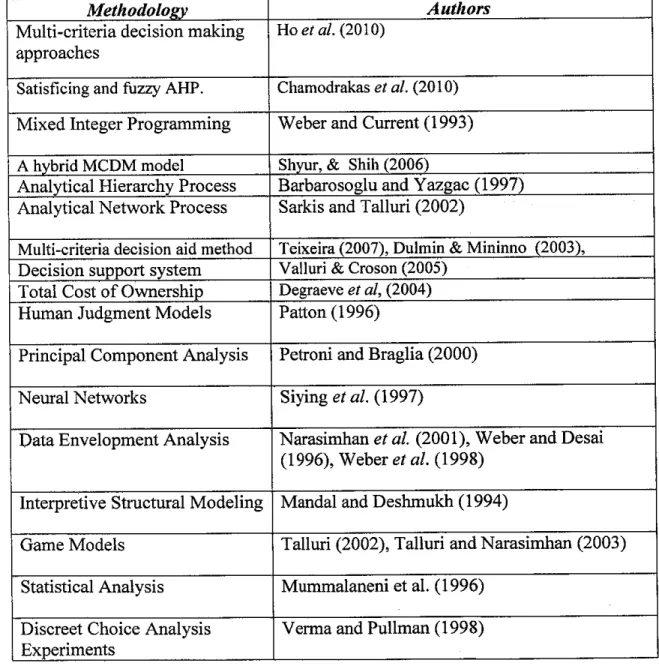
vendor selection pertaining to IT outsourcing are listed in table 2.4.Table 2.4 Vendor selection methodologies
Methodology Authors
Multi-criteria decision making approaches
Ho etal. (2010)
Satisficing and fuzzy AHP. Chamodrakas et al. (2010) Mixed Integer Programming Weber and Current (1993) A hybrid MCDM model Shyur,& Shih (2006)
Analytical Hierarchy Process Barbarosoglu and Yazgac (1997) Analytical Network Process Sarkis and Talluri (2002)
Multi-criteria decision aid method Teixeira (2007), Dulmin & Mininno (2003), Decision support system Valluri & Croson (2005)
Total Cost of Ownership Degraeve et al, (2004) Human Judgment Models Patton (1996)
Principal Component Analysis Petroni and Braglia (2000)
Neural Networks Siyingefa/. (1997)
Data Envelopment Analysis Narasimhan et al. (2001), Weber and Desai (1996), Weber etal (1998)
Interpretive Structural Modeling Mandal and Deshmukh (1994)
Game Models Talluri (2002), Talluri and Narasimhan (2003) Statistical Analysis Mummalaneni et al. (1996)
Discreet Choice Analysis Experiments
Verma and Pullman (1998)
Many models and methods have been developed to solve the problem of vendor
selection by different researchers. Each method takes different criteria intoconsideration the Matrix method, Analytical Hierarchy Process (AHP), Data Envelopment Analysis (DEA), Structural Equation Modeling (SEM), Analytic
network process (ANP) are a few methods to name. The researcher has done further
study and found that there are various methods have been adopted by different
researcher to establish those models.
Weber et al. (1991) indicated that the most utilised approach has been linear
weighting models. It assigns a weight to each criterion and calculates the total scorefor each vendor by summing up the vendor's performance on the criteria multiplied by these weights. Mathematical programming models often consider only the more quantitative criteria; this approach includes the Principal Component Analysis (PCA) and the Artificial Neural Network (ANN). According to Bello (2003), the PCA method has two advantages that are accessible and capable of handling multiple
conflicting criteria. The ANN model saves money and time. The weakness of this model is that it demands specialised software and requires qualified personnel who
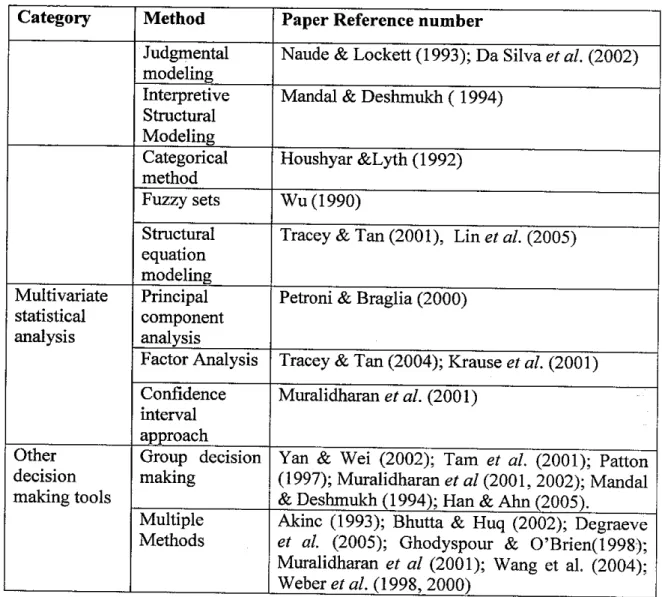
are expert on this subject. The table 2.5 illustrates the list and classification of vendor
selection methods reported on the reviewed articles; under the category the researcher
has briefed the different models have been studied in the relevant literatures.
Table 2.5 List and classification of vendor selection methods
Category Method Paper Reference number
Artificial
Intelligence &
Expert Systems
Neural networks Choy etal. (2003,2004)
Case-based
reasoning
Choy et al. (2002, 2003, 2004, 2005), Humpherys et al. (2003)
Bayesian Belief
Networks
Kreng & Chang (2003)
Mathematical
programming
Total cost based
approaches
Atkinson (2004); Bahli & Rivard (2003);
Berger & Zeng (2006); Bhutta & Huq (2002); Degraeve et al. (1998, 1999, 2000, 2004, 2005); Peng & York (2001); Qu &
Brocklehurst (2003); Roodhooft &
Konnings (1996), Smytka & Clemens (1993)
Non-linear
programming
Ghodyspour & O'Brien (2001) Mixed integer
programming
Chakravastia et al. (2002); Degraeve et al (1999), Jayaraman etal. (1999)
Mathematical
programming
Linear
programming
Ghodyspour & O'Brien (1998, 2001); Yan
& Wei (2002) Integer
programming
Feng et al. (2001); Gupta & Krishna (1999)
Mathematical
programming
Heuristics Akinc (1993); Basnet & Leung (2005);
Ganeshan et al (1999); Tempelmeier (2002).
Goal
programming
Dowlatshahi (2001); Karpak (1999); Wang et al. (2004)
DEA Braglia & Petroni (2000); Liu et al. (2000), Weber (1996); Weber et al (1998, 2000)
MCDM AHP Akarte et al. (2001); Barbarosoglu and
Yazgac (1997), Bhutta & Huq (2002);
Ghodyspour & O'Brien (2001);
Muralidharan et al (2001; Nydick & Hill (1992); Sarkis & Talluri (2002); Tarn et al (2001); Wang et al (2004); Yahya &
Kingsman(1999).
Outranking
methods
Dulmin & Mininno (2003).
MAUT Fonseca et al (2004); Min (1994).
Linear weighted point
Muralidharan et al (2001)
Table 2.5 continued.
Category Method Paper Reference number
Judgmental modeling
Naude & Lockett (1993); Da Silva et al (2002)
Interpretive
Structural
Modeling
Mandal & Deshmukh ( 1994)
Categorical
method
Houshyar&Lyth(1992) Fuzzy sets Wu(1990)
Structural
equation modeling
Tracey & Tan (2001), Lin et al. (2005)
Multivariate statistical
analysis
Principal component analysis <