ST i\ TUS OF TilES IS
Title of thesis Surface Characteristics of Stainless Steel A lSI 316L after Low Temperature Hybrid Thermochemical Treatment
I ASKAR TRIWIY ANTO BRONTO AGUNG
'---~~--~~~~~~~---~---
hereby allow my thesis to be placed at the Information Resource Center (IRC) of Universiti Teknologi PETRONAS (UTP) with the following conditions:
I. The thesis becomes the property of UTP
2. The IRC of UTP may make copies oft he thesis for academic purposes only.
3. This thesis is classified as [ ~ Confidential
I
JI
Non-confidentialIf this thesis is confidentiaL please state the reason:
The contents of the thesis will remain confidential for _________ years.
Remarks on disclosure:
Signature of Author
Permanent address: Komplek Timah Kelapa Dua Blok CC No 53, Cimanggis, Depok, Jawa Barat Indonesia
16951
Endorsed by( _
· / , ('[L\iuv/{-:h"'~il'l~
Signature of Supervisor Name of Supervisor
Assoc. Prof Dr. Patthi Hussain
UNIVERSITI TEKNOLOGI PETRONAS
SURFACE CHARACTERISTICS OF STAINLESS STEEL A lSI 3 I 6L AFTER LOW TEMPERATURE HYBRID THERMOCHEMICAL TRET AMENT
by
ASKAR TRIWIY ANTO BRONTO AGUNG
The undersigned certify that they have read. and recommend to the Centre for Postgraduate Studies for acceptance this thesis for the fulllllment of the requirements for the degree stated.
Signature:
Main Supervisor: Associate Professor Dr. Patthi Hussain
Signature:
Co-Supervisor:
Signature:
Head of Department:
Date:
SURFACE CHARACTERISTICS OF STAINLESS STEEL AISI 3 I 6L AFTER LOW TEMPERATURE HYBRID THERMOCHEMICAL TREATMENT
by
ASKAR TRIWIY ANTO BRONTO AGUNG
A Thesis
Submitted to the Postgraduate Studies Programme as a Requirement for the Degree of
DOCTOR OF PHILOSOPHY MECI IANICAL ENGINEERING UNIVERSITI TEKNOLOGI PETRONAS
BANDAR SERI ISKANDAR, PERAK
DECLARATION OF THESIS
Title of thesis Surface Characteristics of Stainless Steel AISI 3 I 6L after Low Temperature Hybrid Thermochemical Treatment
I ASKAR TRIWIY ANTO BRONTO AGUNG
'---~~~~~~~--~~--~--~---
hereby declare that the thesis is based on my original work except for quotations and citations which have been duly acknowledged. I also declare that it has not been previously or concurrently submitted for any other degree at UTP or other institutions.
Signature of Author
Permanent address: Komplek Timah Kelapa Dua Blok CC No.53, Cimanggis, Depok, Jawa Barat, Indonesia, 16951
Date: 27-12-2013
Witnessed by
/~
i~DiL~;*t"v~ ~·~_ .. v
Signature of Supervisor
Name of Supervisor
Assoc. Prof. Dr. Patthi Hussain
Date: 27-12-2013
DEDICATION
To
Ora. Hj. Hakimah
&
Dra. Hj. Rusmaningsih, Apt.
ACKNOWLEDGEMENTS
I would like to deeply thank my supervisor Assoc. Prof. Dr Patthi Hussain for his unconditional support guidance and understanding, continuous support throughout my work. He encouraged me to investigate the topic of this work which I found it very interesting. His guidance throughout my study thought me to become an independent researcher, which may be of more value. I would like to thank also my co-supervisor Assoc. Prof Dr. Mokhtar Che Ismail for his support and Prof Dr.
Norani Bt. Muti for allowing us to use NanoLab facilities during my research work.
Special thanks go to Mechanical Engineering Materials laboratory technologists Mr. Anuar, Mr. Mahtuz, Mr. lrwan, and Mr. Paris and Mr. Faisal for their help in executing my experiments. I also thank Universiti Teknologi PETRONAS for the financial support during my whole study through the Graduate Assistantship (GA) scheme.
I am indebted to my friends 111 UTP for their continuous support and the brainstorming discussions which I strongly believe that what I have learned from them during the study period is worthy to articulate for problem solving.
Finally, my greatest thanks go to my parents who shaped me with their never ending patience.
Askar Triwiyanto December, 2013.
VI
ABSTRACT
Austenitic stainless steels are the most popular materials in the stainless steel family used in various applications due to their excellent corrosion resistance and good Conning characteristics. Nevertheless. this type of materials has low hardness as well as poor wear resistance due to the inherent austenitic structure.
Earlier attempts to increase the surface hardness and wear resistance of austenitic stainless steels b) surface treatments have led to the deterioration in corrosion resistance arising trom the depletion in chromium in the hardened layer. The development of low temperature nitriding and carburizing processes which are carried out at temperatures lower than 500°C without impairing its corrosion resistance have been successfully conducted by innovative techniques. including plasma nitriding. ion beam nitriding and ion
implantation0~owever.
no attempts have been made to hardenthese materials commercially using conventional processes such as gaseous
processes)~\
This work describes the results of ditlcrent thermochemical treatments of austenitic stainless steels 316L carried out at 400"C to SOO"C in a conventional tube furnace which combining nitriding-carburizing as the newly developed hybrid process involving the simultaneous incorporation of nitrogen and carbon to form a dual layer structure. The formation of alloyed layers with a common feature of being precipitation-tree and supersaturated with nitrogen and carbon or both were occur at 400°C and 450"C which is known as S-Phase or expanded austenite. The structure of the hybrid layer depends on processing temperature: increasing temperature to 500°C results in the formation of a significant amount of CrN in the upper part of the layer which also contirms the breakdown of its corrosion resistance.
The main conclusion from the results in this work indicated that the identified optimum parameter to produces-phase in this investigations have achieved at 450"C.
The hybrid thermochemical treatments have improved hardness as well as wear
resistance\\ ithout impairing its corrosion resistance according to characterization and pcrf(Jrmance improvements USing mechanical and cOITOSion measurements.
ABSTRAK
Keluli tahan karat austenit adalah bahan yang paling popular dalam kumpulan keluli tahan karat yang telah digunakan dalam pclbagai aplikasi kerana rintangan kakisan yang sangat baik dan ciri-ciri membentuk yang baik. Namun begitu, bahan- bahan jenis ini mempunyai kekerasan yang rendah dan kekangan dalam rintangan haus discbabkan olch struktur austenit yang semulajadi.
Usaha awal untuk meningkatkan kekerasan permukaan dan rintangan haus daripada keluli tahan karat austenit melalui rawatan permukaan membawa kepada kcmerosotan dalam ketahanan kakisan yang wujud daripada kekurangan kromium dalam lapisan keras. Pembangunan nitriding bersuhu rendah dan proses-proses pcngkarbonan yang dilakukan pada suhu yang lcbih rendah daripada 500°C tanpa merosakkan ketahanan kakisan yang telah dijalankan dengan jayanya oleh teknik inovatif, termasuk nitriding plasma, nitriding sinaran ion dan implantasi ion. Walau bagaimanapun, tiada percubaan Ielah dibuat untuk mengeraskan bahan-bahan ini secara komersial dengan menggunakan proses konvensional seperti proses-proses bergas.
Kajian ini menerangkan hasil rawatan termokimia keluli austenit tahan karat yang berbeza yang dijalankan pada suhu 400°C kepada SOO"C dalam relau tiub konvensional yang menggabungkan nitriding - pcngkarbonan sebagai proses hibrid yang baru dibangunkan yang melibatkan penubuhan nitrogen dan karbon yang serentak untuk membentuk struktur lapisan bertindih.Pembentukan lapisan alai dengan ciri-ciri biasa yang bebas mendapan dan lebih tepu dcngan nitrogen dan karbon atau kcdua-duanya berlaku pada 400°C dan 450°C yang dikcnali scbagai fasa-S atau austenit yang dipcrluaskan. Struktur lapisan hibrid bergantung kcpada suhu pemprosesan : pcningkatan suhu kepada 500°C mengakibatkan pembcntukan scjumlah besar CrN di bahagian alas lapisan yang juga mcnyebabkan kcmcrosotan dalam ketahanan kakisan itu.
VIII
Kesimpulan utama dari hasil kerja-kerja ini menunjukkan bahawa parameter optimum yang dikcnal pasti untuk menghasilkan fasa-s dalam kajian ini tclah dicapai.
Rawatan tennokimia hibrid tclah meningkatkan kekerasan dan juga rintangan haus tanpa mcrosakkan kctahanan kakisan bcrdasarkan kepada perincian dan peningkatan prestasi menggunakan ukuran dan kakisan mekanikal.
In compliance with the terms of the Copyright Act I 987 and the IP Policy of the university, the copyright of this thesis has been reassigned by the author to the legal entity of the university,
Universiti Teknologi PETRONAS
Due acknowledgement shall always be made of the use of any material contained in, or derived from. this thesis.
© Askar Triwiyanto Bronto Agung, 2013 Universiti Teknologi PETRONAS
All rights reserved.
X
TABLE OF CONTENT
STATUS Or TIIESIS ... i
APPROVAL PAGE ... ii
TITLE OF THESIS ... iii
DECLARATION OF THESIS ... iv
DEDICATION AND ACKNOWI EDGMENT ... v
ABSTRACT ... vii
ABSTRAK ... viii
COPYRIGIIT PAGE ... x
fABLE OF CONTENTS ... xi
I JST Or FIGURES ... xiv
I.IST OF TABLES ... . . ... XVII LIST OF ABBREVIATIONS ... ... xviii
Chapter I. INTRODUCTION ... l 1.1. Overview ... l I .2. Background ... 2
I .3. Problem Statement ... 4
1.4. Objective ... 6
I .5. Scope of Thesis ... 6
I .6. Thesis Organization ... 7
:?.. LITERATURE REVIEW ... 8
2.1. Overview ... 8
2.1. I. Stainless Steel ... 9
2. I .2. History ... 9
2.1.3. Classification of Stainless Steel. ... 9
2.1.4. Austenitic Grade of Stainless Steel ... !! 2.1.5. Metallurgy of Austenitic Stainless Steel ... 13
2.1.5.1. Physical Metallurgy ... l3 2. I .5.2. Inclusion and Precipitates ... I 5 2.2. Corrosion of Austenitic Stainless Steel ... 17
2.2. I. General Corrosion ... l 8 2.2.2. Galvanic Corr-osion ... ... . ... I 8
2.2.3. Pitting Corrosion ... 19
2.2.4. Crevice Corrosion ... 21
2.2.5. lntergranular Corrosion ... 23
2.2.6. Stress Corrosion Cracking ... 24
2.3. Wear of Austenitic Stainless Stee\ ... 24
2.3.1. Abrasive Wear ... 25
2.3.2. Oxidative Wear ... 25
2.3.3. Fatigue Wear ... 25
2.3.4. Corrosion Wear ... 26
2.3.5. Fretting Wear ... 26
2.4. Enlarging Applications of Austenitic Stainless Stee\. ... 31
2.4.1. Ion, Liquid (Salt) and Gas Processes ... 33
2.4.2. Thermochemical and Diffusion Mechanism ... 34
2.4.3. Industrial Surface Engineering Treatments ... 38
2.5. Expanded Austenite (EA) from Thermochemical Surface Treatment...40
2.5.1. Diffusivity of Nitrogen and Carbon in Austenitic Stainless Stee\ ... 43
2.5.2. The Influence of Process Variables and Composition of EA .. .44
3. METHODOLOGY ... 47
3.1. Overview ... 47
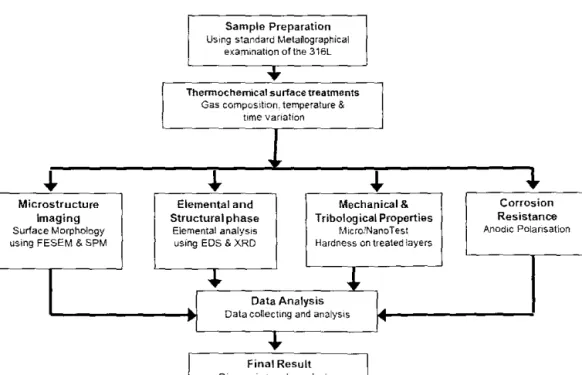
3.2. Methodology ... 47
3.3. Sample Preparation and Material Characterization ... 49
3.3.1. Experimentals ... .49
3.3.1.1. Specimen Handling ... 49
3.3.1.2. Thermochemical Hybrid Treatments ... 50
3.3.2. Characterization and Testing ... 52
3.3.2.1. FESEM-EDS Charaterization ... 53
3.3.2.2. 3.3.2.3. 3.3.2.4. 3.3.2.5. 3.3.2.6. 3.3.2.7. Universal Scanning Probe Microscopy (USPM) ... 54
X-ray Diffraction ... 54
Hardness Measurement ... 55
Wear Test ... 57
Nanoindentation Measurement ... 57
Corrosion Test ... 59
4. ANALYSIS. RESULTS AND DISCUSSIONS ... 61
4.1. Overview ... 61
4.2. Processing ... 62
4.2.1. Surface Morphology and Topography of Treated Layers ... 65
4.2.2. Phase Composition and Mechanical Properties of Expanded Austenite Layer ... 70
4.2.2.1. X-ray Diffraction of Hybrid Treated 316L ... 70
4.2.2.2. Interstitial Diffusion ... 73 xii
4.2.2.3.
4.2.2.4.
4.2.2.5.
Hardness Measurement.. ... 74
Effect of Treatment Temperature on W car Resistance of The Hybrid Treated Layer ... 77
Effect of Treatment Temperature on The Nanoindcntation Results ... 80
4.2.3. Corrosion Resistance Performance of Expanded Austenite l.ayers ... 83
5. CONCLUSION AND RECOMMENDATIONS ... 88
5.1. Conclusion ... 88
5.2. Recommendations ... 90
REFERENCES ... 91 PURLICATIONS DURING TilE RESEARCH WORK ... I 07 CONFERENCES ... I09
LIST OF FIGURES
Figure 2.1: Fe-Cr Phase Diagram [25] ... 10
Figure 2.2: Family of Stainless Steel Relationship for Common Martensitic, Austenitic and Ferritic [26] ... I 0 Figure 2.3: Schaeftler Constitution Diagram for Stainless Steel [27] ... 11
Figure 2.4: Iron-Chromium-Nickel System at 750"C [28] ... 12
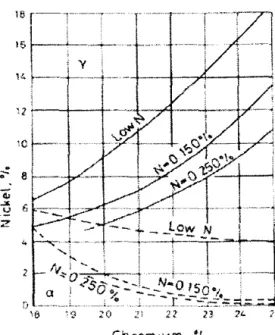
Figure 2.5: Effect of Nitrogen on Austenite Loop [30] ... 14
Figure 2.6: Time- Temperature Curves Showing Effect of Carbon Content on Carbide Precipitation [31] ... 15
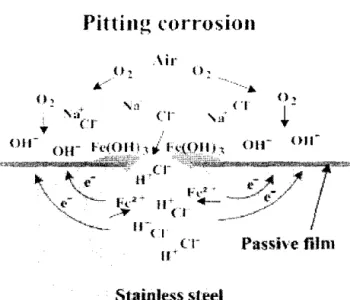
Figure 2.7: Schematic of Various Events During the Growth of Pits [42] ... 19
Figure 2.8: Influence ofNitrogen Addition on Pitting Corrosion Resistance [44] .... 21
Figure 2.9: Schematic of Various Events During Crevice Corrosion ... 22
Figure 2.10: Micrograph with Grain Dropping Due to lntergranular Corrosion [72] .. 24
Figure 2.11: (a) Distribution of Elastic Normal Stress Beneath a Sphere. (b) to (d) Plan Views of Area Contact with Increasing Cyclic Tangential Force [57) ... 29
Figure 2.12: Fretting Regimes between Stainless Steel Surfaces [57) ... 30
Figure 2.13: Steps to Process Specification [58) ... 31
Figure 2.14: Application of Austenitic Stainless Steel [58) ... 32
Figure 2.15: Concentrations and Concentration Gradients of Nitrogen-Carbon [58]..36
Figure 2.16: Low Temperature Surface Hardening of Fe-based Alloys [I 05] ... .46
Figure 3.1: Research Methodology ... .48
Figure 3.2: Hybrid Thermochemical Tube Furnace Setup ... 50
Figure 3.3: Temperature/Time Diagram of Hybrid Treatment of A lSI 3 16L at 500"C ... 51
XIV
Figure 3.4: (a) Supra 55VP FESEI\.1. (b) Nano Navi: E-swcep USPM ... 53 Figure 3.5: D8 Advance XRD Machine ... 55 Figure 3.6: Schematic Diagram of Vickers Pyramid Indenter Pressed into Harden
Layer ... 56 Figure 3. 7: Vickers Hardness Test: Model HV -I OOOA Microhardness Tester ... 56 Figure 3.8: (a) Ducom TR-701-M6 Multi Specimen Tester Machine. (b) Pin and
Disc Holder ... 53 Figure 3.9: Nanoindentation Instrument at AMREC SIRIM.Sdn.Bhd.2012.Kulim .. 58 Figure 3.1 0: Schematic Diagram of Flat Cell used for Polarization Corrosion Test... 59 Figure 4.1: Weight Gains of Samples due to Varied Temperature Treatments ... 64 Figure 4.2: Cross-sectional SEM Micrograph:(a) Hybrid 400"C. (b) 450"C. and (c)
SOO"C Samples ... 65 Figure 4.3: Elemental Analysis of Hybrid T rcated l.ayer at Di trerent Tcm pcraturcs:
(a and d) H) brid 400"C.(b and c) 450"C and (c and I) 500"C Samples ... 66 Figure 4.4: Details of Elemental Pro tile of llybrid Treated A lSI 3 I 6L ... .... 67
Figure 4.5: JD Surface Topography Resulting from Universal Scanning Probe Microscopy (USPM): (a) Hybrid 400"C. (b) 450"C and (c) SOO"C
Samples ... 68 Figure 4.6: Cross-Sectioned llybrid Treated USPM Topography ... 68 Figure 4.7: (a) and (b) Cross-Sectioned Surface Roughness of Hybrid Treated USPM Topography ... 69 Figure 4.8: Comparison of XRD Patterns of Specimens at 400"C. 450"C and 500"C ..
... 70 Figure 4.9: Micro Hardness Data as Function of Hybrid Treated Temperature ... 74 Figure 4.10: Microhardness Profiles of Untreated-Treated Samples vs Temperature ...
... 76 Figure 4.1 I: Microhardncss Indentation of I Jybrid Treated Sample ... 77 Figure 4.12: (a) Worn Morphology Untreated 3161 .. (b) Worn Morphology t(,r 400"C
Sample ... 78 Figure 4.1]: (a) Worn Morpholog0 450"C. (b) Worn Morphology for 500"C Sample ..
··· ... 79
Figure 4.14: Coefficient of Friction vs. Time Protlle for Untreated 316L using 400"C.
450"C and 500"C ... 79 Figure 4.15: Depth-Sensing Indentations Pertormed on: a) Hybrid Treated Layer,
b) Hybrid 500°C, (c) Hybrid 400"C ... 80 Figure 4.16: Hardness Mapping for Regular Arrays of 6 x 6 Indentations on 450°C
Sample ... 81 Figure 4.17: Depth-sensing Indentations on Hardened Layer of 450"C Sample and
Substrate ... 82 Figure 4.18: Polarization Curve for Hybrid Treated compared to Untreated 316L. .... 84
XVI
LIST OFT ABLES
Table 2.1: Typical Compositions of Austenitic Stainless Steels 124] ... 12 Table 2.2: Secondary Phases in Austenitic Stainless Steels without Concentrations
of Non-Metallic Elements [351 ... I 7 Table 2.3: Typical Characteristics ofNitriding
f
I 041 ... 34 Table 2.4: Possible Conllgurations of(a) Nitriding (b) Carhurizing ... 39 Table 3.1: Treatment Conditions and l.aycr Thicknesses ... 5 I Table 3.2: Instrumented Hardness Settings ftlr Nanoindentation Measurement.. .... 58 Tahlc 4.1: Flux Values Measured from Weight Differences ... 63 Table 4.2: Lattice Expansion Measured on Expanded Austenite from XRD PeakShift for Hybrid Specimens at 400"C. 450"C and 500"C ... 72 Table 4.3: Microhardness Data of Untreated Sample and llybrid Treated Samples ...
... 75 Table 4.4: Roughness. Indentation Hardness and Elastic Modulus for Each Hybrid
Treatment ... 82 Table 4.5: Results ofCorrosion Resistance Test in AISI 3161. Stainless Steel
Electrodes in 3.5'% wt.% NaCI Solution ... 85
AISI ASTM EIS FESEM EDX EA HV LPR SE USPM CH4 NH3 N2 XPS XRD
LIST OF ABBREVIATIONS
American Institute of Steel and Iron American Society for Testing Material
Electrochemical Impedance Spectroscopy Field Emission Scanning Electron Microscopy Energy Dispersive X-rays analysis
Expanded Austenite Hardness Vickers number Linear Polarization technique Surface Engineering
Universal Scanning Probe Microscopy Methane gas
Ammonia gas Nitrogen gas
X -rays Photoelectron Spectroscopy X-Ray Diffraction
XVIII
1.1 Overview
CHAPTER I INTRODUCTION
This work focuses on exploiting science and technology of nanostructured materials for future generation. The works involved syntheses of various novel hybrid surface treatments. development of experimental techniques lex characterization of nano phase. discovery of new phenomena, and searching for new applications. This works is not only to achieve excellence in academic \\orld but also to provide some solutions to technological applications in the real world.
This investigation proposed the low temperature thermochemical treatments 111 conventional tube furnace of hybrid treating which introduces nitrogen and carbon simultaneously with the aim to improve surface properties of AISI 3161.. The outcome of the work showed the 1(1rmation expanded austenite structured which is supersaturated with nitrogen and carbon. This structure is responsible to the higher
hardness and has better wear property without impairing its corrosion resistance.
Characterization of this expanded austenite layers were be performed including XRD analysis. SEM and USPM. All these characterizations were used to reveal the characters of the produced thin layers. Elemental profile of nitrogen and carbon across the hybrid treated layer were obtained by EDS-SEM.
The improvement of mechanical properties such as hardness and wear property were measured by micro hardness. wear tests and nanomechanical testings. The
corrosion resistance performance \\as measured by anodic Polarization test and by using USPM to conlinn the corrosion behavior which is related to the nanostructure of treated layer. ;\t the end of the chapter. organization and content of each chapter is
1.2 Background
Austenitic stainless steels arc the most widely used in chemical and petrochemical industry, cryogenic vessels, heat exchangers, machinery for paper, pulp, textile, pharmaceuticaL implant biomaterial, bipolar plate tor fuel cell, electronic consuming devices like Iphone4 case and other domestic equipment. This type of steel has excellent corrosion resistance and forming characteristics. However, this material has relatively low in hardness as well as poor wear resistance due to its inherent austenitic structure.
Earlier works in surface engineering for increasing the surface hardness and the wear resistance of the austenitic stainless steels. such as conventional nitriding and nitrocarburizing, have led to the deterioration in the corrosion resistance arising from depletion of chromium in the hardened layer. Attempts have been made to harden the surface of these materials without compromising their good corrosion resistance.
These works have encouraged the development of the low temperature nitriding and carburizing processes which are carried out at temperatures lower than 500°C. So far, low temperature nitriding and carburizing of austenitic stainless steels have been successfully conducted by innovative techniques. including plasma nitriding which is conducted by Ichii, et. al [I] and Lewis, ct. al [2], for the use of ion beam nitriding and ion implantation respectively [3, 4]. However, only few investigations have been made commercially by using conventional processes such as gaseous and fluidized bed processes. Previous work has shown that low temperature nitriding of austenitic stainless steel is possible to be conducted by using a fluidized bed furnace [5].
Other work by Gemma et. al in 200 I [6] has proven the feasibility and industrially acceptance for performing low-temperature nitriding and carburizing of stainless steels. The precondition before performing low-temperature nitriding and carburizing involves the component surface activated before the gaseous process by special chemical treatments to remove the oxide tihn which acts as a barrier for diffusion process.
The low temperature nitriding is suitably pertormed at temperature below 500°C to dissolve a large amount of nitrogen in the nitrided layer which is able to reach 20
J..ll11 thick of an expanded austenite (YN) structure and free from nitride precipitates.
2
Such a lmv temperature nitrided layer possesses good corrosion resistance and high hardness hut quite brittle. Moreover. it has relatively lo" load bearing capacity due to its small thickness and the abrupt hardness drop at the layer-core interface [7]. On 1999. Sun et.al has f(Jund another technical problem associated with the nitriding process which is the non-unitonnity of layer thickness across the treated surface 18].
In further effort to improve the quality of the surface harden tor industrial applications. it has been found that treatment gas composition has a significant effect on the structural characteristics of the nitrided layer using plasma processing technique. A small amount of carbon-containing gas such as methane (CH4 ) to the treatment atmosphere can alter the structural development in the alloyed zone and offer several benellcial effects to the nitriding process [9]. Based on this discovery. it is possible to attempt a new hybrid process. which involves the simultaneous incorporation of both nitrogen and carbon into the alloyed zone to form a dual-layer structure. As a result the surface hardness was increased up to 1550 VHN, which is considerably higher (around six times) than the untreated austenitic stainless. The process also improved a corrosion resistance of the alloy. as achieved by several investigators [I 0 ]. Indeed. nitriding and nitrocarburizing are now commonly performed in conventional and fluidized bed furnaces for surface hardening of engineering steel components.
However. very tCw efforts have been made to produce expanded austenite layers
on austenitic stainless steels in a conventional tube furnace by employing the low- temperature techniques. Recent study by the work _ir:j~_lj_ilas demonstrated that a nitrogen expanded austenite layer can b~formed on 316L austenitic stainless steel in a fluidized bed furnace by low-temperature nitriding.
Based on the above evidence. the proposed research aims to explore the possibility of implementing the hybrid process of low temperature nitriding- carburizing with its special characteristics. especially according to nano mechanical properties perlc1rmance
or
surface harden layers 1(Jr potentially commercial application by using conventional gaseous furnace type. It is expected that a successful investigation may extend the application of austenitic stainless steels forvarious combined wear-corroston environments, and may provide new innovative surface heat treatment for stainless steel materials.
L3 Problem statement
The common practice of surface treatments by using carbon and/or nitrogen source gases is usually performed with temperature around SOO"C (932"F). However, stainless steels raise two problems: first, the native passive layer may cause problem to nitrogen and carbon atoms for penetrating through thermal activated diffusion processes. Second, chromium tends to reacts with nitrogen and carbon then forms nitrides/carbides which will cause the breakdown of corrosion resistance [ 12].
Austenitic stainless steels exhibit a native surface oxide layer that protects the substrate-metal matrix from corrosion. It is difficult to harden the surface by gaseous thermochemical treatment as the native passive layer which is impenetrable by nitrogen and carbon atoms. The oxide layer is believed to act as a barrier for diffusion nitrogen transport. Therefore, in process of optimization toward eftlcient nitriding by a pre-cleaning procedure, is supposed to remove the oxide layer, which is generally recommended [13],
Moreover, traditional gaseous thermochemical treatment is associated with a loss of corrosion resistance where nitrogen and carbon react with chromium to form carbides/nitrides. The reaction arises a problem due to the sensitazion effect caused by the formation of chromium nitrides when these materials are treated at a nitriding temperature above 500°C [14], thus redrawing chromium from solid solution. The precipitation of chromium carbides/nitrides triggers hardening of the n itrided case, but also leads to depletion of chromium content in the austenitic matrix, then significantly reduces the corrosion resistance of the carburized/nitrided layers. On the other hand, the improvement on corrosion resistance is related to the presence of YN -nitrogen expanded austenite [7]. As a consequence, surface hardening of stainless steel by thermochemical treatment has been considered as a bad practice or a compromise between corrosion properties and tribological properties, as surface engineering invariably impairs the corrosion resistance. In terms of carburizing. hardness is increased only by giving up the corrosion resistance property [14],
4
The most popular technology used to achieve the aforementioned low temperature thermochemical treatments of stainless steels is plasma technology. namely plasma nitriding [ 15. 16]. plasma carburizing [I 7. IS j and plasma hybrid treatments [ 19, 20].
Early investigations in the mid of 1980"s suggested that applying low temperature plasma nitriding would suppress the formation of chromium nitrides and produce a thin nitrided layer with high hardness and acceptable corrosion resistance [ 1]. On the other hand. the method of surface heat treatment using plasma technology is hardly found in such mass production industries due to cost consideration and high investment facility. The needs of an alternative method is come into the picture, such as the use of conventional gaseous processes like gas nitriding [6] and gas carburizing [21]. Therefore. it is important to investigate the use of conventional gas treatments which incorporates treatment parameters on austenitic stainless steel without sacrificing its corrosion resistance.
( In the gaseous process. nitrogen diffusing spcc1es are resulted from catalytic dissociation of ammonia gas at temperatures around 510- 530"C which may lead to the sensitivit) effect. On the other hand, low temperature nitriding at temperature range 400"C - 450"C ma) cause problems with nitrogen dif!i1sion from the atmosphere due to insurticient dissociation of ammonia gas l22]. In addition. with this method, the rate of diffusing species into the substrate is solely governed by thermal activation which is clearly below the rate of plasma method, as a result of the low temperature diffusion treatment, the S phase has a thin layer and steep drop of hardness at the border between the hardened layer and substrate as the character of nitriding. Meanwhile, the low temperature carburizing also forms an S phase like layer at the surface of austenitic stainless steel. These carburized layers have a gentle drop of hardness but have a lower surface hardness than that ofnitrided S phase [7]. ) More recently, a hybrid process has also been developed, which combines the nitriding and carburizing actions in a single process cycle by introducing nitrogen and carbon simultaneously into the austenite lattice to form a hardened zone comprising a nitrogen expanded austenite layer on top of a carbon expanded austenite layer r 19.
20]. I knee the case hardening process of combination carburizing-nitriding is chosen
nanocharacteristics of the layers resulting from low temperature hybrid treatments in order to open the opportunity of wider application to the austenitic stainless steel users because of significant improvement in surface hardness and tribological properties obtained by the conducted experiments.
The purpose ofthis work investigates the feasibility of conventional tube furnace for hybrid treating of nitriding-carburizing of austenitic stainless steels at low temperatures to form a precipitation-free layer with improved properties.
1.4 Objective
The main objective of the research develops a novel hybrid surface harden layer on AISI 316L using conventional tube furnace at low temperature thermochemical treatments:
• To establish the optimal treatment parameters of low temperature hybrid thermochemical to produce the hardened S-phase layer on AISI316L without impairing its corrosion resistance.
To investig<Il_('!Jlle effect of treatment temperature in order to characterize the S-phase layers formed during the optimized hybrid thermochemical treatments in terms of phase constituents, microstructure, composition and hardness. thus advancing the scientific understanding of this layer.
• To assess the wear and corrosion performance of the hybrid treated austenitic stainless steel AISI316L.
1.5 Scope of Thesis
This research is conducted through three stages: firstly, the development of hybrid process of low temperature nitriding-carburizing in order to improve surface properties of the austenitic stainless steel which is derived trom the analysis of literature review. Secondly. the systematic characterization of resulting layers are performed for the purpose of evaluating the specimens that include X-ray diffraction analysis. micro structural examination by optical and electron microscopy, as well as
6
scanning probe microscopy for nano feature of sur lace topography, elemental analysis by x-ray spectroscopy. Together with these characterizations, nanr!-mcchanical and
vv'~
wear tests arc carried out to the selection of specimens tc corro orate- with the results
~
from the above characterization methods. Thirdly. polarization test is conducted to investigate the behavior of hybrid layers in corrosive environment. And lastly. results analysis and interpretation of the resulting layers arc carried out to enhance the understanding of hybrid processing. the carbon and nitrogen expanded austenite layers and its relationship to the hardness and wear properties.
1.6 Thesis Organization
This thesis consists of live chapters. Chapter one describes the background. problem statement. research objective. scope of study as well as thesis organization. Chapter two consists of literature review. This chapter will star1 with introduction then followed by classilication of stainless steels. history and current applications of austenitic stainless steeL sensitiLation phenomena, surface engineering design~
nitriding in gaseous atmosphere. diffusion model of nitriding. thermochemical surface treatment of austenitic stainless steel to produce expanded austenite and reasons for selecting the combination of nitriding-carburizing (hybrid) process tcx the study.
Chapter three illustrates on the methodology where research method. materials
preparation. experimental procedure. characterization techniques such as optical
microscopy. field emission scanning electron microscope (FESEM). scanning probe microscope (SPM). energy dispersive X-ray spectroscopy (EDS). X-ray diffraction, microhardness measurement. nanoindentation. wear testing and corrosion test. Results of the experiment and its analysis are discussed in chapter four. In this chapter, the results on microsructure imaging. XRD. microhardness and nanoindentation test results. wear. and corrosion properties arc presented. Finally. in chapter five, conclusions and recommendations as result of analysis arc presented. This chapter
summanzes expcriment"s finding, goals achieved and recommendation for future
work which might be possible li:lr development.
2.1 Overview
CHAPTER 2 LITRA TURE REVIEW
This chapter contains a review on the theory and previous works that are relevant with this research. The first section deals with the materials used in the development of the composite. The second section presents the basic understanding of the thermodynamic and kinetic phenomena of the diffusion process in pressure-less sintering. Within this section it is also discussed previous works of pressure-less sintered composite of related materials. In the third section, the mechanical properties and toughening methods in relation with the microstructural design, has been reviewed. In the last section, the need tor thermal shock resistance of the material produced is discussed since it is related to the objectives of the research. Basically, this chapter attempts to examine the previous works and identities the issues which are relevant to this work.
2.1.1 Stainless Steels
Stainless steel is a widely used material where corrosion resistance is needed. In 20 I 0, the production of stainless steel is 30.7 million tons worldwide, which is more than carbon steel. And among that, 57.7% is 300 series austenitic stainless steels (Global stainless steel output figure for 20 I 0, IS SF 20 I I).
According to metallurgical aspects. the stainless steels are iron-based alloys that contain a minimum of approximately II% Cr. The amount ofCr is needed to prevent the formation of rust in unpolluted atmospheres [23]. The material must be a ferrous alloy and it must contain more than 50% iron [3]. They achieve their stainless characteristics through the formation of an invisible and adherent chromium-rich
8
oxide surface film. This oxide lrm11s and heals itself in the presence of oxygen. Other alloying clements such as nickeL molybdenum, carbon. titanium. aluminum. silicon, niobium. nitrogen. sulphur and selenium are added to improve particular characteristics [23j.
~
The discovery of stainless steel dates back to a period just afler the turn of the century when French. German, English and later US metallurgists began publishing the results of their studies on low carbon. chromium containing ferrous alloys. The industrial usefulness of stainless steel became evident between 1910 and 1915 when Harry Brearley (England) developed martensitic stainless steels: Fredrick Becket and Christian Dantisizen (United States) developed ferritic stainless steels: and Edward Maurer and Benno Straus (Germany) developed austenitic stainless steel [22. 23J.
2.1.3 Classification of Stainless Steels
Stainless Steels can be divided into live groups. Four arc based on the characteristic crystallographic structure/microstn1cture of the alloys in the family: ferritic.
ma.1ensitic. austenitic or duplex (austenitic and ferritic). The fifih group the precipitation-hardenable alloys. is based on the type of heat treatment used. rather than microstructure (23]. This thesis is concerned with the surtacc engineering of austenitic stainle'5 't<:cb therefore ma11ensitic. fcrritic. duplex and prccipitation- hardenable stainless \\ill not be considered in this review.
The iron-chromium phase diagram, presented in Figure 2.1. is the pnmary diagram to describe stainless steels, since chromium is the primary alloying element.
Chromium is the major alloying element as shown in Figure 2.1 that imparts to stainless steels. Its corrosion resistance is dellned by combining with oxygen to J(Jrm a thin, invisible chromium-oxide protective tilm on the surface. Since the passive film is an impo1iant f;tctor. there arc pi-ecautions which must be observed in designing stainless steel equipment in manufacturing the equipment. and in operation and usc of the equipment. to avoid destroying or disturbing the protective 111m. Figure 2.2 shows that
vanous alloying elements are added to the basic iron-chromium-carhon and iron- chromium-nickel systems to control microstructure and properties.
i>:f,,-1
II'J\!11
I ~111;
:~1»1
i
11¥'<1
~IX'
uuo
~IKJ
,,
' I,,, -1.1-' _,,,
-~---
,,,,. ;,,,,
"JJ
Figure 2.1. Fe- Cr Phase Diagram [25].
T
Add Ni I<;" <;o<>r<ooo•on
,..,.,,.,.,,,,...,,., "' »lgn-'"'"'P"'·'''"""
'"'v'~f""""nh
Add Nb • T«
.... ,.,<.~ ... .,
""""'it;o;<.~tlon
1
+ii'·Fif-*&·•
!
A d d C~ and N' f<><" ,_.,.,,,.,h :.nd
oxidt>tlon
~""''"'"'"'"'
AddS<:>< 5<0 t<>•
""'"'~'""'""""Y
Add 5 " " S.o f<><
m • .,~"'""''-'""Y
Add Cu, Ti AI _... l..owcr !'li for
p•<>clpltatlon
""""'"'"'"9
Figure 2.2. Family of Stainless Steel Relationship for Common Martensitic.
Austenitic and Ferritic [26].
\0
There are over !50 grades of stainless steels of which austenitic stainless steels (type 304. type 3 16. 18/8. etc.) are the most widely used. For example. the clements included alloying. arc manganese lor 200 series. molybdenum lor pitting resistance in AISI 316. niobium to reduce sensitization in A!SI 347. titanium to reduce sensitization in A lSI 321 and nitrogen.
In addition. Figure 2.3 shows the Schaetller diagram roughly which illustrates the structure obtained a tier rapid cooling to room temperature from I 050°C. The Schaetller diagram is an approximation. not a phase diagram and is expressed in terms of weight percent of chromium and nickel due to their respective roles as a fcrritic stabilizer and an austenitic stabilizer.
hh-~ • ..1 __ -, .. ,, •• 1~.,, ~
~. r1, + ,, · -. t.A,. + 5:.•, ·, ( +".H•. ~" t'-J
'- ho "'-'• I' "~--,1_,,, -
' t , , '•'•··, I C• · , -., +' -·.r,ll·
Figure 2.3. Schactller Constitution Diagram f(Jr Stainless Steels [27].
2.1.4 A ustcnitic grade of stainless steel
This grade of steel contains at least 16% chromium and 6% nickel (the basic grade 304 is referred to as !8/8) and range through to the high alloy or "super-austenitic"
such as 9041. and 6% molybdenum grade. and also the higher-alloy AISI 310S and ASTM N08904. The addition of nickel as an alloying clement is to maintain the austenitic structure of this steel. Austenitic steels arc characterized by their high content of austcnitc-f(mncrs. especially nickel. They arc also alloyed with chromium.
molybdenum and sometimes \\-ith copper. titanium. niobium and nitrogen. Alloying
with nitrogen raises the yield strength of the steels. Austenitic steels cannot be hardened by heat treatment. They are normally supplied in the quench annealed state, which means that they are soft and highly formable. Their hardness and strength are increased by cold working. Certain steels grades arc supplied in the cold-stretched or hard-rolled condition. These groups of steels are also suitable for cryogenic applications because the effect of the nickel content in making the steel austenitic avoids the problems of brittleness at low temperatures, which is a characteristic of other types of steel.
Table 2.1: Typical Compositions of Austenitic Stainless Steels [24].
.\[q 21Jl .\[\] Ji..::
Al~J ..::o::;
.-\[',] "\ill .-\[<;.,! ?·ll2 U'-l .Ill_~.
-\["-] '·•4
J,.[Sj _\11 .. Hj
-\[',] _114]_
\[".] ''·IJ-l~~
\[:,] :'>1)-.j.l_?'-,;
. .\['..:.] ~l-IS
.-\!',] ~f)LI
A[S] ~11)
AJSJ ;.Jh .ld'.l _'\lhH
-\["-J '·IAL
\!\l '.JhL:--;
A.!Sl ~1-:-
\l \1 :'-1 ~~
AFJ \.::1 .\l\1 :'-2!H At'l.'4"' AI"-1 .~!l-1 r•:"-l Sl\to•
ll~'j Je'>i~·ruti•'•ll
S2C<Ii!i•
S'IJ'I•Il S2H~(.!'J
;';inli"'
:'\.~l(~(JIJ
:'\3 ]lljJI_i
S3!t<t•D
SJ!~C~•
'l<!"iH
S:'l21f'"
>-;_q;IJI' S.<.riv_,
{
~·) 15 :.i•Y:;
::::_,1_15
".L'--t-1-'.1••
::._11 1
sn•l.<
!(4-•· jit
~II}.Jt',
Si
:;..,? '"J :~ 1 i f '
_2•\d ...ol'n
:._.':: •h I c_,].O!
;:,_:' of• I ;; l I))
:;;_~ (!•; . I ().) ::....::: •1'1 ~~ ( ) l
lh U•}-IS "'I '' •!-::<_•'!
J(_(l{f .. ]'J/01 ~~J:I .. \•1•1
1::1 (loJ .. ~'! I"' ~-d .. !(I 5 rr</J•:J-:n•J<I l-~11-l•_i_~
]Sd(t.'qu•• :S•LJ.::•!
I:~ '!<J-:20 lli'l b ••·I:: •.1
j Y/1•)-~ I )I' I I •' II-!.::' il :2~.P!J-.":41~') \21l-J5•j .":..i/h"f-.":r./:11 1')/)-.::'.::'•1 1/).U•J-Jb.'Jit l'>IJ-!-1 ,·,
\I)UU-Il'S:>II 111'-!-l-t'-1
() ji_U\ j(·.
')_ ](\..() !(~
jh\){j.j('.'l(l jtl•t.j-);j ..:.IL''' \l.]iUJ,\(~
l/1.'1>)-J\.11•.1 1"11-\4•.1 ~·::..3.1• "•J•:'-illh j;\_(")-:2il(".l 11••-\:~:) 3/L..j:">
PI (lfJ.-.::'•JIItl 1 r ii.J:" '·' 1 •L-1 n
1'?'.1•)-J'"I•J··I 'l•l-\2iJ TL:::5 • :YC
I:'.•!<J-1'!.'!'' '"'"-l:>•l 1 •.\.:.::Nl • ...::l\1 ··+c 2-f d-~5.' I .:'I •l-2.\ •'I ·~-.;.;p H-l<:_n)5 cu :::cd .. '\JJ .. u/,1}
In most of the steels shown 111 Table 2.1 by Padilha et al. (2007) reported that the maximum silicon content is I wt%. However, higher Si contents between I and 3 wt% can improve oxidation or scaling resistance. Even higher Si contents up to 5 wt%
are used in certain cases to improve the corrosion resistance in nitric acid. The term super-austenitic relates to austenitic stainless steels containing high amounts of
12
chromium, nickel. molybdenum and nitrogen. resulting in an iron content close to or less than 50 wt%. One of the most well known super-austenitic stainless steels is the UNS S32654 (also known as 654 SMO"): Fe-0.02C-3Mn-24Cr-7.3Mo-22Ni-0.5Cu- 0.5N wt%. Other alloying elements such as copper. boron or sulfur arc sometime added to the austenitic stainless steels and will be mentioned during this review.
Using low carbon content (such as A!SI 304L. 316L and 317L) or/and titanium or niobium stabilized alloys (such as AISI 321 and 347) it is possible to minimize intergranular attack in austenitic stainless steels.
2.1.5 Metallurgy of Austenitic Stainless Steel 2.1.5.1 Physical Metallurgy
Austenitic stainless steels contain large amounts of chromium and iron. therefore the iron chromium phase diagram provides the basis for understanding its basic metallurgy. As can be seen in Figure 2.1. the allotropic forms of iron constitute the iron end of the diagram. With increasing chromium content. the ferrite field expands and the austenite (y) field conlracts. thus providing the so-called y-loop since chromium is a ferrite stabilizing clement [26. 29]. Figure 2.4 shows the iron-
l ~
chromium-nickel ternary alloy system. The tigure:illustrates how temperature affects
"
solubility of three clements at 750°C.
Figure 2.4. Iron-Chromium-Nickel System at 750"C [28].
Next to chromium, nickel is the alloying element that mostly influences alloy design. The prototype ferritizing element is chromium while the prototype austenising element is nickeL When comparing the ternary diagram with the iron-chromium binary diagram. it can be clearly seen that nickel addition extends the austenite phase field. The phase diagram also indicates that as the chromium content increases above 18%. It also becomes necessary to raise the nickel content otherwise increasing amounts of ferrite will form [26. 29). Carbon is considered as a strong austenite former, while manganese does not seem to promote transformation of ferrite to austenite but promotes solubility of nitrogen in steeL Nitrogen also enhances the formation of austenite and its influence on phase equilibria in the Fe-Ni-Cr phase diagram is shown in Figure 2.:5 [30).
In reality. the commercial alloys also contain a certain amount of other alloying elements which might somewhat alter the phase balance, but by large the structure is determined by the three primary constituents: iron, chromium and nickeL In order to broadly describe the effect of composition on microstructure in a wide range of stainless steels. the concept of chromium and nickel equivalent was developed to normalize the effect of these alloying elements on the microstructure evolution relative to the effects of chromium and nickeL
Figure 2.5. Effect of Nitrogen on Austenite Loop f30).
14
The Schaetllcr diagram shown in Figure 2.3 is a plot of chromium and nickel equivalents on opposing axis to provide a graphic depiction on the relationship between composition and microstructure for stainless steel. Molybdenum. silicon and niobium are considered as ferrite formers and therei(Jre they are included in the chromium equivalent axis [27]. It is for this reason that both carbon and manganese are found in the nickel equivalent axis [29]. The martensite may form in austenitic stainless steel during cooling below room temperature (i.e. thermally) or in response
to cold work (i.e. mechanically). Besides extending the y-phase field nickel also lowers the martensite start (M,) alter cooling from solution annealing. In fact all the alloying elements commonly found in austenitic stainless steels lower the M,.
including chromium and molybdenum which at high temperatures promote the ferrite formation. Strain-induced martensite formation is a unique feature in austenitic stainless steels. This forms at higher temperatures than does martensite. which forms on cooling [26].
2.1.5.2 Inclusions and Precipitates
Lack of steel cleanliness and improper heat treatment can produce deleterious changes in the microstructure of austenitic stainless steels. These inclusions and precipitates also increase the susceptibility to localized corrosion and embrittlement. Figure 2.6 shows curves which separate the area to the leti. where sensitization IS negligible.
from that to the right of the curve. where sensitization is present.
900
·---,-
t600
I '
BOO
'400
,
!1-i
i!t E t200t
,; EID ~
~ ~
1000
A
BOO
tO> 1 m•n 10mm 1 h tO h tOO h tOOOh
T1me to :sens•t,zalion
Figure 2.6. Time- Temperature Curves Showing Fffect
or
Carbon Content on Carbide Precipitation [31].Carbide Precipitation
Sensitization or carbide precipitation at grain boundaries can occur when austenitic stainless steels arc heated for a period of time in the range of about 425°C to 870oC [26, 34]. Time-temperature sensitization curves, as shown in Figure 2.6, provide a guidance to avoiding sensitization and illustrate the carbon content on this phenomenon [26, 29. 32]. In the absence of stabilizing elements, M21C6 is the predominant carbide formed in austenitic stainless steels. The M2JC6 is mainly composed of chromium carbide, so the designation CmC6 is used frequently [26, 29, 32]. However, since other elements can particularly substitute for chromium, the formula may be written as: (Cr,Fe,Mo)23C6, [26,32] (Cr,Fe)21C6 [26], (Fe,Cr)2M02C6 [33]. Austenitic Stainless steels which are alloyed with titanium and/or niobium resist better carbide precipitation and are called stabilized steels. These elements have an affinity for carbon and form MC type carbides readily: effectively reducing the matrix carbon content and thus protecting against the deleterious M21C6 precipitation [26, 29, 32. 34].
Nitride Precipitation
Nitrogen in solid solution is the most beneficial alloying clement in promoting high strength of austenitic stainless steel without atTecting their good ductility and toughness properties as long as the solubility of nitrogen in y is not exceeded (<0.9wt%N). If the solubility is exceeded, CnN precipitates at the grain boundaries of the austenitic stainless steel [32, 37].
Sulphides
Several types of sulphides have been observed in austenitic grades, the most common being MnS. However if the manganese content is low, chromium will replace some of the manganese in the sulphide [38, 39].
Other Phases
Z-Phase is a niobium rich nitride with a typical composition of CnNb2N2. Primary precipitation arc frequently present as agglomerates and can be found at grain boundaries and at the triple point grain boundary ofhigh-N stainless steel [26, 36, 40].
Sigma phase (a) formed in austenitic stainless steels is a hard and brittle intermetallic
16
phase which is rich in chromium and molybdenum. Sigma phase precipitates on gram boundary triple points and then grain boundaries after a long time at high temperature on incoherent twins and intergranular inclusions [26. 32].
Table 2.2. Secondary Phases in Austenitic Stainless Steels without Concentrations of Non-Metallic Elements [35].
!
j :IY'·Ul ,.,~.-;::-T~,"""' r!(Jill tl'f"lJ-:=I, -- ',
,, J , • , '> S:r
>l!lh··. ~-rh.h· ',': ::::: -''' •;:: -7,_~ •. ~_,~,-t---:,-c.;c---+--:-,-c.,c;,--;lr-:-·--r---.,c;r;;cs7r".<"'"••:-.---~
h"'
'.:: '-:-: I
J l'K f·I2:-..:HHt,:?C,, - o '"-' '" .::" ~ 1 l \J~I .'!(•
~·t ··-·~--~ :~.~+---;
!!< ''---j-- ..!,.i.~;;;-:.~ --~':'::f~· --+--'-' -';-, .,.. ',ci_J ____
> _ _ I··---~-2~'5:j~2-~;~}J,_'
_ i1
.:-=n-<-.·' :n 11 -1 -1.:'
1
'-t, \ISI;u, :
"'if --,,J
I
-
ll . ' ' h; l: (t _._., ·\!"l _, l6:·: ,, :", I
,; ::; u ~':'1
< "-\f 77 :.:_
' ' 1' .;_;._.; .~ >Jh-LS"-_;
(,_,)
,,
\1">1 'l6
·\1\1 3lf, _; l<'• L:>.-_, 1:-..;-; 'J '>;lj_, ~
\J:-. r -' 1 (,_\ ~~~x l'~ I 12:"'!-~\:-Pn.::t
-\J'>l 'lh :_
I '.it-t-I ,:':"1- :S:;-0 n:{"
:ot· r-~5'1·4~1"
t 1<>1.;>.;
2.2 Corrosion of Austenitic Stainless Steel
The corrosion protection for austenitic stainless steel differs !rom that for carbon steels. alloy steels and other metals [26. 41!. Austenitic stainleS' steels like other related chromium bearing allo)s. rely largely on the phenomena of passivity.
Passivity is a result of an invisible and thin passive film that forms on the surface of the austenitic stainless steel.
Chromium is the one element essential in forming the pass1ve film [26]. This passive film has the property of 'self-repair' and will spontaneously re-form if the surface is broken or damaged mechanically, provided that there is a source of oxygen present. This passive film acts as a barrier and separates the metal from the surrounding atmosphere and therefore the integrity of this film is essential in protecting the austenitic stainless steel against corrosion [26, 34, 41]. If passivity is destroyed under conditions that do not permit restoration of the passive film, then the austenitic stainless steel will corrode much like a carbon or low alloy steel would do [10]. In reality the total loss of the passive film is not a common occurrence but localized breakdown of the film. This breakdown of the film leads to localized corrosion which is great concern in austenitic stainless steel.
The forms of corrosive attack that most affect austenitic stainless steels which include general (uniform corrosion). galvanic corrosion, pitting corrosion, crevice corrosiOn, intergranular corrosion, stress-corrosion cracking and wear-corrosion [26, 41].
2.2.1 General Corrosion
General corrosion refers to corrosion dominated by uniform thinning that proceeds without appreciable localized attack. Passive materials like austenitic stainless steels are generally subject to localized attack however under specific conditions - high temperature corrosive environments - they are also susceptible to general corrosion [26].
2.2.2 Galvanic Corrosion
Galvanic corrosion results when two dissimilar metals are in elec~al contact in a corrosive medium [26]. Galvanic corrosion behavior of austenitic stainless steel is ditlicult to predict because of the influence of passivity. In fact austenitic stainless steels occupy two positions in the galvanic series, representing the active and passive states; close to steel when active and in a more noble state when passive [26, 34]
18
2.2.3 Pitting Corrosion
Pitting corrosion is a type of localized corrosiOn 111 which microscopic holes or
j
cavities form on the surface of metals [39]. This attack occurs either due to direct corrosion of heterogeneities present on the surface. local discontinuity of the passive film or due to the localized damage of the protective passive film. Under certain environmental conditions. particularly in the presence of aggressive ions such as halides. the protective passive film of austenitic stainless steel is damaged at weak sites either by adsorption and penetration or by penetration and migration of aggresSive Ions [39]. The preferential sites of attack are in the proximity of surface defects which are in the fonn of: inclusions. second phase precipitates. grain boundaries. slip steps and segregated interfaces [39]. It is for this reason why steel cleanliness in austenitic stainless steel is given so much importance. Figure 2.7 shows a schematic diagram of a pit forming in the presence of halide ions.o,
Pitting rorrosion
.\ir
0~ "····~
cr
II"
cr
....
,ll.
nStainless steel
o,
r
Figure 2.7. Schematic of Various Events During the Growth of Pits [42[.
Pit initiation commences when aggressive chloride anions react with the metal atoms at the film-substrate interface to form metal chlorides. These. in turn. hydrolyze according to the reaction in Equation I to give metal hydroxide. but at the cost of increasing acidity at the reaction site [39. 41. 43].
M Cl+ 11~0 "MOll' II'Cl.
,, ··-v \
( I ) )
There is a decrease in pH at these pitting sites and this enhances further the metal dissolution according to the reaction in Equation 2 [39]. The rapid dissolution of metal within the pit produces an excess of positive charges in this area, causing migration of more chloride ions into the pit. Both hydrogen and chloride ions act together to stimulate the dissolution even further and the entire process accelerates with time. Also because the solubility of oxygen is virtually zero m concentrated solutions, no reduction of oxygen occurs within a pit [ 41].
Fe __,Fe2++2·.
The electrons released during dissolution are consumed by the cathodic reaction occurring on the passive tllm present turther away from the pitting sites. There arc two types of reduction reactions that occur at the cathode: hydrogen evolution (Equation 3) and reduction of oxygen (Equation 4 and Equation 5) [28].
(3)
(4) (5) Cathodic reduction of oxygen on the surface areas adjacent to the pit tends to suppress corrosion on these surfaces and therefore isolated pits cathodically protect the surrounding metal surface [39]. When all of this occurs, it is said that the pit has reached a stable stage, making the environment inside the pit more aggressive, and therefore penetrates the metal at an ever-increasing rate by an autocatalytic process [39,41].
The chemical composition of the austenitic stainless steel plays a major role in affecting the pitting resistance. Chromium, molybdenum and to a lesser extent nickel are the main alloying elements required to improve the pitting resistance [39, 41] but nitrogen is also considered as an important alloying addition as it promotes passivity and widens the passive range in which pitting is less probable [39]. Pitting resistance of austenitic stainless steel is primary a function of the Cr, Mo and N levels. The pitting resistance equivalent (PRE) of an alloy, which also can be used for alloy ranking, according to
r
4, 5, 28, 30, 32, 33] is generally defined as:PRE= %Cr + 3.3(%Mo) + x(%N) where x = 13, ... ,30.
20
![Figure 2.3. Schactller Constitution Diagram f(Jr Stainless Steels [27].](https://thumb-ap.123doks.com/thumbv2/azpdforg/10314337.0/29.915.220.617.466.751/figure-schactller-constitution-diagram-jr-stainless-steels-27.webp)
![Figure 2.6. Time- Temperature Curves Showing Fffect or Carbon Content on Carbide Precipitation [31]](https://thumb-ap.123doks.com/thumbv2/azpdforg/10314337.0/35.915.188.653.778.1007/figure-temperature-curves-showing-fffect-content-carbide-precipitation.webp)
![Table 2.2. Secondary Phases in Austenitic Stainless Steels without Concentrations of Non-Metallic Elements [35]](https://thumb-ap.123doks.com/thumbv2/azpdforg/10314337.0/37.915.127.719.305.857/secondary-phases-austenitic-stainless-steels-concentrations-metallic-elements.webp)
![Figure 2.1 0. Micrograph with Grain Dropping Due to lntergranular Corrosion [72]](https://thumb-ap.123doks.com/thumbv2/azpdforg/10314337.0/44.913.188.804.294.567/figure-2-micrograph-grain-dropping-lntergranular-corrosion-72.webp)
![Figure 2.14. Application of Austenitic Stainless Steel [58].](https://thumb-ap.123doks.com/thumbv2/azpdforg/10314337.0/51.915.68.648.444.952/figure-2-14-application-austenitic-stainless-steel-58.webp)
![Figure 2. I 5. Concentrations and Concentration Gradients ofNitrogen-Carbon [58].](https://thumb-ap.123doks.com/thumbv2/azpdforg/10314337.0/56.925.312.713.719.1044/figure-i-concentrations-concentration-gradients-ofnitrogen-carbon-58.webp)
![Figure 2.16. Low Temperature Surface Hardening ofFe-based Alloys [I 05].](https://thumb-ap.123doks.com/thumbv2/azpdforg/10314337.0/66.930.193.804.336.649/figure-low-temperature-surface-hardening-offe-based-alloys.webp)