
STATUS OF THESIS
Title of thesis
I SALAH ELDIN MOHAMMED , hereby allow my thesis to be placed at the Information Resource Center (IRC) of
Universiti Teknologi PETRONAS (UTP) with the following conditions:
1. The thesis becomes the property of UTP.
2. The IRC of UTP may make copies of the thesis for academic purposes only.
3. This thesis is classified as Confidential Non-confidential
If this thesis is confidential, please state the reason:
_____________________________________________________________________
The contents of the thesis will remain confidential for ___________ years.
Remarks on disclosure:
_____________________________________________________________________
Endorsed by
_________________________ _________________________
Signature of Author Signature of Supervisor
SALAH ELDIN MOHAMMED IR. Dr. MASRI BAHAROM
Juba University Universiti Teknologi PETRONAS College of Engineering Bandar Seri Iskandar, 31750 Tronoh Khartoum Sudan Perak Malaysia
Date: ___________________ Date: ________________________
ANALYSIS OF ENGINE CHARACTERISTICS AND EMISSIONS FUELED BY IN-SITU MIXING OF SMALL AMOUNT OF HYDROGEN IN COMPRESSED NATURAL
GAS
UNIVERSITI TEKNOLOGI PETRONAS
“ANALYSIS OF ENGINE CHARACTERISTICS AND EMISSIONS FUELED BY IN-SITU MIXING OF SMALL AMOUNT OF HYDROGEN IN COMPRESSED
NATURAL GAS”
by
SALAH ELDIN MOHAMMED ELFAKKI HASSAN
The undersigned certify that they have read, and recommend to The Postgraduate Studies Programme for acceptance this thesis for the fulfillment of the requirements for the degree of Master of Science in Electrical and Electronics Engineering.
Signature:
Main Supervisor: IR. Dr. MASRI BAHAROM . Signature: _
Co-Supervisor: ASSOC. PROF. Dr. A. RASHID A. AZIZ . Signature:
Head of Department: ASSOC. PROF. Dr. AHMAD MAJDI A.RANI . Date:
UNIVERSITI TEKNOLOGI PETRONAS
ANALYSIS OF ENGINE CHARACTERISTICS AND EMISSIONS FUELED BY IN-SITU MIXING OF SMALL AMOUNT OF HYDROGEN IN COMPRESSED
NATURAL GAS
by
SALAH ELDIN MOHAMMED
A Thesis
Submitted to the Postgraduate Studies Programme as a Requirement for the Degree of
MASTER OF SCIENCE
MECHANICAL ENGINEERING DEPARTMENT UNIVERSITI TEKNOLOGI PETRONAS
BANDAR SRI ISKANDAR PERAK
May 2011
iv
DECLARATION OF THESIS
Title of thesis
I SALAH ELDIN MOHAMMED , hereby declare at the thesis is based on my original work except for quotations and citations which have been duly acknowledged. I also declare that it has not been previously or concurrently submitted for any other degree at UTP or other institutions.
Witnessed by
_________________________ _________________________
Signature of Author Signature of Supervisor
SALAH ELDIN MOHAMMED IR. Dr. MASRI BAHAROM
Juba University Universiti Teknologi PETRONAS College of Engineering Bandar Seri Iskandar, 31750 Tronoh Khartoum Sudan Perak Malaysia
Date: ___________________ Date: ________________________
ANALYSIS OF ENGINE CHARACTERISTICS AND EMISSIONS FUELED BY IN-SITU MIXING OF SMALL AMOUNT OF HYDROGEN IN COMPRESSED NATURAL
GAS
v
I would like to dedicate my thesis to my beloved parents who taught me that knowledge is the key to success.
vi
ACKNOWLEDGEMENT
First of all, I would like to give my sincere thanks to Allah who gave me the strength to complete this work.
I wish to express my deepest gratitude to my supervisor Ir Dr. Masri Bin Baharom, for his unconditional encouragement and guidance during this research. I wholeheartedly appreciate his valuable advice, help, and state of art supervision during the course of this research work, thesis writing, and paper publishing.
I would like to express my gratitude to my co-supervisor Assoc. Prof. Dr. A.
Rashid A. Aziz, for guiding me, reviewing my work, and also for his kindness and helping whenever necessary.
Furthermore, thanks should go to my colleagues Mr. Firmansyah, Mr. Naveen, Mr. Saheed, Mr. Yohannes, Mr. Emishaw, Mr. Ftwi; and all PhD students and, also Mr. Noras together with all MSc student at the Center for Automotive Research in Mechanical Engineering Department, UTP for their help and assistance.
I would like also to thank my friends who made my study at the university conformable, memorable, and valuable experience. Finally, I want to thank my family, and especially my parents, for their ongoing support of my educational pursuits.
vii ABSTRACT
The use of gaseous fuels in internal combustion engines has long been observed as a possible method of reducing emissions while maintaining engine performance and efficiency. Most of the research interests is focused on the use of compressed natural gas as alternative fuel, mainly due to its wide availability, high thermal efficiency and lower exhaust emissions compared to other hydrocarbon fuels. But compressed natural gas has the penalty of slow burning velocity and poor lean burn ability. One effective way to solve this problem is to mix the compressed natural gas with a fuel that possesses the high burning velocity. Hydrogen is the best additive candidate to natural gas due to its unique characteristics in promoting flame propagation speed, which stabilizes the combustion process.
This research investigated the engine characteristics and emissions of a CNG-DI engine fueled by low levels of hydrogen enrichment (lower than 10%) in CNG utilizing an in-situ mixing system. Prior to the main experiment, two pre-experiments were conducted to determine the best and most suitable parameters for optimization of engine performance, combustion as well as emissions. The first experiment was to determine the suitable injector type to be used, and it was found that the wide cone angle injector of 70o was better for the applications. The second experiment was to determine the suitable injection timing, and it was discovered that the earlier injection timing was the best for this work.
In this research, the engine used was a 4-stroke single cylinder, with a swept volume of 399.25 cc and a compression ratio of 14:1. The injection timing was set to 300o crank angle before top dead center as determined in the pre-experiment; the engine speed from 2000 to 4000 rpm and the spark timing for all the operating conditions were set to maximum brake torque. All the experiments were conducted at full load and relative air-fuel ratio λ =1.0. The injection pressure was fixed at 14 bar for all the cases.
viii
The findings revealed that the brake torque, brake power and brake mean effective pressure increased with the increase of hydrogen fraction at low and medium engine speeds. The brake specific energy consumption decreased and brake thermal efficiency increased with the increase of hydrogen percentage. In general, significant changes have been observed with the engine characteristics at low engine speed but the rate of increase/decrease of the parameters decreased was less significant with the addition of higher percentages of hydrogen as well as with the increase in engine speeds.
For all the cases, the cylinder pressure and the heat release rate increased while the flame developement and rapid combustion duration decreased with the increase in the amount of hydrogen in the blends. The phenomenon was more obvious at the low engine speed, suggesting that the effect of hydrogen addition in the enhancement of burning velocity plays more important role at relatively low cylinder air motion.
Exhaust THC, CO and CO2 concentrations decreased with the increase of hydrogen fraction due to the increase in hydrogen to carbon ratio (H/C). However, the variation in the NOx emissions was found to be negligible with the addition of hydrogen.
ix ABSTRAK
Penggunaan gas bahan api dalam enjin telah diperhatikan sebagai cara yang berkemungkinan dapat mengurangkan pelepasan dan dalam masa yang sama mengekalkan prestasi dan kecekapan enjin. Kebanyakkan kajian memfokuskan kepada penggunaan gas asli mampat sebagai bahan api alternatif kerana sumber yang banyak, kecekapan terma yang tinggi, dan kurangnya pelepasan berbanding lain-lain bahan api asli. Akan tetapi gas asli mampat mempunyai seperti halaju pembakaran yang perlahan dan kurang kemampuan membakar. Cara untuk menyelesaikan masalah ini ialah dengan mencampur gas asli mampat dengan gas asli yang mengandungi halaju pembakaran yang tinggi. Hidrogen ialah calon bahan tambahan yang terbaik kepada gas asli kerana sifat uniknya yang menggalakkan kelajuan pergerakkan jelaga, yang mengstabilkan proses pembakaran.
Ujikaji ini telah mengkaji sifat-sifat enjin dan pelepasan oleh enjin CNG-DI yang dijanakan oleh pengkayaan hidrogen tahap rendah (kurang dari 10%) dalam CNG menggunakan in-situ sistem campuran. Sebelum ujian dijalankan, dua pra-ujikaji telah dijalankan untuk mengetahui parameter yang terbaik dan paling sesuai untuk mengoptimisasikan prestasi enjin, pembakaran, dan juga pelepasan. Ujikaji yang pertama adalah untuk mengetahui jenis suntikan yang sesuai untuk digunakan, dan suntikan sudut kon luas 70o adalah yang terbaik untuk tujuan ini. Ujian yang kedua adalah untuk mengetahui masa suntikan yang sesuai, dan didapati suntikan awal masa adalah yang terbaik untuk tujuan ini.
Dalam ujikaji ini, enjin yang digunakan adalah 4-lejang 1 silinder, dengan isipadu sapuan 399.25 cc dan nisbah mampatan 14:1. Masa pancitan ditentukan pada 300o sudut engkol sebelum top dead center seperti yang ditentukan dalam pra-ujikaji; julat kelajuan enjin pada 2000 ke 4000 putaran per minit dan masa nyalaan untuk semua kondisi operasi ditentukan pada tahap torque brek maksimum. Kesemua ujikaji dijalankan pada beban penuh dan relatif nisbah udara kepada bahan bakar ialah λ
=1.0. Tekanan pancitan dikekalkan pada 14 bar untuk semua keadaan.
x
Keputusan menunjukkan brek torque, kuasa brek, dan min tekanan efektif enjin meningkat dengan peningkatan kandaungan hidrogen pada kelajuan enjin yang rendah dan sederhana. Penggunaan tenaga spesifik brek berkurang, dan kecekapan terma brek meningkat dengan peningkatan hidrogen. Secara amnya, perubahan besar dapat diperhatikan dengan sifat-sifat enjin pada kelajuan enjin yang rendah, tetapi kadar peningkatan dan pengurangan parameter berkenaan menurun sedikit dengan penambahan hidrogen kepada peratusan yang lebih tinggi dan juga dengan peningkatan kelajuan enjin.
Untuk semua kes, tekanan silinder dan kadar pelepasan haba meningkat sementara perkembagan jelaga dan tempoh pembakaran tinggi berkurang dengan peningkatan kandugan hidrogen dalam campuran itu. Keadaan ini lebih ketara pada kelajuan enjin yang rendah, menandakan kesan penambahan hidrogen dalam meningkatkan halaju pembakaran memainkan peranan yang lebih penting pada pergerakan udara silinder yang rendah secara relatifnya.
Pelepasan kepekatan THC, CO dan CO2 berkurangan dengan peningkatan kandungan nisbah hidrogen kepada karbon (H/C). Walaubagaimanapun, variasi dalam pelepasan NOx ditemui berada dalam keadaan yang boleh diabaikan dengan penambahan hidrogen.
xi
In compliance with the terms of the Copyright Act 1987 and the IP Policy of the university, the copyright of this thesis has been reassigned by the author to the legal entity of the university,
Institute of Technology PETRONAS Sdn Bhd.
Due acknowledgement shall always be made of the use of any material contained in, or derived from, this thesis.
©
SALAH ELDIN MOHAMMED ELFAKKI HASSAN, 2011 Institute of Technology PETRONAS Sdn BhdAll rights reserved.
xii
TABLE OF CONTENTS
STATUS OF THESIS. .………..i
APPROVAL PAGE………...ii
TITLE PAGE ………...iii
STATUS OF THESIS ... iv
DECLARATION OF THESIS ... v
ACKNOWLEDGEMENT ... vi
ABSTRACT ...vii
ABSTRAK... ix
COPYRIGHT PAGE ... xi
TABLE OF CONTENTS ...xii
LIST OF FIGURES ... xv
LIST OF TABLES ... xvii
LIST OF ABBREVIATIONS...xviii
NOMENCLATURE ... xxi
CHAPTER 1 INTRODUCTION ... 1
1.1 Research Background and Motivation ... 1
1.1.1 Natural gas and Hydrogen as Alternative Fuels ... 2
1.2 Problems Statement ... 3
1.3 Scope of Study ... 4
1.4 Objectives of the Study... 5
1.5 Thesis Outlines ... 5
CHAPTER 2 LITERATURE SURVEY ... 7
2.1 Compressed Natural Gas as an Engine Fuel ... 7
2.2 Direct Injection of Compressed Natural Gas Engine ... 8
2.3 Hydrogen as a Supplementary Fuel... 9
2.4 Use of NG-H2 Mixture in Internal Combustion Engines ... 11
2.5 Port-injection of NG-H2 Mixtures ... 12
2.6 Direct-injection of NG-H2 Mixtures... 14
2.7 Summary ... 16
xiii
CHAPTER 3 EXPERIMENTAL WORKS ... 19
3.1 The Experimental Setup ... 19
3.1.1 The Engine and Accessories ... 20
3.1.1.1 Engine ... 20
3.1.1.2 Injector and Spark Plug Position ... 21
3.1.1.3 Piston ... 22
3.1.2 The Engine Dynamometer ... 23
3.1.3 Exhaust Gas Analyzers ... 23
3.1.4 Pressure Sensor and Cylinder Pressure Data Acquisition... 24
3.2 Fuel Composition and Properties ... 25
3.2.1 Fuel Gas Supply System ... 27
3.2.2 Leakage Test ... 29
3.3 Engine Operating Conditions ... 30
3.4 Test Procedures... 30
3.4.1 Fuel Blends... 30
3.4.2 Selection of Injection Parameters ... 32
3.4.2.1 Pre-experiment to Determine the Suitable Spray Cone Injector ... 32
3.4.2.2 Pre-experiment to Determine the Suitable Injection Timing ... 32
3.5 Device Calibration ... 33
3.5.1 Dynamometer Calibration ... 33
3.5.2 Pressure Data Acquisition Systems Calibration Check ... 34
3.5.3 Exhaust Gas Analyzer Calibration ... 34
3.6 Engine Parameters and Data Collections ... 35
3.6.1 Engine Performance Parameters ... 35
3.6.2 Analysis of Combustion Characteristics ... 36
3.6.3 Exhaust Gas Concentration ... 36
CHAPTER 4 RESULTS AND DISCUSSIONS ... 37
4.1 The Results of the Pre-experiment to Determine a Suitable Spray Injector ... 37
4.1.1 Conclusion for the Pre-experiment to Determine
xiv
a Suitable Spray Injector ... 38
4.2 The Results of the Pre-Experiments to Determine the Effect of the Injection Timings on the Engine Performance of CNG-DI Engine ... 38
4.2.1 Conclusion of the Injection Timing Test ... 43
4.3 Analysis of the Engine Characteristics and Emissions of a Small Amount of Hydrogen ... 43
4.3.1 Engine Performance ... 44
4.3.2 Engine Combustion ... 48
4.3.2.1 Cylinder Pressure ... 48
4.3.2.2 Mass Fraction Burned ... 52
4.3.3 Engine Exhaust Emission ... 55
4.3.4 Conclusion of the Main Experiment ... 58
CHAPTER 5 CONCLUSION AND RECOMMENDATION ... 61
5.1 Conclusion ... 61
5.2 Recommendations ... 62
REFERENCES ... 64
Appendix A ... 74
Appendix B ... 76
Appendix C ... 77
LIST OF PUBLICATIONS ... 78
xv
LIST OF FIGURES
Fig 2.1 Variation of torque against speed for of 1.0 and TO of 100% [80]... 16
Fig 3.1 The schematics diagram of the experiment setup………. 20
Fig 3.2 Cut-off view of the engine showing the injector and spark plug position [81]………. 22
Fig 3.3 Stratified piston head shape [81]……… 22
Fig 3.4 Cylinder pressure data capture system [82]……….. 25
Fig 3.5 Schematic diagram of fuel supply system………. 28
Fig 3.6 Fuel injector used for testing……….. 29
Fig 3.7 Differences between pre-mixed and in-situ mixing……….. 29
Fig 3.8 The calibration of the dynamometer……….. 33
Fig 3.9 Calibration spectrum on FTIR system for emission analysis……… 35
Fig 4.1 Schlieren image of spray pattern of CNG at atmospheric conditions 14 bar using NAI and WAI………. 37
Fig 4.2 Schlieren image of spray pattern of hydrogen in comparison to natural gas at atmospheric conditions 14 bar using WAI…………. 38
Fig 4.3 Engine performance versus fuel injection timings for different H2 fractions………. 41
Fig 4.4 Engine performance versus engine speeds two different injection timings at CNG-H2 mixture………. 43
Fig 4.5 Engine performance characteristics of fuel blends versus engine speeds………. 48
Fig 4.6 Cylinder pressure values versus the crank angle for different engine speeds and different H2 fraction………. 50
Fig 4.7 Heat release rate versus the crank angle for different engine speeds and different H2 fraction………. 52
Fig 4.8 Mass fraction burned versus the crank angle for different H2 fraction and 2000-4000 rpm……….. 54
xvi
Fig 4.9 Flame development duration and rapid combustion duration versus
hydrogen fractions………... 55
Fig 4.10 Engine emissions versus engine speeds and different H2 fractions….. 58
xvii LIST OF TABLES
Table 3.1: The specifications of the single cylinder engine [24]………….…..…...21
Table 3.2: The dynamometer specifications………...……….…... 23
Table 3.3: The specifications of the pressure transducer……….25
Table 3.4: The specifications of hydrogen [83]...……….……...26
Table 3.5: Typical composition of the CNG in Malaysia [19] ………..……...26
Table 3.6: Fuel properties of natural gas and hydrogen [78] ………...27
Table 3.7: The stoichiometric air-to-fuel ratio values………...31
Table 3.8: Fuel blends preparation………...31
Table 3.9: The calibration of the dynamometer……….…………...33
Table 4.1: The equation of equilibrium at different hydrogen percentage………...…56
xviii
LIST OF ABBREVIATIONS
ATDC After Top Dead Center
A/D Analog/Digital
AFRstoich Air Fuel Ratio at Stoichiometric BMEP Brake Mean Effective Pressure BSFC Brake Specific Fuel Consumption
BP Brake Power
BSEC Brake Specific Energy Consumption
BTE Brake Thermal Efficiency
BT Brake Torque
BTDC Before Top Dead Center
BSHC Brake Specific Hydrocarbon
BSNOx Brake Specific Nitric Oxide
CA Crank Angle
CFR Cooperative Fuel Research
CH4 Methane
CO Carbon Monoxide
CO2 Carbon Dioxide
COV Coefficient of Variation
CNG Compressed Natural Gas
CVm Calorific Value of Mixtures
DC Direct Current
DI Direct Injection
ECU Engine Control Unit
xix
EGR Exhaust Gas Recirculation
ERI Engine Remote Interface
FSO Full Scale Output
FTIR Fourier Transformed Infrared
GHGs Green House Gases
H2 Hydrogen
HC Hydrocarbon
HCCI Homogeneous Charge Compression Ignition IMEP
LHV
Indicated Mean Effective Pressure Lower Heating Value
LPG Liquid Petroleum Gas
MBT Maximum Brake Torque
MFB Mass Fraction Burn
MPI Multi Port Injection
NAI Narrow Angle Injector
NG Natural Gas
NG-H2 Natural Gas and Hydrogen Fuel Mixtures
NOx Oxides of Nitrogen
ppm parts per million
rpm revolutions per minute
SCRE Single Cylinder Research Engine
SI Spark Ignition
TDC Top Dead Center
THC Total Hydrocarbon
TO Throttle Open
xx vpm parts per million by volume
Vs Engine Swept Volume
WAI Wide Angle Injector
WOT Wide Open Throttle
xxi
NOMENCLATURE λ relative ratio 1
f The hydrogen fraction
The molecular weight of methane (g/mol) The molecular weight of hydrogen (g/mol) The molecular weight of air (g/mol) T Torque output of the engine (Nm) N Engine speed (rpm)
̇ The fuel consumption (g/s) equivalence ratio
xxii
CHAPTER 1
INTRODUCTION
1.1 Research Background and Motivation
With the dramatic increase in number of vehicles, the energy needs in the transportation sector is growing rapidly. Fossil fuels, particularly crude oil, have become the main energy sources and the primary fuel for transportation. Continuing depletion of such fossil fuels and the danger of air pollution linked to vehicular emissions have widely become the focus of concerns of every designer and researcher all over the world. The total fossil fuel reserves are undoubtedly limited and will be inevitably depleted at some point in the future. Therefore, the improvement in the fuel economy of combustion engines is quite important until new affordable alternative energy resources are found and widely used. As a result, petroleum companies continue to find new sources of crude oil and develop innovative technologies to reduce the dependencies on liquid fuels (diesel and gasoline).
Furthermore, automotive sector has largely contributed to the global air pollution leading to the deterioration of the environment. Correspondingly, interest is growing to reduce the exhaust emissions of the regulated pollutants. In particular, the hazardous polluting gases related to the fossil fuel combustion engines are hydrocarbon (HC), carbon monoxide (CO) and nitrogen oxide (NOx) which can bring hazards to humans. Another class of gaseous pollutants is the group of gases commonly referred to as "greenhouse" [1]. Green House Gases (GHGs) can cause global warming due to the increased carbon dioxide (CO2) emissions, which in turn, results in chain of tragedies that jeopardize human life and ecosystem at large. It is clear from the previous descriptions that alternative fuels may eventually be required in order to meet future emissions standards. Reducing automobile emissions is part of a larger strategy to tackle the negative health and environmental effects of air
2
pollution created by all sectors. Emission standards are requirements that set specific limits to the amount of pollutants that can be released into atmosphere. Many emissions standards (United States Emissions Standards, European Emissions Standards, India Emissions Standards, etc) focus on regulating pollutants released by automobiles and others from industries.
Due to limited reserves of crude oil and environmental problems, development on alternative engine fuel has attracted more attention in the engine community.
Alternative fuels are usually cleaner fuels compared to conventional liquid fuels such as gasoline and diesel fuel in the combustion process of engine. The introduction of these alternative fuels helps reduce fuel shortage and may also be beneficial to reducing engine exhaust emissions [2, 3]. The alternative fuels under studies are mainly methanol, ethanol, liquefied petroleum gas (LPG), compressed natural gas (CNG) and hydrogen (H2). The most common alternative gaseous fuels are often considered as CNG and hydrogen H2.Over the years, a few possible approaches for improving engine combustion and reducing exhaust emissions have been proposed including the application of low carbon level fuel such as methane (CH4) [4, 5] or carbon free fuel such as hydrogen (H2) [6, 7].
1.1.1 Natural gas and Hydrogen as Alternative Fuels
The use of gaseous fuels in internal combustion engines has long been observed as a possible method for reducing emissions while maintaining engine performance and efficiency. Most of the research interest is focused on the use of natural gas as alternative fuel, mainly due to its wide availability and low cost compared to other gaseous fuels.
Compressed natural gas is the most favorite for fossil fuel substitution. The use of compressed natural gas as engine fuel has been studied for many years and realized in both spark-ignition engines and the compression-ignition engines. Compressed natural gas is a mixture of different gases where methane is a major component and it is widely used gaseous fuel considered as a potential alternative to traditional liquid fuel. There are several benefits of using CNG in internal combustion engines such as
3
high thermal efficiency due to higher octane value, desirable combustion properties including its superior knock resisting capability and lower exhaust emissions due to its simple chemical structure [8, 9]. Recently, hydrogen has received increased attention both popular and scientific as a potential alternative for fossil fuel based power generation and transportation applications. Internal combustion engine using hydrogen is considered as a suitable pathway to hydrogen economy [10].
Most researchers around the world support the use of hydrogen because, it can be produced from abundant sources and it is environmentally secure and clean. In terms of ignitability, hydrogen combustion processes have been found to have better characteristics compared to any other hydrocarbon fuel. Moreover, hydrogen has a wide flammability range which allows higher efficiency with leaner operation for reduced toxic emissions, low ignition delay, and higher flame stability. These inherent advantages are associated with hydrogen [7, 11]. However, there are serious problems which are affecting the development of hydrogen vehicles such as hydrogen storage, cost and methods of the fuel production.
Hydrogen is the best additive candidate to natural gas due to its unique characteristics in promoting flame propagation speed, which stabilizes the combustion process. The improvement of engine efficiency and reduction of emissions had been realized by adding H2 into NG [12, 13].
Many studies has been conducted using natural gas and hydrogen blends on homogeneous charge port-injection engine. However, there are still some lingering obstacles associated with the port injection [14]. While CNG engine with turbocharger is beneficial at increasing power due to higher intake charge, the power increase is still lower at low engine speed [15].
1.2 Problems Statement
The main disadvantage of compressed natural gas as engine fuel is its low flame propagation speed, narrow combustible range and high ignition energy. Low flame propagation of CNG results in a longer combustion duration which in turn leads to incomplete combustion and high misfire ratio. In addition, at low engine speeds, CNG
4
combustion becomes less complete resulting in lower torque and power as well as higher CO and THC emissions. In view of better and more improved combustion, undoing these problems associated with CNG becomes imperative. This can be done by adding hydrogen gas along with CNG into the DI-CNG engine which would be expected to ease these problems due to its faster burning velocity. However, addition of H2 reduces the ignition energy of the mixture which may result in uncontrolled auto-ignition problems especially for the high H2 fraction cases. The present work will investigate enriching of CNG with small amount of H2 in in-situ mixing process in the DI-CNG engine.
1.3 Scope of Study
This research focuses on the experimental studies of engine performance at different parameters. The research also involved the analysis of engine combustion data and measurement of exhaust gas emissions of a direct-injection CNG spark-ignition engine enriched with a small amount of hydrogen (3%, 5%, and 8%) at different engine speeds: low (2000 rpm), medium (3000 rpm) and high (4000 rpm) with the H2
injection pressure set at 14 bar. The experiments were carried out at wide open throttle (WOT) conditions with ignition timing set for maximum brake torque, and the air-fuel ratio was kept at stiochiometric, while three injection timings were selected to be at 120o, 180o, and 300o CA BTDC. The engine performance characteristics are brake torque, brake power, brake mean effective pressure and brake specific energy consumption; the combustion characteristics are cylinder pressure, heat release rate, mass fraction burned, flame development duration and rapid combustion duration while the exhaust emissions are CO, CO2, NOx, and THC.
Prior to the main experiment, two pre-experiments were conducted to determine the best or most suitable parameters for optimized engine performance, characteristics and emissions. The first experiment was to determine the suitable injector type to be used. Two types of injector were selected, narrow cone angle injector of 30o and wide cone angle injector of 70o. The second experiment was to determine the suitable injection timing, three injection timings were selected to be at 120o, 180o, and 300o CA BTDC.
5 1.4 Objectives of the Study
The main objectives of this work are
1. To investigate the combustion and engine performance of small amount of H2
addition to CNG in a CNG-DI engine using in-situ mixing concept.
2. To investigate the effects of small amount of H2 addition to CNG on emissions of a CNG-DI engine using in-situ mixing concept.
1.5 Thesis Outlines
This thesis is divided into five chapters. Chapter 1 discusses the background of depletion of fossil fuels, the air pollution caused by conventional liquid fuel and renewable clean burn alternative fuels. It also introduces the concept of hydrogen and natural gas mixtures, and provided preliminary indications of the potential benefits of such fuel. In addition, the chapter illustrates the research problems, objectives and scope of work.
Chapter 2 highlights the ground works related to the application of CNG, hydrogen and hydrogen-natural gas blend in spark ignition port–injection engine. It also discusses the application of a direct-injection spark-ignition engine fueled with natural gas-hydrogen mixtures; and presents the earlier research investigation of natural gas-hydrogen blends relevant to the present study.
Chapter 3 describes the detailed methodology of the experimental engine which includes experimental setup, data acquisition, gas supply systems, tests and calibration.
Chapter 4 presents the results and discussion of the research. The experimental results are presented in graphical forms which elaborated the results in detail.
Finally, Chapter 5, which is the last chapter shows the major conclusion and recommendations as well as the future work.
6
7
CHAPTER 2
LITERATURE SURVEY
2.1 Compressed Natural Gas as an Engine Fuel
The rapid depletion of the world oil reserves, high cost of oil refining, and the danger of air pollution linked to vehicular emission have widely become the focus of concerns of engine researchers all over the world. The situation therefore led the transportation industries to concern themselves with the fuel which is low in cost, readily available for use in abundant quantity and less harmful to the environment.
The use of gaseous fuels in internal combustion engines has long been observed as a possible method for reducing emissions while maintaining engine performance and efficiency. Most research has focused on the use of compressed natural gas as alternative fuel, mainly due to its wide availability and low cost compared to other gaseous fuels. CNG is a mixture of different gases and concentration of these gases may differ from one reserve to another. The primary constituent of CNG is methane (CH4), which typically makes up from 90% to 99% of the total volume [16]. Methane can be produced from gas wells or can be obtained from renewable sources, such as organic matter decomposed in landfills, and through processing of animal waste.
The use of CNG from the point of view of engine efficiency has some advantages and disadvantages. One of the advantages of CNG is that it possesses high octane number which means that it can have a higher compression ratio. The use of higher compression ratio increases the expansion ratio of the burned gases as a result increasing the cycle efficiency. The flammability limits of CNG fuel are wider than gasoline, so it can operate on a very lean limit [2, 17]. As for the results of wider flammability limits, CNG can be operated at lower fuel consumption than that of
8
gasoline. In addition, from the environmental perspective and cost, it is cleaner and cheaper than either gasoline or diesel fuels [4, 18].
Despite the advantages of CNG as one of the most important alternative fuels, CNG has some drawbacks and disadvantages. The primary disadvantage of CNG as fuels is that, firstly, power produced from CNG engine shows approximately 10%
lower output as compared to gasoline fuel. This is due to the gaseous state of CNG that decrease the engine volumetric efficiency [19]. Secondly, the lower flame speed of CNG would increase the combustion duration [20]. This could be overcome somewhat by changing the spark timing but some reduction in fuel economy and power will occur. Thirdly, natural gas engine conversion from gasoline fueled engine requires some modification on the fueling systems, valve train and ignition system [21]. However, other systems in CNG fueled engine basically operate on the same fundamental concept as that of gasoline fueled engine.
On the other hand, the performance of CNG fueled internal combustion engine however can be significantly improved by adjusting air-fuel ratio, using maximum knock free compression ratio, adjusting ignition timing and using other methods such as turbo-charging, stratified charge engine and revised combustion chamber shape [22]. For natural gas engines, direct injection improved the performance of the engine due to increased volumetric efficiency.
2.2 Direct Injection of Compressed Natural Gas Engine
The process of injecting natural gas directly into the cylinder near TDC is an entirely different process than injection of diesel fuel under the same conditions. The major difference is that the natural gas is in gaseous state when it is injected while the diesel fuel is injected as liquid. For current passenger car standard applications, a power drop of approximately 10% is noticed by the use of CNG, which occurs from reduced volumetric efficiency. But this drawback can be compensated by direct injection of CNG straight into the combustion chamber. It was noticed that direct injection system has 9-35% higher indicated mean effective pressure (IMEP) compared to multi-port- injection (MPI) system from the effect of improved volumetric efficiency [23, 24].
9
It was discovered that the emission level of CNG-DI engine is higher compared to MPI system especially for NOx and HC emission near stoichiometric condition [25].
However, by controlling the mixture preparations and regulating injection parameters such as injection timing, ignition timing, and injection pressure, the drawbacks in emission and the increase in power could be improved [25].
There are two types of mixture preparation methods namely, homogeneous charge and stratified charge. Homogeneous systems on gasoline direct injection offers good exhaust emission [26, 27]. The combustion characteristics can be improved when the stratified charge is controlled [9, 28].
From the previous studies, it can be summarized that the possibility of direct injection system to be applied on CNG engine could increase the performance of the engine. In order to achieve more power output, one has to optimize the parameter that controls the injection events in direct injection systems. Injection parameters such as injection timing [25, 29-32], injection pressure [24, 33, 34] and type of injectors [34- 37] had proven to be important parameters that affect the combustion and performance of direct injection engine.
Due to the low flame propagation speed of the CNG and high ignition energy, the improvement is limited especially at lower engine speeds where the combustion becomes less complete. An effective method to increase the flame propagation speed is to mix the CNG with a fuel which has higher flame speed. Hydrogen is the best additive candidate to natural gas due to its unique characteristics in promoting flame propagation speed and it also stabilizes the combustion process.
2.3 Hydrogen as a Supplementary Fuel
Hydrogen has long been realized as a true alternative fuel as it can be produced by several methods, from non-fossil fuel source. Hydrogen is a better fuel for spark ignition engines because it mixes easily with air and having highly desirable combustion properties [7, 38]. Furthermore, hydrogen offers many advantages for the improvement of the combustion process. This is due to some favorable combustion properties such as wide flammability limits, low ignition in air, high heating value,
10
and it has exceptionally higher flame velocity than most common fuels which leads to high thermal efficiency. Therefore, it can be estimated that the addition of hydrogen to the slow burning fuels such as methane and gasoline can accelerate the flame propagation, extend the lean operational limits and improve combustion [39, 40].
Nevertheless, recent studies showed that the desirable combustion properties of H2
make it the most likely candidate to finally replaced conventional liquid fuels [41].
Despite these advantages, hydrogen has some serious problems relating to the development of hydrogen vehicles such as occasional occurrence of back-fire, pre- ignition, hydrogen storage, cost and methods of the fuel production [42, 43].
Over the years, scientists and engineers around the world have suggested hydrogen as a supplementary fuel not only for gasoline and diesel [44, 45] but also for NG and other fuels [46, 47], in order to improve engine performance and enhance the combustion stability.
Hydrogen-enriched gasoline engine has also attracted many researchers to study its combustion and emission characteristics [48-52]. Results of these studies showed that the hydrogen addition could increase the flame propagation rate, extend the lean equivalence ratio for smooth operation from 0.8 to 0.5 [52]. This enhances the combustion process and improves the effective thermal and mechanical efficiency. Ji and Wang [53] studied the effect of hydrogen addition on improving spark ignition engine idle performance at stoichiometric condition. The experimental results showed that thermal efficiency, combustion performance, and NOx emission are improved.
While the HC and CO emissions first decrease with the increasing hydrogen enrichment level, but when hydrogen energy fraction exceeds 14.44%, it was observed to increase again at idle and stoichiometric conditions. According to Aly and Siemer [54] the CO2 was found to decrease when hydrogen is added to existing natural gas in internal combustion engines. Thus, these results showed there is an increase in thermal efficiency and exhaust emission reduction of CO2, CO, NOx and unburned HC’s.
11
2.4 Use of NG-H2 Mixture in Internal Combustion Engines
The idea of using hydrogen as additive, to improve the combustion rate in spark ignition engines was first suggested for conventional gasoline fuelling [55, 56].
Several more recent researchers have investigated the effects of blending NG and H2
for use in homogenous charge of spark ignition engines [47, 57-62]. The data have shown varying positive and negative results.
The most common application of hydrogen addition to CNG is to extend the lean limit of mixtures [57, 58, 60]. This has been attributed to enhance combustion rate due to the shorter ignition delay [12, 57]. For a given air-fuel ratio neither stoichiometic nor lean, NOx emissions are higher with the hydrogen addition, due to higher temperature, while CO and HC emission are reduced [58, 60].
Because of the hydrogen’s ability to extend the lean limit, lower NOx emissions could be achieved by running the engine at leaner air-fuel ratio with hydrogen addition [59, 60]. Hydrogen addition could broaden the range of EGR while maintaining the engine to operate at low cyclic variations and low level of NOx
emission, and flame stability in the presence of EGR was also improved [47, 61].
The effects of hydrogen addition on engine efficiency appear to depend on operating condition, with some studies indicating improved efficiency [16, 57, 58]
and other reporting reduced efficiency [61, 62].
Due to the NG features which have low laminar burning velocity and high ignition energy, the NG is even more prone to cyclic variation. The H2 addition to NG has increased the burning velocity of mixture and also led to the reduction of the cycle-by-cycle variation of the engines [63-65].
Laminar burning velocities are fundamentally significant in regard to developing and justifying the chemical kinetics mechanism, as well as the performance and emission of combustion systems [66]. The laminar flame velocities of natural gas- hydrogen-air mixtures were studied in order to investigate the combustion fundamental characteristics of natural gas-hydrogen-air mixtures at various hydrogen fractions (volume fraction from 0 to 100%) [67]. They found that the laminar burning
12
velocities increased exponentially with the increase of hydrogen fractions in mixtures, while the Markstein number decreased and flame instability increased with the increase of hydrogen fractions in mixtures. In general, the fundamental concept of hydrogen addition to CNG is to increase the combustion flame speed.
2.5 Port-injection of NG-H2 Mixtures
Many studies had been carried out on using natural gas and hydrogen blends in port- injection spark ignition engines. One of the studies was conducted experimentally on a one-cylinder research engine in Germany by Nagalingam et al. [68]. Blends of hydrogen in methane of 0, 20, 50, and 100% by volume were studied at one engine speed. The addition of hydrogen was found to extend the lean limit of combustion due to its inherent nature, but it decreased the power due to an overall lower volumetric heating value. Indicated thermal efficiency decreased with H2 addition, possibly due to a decreasing ratio of brake power to friction power and increasing heating value of the fuel.
Blarigan and Keller [69] investigated the feasibility of a hydrogen fueled internal combustion engine for both stationary and auxiliary power applications. These findings indicated that it is possible to construct a highly efficient power with equivalent zero emissions, fueled by 100/0, 70/30, and 100/0 CH4/H2 gas mixtures.
Karim et al, [70] studied the engine performance and emission fueled by various hydrogen fractions in natural gas. Also, Bauer and Forest [62] reported a test conducted on a single cylinder cooperative fuel research engine (CFR) operating on mixtures of hydrogen in methane of 0%, 20%, and 60% by volume. Each fuel was tested at the speed of 700 and 900 rpm, full and part loads, and equivalence ratios from stoichiometric to partial burn limit. However, these experimental results showed that hydrogen enrichment reduced the value of spark advance for the best torque and decreased power due to a reduction in volumetric lower heating value. Furthermore, their experiments yielded unusual results which are rarely found in other researchers on engines were thermal efficiency dropped as hydrogen fraction increased.
Considering the experimental studies on NG and H2 mixtures in combustion
13
engine, some emissions from the engine fueled with the mixture of NG and H2 were discovered. According to Wallace and Cattelan [71] experiments, the emissions from the engine fueled with the mixture of NG and H2 is approximately 15% by volume.
The experiments were conducted using a Chevrolet Lumina, which has six cylinders, four stroke cycles, water cooled, and a total engine cylinder volume of 3.135 l, bore of 89 mm, stroke of 84 mm and compression ratio 8.8:1. In their study, BSFC of 85/15 CNG/H2 mixture was found to be less than that of NG. The BSFC values reduce for both NG and 85/15 CNG/H2 mixture while spark timing (BTDC) values increased.
BSHC of CNG is higher than that of the fuel mixture. But BSNOx emission values of 85/15 CNG/H2 mixture are higher than that of CNG. If a catalytic converter was used, BSNOx values would decrease drastically. But, Collier et al. [60] examined the untreated exhaust emissions of hydrogen enriched compressed natural gas (H2-CNG) production engine. The addition of hydrogen has increased NOx emission for a given equivalence ratio while decreased total hydrocarbon emission. The effects of a spark ignition engine fueled by hydrogen and methane have been experimentally considered, for four cylinder tests with mixture of hydrogen in methane of 0, 10, 20, and 30% by volume. Similarly, Akansu et al. [72] found that by varying the equivalence ratio from 0.6 to 1.20, each fuel had been investigated at 2000rpm under constant load condition. These results showed that NOx emission increased while, HC, CO2 and CO emission value decreased and brake thermal efficiency (BTE) value increased with the increasing of hydrogen percentage.
IIbas et al. [73] experimentally studied laminar burning velocities of hydrogen-air and hydrogen-methane-air mixture. They concluded that increasing the hydrogen percentage in the hydrogen-methane mixture brought about an increase in the resultant burning velocity and caused a widening of the flammability limit. But, Shrestha and Karim [74] investigated proportions of 100/0, 90/10, 80/20, 70/30, 20/80 and 10/90 CH4/H2 percentages in different compression rates by varying equivalence ratio. They studied that the addition of some H2 to CH4 in a spark ignition engine enhanced the performance, particularly when operating on relatively low equivalence ratio mixtures. The optimum concentration of hydrogen in the mixture for producing a power gain and avoiding knock appears to be about 20-25% by volume over the range of conditions considered. Therefore, the idea of adding hydrogen into conventional
14
vehicle fuels to improve thermal efficiency and inhibit cyclic variation could date back to several decades ago.
Many researchers conducted their experiments at MBT spark timing [14, 75, 76].
However, Ma et al. [13] studied the effect of hydrogen addition on thermal efficiency and emissions both at unchanged spark timing and changed spark timing to MBT, by doing this they found that optimizing spark timing according to hydrogen’s special combustion characteristics was critical to the engine’s overall performance and emissions.
Thus, the lower energy density of the gaseous charge can be enhanced through turbocharger. However, this further increases the chance of knock at high hydrogen concentration [59, 60]. The previous study, mainly concentrated on homogeneous mixture fueled from the port and very few studies were reported on direct-injection engine.
2.6 Direct-injection of NG-H2 Mixtures
The disadvantage of port-injection gas engine is that its volumetric efficiency decreases as gas fuel occupies certain portion of intake charge, leading to the decrease of power output. Direct-injection gas engine can avoid the problem of the decrease in volumetric efficiency and it can maintain high engine power output. Meanwhile, the direct injection system can realize the stratified charge combustion and extend the lean mixture combustion capability, leading to the increase in thermal efficiency and the decrease in exhaust emissions [14, 77].
Preliminary studies have been conducted on direct-injection spark-ignition engine fueled with NG and H2 blends at low compression ratio 8 and hydrogen volumetric fraction less than 20% [2, 77, 78]. The results showed that the heat release rate increased and combustion duration decreased when hydrogen volumetric fraction was over 10%. Nevertheless, Wang et al. [14] investigated the combustion and emission of a direct-injection engine fueled with NG-H2 blends at extended hydrogen fraction of over 20%, and increased compression ratio of 12. These results showed that the brake effective thermal efficiency increased with the increase in hydrogen fraction for low
15
and medium engine loads. The rapid combustion duration decreased, the heat release rates and exhaust NOx increased with the increase in hydrogen fraction of the blends.
Therefore, their findings suggested that the optimum hydrogen volumetric fraction in NG-H2 blends is around 20% in order to obtain good engine performance and emission.
The fraction of hydrogen in the fuel varies from studies to studies. Most of the previous researchers used high percentage of hydrogen which is more than 10% in order to investigate important parameters [14, 68, 71, 74]. All the previous studies showed that the exhaust hydrocarbon emissions decreased when hydrogen was added to natural gas. However, NOx was found to increase due to the increase in the combustion temperature. The addition of hydrogen with the higher percentages as previously mentioned extend the lean operation limit, improved the engines lean burn ability and decreased the burn duration. Additionally, the cycle-by-cycle variation was found to decrease and lower the brake Specific Fuel Consumption (BSFC) as compared to the pure CNG [7]. However, with the addition of higher percentages of hydrogen it was found to decrease the power output due to decreasing of the lower heating value of the mixtures.
The methods of mixing hydrogen and NG used in the past were mainly pre-mixed port injection [68, 69, 74], premixed direct injection [14, 77], and the combination of both [79]. Shudo et al. [79] argued that the effects on combustion and emissions of methane fueled direct injection of a stratified charge engine, and premixed port injection of hydrogen lean mixture. Their results revealed that the combustion system achieved higher thermal efficiency due to higher flame propagation velocity and lower exhaust emissions. The increase in NOx emission can be maintained at a lower level with retarded ignition timing without deteriorating the thermal efficiency. Also, the effect of the hydrogen fraction on the engine torque studied and investigated by Chapman and Patil [80] at full load and stoichiometric air to fuel ratio using 0, 10, and 20% H2 in NG. They found that a reduction in engine torque was measured as hydrogen concentration increased. One reasonable explanation is that the increased presence of hydrogen in natural gas fuels starts to adversely affect the power output due to lower volumetric heating value of the natural gas-hydrogen blends as shown in Figure 2.1. A reduction in the engine torque was also measured by Shrestha and
16
Karim [74] for natural gas-hydrogen mixtures more than 20%.
Fig 2.1: Variation of torque against speed for of 1.0 and TO of 100% [80]
2.7 Summary
The literature review advocates that hydrogen is the best additive candidate supplemented dual-fuel engine operation due to its unique characteristics in promoting flame propagation speed, which stabilizes the combustion process, reduce exhaust emissions from combustion engines and at the same time improve the engine efficiency.
Previous researchers have been conducted to investigate the premixed NG-H2
blend combustion in spark ignition engine at higher levels of hydrogen percentage.
However, only few studies were identified that investigated the engine performance characteristics of a small amount of hydrogen in natural gas blends. They found that higher percentage of hydrogen reduced the exhaust emissions close to zero; while other research conducted at the same percent of fuel blends showed a reduction in CO emissions and increase in NOx emissions. A significant reduction in power was also observed for a 20% natural gas-hydrogen mixture. The major benefits of hydrogen- supplemented engine operation mentioned in the literature are reduced greenhouse gas
17
emissions, reduced fuel consumption, and improved overall engine efficiencies.
However, there are still some lingering obstacles that limit the wide application of hydrogen in SI engines, such as the occasional occurrence of back-fire, pre-ignition, the onset of knock and reduced engine power.
The previous study mainly concentrated on homogeneous mixture fueled from the port and few literatures were reported on direct-injecting engine using CNG-H2
blends. Also most of the previous researchers used high percentages of hydrogen i.e.
more than 10% in order to investigate important parameters. Consequently, the performance of the engine decreases due to the increased in hydrogen.
There are potentials for futher improvement of engine efficiency and reduce exhaust emission by adding small amount of hydrogen in CNG. This research aimed at investigating engine characteristics and emissions of CNG-DI engine with low levels of hydrogen (less than 10%) enrichment with CNG utilizing an in-situ mixing system.
The results of this work suggest that small amounts of hydrogen which exists within the locality of CNG utilizing in-situ mixing system is expected to improve the performance, combustion and reduce engine emissions.
18
19
CHAPTER 3
EXPERIMENTAL WORKS
This chapter describes the experimental setup and procedures adopted for collecting and analyzing the needed data for this project. The equipment which was used, the calibration of devices, and the engine parameters and data collection systems are described.
3.1 The Experimental Setup
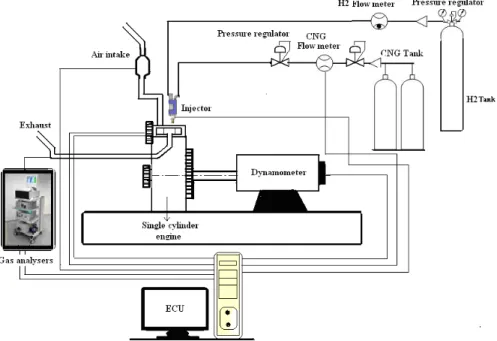
In general, the experimental setup consists of a four-stroke, single cylinder, water cooled and direct injection CNG engine. The schematic layout of the experimental setup is shown in Figure 3.1. The engine was coupled to a direct current dynamometer that allowed the engine braking and motoring while the performance parameters were measured. The concentration of the exhaust emission (CO, CO2, THC, and NOx) and lambda were measured using a GASMET gas analyzer. The type and specification of the equipment used during this experimental work for testing and measurement are described in the subsequent sections.
20
Fig 3.1: The schematic diagram of the experimental setup
3.1.1 The Engine and Accessories
3.1.1.1 Engine
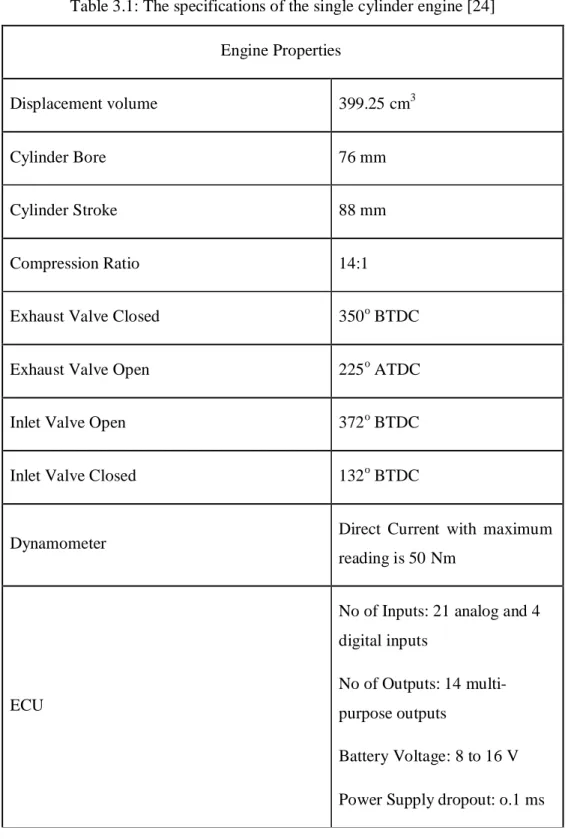
The engine used for the experiment was a HYDRA engine with some modification done to its cylinder head to enable direct injection of gaseous fuel. It was a single- cylinder, four-stroke spark-ignition engine with a swept volume of 399.25 cc and a compression ratio of 14:1. The detailed specifications of the engine are given in Table 3.1.
The engine was originally a gasoline engine but it was modified for natural gas application. The data for gasoline as well as natural gas were made available for comparisons with other fuels. For this experiment no modification was done to the engine when using CNG and H2 mixtures because the content of H2 is very small and it was expected that the combustion characteristics would not vary in a large scale. A programmable Electronic Control Unit, or ECU connected to a computer was used to control the engine. Engine parameters such as injection timing, ignition timing, injection duration and the amount of fuel were controlled by ECU that is connected with ECU Remote Interface, or ERI installed in the personal computer. The real time data is available from the engine ECU and can be viewed and recorded accordingly.
21
Table 3.1: The specifications of the single cylinder engine [24]
Engine Properties
Displacement volume 399.25 cm3
Cylinder Bore 76 mm
Cylinder Stroke 88 mm
Compression Ratio 14:1
Exhaust Valve Closed 350o BTDC
Exhaust Valve Open 225o ATDC
Inlet Valve Open 372o BTDC
Inlet Valve Closed 132o BTDC
Dynamometer Direct Current with maximum
reading is 50 Nm
ECU
No of Inputs: 21 analog and 4 digital inputs
No of Outputs: 14 multi- purpose outputs
Battery Voltage: 8 to 16 V Power Supply dropout: o.1 ms
3.1.1.2 Injector and Spark Plug Position
Figure 3.2 shows the geometry of the combustion chamber with injector and spark plug location. The fuel injector is placed at the top centre of the combustion chamber
22
with the spark plug next to it with an offset of 6 mm. A spark plug with a longer tip as compared to the standard one is used. In this experiment, original NG direct injector is used for the study without any modification. As hydrogen has low density, Wide Angle Injector, or WAI of 70o (refer to Section 3.4.2.1) is chosen to allow maximum fuel spray distribution.
Fig 3.2: Cut-off view of the engine showing the injector and spark plug position [81]
3.1.1.3 Piston
The experimental work was done in a stratified condition using a stratified piston as illustrated in Figure 3.3. It has a bigger cup positioned away from the center as shown in the sectional view. This configuration is specially designed to achieve stratified conditions of the mixture, in which fuel is deflected back from the piston head to the spark plug, so that a rich mixture is created near the spark plug.
Fig 3.3: Stratified piston head shape [81]
Injector Spark plug
Piston cup center line
Piston center line
23 3.1.2 The Engine Dynamometer
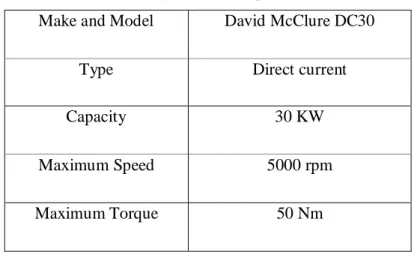
For the toque measurement during the experimental work, a dynamometer is coupled to the engine. Direct current or DC dynamometer is used to measure the brake torque.
Table 3.2 shows the specifications of the dynamometer.
The DC dynamometer has the capability to motor the engine. Engine oil temperature, coolant temperature, intake air temperature were recorded manually from the engine control panel.
Table 3.2: The dynamometer specifications Make and Model David McClure DC30
Type Direct current
Capacity 30 KW
Maximum Speed 5000 rpm
Maximum Torque 50 Nm
3.1.3 Exhaust Gas Analyzers
The Fourier Transformed Infrared or FTIR gas analyzer used in this study was called GASMET, manufactured by Temet Instruments. It uses the CALCMET software to compute the concentrations of the components present in the sample gas from the absorbance spectrum. The gas sample is introduced into the gas cell through standard gas line connectors. The transmitted infrared radiation is finally detected by a thermoelectrically cooled detector. The gas analyzer was used to measure the concentration of CO, CO2, NOx, THC and lambda with the accuracy of ±2% for each gas. The GASMET analyzer is capable of measuring about 50 gas species in the exhaust and providing the reading in parts per million, or ppm.
For oxygen concentration measurement, a GASMET oxygen analyzer was used. It utilized a Zirconia Measurement Cell that gave out voltage in proportion to the oxygen concentration. The analyzer was able to calculate the lambda values based on
24
the oxygen concentration. Appendix A shows the general specification of the GASMET analyzer, its measuring parameters and the general specification of the oxygen analyzer.
3.1.4 Pressure Sensor and Cylinder Pressure Data Acquisition
The in-cylinder pressure has been measured using Kistler Piezoelectric pressure transducer. A piezoelectric pressure transducer generates electric charge proportional to the pressure. The signal for the transducer is then amplified using a charge amplifier that gave output in terms of voltage which was proportional to the charge.
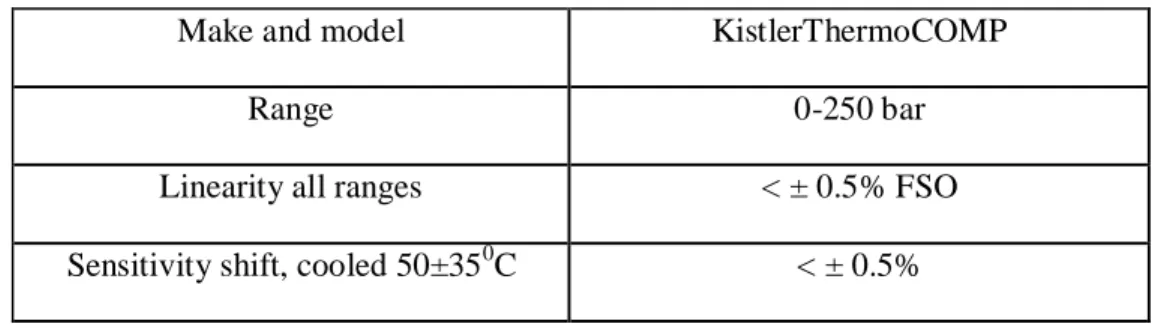
The transducer temperature variation can affect the calibration of the sensor due to the expansion of the casing as a result of the decompression of the crystal. Thus, the piezoelectric transducer is designed to have a water cooling passage to maintain its temperature in order to ensure correct pressure reading. Table 3.3 shows the specification of the transducer.
A crank angle encoder is used to establish the top dead center position and the phasing of cylinder pressure to crank angle. Typical set up for the cylinder pressure data capture system is as shown in Figure 3.4.
Combustion characteristics can be generated from the pressure reading obtained from the pressure sensor. A computer-based combustion analysis hardware and software are used to acquire and analyze the pressure data. The schematic of the system is shown Figure 3.4.
The hardware consists of high speed A/D data acquisition system and dedicated digital signal processors. The software performs statistical and thermodynamic analysis of the pressure data in real time. The data from the measurements of cylinder pressure can be used to determine not only the location of peak pressure but also the instantaneous heat release, burn fraction, and gas temperature [82]. Lab-view software of high speed data acquisition is used to record the reading of cylinder pressure.
Pressure acquired data of 100 engine cycles are averaged to analyze the cylinder gas pressure, and the resolution of the pressure data is 0.5o CA.
25
Table 3.3: The specifications of the pressure transducer
Make and model KistlerThermoCOMP
Range 0-250 bar
Linearity all ranges < ± 0.5% FSO
Sensitivity shift, cooled 50±350C < ± 0.5%
Fig 3.4: Cylinder pressure data capture system [82]
3.2 Fuel Composition and Properties
The fuel tests are carried out with gaseous fuel such as pure CNG and hydrogen supplemented CNG gas mixtures. The hydrogen is supplied by MOX Sdn. Bhd. in gas bottles of 200 bar pressure. The hydrogen has high purity of 99.999% and its specification is shown in Table 3.4.
Compressed natural gas supplied by Gas Malaysia Snd. Bhd. is used in the study of engine performance and combustion comparisons, and its specification is shown in Table 3.5. In this experiment, four fuel blends with the volumetric fraction of hydrogen in CNG of 0, 3, 5, and 8% are studied. The small amount of H2 is preferred
26
because it can be easily transported through the present natural gas delivery systems.
The fuel properties of the natural gas and hydrogen are listed in Table 3.6.
Table 3.4: The specifications of hydrogen [83]
Purity 99.999%
Moisture <3 vpm
Oxygen <3 vpm
Hydrocarbon <1 ppm
CO <1 ppm
CO2 <1 ppm
Table 3.5: Typical composition of the CNG in Malaysia [19]
Component Symbol Volumetric (%)
Methane CH4 94.42
Ethane C2H6 2.29
Propane C3H8 0.03
Butane C4H10 0.25
Nitrogen N2 0.44
Carbon dioxide CO2 0.57
Others H2O+ 2.00
![Fig 2.1: Variation of torque against speed for of 1.0 and TO of 100% [80]](https://thumb-ap.123doks.com/thumbv2/azpdforg/11113553.0/38.918.199.668.164.491/fig-2-1-variation-torque-speed-100-80.webp)
![Table 3.1: The specifications of the single cylinder engine [24]](https://thumb-ap.123doks.com/thumbv2/azpdforg/11113553.0/43.918.206.765.122.962/table-3-1-specifications-single-cylinder-engine-24.webp)
![Fig 3.2: Cut-off view of the engine showing the injector and spark plug position [81]](https://thumb-ap.123doks.com/thumbv2/azpdforg/11113553.0/44.918.240.642.287.464/fig-cut-view-engine-showing-injector-spark-position.webp)
![Fig 3.3: Stratified piston head shape [81]](https://thumb-ap.123doks.com/thumbv2/azpdforg/11113553.0/44.918.252.720.779.938/fig-3-3-stratified-piston-head-shape-81.webp)
![Fig 3.4: Cylinder pressure data capture system [82]](https://thumb-ap.123doks.com/thumbv2/azpdforg/11113553.0/47.918.217.766.270.660/fig-3-cylinder-pressure-data-capture-system-82.webp)
![Table 3.5: Typical composition of the CNG in Malaysia [19]](https://thumb-ap.123doks.com/thumbv2/azpdforg/11113553.0/48.918.170.700.643.961/table-3-5-typical-composition-cng-malaysia-19.webp)
