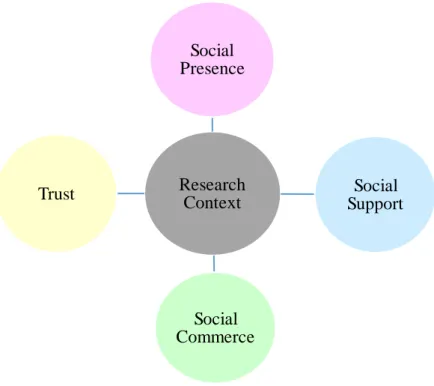
The relative scarcity of rules and customs on the internet makes consumer familiarity and trust especially important in the case of social trading. Nevertheless, the lack of the presence and support of human and social elements is also claimed as a major weakness that hinders the growth of social trade. Therefore, it is interesting to examine the factors in social presence and social support that will influence consumer confidence in social commerce.
Social commerce is a new development of e-commerce that merges the commercial and social activities by deploying social technologies on e-commerce sites. The findings demonstrate the validity of three dimensions of social presence: social presence of online brand community, social presence of others, and social presence of interaction; and two dimensions of social support: informational support and emotional support. Our findings indicate that all factors in social presence and social support had a significant relationship with trust in social trading, except emotional support.
Theoretically, these findings contribute to a better understanding of the effect of social presence and social support on consumers' trusting beliefs about social commerce. This research introduces a new perspective on e-commerce and puts more focus on this new phenomenon of social commerce.
RESEARCH OVERVIEW
- Research Background
- Problem Statement
- Research Questions
- Research Objectives
- Research Scope
- Significance of Study
- Summary
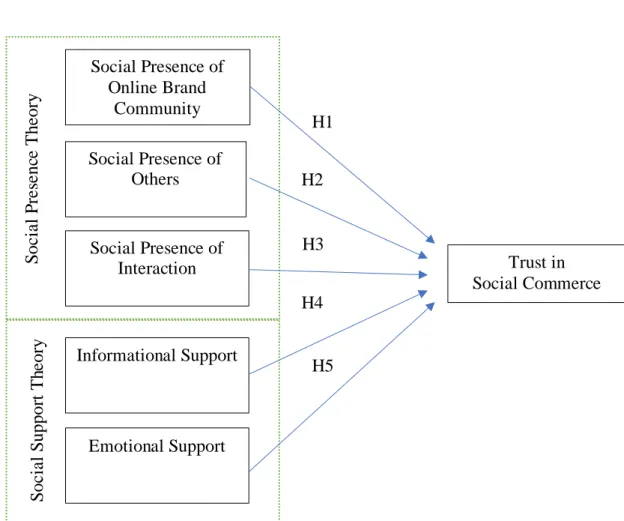
This study was therefore conducted to investigate the influence of social presence and social support regarding trust on social trading during national recovery plan. Influences social presence of online brand community (SPW) consumers trust on social commerce (Facebook) during national recovery plan. Social presence of others (SPO) influences consumers' trust in social commerce (Facebook) during national recovery plan.
Does Social Presence of Interaction (SPI) Affect Consumer Confidence in Social Commerce (Facebook) During the National Recovery Plan? Does informational support (IS) affect consumer confidence in social commerce (Facebook) during the national recovery plan. Does emotional support (ES) affect consumer confidence in social commerce (Facebook) during the national recovery plan.
This study aims to examine the influence of social presence and social support on consumer confidence in social commerce (Facebook) during the national recovery plan. This study examined the influence of social presence and social support on trust in social trading during the national recovery plan.

LITERATURE REVIEW
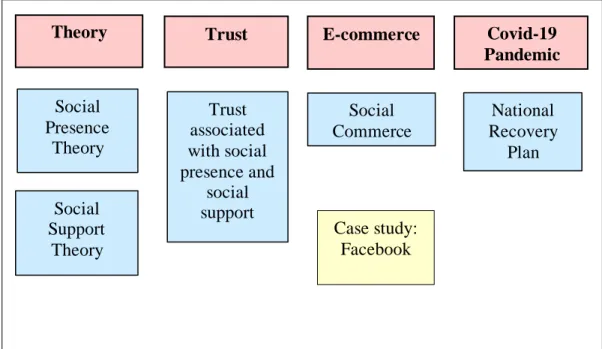
- Theories and Models
- Social Presence Theory
- Social Support Theory
- Trust
- Trust associated with Social Presence and
- E-commerce
- Social Commerce
- Covid-19 Pandemic
- National Recovery Plan
- Hypothesis Development
- Social Presence of Online Brand
- Social Presence of Others (SPO)
- Social Presence of Interaction (SPI)
- Informational Support (IS)
- Emotional Support (ES)
SS came in many forms, including from family, neighbours, friends and organizations (Makmor et al., 2018). In addition, trust is created through the surrounding environment and social interactions with other individuals in the context of s-commerce (Dabbous et al., 2020). Recent research has shown that trust plays an important role in social commerce, which Leong et al. 2020) have used trust as an interpreter of social behavior in studies of social commerce.
To be more specific, social support is information that is supportive in online communities and builds confidence in one's own individual decisions (Makmor et al., 2018). Consumer confidence in social commerce grows when they receive favorable support from other consumers in the same network that is reliable and accurate (Yeon et al., 2019). Therefore, the social presence of the online brand community created by online merchants would increase consumers' trust in social commerce (Lu et al., 2016).
Previous research also showed that IS can influence trust (Hajli, 2015; Yahia et al., 2018). Several studies have even shown that caring is the basis for developing trust (Schiemann et al., 2019).
METHODOLOGY
- Research Design
- Sampling Design
- Data Collection Method
- Research Instrument
- Questionnaire Design
- Pilot Study
- Construct Measurement
- Original Source of Construct Measurement 31
- Data Processing
- Questionnaire Checking
- Data Coding
- Data Transcribing
- Data Analysis
- Descriptive Analysis
- Scale Measurement (Reliability Analysis) 33
- Inferential Analysis
- Conclusion
The target population for this study is anyone 18 years of age or older who is an online shopper on Facebook. Therefore, the convenience sampling technique was used to select the target respondents in this study. The self-administered questionnaire of the research contains 20 questions with 5 IVs, therefore a minimum of 100 respondents is required.
In this study, the survey method was used to collect primary data to answer the research questions in this study. Before answering the questions, there is an introduction to the study to ensure that respondents understand the reason for completing the questionnaire. In section B, a 5-point Likert scale was applied to assess the level of agreement for the measured items.
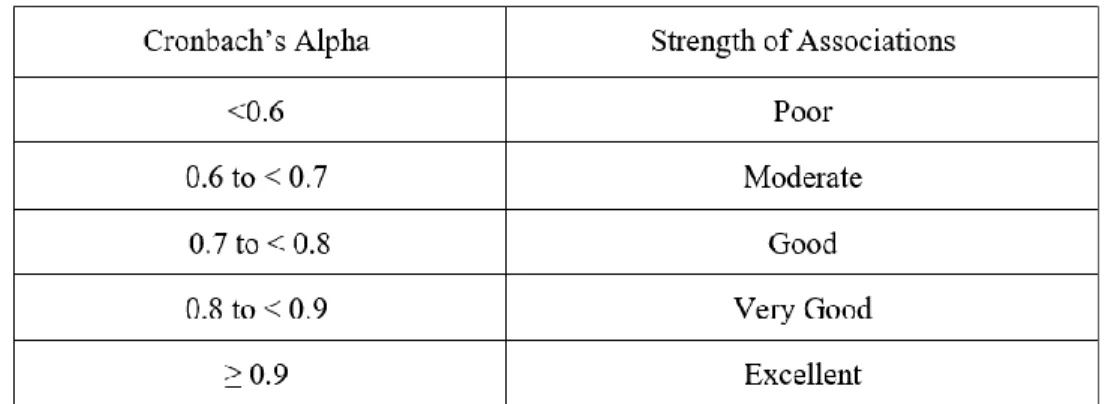
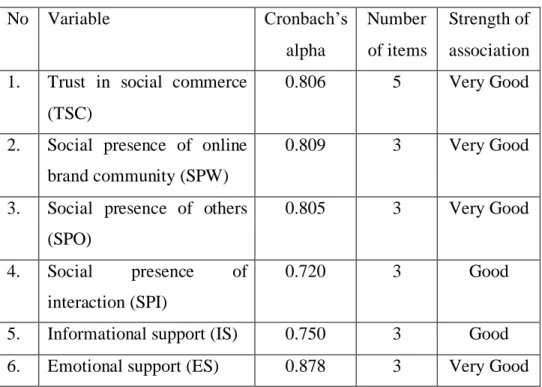
An online questionnaire was distributed and completed by 30 Facebook online customers, which presents the actual sample of this study. The results of the pilot study showed that the questionnaire flows well and does not contain any errors or confusing items. Among all 6 variables, ES achieved the highest Cronbach's alpha of 0.878, placing in "very good" strength of association.
Cronbach's alpha for the SPI is 0.720, which ranks lowest and falls below "good" strength of association. Meanwhile, the ordinal scale involves ranking and ordering data such as age, average monthly income, and average number of visits per visit. month on Facebook. The statistical information, including tables and charts for the questions in the questionnaire, will be made to summarize the results.
It was used to verify the reliability of the instrument in all constructs including TSC, SPW, SPO, SPI, IS and ES. It was used for hypothesis testing and investigating whether there is a relationship between the proposed factors and TSC. The higher the value of Beta, the more impact the predictor has on DV (Uyanık & . Güler, 2013).
DATA ANALYSIS
- Descriptive Analysis
- Demographic Profile and General
- Central Tendencies Measurement of
- Scale Measurement
- Reliability Test for Actual Result
- Inferential Analysis
- Pearson Correlation Analysis
- Multiple Linear Regressions
- Hypothesis Testing
- Conclusion
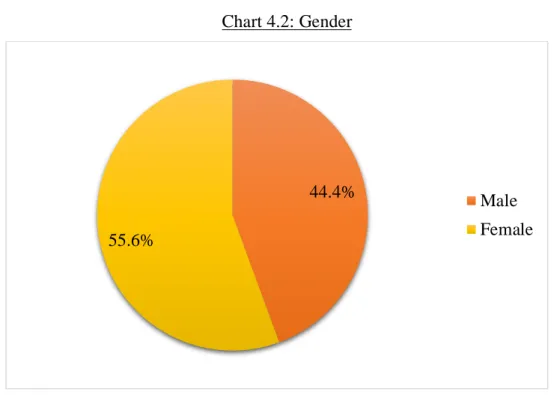
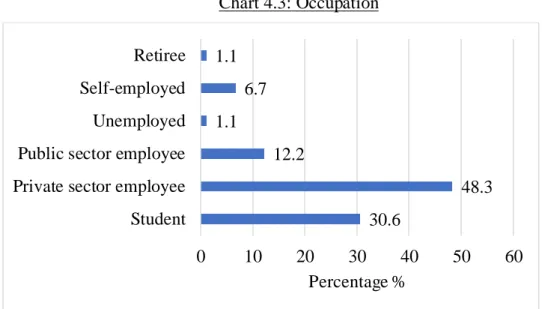
Finally, the Retirees and Unemployment categories have the same total of 2 respondents (1.1%) of the total number of respondents. Next, the remaining 4 respondents (2.2%) are those who have only used Facebook for less than 2 years. It is followed by of respondents who visit Facebook an average of 5-10 times per month, and only 5 respondents (2.8%) of respondents who visit Facebook less than 5 times.
According to Table 4.8, the average value of emotional support is the highest and amounts to 4.3444. The next, second highest value is the social presence of the brand's online community with a mean of 4.3433. They are followed by social presence of others with a mean of 4.2685, social presence of interaction with a mean of 4.2574, informational support with a mean of 4.2537.
Moreover, the standard deviation of trust in social commerce is the highest among all variables which is 0.73430. This is followed by social presence of online brand community with a standard deviation of 0.64894, social presence of others with a standard deviation of 0.64691 and emotional support with a standard deviation of 0.57021. Finally, the weakest relationship among the 5 variables is between ES with correlation of 0.440, which indicated a weak positive relationship.
In this equation, the value of the unstandardized Beta coefficients indicated the gradient of the line between an IV and a DV. However, ES has the lowest Beta value of -0.059 which is the least influential factor among other IVs. In other words, trust in social commerce will not affect when emotional support is provided.
H1: There is a relationship between the social presence of an online brand community and consumer trust in social commerce during a national recovery plan. H2: There is a relationship between the social presence of others and consumer trust in social commerce during the national recovery plan. H4: There is a relationship between information support and consumer trust in social commerce during the national recovery plan.
DISCUSSION, CONCLUSION AND IMPLICATIONS
Summary of Statistical Analysis
The end result showed that all variables were positioned within the range of Good and Very Good. The highest correlation is between SPO and TSC with 0.711 while the lowest correlation is between ES and TSC with 0.440. Meanwhile, multiple regression analysis showed that SPO,SPW,SPI, IS have relationship with TSC except ES.
Discussion on Major Findings
- Social Presence of Online Brand
- Social Presence of Others (SPO)
- Social Presence of Interaction (SPI)
- Informational Support (IS)
- Emotional Support (ES)
H2: There is a significant relationship between social presence of others (SPO) and consumer trust in social commerce (TSC) under the National Recovery Plan. According to the final result, there is a correlation between SPO and TSC at a significant level of 0.001 (below 0.05), which is consistent with previous studies. Respondents believe that other consumers' purchase experiences will cause their TSC to be affected.
H3: There is a significant relationship between social presence of interaction (SPI) and consumers' trust in social commerce (TSC) during national recovery plan. When there is an interaction between sellers and consumers in social commerce it is more possible to increase their TSC. According to Lu et al. 2016), interaction using special words and greetings will make consumers feel the sense of human warmth from sellers.
It is supported by Liu et al. 2020), the interaction between sellers and buyers using online chat tools can also generate a high social presence in social commerce. H4: There is a significant relationship between information support (IS) and consumer trust in social commerce (TSC) under the National Recovery Plan. When there are friends or a community member who provides information to help tackle the problem, consumers will increase their TSC (Hossain et al., 2020).
When consumers receive IS with consistent results, they are likely to trust the benevolence and integrity of sellers, so they will eventually develop a sense of trust in social commerce. H5: There is a significant relationship between emotional support (ES) and consumer trust in social commerce (TSC) during the national recovery plan. Respondents believe that emotional support (ES) from social commerce community and friends will not affect their trust in social commerce (TSC).
According to Leong et al. 2020), regardless of the amount of emotional support provided by e-commerce sellers, consumers' trust in e-commerce remains unchanged. This is because the rationalization of the emotional stability of consumers, which is not easily affected by the emotional support provided by sellers in e-commerce. Furthermore, according to Li (2019), emotional support has no effect on consumer transaction costs, which has no effect on the price to purchase the product.
Implications of the Study
- Theoretical Implication
- Managerial Implication
Limitations of the Study
Recommendations for Future Research
Conclusion
Predicting the Antecedents of Trust in Social Trading - A Hybrid Structural Equation Modeling with Neural Network Approach. Building e-commerce satisfaction and driving sales: The role of trust in social commerce and its antecedents. Exploring the drivers of social trading in social media platforms: the importance of trust, social support, and perceived use of the platform.
A study on the influential power of social presence and social support versus trust on social commerce during national recovery day. I am conducting a survey to study about the influential power of social presence and social support to trust on social commerce during the National Recovery Plan.