USAGE OF ARTIFICIAL INTELLIGENCE IN ONLINE SHOPPING APPLICATION: MALAYSIAN
CUSTOMER ATTITUDE
SOO HUI YEE
BACHELOR OF INTERNATIONAL BUSINESS (HONOURS)
UNIVERSITI TUNKU ABDUL RAHMAN
FACULTY OF ACCOUNTANCY AND MANAGEMENT
DEPARTMENT OF INTERNATIONAL BUSINESS
APRIL 2022
USAGE OF ARTIFICIAL INTELLIGENCE IN ONLINE SHOPPING APPLICATION: MALAYSIAN
CUSTOMER ATTITUDE
BY
SOO HUI YEE
A final year project submitted in partial fulfilment of the requirement for the degree of
BACHELOR OF INTERNATIONAL BUSINESS (HONOURS)
UNIVERSITI TUNKU ABDUL RAHMAN
FACULTY OF ACCOUNTANCY AND MANAGEMENT
DEPARTMENT OF INTERNATIONAL BUSINESS
APRIL 2022
ii Copyright @ 2022
ALL RIGHTS RESERVED. No part of this paper may be reproduced, stored in a retrieval system, or transmitted in any form or by any means, graphic, electronic, mechanical, photocopying, recording, scanning, or otherwise, without the prior consent of the author.
iii 26th April 2022
DECLARATION
I hereby declare that:
(1) This undergraduate FYP is the end result of my own work and that due acknowledgement has been given in the references to ALL sources of information be they printed, electronic, or personal.
(2) No portion of this FYP has been submitted in support of any application for any other degree or qualification of this or any other university, or other institutes of learning.
(3) Sole contribution has been made by me in completing the FYP.
(4) The word count of this research report is 14380
Name of student Student ID Signature
SOO HUI YEE 1801928
Date: ______________________
iv
ACKNOWLEDGEMENT
I would like to express my sincere gratitude to several individuals and organizations for having my back throughout my Final Year Project.
First, I wish to express my heartfelt thanks to my supervisor, Dr. Seah Choon Sen for his enthusiasm, tolerance, thoughtful, and perceptive comments, valuable information, practical advice, as well as endless ideas that have assisted me immensely consistently in my research writing. His vast knowledge and profound experience in Computer Science as Artificial Intelligence has helped me to complete this research successfully. This project would not have been possible without his support and guidance.
Secondly, I would like to thank Ms. Goh Poh Jin for providing me feedbacks recommendations for this research project that helped me to figure out mistakes I had made and filter out incorrect information.
Besides that, I also wish to express my gratitude to the Faculty of Accountancy and Management of Universiti Tunku Abdul Rahman for having this final year project and accepting me into the graduate program.
Moreover, I would like to convey my sincere to my course mates for their helpful commentary and fair criticism throughout this research project. Furthermore, I would express my sincere appreciation to all of the respondents who have been submitting their feedback through the survey questionnaire. Not only that, but I would also like to warmly thank my parents and family members who supporting me through the project.
v
DEDICATION
This research project is mainly dedicated to:
Dr. Seah Choon Sen, my beloved supervisor.
He guided me with patience and shared his useful knowledge throughout this research project. He has been a positive and passionate supervisor who leading me
all the way to the end.
Ms. Goh Poh Jin, for providing feedbacks for improvements of this research and,
friends, family, and respondents for their support across the research.
vi
TABLE OF CONTENTS
Page
Copyright Page... ii
Declaration ... iii
Acknowledgement ... iv
Dedication ... v
Table of Contents ... vi
List of Tables ... x
List of Figures ... xi
List of Abbreviations ... xii
List of Appendix ... xiii
Preface... xiv
Abstract ... xv
CHAPTER 1: INTRODUCTION ... 1
1.1 Introduction ... 1
1.2 Research Background ... 1
1.3 Problem Statement ... 4
1.4 Research Objectives ... 6
1.5 Research Questions ... 6
1.6 Scope of Study ... 7
1.7 Significant of the Study ... 7
1.8 Chapter Layout ... 8
1.9 Summary ... 9
CHAPTER 2: LITERATURE REVIEW ... 10
2.1 Introduction ... 10
2.2 Underpinning Theory ... 10
2.2.1 Technology Acceptance Model (TAM) ... 10
vii
2.3 Artificial Intelligence ... 11
2.4 Online Shopping Application ... 12
2.4.1 Shopee ... 13
2.4.2 Lazada ... 15
2.5 Malaysian Customer Attitude ... 16
2.6 Review of Variables ... 17
2.6.1 Dependent Variable – Attitude ... 17
2.6.2 Independent Variable – Perceived Usefulness ... 18
2.6.3 Independent Variable – Perceived Ease of Use ... 19
2.6.4 Independent Variable – Perceived Trust ... 20
2.6.5 Independent Variable - Perceived Performance/ Quality ... 21
2.7 Proposed Research Framework ... 22
2.8 Hypothesis of the Study ... 22
2.9 Summary ... 25
CHAPTER 3: RESEARCH METHODOLOGY ... 26
3.1 Introduction ... 26
3.2 Research Design... 26
3.3 Data Collection Methods ... 27
3.3.1 Primary Data ... 27
3.4 Sampling Design ... 28
3.4.1 Target Population ... 28
3.4.2 Sampling Location ... 28
3.4.3 Sampling Elements ... 28
3.4.4 Sampling Techniques ... 29
3.4.5 Sampling Size ... 29
3.5 Research Instrument... 29
3.5.1 Questionnaire Design ... 30
viii
3.5.2 Pilot Test ... 30
3.6 Construct Measurement ... 32
3.6.1 Scale Management ... 34
3.6.1.1 Nominal Scale ... 34
3.6.1.2 Ordinal Scale ... 35
3.6.1.3 Interval Scale ... 36
3.6.1.4 Ratio Scale ... 36
3.7 Data Processing ... 37
3.7.1 Collection ... 37
3.7.2 Preparation ... 38
3.7.3 Input ... 38
3.7.4 Processing ... 38
3.7.5 Output ... 38
3.7.6 Storage ... 38
3.8 Data Analysis ... 39
3.8.1 Descriptive Analysis ... 39
3.8.2 Reliability Test ... 39
3.8.2 Inferential Analysis ... 40
3.8.2.1 Multiple Regression Analysis ... 40
3.9 Conclusion ... 41
Chapter 4: DATA ANALYSIS ... 42
4.1 Introduction ... 42
4.2 Respondents Demographic Profile ... 42
4.3 Central Tendencies of Variables ... 52
4.4 Scale Measurement ... 53
4.4.1 Internal Reliability Analysis ... 53
4.6 Pearson Correlation Analysis ... 54
ix
4.5 Multiple Linear Regression... 55
4.6.1 Test of Significant ... 58
4.7 Conclusion ... 59
CHAPTER 5: DISCUSSION AND CONCLUSION ... 60
5.1 Introduction ... 60
5.2 Discussion on 1st Research Objective ... 60
5.3 Discussion on 2nd Research Objective ... 63
5.4 Discussion on 3rd Research Objective... 65
5.4.1 Relationship between Perceived Usefulness and Attitude ... 65
5.4.2 Relationship between Perceived Ease of Use and Attitude ... 66
5.4.3 Relationship between Perceived Trust and Attitude ... 66
5.4.4 Relationship between Perceived Performance and Attitude ... 67
5.5 Implications of the Study ... 68
5.5.1 Theoretical Implications ... 68
5.5.2 Managerial Implications ... 68
5.5 Limitations of the Study... 70
5.5.1 Limited Framework ... 70
5.5.2 Limited Outcomes in Quantitative Research ... 70
5.5.3 Imbalance Sample Size ... 70
5.6 Recommendations for Future Research ... 71
5.6.1 Extend the Framework ... 71
5.6.2 Apply Both Quantitative and Qualitative Research ... 71
5.6.3 Enlarge the Sample Size ... 71
5.7 Conclusions ... 72
References ... 73
Appendix ... 87
x
LIST OF TABLES
Page
Table 3.1: Cronbach’s Alpha Range ... 31
Table 3.2: Results of Pilot Test ... 31
Table 3.3: Construct Measurement ... 32
Table 3.4: Example of Nominal Scale Question ... 35
Table 3.5: Example of Nominal Ordinal Question ... 35
Table 3.6: Example of Interval Ordinal Question ... 36
Table 3.7: Example of Interval Ratio Question ... 37
Table 4.1 Respondents’ Gender ... 43
Table 4.2: Respondents’ Age Group ... 44
Table 4.3: Respondents’ Highest Degree or Level of School have completed. .... 46
Table 4.4: Respondents’ Most Commonly Used Online Shopping Application ... 47
Table 4.5: Respondents’ Frequency of Using Online Shopping Application to Purchase. ... 48
Table 4.6: Respondents’ Amount Spend on Online Shopping Application Monthly. ... 50
Table 4.7: Respondents’ Enjoyment with Artificial Intelligence Assistance while Using Online Shopping Application. ... 51
Table 4.8: Central Tendencies on Variables ... 52
Table 4.9: Reliability Statistics for Actual Research ... 53
Table 4.10: Correlations... 54
Table 4.11: Model Summary ... 55
Table 4.12: ANOVAa ... 56
Table 4.13: Coefficientsa ... 56
Table 5.1: Summary of Bootstrapping Result... 65
xi
LIST OF FIGURES
Page
Figure 2.1: The Monthly Visitors of Shopee ... 14
Figure 2.2: The Monthly Visitors of Lazada ... 15
Figure 2.3: Proposed Conceptual Framework ... 22
Figure 4.1: Respondents’ Gender ... 43
Figure 4.2: Respondents’ Age Group ... 44
Figure 4.3: Respondents’ Highest Degree or Level of School have completed. ... 46
Figure 4.4: Respondents’ Most Commonly Used Online Shopping Application .. 47
Figure 4.5: Respondents’ Frequency of Using Online Shopping Application to Purchase. ... 48
Figure 4.6: Respondents’ Amount Spend on Online Shopping Application Monthly. ... 50
Figure 4.7: Respondents’ Enjoyment with Artificial Intelligence Assistance while Using Online Shopping Application. ... 51
Figure 5.1: Demographic Profile of Respondents... 60
Figure 5.2: Online Shopping Application Preferences ... 61
Figure 5.3: Consumers’ Preferences regarding AI Tools ... 63
Figure 5.4: Modified TAM Model Framework ... 64
xii
LIST OF APPENDICES
Page Appendix A: Questionnaire ... 87 Appendix B: SPSS Output ... 93
xiii
LIST OF ABBREVIATIONS Adj R2 Adjusted R-squared
AI Artificial Intelligence
ANOVA Analysis of Variance
B/ β Beta
B2C Business-to-consumer
C2C Consumer-to-consumer
Df Degree of Freedom
F F ratio
H1 Hypothesis 1
H2 Hypothesis 2
H3 Hypothesis 3
H4 Hypothesis 4
N Sample Population
NLP Natural Language Process
PEOU Perceived Ease of Use
PP Perceived Performance
PT Perceived Trust
PU Perceived Usefulness
R2 R-squared
SE Standard Error
Sig. Significance
SPSS Statistical Package for Social Science
TAM Technology Acceptance Model
UTAR Universiti Tunku Abdul Rahman
xiv PREFACE
The rapid adoption of smartphones, effortless and affordable access to technology, and the accessible of shopping from anywhere, every time are the main reasons of rapidly rising e-commerce. This have dramatically changed the Malaysian lifestyle. Moreover, the AI are becoming more important from time to time, there are people still not aware about it. Furthermore, there is much away from being understood regarding the factors influence customer’s attitude towards AI in online shopping application.
This research paper main objective is to examine the AI tools enhance online shopping application, for the purpose of enhance customer attitude towards AI in the application. Moreover, this research will identify and examine how AI tools influence and enhance customer attitude by utilizing the TAM. Therefore, it can provide a deeper understanding to customers and online sellers as well as online shopping application developers.
xv ABSTRACT
Artificial Intelligence (AI) has become increasingly important towards consumer’s attitude in online shopping application. Furthermore, in this study, the main objective is to study regarding the utilization of AI in online shopping application of Malaysian consumer attitude. An empirical data through a survey questionnaire from 250 respondents of Malaysian online shopping application as Shopee and Lazada consumers between the age range of 18 to 35 had been collected.
On top of that, the proposed hypothesises were analysed and interpret through Statistics Package for Social Science (SPSS).
In view of this, the Technology Acceptance Model (TAM) had been applied along with enhanced as a theoretical basis. Additionally, the independent variables included perceived usefulness, perceived ease of use, perceived trust, together with perceived performance toward the dependent variable which is attitude.
Along with that, the results of this study stated that perceived usefulness has no significant relationship towards attitude. However, the other variables as perceived ease of use, perceived trust, and perceived performance have a significant relationship towards attitude.
At the end of this study, discussions regarding the objectives, implications, limitations, and recommendations have been discussed.
1
CHAPTER 1: INTRODUCTION
1.1 Introduction
Chapter 1 delivers an outline as include few sections. To be specific, sections as research background, problem statement, research objectives along with questions.
Not only this, other sections as scope of study, significant of study, chapter layout and a summary will be delivered.
1.2 Research Background
Artificial Intelligence’s (AI) foundation has started thousand years ago, nevertheless, it classified among the latest field of intellectual research. In addition to that, there are few subjects that made up of AI including philosophy, linguistics, psychology, and biology (Artificial Intelligence Illuminated - Ben Coppin - Google Books, n.d.).
Not only that, but AI programming also mainly focus on three cognitive skills which are learning, reasoning along with self-correction. By way of illustration, Google turned out to be part of largest players for a wide range of online services through machine learning to understand the way public use their services along with improving them (Burns, n.d.)
Along with that, AI can be classified as strong or weak AI. Strong AI also defined as Artificial General Intelligence (AGI), as the machine need to obtain an intelligence equal to humans. On the other hand, the weak AI which or narrow AI emphasis on carrying out a particular task like replying to questions according to input from a user (What Is Strong AI? 2020). By way of illustration, the recommendation engine, search engine, and chatbots that provide on the online shopping application is known as weak AI (Marr, n.d.).
2
Apart from that, online shopping application corresponds to a special form of e- commerce (electronic commerce) which connects buyers and sellers on every corner of the internet. Online shopping application has now been very common nowadays as consumer discover that it is easy to shop from anywhere. As a matter of fact, it is common enough to come upon online stores that sow a scope of products plus details, characteristics, images as well as prices for consumers.
As a matter of fact, online shopping can substitute for the traditional form of shopping. Besides that, technological changes that promote and boost the online shopping agenda is on account of credit. (Donszem, 2020)
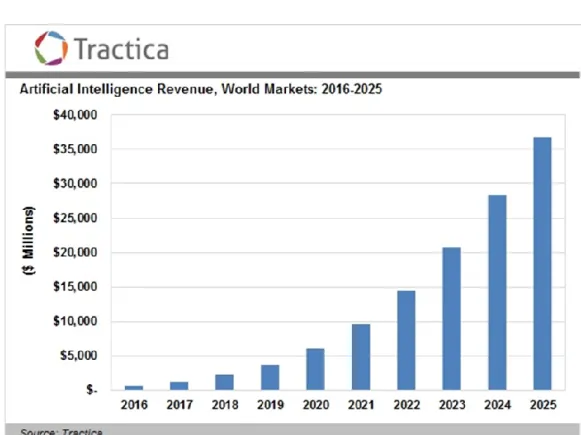
On the other hand, corresponding to a survey developed by Tractica (Martin, 2019) AI in E-commerce is expanding tremendously. The revenue is predicted to achieve $36.8 Billion all around the world by 2025 (figure 1.1).
Figure 1.1: The revenue of AI
Source: Martin. (2019). 5 Reasons Why Your Business Needs a Mobile E- Commerce Application. (n.d.). Sam Solutions
3
Consequently, the business shall be available for consumer continuously for the sake of achieving goals. In fact, AI is essential for the businesses to collect real- time information. AI has improved consumer experience in online shopping application and brought it to a whole new level.
For example, every online shopping application has using AI with the intention of produce more leads along with offer superb user engagement. Therefore, AI is very important in online shopping application as it offer chatbots, it able to provide 24/7 assistance. These bots communicate with consumers mostly via text on online shopping application (Asling, n.d.)
Apart from that, AI also provide personalization to consumer. For instance, a survey carried out by (Landsberg, 2021). stated that approximately 74% of marketers claimed that personalization enhances consumer engagement rates. Not only that, AI also can provide right recommendation to consumers effectively and efficiently as AI able to predict consumer behaviour along with their needs and offer recommendations.
Other than that, AI also able to create customer-centric visual search. For instance, when user use online shopping application to shop may experience that the product results given are unrelated and result in leave the page. However, AI able to tackle this issue by using Natural Language Process (NLP) for the sake of contextualize along with enhance the search result. This can help consumer to shop for the products that are interested or looking for (Martin, 2019)
To sum up, research carried out by the (Why It’s Time Your Business Went All in on Chatbots, 2016) claimed that approximately 85% of customer fundamental interactions ought to be take place through technology by the earliest of 2020.
Besides that, majority of the online shopping application have applied AI to improve understanding consumers along with create new leads and offer better customer experience for user.
4
1.3 Problem Statement
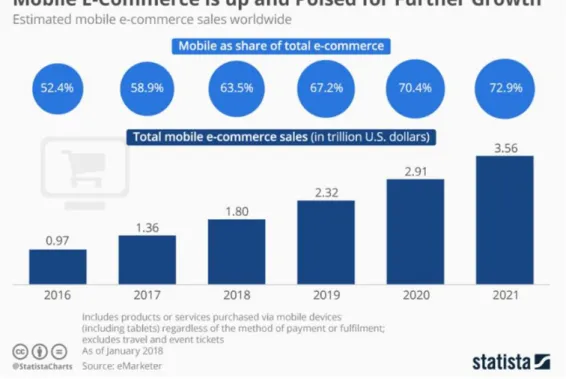
Figure 1.2: Total Mobile E-commerce Sales
Source: 5 Reasons Why Your Business Needs a Mobile E-Commerce Application.
Statista.
The reason of E-commerce industry development is highly successful because the software solutions of mobile devices deliver new channel for retailers linking with consumers as shown in figure 1.2. (5 Reasons Why Your Business Needs a Mobile E-Commerce Application, n.d.). Sadly, these e-commerce industries do not really equip the application with AI technology.
By way of illustration, Lazada, the online shopping application that control the lead in Southeast Asia is also one of the Alibaba’s largest overseas investments.
As Lazada acknowledging the significance of AI, it has been focusing its core business model on creation of value over the deployment of AI (Vichit-Vadakan, 2020)
5
In addition to that, number of applications have been gaining benefits from AI, however, there are also obstacles and drawbacks. As a matter of fact, one of the obstacles by putting AI into practice is the availability of data. In fact, it is generally known that AI is only as good as complete data fed into it. The AI systems required to be practiced or instructed with data beforehand as AI demand for precise, clear, and beneficial data to conclude from. On the other hand, data is often erratic and decline in the quality, all of them shows problems or difficulties for business that try to create value from AI in large scale. Furthermore, a clear strategy from the outset for the sake of sourcing data that required by AI can effectively overcome this issue (Artificial Intelligence in Business, n.d.)
Not only that, the following limitation of implementing AI is skills shortage.
Besides that, the availability of professional staff with experience and trained also facing shortage. In fact, AI is not only cover software engineering, but it also includes other disciplines suchlike mathematics, statistics, psychology and more.
Therefore, shortage of human resource may lead to unable to deploy and operate AI solutions effectively and efficiently. Along with that, the AI also has implementation risk as even successful implementation, it requires to maintain a team for the sake of interpret and enhance the AI algorithm (AI in ECommerce:
Limitations and Solutions, 2021)
Quite apart from that, failures of AI at the present time can be small or immense.
According to (Business Analysis Tips for Avoiding Failure Rates, Part 1, 2022)approximately 87% of the data science projects not ever able succeed to the production stage. Not only that, (Digital Transformation: The Definitive Guide (2021), n.d.) also stated that 56% of worldwide CEOs presume that it needs 3-5 years to notice any real return on investment (ROI) on the AI investment.
In addition to that, investors must overcome numbers of hill on the journey for the return on AI investments. For instance, applying AI in the online shopping application by no means applying a one-size fits-all and off-the-shelf resolution for the application. In fact, AI systems shall be treated like other technology investment where it shall require a specific objective for the sake of solving a specific goal. Besides that, AI also need to be tracked with benchmarks along with
6
KPIs. Therefore, the online shopping application firms should hold the teams accountable for those numbers (Minevich, 2020)
1.4 Research Objectives
The primary purpose of the research is to identify the usage of Artificial Intelligence in online shopping application as Malaysian consumer attitude.
Additionally, the objectives can be further explored as follow:
RO1: To identify the factors affecting Malaysian consumers’ attitude towards AI.
RO2: To develop a research model based on Technology Acceptance Model (TAM) that can define the factors that affect the consumers’ attitude towards AI.
RO3: To investigate the factors used in the proposed research model.
1.5 Research Questions
There are a few questions to be discusses and are aiming to be figured out across this study:
RQ1: What are the factors affecting Malaysian consumers’ attitude towards AI?
RQ2: Which research model could define the factors that affect the consumers’
attitude towards AI?
RQ3: How does the effectiveness of factors used in the proposed research model?
7
1.6 Scope of Study
This study is focused throughout people using online shopping application and this article has selected 2 online shopping application which are Shopee and Lazada. Apart from that, the target respondents for this study are Malaysian between 18-30. Lastly, this research is using quantitative method.
1.7 Significant of the Study
This research is important to earn a deeper understanding and increase awareness of how AI influence Malaysian consumers’ attitude in online shopping application.
Additionally, this study may provide the possibility to benefit a broad range of people suchlike online shopping application operators, sellers, buyers and so on.
Due to the Covid-19 pandemic, people have been practising social or physical distancing and staying home to restrict the spread of virus. Therefore, it is expected to push the customers towards online shopping. As a result, the pandemic also may affect businesses that sell physically as facing a drop in sales.
Moreover, this study also showed the importance of aware the online shopping or E-commerce industry has grown which bring a greater focus on the industry. Not only that, by understanding the primary element that push consumers’ attitude AI, developers able to further explore for the sake of enhancing the quality of AI systems attract new or potential consumers and maintain existing customers.
Apart from that, this study will provide suggestions for the AI systems developers in online shopping application. As a matter of fact, these findings may be applied by AI systems developers when promoting their techniques. Besides that, they are also able to focus on the expectations of consumers towards AI in the online shopping application.
Not only that, sellers, or businesses also able to benefit from this study where it showed the ways to attract consumers through variables that are suitable. In fact,
8
sellers able to understand consumers’ attitude deeply through studying those major factors which affect their attitude towards AI.
Lastly, this study also benefits the government ability or capacity to identify systems which related to AI in the E-commerce industry. Not only that, but as online shopping is also growing tremendously and bring a huge impact to the economy, this study may support government to enhance the AI systems in the online shopping application for the sake of improving user experience and gain more profit.
1.8 Chapter Layout
This study is separated into 5 main chapters which shown below:
Chapter 1: Introduction
Chapter 1 is the part where mainly explain the conceptual foundation of the study, for instance, background of research, problem statement, research questions along with objectives. In addition, the scope of study, research significance, chapter layout and lastly a short summary will also include in this chapter.
Chapter 2: Literature Review
Chapter 2 shows the hypothetical structure of the study along with foster the theme. In additionally, this chapter primarily focus on research issue, questions as well as plan elements. In short, this chapter will explain in detail regarding the previous chapter.
Chapter 3: Research Methodology
This chapter showed the way that this research is systematically designs for the sake of make sure valid and effective results that match research objectives. There are numbers of sub-chapters included.
9 Chapter 4: Research Result
Chapter 4 provided the details regarding data analysis along with interpretation.
For example, this chapter will conclude the results of questionnaire survey.
Chapter 5: Discussion and Conclusion
Chapter 5 present few sub-chapters as the findings, conclusions, along with recommendations. However, there are also few limitations will be shown.
1.9 Summary
On a final note, chapter 1 has reviewed the background along with importance of studying on how AI in online shopping application affect Malaysian customer attitude. Furthermore, this chapter also has showed the problem statement and hypothesis of this study
10
CHAPTER 2: LITERATURE REVIEW
2.1 Introduction
In this chapter will show the results understanding or analysis regarding earlier research papers which are relevant to area of study of this research and relevant underpinning theory. Additionally, a conceptual framework also presented in this chapter which illustrate elements that expected to find through in this study. For instance, it specifies the related variables in this study along with indicate the way they are relevant. At last, this chapter also will explore the four variables hypothesis by studying research undertook by other researchers.
2.2 Underpinning Theory
2.2.1 Technology Acceptance Model (TAM)
In accordance with determined relevant conceptual fundamentals and literature, one research model was applied for the sake of examine the technology acceptance which affect acceptance towards AI in online shopping application in the context of Malaysian consumers. Additionally, the Technology Acceptance Model (TAM) developed by (F. Davis, 1989) had classified as the best-known research models with forecast use as well as acceptance towards information systems along with technology of users.
In addition, the TAM has proven to be widely studied and reviewed by various of studies that investigate the individual technology acceptance behavior from various information systems constructs. For example, a study developed by (Gómez Chova et al., 2016) tried to examine teachers’ acceptance towards eLearning systems by using TAM.
On top of that, the reason of applying TAM for research model as it consists of the real system use is identified by individuals’ behavioral intention to utilize that
11
influence by attitude. Besides that, the attitude can be instantaneously and straightaway influence through the usefulness together with ease of use from that system.
Apart from that, even though this model was originally adopted of information systems (F. Davis, 1989), however, researchers in the consumer behavior industry delivered two particular aspects that associated with online shopping which are perceived usefulness and ease of use.
Moreover, (F. Davis, 1989) described perceived usefulness as the potential user’s possibility which apply a system may improve their work performance.
Furthermore, the perceived ease of use equals to user presumes the system to be use without effort. Nevertheless, both variables are most important factors of actual system apply in the TAM.
2.3 Artificial Intelligence
AI is correlated with similar function or job of utilizing computers for the sake of having deeper knowledge regarding human intelligence (McCarthy, 2004)
Apart from that, the main objective of AI is to construct the computers that they able to notice including see, hear, walk, so on and so forth. However, the primary force of AI is the computer functions are clustered with individual intelligence like critical thinking (Bhbosale et al., n.d.)
On top of that, from the moment of drastic change in the industry, there had a rapid growth in technology. Besides that, numerous tough manually operated by human had taken place by technology. For instance, AI is included in the technological evolutions to substitute the work that is originally performed by human in different domains (Ting et al., n.d.)
12
Not only that, according to a studied done by (Abdulov, 2020) stated that there had an immense capacity of introduce AI into the country economy system as well as personal company.
Aside from that, investigators have educated computer models to recognized or distinguished user’s distinct characteristics more precisely (Wu et al., 2015). In fact, AI have an outstanding relationship with Big Data where the machine learning has instructed AI by using large data sets rather than dictating a fixed set of directions for AI to obey. The Big Data has been analyzed or examined more efficiently as even faster, broadly, and deeply than previously, AI’s value had been redefined along with opened a new age (Chien, 2020)
Aside from this, as claim by (Dimitrieska et al., 2018)the function or capacity of AI in marketing is to track and forecast the following purchasing choices of target customers together with enhance users shopping experience.
2.4 Online Shopping Application
The dramatical growth of online shopping causes an intense rivalry in the industry.
In fact, there are many factors that will affect customer’s attitude as customer be inclined to continue shop online if they trust the seller. The reason for this is that customers are unable to see the products before purchase (Pratminingsih et al., 2013)
Apart from that, customer have a broad range of products to shop online conveniently and efficiently by way of shop anytime from anywhere across the globe (Redda, 2019). Besides of that, as stated by a study carried out by (Kim et al., 2017), both online experience and mobile experience just as the experience throughout the smartphone usage are positively or clearly relate to the possess of online shopping application.
Not only that, according to the result of a research developed by (al Dmour et al., 2014)showed that consumer is highly possible to purchase while the mobile
13
application quality is highly perceived. By way of illustration, according to the (Top Shopping Apps Ranking- Most Popular Apps in Malaysia, 2021) top online shopping application, Shopee ranked the first place following by Lazada on both Goole Play Store and Apple App Store.
2.4.1 Shopee
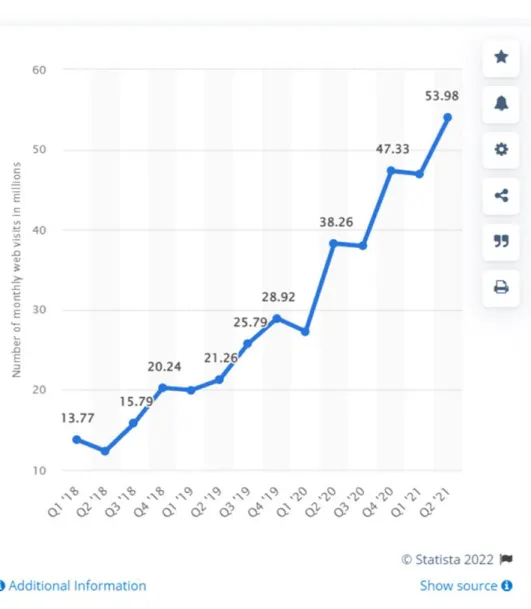
Shopee is a Singaporean international technological corporation founded in 2015 as an e-commerce platform (Shopee Company Profile: Overview & Executives, n.d.). In addition to that, Shopee is presently the biggest e-commerce platform within the Southeast Asia with 343 million of visitors per month (Hirschmann, 2022) On top of this, in accordance with the (Hirschmann, 2022), the amount of Shopee’s monthly visitors in Malaysia had a total of approximately 54 million users in the second quarter of 2021. This also proved that is has a dramatically growth in comparison with the past quarter.
14
Figure 2.1: The Monthly Visitors of Shopee
Source: Hirschmann, R. (2022) Malaysia: Number of Monthly Web visits on Shopee 2021.Statista.
For instance, as per a survey conducted by Ipsos, that data showed that 82% of respondents used the application for the last six months. This also proved that Shopee is the leading online shopping platform for Malaysians (Loheswar, 2021).
On the other hand, Shopee had received the gold award in the category of Excellence in Mobile Marketing from the Marketing-Interactive’s Marketing Excellence Awards in the year 2021 (Writer, 2022)
15
2.4.2 Lazada
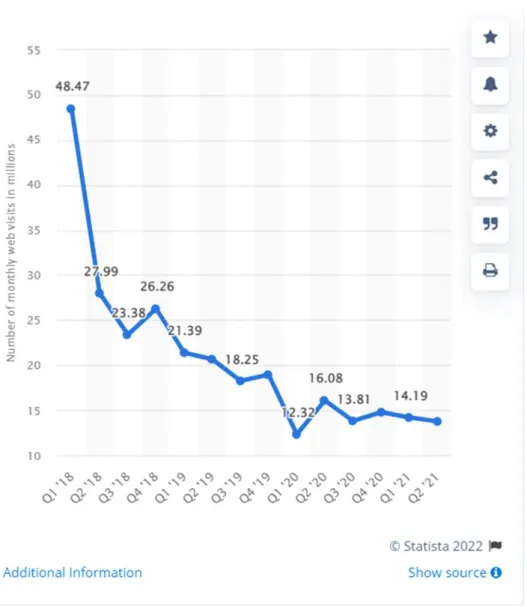
Lazada Group is the Southeast Asia’s multinational leading E-Commerce platform that founded in the year 2012 (Lazada. Setting the Pace for a Retail Revolution., 2022). Additionally, on the authority of Similar Web, Lazada had around 13.75 million of monthly visitors during the second quarter of 2021 in Malaysia. In fact, in had declined in contrast to the past quarter (Müller, 2021). However, according to a survey done by iPrice Group, Lazada still holding most of the market share throughout the Southeast Asia (The Map of E-Commerce in Malaysia, n.d.)
Figure 2.2: The Monthly Visitors of Lazada
Source: Müller, J. (2020). Malaysia: Number of Monthly Web Visits on Lazada 2021. Statista
16
On the other hand, Lazada had launched LazMall as the biggest online shopping mall along with the greatest broad range of highest ranked products (Lazada Launches Southeast Asia’s Biggest Mall ‘LazMall,’ 2018). Aside from that, Lazada Malaysia had reached a new record as had more than 3,000 transactions per minute during the Singles Day peak un the year 2018 (Hong, 2018).
Furthermore, the Lazada Group also received a gold for PR Team along with a silver for the Best Regional PR at the PR Awards 2021 (Writer, 2021).
2.5 Malaysian Customer Attitude
Attitude defines as the learned predisposition for the sake of responding positively or negatively to an object. Therefore, attitudes are affected by information along with experiences considering that attitudes are learned (Wilkie, 1994).
Additionally, behaviour is defined by intentions that also affected by attitudes (Ajzen & Fishbein, 1980)
Apart from that, according to (Ostrom et al., 2018) stated the set of possible effects regarding customer acceptance through AI in particular whatever consumers might experience and the factors of AI that affect consumers.
Furthermore, consumers are glad to practice AI as it is advantageous and convenient for day-to-day life. For an instance, a study performed by (Noor &
Mansor, 2019)stated that by applying AI will help to enhance effectiveness and provide immediate actions.
On the other hand, as reported by (Poll: Over Half of Malaysians down on Robots for Automation, 83pc Positive on Country’s Space Programme, 2020), Malaysians had mixed opinions about either AI was good or bad for society. As a matter of fact, majority of the respondents as 53% claimed that AI is generally good for the society; while 44% of respondents think that it is bad for the society, and the remaining 4% think that it is both good and bad or refuse to answer.
17
In addition to that, according to Malaysia’s business leaders, AI able to enhance the rate of innovation to nearly double (x1.8) together with improve staff productivity improvements near 60% by 2021 (AI to Nearly Double the Rate of Innovation in Malaysia by 2021, 2019). Not only that, according to (Gnaneswaran, 2019)there is a great optimism for AI in Malaysia even though the adoption and utilization is still in nascent stages. As mostly of the Malaysian consumers as 89%
are aware of AI along with 51% of Malaysians have a positive attitude towards the future of AI.
2.6 Review of Variables
2.6.1 Dependent Variable – Attitude
Individuals have attitudes whenever they adored or dislike either things or people along with when they accept or reject of them. For instance, emotions, perception, and open behavior are infused with the meaning of attitude (Eagly & Chaiken, 1998). Apart from that, majority of the theories address attitudes as constant evaluative tendencies as it is compatible with individual’s preference for the dispositional explanations (Schwarz, 2007)
On top of that, according to (Allport, 1993), the concept of attitude is unique and essential where the study has continued to be supreme in social psychology down to date (Lasagabaster, 2008).
On the other hand, consumer’s attitude may influence their buying willingness directly. By way of illustration, (Crisp et al., 1997) had composed a model regarding attitudes and shopping intention on electronic shopping. Additionally, the study composes several pointers, however, it is classified to 4 categories as the products’ value, shopping experience, service quality offered through e-commerce also a risk perception towards online shopping.
Besides that, according to (S. A., Brown & Venkatesh, 2005), attitudes are especially relevant for the consumer decision-making context. Apart from that, by
18
understanding consumer attitude can provide beneficial information for online retailers and physical retailers that may expand their business on the virtual platform (Jin et al., 2015).
In a nutshell, there are many studies regarding online shopping have investigated different determinants of factors.
2.6.2 Independent Variable – Perceived Usefulness
(F. Davis, 1989) specified that perceived usefulness is subjective insight of users as they assume by using certain technologies able to enhance their work performance. Additionally, for the needs of this study, perceived usefulness is the degree to a user presumes that purchasing through online shopping application, will build value for him/her.
Consumer can feel perceived usefulness when the online shopping system able to use quickly, easily, and efficiently as compared to manual shopping systems.
Besides that, perceived usefulness also can enhance the performance of its user (Iriani & Andjarwati, 2020).
Additionally, there are number of researchers utilize the TAM to clarify that the perceived usefulness against affecting online shopping behavior of customers.
Besides that, (Lim & Ting, 2012)conducted a study and showed that perceived usefulness can indirectly affects consumer’s intention to shop online. It also proved that it is mediated by attitude on online shopping.
Apart from that, (Suleman, 2019) conducted a study and shown that perceived usefulness is a significant element that affects consumers online shopping decisions. Besides that, perceived usefulness emerges as primary factor that influence Malaysian consumers to shop online. Therefore, online retailers or sellers can create effective marketing strategies for the sake of improve company competitive advantage (Ramlan & Omar, 2011).
19
On top of that, (Alreck et al., 2009) indicated that online retailers that promote both timesaving and the efficient of task accomplishment at the same time have the higher probability to win more buyers.
Furthermore, perceived usefulness towards online shopping including consumers able to find bargain price as well as low cost of searching (Barkhi & Wallace, 2007). Not only that, the factor of perceived usefulness also including the flexibility, or advantages of buying on online compared to buying from brick-and- mortar store (Moslehpour et al., 2018).
2.6.3 Independent Variable – Perceived Ease of Use
Perceived ease of use is the extent or level to a user who assumes that applying a specific system and able to free from effort (Davis, 1989). In addition to that, perceived ease of use generally means users’ insight or judgement of whether using certain technological or scientific work would need an intellectual effort or thought process on their part (Fishbein & Ajzen, 1980). Apart from that, perceived ease of use in this study had been known as the general conception of users regarding to the convenient or simple to purchase through online.
(Revels et al., 2010) claimed that perceived ease of use is an essential element for users’ technology intention. Not only that, perceived also factor that influence consumer’s initial purpose to use online services as well as the primary element of user’s attitude (Martins et al., 2014).
Furthermore, the TAM is broadly applied for the sake of studying the motives firm or individual accepts new technology. Additionally, in this model, perceived ease of use is relevant or connected with attitude on acceptance towards new technology (Shen & Chiou, 2010). For instance, users might adapt or alter their behaviour to new technology when they find out they perceived to be easy (Morosan, 2012).
20
Apart from that, ease of use can be considered as the performance of online shop suchlike the online shopping application shows through its utilization on webpage along to the payment system(Putro & Haryanto, 2015). Besides that, (Mengli, 2005)concluded that ease of use able lead to positive attitude formation if consumers assume that online application would be easy for them to use.
On top of that, perceived ease of use on online shopping including the interface design, web preview, download speed, and the convenient or effectiveness of information searching will affect consumers shopping behaviour (Lai & Wang, 2012).
2.6.4 Independent Variable – Perceived Trust
(Johnson-George & Swap, 1982)define that one of the characteristics of trust is willingness to take risks. Additionally, in many cases, trust express the expression of an expectation or expected value regarding the future behaviour of an individual according to past interactions. Trust also has been investigated in numerous industries as social psychology, e-commerce, along with e-banking (Roca et al., 2009).
In addition to that, trust also outlines as behavioural which in accordance with one persons’ belief regarding the features or traits of different person (Mayer & Davis, 1995). Besides that, trust is a dynamic process and is built over a period exceedingly the effects of economic outcome (Fam et al., 2004).
Not only that, but trust is also an important antecedent for consumer to purchasing online (Morrison & Firmstone, 2000). Additionally, since online shopping occurs through the electronic environment, the level of uncertainty and hesitancy for each transaction is way greater compared to the traditional way. Therefore, trust is a significant element for online shopping (Reichheld & Schefter, 2000).
On top of that, trust shall be specifically major factor within an online context as consumer do not in any way have direct control over a retailer’s acts.
21
Consequently, distrust on online businesses can be the factors that consumers not performing any transactions through online (Pavlou, 2003).
Furthermore, according to (McCole, 2002b), ten dimensions that most frequently cited by researchers such as accessibility, capability, consistency, and other dimensions. Additionally, online trust is formed through consumers’ positive interactions with online retailers (Jarvenpaa et al., 2000).
2.6.5 Independent Variable - Perceived Performance/
Quality
The theoretical framework of service quality that formed by (Parasuraman et al., 1991) that created from empirical research. Additionally, the model mainly focuses on 5 service quality gaps: (1) consumer expectations through the management observations, (2) consumer expectations from management perception as qualifications that had been determined, (3) service quality specifications, (4) actual service perform and lastly, (5) the result of above four gaps.
On top of that, it is important to define the quality of shopping experience for consumers for online retailers to achieve or exceed consumer expectations. This can help them to stay competitive in the industry (Sebastianelli et al., 2008).
Apart from that, (Deming, 1986) claimed that improved or strengthen quality has been acknowledge that able to rise profitability along with secure the long-run survival in the continuously changing business environment.
(Cox & Dale, 2001)claimed that lack of human interaction while performing online experience may affect the service quality dimensions irrelevant online operations, however, some do apply. Therefore, there are number of studies investigate quality in the e-commerce industry apply service quality criteria as starting points.
22 H1
H2 H3 H4
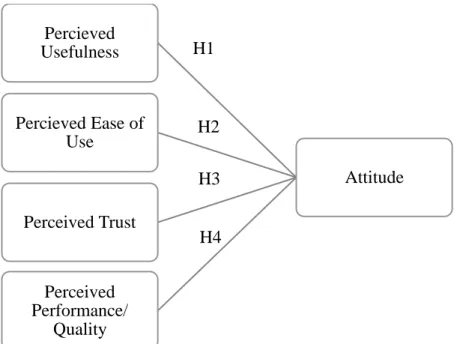
2.7 Proposed Research Framework
Figure 2.3: Proposed Conceptual Framework
Source: Develop for the research
2.8 Hypothesis of the Study
Hypothesis 1: Perceived Usefulness and Consumer Attitude
(Alhashmi et al., 2019)had conducted a study that expand and analyses an adjusted TAM to explore the vital success elements for adopting the AI in the healthcare sector. Additionally, the study stated that perceived usefulness is the measurement of AI enhance a physician’s performance in the healthcare sector. In short, the study shown that perceived usefulness positively influences the attitude towards implementation of AI projects. Besides that, according to a study performed by (Raza et al., 2017), the study focusses on the factors that influence the purpose of individuals keep using mobile banking in Pakistan by applying the TAM. Additionally, the instrument used for this research in a survey questionnaire
Attitude Percieved
Usefulness
Percieved Ease of Use
Perceived Trust
Perceived Performance/
Quality
23
that certified by market professionals. The result proved that perceived usefulness has significant positive relationship against users’ attitude.
H1: There is a significant positive relationship between perceived usefulness and consumer attitude.
Hypothesis 2: Perceived Ease of Use and Consumer Attitude
(Bou-Ghanem, 2020) conducted a study where her main purpose is searching for appropriate journal including both hybrid and academic. Furthermore, the review articles emphasis on the AI such like its definition along with various building blocks. The result revealed that the greater the perceived ease of use of high technology innovation including AI, the higher positive attitude towards the action of selecting the innovation. Therefore, perceived ease of use has significant positively affect consumer attitude. Furthermore, another study carried out by (Belanche et al., 2019), the primary aim of the study corresponds to have a greater understanding towards robo-advisor which is an AI against financial technology (FinTech). Moreover, the survey consists of 765 of potential users from North American, British, and Portuguese. The results prove that perceived ease of use of the financial robo-advisors as AI perceived significantly effect on attitudes toward them.
H2: There is a significant positive relationship between perceived ease of use and consumer attitude.
Hypothesis 3: Perceived Trust and Consumer Attitude
(Vasiljeva et al., 2021)carried out a study about public and business attitudes regarding the AI along with the elements affect them. Additionally, the primary data were collected through public survey along with questionnaire and semi- structured interviews with the professionals in the AI industry. In short, the result showed that trust can positively influence the attitude towards AI, even it is not as high weight as cost effectiveness and relative advantage. Besides that, another
24
study performed by (Shahbandi et al., n.d.) to identify the relationship regarding customer satisfaction, attitude, and loyalty towards relation to the factor of customer trust. Additionally, the surver had collected 120 respondents which selected through simple random sampling method. A 5-point Likert scale has applied for the sake of collect information required. In sum, the result of the survey showed that customer trust has positively influence the customer attitude.
For example, the results from the study shown that the correlation coefficient between customer trust and customer attitude is 0.831 which proved it is a significant positive relationship.
H3: There is a significant positive relationship between perceived trust and consumer attitude.
Hypothesis 4: Perceived Performance/ Quality and Consumer Attitude
(Turab et al., 2018) had performed a study to investigate the effect of perceived quality towards consumer attitude within the food industry. Additionally, the study is in accordance with quantitative approach and the data was collected from consumers from the specific industry. The research’s result shown that there has a positive significant relationship against perceived quality and consumer attitude.
Hence, attitude against AI will influence by perceived quality. Furthermore, Al- (Al-Debei et al., 2015) had been performed a study about attitudes of consumers towards online shopping from the developing countries. As investigating attitudes of early adopters is significantly important as attitude can influence repurchase decisions. The results of the study shown that higher perceptions for the online shopping websites will enhance the positive and favourable attitudes. Therefore, customer attitudes may influence by perceived quality.
H4: There is a significant positive relationship between perceived performance/ quality and consumer attitude.
25
2.9 Summary
In short, the dependent variable and the independent factors have shaped this chapter. Additionally, a research framework that included 4 factors to identify the relationship between both independent variables along with dependent variables.
Moreover, Chapter 3 will provide a research approach.
26
CHAPTER 3: RESEARCH METHODOLOGY
3.1 Introduction
Research methods in large depth will be provided in this chapter. Additionally, it comprises the required information or data on the research approach used along with justification for its implementation. On top of that, participant selection, data collection, together with data analysis as the stages of study also provided in this chapter. Following by the researcher’s role in qualitative research that related to reflexivity will also be discussed. Lastly, the details of the qualitative research will be discussed.
3.2 Research Design
Research design is a blueprint or plan particularly invented for the sake of answer the research question as well as control the variance. The control of variance specifies the researcher shall contemplate factors may methodically contribute to the research results. Besides that, researchers also can provide the factors that confound the interpretation of the result, however that are not included in the research question (Dulock, 1993).
Not only that, but the design of a research may also be affected by the obtainable knowledge or details in the area that being researched (Dulock, 1993).
This study will implement the quantitative research, which according to (Creswell
& Creswell, 2017), it is a type of research which interpret a phenomenon through gathering data that analysed or examine through mathematically based approaches.
In addition to that, (Cohen et al., 2002) defined quantitative research as the social research which utilizes empirical methods as well as statements. Moreover, the empirical statements are stated in numerical terms.
27
Aside from that, it is significant to apply the appropriate data analysis tools and suitable research design along with data collection instruments (Sukamolson, 2007).
3.3 Data Collection Methods
Data collection methods have been vital as the information collected is applied and types of explanations it able to create are ascertain through the methodology along with analytical approach applied according to the researcher (S. Wright et al., 2016). The researcher shall comprehend the characteristics and limitations of the data (Rabianski, 2003).
3.3.1 Primary Data
According to (“The Dictionary of Real Estate Appraisal.,” 2002), primary data is the information or data which researchers gather first hand. For instance, specific data and supply as well as demand data that related or comparable to the topic which are obtained by the researchers oneself are qualified as primary data (McKinley, 2001).
Moreover, this study will collect primary data through survey questionnaire. 250 copies of survey questionnaire will be distributed to target respondents through Google Form online. Besides that, it is a self-completion data as an effective and productive method to collect data from a significant quantity of respondents.
Apart from that, according to (Wilson, 2014), the advantages of using questionnaire including able to acquire accurate data and information. It also can provide a cost effective and reliable means of collecting feedback. Lastly, (McClelland, 1994) claimed that a survey questionnaire able to deliver accurate and applicable data by thoughtful design.
28
3.4 Sampling Design
A sample design is the framework which perform the function of the basis for the selection of a survey sample. Besides that, it also will influence various essential aspects of a survey (Lavrakas, 2008).
3.4.1 Target Population
The characteristics of the target population or whichever subgroups shall be described or portrayed unquestionably. In practice, the target population of this research are the Malaysian online shopping application users particularly Shopee and Lazada users. Moreover, the age ranges are between 18 to 35. On top of that, the choice of characteristics relies on the literature and practices, along with the main goals of the study.
3.4.2 Sampling Location
This study will focus on every single state in Malaysia. By way of illustration, the state in Malaysia recorded are 13 states and 3 federal territories.
3.4.3 Sampling Elements
Malaysian online shopping application consumers within the age 18-35 were the respondents chosen in this study. The reason for this is that the (Müller, 2020) had conducted a survey about the age group allocation of internet users in Malaysia throughout 2020. Moreover, the result shown that most of the users were in 20-30, which has approximately 46% of internet users. Besides that, the smallest group of respondents were users aged 60 and above.
29
3.4.4 Sampling Techniques
Sampling techniques may subdivide into two major categories: probability sampling and non-probability sampling (Barratt & Kirwan, 2009).
The non-probability sampling which applied within this research as it is a fast, effortless, and cost-efficient method to collect data. The reason for this is that is does not need a complete survey frame.
3.4.5 Sampling Size
The amount if respondents for this investigation is 250 respondents. Furthermore, (Roscoe, 1975) proposes few rules of thumb for the sake of define the sample size.
Additionally, the rules included that the sample sizes that are larger than 30 and less than 500 are suitable for majority of the research.
3.5 Research Instrument
Research instruments represent the measurement equipment’s that intend to collect data on a specific topic regarding to the research subjects and transforming it into valuable information. Besides that, there are number of applicable approaches to carry out the research. (Hinds, 2002).
A self-administered questionnaires that only closed-ended questions will be available in this research, as provided a list of possible options listed.
By way of illustration, the data being gathered by using an online-administered questionnaire. Additionally, Google Forms has been applied to distribute the online-administered questionnaire to target respondent. The reason of applying Google Forms is it allows researchers to gather information effortlessly and productively.
30
3.5.1 Questionnaire Design
The surveys in this study have been categorised into Section A and Section B.
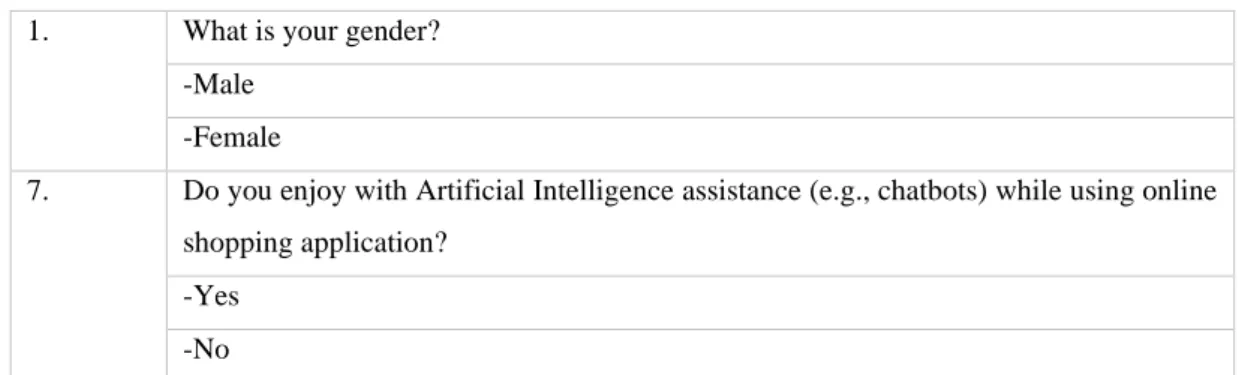
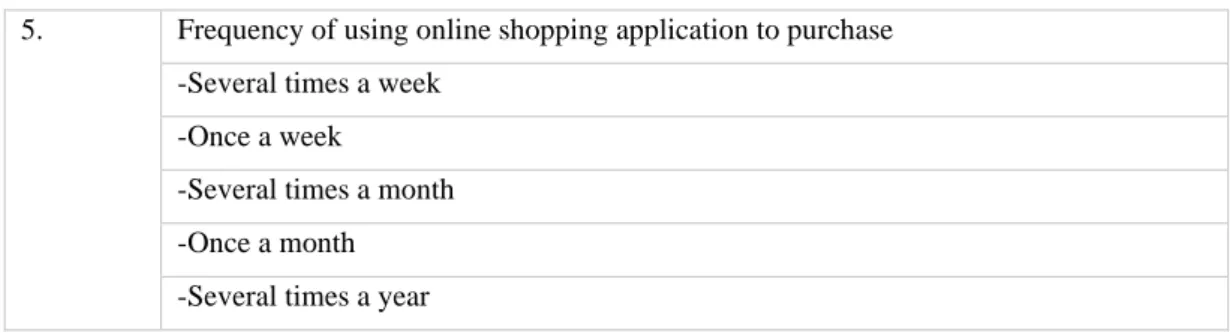
Additionally, Section A included demographic profile as the broad features regarding the groups of people and population. Section A of the survey questionnaire has 7 questions in total that ask for respondents’ gender, age group, highest degree or level of school had been completed, most used online shopping application. Besides that, Section A also consists of questions as the respondents’
frequency of using online shopping application to purchase, the amount spends on online shopping application monthly, and whether they enjoy with the AI assistance while using online shopping application.
Section B of the survey questionnaire is composed by 6 categories including both dependent and independent variables. Additionally, respondents were being required to answer their opinions or judgements toward one and all constructs.
Furthermore, table 3.5 shows the parts that form the constructions for Section B.
On top of that, respondents need to rate the degree for every single statement through a five-point Likert scale. The Likert scale gives 5 possible answers to a question which enables respondents to specify their positive-to-negative strength of agreement regarding the question.
Five-point Likert scale response framework [(1) = strongly disagree; (2) = disagree; (3) = neutral; (4) = agree and (5) = strongly agree].
3.5.2 Pilot Test
Pilot testing can be described as rehearsal of the study that enables researcher to test the research approach through a smaller amount of test participants.
Furthermore, according to (Polit & Beck, 2010), the main goal of conducting a pilot test is to prevent researcher from releasing a large-scale study without sufficient knowledge of methods proposed, instead of answer specific questions.
31
By conducting a pilot test, researcher able to make sure that the research carried out properly and go as planned from the study (M. Wright & So, 2022). Therefore, a pilot test is effective and important for this study.
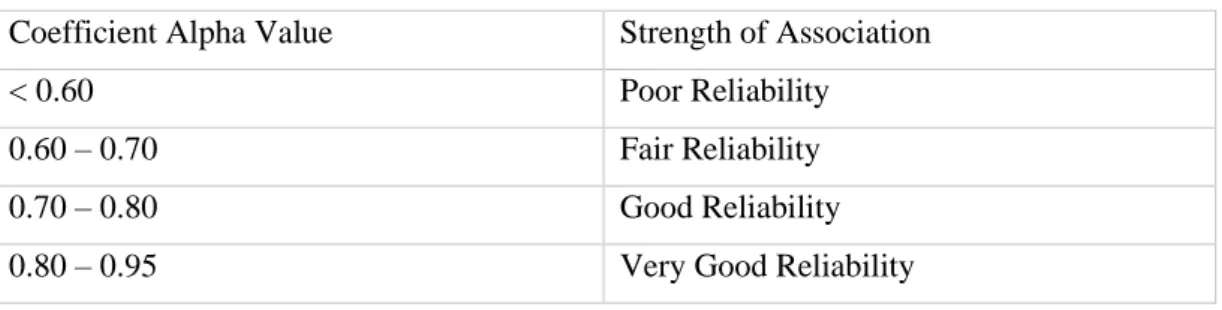
On top of that, this research has distributed the questionnaire to 30 target respondents for pilot testing. Besides that, the Cronbach’s Alpha had been utilized to investigate the internal reliability of pilot test and it had been categorized into 4 categories by (Zikmund et al., 2013)as shown in Table 3.1.
Table 3.1: Cronbach’s Alpha Range Coefficient Alpha Value Strength of Association
< 0.60 Poor Reliability
0.60 – 0.70 Fair Reliability
0.70 – 0.80 Good Reliability
0.80 – 0.95 Very Good Reliability
Source: Zikmund et al. (2013). Business research methods. Cengage Learning.
Furthermore, after respondents had completed the questionnaire, the reliability test had been tested through Statistical Package for the Social Science (SPSS) to investigate the reliability and validity.
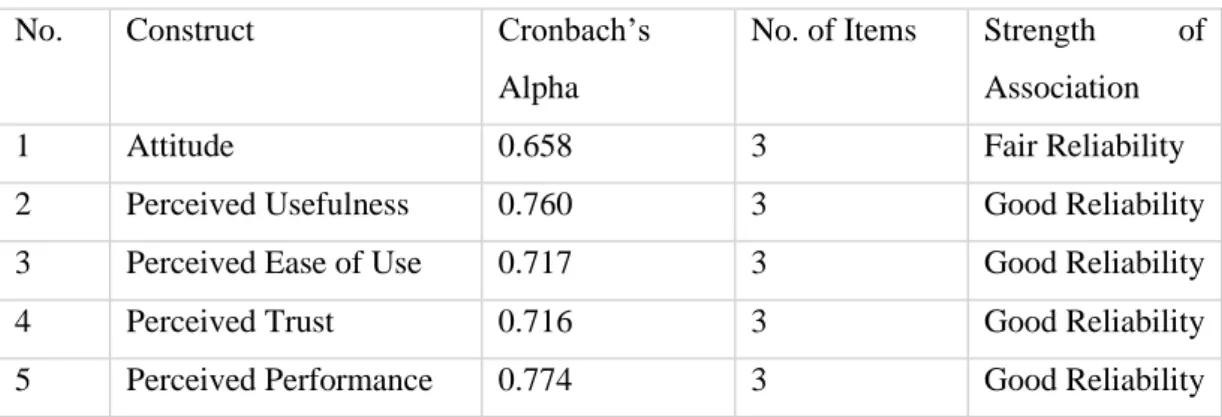
Table 3.2: Results of Pilot Test
No. Construct Cronbach’s
Alpha
No. of Items Strength of Association
1 Attitude 0.658 3 Fair Reliability
2 Perceived Usefulness 0.760 3 Good Reliability
3 Perceived Ease of Use 0.717 3 Good Reliability
4 Perceived Trust 0.716 3 Good Reliability
5 Perceived Performance 0.774 3 Good Reliability
Source: Develop for the research
32
According to Table 3.2, there are 4 constructs have good reliability as the value of Cronbach’s Alpha lies between 0.70 and 0.80. Besides that, there is one construct that has fair reliability.
3.6 Construct Measurement
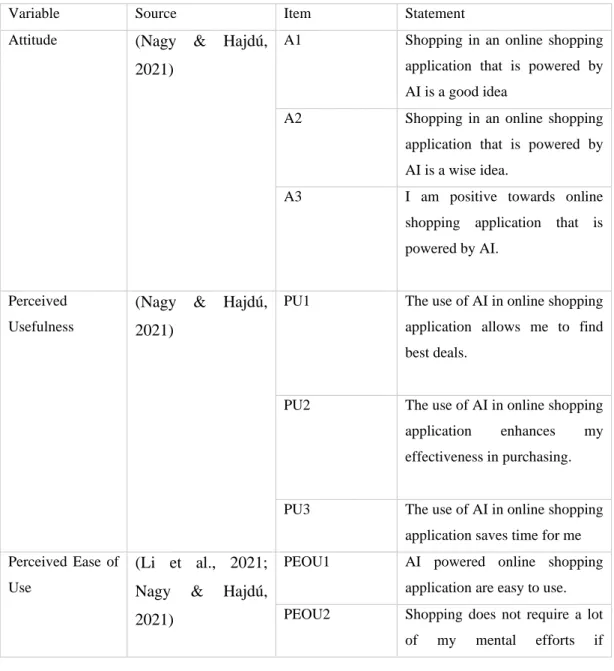
The 5 independent variables have been applied for the sake of design survey questionnaires regarding Malaysian consumers attitude to awards AI in online shopping application.
Table 3.3: Construct Measurement
Variable Source Item Statement
Attitude (Nagy & Hajdú, 2021)
A1 Shopping in an online shopping application that is powered by AI is a good idea
A2 Shopping in an online shopping application that is powered by AI is a wise idea.
A3 I am positive towards online shopping application that is powered by AI.
Perceived Usefulness
(Nagy & Hajdú, 2021)
PU1 The use of AI in online shopping application allows me to find best deals.
PU2 The use of AI in online shopping application enhances my effectiveness in purchasing.
PU3 The use of AI in online shopping application saves time for me Perceived Ease of
Use
(Li et al., 2021;
Nagy & Hajdú, 2021)
PEOU1 AI powered online shopping application are easy to use.
PEOU2 Shopping does not require a lot of my mental efforts if
33
supported by AI.
PEOU3 Shopping is not so complicated if AI offers products to me.
Perceived Trust (Li et al., 2021) PT1 I believe that the AI in-app customer support have sufficient expertise.
PT2 I believe that the AI promoters will put consumer’s interest first.
PT3 I believe that the AI will not harm my personal interests.
Behavioural Intention
(Gansser & Reich, 2021)
BI1 In the future, I intend to use online shopping application that contains AI.
BI2 In the future, I intend to use online shopping application containing AI on a regular basis.
BI3 I will recommend others to use online shopping application that contain AI.
Perceived Performance/
Quality
(Brill et al., 2019) PP1 Based on my experience with Artificial Intelligence, it increased my productivity during shopping.
PP2 Based on my experience with Artificial Intelligence, it improved my performance during shopping.
PP3 Based on my experience with my Artificial Intelligence, it is easier to find products I want.
Source: Develop for the research