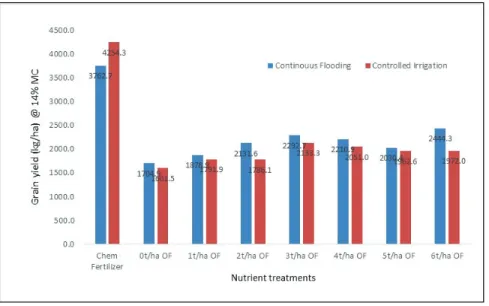
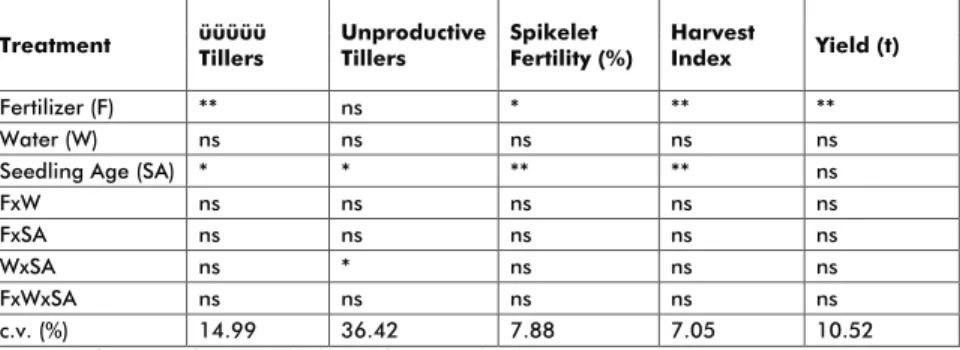
Optimizing Crop Establishment and Water Management Technologies for Organic Rice Production Systems of PhilRice Negros. The station's R&D efforts focused on providing science-based technologies for organic rice farming. In 2012, the average yield of organic rice at the station is 2.3 t/ha, 1 ton lower compared to conventional rice.
The increase in yield will increase the station's production and income as organic rice is sold commercially at PhP60/kg. One way to increase production is to optimize practices in the organic rice seed production system. The aim of the study is to optimize crop management technologies, especially seedling age and water management, for the PhilRice Negros organic rice seed production system.
Determining the optimal timing of GA3 application for increased seed yield of M20 in PhilRice Negros.
Performance evaluation of rice genotype under low- external input system
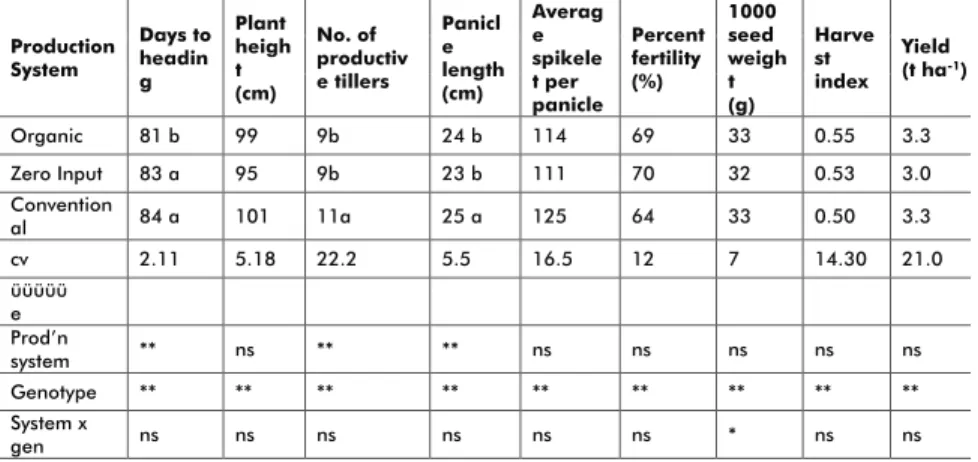
A total of 30 genotypes were planted in organic, zero and conventional production systems during the wet season of 2014 (Table 10). Early days to start were observed with the low-input or organic field, while no significant difference was observed between zero-input and conventional fields. Days to onset ranged from 73 to 89, 76 to 91, and 74 to 91 days after planting in organic, zero, and conventional fields, respectively.
Although it did not differ significantly between production systems, the average yield under conventional and organic conditions is relatively higher than zero input at 3.3 t/ha-1. NSIC Rc226 had the highest yield in the conventional system at 4.2 t/ha and performed well in organic and zero. input systems with 3.8t/ha.

The role of GxE in breeding for superior genotypes for low-external input system
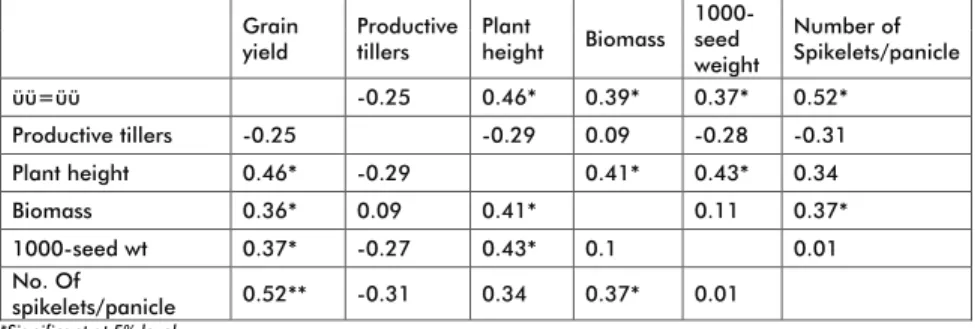
One public hybrid, 7 NSIC-released varieties, 1 specialty rice and 1 farmer's selection variety are top 10 yielders in organic systems with an average yield of 3.5 t/ha and above (Table 12). Moreover, grain yields less than zero and conventional systems are positively correlated with the yield in organic system with coefficients of 0.50 and 0.45 respectively. Other traits that respond in conventional systems with significant positive correlation with yield under organic systems are plant height, harvest index and seed weight.
The response of cultivars to the conventional rice production system is more likely to be different from their response to the organic rice system, apparently due to the difference in the level of inputs used. Thus, indirect selection of varieties with higher grain yield under conventional system intended for organic system may not be effective. The study aims to (a) examine the effect of genotype x environment (input) interaction on grain yield and other agronomic traits; b) identify genotypes generally and specifically adapted to systems with low external input.
Among others, phenotypic traits relevant to a system of low external inputs (organic farming), rice production and farmer preference traits such as grain yield and aboveground biomass were measured. The average grain yield at the three locations is 1,845 kg/ha, and the average biomass yield is 9,011 kg/ha. However, trait correlation analysis showed that biomass was positively related to yield; secondary/indirect selection is possible for this trait.
A farm walk was conducted to facilitate participatory variety selection where neighboring organic rice farmers were invited to select for their preferred rice genotypes/varieties. Some of the preferred varieties are also NSIC Rc224 and Masipag 10-1-1-1 which are believed to have been developed specifically for organic rice production. Participatory variety selection will enable breeders to identify traits preferred by organic rice farmers.
Upland Rice Development Program (URDP)
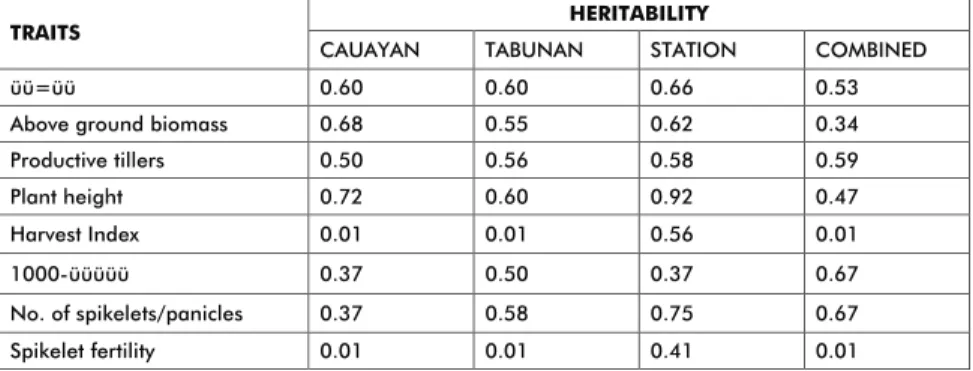
In the 2012 to 2013 crop year, a total of 5,280 kg of seeds of different traditional varieties were distributed to 445 farmers, for planting approximately 257 ha of upland rice, through Component 2 of URDP or the Rice Seeds Assistance of Traditional and Modern Upland. Rice varieties (Table 18). These were farmers who consistently planted upland rice and had significant agricultural land that could produce enough seeds for PhilRice's seed acquisition project or D-RFO 6. They came from Aklan, Capiz, Guimaras, and Iloilo and usually planted upland rice once a year. year.
They plant different traditional rice varieties, but a number of them planted Malido, Palawan and Azucena, which were also among the most preferred varieties in the region. Thirty-five farmers, one agricultural technologist and one local farmer technician participated in the URDP Farmer Field School. Three hundred and twenty-four upland rice farmers were identified who cultivated a validated upland rice area of 175.30 ha.
Two URDP sites were established in Region VII in collaboration with the Department of Agriculture Regional Field Office VII and the Agricultural Training Institute Regional Training Center VII. URDP Palayamanan model farms were established in Barangay Villa Teresita, Ubay, Bohol and Barangay Bulak, Dalaguete, Cebu (Table 21). The project has distributed a total of 12,660 kg of seeds in Hinobaan to Region VI and in the four provinces of Region VII (Table 22) through the Rice Assistance Component.
Three URDP cities were established covering the provinces of Northern Samar (Lope de Vega), Samar (Motiong) and Leyte (Ormoc). Component 3 of the program established three Palayamanan Model Farms (Table 25) where Farmer Field School and Participatory Technology Development (PTD) took place. Nevertheless, Brgy Getigo Upland Farmers Organization (Upland UFO) reestablished its crop and remained a supplier of this variety in the next season.
The Learning Center of PhilRice Negros
LEFT: dr. Teodoro Mendoz (Board Director) explains the benefits of optimal soil depth for rice production; RIGHT: Presentation of the mechanical transplanter, PhilRice Negros.
Integrated Rice-Based Agri-bio System (IRBAS)
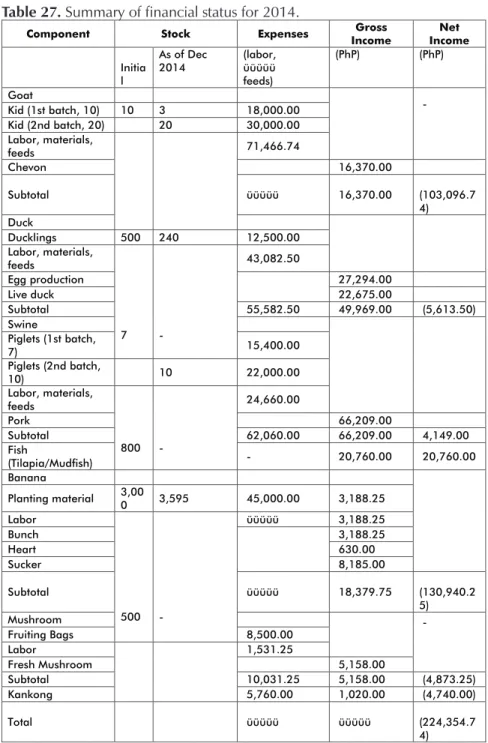
Banana production: The banana component of the farm is conceptualized to provide additional substrate for the vermicast production – biomass residues from the banana (dead stems, pips and leaves) will be collected and fed to vermi-worms for decomposition; and obtain additional income from the banana fruits and pistons. The initial stock (10,000 tissue cultured seedlings) was obtained from Davao City and was planted on both sides of the main roads. Due to inclement weather, 35% mortality was noted to account for the significant decrease in stock.
Significant increase in growth was recorded and more active goats were observed when transferred to the larger barn. Goats were fed leaves of paragrass, ipil-ipil, kakawate and other green biomass found within the station. Salt lek (molasses and salt mixture in a bamboo container) was also provided for the goats as supplements.
Tilapia Culture: In collaboration with the Bureau of Fisheries and Aquatic Resources (BFAR), the station purchased 5,000 tilapia and 25 bags of feed for tilapia production at the station. By November, another 1,000 breeding tilapia (Excel A & B) were purchased from the BFAR head office in Nueva Ecija and raised in different ponds at the station. Sorjan Technology: PhilRice Negros adapted and modified an indigenous Indonesian technology for the swamp environment called, “Sorjan”.
An area in the Palayamanan Model Farm was excavated to create a swampy ecosystem consisting of two raised beds/plots, separated and surrounded by perimeter channels. The canal served as a water source for the high-altitude kangkong, which is distributed using a 'rain boat' or a modified floating pump. The station demonstrated the technology as one of the components of an integrated rice farming system that can increase farmers' income and production per unit of land area.
PALAYABANGAN: The 10-5 Challenge
At the Palayabangan: The 10-5 Challenge in the 2014 wet season was participated by six competitive entries (5 conventional and 1 organic) from various individuals and private companies and six non-competitive entries (5 conventional and 1 organic) falling under the management of the PhilRice Negros Business Development Unit (BDU) (Table 31). The results show that the 10-5 standard is still not met given the conditions at the station. Two sets of two-day training courses were conducted on November 11 and 12 and 13 and 14 respectively for the seed production staff of the Business Development Division and the office staff of the Administration and Finance Division, as well as for the R&D Division to keep the staff informed on the PalayCheck system and with the latest rice technologies.
The first day of the training session was a full day lecture on the principles and key controls of PalayCheck, while the second day consisted of half a day of practical field activities and sharing of technology updates. In addition to the National Year of Rice 2013, the station joins the advocacy by giving importance to our country's staple crop through our new advocacy campaign, Be Riceponsible;. In light of our commitment to serve the Visayan farmers, the station has dispatched its R&D personnel to serve as resource persons in various meetings, seminars and trainings in rice as requested by our partner agencies.
Common concerns raised during the seminar/training courses such as: available seeds at the station; where to buy high quality seeds; clarification of some ideas and management practices addressed in the lecture were addressed accordingly. There were almost 200 visitors accommodated in the Station composed of farmers, students and other stakeholders. On July 31, 2014, PhilRice Negros in partnership with the Department of Health launched "Pinggang Pinoy" in accordance with National Nutrition Month and to promote better health while helping achieve rice self-sufficiency in the country.
In support of the advocacy, PhilRice Negros led the cooking competition at the Marañon Elementary School, followed by a food program for the elementary school students of this school. The event was a success, with 20 participants in the 16 km run and 34 participants in the 5 km run. IPDTK – insect pest diagnostic toolkit IPM – Integrated Pest Management IRRI – International Rice Research Institute IVC – in vitro culture.
VSU – Visayas State University WBPH – white-backed WEPP – water erosion prediction project WHC – water holding capacity WHO – World Health Organization WS – wet season. Summary of upland areas certified in the URDP Master List for Panay and Guimaras Islands, Region.