ELADJOE, KEVIN JOE P. APRIL 2011. Insects and Other Arthropods Associated with Cape Gooseberry (Physalis peruviana Linnaeus) in La Trinidad, Benguet. Benguet State University, La Trinidad, Benguet.
Adviser: Gemma S. Das-ilen, MSc.
ABSTRACT
The study was conducted at the Balili Entomology Experimental Area, Benguet State University from September 2010 to January 2011. It aimed to identify the insects and other arthropods found on Cape gooseberry plants, to evaluate the degree of injury or damage inflicted by the different insect species and other arthropods to the plant, to identify the major and minor pest of Cape gooseberry, to record the population of the insect and other arthropod species, to identify the growth stages of the Cape gooseberry where most insects and other arthropods most occur.
There were 30 organisms found on the Cape gooseberry plant during the study. It comprised of 24 insects and six other arthropods.
The chewing insects and other arthropods had a sound to slight (zero to 25%) injury on the plant during the seedling, vegetative, flowering and fruiting stages of the plant while the piercing-sucking insects and other arthropods had a sound (no injury) during the seedling stage, sound to slight (no injury to curling of distorted leaves) during the vegetative stage, slight to moderate (curling of distorted leaves to yellowing or stripling of leaves) injury on the flowering
of plants) injury on the fruiting stage of the plant.
All insect found on Cape gooseberry belong to the minor pest category, while Broad mites were classified as major pests.
The population of insects and other arthropods during the seedling stage was few, slightly abundant to abundant on the vegetative stage, and abundant to severely abundant on the flowering and fruiting stages of the plant.
The population of arthropods was most prominent was during the fruiting stages of the plant.
Page
Bibliography……….. i
Abstract ………. i
Table of Contents ……….. iii
INTRODUCTION ………... 1
REVIEW OF LITERATURE ………... 3
MATERIALS AND METHODS ………. 7
RESULTS AND DISCUSSION ………... 15
Identified Insects and Arthropods found on Cape gooseberry Plant ………. 15
Degree of Injury Inflicted by Insects and other Arthropods on Cape Gooseberry Plant ……….. 26
Major and Minor Pests of Cape Gooseberry………. 28
Population of Insects and other arthropods on the Seedling, Vegetative, Flowering, and Fruiting stages of the Plant ……… 29
Stage of the Plant where Most Insect and Other Arthropods Occur ………... 29
SUMMARY, CONCLUSION AND RECOMMENDATION ……… 31
Summary ………... 31
Conclusion………... 32
Recommendation……….. 33
LITERATURE CITED ………. 34
APPENDICES ……….. 35
INTRODUCTION
Cape gooseberry (Physalis peruviana Linnaeus) is a deciduous shrub which grows fast under optimum conditions to 3 feet tall and six feet wide. It is a relatively known plant under the family Solanaceae. Among its popular relatives which are being grown are the eggplants and tomatoes (Anonymous, 2010).
Here in the Philippines, Cape gooseberry is locally known as “lobo-lobohan”. It is widely distributed in the Cordillera Administrative Region (CAR) particularly in the Benguet province (Philippine Medicinal Plants, 2010).
It bears an edible fruit or berry that is bell-shaped having a soft, lustrous and orange-yellow exterior. Apart from being edible, the fruit also has many uses. Some are used in culinary purposes as in preparing sauces, puddings, ice creams, salads, cocktails and etc. Others are used as ornamentals and as an ingredient in making perfume (Morton and Russel, 1990).
The fruit also contains many nutrients and vitamins. Reports show that the bioflavonoids present in the fruit have an anti-inflamatory, anti-oxidant and anti-viral properties (Chittendon, 1992).
In our locality, Cape gooseberries are not highly commercialized or marketed.
Only few farmers grow the plant and most are only cultivated on the backyard of houses for family consumption. Hence, any records of insects associated with the plant have no proper documentation. Likewise, due to the increasing demand of the Cape gooseberry fruit, time will come when farmers will produce in a commercial scale (Das-ilen, 2010).
Since the Cape gooseberry belongs to the Solanaceous family, there are possibilities that it can harbor the insect pests of its distant relatives like the tomatoes and eggplants.
Thus, one must have knowledge on the insects and other arthropods associated with the crop in order to know the appropriate ways in controlling any potential pests that may infest the plant and in order to know the proper ways in propagating it to obtain optimum to maximum yield.
This study aimed to identify the insects and other arthropods found on Cape gooseberry plants, to evaluate the degree of injury or damage inflicted by the different insect species and other arthropods to the plant, to identify the major and minor pest of Cape gooseberry, to record the population of the insect and other arthropod species, and finally, to identify the growth stages of the Cape gooseberry where most insects and other arthropods most occur.
The study was conducted at the Balili Entomology Experimental Area, Benguet State University from September 2010 to January 2011.
REVIEW OF LITERATURE
History of Cape Gooseberry Cultivation
According to Morton (1987), the Cape gooseberry reportedly was native to Peru and Chile, where the fruits are casually eaten and occasionally sold in markets but the plant is still not an important crop, it has been widely introduced into cultivation in other tropical, subtropical and even temperate areas. It is said to succeed wherever tomatoes can be grown. The plant was grown by early settlers at the Cape of Good Hope before 1807. Soon after its adaption in the Cape of Good Hope it was carried to Australia and there acquired its common English name. It was spread all over Europe and was brought by the Spanish colonizers to the Philippines. It was naturalized on the islands of Luzon. The seeds were then taken to Hawaii before 1825 and the plant is naturalized on all the islands at medium and somewhat higher elevations.
Cape Gooseberry Characteristics
Cape gooseberry is a perennial herb about 5-2 m tall with purplish, ribbed and spreading branches. The leaf is pointed towards the tip but irregularly round at the basal end. Flower is yellow with five large dark-brown-purple spots. Fruit is orange-yellow and round that may be the basis for its local name “lobo-lobohan” (balloon like). The fruit which is technically called a berry has juicy pulp with very small seeds (PCCARD, 1992).
Uses of Cape Gooseberry
Cape gooseberries have many known uses. As a food, it can be consumed alone and it can be also used in preparing soups, ice creams, icings, sauces, wines, cocktails, jams, yogurts, juices, and others. Food artisans also use them as a decoration in gourmet foods to make it look more attractive. They add them in cakes and pastries as well as in salads. Certain food processing companies process them into frozen, pulped, and canned commodities (Morton and Russel, 1990).
In the science of medicine and Nutrition, Cape gooseberry is believed to have ailment curing properties. In Colombia, the leaves are boiled into a decoction which is believed to be diuretic and antiasthmatic. In South Africa, the leaves are heated and applied as poultices on inflammations. The people of the Zulu tribe believe that infusion made with the leaves relieve abdominal ailments in children. The fruit contains antioxidants such as vitamin C as well as carotenoids and bioflavonoids, all of which promote good health. Including the fruit as a part of our daily diet helps us to maintain our heart, our vision, our immune system, and lowers the risk of cancers, malaria, asthma, hepatitis, dermatitis and rheumatism. Though there were reports in Australia that the unripe fruit are poisonous and is believed to have caused illness and deaths to cattle (Ozweightloss, 2010).
Propagation of Cape Gooseberry
The plant is often propagated from seeds. However, germination is slow and irregular. If early flowering is preferred, propagate by using mature stem cutting treated with rooting hormone. The seeds are planted in raised seedbeds, manured well in advance. The seeds are dibbled in rows; 10-15 cm apart and four to six seeds for every 10
cm. The seeds are covered with a thin layer of soil and water lightly. It is provided with shade and mulch. Thin out weak seedlings and transplant after six to eight weeks. Plant the seedling at desired spacing which ranges from 0.9 m x .45 to 1.8 m to 0.9 m. Widely spaced plants produce bigger fruits while closely spaced plants bear smaller and more numerous fruits. Fertilizers are applied at the rate of 50-100 g per plant with 5-13-5 NPK at planting. Manure may also be applied. After planting, the soil must be cultivated taking care not to damage the roots. Weeds must be controlled to prevent the fruit from touching the ground. Water the plants during the dry season. After fruiting, plants may be made to produce new shoots by severe pruning but yields from these shoots are very low. It is therefore not economically advised to do this. It is much better to plant again in new area (UPLB, 1992).
Diseases and Pests of Cape Gooseberry
Gooseberry shrubs are host plants for white pine blister rust fungus, a disease harmful to pine trees. Thus, they should not be planted close to white pines (Jacobs, 1996).
In South Africa, the most troublesome diseases are powdery mildew and soft brown scale. The plants are prone to root rots and viruses if on poorly-drained soil or if carried over to a second year. Bacterial leaf spot occurs in Queensland. A strain of tobacco mosaic virus affects plants in India (Morton, 1987).
Cape gooseberries have wide range of insect pests. In South Africa the Cape gooseberries were attacked by cutworms, red spider, potato tuber moth, flea beetle and whiteflies. It was also noted that the plants are attacked by stem borer, leaf borer, fruit worm, and stripped cucumber beetle. In Peru, Broad mites, feed on the stem by sucking
the sap from the wound. This causes stunted growth, discolored leaves and deformed young foliage. Solanaceous treehopper, thrips and various beetles also affect the Cape gooseberry plants (Morton, 1987).
In the Benguet province, according to Das-ilen in 2010, due to the fact that the Cape gooseberry belongs to the family Solanaceae, the Cape gooseberry could harbor insect pests of its distant relatives such as the tomatoes and the eggplants. Some known pests of the tomatoes and eggplants which can become potential pests of the Cape gooseberry include the 28-spotted beetles, aphids, fruit worm, and whiteflies (Morton, 1987).
Yield of Cape Gooseberry
According to Ligat Sr. (2010), a grower of Cape gooseberry, the yield of Cape gooseberry in La Trinidad, Benguet is very good. The conditions present in the locality are favorable to the plant. These circumstances enable the plant to provide optimum to maximum yield. With its growing potential in the market, it is seen to provide more profit to the farmers.
METHODOLOGY
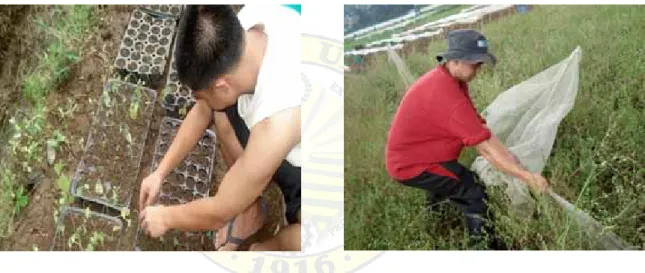
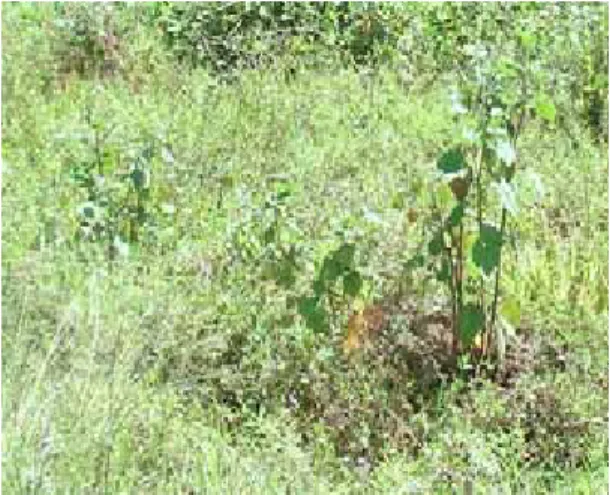
The materials used in this study were seedlings of Cape Gooseberry, small pricking pots, plastic watering can, chicken manure fertilizers, nylon ropes, tape measure, stereo zome microscope, holing device, entomology books and compendiums, digital camera, and other recording materials. The area before and after planting is shown in Figures 1 and 2.
Preparation of Materials
The seedlings were first planted into small plastic pots with a diameter of 15-20 cm for 6-8 weeks (Figure 3). The seedlings were allowed to establish and were maintained in a cool dry place for at least one month to provide suitable conditions for the development of the seedlings. Meanwhile, an area of 400 sq. meters of untilled plots where the matured seedlings were transplanted was prepared in advance as shown in Figure 3. Holes with a depth of about 40 cm were dug at the center of the plot using a holing device and were assured to have a one meter distance from on hole to another (Figure 5 and 6) by using a tape measure. Nylon ropes was also used as a guide to align the holes into straight lines and the dug soil was placed just beside the hole for this method employs the organic way of planting wherein minimum tillage is applied as shown in Figures 7 and 8.
Planting of the Seedlings
The matured seedling was transplanted in plots measuring 1 m by 10 m (Figures 8 to 11). The distance of one seedling from one another was 100 cm in between holes and 200 cm between hills or just every other plot. The plant was provided with 200 g of
Figure 1. The study area before planting Figure 2. The study area after planting
Figure 3. Pricking of seedlings Figure 4. Removal of obstruction in the planting area
Figure 5. Digging of holes with the use of Figure 6. The dug soil beside the hole holing device
Figure 7. Measuring one meter distance Figure 8. Pouring of approximately 200 g from one hole to another with of vermicompost in the hole the use of tape measure before planting
compost (firmed) and was watered after transplanting as shown in Figure 12. It was fertilized with fermented chicken manure two months from transplanting (Figure 13).
Observation of the Cape Gooseberry Plant
The plants were visually observation and scouted two weeks after planting and it was done once a week. Every insect and other arthropods spotted on the plant were observed and photo documented together with its injury on the plant if present (Figure 14).
Identification of Insects and other Arthropods
One sample from each of the arthropods scouted within the plant was collected.
Collected arthropods were brought to the laboratory for proper identification and were classified according to their mouthparts as either chewing or piercing-sucking and whether they are pest, beneficial and visitors. The observed benefits or damage of the arthropods to the plant were also enumerated.
Population of Insects and other Arthropods
The population of the insects and other arthropods was observed through visual estimates. The evaluation of arthropod population took place before the onset of the vegetative, flowering, and fruiting stages of the plant. The criteria followed in visually estimating the arthropod populations on the plants as prepared by the researcher were as follows:
Figure 9. The uprooted cape gooseberry Figure 10. The vermicompostt soil firmed seedling ready for planting by pressing
Figure 11. The newly planted cape Figure 12. Watering of the newly planted Gooseberry cape gooseberry.
Figure 13. Preparation of fermented Figure 14. Observation and chicken manure used in photodocumentation of watering the plants arthropods and its injury
Scale Index Description
1 Absent 0 population per plant 3 Few 1 – 10 population per plant 5 Slightly abundant 11 – 20 population per plant 7 Abundant 21 – 30 population per plant 9 Severely abundant 31 – onwards population per plant
Identifying the Growth Stage of the Cape Gooseberry where most Arthropods Occur
The stages of the plant development (as whether seedling, vegetative, flowering, and fruiting) wherein the visually estimated population of insects and other arthropods has the highest were identified as the stage where insects most occur.
Evaluation of the Degree of Injury Inflicted by the Species of Insects and other Arthropods
The degree of injury inflicted by the insects and other arthropods to the plant and fruit was evaluated based on the damage done by the chewing or piercing-sucking insects. The arthropods that were categorized as chewing were the arthropods that were seen directly feeding on plant parts by nibbling or chewing and the arthropods that were categorized as piercing-sucking were the arthropods that were observed sucking the plant parts for their subsistence.
The amount of plant part damaged by the chewing insects was rated by percentage through visual estimates following the rating scales below:
Scale Index Description 1 Sound No injury
3 Slight 1-25% injury on plants 5 Moderate 26-50% injury on plants 7 Slightly severe 51-75% injury on plants 9 Severe 76-100% injury on plants
The degree of injury inflicted by the piercing-sucking arthropods were rated by visual estimates following the rating scales below:
Scale Index Description 1 Sound No injury
3 Slight Curling of distorted leaves 5 Moderate Yellowing or stripling of leaves 7 Slightly severe Stunted growth of plants 9 Severe Wilting of plants
Identification of the Major and Minor Pest of Cape Gooseberry
Chewing insects which inflicted a degree of injury from 1-50% were considered as minor pests and those had an injury from 51-100% were considered as major pests.
Piercing-sucking insects which inflicted sound, slight, and moderate damage to the plant were considered as minor pests. Those which inflicted slightly severe and severe damage to the plant were considered as major pests.
Data Gathered
1. Insect species. This was the classification of the insects and other arthropods that fed on the Cape gooseberry plant.
2. Degree of injury. This was the amount of plant parts eaten by the arthropods based on the percentage scale.
3. Major and minor pest. This were the insects which either had minimal or severe damage to the plant.
4. Insect population. This were the number of each of the insect species encountered during the period of the study.
5. Growth stages of the cape gooseberry where insects and other arthropods most occur. This was the developmental stage of the plant when most arthropods were present.
RESULTS AND DISCUSSION
Identified Insects and Arthropods found on Cape gooseberry Plant
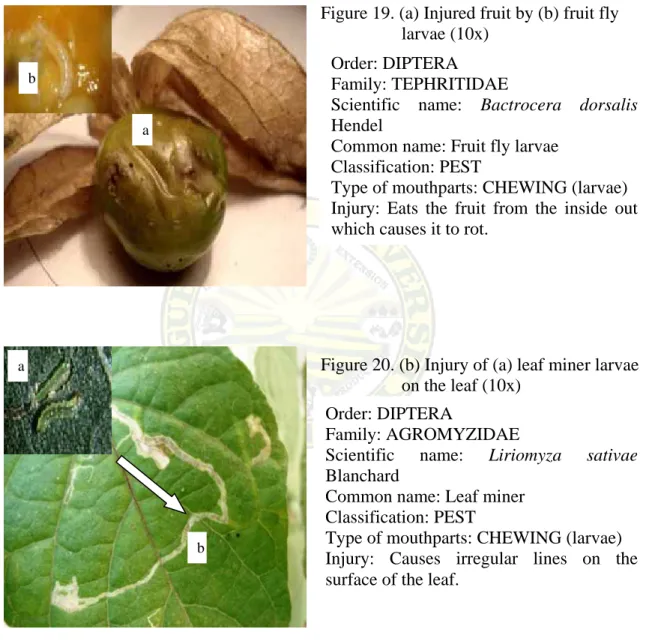
There were 30 organisms found on the Cape gooseberry plant during the study. It comprised of 24 insects and six other arthropods. The Chewing insects and other arthropods were Elm leaf beetle (Figure 15), Chrysomelid beetle (Figure 16), Earwigs (Figure 17), Fruit worm (Figure 18), Fruit fly larvae (Figure 19), Leaf miner (Figure 20), and earthworm (Figure 21). The piercing-sucking insects and other arthropods were Aphids (Figures 22 and 23), Whitefly (Figure 24), Thrips (Figure 25), Leaf hopper (Figure 26), Leaf footed bug (Figure 27), and Broad mite (Figure 28). The beneficial insects and other arthropods were Soldier bug (Figure 29), Spined soldier bug (Figure 30), Coccinellid beetles (Figures 31 and 32), Spider ant (Figure 33), and Spiders (Figures 34, 35 and 36). The visitors were Grasshopper (Figure 37), Katydid (Figure 38), Long- horned grasshopper (Figure 39), Fruit fly (Figure 40), Sepsid fly (Figure 41), Midges (Figure 42), Cranefly (Figure 43), and Hover fly (Figure 44).
Figure 15. (a) Leaf injured by adult (b) elm leaf beetle (8x)
Order: COLEOPTERA Family: CHRYSOMELIDAE
Scientific name: Poneridia australis Linnaeus Common name: Elm leaf beetle
Classification: PEST
Type of Mouthparts: CHEWING
b
Figure 16. (c) Injured leaf by (a and b) adult chrysomelid beetles (10x)
Figure 17. (a) Injured fruit by adult (b)earwigs (10x)
Figure 18. (a) Injured fruit by (b) fruit worm larvae (10x)
Order: COLEOPTERA Family: CHRYSOMELIDAE
Scientific name: Monolepta australis Linnaeus
Common name: Chrysomelid beetle Classification: PEST
Type of Mouthparts: CHEWING
Injury: The (a) orange and (b) red Chrysomelid beetles create irregular holes on the leaf.
Order: DERMAPTERA Family: LABIDURIDAE
Scientific name: Anisolabis maritime Bonelli
Common name: Earwigs Classification: PEST
Type of mouthparts: CHEWING
Injury: Nymph and adult nibbles on thefruit causing fruit injury.
Order: LEPIDOPTERA Family: NOCTUIDAE
Scientific name: Heliothis zea Linnaeus Common name: Fruit worm larvae Classification: PEST
a b
b
a c
b
Figure 19. (a) Injured fruit by (b) fruit fly larvae (10x)
Figure 20. (b) Injury of (a) leaf miner larvae
on the leaf (10x) Order: DIPTERA
Family: TEPHRITIDAE
Scientific name: Bactrocera dorsalis Hendel
Common name: Fruit fly larvae Classification: PEST
Type of mouthparts: CHEWING (larvae) Injury: Eats the fruit from the inside out which causes it to rot.
a
Order: DIPTERA
Family: AGROMYZIDAE
Scientific name: Liriomyza sativae Blanchard
Common name: Leaf miner Classification: PEST
Type of mouthparts: CHEWING (larvae) Injury: Causes irregular lines on the surface of the leaf.
a
a
b b
a
F O F S C C T S I n m
igure 22. (a) (b) Order: HEM Family: APH Scientific na Common nam Classificatio Type of mou SUCKING Injury: Suck not put much makes the fru
) Injury on th ) aphid (10x) MIPTERA
HIDIDAE ame: Myzus c
me: Aphid n: PEST uthparts: PIE ks the fruit h injury in th
uit filthy.
a
he fruit by a )
cerasi Linna
ERCING- juices but i he plant. Ins
b Figur
dult
Figur Ord Fam Scie Com Clas Typ Inju verm
aeus
it does stead, it
Orde Fami Scien Linn Com Class Type SUC Injur the p on fr
re 21. (a) Inj (10x)
re 23. Adult er: HAPLOT mily: LUMBR entific name:
mmon name:
ssification: P e of mouthp ury: Burrows micompost fe
er: HEMIPT ily: APHIDI ntific name naeus
mmon name:
sification: P e of m CKING
ry: Sucks th plant was ab ruits and leav
jury of (b) g )
t aphid on fru TAXIDA RICIDAE : Lumbricus
Earthworm PEST parts: CHEW
s and feeds o fertilizer.
ERA IDAE e: Acyrthos
Aphid EST mouthparts:
he sap of th ble to tolerat
ves.
giant earthwo
uit (10x) sp.
m WING
on the
siphon pisu
PIERCIN he plant whi te and is fou
orm
um
NG- ich und
a
F
O F S C C T S I
b th
igure 25. (a) lea Order: THYS Family: THR Scientific nam Common nam Classification Type of SUCKING
njury: Adult he leaves ca
) Injury of ad aves (10x) SANOPTER RIPIDAE
me: Thrips t me: Thrips
n: PEST mouthpart ts and nymp ausing it to cu
dult (b) thrip RA
tabaci Linde
ts: PIERC ph suck the
url.
a
b Figu
ps on
Figur Ord Fam Scie vapo Com Clas Typ SUC Inju whic foun
eman
CING- sap of
Orde Fam Scien Com Clas Type SUC Injur inflic leave
ure 24. (a) In on lea
re 26. Adult (10x) er: HEMIPT mily: ALEYR entific name:
orariorum L mmon name:
ssification: P e of mouthp CKING ury: Adults su
ch turns the nd on the und
er: HEMIPT mily: CICADE
ntific name:
mmon name:
sification: P e of mouthpa CKING
ry: Sucks the cts less dama es.
njury of adult aves (10x)
t leafhopper TERA RODIDAE
: Trialeurod Linnaeus
White fly PEST parts: PIERC
uck the sap o leaves to ye derside of le
TERA ELLIDAE
Cofania sp.
Leaf hopper PEST
arts: PIERCI e sap of the p
age. They ar
t (b) whitefl
on the leave des
CING- of the plant
llow. They a eaves.
Linnaeus r
ING- plant but re found on t
ies
es are
the
a
F O F S la C C T S In to
Figure 28. (a ad Order: TROM Family: TAR Scientific n atus Linnaeu Common nam Classification Type of SUCKING
njury: Sucks o bronzing a
a) Injury on t dult of (b) br MBIDIFORM RSONEMIDA name: Polyp
us
me: Broad m n: PEST
mouthpart s the plant j and cause cu
the plant by road mite (2
MES AE
yphagotarson
mite
ts: PIERC juices which urling of leav
Figur
the 25x)
Figur Orde Fam Scien term Com Clas Type SUC Injur are f
Orde Fam Scie Clas Com Type Bene as ap nemus
CING- h lead ves.
re 27. Adult leaves
re 29. Adult (10x) er: HEMIPT mily: PENTA ntific name:
minalis Linna mmon name:
sification: P e of mouthpa CKING
ry: Sucks the found on the
er: HEMIPT mily: PENTA ntific name:
ssification: B mmon name:
e of mouthp efit: Sucks th phids, and la
t leaf footed s (10x)
of soldier bu TERA
ATOMIDAE Acanthocep aeus
Leaf footed PEST
arts: PIERCI e sap of the p
leaves.
TERA ATOMIDAE
Halyomorp BENEFICIA Soldier bug arts: PIERC he body flui arvae.
bug on the
ug on the lea phala
d bug ING- plant and
pha sp. Linn AL
g
ING-SUCK d of insects
aves
naeus
KING such
Figu
Figur
Figur Ord Fam Scie Linn Com Clas Typ SUC Ben such
Ord Fam Scie Linn Com Clas Typ Pred aphi
Orde Fam Scien Linn Com Clas Type Pred aphid
re 30. Adult leave
re 31. Adult
re 32. Adult er: HEMIPT mily: PENTA entific name:
naeus mmon name:
ssification: B e of CKING nefit: Sucks
h as aphids, a
er: COLEOP mily: COCCI
entific name naeus mmon name:
ssification: B e of mouthp dation: Larv
ids, mites, an
er: COLEOP mily: COCCIN
ntific nam naeus mmon name:
sification: B e of mouthpa dation: Larv
ds, mites, an
t of spined so s (12x)
t of coccinell
of coccinell TERA ATOMIDAE
: Podisus m Spined sold BENEFICIA mouthparts:
the body and larvae.
PTERA INELLIDAE
: Coccinella Lady bird b BENEFICIA parts: CHEW vae and ad nd thrips for
PTERA NELLIDAE me: Harmon
Lady bird b BENEFICIAL
arts: CHEW vae and ad nd thrips for
oldier bug on
lid beetle (10
lid beetle (10 E
maculivertris dier bug AL
PIERCI fluid of in
E
a transversal beetle AL WING
dult hunt fo r prey.
E
nia axyrid eetle L WING
dult hunt fo prey.
n the
0x)
0x) ING-
sects
lis
for
dis
for
b a
Figur
Figur
Figur Orde Fami Scien Linn Com Class Type Pred prey
Orde Fam Scie Com Clas Type Pred captu
Orde Fam Scie Com Clas Type Pred such
re 33. (a) Ad (b) mi
re 34. Adult
re 35. Adult er: ARANEA
ily: SALTIC ntific name naeus mmon name:
sification: B e of mouthpa dation: Hunt such as mid
er: ARANEA mily: ARANE
ntific name:
mmon name:
ssification: B e of mouthp dation: Suck
ured on its w
er: ARANEA mily: THERID ntific name:
mmon name:
ssification: B e of mouthp dation: Preda h as thrips an
dult spider an dges (10x)
t spider on th
t spider on th AE
CIDAE e: Myrmara
Spider ant BENEFICIAL
arts: CHEW ts small in dges.
AE EIDAE
unknown Spider BENEFICIA
arts: SUCKI ks soft bod web such as m
AE DIIDAE
unknown Spider BENEFICIA
arts: SUCKI ates on soft nd aphids.
nt feeding on
he plant (10x
he leaves (15 chne sp.
L ING nsects as
L ING
died insects midges.
AL ING
bodied insec n
x)
5x) s
ct
Figure 36. Adult spider on the leaves (15x)
Figure 37. Adult grasshopper resting on leaves (10x)
Figure 38. Adult katydid resting on the leaves (10x)
Order: ARANEAE Family: THERIDIIDAE Scientific name: unknown Common name: Spider Classification: BENEFICIAL Type of mouthparts: SUCKING
Predation: Predates on soft bodied insect such as thrips and aphids.
Order: ORTHOPTERA Family: ACRIDIDAE
Scientific name: Melanoplus differentialis Linnaeus
Common name: Grasshopper Classification: VISITOR
Type of mouthparts: CHEWING
Injury: No injury was found to be inflicted by the grasshopper. It was just resting. Although they are known as pests in other crops such as lettuce.
Order: ORTHOPTERA Family: TETTIGONIIDAE
Scientific name: Torbia viridissima Linnaeus
Common name: Grasshopper Classification: VISITOR
Type of mouthparts: CHEWING Injury: No injury was found to be inflicted by the insect. It was just resting. Although they are known as pests in other crops such as lettuce.
Figur
Figur
Figur Figur
Figur Figur Orde Fam Scie Linn Com Clas Type Injur inflic Alth crop
Ord Fam Scie Com Clas Typ Inju plan infe as p crop
Orde Fam Scien Linn Com Clas Type Injur on sapro
re 39. Adult restin
re 40. Adult (10x)
re 41. Adult plant re 30. Midge
re 31. Leaf m re 32. Crane er: ORTHOP mily: TETTIG ntific nam naeus mmon name:
ssification: V e of mouthp ry: No inj cted by the i hough they ar ps such as let
der: DIPTER mily: TEPHR
entific name mmon name:
ssification: V pe of mouthp ury: The adu
nt but there esting the fr
pest in mang ps.
er: DIPTERA mily: SEPSID
ntific nam naeus
mmon name:
sification: V e of mouthpa ry: No injur
the plant.
ophage.
t long-horned ng on the leav
t fruit fly res
t sepsid fly r (10x) es (12x).
miner (20x).
e fly (10x).
PTERA GONIIDAE me: Conoce
Grasshoppe VISITOR
arts: CHEW jury was f insect. It was re known as ttuce and bea
RA RITIDAE
: Tephritis sp : Fruit fly VISITOR parts: CHEW ults were see
was no sig ruit. Its larva
goes, bell pe
A DAE
me: Sepsis Sepsid fly VISITOR
arts: SPONG ry. Most are
Most are
d grasshoppe ves (10x)
ting on the p
esting on the ephalous s
er WING
found to b s just resting s pests in oth
ans.
sp. Linnaeus
WING (larva) n resting on gn of its lar
a is conside epper and ot
s cynipse
GING seen restin
known a er
plant
e sp.
be g.
her
) the rvae ered ther
a
g as
Figure 42. Adult midges resting on the leaves (10x)
Figure 43. Adult cranefly resting on the leaves (10x)
Figure 44. Adult of hover fly (10x) Order: DIPTERA
Family: CERAPTOPOGONIDAE
Scientific name: Culicoides impunctatus Linnaeus
Common name: Midges Classification: VISITOR
Type of mouthparts: PIERCING- SUCKING
Injury: No injury. Most are seen resting on the plant.
Order: DIPTERA Family: TIPULIDAE
Scientific name: Tipula sp. Linnaeus Common name: Crane fly
Classification: VISITOR Type of mouthparts: SNOUT
Injury: Most are seen resting on the plant. Adults barely feed.
Order: DIPTERA Family: SYRPHIDAE
Scientific name: Taxomerus geminates Linnaeus
Common name: Hover fly Classification: BENEFICIAL
Type of mouthparts: SPONGING (adult)
Injury: No injury inflicted on the plant.
Although, the larvae feed on insects such as aphids and thrips.
Degree of Injury Inflicted by Insects and other Arthropods on the Cape Gooseberry Plant
The chewing insects and other arthropods had a sound to slight (zero to 25%) injury on the plant during the seedling, vegetative, flowering and fruiting stages of the plant with a mean of one on the seedling stage, 1.36 on the vegetative stage, 1.53 on the flowering stage, and a mean of two during the fruiting stage. Thus, the plant was able to tolerate the injury made by the chewing arthropods during the seedling, vegetative, flowering, and fruiting stages of the plant. Furthermore, the injury inflicted by the chewing arthropods significantly increased from the seedling stage to the vegetative stage of the plant. However, the injury of the chewing arthropods remained the same during the vegetative and the flowering stage. As the plant matures to the fruiting stage, the degree of injury further increased as shown in Table 1. The most injurious chewing arthropod identified was the Fruit worm larvae as also mentioned by Morton in 1987.
The piercing-sucking insects and other arthropods scouted and observed on the Cape gooseberry plant inflicted a sound (no injury) during the seedling stage which has a mean of one. The piercing-sucking arthropods inflicted sound to slight (no injury to curling of distorted leaves) during the vegetative stage which had a mean of 2.21. During the flowering stage, the piercing-sucking insects inflicted slight to moderate (curling of distorted leaves to yellowing or stripling of leaves) injury on the plant with a mean of 3.85 and during the fruiting stage, the piercing-sucking insects inflicted a moderate to slightly severe (yellowing or stripling of leaves to stunted plant growth of plants) injury with a mean of 6.25 which affected the proper growth of the plant. Moreover, the degree of injury of the piercing-sucking insect significantly increased every time the plant
Table 1. The mean injury of chewing arthropods on the different growth stages of the cape gooseberry plants
PLANT SAMPLE
SEEDLING STAGE
VEGETATIVE STAGE
FLOWERING STAGE
FRUITINGSTAGE
1 1.00 1.57 2.00 2.50
2 1.00 1.57 2.00 2.50
3 1.00 1.00 1.00 2.25
4 1.00 1.57 1.50 1.75
5 1.00 1.29 1.50 2.25
6 1.00 1.29 2.00 2.00
7 1.00 1.00 1.50 1.75
8 1.00 1.57 1.50 2.00
9 1.00 1.29 1.00 2.00
10 1.00 1.29 1.50 1.75
11 1.00 1.57 1.00 2.00
12 1.00 1.00 2.00 2.25
13 1.00 1.86 1.00 1.50
14 1.00 1.00 1.50 1.75
15 1.00 1.00 1.50 1.50
16 1.00 1.57 1.50 2.50
17 1.00 1.86 1.50 1.75
18 1.00 1.29 2.00 2.00
19 1.00 1.29 1.50 1.75
20 1.00 1.29 1.50 2.25
MEAN 1.00c 1.36b 1.53b 2a
matures from the seedling up to the fruiting stages of the plant as presented on Table 2.
The most injurious was the Broad mite which resulted to the stunted growth of the plant, discolored leaves, and deformed young foliage as also mentioned by Morton (1987) in Peru.
Table 2. The mean injury of piercing-sucking arthropods on the different growth stages of cape gooseberry plants
PLANT SAMPLE
SEEDLING STAGE
FRUITING STAGE
FLOWERING STAGE
FRUITING STAGE
1 1.00 2.14 4.00 6.25 2 1.00 2.43 3.50 6.25 3 1.00 1.86 4.00 6.25 4 1.00 2.43 4.00 6.25 5 1.00 2.14 4.00 6.25 6 1.00 2.43 3.50 6.25 7 1.00 2.43 4.00 6.25 8 1.00 2.43 4.00 6.25 9 1.00 1.86 4.00 6.25 10 1.00 2.14 3.50 6.25 11 1.00 2.43 4.00 6.25 12 1.00 2.14 4.00 6.25 13 1.00 2.43 3.50 6.25 14 1.00 1.86 3.50 6.25 15 1.00 2.43 4.00 6.25 16 1.00 2.14 4.00 6.25 17 1.00 2.14 4.00 6.25 18 1.00 2.43 3.50 6.25 19 1.00 2.14 4.00 6.25 20 1.00 1.86 4.00 6.25
MEAN 1.00d 2.21c 3.85b 6.25a
Major and Minor Pests of Cape Gooseberry
The chewing arthropods had a mean of one, 1.36, 1.53, and two during the seedling up to the fruiting stages of the plant which inflicted a damage that is well below 50% (Table 2). Therefore, the chewing arthropods were categorized as minor pests of the Cape gooseberry plant.
The piercing-sucking arthropods had a mean of one during the seedling stage, 2.21 mean during the vegetative stage, 3.85 mean during flowering stage, and 6.25 during the fruiting stage of the plant (Table 2) which means that the piercing-sucking insects inflicted sound to slight injury to the plant. Therefore, the piercing-sucking arthropods
were categorized as minor pests. However, the damage inflicted by the Broad mite which caused stunting of the plant was clearly visible (Figure 27). Hence, it was classified as a major pest of the Cape gooseberry plant.
Population of Insects and other Arthropods on the Seedling, Vegetative, Flowering, and Fruiting Stages of the Plant
Total population of insects and other arthropods during the seedling stage was few (zero to 10) on the rating scale with a mean of 2.13. In the vegetative stage, there were slightly abundant to abundant (11 to 30) population of arthropods per plant with a mean of 5.32. In the flowering stages of the plant, there were abundant to severely abundant (21 to 31) population of arthropods per plant and during the fruiting stage of the plant, there were also an abundant to severely abundant population of arthropod per plant with a mean of 8.61. Moreover, the population of arthropods significantly increased every time the plant matures from the seedling up to the fruiting stages of the plant as presented on Table 3.
Stage of the Plant where Most Insect and Other Arthropods Occur
The stage of the plant wherein the population of arthropods was most prominent was during the fruiting stages of the plant which had a mean of 8.61. Meaning, there were abundant to severely abundant population of insects and other arthropods per plant compared to the flowering stage which had an abundant to severely abundant population of insects and other arthropods per plant with a mean of 8.25; and compared to the vegetative stage which had a slightly abundant to abundant population of insects and other arthropods per plant with a mean of 5.32; and to the seedling stage which have a
few population of insects and other arthropods per plant with a mean of one. Most species of insects and other arthropods which were observed previously on the seedling stage of the plant remained until the fruiting stages. As the plant continued to grow, the same species of arthropods found in the plant thrives. Some of the arthropods classified as visitors and pest such as the Earthworm (Figure 21), Crane fly (Figure 41), and Midges (Figure 42) were only present on the plant in one or two particular stages of the plant.
Table 3. Average population of arthropods during the seedling, vegetative, flowering and fruiting stages of cape gooseberry
PLANT SAMPLE
SEEDLING STAGE
VEGETATIVE STAGE
FLOWERING STAGE
FRUITING STAGE
1 2.00 5.29 8.00 8.50
2 2.00 5.86 8.00 8.50
3 2.50 5.57 8.50 8.75
4 2.00 5.57 8.50 8.50
5 1.50 5.29 8.00 9.00
6 2.50 5.29 8.50 8.75
7 2.00 5.00 8.50 8.25
8 2.00 4.71 8.50 8.75
9 2.50 5.57 8.00 8.75
10 2.00 5.86 8.00 8.50
11 2.50 5.29 8.50 8.75
12 2.00 5.57 8.00 8.50
13 2.50 5.57 8.00 8.75
14 1.50 5.29 8.00 8.50
15 2.50 5.29 8.50 8.50
16 1.50 4.71 8.50 8.75
17 2.50 5.29 8.50 8.50
18 2.50 5.29 8.00 8.75
19 1.50 5.00 8.50 8.50
20 2.50 5.00 8.00 8.50
MEAN 2.13d 5.32c 8.25b 8.61a
SUMMARY, CONCLUSION AND RECOMMENDATION
Summary
The study was conducted at the Balili Entomology Experimental Area, Benguet State University from September 2010 to January 2011. This study aimed to identify the insects and other arthropods found on Cape gooseberry plants, to evaluate the degree of injury or damage inflicted by the different insect species and other arthropods to the plant, to identify the major and minor pest of Cape gooseberry, to record the population of the insect and other arthropod species, and finally, to identify the growth stages of the Cape gooseberry where most insects and other arthropods most occur.
The Chewing insects and other arthropods were Elm leaf beetle, Chrysomelid beetle, Earwigs, Fruit worm larvae, Fruit fly larvae, Leaf miner, and earthworm. The piercing-sucking insects and other arthropods were Aphids, Whitefly, Thrips, Leaf hopper, Leaf footed bug, and Broad mite. The beneficial insects and other arthropods were Soldier bug, Spined soldier bug, Coccinellid beetles, Spider ant, and Spiders. The visitors were Grasshopper, Katydid, Long-horned grasshopper, Fruit fly, Sepsid fly, Midges, Crane fly, and Hover fly.
The chewing insects and other arthropods had a sound to slight (zero to 25%) injury on the plant during the seedling, vegetative, flowering and fruiting stages of the plant with a mean of one on the seedling stage, 1.36 mean on the vegetative stage, 1.53 mean on the flowering stage, and a mean of two during the fruiting stage while the piercing-sucking insects and other arthropods had a sound (no injury) during the seedling stage which has a mean of one, sound to slight (no injury to curling of distorted leaves) during the vegetative stage with a mean of 2.21, slight to moderate (curling of distorted
leaves to yellowing or stripling of leaves) injury on the flowering stage with a mean of 3.85, and a moderate to slightly severe (yellowing or stripling of leaves to stunted plant growth of plants) injury with a mean of 6.25 on the fruiting stage of the plant.
The identified chewing and piercing-sucking insects were categorized as minor pests of the Cape gooseberry plant. However, the damage inflicted by the Broad mite which caused stunting of the plant was clearly visible. Hence, it was classified as a major pest of the Cape gooseberry plant.
The population of insects and other arthropods during the seedling stage was few, slightly abundant to abundant on the vegetative stage, and abundant to severely abundant on the flowering and fruiting stages of the plant.
The stage of the plant wherein the population of arthropods was most prominent was during the fruiting stages of the plant which had a mean of 8.61. Compared to the flowering, vegetative, and seedling stages of the plant which had a mean of 8.25, 5.32, and 2.31, respectively.
Conclusion
In La Trinidad, Benguet, many injurious arthropods are associated with the Cape gooseberry (Physalis peruviana Linnaeus) plant. However, each also has coinciding natural enemies which keep their population in check. Furthermore, it harbored pests of its distant relatives in the Solanacea family like the tomatoes and potatoes. Harbored pests includes: Whiteflies, Thrips, Fruit worm larvae, and Chrysomelid beetles.
Recommendation
It is therefore recommended that the Cape gooseberry plant should be cultivated in distant places away from its relatives such as the tomato, potato, and eggplant to discourage the migration of pest to the Cape gooseberry plant to prevent infestation and damage.
LITERATURE CITED
ANONYMOUS. 2010. Retrieved August 09 , 2010 from http://www.herbs2000.com/herbs/herbs_cape_gooseberry.htm
CHITTENDON, F. 1992. RHS Dictionary of Plants plus Suppliment: Plants for a future Retrieved August 9, 2010 from http://www.pfaf.org/user/Plant-aspx?LatinName=
Physalis+peruviana
DAS-ILEN, G. S. 2010. Possible Insect Pest of Cape gooseberry in La Trinidad, Benguet.
(personal interview).
JACOBS, P. W. 1996. The World Book Encyclopedia. Chicago: World Book Inc. P. 271.
LIGAT, B. SR. 2010. Yield of Cape gooseberry in La Trinidad, Benguet. (personal interview).
MORTON, J. F. 1987. Fruits of Warm Climates. Winterville, USA: Creative Resources System Inc. Pp. 430-434.
MORTON, J. F. and O. S. RUSSEL. 1990. Cape Gooseberry: A fruit with Therapeutic Properties. Winterville, USA: Creative Resources System Inc. Pp. 261-266.
OZWEIGHTLOSS. 2010. The Cape gooseberry: A fruit with therapeutic properties.
Retrieved August 11, 2010 from http://ozweightloss.com/the-cape-gooseberry-a fruit-with-therapeutic-properties.html.
PCCARD. 1992. Edible Fruits and Nuts. Philippine Council for Agriculture, Forestry and Natural Resources Reserch nd Development. P. 2.
PHILIPPINE MEDICINAL PLANTS. 2010. Lobo-lobohan. Retrieved August 09, 2010 from http://www.stuartxchange.org/Lobo-lobohan.html
UPLB. 1992. Edible Fruits and Nuts. University of the Philippines Los Baños. P. 3.
APPENDICES
Appendix Table 1. Mean injury of chewing arthropods during the seedling stage of the cape gooseberry plant
PLANT SAMPLE
REP 1 REP 2 REP 3 REP 4 TOTAL MEAN
1 1.00 1.00 1.00 1.00 4.00 1.00 2 1.00 1.00 1.00 1.00 4.00 1.00 3 1.00 1.00 1.00 1.00 4.00 1.00 4 1.00 1.00 1.00 1.00 4.00 1.00 5 1.00 1.00 1.00 1.00 4.00 1.00 6 1.00 1.00 1.00 1.00 4.00 1.00 7 1.00 1.00 1.00 1.00 4.00 1.00 8 1.00 1.00 1.00 1.00 4.00 1.00 9 1.00 1.00 1.00 1.00 4.00 1.00 10 1.00 1.00 1.00 1.00 4.00 1.00 11 1.00 1.00 1.00 1.00 4.00 1.00 12 1.00 1.00 1.00 1.00 4.00 1.00 13 1.00 1.00 1.00 1.00 4.00 1.00 14 1.00 1.00 1.00 1.00 4.00 1.00 15 1.00 1.00 1.00 1.00 4.00 1.00 16 1.00 1.00 1.00 1.00 4.00 1.00 17 1.00 1.00 1.00 1.00 4.00 1.00 18 1.00 1.00 1.00 1.00 4.00 1.00 19 1.00 1.00 1.00 1.00 4.00 1.00 20 1.00 1.00 1.00 1.00 4.00 1.00 .
Appendix Table 2. Mean injury of chewing arthropods during the vegetative stage of the cape gooseberry plant
PLANT SAMPLE
REP 1
REP 2
REP 3
REP 4
REP 5
REP 6
REP 7
TOTAL MEAN 1 1.00 1.00 1.00 3.00 1.00 1.00 3.00 11.00 1.57 2 1.00 3.00 1.00 1.00 1.00 1.00 3.00 11.00 1.57 3 1.00 1.00 1.00 1.00 1.00 1.00 1.00 7.00 1.00 4 1.00 1.00 1.00 3.00 1.00 1.00 3.00 11.00 1.57 5 1.00 1.00 1.00 1.00 1.00 3.00 1.00 9.00 1.29 6 1.00 1.00 1.00 1.00 1.00 1.00 3.00 9.00 1.29 7 1.00 1.00 1.00 1.00 1.00 1.00 1.00 7.00 1.00 8 1.00 1.00 3.00 1.00 1.00 3.00 1.00 11.00 1.57 9 1.00 1.00 3.00 1.00 1.00 1.00 1.00 9.00 1.29 10 3.00 1.00 1.00 1.00 1.00 1.00 1.00 9.00 1.29 11 1.00 1.00 3.00 1.00 1.00 3.00 1.00 11.00 1.57 Appendix Table 2. Continued.
12 1.00 1.00 1.00 1.00 1.00 1.00 1.00 7.00 1.00 13 1.00 1.00 3.00 1.00 1.00 3.00 3.00 13.00 1.86 14 1.00 1.00 1.00 1.00 1.00 1.00 1.00 7.00 1.00 15 1.00 1.00 1.00 1.00 1.00 1.00 1.00 7.00 1.00 16 1.00 3.00 1.00 1.00 1.00 3.00 1.00 11.00 1.57
17 3.00 1.00 3.00 3.00 1.00 1.00 1.00 13.00 1.86 18 1.00 1.00 3.00 1.00 1.00 1.00 1.00 9.00 1.29 19 1.00 1.00 1.00 3.00 1.00 1.00 1.00 9.00 1.29 20 1.00 1.00 1.00 1.00 3.00 1.00 1.00 9.00 1.29
Appendix Table 3. Mean injury of chewing arthropods during the flowering stage of the cape gooseberry plant
PLANT SAMPLE
REP 1 REP 2 REP 3 REP 4 TOTAL MEAN 1 3.00 1.00 1.00 3.00 8.00 2.00 2 1.00 3.00 3.00 1.00 8.00 2.00 3 1.00 1.00 1.00 1.00 4.00 1.00 4 1.00 1.00 1.00 3.00 6.00 1.50 5 1.00 3.00 1.00 1.00 6.00 1.50 6 3.00 3.00 1.00 1.00 8.00 2.00 7 1.00 1.00 3.00 1.00 6.00 1.50 8 1.00 1.00 3.00 1.00 6.00 1.50 9 1.00 1.00 1.00 1.00 4.00 1.00 10 1.00 1.00 3.00 1.00 6.00 1.50 11 1.00 1.00 1.00 1.00 4.00 1.00 12 1.00 1.00 3.00 3.00 8.00 2.00 13 1.00 1.00 1.00 1.00 4.00 1.00 14 3.00 1.00 1.00 1.00 6.00 1.50 15 1.00 1.00 1.00 3.00 6.00 1.50 16 1.00 3.00 1.00 1.00 6.00 1.50 17 1.00 1.00 3.00 1.00 6.00 1.50 18 1.00 1.00 3.00 3.00 8.00 2.00 19 1.00 3.00 1.00 1.00 6.00 1.50 20 1.00 3.00 1.00 1.00 6.00 1.50
Appendix Table 4. Mean injury of chewing arthropods during the fruiting stage of the cape gooseberry plant
PLANT SAMPLE
REP 1
REP 2
REP 3
REP 4
REP 5
REP 6
REP 7
REP 8
TOTAL MEAN 1 1.00 1.00 3.00 3.00 3.00 3.00 3.00 3.00 20.00 2.50 2 3.00 1.00 3.00 1.00 3.00 3.00 3.00 3.00 20.00 2.50 3 1.00 1.00 1.00 3.00 3.00 3.00 3.00 3.00 18.00 2.25 4 1.00 1.00 1.00 3.00 1.00 3.00 3.00 1.00 14.00 2.75 5 1.00 3.00 1.00 3.00 3.00 1.00 3.00 3.00 18.00 2.25 6 3.00 1.00 1.00 3.00 1.00 3.00 1.00 3.00 16.00 2.00
7 1.00 1.00 1.00 1.00 3.00 1.00 3.00 3.00 14.00 1.75 8 1.00 1.00 1.00 3.00 3.00 3.00 3.00 1.00 16.00 2.00 9 1.00 1.00 3.00 3.00 1.00 3.00 1.00 3.00 16.00 2.00 10 1.00 1.00 1.00 3.00 3.00 1.00 1.00 3.00 14.00 1.75 11 3.00 1.00 1.00 1.00 3.00 3.00 1.00 3.00 16.00 2.00 12 3.00 1.00 3.00 3.00 3.00 1.00 3.00 1.00 18.00 2.25 13 1.00 3.00 1.00 1.00 1.00 3.00 1.00 1.00 12.00 1.50 14 1.00 1.00 1.00 1.00 3.00 3.00 1.00 3.00 14.00 1.75 15 1.00 1.00 3.00 1.00 1.00 1.00 1.00 3.00 12.00 1.50 16 3.00 3.00 1.00 3.00 3.00 3.00 3.00 1.00 20.00 2.50 17 1.00 3.00 1.00 1.00 1.00 3.00 1.00 3.00 14.00 1.75 18 1.00 1.00 1.00 3.00 3.00 3.00 3.00 1.00 16.00 2.00 19 3.00 1.00 1.00 1.00 3.00 1.00 1.00 3.00 14.00 1.75 20 3.00 1.00 1.00 3.00 3.00 3.00 3.00 1.00 18.00 2.25
Appendix Table 5. The mean injury of chewing arthropods on cape gooseberry plant PLANT
SAMPLE
SEEDLING STAGE
VEGETATIVE STAGE
FLOWERING STAGE
FRUITINGSTAGE
1 1 1.57 2 2.5
2 1 1.57 2 2.5
3 1 1 1 2.25
4 1 1.57 1.5 1.75
5 1 1.29 1.5 2.25
6 1 1.29 2 2
7 1 1 1.5 1.75
8 1 1.57 1.5 2
9 1 1.29 1 2
10 1 1.29 1.5 1.75
11 1 1.57 1 2
12 1 1 2 2.25
13 1 1.86 1 1.5
Appendix Table 5. Continued.
14 1 1 1.5 1.75
15 1 1 1.5 1.5
16 1 1.57 1.5 2.5
17 1 1.86 1.5 1.75
18 1 1.29 2 2
19 1 1.29 1.5 1.75
20 1 1.29 1.5 2.25
TOTAL 20 27.17 30.50 40 MEAN 1c 1.36b 1.53b 2a
SD 0 0.276 0.343 0.314
RANGE 1 1.36 ± 0.062 1.53 ± 0.077 2.00 ± 0.070
ANALYSIS OF VARIANCE
TREATMENTS COMPUTED T SEEDLING STAGE 0 ns
VEGETATIVE STAGE 10.757 * FLOWERING STAGE 24.997 * FRUITING STAGE 60. 503 * ns = not significant
* = significant
Appendix Table 6. Mean injury of piercing-sucking arthropods during the seedling stage of the cape gooseberry plant
PLANT SAMPLE
REP 1 REP 2 REP 3 REP 4 TOTAL MEAN
1 1.00 1.00 1.00 1.00 4.00 1.00 2 1.00 1.00 1.00 1.00 4.00 1.00 3 1.00 1.00 1.00 1.00 4.00 1.00 4 1.00 1.00 1.00 1.00 4.00 1.00 5 1.00 1.00 1.00 1.00 4.00 1.00 6 1.00 1.00 1.00 1.00 4.00 1.00 7 1.00 1.00 1.00 1.00 4.00 1.00 8 1.00 1.00 1.00 1.00 4.00 1.00 9 1.00 1.00 1.00 1.00 4.00 1.00 10 1.00 1.00 1.00 1.00 4.00 1.00 11 1.00 1.00 1.00 1.00 4.00 1.00 12 1.00 1.00 1.00 1.00 4.00 1.00 13 1.00 1.00 1.00 1.00 4.00 1.00 14 1.00 1.00 1.00 1.00 4.00 1.00 15 1.00 1.00 1.00 1.00 4.00 1.00 16 1.00 1.00 1.00 1.00 4.00 1.00 17 1.00 1.00 1.00 1.00 4.00 1.00 18 1.00 1.00 1.00 1.00 4.00 1.00 19 1.00 1.00 1.00 1.00 4.00 1.00 20 1.00 1.00 1.00 1.00 4.00 1.00
Appendix Table 7. Mean injury of piercing-sucking arthropods during the vegetative stage of the cape gooseberry plant
PLANT SAMPLE
REP 1
REP 2
REP 3
REP 4
REP 5
REP 6
REP 7
TOTAL MEAN 1 1.00 1.00 1.00 3.00 3.00 3.00 3.00 15.00 2.14 2 1.00 1.00 3.00 3.00 3.00 3.00 3.00 17.00 2.43 3 1.00 1.00 1.00 1.00 3.00 3.00 3.00 13.00 1.86 4 1.00 1.00 3.00 3.00 3.00 3.00 3.00 17.00 2.43 5 1.00 1.00 1.00 3.00 3.00 3.00 3.00 15.00 2.14
6 1.00 1.00 3.00 3.00 3.00 3.00 3.00 17.00 2.43 7 1.00 1.00 3.00 3.00 3.00 3.00 3.00 17.00 2.43 8 1.00 1.00 3.00 3.00 3.00 3.00 3.00 17.00 2.43 9 1.00 1.00 1.00 1.00 3.00 3.00 3.00 13.00 1.86 10 1.00 1.00 1.00 3.00 3.00 3.00 3.00 15.00 2.14 11 1.00 1.00 3.00 3.00 3.00 3.00 3.00 17.00 2.43 12 1.00 1.00 1.00 3.00 3.00 3.00 3.00 15.00 2.14 13 1.00 1.00 3.00 3.00 3.00 3.00 3.00 17.00 2.43 14 1.00 1.00 1.00 1.00 3.00 3.00 3.00 13.00 1.86 15 1.00 1.00 3.00 3.00 3.00 3.00 3.00 17.00 2.43 16 1.00 1.00 1.00 3.00 3.00 3.00 3.00 15.00 2.14 17 1.00 1.00 1.00 3.00 3.00 3.00 3.00 15.00 2.14 18 1.00 1.00 3.00 3.00 3.00 3.00 3.00 17.00 2.43 19 1.00 1.00 1.00 3.00 3.00 3.00 3.00 15.00 2.14 20 1.00 1.00 1.00 1.00 3.00 3.00 3.00 13.00 1.86
Appendix table 8. Mean injury of piercing-sucking arthropods during the flowering stage of the cape gooseberry plant
PLANT SAMPLE
REP 1 REP 2 REP 3 REP 4 TOTAL MEAN
1 3.00 3.00 5.00 5.00 16.00 4.00
2 3.00 3.00 3.00 5.00 14.00 3.50
3 3.00 3.00 5.00 5.00 16.00 4.00
4 3.00 3.00 5.00 5.00 16.00 4.00
5 3.00 3.00 5.00 5.00 16.00 4.00
6 3.00 3.00 3.00 5.00 14.00 3.50
7 3.00 3.00 5.00 5.00 16.00 4.00
8 3.00 3.00 5.00 5.00 16.00 4.00
9 3.00 3.00 5.00 5.00 16.00 4.00
10 3.00 3.00 3.00 5.00 14.00 3.50
11 3.00 3.00 5.00 5.00 16.00 4.00
12 3.00 3.00 5.00 5.00 16.00 4.00
13 3.00 3.00 3.00 5.00 14.00 3.50
Appendix Table 8. Continued.
14 3.00 3.00 3.00 5.00 14.00 3.50
15 3.00 3.00 5.00 5.00 16.00 4.00
16 3.00 3.00 5.00 5.00 16.00 4.00
17 3.00 3.00 5.00 5.00 16.00 4.00
18 3.00 3.00 3.00 5.00 14.00 3.50
19 3.00 3.00 5.00 5.00 16.00 4.00
20 3.00 3.00 5.00 5.00 16.00 4.00
Appendix Table 9. Mean injury of piercing-sucking arthropods during the fruiting stage of the cape gooseberry plant
PLANT SAMPLE
REP 1
REP 2
REP 3
REP 4
REP 5
REP 6
REP 7
REP 8
TOTAL MEAN 1 5.00 5.00 5.00 7.00 7.00 7.00 7.00 7.00 50.00 6.25 2 5.00 5.00 5.00 7.00 7.00 7.00 7.00 7.00 50.00 6.25 3 5.00 5.00 5.00 7.00 7.00 7.00 7.00 7.00 50.00 6.25 4 5.00 5.00 5.00 7.00 7.00 7.00 7.00 7.00 50.00 6.25 5 5.00 5.00 5.00 7.00 7.00 7.00 7.00 7.00 50.00 6.25 6 5.00 5.00 5.00 7.00 7.00 7.00 7.00 7.00 50.00 6.25 7 5.00 5.00 5.00 7.00 7.00 7.00 7.00 7.00 50.00 6.25 8 5.00 5.00 5.00 7.00 7.00 7.00 7.00 7.00 50.00 6.25 9 5.00 5.00 5.00 7.00 7.00 7.00 7.00 7.00 50.00 6.25 10 5.00 5.00 5.00 7.00 7.00 7.00 7.00 7.00 50.00 6.25 11 5.00 5.00 5.00 7.00 7.00 7.00 7.00 7.00 50.00 6.25 12 5.00 5.00 5.00 7.00 7.00 7.00 7.00 7.00 50.00 6.25 13 5.00 5.00 5.00 7.00 7.00 7.00 7.00 7.00 50.00 6.25 14 5.00 5.00 5.00 7.00 7.00 7.00 7.00 7.00 50.00 6.25 15 5.00 5.00 5.00 7.00 7.00 7.00 7.00 7.00 50.00 6.25 16 5.00 5.00 5.00 7.00 7.00 7.00 7.00 7.00 50.00 6.25 17 5.00 5.00 5.00 7.00 7.00 7.00 7.00 7.00 50.00 6.25 18 5.00 5.00 5.00 7.00 7.00 7.00 7.00 7.00 50.00 6.25 19 5.00 5.00 5.00 7.00 7.00 7.00 7.00 7.00 50.00 6.25 20 5.00 5.00 5.00 7.00 7.00 7.00 7.00 7.00 50.00 6.25
Appendix Table 10. The mean injury of piercing-sucking arthropod on cape gooseberry plant
PLANT SAMPLE
SEEDLING STAGE
FRUITING STAGE
FLOWERING STAGE
FRUITING STAGE
1 1.00 2.14 4.00 6.25 2 1.00 2.43 3.50 6.25 3 1.00 1.86 4.00 6.25 4 1.00 2.43 4.00 6.25 5 1.00 2.14 4.00 6.25
6 1.00 2.43 3.50 6.25 7 1.00 2.43 4.00 6.25 8 1.00 2.43 4.00 6.25 9 1.00 1.86 4.00 6.25 10 1.00 2.14 3.50 6.25 11 1.00 2.43 4.00 6.25 12 1.00 2.14 4.00 6.25 13 1.00 2.43 3.50 6.25 14 1.00 1.86 3.50 6.25 15 1.00 2.43 4.00 6.25 16 1.00 2.14 4.00 6.25 17 1.00 2.14 4.00 6.25 18 1.00 2.43 3.50 6.25 19 1.00 2.14 4.00 6.25 20 1.00 1.86 4.00 6.25
TOTAL 20 44.29 77 125
MEAN 1d 2.21c 3.85b 6.25a
SD 0 0.225 0.235 0
RANGE 1 2.21±0.050 3.85±0.053 6.25
ANALYSIS OF VARIANCE
TREATMENTS COMPUTED T SEEDLING STAGE 0 ns
VEGETATIVE STAGE 10.757 * FLOWERING STAGE 24.997 * FRUITING STAGE 60. 503 * ns = not significant
* = significant
Appendix Table 11. Average population of insect and other arthropods during the seedling stage of the cape gooseberry plant
PLANT SAMPLE
REP 1 REP 2 REP 3 REP 4 TOTAL MEAN 1 1.00 1.00 3.00 3.00 8.00 2.00 2 1.00 1.00 3.00 3.00 8.00 2.00
3 1.00 3.00 3.00 3.00 10.00 2.50
4 1.00 1.00 3.00 3.00 8.00 2.00 5 1.00 1.00 1.00 3.00 6.00 1.50
6 1.00 3.00 3.00 3.00 10.00 2.50 7 1.00 1.00 3.00 3.00 8.00 2.00 8 1.00 1.00 3.00 3.00 8.00 2.00
9 1.00 3.00 3.00 3.00 10.00 2.50
10 1.00 1.00 3.00 3.00 8.00 2.00
11 1.00 3.00 3.00 3.00 10.00 2.50
12 1.00 1.00 3.00 3.00 8.00 2.00
13 1.00 3.00 3.00 3.00 10.00 2.50
14 1.00 1.00 1.00 3.00 6.00 1.50
15 1.00 3.00 3.00 3.00 10.00 2.50
16 1.00 1.00 1.00 3.00 6.00 1.50
17 1.00 3.00 3.00 3.00 10.00 2.50
18 1.00 3.00 3.00 3.00 10.00 2.50
19 1.00 1.00 1.00 3.00 6.00 1.50
20 1.00 3.00 3.00 3.00 10.00 2.50
Appendix Table 12. Average population of insects and other arthropods during the vegetative stage of the cape gooseberry plant
PLANT SAMPLE
REP 1
REP 2
REP 3
REP 4
REP 5
REP 6
REP 7
TOTAL MEAN 1 3.00 5.00 5.00 5.00 5.00 7.00 7.00 37.00 5.29 2 5.00 3.00 5.00 7.00 7.00 7.00 7.00 41.00 5.86 3 3.00 5.00 5.00 5.00 7.00 7.00 7.00 39.00 5.57 4 5.00 5.00 5.00 5.00 7.00 5.00 7.00 39.00 5.57 5 3.00 3.00 5.00 7.00 5.00 7.00 7.00 37.00 5.29 6 3.00 5.00 5.00 5.00 7.00 5.00 7.00 37.00 5.29 7 3.00 3.00 5.00 5.00 7.00 5.00 7.00 35.00 5.00 8 3.00 3.00 5.00 5.00 5.00 5.00 7.00 33.00 4.71 9 5.00 5.00 3.00 7.00 5.00 7.00 7.00 39.00 5.57 10 3.00 5.00 5.00 7.00 7.00 7.00 7.00 41.00 5.86 11 5.00 5.00 5.00 5.00 5.00 5.00 7.00 37.00 5.29 12 5.00 5.00 5.00 5.00 5.00 7.00 7.00 39.00 5.57 13 5.00 5.00 5.00 5.00 7.00 5.00 7.00 39.00 5.57 14 3.00 3.00 5.00 7.00 5.00 7.00 7.00 37.00 5.29 Appendix Table 12. Continued.
15 3.00 3.00 5.00 5.00 7.00 7.00 7.00 39.00 5.29 16 3.00 3.00 5.00 5.00 5.00 5.00 7.00 35.00 4.71 17 3.00 3.00 5.00 7.00 5.00 7.00 7.00 39.00 5.29 18 3.00 3.00 5.00 5.00 7.00 7.00 7.00 39.00 5.29 19 3.00 3.00 5.00 5.00 5.00 7.00 7.00 37.00 5.00 20 3.00 3.00 5.00 5.00 5.00 7.00 7.00 37.00 5.00
Appendix Table 13. Average population of insects and other arthropods during the flowering stage of the cape gooseberry plant
PLANT SAMPLE
REP 1 REP 2 REP 3 REP 4 TOTAL MEAN
1 7.00 7.00 9.00 9.00 32.00 8.00
2 7.00 7.00 9.00 9.00 32.00 8.00
3 7.00 9.00 9.00 9.00 34.00 8.50
4 7.00 9.00 9.00 9.00 34.00 8.50
5 7.00 7.00 9.00 9.00 32.00 8.00
6 7.00 9.00 9.00 9.00 34.00 8.50
7 7.00 9.00 9.00 9.00 34.00 8.50
8 7.00 9.00 9.00 9.00 34.00 8.50
9 7.00 7.00 9.00 9.00 32.00 8.00
10 7.00 7.00 9.00 9.00 32.00 8.00
11 7.00 9.00 9.00 9.00 34.00 8.50
12 7.00 7.00 9.00 9.00 32.00 8.00
13 7.00 7.00 9.00 9.00 32.00 8.00
14 7.00 7.00 9.00 9.00 32.00 8.00
15 7.00 9.00 9.00 9.00 34.00 8.50
16 7.00 9.00 9.00 9.00 34.00 8.50
17 7.00 9.00 9.00 9.00 34.00 8.50
18 7.00 7.00 9.00 9.00 32.00 8.00
19 7.00 9.00 9.00 9.00 34.00 8.50
20 7.00 7.00 9.00 9.00 32.00 8.00
Appendix Table 14. Population of insects and other arthropods during the fruiting stage of the cape gooseberry plant
PLANT SAMPLE
REP 1
REP 2
REP 3
REP 4
REP 5
REP 6
REP 7
REP 8
TOTAL MEAN 1 9.00 9.00 9.00 9.00 9.00 7.00 9.00 7.00 68.00 8.50 2 9.00 9.00 9.00 9.00 9.00 9.00 7.00 7.00 68.00 8.50 3 9.00 9.00 9.00 9.00 9.00 7.00 9.00 9.00 70.00 8.75 4 9.00 9.00 9.00 9.00 7.00 9.00 7.00 9.00 78.00 8.50
5 9.00 9.00 9.00 9.00 9.00 9.00 9.00 9.00 72.00 9.00 6 9.00 9.00 9.00 9.00 7.00 9.00 9.00 9.00 70.00 8.75 7 9.00 9.00 9.00 9.00 7.00 9.00 7.00 7.00 66.00 8.25 8 9.00 9.00 9.00 9.00 9.00 7.00 9.00 9.00 70.00 8.75 9 9.00 9.00 9.00 9.00 9.00 9.00 7.00 9.00 70.00 8.75 10 9.00 9.00 9.00 9.00 9.00 9.00 7.00 7.00 68.00 8.50 11 9.00 9.00 9.00 9.00 9.00 7.00 9.00 9.00 70.00 8.75 12 9.00 9.00 9.00 9.00 7.00 7.00 9.00 9.00 68.00 8.50 13 9.00 9.00 9.00 9.00 9.00 9.00 7.00 9.00 70.00 8.75 14 9.00 9.00 9.00 9.00 9.00 7.00 9.00 7.00 70.00 8.50 15 9.00 9.00 9.00 9.00 7.00 7.00 9.00 9.00 68.00 8.50 16 9.00 9.00 9.00 9.00 7.00 9.00 9.00 9.00 70.00 8.75 17 9.00 9.00 9.00 9.00 9.00 7.00 9.00 7.00 68.00 8.50 18 9.00 9.00 9.00 9.00 7.00 9.00 9.00 9.00 70.00 8.75 19 9.00 9.00 9.00 9.00 9.00 9.00 7.00 7.00 68.00 8.50 20 9.00 9.00 9.00 9.00 7.00 9.00 9.00 7.00 68.00 8.50
Appendix Table 15. Average population of arthropods during the seedling, vegetative, flowering and fruiting stages of cape gooseberry
PLANT SAMPLE
SEEDLING STAGE
VEGETATIVE STAGE
FLOWERING STAGE
FRUITING STAGE
1 2.00 5.29 8.00 8.50
2 2.00 5.86 8.00 8.50
3 2.50 5.57 8.50 8.75
4 2.00 5.57 8.50 8.50
5 1.50 5.29 8.00 9.00
6 2.50 5.29 8.50 8.75
7 2.00 5.00 8.50 8.25
8 2.00 4.71 8.50 8.75
9 2.50 5.57 8.00 8.75
10 2.00 5.86 8.00 8.50
11 2.50 5.29 8.50 8.75
12 2.00 5.57 8.00 8.50
13 2.50 5.57 8.00 8.75
Appendix Table 15. Continued.
14 1.50 5.29 8.00 8.50
15 2.50 5.29 8.50 8.50
16 1.50 4.71 8.50 8.75
17 2.50 5.29 8.50 8.50
18 2.50 5.29 8.00 8.75
19 1.50 5.00 8.50 8.50
20 2.50 5.00 8.00 8.50
TOTAL 42.5 106.31 165 172.25
MEAN 2.13d 5.32c 8.25b 8.61a
SD 0.393 0.321 0.257 0.172 RANGE 2.13±0.088 5.32±0.072 8.25±0.057 8.61±0.038
ANALYSIS OF VARIANCE
FC Prob 2067.93* <0.01
*= significant