Risk communication in the early stage of the MERS outbreak in the Republic of Korea could have been improved. Before the government of the Republic of Korea released the names of the hospitals, 8 citizens turned to self-help solutions and created their own website to map confirmed and suspected cases of MERS in the Republic of Korea.9. We thank Christine Kim of the University of Georgia Master of Public Health Program and Juwon Park.
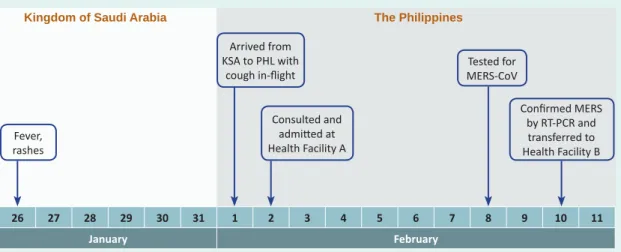
This is a report on the investigation of the outbreak of the first confirmed case of MERS in the Philippines and subsequent contact tracing activities. Category E, developed during this investigation, included patients in the adjacent room of health care facilities with a confirmed case, all health care workers from the facility where the case was located, and all other passengers on the flight. We report the investigation of the first confirmed case of MERS-CoV in the Philippines.
In July 2012, the Philippine Department of Health Regional Office for Region 4A reported a suspected chikungunya outbreak in San Pablo City, Laguna Province to the Philippine Event-Based Surveillance and Response Unit of the National Epidemiology Center. These were the first chikungunya cases reported by the city since the establishment of the disease surveillance system in 2007.
RESULTS
This was then compared to the goals of the Philippines National Dengue Prevention and Control Program of < 5% and 20% respectively.5 Entomologists on site determined mosquito larvae species. Human serum samples collected from both cases and controls were sent to the Research Institute of Tropical Medicine in Muntinlupa City, Philippines for laboratory confirmation of chikungunya IgM by enzyme-linked immunosorbent assay (ELISA) (NovaTec, Waldstrasse, Dietzenbach, Germany).
DISCUSSION
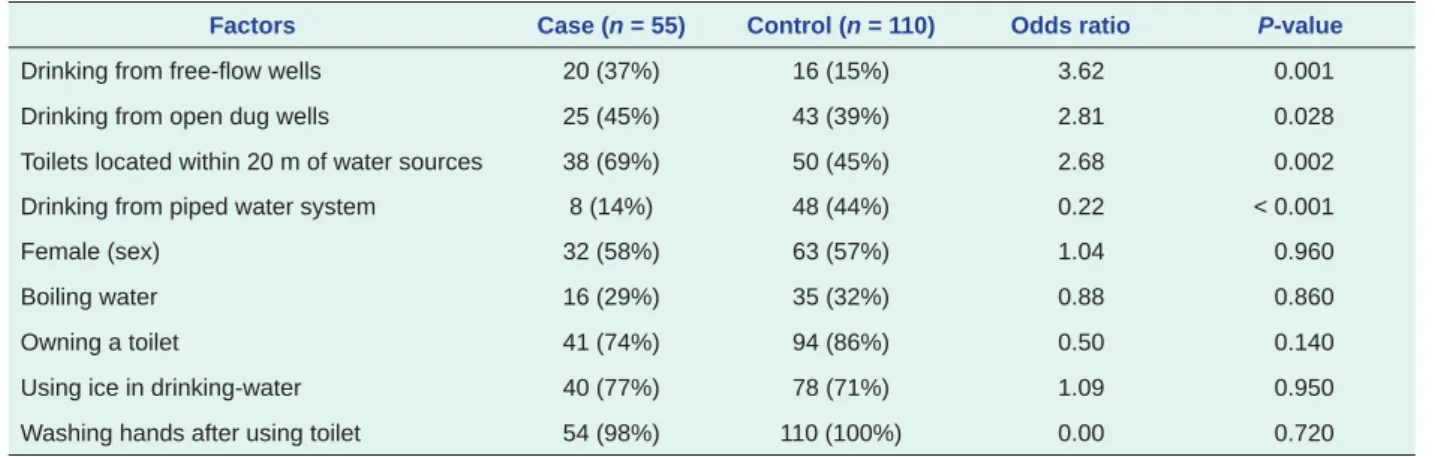
We also interviewed the manager of the Level III water system to identify which towns had access to the system and how water quality was monitored. We investigated for leaks, possible entries for pollution and the sanitary conditions of the area around the water sources. Of the 222 rectal swabs collected, eight (4%) were positive for Vibrio cholerae Ogawa El Tor and one (0.5%) for Vibrio cholerae Non-01.
Rumor control revealed that about three-quarters of children in one area of the eastern Kwaio Mountains had suspected measles that had not been reported to the AAH. This report describes the local response to the outbreak and the epidemiological investigation of the measles outbreak in East Kwai. East Kwaio is on the eastern side of Malaita Island in the Solomon Islands (Figure 1).
According to rumors, there were only two suspected cases of measles in the mountains of the Karfurumu area. The vaccination status of the cases was not collected, which may have hindered further understanding of the outbreak.

CONCLUSIONS
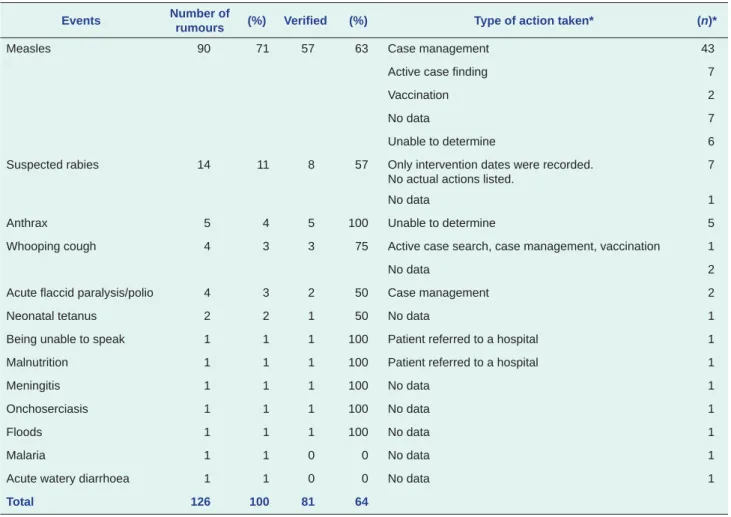
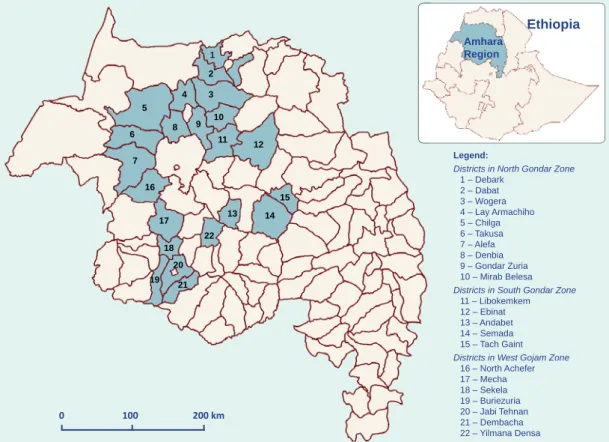
A total of 126 rumors were recorded in two-thirds of the HCs during the study period. Given the community's limited access to formal health facilities, especially in rural Ethiopia,3-5 the Federal Ministry of Health of Ethiopia distributed rumor logbooks (a registry to record information about potential outbreaks) to regional, zonal and district health offices as a tool for EBS registration in 2011.6 However, the logs were rarely used, with only a few incidents recorded at the district level. Event-based surveillance in northwestern Ethiopia: experiences and lessons learned in the field.
A reported rumor from the community or a HP was recorded in the rumor log by the surveillance contact at HC. The project group informed the HC monitoring contact persons about the use of the rumor logs. The monitoring officer from the district health office and the project team conducted quarterly monitoring visits to the HCs.
In 2012, the Federal Ministry of Health established the Health Development Armies (HDAs), a volunteer community health group that uses existing human resources in the government health structure to facilitate community health promotion.7 The team created a network structure of one volunteer per five households7 and collected health-related information from these households. HEWs and HDAs were mobilized to verify rumors in the community if necessary. Timeliness was defined as the relative timeframe of reporting time and HC response time.
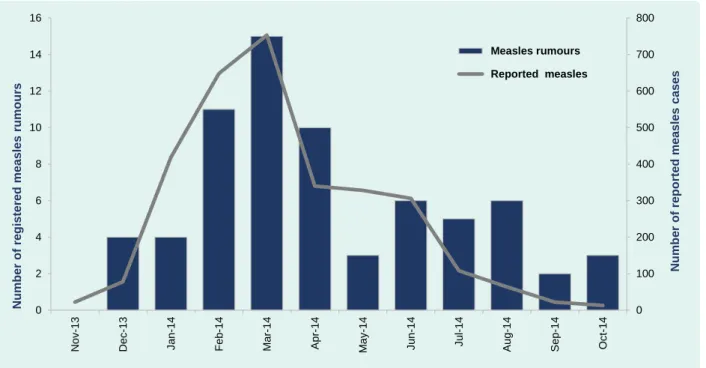
In the six project pilot districts that were monitored more closely, all HCs were available. The trends of the measles cases reported through the routine indicator-based surveillance system and the rumors recorded at the study HCs were compared (Figure 2). Rumors of measles followed a pattern similar to the measles cases reported through the routine surveillance system.
As pertussis was not a notifiable disease, none of the three pertussis rumors were caught by routine surveillance. Meanwhile, the representativeness of rumors depended on how the HDA structure worked in the community. The costs of setting up the system were minimal, requiring only a brief orientation for control contacts and the printing and distribution of HC rumor logs.
CONCLUSIONS AND RECOMMENDATIONS
The potential risk factors of the neonatal tetanus group were compared with the control group using univariate analysis and an unconditional logistic regression model. Tetanus is acquired by exposure to the spores of the bacterium Clostridium tetani, which is universally found in the environment. Some known risk factors of neonatal tetanus, including the education level of the parents and immunization against tetanus were not recorded in the medical records and therefore could not be assessed.
Discussion: Our study showed that social media and traditional media are two interconnected arms of the GHD campaign in China. A retweet on Twitter must be limited to 140 characters, including the content of the original tweet. We also visited the Weibo homepages of the key stakeholders of GHD 2012 in China, including the Chinese public followed by the Weibo post content.18 This protocol of.
Example 1 [Global Handwashing Day] Global Handwashing Day was initiated in 2008 by the Global Public-Private Partnership for Handwashing with Soap to call on countries around the world to hold activities to promote handwashing with soap on October 15 each year. A Report on a Study on Hand Washing Behavior We identified 50 Weibo posts in our dataset that quoted a report from China's official national newspaper (People's Daily) on a study that showed that only 7% of respondents in all seven conditions specified in the survey (after defecation, before meals, after changing diapers, after meals, after touching pets, after touching money, and after sneezing). According to estimates by the World Health Organization, about 40,000 children under the age of five die from diarrhea in China each year.
The Weibo posts were part of an overall health communication strategy to raise awareness of GHD along with other promotional events, TV shows, guest stars, videos and songs. These examples highlight how a successful public health campaign can attract the attention of a variety of people who may or may not interpret it in the way the campaign organizers originally intended. According to a random sampling study, 5% of Weibo accounts generate 80% of the original posts, and more than 50% of Weibo accounts never post anything.13.
The Chinese keyword for hand washing can be combined with other Chinese characters to form other terms, as shown by two of the four peaks discussed in the Results section. We conducted a qualitative analysis of the content of Weibo posts on GHD 2012 to identify topics and themes of handwashing promotion in China. Our research showed that social media and traditional media are two interrelated branches of China's GHD campaign.
On the commencement of the promotional activities on "Global Handwashing Day" 2012, a notice from the Office of the National Committee for Patriotic Health Campaign [A repost from the BaoTou Center for Disease Control and Prevention]. The distinct clinical features, high contagiousness of the disease and the necessary laboratory evidence (both for probable and confirmed cases) minimized cases.

CONCLUSION
Objective: Tuberculosis (TB) represents a significant public health challenge in 22 Pacific Island countries and territories. Using TB surveillance data and World Health Organization (WHO) estimates from 2000 to 2013, we summarize the epidemiology of TB in the Pacific. Discussion: TB in the Pacific is improving in some areas; however, high rates affect many countries and the estimated regional incidence rate is stable.
Tuberculosis (TB), one of the world's most important infectious diseases, continues to burden people in the Pacific. There is limited published information on the epidemiology of TB in the Pacific, and progress towards international and regional TB targets requires further investigation. However, they do not assess the epidemiology of TB in the Pacific Islands as a whole.
In cases of TB (which consists of new and relapsed patients) have been notified in the Pacific region. Number of TB notifications and notification rates (all forms and sputum smear positive, with and without Papua New Guinea) in the Pacific Island countries and territories,* 2000 to 2013. Estimated TB incidence, prevalence, deaths* and case notification rates in the Pacific island countries and territories,† with and without Papua New Guinea, 2000 to 2013.
This low proportion therefore makes the importance of HIV for tuberculosis in the region unclear. Further studies are needed to determine the burden and diagnostic practices of pediatric tuberculosis in the Pacific. Case detection rates indicate that approximately 15% of all TB patients in the Pacific are never diagnosed.
Notifications of tuberculosis cases are increasing in parts of the Pacific and there has been little change in the estimated TB incidence rate since 2000. We also gratefully acknowledge the continued cooperation and contribution of national TB program managers to control TB. in the Pacific region. Tuberculosis epidemiology and control in the Western Pacific Region: analysis of 2012 case notification data.
We provide only a preliminary analysis of the available data to generate initial hypotheses about sex-specific differences for the MERS outbreak in the Republic of Korea. This analysis of the MERS outbreak in the Republic of Korea revealed significant gender differences.