BIBLIOGRAPHY
ANUDON, LA MARIA VICTORIA C. MARCH 2013. A Diagnostic Analysis of the Land Tenure System of Farmers in Kiangan, Ifugao. Benguet State University, La Trinidad, Benguet.
Adviser: Jovita M. Sim, MSc.
ABSTRACT
This was conducted to: identify the land tenure systems practiced by landlords and landless tenants; describe the terms and conditions of the agreement between the landlords and the tenants; and determine the problems encountered by the respondents in the terms and conditions of the agreement. This study was conducted in Kiangan, Ifugao from December 2012 to February 2013.
All of the respondents were involved in share cropping. There were three types of landlord and tenant sharing such as 50:50 share, 15:85 share and 30:70 share. The conditions of inputs depended upon the type of share cropping. It may be shared by both the landlord or his tenant or it may be shouldered solely by the landlord or vice versa.
There were no written contracts since the respondents preferred verbal agreements by which they could subject to changes when called for.
Furthermore, the respondents added that they experienced many problems like problems on the repair of farm after calamities, maintenance of irrigation system,
incomprehensive tenure agreement, disagreeable attitudes of the tenure strata, additional expenses and misunderstanding between the landlord and tenant.
In conclusion, there are still existing imperfections of the share cropping agreement even if it was practiced for generations.
Thus, it is recommended that the existing policies should be reviewed and developed governing the land tenure practices that may improve arrangements among landlords and tenants and it is also recommended that in order to promote a comprehensive working agreement, a written contract should be considered to properly define the terms and conditions of the agreement that will help avoid disputes among the tenurial strata.
INTRODUCTION
Rationale
Land is the most basic economic resource in all corners of the world especially in developing countries with a large rural population. It is the mainstay of human life from where man derives his sustenance.
According to the Food and Agriculture Organization (2003), the problem of land tenure and its relationship to rural productivity is currently receiving serious attention in most developing countries. One must constantly bear in mind that in predominantly agricultural communities, the form of tenure constitutes the social framework of production. It is thus of immense importance to address who has the right to cultivate land and on what terms
In Kiangan, Ifugao, most of the inhabitants are dependent on agriculture as their source of livelihood. It is a 4th class municipality with a land area of 20,419.20 hectares devoted to agricultural potentials. It used to be branded as the “Vegetable Bowl of Ifugao,”
being the main source of vegetables in the province; however, production had decreased in recent years and already overtaken by other municipalities (MAO, 2005).
According to the Food and Agricultural Organization (FAO, 2003), the form of social structure and productivity are in direct and close relationship with the form of land tenure. The security of land tenure need not amount to ownership of the land. A tenant’s security may be as good as his landlord when the conditions are efficiently regulated.
The Global Agriculture and Policy Institute (GAPI, 2003) revealed that insecure tenure creates uncertainties that lead sub-optimal outcomes both for short-term agricultural output and sustainable development. Furthermore, while ownership can be the surest way to have access to land, it does not have to be the only way. The more important thing, according to GAPI, is that the security is properly defined. That is, regulations are pertaining to even tenancy arrangements. In fact, ownership may not even be affordable.
It is in this premise that this study is formulated.
Importance of the Study
The result of this study would provide essential information for policy makers who attempt to improve the economic situation of the farmers through better tenurial arrangements. Also, it would help in assessing the tenurial problems and conditions that will serve as basis for the proper authorities to take proper action to increase efficiency and productivity of land use. Lastly, it will help other researchers with a similar study.
Statement of the Problem
This study addressed the following questions:
1. What are the tenure systems practiced between a landlord and a landless tenant in Kiangan, Ifugao;
2. What are the terms and conditions set by the agreement between the tenant and the landlord; and,
3. What are the problems encountered by the landlord and tenant in the terms and conditions of the agreement?
Objectives of the Study This research study aimed to:
1. identify the land tenure systems practiced by a landlord and a landless tenant in Kiangan, Ifugao;
2. describe the terms and conditions of the agreement between the landlord and the tenant; and,
3. determine the problems encountered by the respondents in the terms and conditions of the agreement.
Scope and Delimitation of the Study
The study focused on gathering information of land tenure arrangements among landless tenants with a landlord, the terms and conditions of the arrangement and the problems encountered by the respondents in relation to land tenancy.
REVIEW OF LITERATURE
Revisiting Land Reforms
According to Hildemann et al. (1998), the Spanish occupation started private ownership of land. All public lands were converted to crown lands and were awarded to Spanish officials, the military men and the clergy.
At the end of the 18th century, sharecropping arrangements were introduced between landlord and tenant, with the land owner usually getting more than half of the share and more if the landlord provided the inputs. Lands were being acquired by buying and settling on unoccupied land and getting it registered and titled as private land but, only a few Filipinos were able to acquire land. In many cases, the people borrowed from businessmen and other land owners to purchase lands. In return, these lenders took their lands as collateral. (Hildemann et al., 1998)
Extreme disparities in land distribution were rampant. Large tracts of land ended up in the hands of the few who had descended from the Spaniards, Chinese traders and Filipinos who collaborated with the colonizers. A majority of the Filipino population lived in complete dependence on their landlords and suffered terrible poverty. With the coming of the Americans, lands were purchased from the church and resold to the tenants.
However, the poor cannot afford the price so lands were taken by the Americans. There were many government programs that intended to establish access of the Filipinos to land.
The introduction of land titling systems, the Homestead Act and land ceilings gave rise to new landed mestizo class. (Hildemann et al., 1998)
The majority of the population could not undergo the expensive registration process. After all, it fell on the hands of the elite and upper classes.
The hunger for land awoke upheavals and uprisings the years after. The first attempt at land Reform was Presidential Decree (PD) 27, declared by then President Ferdinand Marcos in 1972 under Martial law. But it was limited only among tenanted rice and corn lands.
In 1986, the People’s Power Revolution ended the martial rule and propelled Republic Act 6657 which instituted the Comprehensive Agrarian Reform Law (CARL).
The bill was debated intensely in and out the halls of congress. Due to mass demonstrations, CARL was compromised. Much of the compromise was in favor of the landowners while the militant groups denounced it as pro-landowner.
The CARL set the implementation of the Comprehensive Agrarian Reform in June 1988. It specified that property bears social function and therefore, the right to own land or other property also bears the obligation to use it according to norms that are agreed upon and are beneficial to the society.
Agrarian Reform constitutes a major change in the structure of ownership of agricultural land. In the Philippines, it seeks to solve centuries-old problems of rural landlessness. It aims to change land tenure relationships and change the current culture of exclusion so that the poor gains access to credit, technology and markets. Lastly, it aims for the poor to become active participants in the development programs of the government.
A just distribution, equality and ecologically-sound agricultural production, welfare of farmworkers, social justice and rural development were the immediate aims of the reform program. (Hildemann et. al., 1998)
A study conducted by the FAO (2003) found that despite the many constraints and resistances, the Agrarian Reform program in the country is positive and encouraging. It benefited at least a significant portion of the rural population towards the overall development of the country. The study further stated that agrarian reform is not simply land distribution but access to land is coupled with the security of tenure to motivate investment and incentive to increase productivity.
Land Tenure and Access to Land
Poverty is still a rural phenomenon in the Philippines. Three-quarters of the poor live in the rural-areas and the majority depends on agriculture and related industries for employment and income. Struggling through this phase of rural poverty is the so called unequal system of land tenure. Its impact in retarding agricultural development and farm investment is well known. (GAPI, 2003)
Land tenure is the set of rules that determines how land is used, possessed, leveraged, sold, or in other ways disposed within societies. These rules may be established by the state or by custom, and rights may accrue to individuals, families, communities, or organizations (Garvelink, 2007). Rules of tenure define how property rights to land are to be allocated within societies. They define how access is granted rights to use, control, and transfer land, as well as associated responsibilities and restraints. Rural landlessness, according to FAO (2003), is a predictor of poverty. Inadequate rights of access to land and insecure tenure impedes rural development.
Access to land had been a central issue in recent years. The rights of access may have their origin in the use of the land over a long period. They are often rights developed by ancestral occupation and by the use of land by ancestral societies. According to the Economic and Social Development Department (2005), people also use a wide range of strategies to gain access to land by purchasing which often uses capital accumulated while working as migrants in urban areas. In some countries, the only method for small farmers to gain formal access to vacant or abandoned land and to bring it into productive use is by adverse possession and prescription of land (the acquisition of rights through possession for a prescribed period of time). Others use leasing or gaining access to land by paying rent to the owner. Through sharecropping, land is accessed in return for paying the owner a percentage of the production. Some may inherit land or squat illegally on land.In addition to individual strategies of gaining access, land can be granted by the intervention of the government. It is of great importance to create frameworks and programs that enhances fair access to land which will promote a just social structure.
Security of Tenure and Agricultural Productivity
Presently, there are great debates that tenure security is the transfer of land from large land owners to the landless and land poor.
A study by Petersen (1991) revealed that without security of tenure, households are impaired in their ability to secure sufficient food and to enjoy sustainable rural livelihood.
Many argue that security can arise only when there is full private ownership. That is, only an owner enjoys secure rights while holders of fewer rights have insecure tenure because they are dependent on the will of the owner. (Petersen, 1991)
As published by the FAO (2003), equating security with transfer rights to sell and mortgage is true to a few parts of the world but not among many others. In some areas of the Philippines, the beneficiaries of land reform refused lands that were being awarded to them because they are dependent on their landlords for other farm inputs. Others have sold their lands or mortgaged their rights due to reasons of urgent need of money and rampant poverty.
According to the International Land Coalition (2006), adequate tenure security does not necessarily mean ownership but what the rural people need, how land can be efficiently utilized and how tenants undertake investment in the land. The uncertainty undermines the incentives of the tenants to make long-term investment. Security of tenure lies in the assurance that the rural poor is provided access to land, the person’s rights are duly recognized, protected and that investment in agriculture is promoted.
There are widespread acknowledgements that secure access to land and property rights promote and expand the rural economy. When the poor are able to access and use their lands to secure credit and financial services, more livelihood options open up for them. Security of tenure is the first step to agricultural productivity. Farmers are reasonably secure that their families eat three meals a day and enough money is left to send their children to school (Kuhnen, 2007).
Furthermore, according to Kuhnen (2007), when tenure is insecure, farmers have no incentive to make investments. Farmers are inclined to milk the land for all its worth instead of giving back what it takes from the soil.
The resulting degradation of the land threats the livelihood of millions of farmers and put food security at risk. This holds true not just among tenants who feel that their tenure is uncertain but also for those holding short-term use rights.People with insecure tenure face the risk that their rights to land will be threatened by competing claims, and even lost as a result of eviction. Without security of tenure, households are significantly impaired in their ability to secure sufficient food and to enjoy sustainable rural livelihoods.
According to Acquaye (2000), it is widely recognized that improvement in security of tenure, to some extent, plays a major role in agricultural productivity because it is that which encourages or discourages a farmer to invest in the farm. Tenure security provides key assets for poverty reduction, allowing the poor to help themselves by growing food and investing in more productive activities. A secure tenure will encourage a farmer to invest for he will be sure to reap the benefits of his labor and thus increase productivity.
Typology of Filipino Peasants by Tenure and Access to Land
The International Land Coalition (ILC, 2006) study stated that the types of Filipino peasants today are defined by their land holdings and labor arrangements.
Type 1. The subsistence owner-cultivator, commonly found in upland or rain-fed areas, a small settler in a pioneer area; the peasant with his own family, independent and bound to traditional agriculture.
Type 2. The “Kasama” sharecropper of a small landlord or a landless worker who hires out his labor to other small farmers in seasonal periods through sub-tenancy arrangements or labor arrangements that are actually disguised forms of share tenancy.
Type 3. The share tenant or lessee of a hacienda whose patron to client relations are more pronounced and with expectations of landlord reciprocity.
Type 4. The “hacienda” worker who is either a permanent or a migrant, like the
“dumaans” and “sacadas” of the Negros and Panay sugar areas; under an administrative hierarchy composed of “encargado, cabo and contratista.”; haciendas of this type continue to adopt traditional methods of agriculture resulting in inefficient production and high costs of cheap labor.
Type 5. The agricultural worker, regular or casual, within a plantation that is capital-intensive, export-oriented and oftentimes, linked to translational corporations for capital and marketing requirements.
Type 6. A member of a farm or land consolidation project wherein production and credit marketing activities are stressed. Communal ownership of the land is invoked.
Cultural minorities with a tradition of communal landownership may fit in this category once easier access to credit and market is afforded.
Type 7. A small farmer linked to a cooperative network or a corporation.
Type 8. The individual small farmer receiving some government support in the form of a crop loan, irrigation service and farm-to-market roads. Without farmers’
organization or cooperative, however, these services are limited or may be curtailed.
Definition of Terms
Agreement. This refers to the land tenure arrangements that the landlord and tenant will agree upon.
Income share. This refers to the net income after selling the harvest shared by the landlord and tenant.
Input. This refers to the material needs of the farm ranging from production to harvesting operations such as seeds, fertilizers, insecticides and chemicals.
Landlord. This refers to the owner of the land.
Lease. This refers to the tenure system wherein the tenant pays the landlord a fixed amount (rent) for the use of his land.
Mode of payment. This refers to the amount or crop share that is used to pay the landlord by the tenant for his use of the land or by the landlord to the tenant for his labor.
Share cropping/ Share tenancy. The tenants will have to pay the landlord in the form of the crop share in return for his land use. It may also mean that the crop is shared among family members.
Security of Tenure. This refers to the productivity and efficiency of land tenure system that benefits both the tenant and his landlord.
Tenant. This refers to the landless farmer who cultivates the land rented from the landlord.
Tenure system. This refers to land operating practices existing between a landlord and a tenant.
Terms and Conditions. This refers to the mode of sharing by the landlord and tenant in terms of the inputs and share of the harvest.
METHODOLOGY
Locale and Time of the Study
The study was conducted in Kiangan, Ifugao where rice fields are found scattered in patches of terraced land along mountain slopes, plateaus and on the sides of the rivers, streams and creeks. Other areas are planted with root crops and vegetables that augment the inadequate rice production. Fruit trees such as bananas, oranges, santol, mangoes, citrus, rattan and coffee trees are found on non-irrigated slopes, on the mountains, on hillsides and at the backyards of residents.
The study was conducted from December 2012 to January 2013.
Respondents of the Study
There were (20) tenant farmers and (20) landlords who were identified through purposive sampling. They were determined according to the type of tenancy they are in.
Data Gathering Procedure
A survey questionnaire was distributed to the respondents together with personal interview for validation.
Data Gathered
The expected data included the tenure systems, the terms and agreement of the tenurial arrangement and problems faced by the respondents that are related to the tenurial arrangements.
Data Analysis
The data were analyzed using frequency analysis and descriptive method.
RESULTS AND DISCUSSION
This section is divided into three parts. The first part chiefly discusses the profile of the respondents in terms of age, civil status, number of dependent members, educational attainment, source of income, annual income and years of experience in farming.
The second part tackles the crops being planted and whether the respondents consume or sell their harvest, the different terms and conditions of the existing tenurial arrangements, the perception of the respondents whether the arrangement is fair or unfair, the benefits provided for by the landlords. Lastly, the problems encountered by the respondents in the tenurial arrangements are enumerated.
Profile of the Respondents
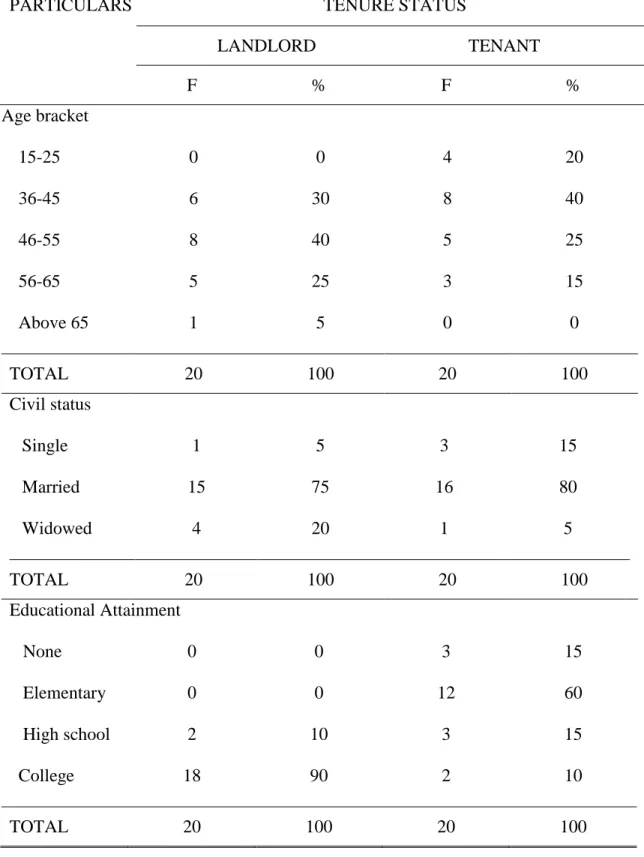
Age. Greater proportions (40%) were at the age of 46 to 55 years old. There are few (5%) who are above 65 years. On the other hand, a greater proportion (40%) of the tenants is relatively younger at 36-45.
This finding shows that most of the landlords were generally older than the tenants.
Civil status. A majority (75%) and most (80%) of the landlords and tenants were married, respectively. Some (20 %) of the landlords are widowed and others (5%) are single. Meanwhile, there were 15% widowed tenants and a few (5%) are single.
This finding shows that there were more married people who are involved in land tenancy either as a landlord or a tenant. There were also single individuals who involve themselves in farming for additional source of income.
Educational attainment. The landlords generally have finished college at 90% and high school at 10%. There were no landlords who have not finished elementary level.
Meanwhile, majority (60 %) of the tenants reached elementary but did not pursue higher education. Some (15 %) continued on to high school and a few (10%) finished college. The rest (15%) did not have any formal education.
As expected, most (90%) of the tenants did not finish school or have not received any formal education. This is in contrast with the landlords, who, mostly (90%) graduated college. According to Awasthi (1988), it is not illogical to argue that ownership of land provides the landlord and his family members a greater access to education because as security of tenure is assured, their preferences are oriented to other items such as education.
Meanwhile, education is a sacrifice for most of the tenants in terms of salary foregone for the labor that the family members could have provided for in the farm.
Number of dependent family members. Table 1 shows that there is a difference of the respondents in terms of number of dependents or household members they have. The majority (65%) of the landlords have household members ranging from four to six members. Some (15%) have above six members and 20% had one to three family members.
Half (50%) of the tenants have family members above six and 40% at four to six members.
The rest (10 %) have one to three members.
This finding reveals that more tenants have more household or dependent family members. According to the respondents, this trend can be attributed to the capacity of the landlords to send their children away and live in other places to venture on greener pastures.
As observed, most of the children of the landlords reside in the cities or travelled abroad leaving their parents to hire labor to tend to their farms.
As for the tenants, their children share with the labor in the farm and more often than not, merge their families in their parents’ household. This is because their family does not have enough resources to send their children away like the landlords do.
Years of experience in farming. Table 1 showed that majority (60%) of the landlords have been involved in farming for twenty to thirty years and 25% for the landlords who have been farming for ten to twenty years. A few (10 %) have been in farming for more than thirty years and 5% for less than ten years.
Meanwhile, a majority (75 %) the tenants have worked in the farm for one to twenty years and 20% for those who have been farming for twenty to thirty years and the rest (5
%) for more than thirty years.
This can be explained by the age difference of the respondents were landlords are generally older than the tenants and have been in farming quite longer than the tenants.
Table 1. Profile of the respondents
PARTICULARS TENURE STATUS
LANDLORD TENANT
F % F %
Age bracket 15-25 36-45 46-55 56-65 Above 65
0 6 8 5 1
0 30 40 25 5
4 8 5 3 0
20 40 25 15 0
TOTAL 20 100 20 100
Civil status Single Married Widowed
1 5 3 15
15 75 16 80
4 20 1 5
TOTAL 20 100 20 100
Educational Attainment
None 0 0 3 15
Elementary 0 0 12 60
High school 2 10 3 15
College 18 90 2 10
TOTAL 20 100 20 100
Table 1. continued…
PARTICULARS TENURE STATUS
LANDLORD TENANT
F % F %
F % F %
Number of dependent family members
None 0 0 0 0
1-3 4 20 2 10
4-6 13 65 8 40
Above 6 3 15 10 50
TOTAL 20 100 20 100
Years of experience in farming 1-10 years
10-20 years 20-30 years Above 30 yrs.
1 5 8 40
5 25 7 35
12 60 4 20
2 10 1 5
TOTAL 20 100 20 100
Sources of Income
All of the tenants reported farming as their major source of income. In addition, some (40%) of the tenants were involved in short-term employment like clerical jobs and contractual services like carpentry, machine operators and assemblers. On the other hand, all of the landlords were involved in farming but majority (75%) were employed in public and private agencies as their primary source of income.
Some (20%) have their own businesses like sari-sari store, hog and poultry raising, shops, restaurants and handicraft stores.
Annual Income
Long-term employment refers to permanent jobs either in government or private agencies and receiving regular salary while short-term employment are contractual services that are short-lived and are normally irregular with no stable salary. Business refers to the ventures of individuals who own their private businesses like large general merchandizing establishments to small grocery stores, woodcarving stores, restaurants and livestock production.
Of the twenty landlords, majority (60%) earn income above P75, 000 annually.
Some (40%) earn income ranging from P45, 000 to P75, 000. These are the non-working landlords who tend to manage the farms and receive allowances from their well-off children and their retirement fees.
There is a great difference with that of the tenants where none of the respondents earn income above P65, 000. A majority (75%) earn from P30, 000 to P45, 000. Some (15%) earn P15, 000 to P30, 000 and only (10%) earn P45, 000 to P65, 000.
As presented, there is an obvious difference of the annual incomes of the two tenurial strata. It should be noted that the annual income from other sources of income is higher than that of farming. This situation can be explained by the employment factors of the respondents. There are no tenants involved in long-term employment in private or public agencies that could be a result of their poor educational attainment. In addition, since
contractual services are short lived and irregular, they are not provided with a stable source of income.
Whereas, there are many landlords who are employed in stable jobs that provide them with higher and regular pay. Included to this, is the fact that some landlords have other business ventures that add to their income.
Land Area
Majority (60%) of the landlords own 2 to 3 hectares of land. The other 20 percent own lands from one to two hectares. There are 15 percent with more than three hectares and 5 percent who own less than a hectare.
A majority (55%) of the tenants cultivate land less than a hectare, while there are about 30 percent who cultivate 1 to two hectares and 15 percent for those who cultivate two to three hectares.
An explanation to this because a landlord may have more than one tenant who has to share with other tenants the land to be cultivated, therefore, allowing them only a portion of the landlord’s land.
Table 2. Sources and annual income
SOURCE/ ANNUAL INCOME TENURE STATUS
LANDLORD TENANT
F % F %
Farming 20 100 20 100
Long-term employment 15 75 0 0
Short-term employment 0 0 4 20
Business 4 20 3 15
*Multiple response
P15,000- 30,000 0 0 3 15
P30,001-45,000 0 0 15 75
P45,001-60,000 4 20 2 10
P60,001-75,000 4 20 0 0
Above P75,000 12 60 0 0
TOTAL 20 100 20 100
Table 3. Land area owned by landlord and land area cultivated by tenant
LAND AREA TENURE STATUS
LANDLORD TENANT
(Owned by landlord) (Cultivated by tenant)
F % F %
< 1 hectare 1 5 11 0
1-2 hectares 4 20 6 15
2-3 hectares 12 60 3 30
> 3 hectares 3 15 0 55
TOTAL 20 100 20 100
Crops and Utilization
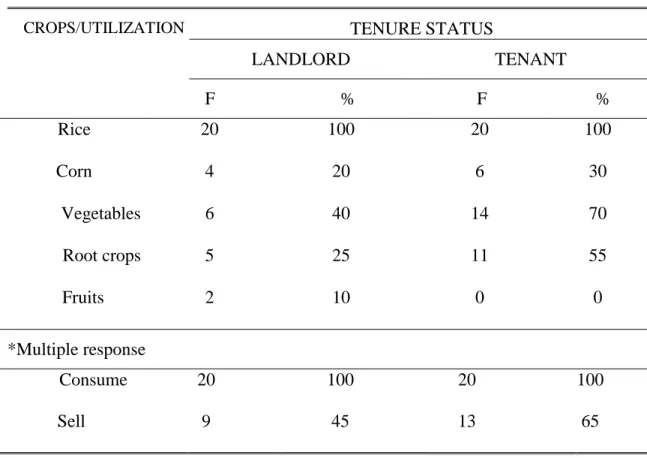
Table 4 reveals that for all the landlords and the tenants plant rice as the common main crop.
According to data of MA0 (2005), rice being the staple food of the people is the main crop planted in the municipality. The culture revolves around rice which is considered a prestige crop. There are various rice culture feasts connected with taboos and agricultural rites ranging from rice cultivation to rice consumption. Many practices are linked with the crop; however, there are those who converted their rice lands into vegetable patches because they prefer cash crops to raising rice.
Many rice fields are converted to vegetable gardens. The common vegetables being planted now are tomatoes, eggplant, wing beans, pepper, cabbage, Chinese cabbage, sweet peas.
There are fruit trees like coffee, citrus and bananas. Some fruits brought outside the province usually go to Manila or Baguio for selling.
Also, the table presents that 45% and 65% of the landlords and the tenants, respectively, sell a part of their produce in the local market. Accordingly, most crops that are being sold are the secondary crops like vegetables and root crops in the nearby markets though a few may go as far as the lowlands. Also, some of the fruit growers revealed that they have more lands for other crops than fruits. Often, they send their harvest to their relatives who live in other places. Others may consume it or sell it in their own private businesses.
There are 65% of the tenants who also sell a part of their harvest. Obviously, there are more tenants than landlords who sell. This is because they need to sort out income for their family as they do not have stable jobs.
Added to this, they have revealed that they prefer to plant cash crops as secondary crops. However, consumption is the common practice for the main crop which is rice.
Table 4. Crops planted and their utilization
CROPS/UTILIZATION TENURE STATUS
LANDLORD TENANT
F % F %
Rice 20 100 20 100
Corn 4 20 6 30
Vegetables 6 40 14 70
Root crops 5 25 11 55
Fruits 2 10 0 0
*Multiple response
Consume 20 100 20 100
Sell 9 45 13 65
*Multiple response
Existing Land Tenurial Arrangements
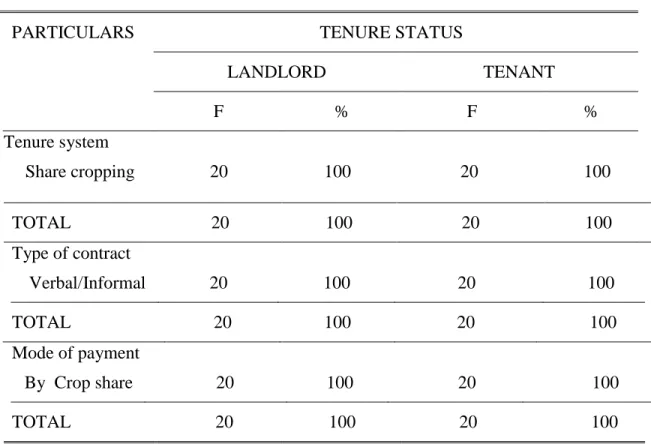
All the respondents are involved in share tenancy and all the respondents are involved in verbal contract
There is basically one major type of tenurial arrangement existing in the area, that is, crop sharing.
Crop sharing is a system of agriculture by which a landowner allows a tenant to use the land in return for a share of the crop produced on the land. A tenant is assigned a piece of land to work on and in exchange owes the landlord a share of the crop at the end of the season. (Petersen, 1991)
There are different situations and types of agreements that have encompassed the system. Normally, a crop sharing agreement would specify which party was expected to cover certain expenses, like seed, fertilizer, weed control, irrigation and fuel. If the tenant spent more than his landlord, he is expected to a larger share of the crop in return. The agreement would also indicate whether the tenant would use his own equipment to raise the crops, or use the landlord's equipment.
Crop share for some are governed by tradition and by norms. As observed, crop sharing is a common practice for both types of tenurial strata in the area. According to the respondents, this has been a long-lived tradition of tenurial arrangement.
Lands in the area are inherited from generations to generations which give the land a deeper meaning and bond among those who have inherited it. It is not a welcoming idea to sell the land to other people outside the bloodline since land is a gift and a symbol of prestige handed down by their forefathers who have settled many land disputes to rightfully accumulate the land.
According to the respondents, there are many native practices to settle land disputes. One is the “Bultung,” whereby disputing men grapple and wrestle each other until one of them is ousted away from the land they are trying to claim. The man who remains on the land gets to claim it under his name. The “Dau” is also another practice whereby the claimants dip their arms in boiling water for two to three days and whoever has less burns and blisters is acknowledged to be the owner of the land. The “Uggub” is also another way of settling land disputes whereby the disputing parties stand at a certain distance and try to hit each other’s back with an arrow made of a plant. The person who hits more will have the right to claim the land.
There are also feasts and rituals wherein animals are butchered to be offered to the spirits, plead for blessings for the land and drive away any bad luck from the family. For some during harvest, there is chanting, singing of hymns and cooking of rice cakes and wine making celebrated by the family and their neighbors in gratitude to the heavens and to ask for a bountiful harvest again.
Added to this, they shared that there is an unspoken vow to protect the family title.
They shared that they prefer to have tenants from their families to ensure that the duty to care for the land is secured. In this case when tenants are also their relatives, share cropping is all the more preferred because it does not seem good to have their own relatives pay them monetarily. It is enough for them to simply have a share of the harvest. In this way, land is kept within the family that allows it to be inherited by the next generation of relatives. Needless to say, crop sharing is a way to maintain and preserve the land within the family tree. If it was settled for lease, it would be among family members only for easier access to having it back. Nevertheless, having lands for lease is the last thing a man in need would do.
It should be noted that the landlord and his tenant negotiates between them the terms and conditions of the sharing. This is often done by verbal agreement; therefore, it can be subjected to changes when called for. A verbal agreement is regarded because written contract seems to impose a question of morality which is vehemently being avoided.
A good working relationship begins with a good arrangement and understanding that is founded on trust. That is, a verbal agreement is a proof of trust among the participants and that both parties put their confidence on each other.
There is no need for a written contract to ensure that the settlements are followed accordingly. This, according to the respondents, is enough foundation for a working environment.
Crop sharing may also take another meaning in the area. That is, it takes the context of sharing the produce among family members for household consumption.
It is significant to take note that the result revealed that all the respondents tend to share their fruits of labor among their family members instead of selling them all. Some respondents shared that to distribute the produce among family members is a way of sharing the blessings of the inherited land. The respondents believe that sharing the harvest is a way of expressing their gratitude to the heavens for having a bountiful harvest.
They tend to either consume all their harvest or sell a part of it. However, selling is done only when the family often the tenants have to sort out sources of income for their needs especially when emergency situations like accidents and sickness in the family arises.
Table 5. Existing land tenurial arrangements
PARTICULARS TENURE STATUS
LANDLORD TENANT
F % F %
Tenure system
Share cropping 20 100 20 100
TOTAL 20 100 20 100
Type of contract
Verbal/Informal 20 100 20 100
TOTAL 20 100 20 100
Mode of payment
By Crop share 20 100 20 100
TOTAL 20 100 20 100
Arrangements of Share Tenancy
Crop sharing comes in many forms. For most, it is based on the main crop only. All other crops being planted within the land may not be subjected to the sharing depending upon the agreed terms. But more often, the secondary crops are owned by the tenant and so are the inputs needed to raise them.
The inputs provided by the landlord are for the main crop only unless they are allowed by the landlord to have it used for other crops.
It lies between the landlord and his tenant how they will share with the inputs. Since it is a verbal agreement, they can talk among themselves who should provide inputs that have not been covered during their initial agreements.
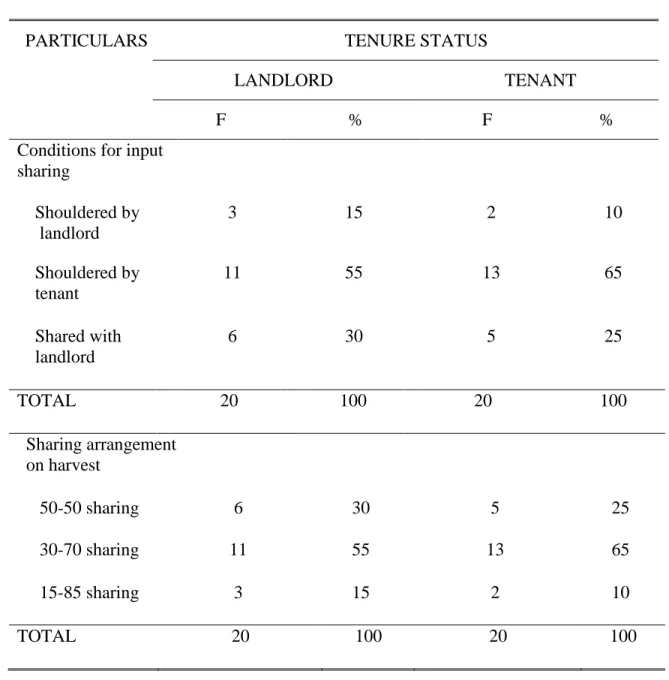
Both the participants can always converse and have the agreement subjected to changes until they settle on a more satisfying settlement. These agreements can fall under the three major types of share cropping in the area. These are:
Type 1: 15-85 sharing. In this type of sharing, the landlord shoulders all the inputs.
He spends for all the needs of the farm and the tenant provides only the labor which is paid by having 15 percent share of the harvest and 85 percent to the landlord.
Type 2: 70-30 sharing. The essence of this agreement is to allow the tenant to operate the land on his own. He spends for all the inputs and pays the land he used by sharing 30 percent of the total harvest to the landlord after which, he gets his seventy percent share
Type 3: 50-50 sharing. This type of sharing involves sharing the total harvest or produce equally between the landlord and the tenant. That is, 50 percent goes to the landlord and the other 50 percent goes to the tenant.
The sources of inputs for this kind of agreement are shouldered by both the tenants and the landlord.
For most cases, the landlord provides the seeds, fertilizers, insecticides, maintenance and harvesting operations. The tenant provides labor and other inputs that may arise during the operation.
Table 6. Share cropping agreement
PARTICULARS TENURE STATUS
LANDLORD TENANT
F % F %
Conditions for input sharing
Shouldered by landlord
3 15 2 10
Shouldered by tenant
11 55 13 65
Shared with landlord
6 30 5 25
TOTAL 20 100 20 100
Sharing arrangement on harvest
50-50 sharing 6 30 5 25
30-70 sharing 11 55 13 65
15-85 sharing 3 15 2 10
TOTAL 20 100 20 100
Perception of Respondents Toward Tenurial Arrangements
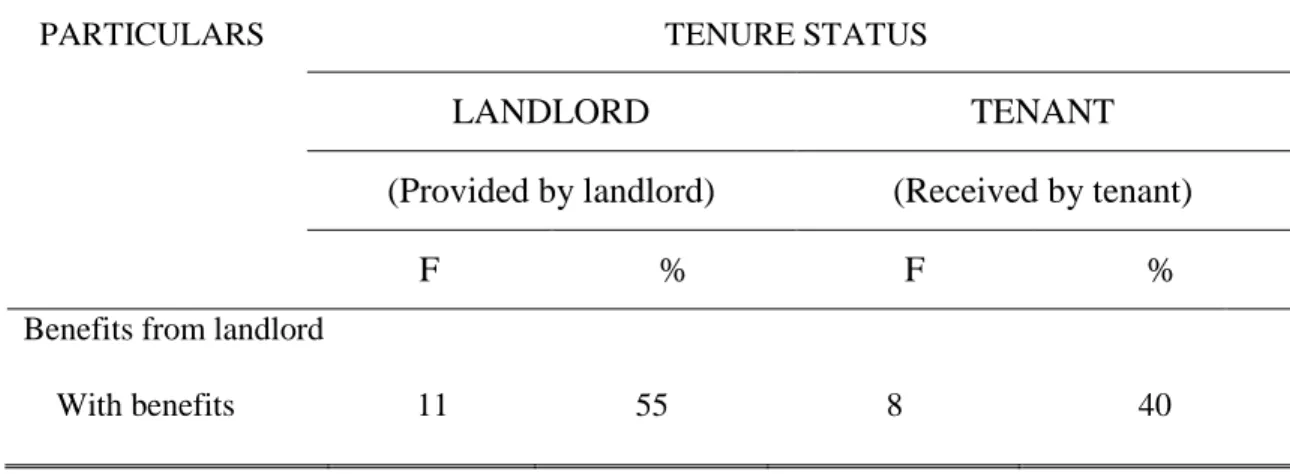
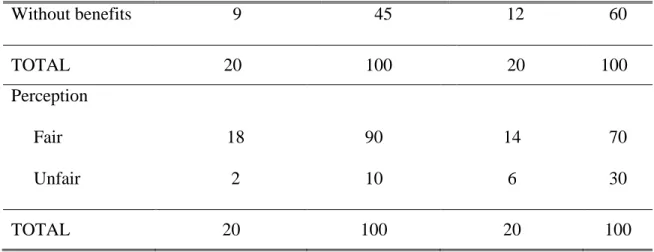
Table 6 presents that majority (55%) of the landlords provides other benefits aside from farming needs and some (40%) of the tenants have agreed that they receive other provisions from their landlord that may not be included in the arrangement.
The benefits being provided for and being received are medicines, gifts like clothes, toys for the children, food and scholarship for the children of the tenants. In some cases, the able children of the tenant are also being employed for other labor and paid in cash by the landlord. With good relations built on trust, there are landlords and tenants who continue their working relationship that lasts for generations.
The tenant and his family members who proved their loyalty are being given priority when the landlord needs to hire more labor for other kinds of jobs apart from farming. Some landlords and their tenant become partners in business.
However, some (35%) of the tenants feel that there is an unfair settlement especially when tenant has to spend his own money when there are inputs that the landlord did not provide
On the other hand, a few (10%) of the landlords said that the sharing is unfair especially when the tenants use the inputs they provide for to other crops being planted especially when the arrangement is based only on the main crop.
Table 7. Benefits and perception of the respondents toward the arrangement
PARTICULARS TENURE STATUS
LANDLORD TENANT
(Provided by landlord) (Received by tenant)
F % F %
Benefits from landlord
With benefits 11 55 8 40
Table 7. continued…
Without benefits 9 45 12 60
TOTAL 20 100 20 100
Perception
Fair 18 90 14 70
Unfair 2 10 6 30
TOTAL 20 100 20 100
Problems and Constraints
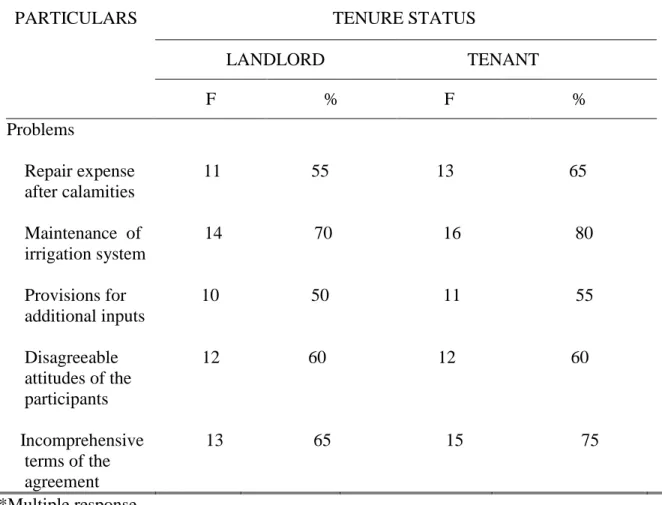
Table 8 presents that majority (70%) of the landlords and most (80%) of the tenants have said that they have difficulty in maintaining a good irrigation system. Following this, a majority (65%) and (75%) of the landlord and tenants, respectively have problems on the incomprehensiveness of the agreement.
Repair expense during natural calamities. The respondents find it difficult to restore the field in time for the next cropping especially when the necessary needs to repair the farm are lacking and are sometimes not provided for by landlords that compel them to spend.
Maintenance of irrigation system. According to the respondents, it is difficult to maintain the irrigation system because it requires expensive costs. Sometimes, landlord cannot provide enough funds for the maintenance and tenant has to seek for other water sources which make farming all the more difficult.
Provision for additional inputs. Many of the farmers reported that they are having problems in treating plant diseases and controlling the pests and rodents that attack the farms. Farmers have complained about snails, rats, birds, locusts, eel and many insects that feed on their crops.
Sometimes, there is a growing misunderstanding between the landlord and his tenant when it comes to additional expenses for insecticides, pesticides and fertilizers because one feels that he is already spending beyond the settlement and refuses to spend more.
Disagreeable attitudes of the two tenure strata. According to the tenants, the landlords tend to impose rules that become apprehensive and inconsiderate during certain situations when tenant seeks out other additional jobs in other farms. Furthermore, they are restricted to work on other farms because they might become unfocused on the farm.
On the other hand, the landlords have revealed that there are tenants who become dishonest in many ways such as the use of farm inputs to other farms or crops that is not part of the sharing. Also, there are tenants who ask for cash too many times for additional inputs and actually use them for their other crops.
Some tend to improperly leave the farms while they work on other farms, as it happens; they become unmindful of their duties. Others prioritize their secondary crops for their personal benefit as they use the land meant for the main crop only.
Incomprehensive terms of the agreement. According to the respondents, problems arise when there are changes that do not satisfy either the landlord or the tenant especially when problems arise and the needs of the farm become costly.
Both the respondents become highly apprehensive to spend more since one thinks the other should be accommodating the additional needed materials.
Since the agreement do not completely cover unforeseen situations, the respondents become uncertain of who should shoulder additional inputs.
Table 8. Problems faced by respondents in the tenure arrangements
PARTICULARS TENURE STATUS
LANDLORD TENANT
F % F %
Problems
Repair expense after calamities
11 55 13 65
Maintenance of irrigation system
14 70 16 80
Provisions for additional inputs
10 50 11 55
Disagreeable attitudes of the participants
12 60 12 60
Incomprehensive terms of the agreement
13 65 15 75
*Multiple response
SUMMARY, CONCLUSIONS AND RECOMMENDATIONS
Summary
This study “A Diagnostic Analysis of the Land Tenure System in Kiangan, Ifugao”
was conducted to identify the existing land tenure systems, describe the terms and conditions of the agreement between the landlord and tenant and determine the problems encountered by the landlord and the tenant. This study was conducted from December 2012 to January 2013.
The respondents of the study were 20 landlords and 20 tenants scattered among the barangays of the area. The data were collected by personal interview using survey questionnaires. The frequency method was used in the analysis of the data.
Most of the landlords were at the age of 46 to above 65 years and the tenants were relatively younger mostly at the age below 45 years. With regards to education, there was an extreme difference between the landlords who only 10 percent of them did not finish college while only 2 percent of the tenants graduated.
All the respondents were involved in farming but majority of the landlords were employed in other stable jobs providing them a good source of income while majority of the tenants were employed in contractual services that are normally irregular and with little pay. Some were also business owners and employees of livestock production and merchandize and handicraft stores.
The respondents were involved in farming from 1 to more than 30 years. They were mostly married and a few are single and widowed. Most landlords have a household of 4 to 6 members and half of the tenants have more than 6 members.
A majority of the landlords have two to three hectares of land while most of the tenants access land from one to two hectares. All the respondents plant rice as main crop.
Other crops planted are corn, vegetables, root crops and fruit trees. For all the respondents, they consume the harvest especially for the main crop. At times, they also sell a part of the harvest usually in the local and nearby markets for additional income.
When it comes to tenure arrangements, all of the respondents are involved in share cropping. There are three types of landlord and tenant sharing: 50:50 share, 15:85 share and 30:70 share. The sources of inputs depend upon the agreement. It may be shared by both the landlord or his tenant or it maybe shouldered solely by the landlord or vice versa.
There are no written contracts since the respondents prefer verbal agreements by which they can subject to changes when called for.
Some of the respondents revealed that they regard the arrangement as unfair during certain situations. However, the tenants do not find it fitting to complain since they rely on the land they till for their sustenance.Nevertheless, tenants mentioned that the landlords provide some benefits that are not part of the agreement.
Furthermore, the respondents added that they experience many problems like problems on the repair of farm after calamities, maintenance of irrigation system, incomprehensive tenurial agreement, and disagreeable attitudes of the tenurial strata, rising needs and additional expenses and misunderstanding among the respondents.
Conclusions
It is significant to note that all the respondents are involved in crop sharing that may fall under the three major types of agreement: 50-50 sharing, 30-70 sharing and 15-85 sharing. Therefore, it is safe to say that share cropping is a dominant tenurial arrangement in the area because it existed for many years that it became a tradition. It had become an unwritten code among the people that defines the working relations among landlords and tenant. However, there are still existing imperfections.
Recommendations
The area may not be under the agrarian reform law, however, it is also recommended, that existing policies should be reviewed and developed governing the land tenure practices that may improve arrangements among landlords and tenants. This is to promote better working relations among the farmers that may encourage them to improve working efficiency and produce more.
It is also recommended that in order to promote a comprehensive working agreement, a written contract should be considered to properly define the terms and conditions of the agreement that will help avoid disputes among the tenurial strata.
.
LITERATURE CITED
ACQUAYE, B. 2000. Land Tenure the Asia Pacific. Food and Agriculture Organization, Via delle Terme di Carcalla, Rome. Pp. 14, 16, 97.
AWASTHI, B.D. 1988. Land Tenure System among Rice Farmers in Parsa District, Nepal. M.S. Thesis. Benguet State University. Pp. 21, 24, 31-40.
ECONOMIC AND SOCIAL DEVELOPMENT. 2005. Land Tenure and Rural
Development. Retrieved July 30, 2012 from
http://www.fao.org/docrep/005/Y4307E/y4307e05.html.
FOOD AND AGRICULTURE ORGANIZATION. 2003. Land Reform, Land Settlement and Cooperatives. University of the South Pacific. Suva, Fiji. Pp. 9, 13, 71-76.
GARVELINK, W.J. 2007. Land Tenure, Property Rights, and Rural Economic Development in Africa. Retrieved September 9, 2012 from http://www.everyculture.com/East-Southeast-Asia/Ifugao-Sociopolitical.htm.
GLOBAL AGRICULTURE POLICY INSTITUTE. 2003. Food Security, Sustainability and Rural Development in Asia-Pacific. South Pacific. Pp. 24, 25.
HILDEMANN, P., A.B. QUIZON, R.V. POLESTICO. 1998. Agrarian reform in the Philippines: Status and Perspectives for 1998 and Beyond. German Agro Action, Adenauralleeb134, 53113 Bonn, Germany and International Institute of Rural reconstruction, Y.C. James Yen Center, Silang, Cavite, Philippines. Pp. 10- 18.
INTERNATIONAL LAND COALITION. 2006. A Resource Book on Enhancing Access of the Poor to Land and common Property Resources. International Land Coalition. Via del Serafico, 107, Rome, Italy. Pp. 66, 67.
KUHNEN, F. 2007. Land Tenure and Agrarian Reform in Asia. Retrieved August 15, 2012 from http://www.professor-frithjof-kuhnen.de/publications/land-tenure- asia/0.htm.
MUNICIPAL AGRICULTURE OFFICE. 2005. The Primary Sector. Retrieved August 25, 2012 from http://www.kianganifugao/agricutlure-publication/html.
PETERSEN, J.B. 1991. Land tenure and the Small Farmer in Asia. Food and Fertilizer Technology Center. Agriculture Building 14, Wen Chow St. Taipei, Taiwan. Pp. 3, 16-20.