
The martial law period that ruled the Philippines was one of the darkest periods in history. Student resistance during the martial law years was not limited to the Metro Manila area.
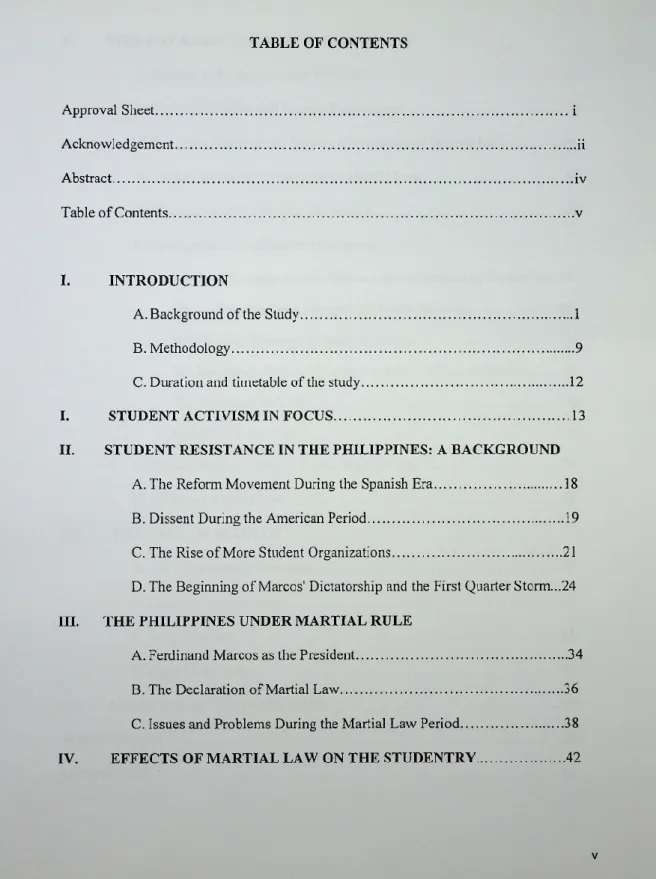
METHODOLOGY
This theory helped the researcher identify the root cause of student resistance that emerged and became prevalent during the martial law years. When conducting interviews, the researcher used questionnaires that served as the primary source of the research.
DURATION AND TIMETABLE OF THE STUDY
However, attempts to study the composition of the protesting student body have shown that four factors are involved in any protest (Keniston, 1968). A cultural climate that promotes protest can also lead to the politicization of people who are exposed to it.
CHAPTER III
THE REFORM MOVEMENT DURING THE SPANISH ERA
They called for the education of the Spaniards, the democratization of access to learning institutions, and the introduction of new programs that would ensure the growth of education in the colony. Nevertheless, the Propaganda Movement's contribution to the broader struggle of the Filipino people became the formation of a national culture and consciousness.
DISSENT DURING THE AMERICAN PERIOD
Those involved in the student movement during the American occupation were different types of students, many of them coming from the state-established and highly regarded University of the Philippines. Moreover, the students were also involved in aiming for a thorough discussion of public issues, the approval of Philippine independence and the lowering of the voting age to 18, the students over the years became more militant in protecting their rights (Damo-Santiago, 1972).
STUDENT MO VEMENT UNDER THE JAPANESE OCCUPA TION
The dark days of the occupation passed without any signs of action or dissent from the student sector. After the defeat of Japanese forces in 1942 and the end of World War II, the Western sphere of influence began to emerge.
THE RISE OF MORE STUDENT-LED ORGANIZA TIONS
Anti-communism and the struggle for the right to academic freedom were the main elements of the student movement in the 1950s. KM began to carry out mass actions and protests against the symptoms of imperialist economic control over the country.
THE BEGINNING OF MARCOS’ DICTATORSHIP AND THE FIRST QUARTER STORM
The late 1960s and the first two years of the 1970s witnessed the radicalization of the country's student population. The incident that marked the beginning of the so-called Democratic Philippines or MDP was one such alliance where I despised Marcos. The so-called Battle of Mendiola raged until the early hours of January 31, 1982. The next day, newspapers reported that four students,.
While Marcos assured the rest of the nation that he was still in full control, the student groups were encouraged to continue their protests. After an hour, the group gathered at the AS steps and moved to the main gate of the campus which formed a human barrier in front of Quezon Hall, the Administration Building. On January 1972, the MDP and the UP student council demonstrated at the Philippine legislature where Marcos was to deliver his State of the Union address.
FERDINAND MARCOS AS THE PRESIDENT
An example of this was that he demanded that businesses and schools throughout the Philippines have his official presidential photo or their facilities would be closed. An economic crisis during his second term in office became a formidable activity such as infrastructure construction, economic planning and program execution, planning and development of regional and industrial areas, community development, etc. He called for the fight against smuggling, criminality and corruption and corruption in the government, revitalization of the judiciary and further defense posture.
At the same time, a recalcitrant and radicalized student body strongly demanded reforms in the education system, protesting the abuses of Marcos and the military, the rising tide of crime and subversion by the reorganized.
THE DECLARA TION OF MARTIAL LA W
Following the declaration, radio and television stations were silenced, telephone service was cut off, and only one newspaper was in circulation - the Philippine Daily Express, which carried the banner "FM Declares Martial Law". Congress was padlocked and, meanwhile, Ferdinand Marcos was governed by presidential decrees, letters of instruction, letters of implementation, letters from favored persons, along with the more traditional proclamations, executive orders, and administrative orders (Sarmiento, 2001). functions. It was believed that the real reason Marcos declared war was to maintain his rule over the Philippines. The 1935 constitution limited the president's term to no more than eight consecutive years in office.
Although the courts remained in the judiciary, the judges of all courts, from the Supreme Court to the lowest courts, are. He also explained that the growing violence in the country caused by left-wing and right-wing elements had reached a certain dimension that martial law was necessary as a solution to the almost successful communist insurgency.
Attempts at legitimization were made by including a group of technocrats in the government, articulating the ideology of a "new society" and conducting staged referendums and plebiscites, which were in reality sham elections or quasi-judicial election exercises (Magadia, 2005). Accumulated unemployment has risen to more than 40 percent of the total labor force due to the contraction of industrial employment, the exhaustion of the land frontier and the expropriation of peasants, and the constant depletion of raw materials. Both the employed and the unemployed suffered from the general state of unemployment, low wages, inflation and repeated currency devaluations.
1, which instructs the Press Secretary and the Minister of Defense to "take over and control or cause the takeover and control of the mass media for the duration of the state of emergency or until production for export." In the early morning hours of September 23, 1972, Philippine Army crack squads began arresting thousands of people belonging to various anti-Marcoscampo ideological tendencies. Similar actions were also carried out in other schools. Fear immediately arose among the disciples.
CHAPTER VI
STUDENT COUNCILS AND STUDENT PUBLICA TIONS
Most of the articles in the two issues exposed and denounced the understanding of the US-Marcos dictatorship and the clerical-fascist Ateneo administration (Macapagal, 2005). The Silimanian of Siliman University, the Weekly Carolinian of the University of San Carlos and Sambayanan. The student councils of various schools were the vortex of the protest movement in the pre-war years, as student bodies served as a venue for protest.
After seven years of forced operation, the UP administration finally announced the restoration of the student council in 1980 (Lumbera, et.al, ed. 2008). While emphasizing the need to preserve whatever remains of the pre-martial law student underground structure. This is based on the simple fact that the majority of the mass is primarily based.
INITIAL STUDENT DEMONSTRA TIONS A GAINST MARTIAL LA W
In short, the concern would be to return to the sectoral demands of students to encourage student involvement. For example, they rode buses and there discussed the national situation and especially the situation of drivers, factory workers, salesmen and other workers. Until 1975, the labor movement showed the way to abandon the terror and fear of martial law, and the strike movement showed the exercise of workers' right to unionize.
Usually the students would first integrate with the workers and become worker organizer, they stick to the slogan "'Link the students' rights to the workers' rights". The year 1976 marked the beginning of the Philippine student movement's rebirth, in alarm, the Marcos regime ordered the arrest of UP students. The first student march under martial law was held at the UP grounds a day after the news of the arrests came has.
WEAKENING OF THE STUDENT MO VEMENT
One is the reorientation of the direction and perspective of the education system to the needs of the regime, and the other is the restructuring of the education system so that it becomes an essential part of the regime's export-oriented national development program.
RESURGENCE OF THE STUDENT MOVEMENT
These expansion plans laid the groundwork for the establishment of the area, the center of the 1977 tuition fee protests. The LFS took the chance to launch its democratic reform statement, advocating a boycott of the local elections. When the Committee took responsibility for the campaign against the local elections, the propaganda campaign for DRM intensified.
The UP faculty, through a decision of the University Council, strongly objected that the Billand faculty organization (A FREE UP) also joined the protest. During the first five hours of the martial law regime, Filipinos were quickly introduced to a new malevolent military establishment. Even women were not spared this treatment, as in the case of Judy Taguiwalo, a former student of the University of the Philippines.
THE FALL OF MARCOS
AQUINO ASSASSINATION
On August 21, 1983, Aquino flew back to the Philippines and was shot dead on the tarmac of the Manila International Airport while in the custody of the Aviation Security Command (AVSECOM). His death gave heart to the Filipino people. Ninoy's sacrifice tore away the fear in people's hearts. Benigno Aquino Jr., as the leading opposition politician, was among the first people arrested by the military when martial law was declared.
SNAP ELECTION
Results tabulated by the government's Commission on Elections (COMELEC) showed Marcos leading, while NAMFREL figures showed a majority for the Aquino-Laurel ticket.
EDS A REVOLUTION
Marcos ordered loyalist troops to crush the uprising, but CardinalSin, broadcasting on the Catholic-run Veritas Radio, called on people to bring food and supplies to the rebels and to nonviolently block the pro-Marcos movements. In the tense days that followed, the priests, nuns and rebels faced the tanks and machine guns of government troops without violence. Many government troops defected, including the crews of seven helicopters that appeared ready to attack the massive crowd on 24 February, but landed at Camp Crameto and announced their support for People Power.
CHAPTER VII
The overthrow of the Marcos regime was the result of ten years of student sacrifice, it was the result of years. Proclamation 1081 and Martial Law (http://countrystudies.us/philippines/28.htm) Philippine Civil Liberties Union. The State of the Nation After Three Years of Martial Law: September 21, 1975. University of the Philippines Official Site, (http://www.up.edu.ph/oldsystem/malay_trib3.htm) Dolan, Ronald, ed.
Ni Dante Ambrosio Ph.D., ket dati a kameng ti Democratic Youth Association ken agdama a propesor iti Departamento ti Pakasaritaan ti Unibersidad ti Filipinas-Diliman. Kalpasan ti panagsardengna iti kolehio tapno agtrabaho kas journalist, a sinaruno ti stint under martial law idi 1973, nagturpos iti University of the Philippines idi 1984. Isu pay ti kontributor iti libro a Militant But Groovy: Stories of the Association of Democratic Kinabannuag"
