The Green Revolution began in the mid-1960s with the introduction of IR8, the first modern variety (MV) of rice. Rice prices and agricultural prices fall, leading to a decline in the agricultural terms of trade (ie, a fall in the relative price of agricultural goods versus non-agricultural goods). The emergence of more lucrative employment opportunities in the rural non-agricultural sector is transformative and promotes poverty reduction.
Due to the ever-increasing employment opportunities in the non-agricultural sector, there is a possibility that the more educated younger generation will choose non-agricultural jobs (Estudillo and Otsuka, 2016). Yang (2008) reported that remittances in the Philippines are used to invest in education and health. The Green Revolution in rice and wheat took place in tropical Asia in the late 1960s when population pressure on limited agricultural land became so severe.
It is noted that modern rice varieties developed in tropical Asia in the 1960s are similar in sensitivity to fertilizers and yield potential to Taiwan's ponlai varieties. The Green Revolution began in Tropical Asia in the mid-1960s with the introduction by the International Rice Research Institute (IRRI) of the very first modern rice variety (MV), IR8, which has a yield potential five times that of traditional rice varieties. rice. Over the course of economic transformation, consumer demand is shifting from grains to high-value agricultural products (HVAPs), such as fresh fruits and vegetables and livestock.
PC is widely used in developing countries for high value crops with high quality constraints in export markets.
INVESTMENTS IN HUMAN CAPITAL
In the Philippines, the high enrollment rate in secondary school can be partially attributed to Republic Act 6655 of 1988, which mandates the country to provide free public secondary education to all its citizens and to promote quality education at all levels. The countries with the highest proportion of tertiary schools are Malaysia and Thailand in Southeast Asia and India in South Asia. While low enrollment rates are the norm worldwide, girls are more likely than boys to participate.
Parents invested in girls' tertiary schooling for three reasons: (1) increasing returns to female education, (2) changing institutional constraints, and (3) changing household constraints. With respect to returning to school, changes in agricultural technology that employ women and a new generation of jobs brought about by globalization (eg, Business Process Outsourcing or BPO) increase returns to women's education. In relation to changing institutional constraints, changes in formal institutions tend to lower the costs of schooling—lower direct costs (fees and uniforms), lower indirect costs (distance to school), and lower prepaid earnings while in school (wages that children earn outside school can earn) to increase investments in girls' school.
With respect to changing household constraints, higher and more stable household income relaxes resource constraint in education. Conditional cash transfer program – cash is given to households only if their children attend school for a minimum number of days – tends to improve children's school attendance.
LUCRATIVE EMPLOYMENT OPPORTUNITIES IN THE RURAL NONFARM SECTOR
Women account for approximately 25% of employment in non-agricultural activities, such as manufacturing and household service activities. Rural industries, typically manufacturing, typically account for only 20 to 25% of RNFE employment, while trade, transport, construction and other services account for 75 to 80%. There are three lines of thought that follow the development of the rural non-agricultural sector.
The third strand—agricultural growth linkages—asserts that agricultural development through new technology can stimulate the development of the non-agricultural sector through forward production linkages (eg, fertilizer shops and machinery repair) and downstream production linkages. backward (eg canning, processing, drying). Regarding the role of the non-agricultural sector in income generation, there is a widespread belief that the highest share of non-agricultural income is pro-poor. This is because non-farm jobs are often held by the poorest segment of the rural community, such as the landless and nearly landless.
Non-farm activities serve to diversify household incomes to maintain household income and stabilize consumption amid uncertainty. The main route through which the poor benefit from the development of the rural non-farm economy is through an increase in agricultural wages. The underlying process is the expansion of informal employment outside agriculture, which shifts labor from agriculture to the RNFE, leading to a tighter agricultural labor market and subsequently to higher agricultural wages (Lanjouw, 2007).
Since most of the poor rely on income from work, rising real wages mean higher household incomes for the poor even if they work for the same amount of time. The development of RNFE constitutes the essence of the economic transformation of rural economies. RNFE provides employment and income and facilitates the transformation of rural livelihoods from farm to non-farm.
In the process of economic transformation, it is often observed that rural people either migrate to urban areas or overseas due to wage difference between the place of origin and destination as well as the greater probability of finding work in the destination. In the Philippines, Yang (2008) shows that remittances, especially overseas remittances, are spent on children's education and small businesses. A CASE STUDY OF THE TRANSFORMATION OF RICE GROWING VILLAGES IN NUEVA ECIJA AND PANAY ISLAND.
A CASE STUDY OF THE TRANSFORMATION OF RICE-GROWING VILLAGES IN NUEVA ECIJA AND PANAY ISLAND
Indeed, land mortgaging began in 1975, soon after the implementation of land reform in the study villages in 1974. This can be traced to the increase in land mortgaging under the new EP titles. I noticed that with the construction of bridges in the two villages, secondary school enrollments increased significantly in CL2 and P2.
There was also an increase in income from rice production due to the increase in rice prices due to the 2007-08 food crises. In the later period, children's progress in school was significantly affected by household non-agricultural income, including remittances. With the development of the non-farm sector, some of the more educated children ventured into non-farm activities in the local area, while others moved to local towns, big cities and abroad.
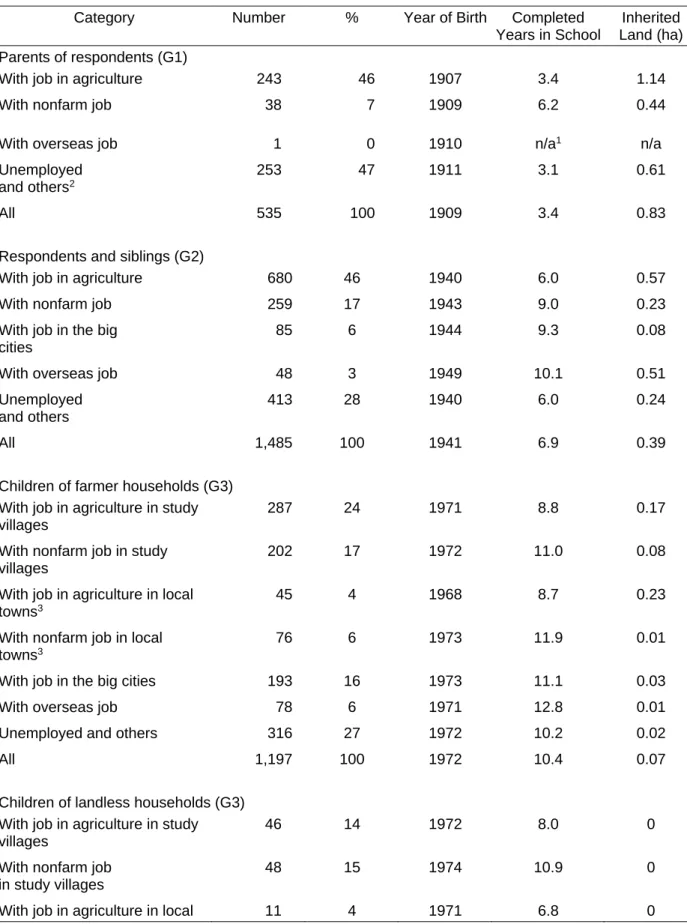
This is the case for landless households that do not have access to agricultural land, but have been able to finance their children's education by participating in the non-agricultural labor market. I collected data on three generations of members of the same household in four villages. Migrant children usually cluster in the northern and central parts of the country, where.
Landless children were more geographically mobile, residing in large cities, local towns and overseas. Therefore, the incidence of poverty and the depth of poverty were highest among children living in villages. Surprisingly, even those children remaining in the study villages received 65 percent of their income from non-agricultural sources, including non-agricultural wage income (44%) and remittances and other sources (21%).
Like G2, children with larger inherited agricultural land are more likely to choose farming in the village and local villages. Inherited farmland remains a decisive factor in the choice of farming over other occupations in the town and local villages. This section identifies the drivers of transformation and examines the associated strategic processes in four rice-growing villages in the Philippines.
Participation in the off-farm labor market and migration to local towns and cities are the main routes out of poverty for the landless poor. This paper explores the drivers and accompanying process of economic transformation in Asia with a particular focus on the Philippines. A microscopic view of economic transformation in four rice-growing villages in the Philippines reveals as drivers of economic transformation: (1) population pressure, (2) new rice technology, (3) land reform, (4) urbanization, and .
Household income composition of respondents and children in the study villages in the Philippines (annual income at USD PPP 2005).