Mahasarakham University has approved acceptance of this dissertation in partial fulfillment of the requirements for the PhD in Philosophy of Music. Anu, Director of Sunan District Culture Office, and others for their great help and support in my fieldwork.
Introduction
- Statement of the Problem
- Research Objectives
- Research Questions
- Importance of research
- Scope of study
- Definition of Clause
- Conceptual Framework
The author researches and studies the history and development of the Yugu people in Sunan County, Gansu Province, China, and the music of the Yugu people, and the promotion and protection of Yugu music culture. To explore a way to promote and preserve the Yugu music culture of the Yugu people in Sunan County, Gansu Province, China.
Literature Reviews
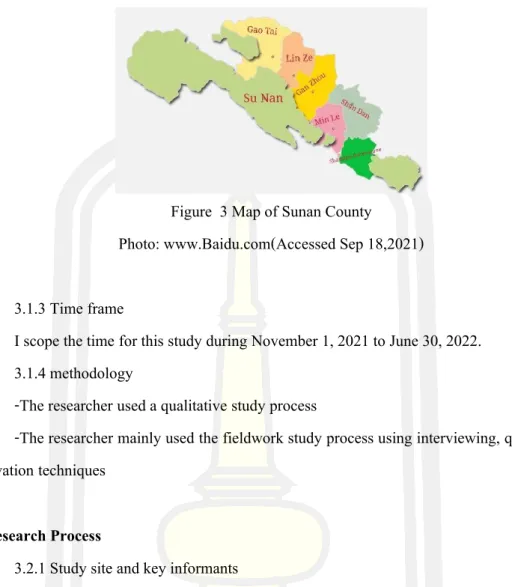
- Understand the basic situation of Sunan County, Gansu Province, China
- Understand yugu society and culture
- The theory used in this study
- Literature and research on Yugu music in various fields
Most Yugu people live in the Qilian Mountains, with an average altitude of about 3200 meters. Therefore, the Uyghur in Hexi is only one of the ancestors of the Yugu people.
The research methods
Research Scope
Research Process
Ms: Ayigis: Ayigis is a soprano of the Jugu ethnic group and a soloist of the Central National Song and Dance Troupe. She is one of the few singers of the Yugu ethnic group who can sing both original traditional Yugu songs and modern songs. To investigate and study the history and development of the Yugu people in Sunan County, Gansu Province, China, the music of the Yugu people and explore the way to protect the Yugu music culture.
In the third objective, the author investigated and interviewed a key informant and several general informants through field investigation, participant observation and in-depth interview to discuss the protection and heritage of Yugu music culture.

History and ethnic status of Yugu Nationality
The formation of the Yugu may have been influenced by the Uighur people in Hexi. In the early 11th century, the Uighur Khanate of Ganzhou was destroyed by Li Yuanhao of the Western Xia Dynasty. Therefore, the Uighur in Hexi is only one of the ancestors of the Yugur people.
Yugu people are mainly scattered in the northern foothills of the Qilian Mountains and the middle part of the Hexi Corridor.
Yugu culture and customs
The founding of the People's Republic of China and the effective implementation of ethnic policy gave the Yugu people a new lease of life. At the end of the Ming Dynasty, with the spread of Tibetan Buddhism, the Yugu people began to use Tibetan. After the founding of the People's Republic of China, the Chinese language was widely spread in the Yugu areas due to the extraordinary dynamics of national unity and ethnic communication, and the Yugu people widely used Chinese scripts, which formed the phenomenon of the sharing of the Yugu language and Chinese scripts. Due to the loss of the Yugu language, the entries of some Yugu languages are indicated in Chinese Pinyin in this document.
Due to language barriers and the sparse population of the Yugu ethnic group before the founding of the People's Republic of China, Tibetan Buddhism has undergone some changes since it was introduced to the Yugu region.
Development of Yugu folk songs in various historical periods
Tiemur and other members of the research office have made major contributions to the heritage of Yugu folk songs. It is clear that such an objective environment is very unfavorable for the survival and development of Yugu folk songs. The study and problem analysis of the current situation of Yugu folk songs are as follows: a.
In addition, the traditional folk songs of the Yugu people are compared with the new folk songs.
Yugu Music Analysis in Sunan Yugu Autonomous County, Gansu Province, China
Classification of Yugu folk songs
Main features of Yugu folk songs
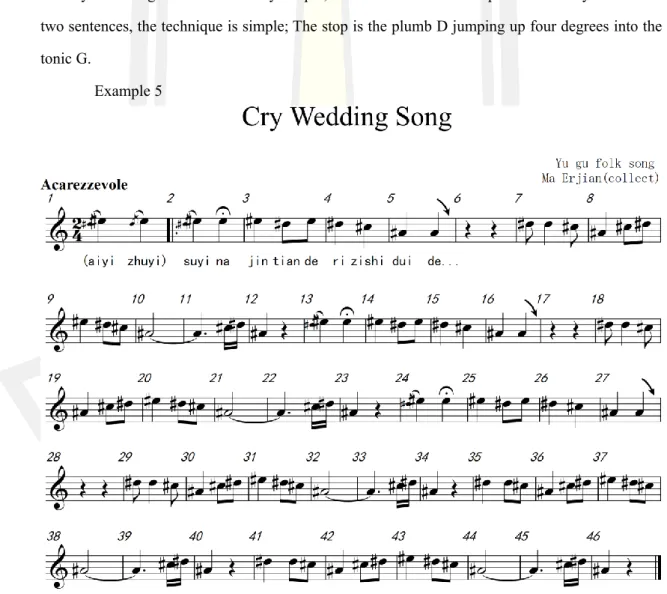
In general, Western folk songs use this technique more than Eastern folk songs to develop music. The syllables are mainly progressive and the jump is paved: progressive is the basis of the melody line of traditional yugu folk songs. Many folk songs consist almost exclusively of progressives, and the jump after progressives is usually four or five degrees up and down.
Musical analysis of yugu folk songs in Sunan, Gansu Province, China
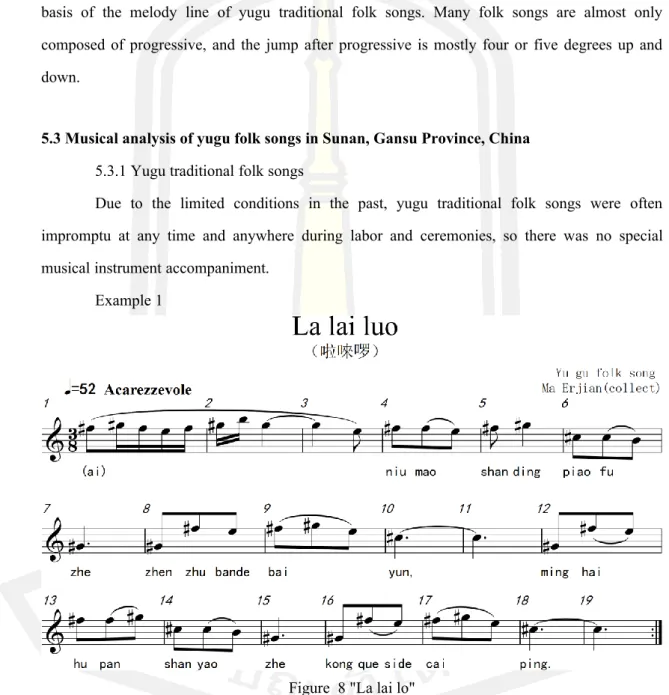
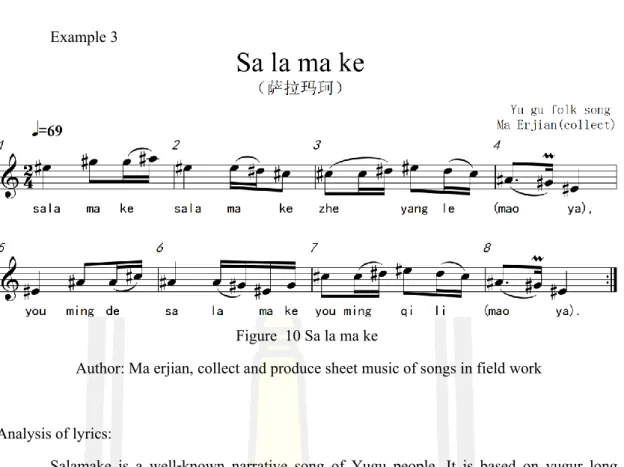
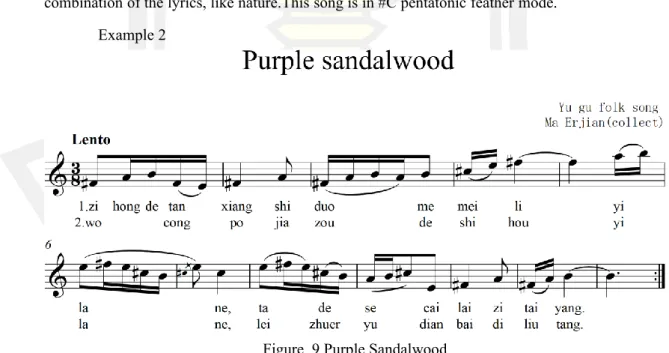
The first part has a cheerful introduction, repeated with the second part, and the mood of the two tunes is the same. This folk song is a traditional folk song in the tone of the song to fill the words, a body structure. The melody of the song is composed of the crown (e) of the melody and the auxiliary (d) of the melody, and the melody is the main motivation of the whole song.
The first movement (bars 3 and 4) is the expansion and development of the backbone notes b, d, e, at the beginning of the song.
Comparison between yugu traditional folk songs and new folk songs
Third, the living environment of the folk singers has an important influence on yugu folk songs. However, this is bound to change the natural state and original environment of Yugu folk songs. However, due to the loss of the Yugu script, Yugu folk songs have become an important means of inheritance.
However, very little has been discussed regarding the phonology of the Yugu language and the lubrication of Yugu folk songs.
Explore the inheritance and protection path of Yugu music culture in Sunan Yugu
Investigation and analysis of the existing situation of Yugu music
Throughout Yugu history, there were professional folk singers who specialized in performing Yugu folk songs. Established in June 2003, the Yugu Culture Research Bureau of Sunan District undertook the collection and classification of Yugu folk songs. When she was young, she often went on stage and sang different types of Yugu folk songs.
Now, yugu folk songs are only sung during gatherings of family and friends or weddings and funerals.

Research on the current inheritance mode of Yugu folk songs
76 Yugu folk songs are nourished by the vast pastoral areas and beautiful grasslands where shepherds express their feelings and sing with devotion. First of all, a large number of narrative songs in Yugu folk songs are an important part or form of expression of folk history and literature. For thousands of years, this mode of inheritance has played an important role in the inheritance and development of folk songs, which also keeps our folk songs alive.
81 These traditional ways of natural heritage have created the southern nation, where everyone can sing, and the beautiful, free and changing southern folk songs.
Analysis of adverse factors affecting the survival and development of Yugu folk songs
Geographical confinement and inconvenient transportation limit the direct and effective transmission and inheritance of southern folk songs to the outside world. It can be seen that the loss of the national language has become one of the important factors that hinders the survival and development of the southern folk song. It is understood that tuoyueyu had been waiting for UNESCO to record her yugu folk songs.
Second, the Yugu language is the lifeblood of the development of Yugu nationality and a key factor for the survival and continuation of Yugu folk songs.
Specific countermeasures for the inheritance and protection of Yugu folk songs
First, government departments should strengthen the protection of traditional Yugu folk songs and support and regulate the living environment of Yugu folk songs. Although the living environment of Yugu folk songs has changed, we can use artificial factors to create. Allowing students to learn to sing is the most direct and effective means of passing on Yugu folk songs.
Schools can hire excellent folk singers from Yugu ethnic group as after-school instructors to teach students to sing authentic Yugu folk songs.
Issues that should be taken into account in the process of inheriting Yugu folk songs
91 investigation tours in the autonomous region, collect all kinds of information about yugu folk song, yugu students in the attention of the defense, heritage and development of yugu folk song have further direction and goals. Now more and more people are constantly exploring the adaptive transformation of yugu folk song in the new era in order to inherit and develop the art of yugu folk song. However, those traditional southern folk songs, linked to the original way of production and life, once "developed" with the economic transformation, are no longer themselves.
Without its ecological environment, yugu folk songs will be nothing but an empty shell even if preserved.
Conclusion Discussion and recommendations
Conclusions on this study
From the perspective of the development of Yugu folk songs, it can be divided into five periods, namely (1) the Mobei period before 840 AD, and the production period of ancestral Yugu folk songs; (2) From 840 AD to the early 16th century, the gradual development of the art of Hui folk songs; (3) From the early 16th century to 1953, the excavation period of traditional folk songs of the Yugu people; (4) From 1953 to 1990, the fruitful period of Yugu folk song creation; (5) Since 1990, the nadir period of traditional folk songs of the Yugu people and the development period of newly created songs. Since the musical instruments of the Yugu people were lost, yugu folk songs have become the main means of inheriting the history, customs and culture of the Yugu people. The musical structure of Yugu folk songs basically belongs to a body part, most of which have very short melodies and are composed of two or more musical phrases.
In addition, some comparisons were made between traditional Yugu folk songs and new folk songs.
Discussion of Yugu folk songs
The unfavorable factors that affect the development of the southern folk song are: the isolation of the geographical environment; Loss of the language of the people; The development of modern economy and culture has gradually deteriorated the ecological environment of the influence of southern folk songs; The "people who sing and walk, and no one to follow" dilemma. As one of China's national intangible cultural heritages, southern folk songs are extremely precious, and to protect southern folk songs is to protect the exquisite and colorful Chinese culture. 97 harmony and short tone, similar to Mongolian folk songs; The folk songs of the southwestern people are soft, peaceful and deep, inheriting the tradition of western Uyghur folk songs.
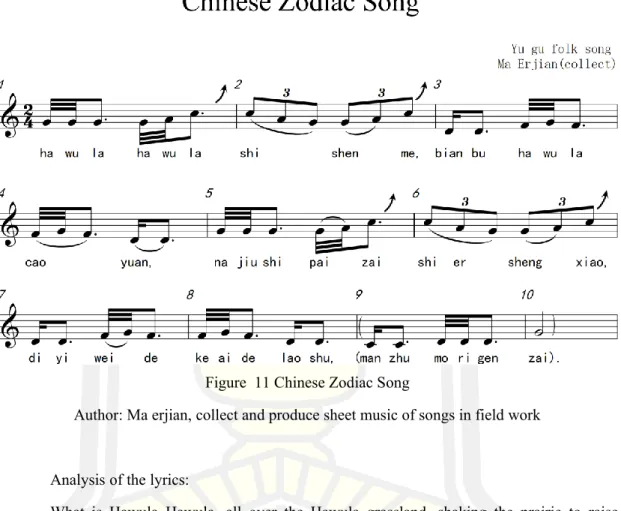
For example, because the word in Yugu has an accent on the last syllable, the rhythm with short front and back length often appears in folk songs.
Some suggestions for disseminators and researchers of Yugu music
Southern music has a long history and the systematic study and in-depth excavation of Southern music began around the beginning of the 20th century. Although many scholars have studied the historical development, cultural background, musical characteristics, and social functions of southern folk songs, only a very small number of scholars have engaged with southern folk songs from the perspectives of musicology and linguistic phonology. Starting from the phonology of the southern language and the lubrication of the southern folk song, make a detailed comparison of the southern language and the international phonetic alphabet and study in depth to discover the relationship between the southern pronunciation and the melody of the southern folk song, and finally enrich the technique of lubrication and the skill of singing southern folk songs.
You can delve into the study of the comparison between Yugu music and the music of ethnic minorities in the north, so that you can have a more detailed and comprehensive understanding of Yugu music and the relationship between them, so as to further promote and expand the influence and development vitality of Yugu music.