BRANDS AND GLOBAL BRANDS IN THE MOBILE PHONE. was submitted to the College of Management, Mahidol University for the degree of Master in Management. THAI CONSUMERS' PERCEPTION TOWARDS LOCAL BRANDS AND GLOBAL BRANDS IN THE MOBILE PHONE INDUSTRY IN BANGKOK NUMPON STONSAOVAPAK 5649218. The main purpose of this study is to investigate and understand Bangkok's mobile phone users. perceptions towards local brands and global brands.
Furthermore, to investigate the important factors of mobile phone characteristics, which are considered for the purchase of mobile phones by users and the effects of the country of origin in the mobile phone industry in Bangkok. Data were analyzed through descriptive analysis to summarize the characteristics of the sample and to compare the brand characteristics of each selected mobile phone. In the past, only the famous mobile phone companies invested and expanded their markets in Thailand.
Consumers are likely to have different perceptions towards local and global brands, which influence their purchase decision. Therefore, studying consumer perceptions of local and global brands in this industry has significant implications for developing marketing strategy for the successful introduction of a brand, whether local or global, to this aggressively competitive market. Furthermore, since a consumer's preference for a certain product is also influenced by his country of origin and the consumer's own ethnocentrism, it is essential to examine the effects of the country of origin and the consumer's ethnocentrism on the consumer's decision to understand a mobile phone for sale.
This study aims to understand mobile phone users in Bangkok regarding their perception of local and global brands and understand the criteria for decision making to purchase their mobile.
Study objective
LITERATURE REVIEW
- Branding and brand attributes
- Local brands Vs. Global brands
- Definition of Local and Global brand
- Global brand Vs. Local brand
- Country of Origin
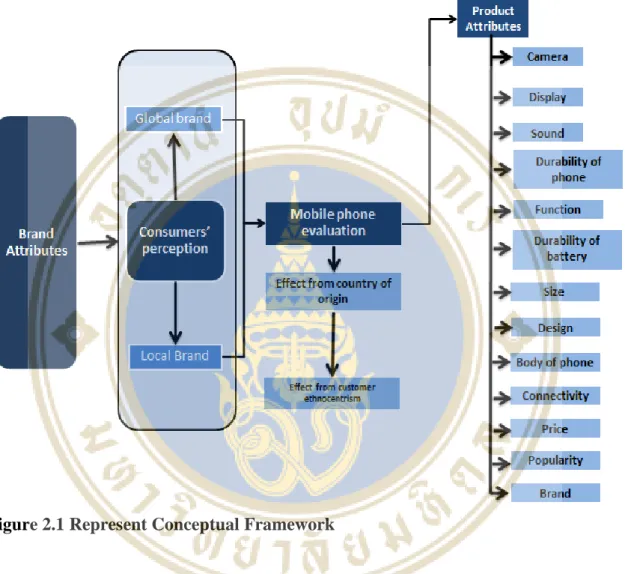
- Customer Evaluation and Product Attributes
According to Schuiling and Kapferer (2004), local brands are brands that exist in one country or a limited geographical area. On the other hand, global brands are brands that have globalized elements of marketing strategy. In another sense, global brands are defined as brands that use the same marketing strategy for all target markets.
Thus, local brands are distinct from brands that exist in one country or in a limited environmental region. Therefore, some groups of consumers may prefer local brands while other groups prefer global brands. According to Bilkey and Nes (1982), the preference for local and global brands varies from developed countries to less developed countries.
It is interesting to investigate the perception of consumers in Bangkok towards the global brands and local brands. According to Moslehpour and Kien Pham (2014), Taiwanese consumers are willing to purchase high quality foreign well-known brands at high prices because of their perception that global brands are imbued with high reliability, quality and performance. Global brands are able to realize economies of scale from the global market (Johansson and Ronkainen, 2004).
Global brands are perceived by consumers as adding more value in terms of better quality, but also as more advanced and modern (Johansson and Ronkainen, 2004). Local Brand: Local brands benefit from better value and a trusted perception as the prices of the local brands are usually lower than those of global brands; Moreover, local brands, due to their good image and value for money, create trust in the minds of consumers (Schuiling and Kapferer, 2004).
Local brands link products to local tradition and local culture more closely than international brands, so local brands are considered traditional brands. It appears that consumers' perceptions and preference towards local and global brands differ; therefore, it is interesting to understand the characteristics and nature of such perceptions and preferences, especially those held by consumers living in Bangkok. In order to understand the consumer's perceptions towards local brands and global brands, it is essential to examine the consumer product evaluation.
RESEARCH METHODOLOGY
Research method discussion
The researcher's target number of respondents for this study is 400 respondents through online survey, to represent Bangkok's population characteristics. Bangkok's population is approximately 10 million people, and Bangkok is the center of trade and business in Thailand.
Questionnaire design
Data analysis method
Consumers in Bangkok are sophisticated and individualistic, often buying imported or domestic brands. The second method is “factor analysis” to find the percentage of Eigen values to analyze the most important components in customers' decision to buy mobile phones, both global brands and local brands.
DATA ANALYSIS
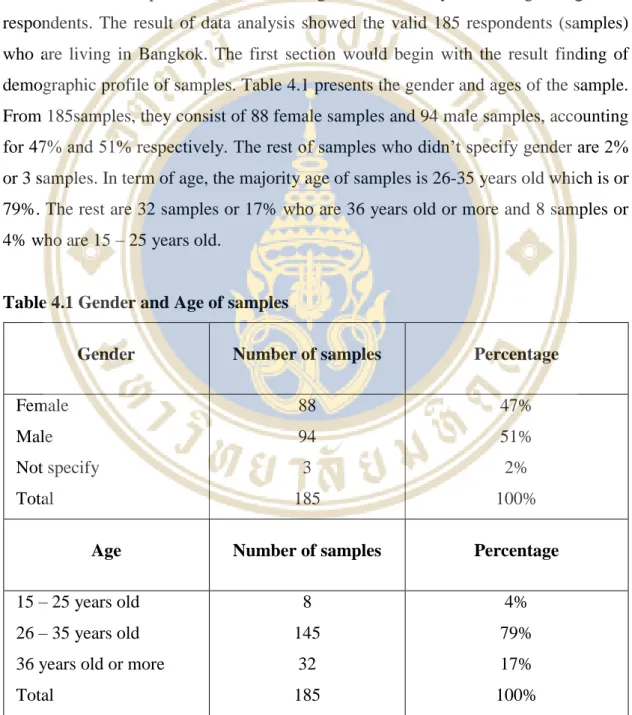
Characteristics of samples
According to Figure 4.1, in terms of monthly income (after tax, total household, from salary and other sources), most of the samples which are 101 samples or 55% have monthly income more than 50,000 baht.
Income per month (after tax, total household, from salary and other sources)
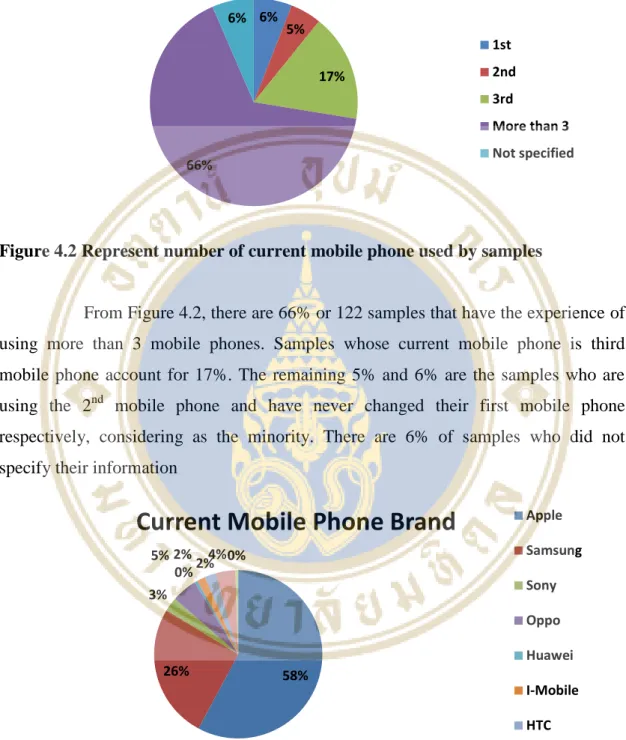
From Figure 4.2 there are 66% or 122 samples who have the experience of using more than 3 mobile phones. The remaining 5% and 6% are the samples who use the 2nd mobile phone and never changed their first mobile phone respectively, considered as the minority.
Number of current mobile phone used by samples
Current Mobile Phone Brand Apple
- Product Attributes
- Country of Origin
- Brand perception toward global brands and local brands
- Overall results
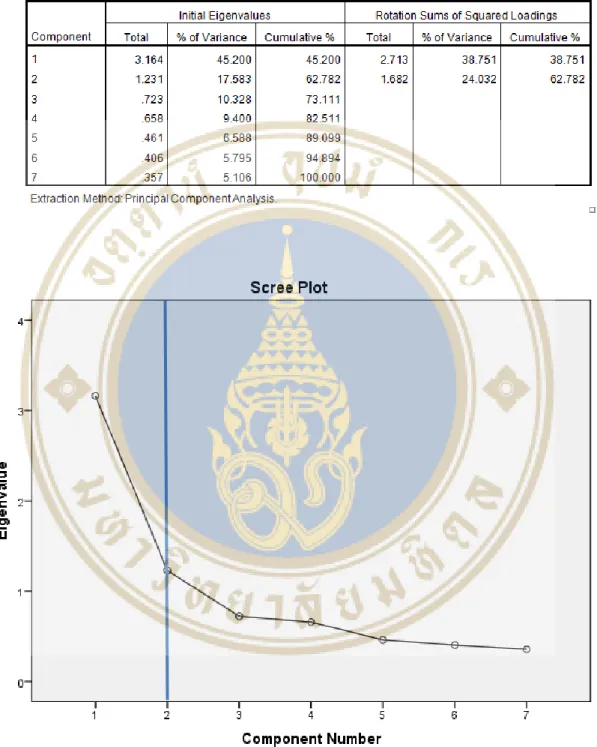
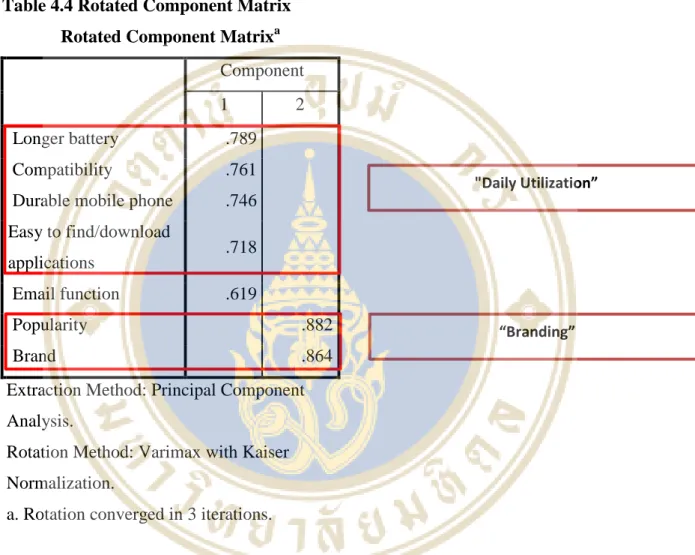
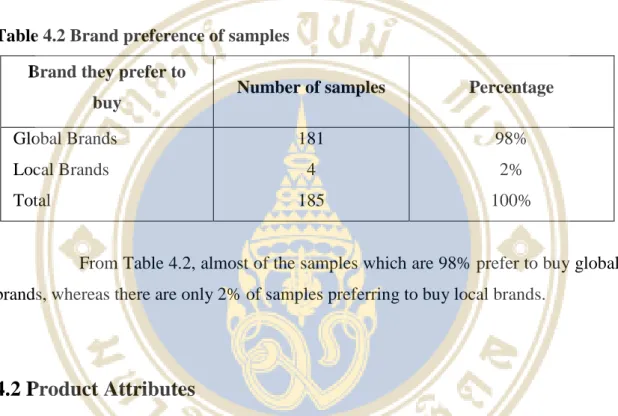
Table 4.2 shows that most samples (98%) prefer to buy global brands, while only 2% of samples prefer to buy local brands. In Figure 4.4, the Scree chart shows two important component numbers of product features, which have an Eigenvalue greater than 1 and influence the consumer when purchasing a mobile phone. The first component that affects consumers when purchasing a mobile phone is 'Daily Use' and the second component is 'Branding'.
In terms of "Daily Use", the factors consist of longer battery life, compatibility, durability, easy to find/download apps, email functions. For Branding, the factors consist of the popularity and brand of the mobile phone. These two components are considered as the factor that can influence and relate to the decision of consumers when purchasing the mobile phone.
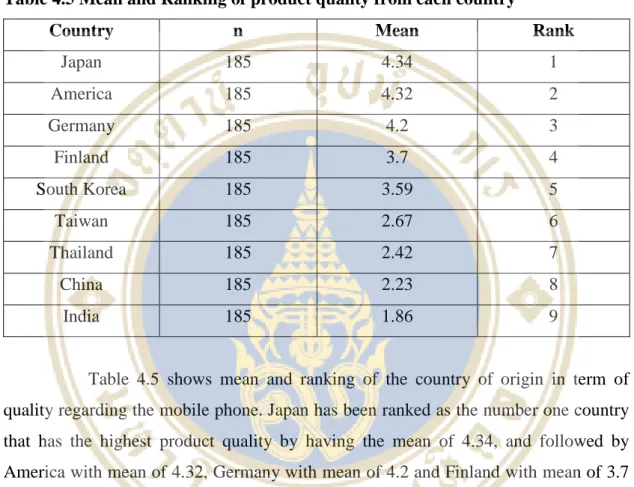
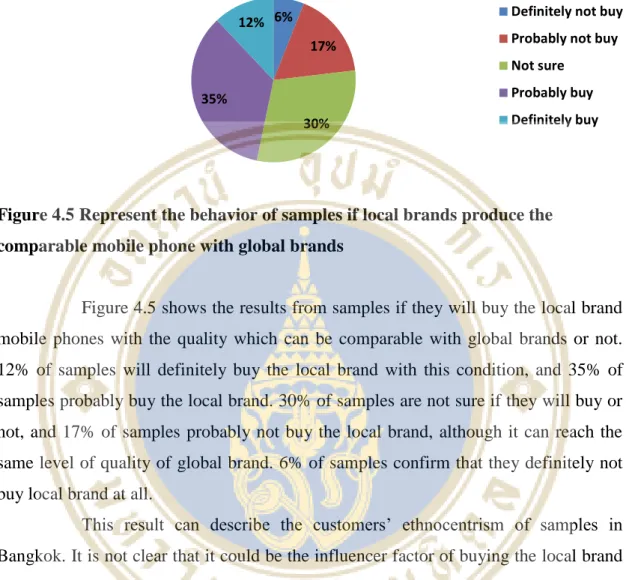
South Korea averaged 3.59, ranking fifth and the highest ranking of Asian countries, excluding Japan. 12% of the sample will definitely buy the local brand under this condition, and 35% of the sample probably buy the local brand. 30% of the samples are not sure whether to buy or not, and 17% of the samples probably do not buy the domestic brand, although it can achieve the same level of quality of the global brand.
It is not clear whether buying a local brand instead of a global brand could be the influencing factor, as there are 30% of the sample who are still not sure whether they will buy or not. If local brands produce mobile phones of comparable quality to global brands, which of the following would describe your behavior. Consumers almost equally perceived the durability of HTC and I-Mobile, and Huawei and Oppo as breakable mobile phones.
From the survey results, the researcher found that most samples have an income of more than 15,000 baht/month, which is above the average income of 13581.09 baht/month in the fourth quarter of 2014. http://www.tradingeconomics .com/thailand/ wages). Most samples have experienced buying a mobile phone more than 2 times in their life, and 66% had bought a mobile phone more than 3 times. At present, regarding the "Daily Use" factors, the researcher found which consists of longer battery, compatibility, durability, easy to find / download applications; e-mail functions are put into the mobile phone.
These things are considered attributes that cell phone suppliers must provide to consumers. The results of sample perception towards the selected mobile phone brands can reflect the gap between individual brands in the minds of consumers in each dimension.
DISCUSSION AND RECOMMENDATION
Discussion
This is a conflict from Batra, (2000) who mentioned that country of origin can create halo effects with customers, especially for global brands. In the mobile phone industry in Bangkok, Thailand, the country of origin cannot influence the customer's perception of the quality of the mobile phone product. In addition to the perceptions of the individual selected brand, another influencing factor is the difference, and the extent of the difference can be seen by the researcher from the research of the six dimensions of the selected perceptions of the individual selected brand.
Therefore, researcher wants to discuss about the rest and how far they are from each other. From Table 5.1, the researcher can see that Oppo, the only one of local brands, can compete with HTC and Sony, global brands, in many dimensions. Sony is very outstanding in terms of durability and can satisfy the rugged lifestyle people, but mostly do not live in Bangkok.
If researcher classified brand perception as the main factor to buy mobile phones for customers and look at the number of Oppo's users. A marketer should consider and focus more on the sophisticated and trendy perception of customers. For I-Mobile, it scores medium in terms of durability, sincerity and value for money.
Huawei, it is a very young brand in Thailand, but this brand is very famous in China. Also, the country of origin may not create this bad perception for samples, but the brand itself creates this perception for customers.

Contributions and Implications
They should emphasize the origin of the brand, which can influence customer perception more easily, quickly and powerfully.
Limitations and Future Research
2005) "Factors influencing consumer choice of mobile phones: Two studies from Finland", Journal of Euromarketing, Vol. 1988) Consumer Behavior: Concepts and Applications, New York: McGraw-Hill. Sarif Ibrahim (2008), "Products and Country of Origin Effects: The Malaysian Consumers' Perception", International Review of Business Research Papers Vol.
APPENDICES
APPENDIX A: QUESTIONAIRE
Please rate how you perceive quality in each of the following countries of origin (1 means very poor quality and 5 means very good quality). If local brands produced the mobile phone of comparable quality to global brands, which of the following would describe your behavior.