First of all, I would like to thank the Chinese company's employees and their stakeholders for initially giving me the opportunity to obtain such useful information and insight into their corporate culture. In addition, I am also grateful that my friend who works at the Chinese company helped me arrange the job interview appointment and gave me an idea and suggestion in this thematic article. Your motivation and advice are a huge help to me in completing this thematic article.
The purpose of this study was to find the influences of culture on the corporate sustainability practices. The result of this study was based on one small Chinese company in Thailand and the research could be varied with different company conditions. They are aware of the benefits that corporate sustainability can bring to their company, as the concept of sustainability combines the environmental, social, financial, ethical, legal and political issues that can be both internal and external to the company.
Culture is an interesting topic to study as all counties or even different groups of people in the same country have a very unique culture. Culture is the complex whole which includes knowledge, belief, art, law, morals, customs and any other abilities and habits acquired by man as a member of society.

Problem Statement
It is a prerequisite for cultural psychology that when people live differently in the world, it may be that they live in different worlds. How a small Chinese company develops sustainability practices such as working conditions, ethical behavior, long-term perspective and environmental responsibility. The qualitative research approach will be carried out in this paper by interviewing the company's stakeholders.
The research findings will include sustainable practices implemented by a small Chinese company and cultural factors that influence the company's decision to adopt a sustainable approach to market completion.
LITERATURE REVIEW
Avery and Bergsteiner’s Sustainable Leadership Practices
- Long-term perspective
- Staff Development
- Organizational culture
- Innovation
- Social Responsibility
- Ethical behavior
Honeybee's management and its stakeholders do not expect even a well-managed firm to grow every quarter, which allows management to invest for the long term. They prefer to grow their own managers and leaders, develop their own employees instead of hiring outsiders. Companies often manage their culture through vision, values, and/or philosophy statements designed to express core beliefs and informal rules that guide members' behavior (Avery, 2005).
Beekeeping organizations are a “special place to work” due to their strong culture (Avery, 2005), and their long-term perspective allows Rhineland organizations more time to communicate a vision and implement it. A radical or breakthrough innovation is one that has a significant impact on the market and the economic activity of companies in that market, while an incremental innovation concerns an existing product, service, process, organization or method whose efficiency has been significantly improved or upgraded. The nature of innovation and the rate of technological change vary greatly from sector to sector and across countries and times.
OECD, 2012) Rhineland enterprises are champions of both types of innovation (Avery, 2005; Lawler et al., 1995), which helps make them successful. Even though there are many problems in doing the business, they prefer to do the right thing or ethical behavior and avoid making an unethical move. Basically, ethical behavior involves "doing the right thing" and is strongly evident among Rhineland enterprises.
Strong, systemic, strategic innovation evident at all levels Values emotionally engaged staff and the resulting. Change is a quick adjustment, fleeting, can be ad hoc. Follows the will of his masters, often slavishly. The culture is weak, other than a focus on short-term results that may or may not be shared. Limits knowledge to a few.
Innovation is limited and selective; buys in expertise Financial rewards are enough as a motivator, no emotional commitment is expected It's a matter of control.

Hofstede's cultural dimensions theory
- Power Distance
- Individualism
- Masculinity
- Uncertainty Avoidance
- Long Term Orientation
A fundamental issue addressed by this dimension is the degree of interdependence that society maintains among its members. It has to do with whether people's self-image is defined in terms of "I" or "we". At a score of 20, China is a very collectivist culture where people act in the interest of the group and not necessarily for themselves.
A high score (masculine) on this dimension indicates that society will be driven by competition, achievement and success, where success will be defined by the winner/best in the field – a value system that begins in school and continues throughout organizational life. A low score (Feminine) on the dimension means that the dominant values in society are caring for others and quality of life. Women's society is one where quality of life is a sign of success and standing out from the crowd is not worthy of admiration.
The fundamental question here is what motivates people, the desire to be the best (male) or liking what you do (female). The need to ensure success can be illustrated by the fact that many Chinese will sacrifice family and leisure time for work. Another example is that Chinese students care a lot about their exam results and ranking, as this is the main criterion for success or failure.
Uncertainty avoidance is about how a society deals with the fact that the future can never be known: should we try to control the future or just let it happen. Truth can be relative even though in close social circles there is concern for Truth. However, compliance with laws and regulations can be flexible to suit the actual situation and pragmatism is a fact of life.
This dimension describes how each society must maintain some connection with its past while dealing with the challenges of the present and the future, and societies prioritize these two existential goals in different ways.
METHODOLOGY
Research Design
Data Collection Methodology
- Interview methodology
- Interview question
- Population
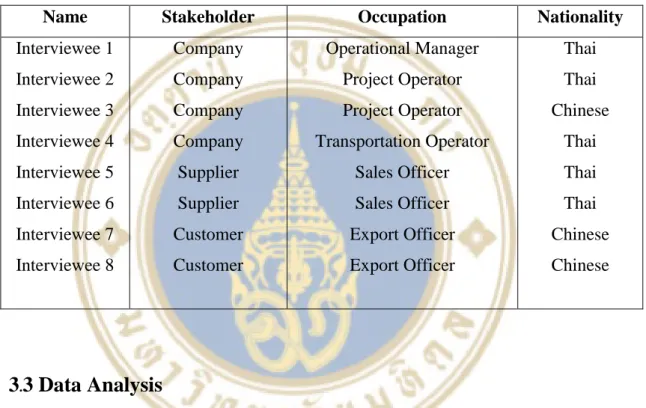
This section will ask interviewees more specifically about their experience with the company regarding sustainability practices. The answer includes history, knowledge and opinions which may differ as all interviewees have different experiences and aspects with the company. This research population focuses on company stakeholders such as management, employee, customer and supplier as this group of stakeholders has experience with company policy and their way of doing business at different levels and a number of aspects.
To avoid the bias of the employees towards the management of the company, external parties such as the customer are included in the interview to gain different aspects of the sustainability of the company's practices.
Data Analysis
FINDINGS
The company does focus on long-term goal and invest in the inputs to reach the target. The company also values a long-term relationship with some group of stakeholders such as customers and the government. Most of their customers are those who have a good relationship with the company or a staff in the company.
Most of our clients in the portfolio are those who have a long relationship with Thai and Chinese staff in the company. The company may have some sort of emergency response plan, but they never communicated with us." ~ Interviewee 2. However, the company does not provide other types of training that are not relevant to work.” ~ Interviewer 2.
Therefore, the company has difficulty in retaining people who have been working for 3-4 years. But there is also a bright side to the company, as they emphasize building a relationship with staff. In addition to the personnel development program, the company gives employees a certain degree of freedom in performing their work.
Although there are about 60 people working in the company, the background of the employees is diverse, so it is very important to have the same understanding. In the past, the company has faced an illegal act from one of their suppliers and the supplier was later taken to court. The company encourages its employees to do the right thing and follow regulations.
The company's ethical principles focus on being an ethical corporate person rather than on social responsibility to a wide range of stakeholders.
CONCLUSION
Conclusion
For social responsibility, the company does not include a wide range of stakeholders in their consideration. There is also no data to show that the company has carried out some CSR activities in the past. They ensure that employees do the right thing and avoid any illegal actions at all costs.
Chinese want to make sure they have a good relationship with opposites before doing business with them. While Thai companies may also value relationships, they will not put relationships as the highest priority in doing business. For Chinese companies, since Chinese have a very high level of masculinity, there are more competitive than Thai companies.
They are willing to fight more on price or speed to win over their competitors, while Thai companies are more relaxed. If Thai companies have influences from Thai culture, based on Hofstede's cultural dimension theory, they will do business with femininity characteristics such as easy-going or more flexible. The person or company looking to do business with a Chinese company must consider their nature, strengths and weaknesses.
Based on the findings, it can be concluded that people working with or seeking employment in Chinese companies will need to consider that not all Chinese companies use practices that lead them to become a sustainable organization. They value Chinese culture very much and intend to pass this culture on to the next generation in order to preserve its original roots. Therefore, it is difficult to motivate the establishment of practices that lead to a sustainable organization while maintaining a close relationship with Chinese culture.
Recommendations
Limitations and suggestions for future research