This article summarizes the insights into consumer acceptance of hybrid electric vehicles (HEVs) gained from a literature review. In the United States, hybrid electric vehicles (HEVS) have already been accepted as a mainstream transportation option with close to a million hybrids on the road (Sanjaka G. Wirasingha, Nigel Schofield, and Ali Emadi, 2008). Hybrid electric vehicles contain a unique powertrain that combines a gasoline engine with an electric motor and battery system.
A hybrid-electric engine uses less gasoline and emits less pollution per mile than a traditional internal combustion engine with similar performance. As such, hybrid-electric vehicles can have significant public benefits for both the environment and energy security. The researcher has chosen to study hybrid electric cars (HEV) in Thailand mainly because, Thailand still faces the uncertainty of the uncontrollable factor related to the fluctuation of oil prices, the increase of car taxes in 2016 and there is still a possibility of increase of the market. and the potential hybrid electric vehicle (HEV) market.

Economic Advantage: Lower Fuel Consumption
Antonio et al (2009) suggested that due to the environmental consciousness that has developed over time, studies on green consumerism will be the main focus in the future, which will lead to identifying the attitudes, behaviors and consumer intentions.
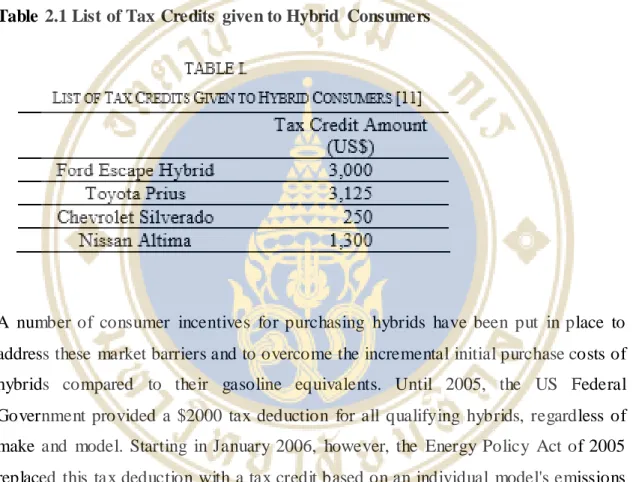
For example, they accelerated the purchase of their HEVs to maximize their federal tax credit. Bridger recalls cheerfully confirming that he had bought a "green vehicle". While he wasn't sure exactly how much his HEV reduced air pollution, the software confirmed that the vehicle was rated "green" in the US. Research shows that at least some HEV owners buy their vehicles because the cars have a "green image", perceived as.
However, it is unclear how important the symbolic benefits of HEVs were to these consumers, and whether these benefits had a major impact on their purchase decisions. Although this suggests the strong importance of symbolic benefits, further investigation is needed to confirm the existence of these symbolic benefits and the extent of their influence on HEV purchases. (Reid R. Heffner, Kenneth S. Kurani, and Thomas S. Turrentine, 2005). According to Deffuant et al. 2005), individuals assign a social value to products, which develops during their interactions with others and with information.
All participants recognized some symbolic benefits rooted in their HEVs. reputation as "green" eco-cars, an image reinforced by automakers, the media and a growing list of vocal celebrity owners. In other words, HEV owners saw their vehicles as having functionality that reduced their impact on the environment, and they also believed that the vehicles projected an image of their owners as people who cared about conserving precious natural resources and preserving the natural ecosystem. The communicative ability of HEVs was recognized by most participants; as one household explained, hybrids are a "way to express feelings about the environment", a clear reference to sending a message to others.
It is important to note that several participants were aware of this “green image” even though they believed it did not apply to them or had not influenced their purchase. Two households even saw. green image" as a potential liability, believing that others might perceive their cars as "too progressive" or representative of radical political views.
Performance and Safety
In these cases, the meaning that participants saw in their HEVs was different from the images they had of themselves, potential evidence of self-image incongruence in certain households. In a parallel hybrid, microprocessor controls switch between power from the engine and power from the battery. During low power driving, when the gasoline engine is least efficient, the electric motor kicks in and draws supplemental power from the battery.
Parallel hybrids can use smaller, less powerful engines compared to conventional internal combustion engine vehicles (ICEVs) because the battery system supplements the engine. Some hybrid designs also use the battery and electric motor to supplement power from the ICE during high-power driving to further reduce engine size requirements. The engine of a parallel hybrid is often reduced by perhaps two-thirds compared to the size used in a conventional vehicle. (Kathryn G. Clay, 2004).
Cherian and Jacob (2012) found that consumers with low awareness and still do not focus on the development of fuel efficient vehicle products because consumers lack knowledge. It also requires the manufacturers to comprehensively communicate the presence and benefits of fuel efficient vehicles to the customers through various tools available for integrated marketing communication. The cost of maintaining a hybrid car is actually very similar to the expense of maintaining an ICE car.
In addition, full hybrids have the ability to stop the engine, allowing the electric motor to take over, resulting in less wear and tear on all engine components, allowing for less maintenance (Mohummud Khaled Bhunnoo, Vanisha Oogarah-Hanuman and Rooma RoshneeRamsaran-Fowdar, 2012). However, with the development of battery technology (NiMH and Li-ion) and reliability, most hybrid manufacturers warrant batteries for 80,000 to 100,000 miles.
Research Framework
Aside from their advanced electric drive motors and large battery pack, all other hybrid vehicle systems are actually quite similar to traditional cars. With regenerative braking, less wear is caused to regular friction brakes, resulting in a much longer lifespan of the brake pads. The one area where the maintenance costs of hybrids can easily exceed those of conventional vehicles are electric drive battery packs (Hybridcars.com, 2006).
As more and more hybrids hit the roads, real world experience shows that few battery failures occur and there have been cases where the batteries have lasted 150,000 miles and more (Toyota, 2006). Based on the above literature review, four factors have been identified that represent customers' purchase intention and consumers' attitude towards Hybrid Electric Vehicles (HEVs), which are: Economic Benefit, Environmental Benefit, Community and Performance and Safety. These four factors provided further customer insights of hybrid electric vehicles (HEVs) that economy and fuel price may play a role in their assessment.
The community will also likely play a role when potential users evaluate the possibility of converting their cars to hybrid electric vehicles (HEVs).
RESEARCH METHODOLOGY
Data Collection
Interview Questions
How does rising retail oil prices affect your motivation to switch from car to hybrid. What influence does the increasing tax policy in 2014 have on your motivation to switch from cat to hybrid car? What do you think is the difference between a hybrid car and a normal car in terms of safety and performance?
How do you see hybrid electric vehicles (HEVS) as an environmentally friendly product? What do you think are the most important sources of information you access before making a decision to purchase a hybrid electric vehicle (HEVS). In addition, they provide respondents with an opportunity to express themselves more openly and encourage respondents to provide information, including their ideas, concerns, feelings and sharing of their own experiences.
Methodology Interviews
FINDINGS AND DISCUSSION
- Economic Advantage
- Environment Advantage
- Community Group (Expertise, Friends and Others)
- Performance and Safety
- Limitations
However, there were few interviews that were interesting and would change their car from pure benzene to a hybrid car. Therefore, most of the respondents still have not accepted and are interested in the hybrid car system in terms of performance and benefits. Research question no. 2: What are the factors influencing customers' persuasion to convert a hybrid car in Thailand.
From the discussion with the interviewees, it can be identified that there are four important factors that may encourage the non-user hybrid car to convert their car in the Thai market, which are: Economic benefit due to the benzene appears to be in daily collect. Reference group also plays an important role of reliability and confidence in terms of image and quality, which is one of four factors that play a role for the prospective customers who were willing to convert their car into hybrid cars in the Thailand market. From the discussion with the majority of interviewees, they provided more insights on the issue of understanding the overall attitude of the Thai consumers towards hybrid cars.
The obvious result shows that Thai consumers are very distrustful of the environmentally friendly hybrid car. The reason given by the interviewees for not changing their car was because they were afraid that the power or acceleration of the hybrid car was lower than that of the conventional car. Another interviewee mentioned the dangers in a hybrid car during the rainy season or in case of floods.
One of the interviewees also mentioned that the salesperson at the dealership plays an important role in convincing the counselor to tell about the new information and updated benefits of using hybrid cars. Before the transferability of this article's results to hybrid car adoption in Thailand can be discussed, it is necessary to point out the limitations of this empirical data. The vehicle manufacturers and car dealers in Thailand should conduct heavy campaigns to encourage consumers the benefit of using hybrid cars with knowledge of hybrid cars because a majority of Thai consumers are not sure about the performance and safety of the hybrid car.
Second, this research was done to collect information using qualitative strategy to collect the in-depth understanding of customer perception and possibly convert their car to use hybrid cars.
CONCLUSION AND RECOMMENDATIONS
Reference Group had some relevance in our studies and literature; it is usually ranked first. Thus, it is likely that the reference group has a greater potential to fulfill motivation, such as showing personal willingness to influence potential consumers to convert the vehicle to electric vehicles (HEVs). Furthermore, the researcher's analyzes suggest that the experience as communicated by other users appears to be one of the most important factors in increasing the perceived reliability and safety of a technology, thus increasing its perceived usefulness and ease of use, as mentioned above in our findings and discussion. result.
On this basis, we recommend creating possibilities for informal social interaction around hybrid cars as an important element for successful marketing. Users with direct experience seem to place strong trust in first-hand information from other users – in this respect, projects such as the field trials that are currently a popular tool appear to be very promising. In addition, setting up and promoting Internet forums on hybrid cars is another way to establish contacts between users and potential users.