50 Table 9 Accuracy performance (%) of the ACO algorithms on the mulberry leaf dataset when applying learning rate schedule and training at different fitness. 56 Table 12 Accuracy performance (%) of the ACO algorithms on the Turkey plant dataset when applying learning rate schedule and training at different fitness.
Introduction
- Introduction
- Research Aim
- Research Questions
- Contributions
- The Automated Plant Leaf Image Recognition System
The first part of the thesis concentrated on the traditional method of image processing and machine learning techniques. The traditional framework for image processing and machine learning techniques is shown in Figure 5.
Plant Leaf Image Recognition using Feature Extraction and Machine
- Introduction
- Proposed Plant Leaf Recognition Method
- Plant Leaf Dataset
- Experimental Results
- Conclusion
Preprocessing plant leaf images from the Folio dataset is very simple. In this experiment, 10-fold cross-validation was examined to evaluate the results of the plant leaf recognition methods.
Ensemble Learning Methods with Deep Convolutional Neural Networks . 19
Related Work
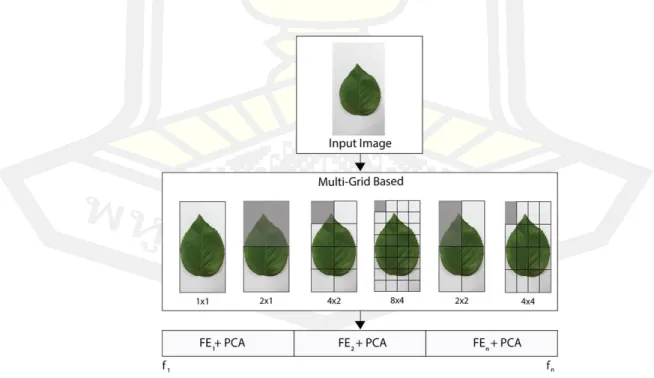
The feature vector was extracted from the leaf shape using Hu geometric and Zernike orthogonal moments. The feature vector was also extracted from the shape, color, edge, and orientation of the plant leaf (Patil, Pattanshetty, & Nandyal, 2013 ; Wang et al., 2008 ). The feature vector was recognized using machine learning techniques such as K-nearest neighbor (KNN) and support vector machine (SVM). 2020) presented a multi-grid method that divided plant leaf images into sub-regions.
The modified GoogLeNet architecture performed better with leaf image dataset and corrupted leaf image. 2017) proposed using AlexNet and GoogLeNet for three plant leaf datasets: AgrilPlant, LeafSnap and Folio. As a result, AgrilPlant's results were 97.27% with fine-tuned AlexNet and 98.60% with fine-tuned GoogLeNet.
Ensemble Convolutional Neural Networks Framework
The bottleneck structure is implemented and directly affects the reduction of the number of parameters. Also, the number of parameters of the DenseNet architecture is less than that of the ResNet architecture. Second, we averaged all the probability values of the CNN models and selected the highest probability as the result.
The weighted average method is the extended version of the unweighted average by multiplying the different weight values with the CNN outputs (Harangi, 2018). The equation of the weighted average method is given by 𝑝′ = 1𝑛∑𝑛𝑖=1𝛼𝑖𝑦⃗, where α is the weight values multiplied by the weight vector 𝑦⃗ and n is the number of ensemble CNN models.
Plant Leaf Datasets
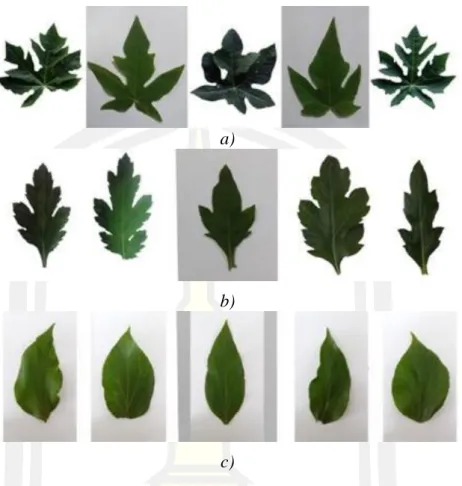
Three cultivars of Australia consist of King Red (500 images), King White (350 images) and BlackAustralia (637 images). Note that mulberry experts recommended examining each mulberry variety to label the data and avoid errors due to the similarity pattern and shape of the leaves. The PlantVillage dataset is a collection of plant images, proposed by Penn State University (Hughes & Salathé, 2015), collecting various plant leaves and plant leaf diseases.
One healthy category has 1162 images and three corn leaf diseases: 513 images of cercospora leaf spot, gray leaf spot, 1192 images of common rust, and 985 images of northern leaf blight.

Experimental Setup and Results
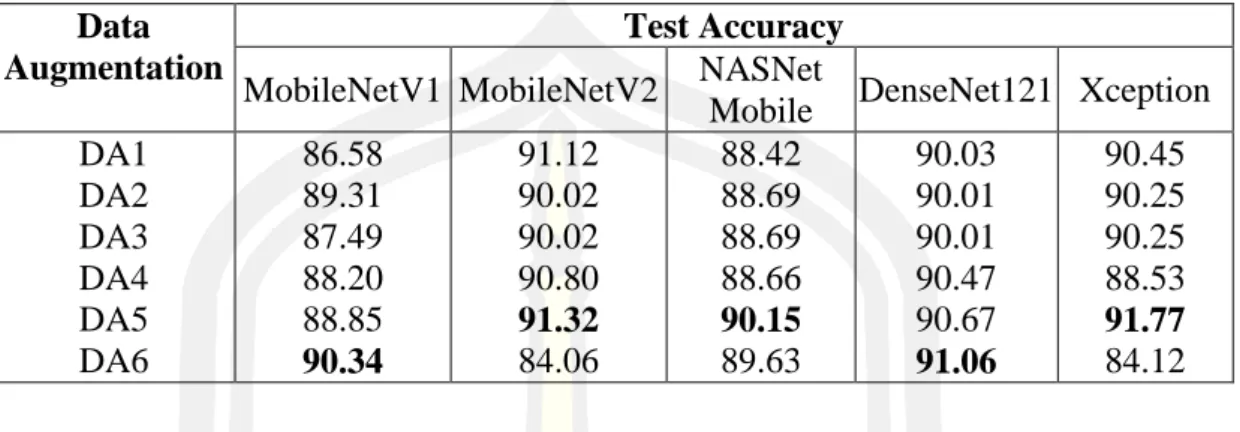
The best data augmentation techniques we found from Table 4 were also applied to training the CNNs. In these experiments, we considered training the CNN models using the data augmentation and without Table 5 Performance evaluation of the CNNs on the tomato leaf disease dataset. The results showed that using data augmentation, the DenseNet121 and Xception outperformed all CNN models with an accuracy of 99.87%.
This shows that Xception in combination with mixed data augmentation techniques (DA6) yielded an accuracy of 99.22%. On the other hand, the recognition performance applying the data augmentation technique was 99.93% on the tomato leaf disease dataset.
Conclusion
The results lead us to conclude that ensemble methods can increase the performance of CNN architectures. In our best experiments, data augmentation techniques: Height Shift, Vertical Flip and Fill Mode, can slightly improve the performance of CNN models, especially significantly increasing the efficiency of the Xception model. The highest accuracy of 94.75% was obtained with the mulberry leaf dataset because the tomato and corn leaf blight images contained only one leaf in the image (see Figure 16 and Figure 17 ) while the mulberry leaf images are taken from the natural environment with different angles, sunlight conditions and some leaves appear in the image (Figure 14 Illustration of the mulberry field area in Thailand was collected as a dataset in this study consisting of Maha Sarakham, Buriram , Nakhon Ratchasima and Phitsanulok and Chiang Mai.).
There is still a lack of improving the accuracy of the mulberry leaf dataset because the ensemble CNN method only achieved 94.75% accuracy. The model selection method is a necessary process proposed to discover robust models that improve the performance of recognition systems.
Introduction
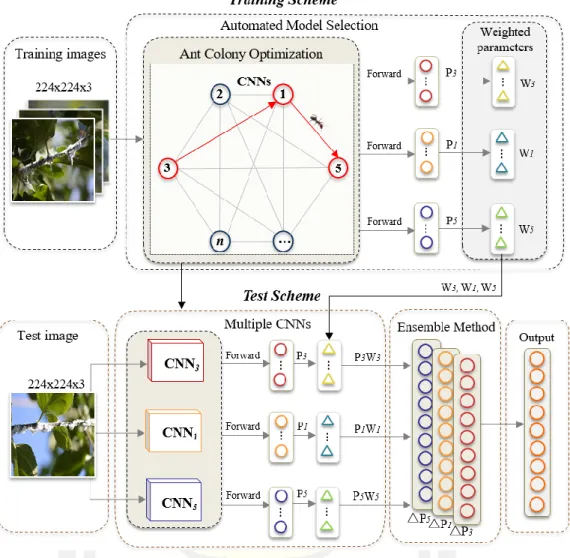
The advantage of the evolutionary ACO algorithm is that it guarantees the selection of the set of robust CNN models every execution time, because the new fitness function and learning rate schedule embedded in the ACO algorithm increases the distribution of pheromones. These CNN models were used in automatic model selection based on the ACO algorithm. The problem of the CNN ensemble method is to find out the best combination among different CNN models and the best number of CNN models used in ensemble learning.
In this study, we proposed the ant colony optimization algorithm (ACO) as the model selection method to automatically discover the best combination of CNN models. Therefore, the proposed ACO algorithm could divide the values of the pheromone table and have a high probability of selecting new robust CNN models.
Related Work
Third, a method of feature extraction using CNN model and classification using SVM was proposed. As a result, the experimental results of PlantDiseaseNet-EF and PlantDiseaseNet-MV were much better than the individual CNN model. First, five CNN models; MobileNetV1, MobileNetV2, NASNetMobile, DenseNet121, and Xception and various data augmentation techniques were used as a single CNN model to recognize leaf image datasets.
On the other hand, the CNN model achieved over 99% accuracy on tomato and maize leaf blight datasets. As a result, the ensemble CNNs outperformed the single CNN model on all plant leaf datasets.
The Proposed Ant Colony Optimization for Automated Model Selection
𝐿𝑏𝑒𝑠𝑡 , 𝐿𝑏𝑒𝑠𝑡 is the overall fitness that provides the best solution for each iteration, and 𝜂 is the learning rate. The uncomplicated learning rate plan is the time-based learning rate plan (J. Park et al., 2020). The time-based scheduler causes the learning rate value to decrease rapidly at the start of the training schedule.
The demonstration of the learning rate values of the time-based scheduler is shown in Figure 19 a). The demonstration of the learning rate values of the CLR scheduler is shown in Figure 19 b).
Plant Leaf Datasets
The weight parameters of class 𝑖 were then averaged and represented as a new weight of class 𝑖. 2021) collected the dataset on Turkish plant diseases in 2021, which contains an overview of common diseases and pests that occur in Turkey. The challenge of this dataset is that the dataset contains unlimited images, including different perspectives and different parts of plants.
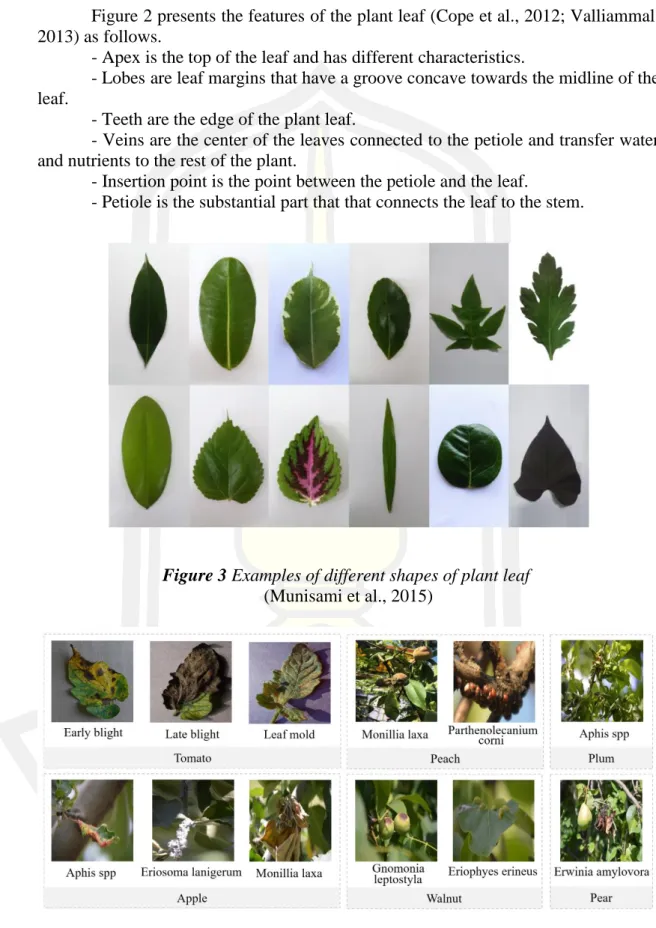
Images of turkey plant diseases were captured from natural environments with a Nikon 7200D camera with a resolution of 4000x6000 pixels and saved in the RGB channel. This dataset consists of 1 5 categories and contains 4 , 4 4 7 images of plant diseases including a) Apple Aphis Spp, b) Apple Eriosoma Lanigerum, c) Apple Monillia Laxa, d) Apple Venturia Inaequalis, e) Apricot Coryneum Beijerinckii , f ) Apricot Monillia Laxa, g) Symptom of fruit tree cancer, h) Cherry Aphis Spp, i) Fruit tree drying, j) Peach Monillia Laxa, k) Peach Parthenolecanium Corni, l) Pear Erwinia Amylovora, m) Plum Aphis Spp, n ) Nut of Eriophyes Erineus and o) Nut of Gnomonia Leptostyla as shown in Figure 21.
Performance Evaluation
We also present a receiver operating characteristic (ROC) curve plot (Hajian-Tilaki, 2013; R. Kumar & Indrayan, 2011) used to comprehensively measure each performance index. We also present the area under the ROC curve (AUC) value to measure the resolution that the proposed model can determine between classes.
Experimental Results
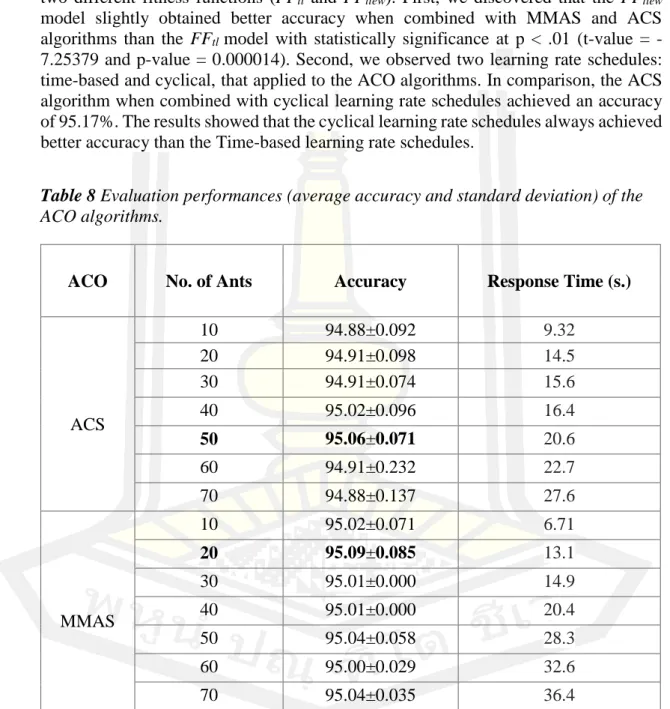
We also evaluated the performance of ACO algorithms (MMAS and ACS) when applying two different fitness functions (FFtl and FFtlew). We demonstrate two graphs to confirm that adding the learning rate schedule improves the performance of the ACS algorithm. From the experiment in Section 4.6.2.2, we used the unweighted ensemble learning method to evaluate the performance of the ACO algorithms.
The previous section reported on the evaluation of the ACO algorithm on the mulberry leaf dataset and found that the proposed method assigned the best CNN models for use in the ensemble learning method. Note that the arrow sign (->) means the order of the CNN models when experimenting with the ensemble learning method.
Big-O Analysis Results
In line 16, the pseudocode allows the program to store the best route, using Big-O = O(1). In line 19, the pseudocode allows the program to store the best route, using Big-O = O(1). In conclusion, the ACO algorithm has a Big-O analysis with higher performance than the ACO algorithm combined with the ensemble method.
In addition, the Big-O analysis of the ACO algorithm combined with the ensemble method shows a similar analysis with the ACO algorithm combined with the learning rate schedule and the ensemble method.
Comparison of the Proposed ACO Algorithm and Other Existing Methods
Discussion
Consequently, all the selected CNN models, which were automatically selected using the ACO algorithm, achieved better performance when classified using the CNN ensemble method.
Conclusion
Discussion
Answers to the Research Questions
Is it possible to classify plant leaf images using image processing and machine learning methods. RQ2: In the previous RQ, image processing and machine learning methods were proposed to classify plants from plant leaf images. Can we classify the plant leaf diseases using the deep learning method, like CNN.
From the work to answer RQ1, we found that we could propose image processing and machine learning techniques to recognize images of plant leaves. From our experimental results, we could ensure that the CNN ensemble method could improve the performance of the CNN model in plant leaf classification.
Future Work
International Conference on the Analysis of Images, Social Networks, and Texts (AIST): Analysis of Images, Social Networks, and Texts, 256–262. Comparing local descriptors and bags of visual words with deep convolutional neural networks for plant recognition.