The first pair of "blue jeans" were invented by Levi Strauss and Jacob Davis in 1873, which at the time were originally designed for cowboys and miners due to the durability of the fabric. Thailand is a hot country and the environmental features in the country limit the consumption of jeans.

Prices of Jeans in Thailand
There are those curious who often wonder why they even wear jeans made of thick denim and cotton fabric since Thailand is a tropical country. Yes, Thailand is a hot country not far from the equator and the heat of the sun. Thailand also has a rainy season which would seem like a hindrance to wearing jeans as it would be too heavy. Despite all those objections, Thai people still remain in the mainstream for jeans, this is because they are not only physically attracted to jeans, but also emotionally (Fletcher 2012).
An example explored by Fletcher (2012) was that even people in hot climates wear jeans because they protect them from the sun. Jeans were considered "rude" in the Thai work environment because they were considered "working class" bottoms. However, workplaces in Thailand seem to be embracing the denim trend more and more these days, with people in offices now even wearing jeans to work.
Thai Brand Consumption
Consumer Behaviour
Visual or Tactile?
The visual input, or appearances and aesthetic responses, can also be defined as an experience. Experiences are both visual and emotional and arise in response to a specific stimulus (Berlyne, 1974; Veryzer 1993). According to previous studies, visual appeal is mainly used to distinguish between products (Schmitt and Simonson, 1997).
The tactile input is often used to assess the substance of a product such as stiffness, roughness, softness and smoothness. This research will focus on the behavior of both visual and tactile input when consumers choose their jeans, as well as the concerns people have when purchasing jeans. A study by Rahman (2011) indicated how visual and tactile input can influence consumers' evaluation processes when shopping for jeans.
Difference between men and women
Another input, or the tactile sense of touch, which refers to the sensations evoked by receiving stimulation from the skin, can also sense a wide variety of information (Peck, 2010). There are also times when people can influence a consumer to buy a pair of jeans that they don't really like, these are visual cues, because that person uses looks to persuade customers, change emotions. The brand is also a visual input, as the brand will influence the buyer's emotions when making a decision.
One hundred women were asked what they wear when they're feeling depressed, and more than half said jeans. Only a third would wear jeans when they were happy, so a study (Pine, 2012) showed that most women would be more likely to buy jeans when they were depressed than to buy fashionable clothes.
Gaps in Literature
Regarding this research, the attitudinal aspect will be drawn out as much as possible. The visual perspective will be defined by whether the customer makes decisions using the sight, smell and feelings of Thai consumers. The tactile perspective will focus on the touch and feel that Thai consumers use while making decisions.
RESEARCH METHODOLOGY
Population and Sample
Research Design
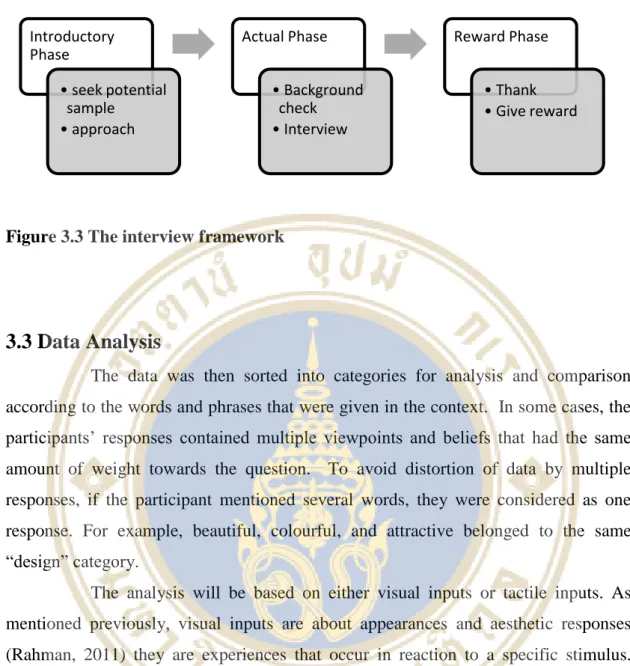
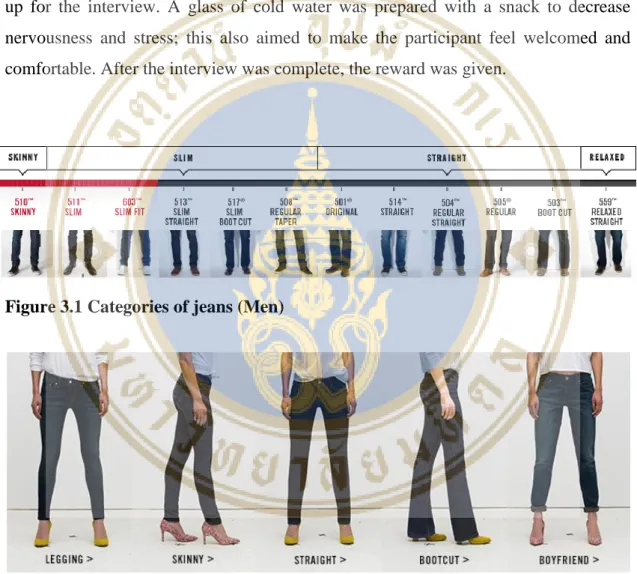
The stages of interview consisted of three sections, the introductory section, the actual interview and the reward distribution. Once a participant agreed, the participant was taken to an area set up for the interview. A glass of cold water was prepared with a snack to reduce nervousness and stress; it also aimed to make the participant feel welcome and comfortable.
Data Analysis
These responses were then counted by summing per code and then identified as significant visual or tactile responses. If the participant were asked about the main aspect they chose when making the decision to buy jeans, the answer would be quite long. For example, the answer could be: “I chose this because when I tried on the jeans they looked good, I tried on many others, but this was the one I wanted.
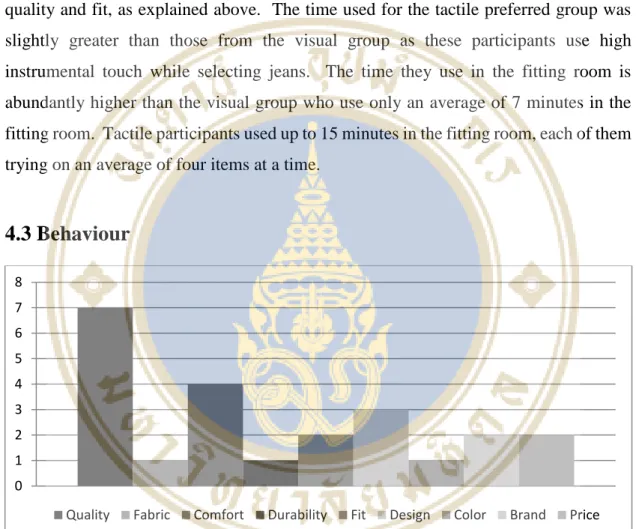
The overall design was also nice and the price was also reasonable for this type of jeans”. For this example we extracted the words "looked good on me" "fit" "comfortable" and "affordable" all of these were then dropped into one of eight categories which were quality, fabric, comfort, durability, fit, design, color, brand and price. Since this participant said it looked good on him, as well as fit and comfortable, this would reflect that this is on the tactile input side.
FINDINGS AND DISCUSSION
Analysis
Preferred Input
Validation & Findings
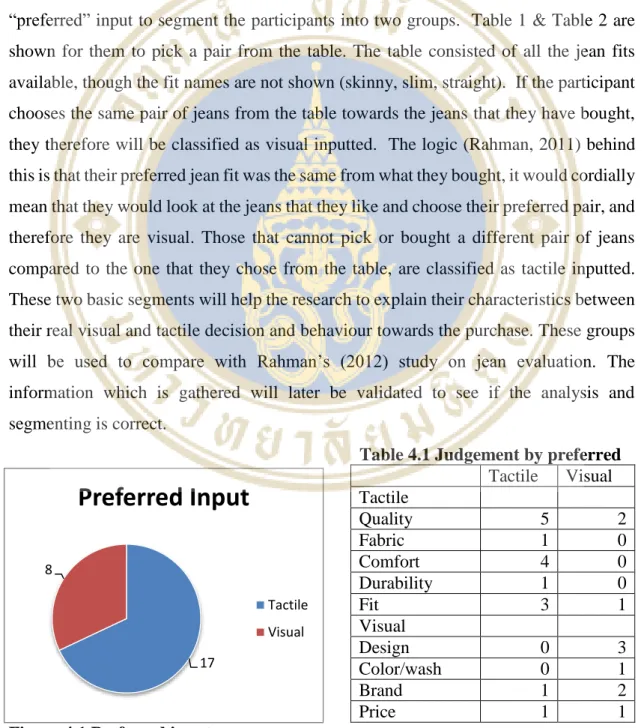
Out of a sample of 25 participants, 8 chose the exact same pair of jeans they bought. Therefore we will classify 8 of those who have chosen the same jeans as "visual favourites" and for those 17 who cannot make a decision until they see the actual jeans they are called "tactile favourites". This research will then challenge the research of Rahman (2012) whether those in Thailand have the same behavior as those in different countries.
The research will also challenge Rahman's (2012) theory of using pictures to explain the segments of visual versus tactile input as well. For the input segmentation, the validation will be based on the time and the decision to shop. At the end of the validation, if the information is accurate, research will continue to the ultimate discussion about what really motivates the behavior of Thai people to choose a pair of jeans.
Decision to shop
Visual theory
However, previous studies (Rahman 2012, James 2011, Ocass 2008) did not consider the time participants used to purchase their jeans when assessing input. The average time it took people in the visual input segment was 17 minutes before making a purchase; this includes the time they spent trying on the jeans and the time spent paying at the checkout. For those in the tactile segment, the average time used was 24 minutes, which was significantly higher than that in the visual segments.
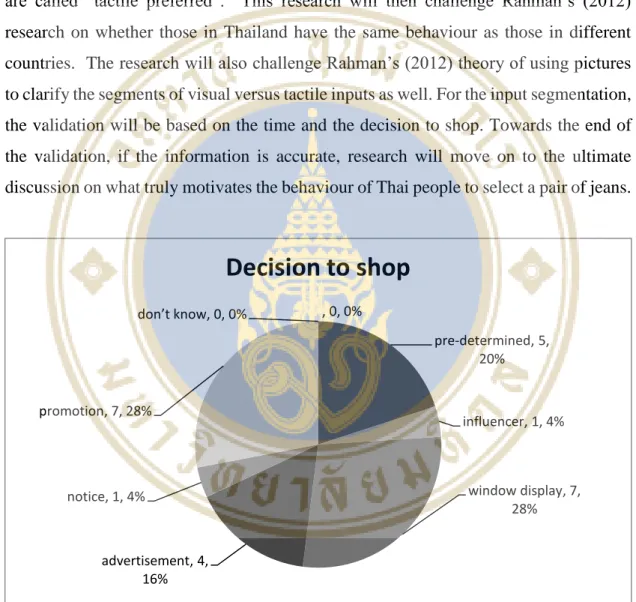
From this information, the tactile segment used more time than the visual segment, partly because they take more time trying on the jeans in the fitting room than those who use visual input when making a purchase. The visual judgment of Thais when they decide to buy a pair of jeans can be classified into two parts, the actual product decision to buy and the decision factor that determines their behavior. The window display is also one of the highest factors because participants claim that the.
Tactile theory
The participants who mainly say that shop windows are the main factor in their shopping decision are mainly from An interesting fact is that those from the "visual preferred" group also took less time to choose, since these participants care less about the fit and feel of the jeans, but more about the external appearance of the jeans. Tactile judgment among Thais is also classified into two parts, the actual decision to purchase the product and the decision factor that determines their behavior.
The time spent for the tactile preference group was slightly longer than those from the visual group, as these participants use high instrumental touch while choosing jeans. The time they spend in the fitting room is considerably higher than the visual group, who spend an average of only 7 minutes in the fitting room. Tactile participants spent up to 15 minutes in the trial room, each trying an average of four objects at a time.
Behaviour
- Other information
- Second party influencers
The decisive factor that determines their buying behavior is quality and fit, as explained above. Most participants who answered quality answered that because quality is the overall grade of the jeans. Another question, "what exactly is quality?" was asked what the answers were "the stitching, material and overall quality".
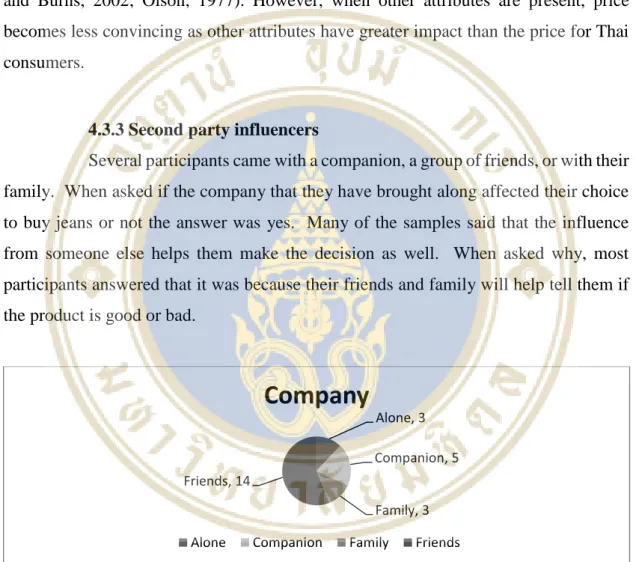
This shows that Thai people really consider the overall quality of a pair of jeans when buying jeans. Brand is not an affinity of any input (Rahman, 2012) as brand is defined by the image, mood and tone and marketing strategy of a clothing company. 2012) contends that the brand can be embedded in a visual input since people typically use visual preceptors to “visualize” the brand. When asked if the company they brought with them influenced their choice to buy jeans or not, the answer was yes.
Company
Discussion
The core of this research is mainly to identify the most important factor that Thai consumers use to purchase jeans. Quality is defined in this study as the general factors of durability, fit and comfort, all of which are processed directly into the tactile input. The time spent buying a pair of jeans cannot be used to determine whether someone would buy a pair of jeans or not. This research shows that there are participants who need 5 to 30 minutes before they decide to buy a pair of jeans.
If the jeans do not trigger their input and key factor, there is a high possibility that the consumer will not buy the product. A high priced pair of jeans would logically only mean that the quality of those jeans is high, although further research would be needed to prove this logic. Rahman's (2012) research claims that people who are visually input are able to judge prices better than those who are tactile input.
RECOMMENDATIONS/CONCLUSION
Conclusion
- Conclusion
- Relationships between visual and tactile inputs
Recommendations to manufacturers
Limitations and further research
- Limitations
- Recommendations for further research
As this research was limited to customers of Levi's stores only, the accuracy of the survey would be improved if further research can capture responses from other brand customers. Levi's is considered one of the higher positioned jean manufacturers, therefore a sample from lower positioned jean manufacturers such as Mc-jeans or Wrangler will also capture the behavior of those in the lower positions who may focus on different factors. Higher positions such as Pronto or CK Jeans can also be samples for further research to capture behavior in the higher market.
If future research can determine that not all products with high prices are of high quality, this will be a more complete research. Then, the next stage would allow participants to touch and feel the material before judging what the price would be. This research is available as a reference for all researchers who want to expand this research.