The purpose of this research is to examine the key factors influencing customers' decision to purchase brands from Retailer A. This study found that "price consciousness" was the most influential factor in customers' decision to purchase brands from a retailer in Thailand . Private labels are flourishing in developed regions such as Europe, North America and Australia, which have a larger market share than the developing market (Nielson, 2014).
However, it is difficult for private brands to gain consumer trust in developing regions such as Asia and the Middle East because consumers are strongly loyal to national brands. These retailers also sell their own private labels, offering low prices to price-conscious consumers (Reutterer and Teller, 2009; Shannon and Mandhachitara, 2008). In Thailand, the private label market is still small with only 1% market share (Nielson, 2014).
This research focuses on private labels in the Thai market by choosing a leading retailer in Thailand as a case study. Unlike the Asian region, private labels are growing slowly in the market because Asian consumers are strongly loyal to national brands.
Scope of Study
So the researcher would like to know why the private labels are struggling in Thailand even though a leading retailer like Tesco Lotus started developing and selling private labels as a core strategy when they first started doing business in the country since 1998.
Expected Benefits
LITERATURE REVIEW
Private Labels in Retail Business
Asian respondents feel too risky to lose money when trying private labels instead of buying national brands. They trust national brands more than private labels, although they have to pay a premium.
Determinants of Private Labels Purchasing Decision
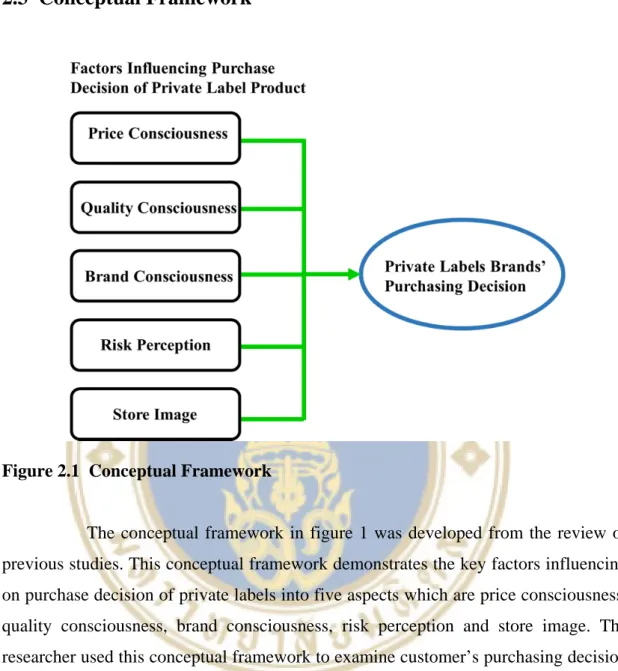
- Price consciousness
- Quality consciousness
- Brand consciousness
- Risk perception
- Store image
The research by Verhoef et al. 2002) argued that the improved quality of private labels has influenced consumers' more positive attitudes towards private labels. Private label consumers are generally price conscious or variety seeking, have a stable brand selection and are less brand loyal (Baltas, 1997; Garretson et al., 2002). National brands are seen as less risky and of higher quality, while private labels are generally seen as high risk, low quality and poor image (Goldsmith et al., 2010).
Perceived risks are considered critical influencing consumers' intention to purchase private labels (Batra and Sinha, 2000; Bettman, 1973; Dunn et al., 1986). Private labels tend to be perceived as higher risk due to their lower quality and low reliability. A study by Dunn et al. 1986) concluded that consumers view private brands as most risky in terms of performance measures compared to national brands, whereas financial brands are considered least risky.
The image of a store or retailer has a significant influence on consumers' perception of private labels (Ailawadi and Keller, 2004; De Wulf et al., 2005; Kapferer, 2008). Vahie and Paswan (2006) stated that a better store image leads to a greater perception of private labels, including brand image and quality perception (Semeijn et al., 2004; Beristain and Zorrilla, 2011).
Conceptual Framework
RESEARCH METHODOLOGY
- Research Design
- Population and Sampling
- Data Collection
- Data Analysis
Due to the limitation of time and resources, the sample group of this research will only be focused on consumers in Retailer A for Bangkok area. The researcher provided the private label product samples to the respondents to ensure that they understood the private labels correctly. This research will use purposive sampling which is one of the common sampling methods used in qualitative research.
Purposive sampling is the method used to identify participants based on selected criteria relevant to a particular research question (Merriam, 2009). The primary data in this study was collected from in-depth interviews as this method provides useful insight into information and context in a particular research topic. The researcher can use the in-depth interviews to explore an individual's experiences, beliefs, values, feelings, and perspectives regarding an issue (Denzin et al., 2000).
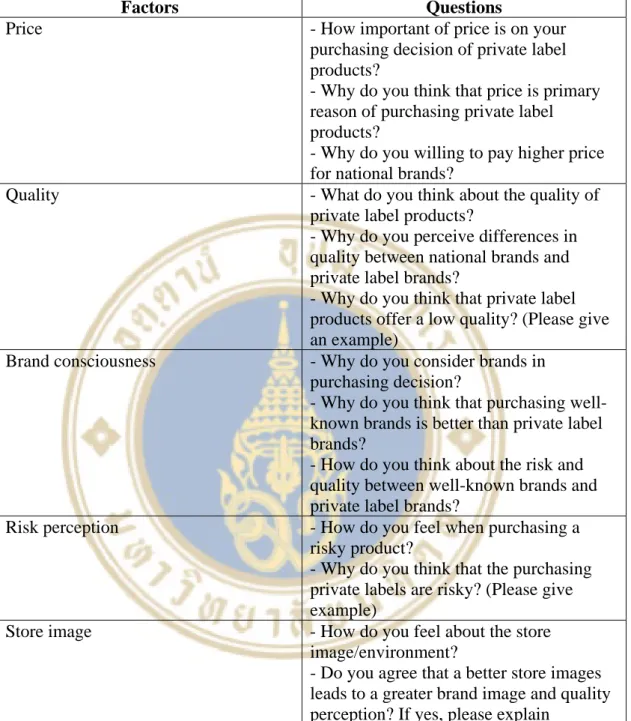
The interviewee is given the opportunity to spontaneously discuss experiences, behavior and beliefs related to the research topic. Most probing questions begin with "why" and "how," so the researcher can get more specific or deeper information from respondents by using probing questions. Why do you think buying name brands is better than private label brands?
How do you think about the risk and quality between famous brands and private label brands. Do you agree that a better store image leads to a greater brand image and quality perception. Qualitative content analysis is one of the research methods used to analyze text data, it involves interpreting the content of text data through the systematic classification process of coding and identifying themes or patterns (Hsieh . & Shannon, 2005).
Data coding process is organizing the data collected in qualitative research into content categories (Weber, 1990). Coding is the process of examining the raw qualitative data, such as in the form of words, phrases, sentences, and then creating the data segments with symbols, descriptive words, or category names. Coding data helps reduce the complexity of the information obtained, making it easier to search for any patterns that will be used in the research.
FINDINGS AND DISCUSSION
Demographic Profiles of Respondents
Factors Influencing on Customer’s Purchasing Decision of Private Label
- Price consciousness
- Quality consciousness
- Brand consciousness
- Risk perception
- Store image
They tended to buy private label products because the selling price was usually lower than the selling price of national brands. I buy private label because some products don't require spending more money than buying brand name products. From the results of the interviews, the researcher found that the majority of respondents believed that price was the main factor in their decision to purchase private label products.
The attractiveness of price is a big reason to buy private label products because consumers can save money, cost, get more products and quantity. Quality is another factor that respondents considered when making a purchasing decision for private label products. There are 14 out of 20 respondents who said they considered quality before purchasing private label products.
From the interviews, the researcher concluded that many respondents considered private label products to be of low quality based on their perceptions and experiences. In my opinion, I think that the raw materials, ingredients or production processes of private label products may differ from those of branded products because the retailers need to reduce costs.” I felt that private label products were of low quality because the packaging design is similar to branded products, making it feel like a copycat.
As a result, quality-conscious consumers are believed to be less likely to purchase private label products. I believe that buying branded products is better than private label products because it is better quality and lower risk. Interview respondents believe that buying branded products is better than private label products because branded products are perceived as higher quality and less risky.
From the interviews, respondents identified perceived risk as a critical factor influencing their purchase intention for private label products. I do not trust private label products because they are perceived as low quality and low reliability. I think better quality leads to greater perception of brand image for private label products.
RECOMMENDATIONS
Practical Implications
In terms of brand awareness, the retailers should introduce advertisements in both offline and online marketing communication. Finally, it suggests that the retailers should offer a guarantee for those products that appear to have a high risk in order to ensure their quality and reduce the perceived risk to their customers.
Limitations of the Study & Recommendations for Future Research The limitations in this study are small sample size and interview location
Research note: The influence of perceived risk on brand preference for supermarket products. 2004), Store Brand Performance: A Cross-Country Analysis of Consumer Store Brand Preferences, Perceptions, and Risks. Retrieved from Global Market Information Database: http://www. 2002), Antecedents of private label attitudes and national brand promotion attitudes: similarities and differences. The effect of store name, brand name and price discounts on consumers' evaluations and purchase intentions.
The effect of store image and service quality on brand image and purchase intention for private label brands. Consumer Perceptions of Price, Quality, and Value: A Means-End Model and Synthesis of Evidence, Journal of Marketing, 52, 2-22.
APPENDICES
Appendix A: The interview guide
Demographic questions 1. What is your gender?
Interview guide questions
Appendix B: Consent Form