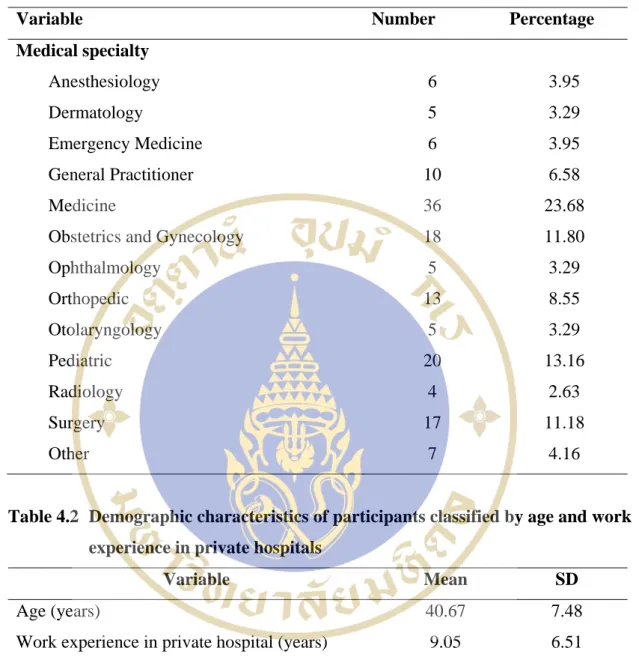
Third, I would like to express my great gratitude to all the participating doctors from public and private hospitals in Bangkok who volunteered their valuable information and valuable time to help me complete the data collection process as per questionnaire, as well as for in-depth interviews. The purpose of this research was to study the factors that influenced the commitment of doctors working in private hospitals to understand their perspectives and to help the management teams of private hospitals understand the concept of a doctor's commitment to the organization. This study addressed the factors that influenced physician engagement in private hospitals in Bangkok.
First, questionnaires were sent to 150 multi-specialty full-time and part-time physicians working in at least ten private hospitals. Second, interviews were conducted with twelve physicians; six worked full-time in private hospitals and six worked part-time. To investigate the factors that influenced physicians' involvement in private hospitals in Bangkok from the physicians' perspective.
LITERATURE REVIEW
Definition
Leiter (2008) believed that engagement is how people participate in certain activities that can increase efficiency and effectiveness. It also refers to the sophistication that doctors are more involved in the health care facility they work for (Hamilton, 2008). Spurgeon (2008) believed that physician engagement was the active and positive contribution of physicians in their usual role of work to maintain and increase both individual and organizational performance.
This commitment supports, stimulates and promotes high quality care and services in the organization that are delivered to the patients.
The Importance of Engagement
Guthrie (2005) believed that hospital administrators should be concerned about physician involvement because it was a top priority and also led to better performing hospitals. Physician turnover is of great importance, not only because it can affect the quality of medical care or patient service, but also because it promotes patient loyalty. Taitz (2011) suggested that physician involvement can be described as 'The physician who knows how to best care for health provides that service to ensure a smooth, seamless, effective and successful outcome for the patient' , Atkinson (2011). also confirmed that sharing clinical and administrative staff is essential.
Mache (2014) suggested that hospital management should be concerned about work engagement because strengthening it will contribute to a sustainable workplace and improve hospital performance.
Physician Engagement Factors
Duffy (2006) studied the factors of job satisfaction among six large medical specialists and found that patient care, sense of success, constant care, autonomy and individual private time were important factors of satisfaction. Shanafelt (2008) found results indicating that physicians need autonomy, work-life balance, flexible schedules, and a culture that encourages life outside of work. Grimes (2012) identified major factors that influenced physician engagement, including positive leadership, management training, work-life balance, strong teamwork, and communication styles.
Wai (2014) studied the satisfaction of surgical and nonsurgical clinicians and found that departmental governance, collaboration, and relationship with supervisors influenced surgeons' satisfaction. High income, working hours, academic practice and age had a significant impact on job satisfaction for practicing urologists (Pruthi, 2016). Philips (2002) commented that physician dissatisfaction was associated with perceived inability to obtain needed medical services, lack of clinical decision-making freedom, insufficient time to spend with patients, inability to maintain a relationship with a physician, and satisfaction with the patient.
RESEARCH METHODOLOGY
- Research design
- Sampling
- Data collection
- The quantitative part
- The qualitative part
- Data Analysis
- Descriptive statistics
- Coding analysis
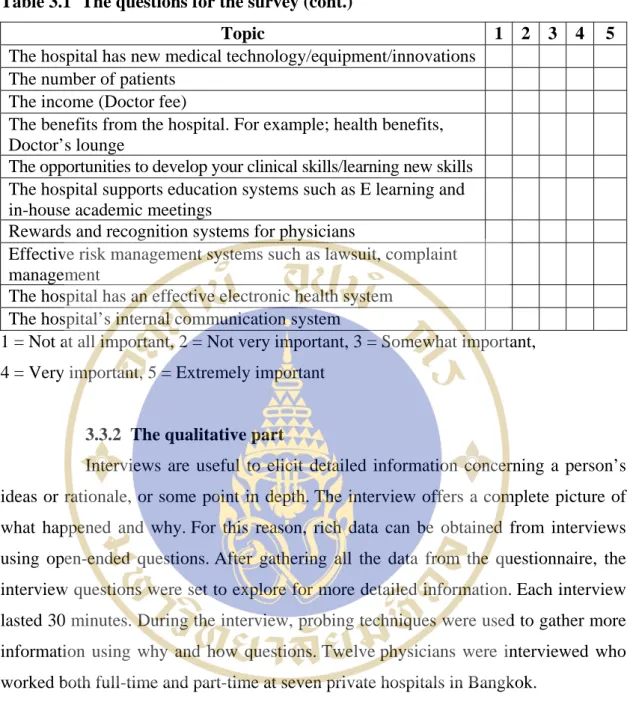
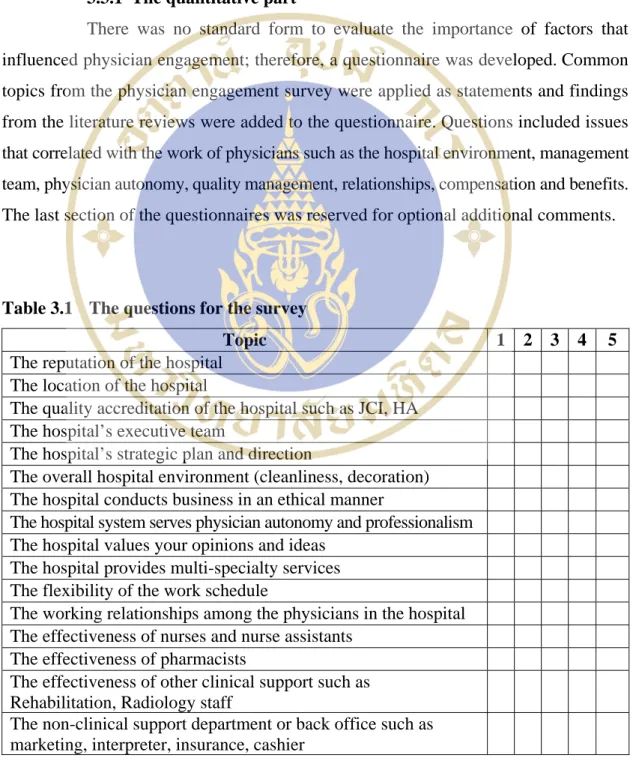
General topics from the physician engagement survey were applied as statements and findings from the literature reviews were added to the questionnaire. Questions included issues that correlated with the work of physicians, such as the hospital environment, management team, autonomy of physicians, quality management, relationships, compensation and benefits. The overall hospital environment (cleanliness, decoration) The hospital conducts business in an ethical manner. The hospital system serves autonomy and professionalism of the physician The hospital values your opinions and ideas.
The working relationships between doctors in the hospital. The effectiveness of nurses and nursing assistants. Opportunities to develop your clinical skills/learn new skills. The hospital supports educational systems such as E-learning and internal academic meetings. After all the data from the questionnaire was collected, the interview questions were set to obtain more detailed information.
From the survey results, I found some significant findings and I would like to explore these topics in more detail, please let me know your opinion on these issues. Could you please suggest additional recommendations to hospital managers that will increase physician engagement. Two types of data analysis such as descriptive statistics and coding analysis were applied to the information from the questionnaire survey and interviews.
DATA ANALYSIS
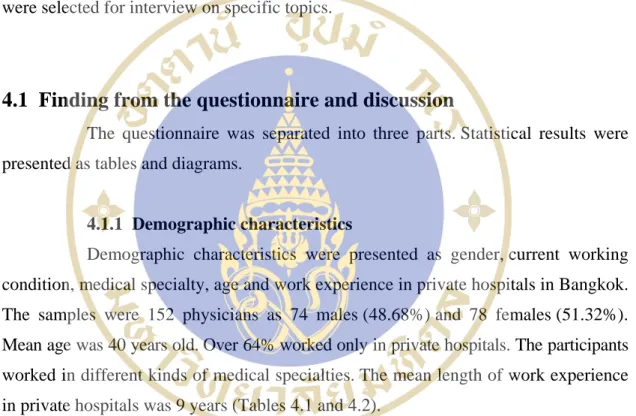
Finding from the questionnaire and discussion
- Demographic characteristics
- Factors affecting the level of physician engagement at private hospitals in Bangkok
- Comments from physicians
- Discussion
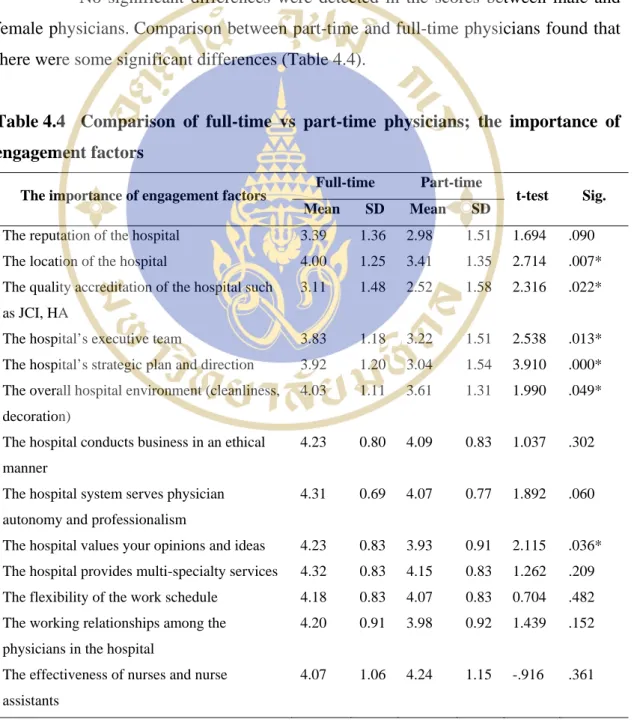
Hospital strategic plan and direction 3.61 1.39 General hospital environment (cleanliness, decoration Hospital conducts business ethically 4.18 0.81 Hospital system serves physician autonomy and professionalism 4.22 0.73 Hospital values your opinions and ideas 4.13 0.87 specialty services 4.26 0, 84 Working relationships between doctors in the hospital 4.13 0.92 Effectiveness of nurses and nurse assistants 4.13 1.09 3.60 1.22 Opportunities to develop your clinical skills/learning new educational skills E 3.71 and.
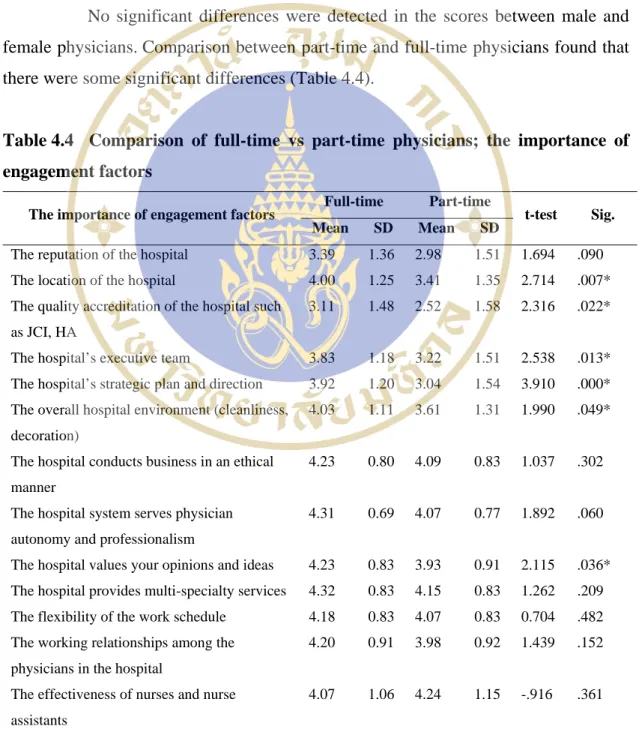
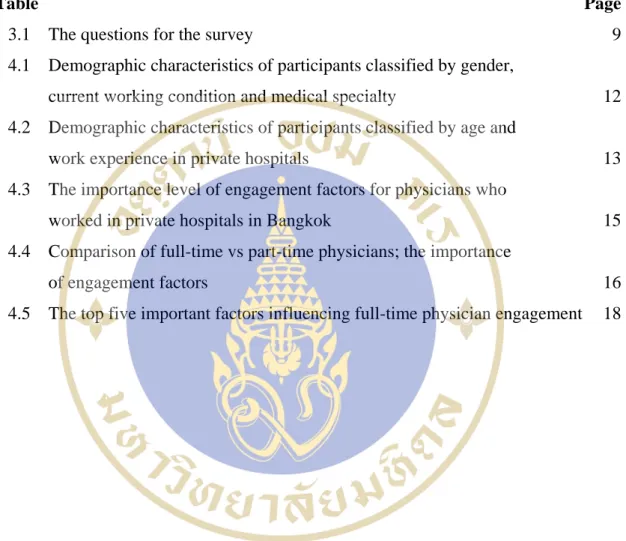
The comparison between part-time and full-time doctors revealed that there were some significant differences (Table 4.4). Full-time physicians scored higher on the hospital's executive team, strategy, listening to their feedback, opportunities for learning and self-development, and rewards and recognition compared to. 1 The hospital offers multi-specialty services 4.32 2 The hospital system serves the autonomy and professionalism of the doctor 4.31 3 The hospital conducts business ethically 4.23 4 The hospital values the thoughts and ideas of doctors 4.23 5 Working relationships between doctors in the hospital 4.20.
Part-time doctors Average 1 The effectiveness of nurses and nurses 4.24 2 The hospital provides multi-specialty services 4.15 3 The hospital operates in an ethical manner 4.09 4 The hospital service serves the doctor's autonomy and professionalism 4.07. The hospital's management, especially the chief physician, should have a high level of management skills. Part-time doctors were not always in the hospital and only visited patients occasionally; they felt less a part of the hospital than full-time doctors.
Quality accreditation of the hospital is done mainly for the benefit of the patient; does not affect organizational commitment. Reward and recognition systems also received a low score, perhaps because doctors take pride in curing patients, they are not interested in earning rewards or recognition from the hospital.
Findings from the interviews and discussion
- Multi-specialty services
- Physician autonomy
- Flexible working hours
- Physicians’ opinions and ideas
- Relationship among physicians
- Nursing abilities
- Risk management system
- Income
- Electronic health system
- Rewards and recognition system
- Hospital’s reputation
- Quality accreditation
- Executive team and hospital strategy
- Learning and development
Therefore, if the hospital can provide specialists in each area, doctors will feel more comfortable at work and have the confidence to care for patients. Therefore, it is important to consult a specialist, which will allow the doctor to continue working in the hospital with pleasure for a long time. All physicians felt it was very important that hospital management valued their ideas and listened to them, especially the full-time physicians.
The hospital management may not decide to accept their suggestions, but at least they listened. If doctors can't trust the nurses, they don't want to work in that organization. The hospital's reputation is also important because if the hospital has a good reputation, it will increase patient numbers and of course affect the doctor's income.
But if the hospital has a bad reputation, especially in terms of ethics, I will resign, because it may mean that the doctors who work there are also unethical." (orthopedic doctor). This topic had a greater impact on full-time physicians, as five out of six paid attention to the hospital's management regarding the vision and work processes, especially regarding ethics. Doctors believed that a good treatment result could create a good reputation and profit for the hospital.
Often I come to work and I don't know what changes the hospital has made. In terms of strategy, physicians felt they needed to be aware of the hospital's strategic plan, or at least know what the hospital was going to do. Physicians are important success factors of the hospital and understanding and cooperation with hospital management can improve hospital performance.
Human development is very important, not only for doctors, but also for other staff and professionals in the hospital.

CONCLUSIONS AND RECOMMENDATIONS
Conclusions
Opportunities for learning and improvement also affect the regular engagement of physicians, as healthcare professionals must continuously learn. Nursing skills affect part-time physician engagement more than full-time physicians because part-time physicians have less time with patients and trusted nurses can help care for their patients.
Recommendations
Rewards and recognition systems improve doctors' inspiration to work; however, the system must be transparent. Communication, especially for important issues or problems related to professional standards, should be done only by acceptable people, without criticism from other professions. Doctors should be given the chance to discuss issues with top management to recognize the management approach of the organization.
Physician Relationship: Relationship among colleagues is important to improve engagement, especially for full-time physicians. Reward and recognition system: Reward and recognition systems have a major impact on full-time physicians; however, the system must be systematic, fair and transparent. If possible, this system should be linked to the work of doctors, such as caring for patients, as it will make doctors feel proud.
Learning and Development: The hospital must provide a wide-ranging and easily accessible learning and development system. The hospital should also arrange learning and development programs for all hospital staff, especially nurses who are essential components, to help the work of doctors. Hospitals must manage doctors' work schedules with concern for their daily activities and daily lives.
Part-time doctors who work in many hospitals will prefer favorable working hours. If the hospital management team understands and implements these factors, it will help increase physician engagement and hospital effectiveness.
Limitations and suggestions for future research