Poomporn Thamsatitdej, who offers a lot of advice and valuable suggestions for the development of this interesting project. At the same time, I would like to thank all twelve interviewees for their cooperation, relevant information and valuable time. ADVISORY COMMITTEE FOR THE THEMATIC CONTRIBUTION: DR. POOMPORN THAMSATIDEJ, Ph.D., ASSOCIATE PROF. VICHITA RACTHAM, ASSIST. PROF. RANDALL SHANNON.
Thus, this study aims to explore the factors that influence parents' intention to purchase organic products, especially skin care for their babies. Consumer interviews and literature review were used to understand parental perceptions to explore the issue and make recommendations regarding the future strategic plan for new entrepreneurs or improvements for current runners. Therefore, twelve in-depth interviews from three different professions were conducted to provide supporting information regarding the conceptual framework to explore their main reasons for their purchase intention.
In addition, it would be beneficial for the new business, marketer or entrepreneur who will develop organic baby business to strengthen their business and benefit from this research. KEY WORDS: Organic Skin Care Product, Purchase Intention, Parental Decision Making, Baby Skin Care Product.
INTRODUCTION 1
LITERATURE REVIEW 2
- Trend of healthy concern 2
- Organic products for baby 4
- Demographic parents’ profile 6
- Influential factors for parents’ intention buying organic products 7
- Health concern 8
- Social influence 9
- Marketing mix (4P’s) 9
- Conceptual framework 10
Due to the growing demand for health care, organic products are a key component of the consumer trend as a comprehensive health solution. The size of the market for organic products (both food and non-food) in the United States in 2012 was US$31.5 billion. The widespread availability of organic baby products has made them more affordable and the ability to purchase organic safe baby products is now a much more enjoyable and feasible task than ever before.
Organic produce not only appeals to the adult population, but parents and many new parents also have a strong interest in purchasing organic baby food (Hill and Lynchehaun, 2002). Moreover, some parents will absorb the organic lifestyle and knowledge from their surrounding stimulation, so they are quick to adopt the consumption of such organic products for health and environmental reasons (Emilio, 2011). Whereas, most European consumers represent nature lovers, environmentalists and socially conscious people; parents usually buy organic products which are regular buyers for both themselves and their children.
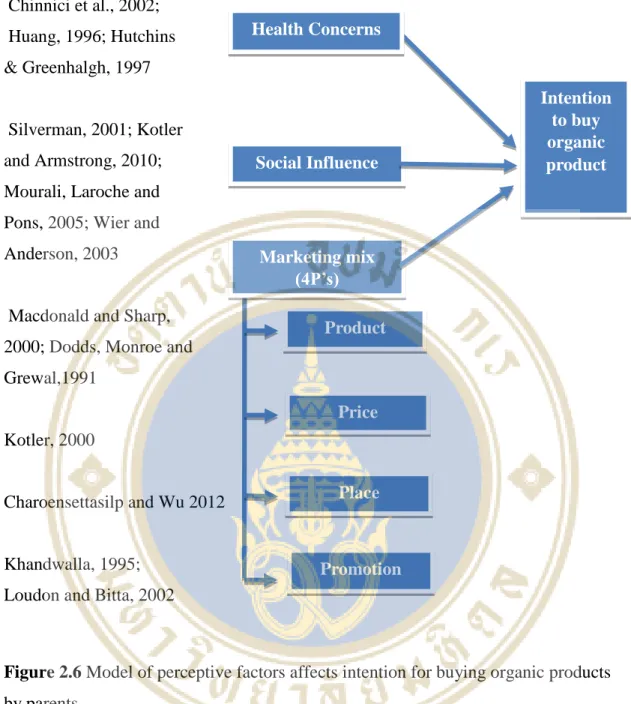
They would buy organic products in the long term, the price of which is not the purchase decision for this group (Marcel Pinckaers, Karin Benz and Hilde Brans, 2010). According to the evidence of some previous articles, the factors that can stimulate the intention to buy organic baby products are health concern, social influence and marketing mix (4P's). Most studies find that "health" is the main reason that drives consumers to buy organic products (Chinnici et al., 2002; Huang, 1996; Hutchins &.
Lea and Worsley (2005) stated that organic products are considered healthier than non-organic ones. According to interviews of regular consumers of organic foods (RCOF) with organic consumers showed that the reasons why they chose organic products is the health factor (Makatouni, 2002). Emilio in 2011 stated that some parents would buy organic products because they absorb the lifestyle and knowledge from their surroundings.
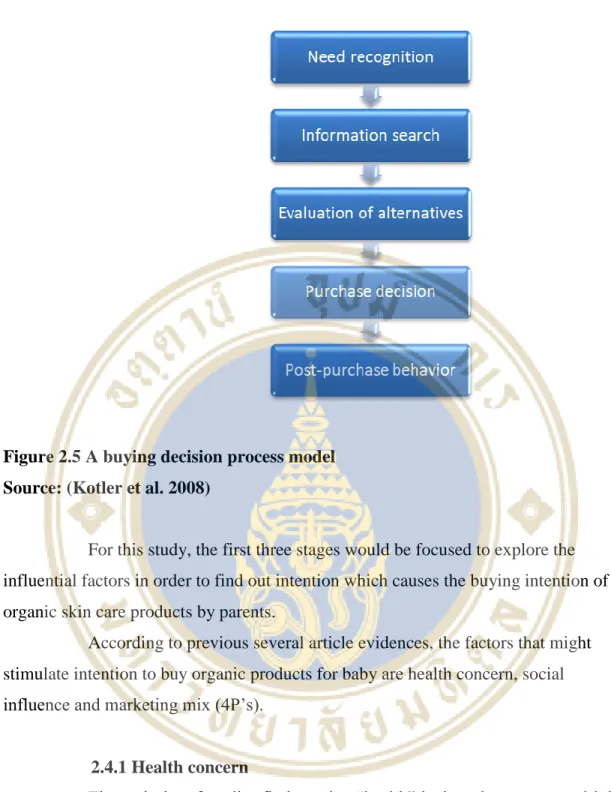
Consumers are willing to buy the products because they are familiar with the brand recognition. Some parents may purchase organic products because of sales promotions that could attract more purchases. According to the theory, all the factors (health concerns, social influence and marketing mix (4Ps)) could have an intention for the consumers, then they will buy organic products for their baby.

RESEARCH METHODOLOGY 12
- Research Explanation 12
- Population and targeted sampling 12
- Data Collection 13
- Data Analysis 13
This research will investigate the main factors that attract parents to buy organic products for their baby from multiple customers. They will also be categorized by profession to see the different perspectives of buying organic products. Regarding the baby's health problems, all parents tend to agree on the same direction, which is to choose organic products for their baby to protect the chemical pollution of the baby's body.
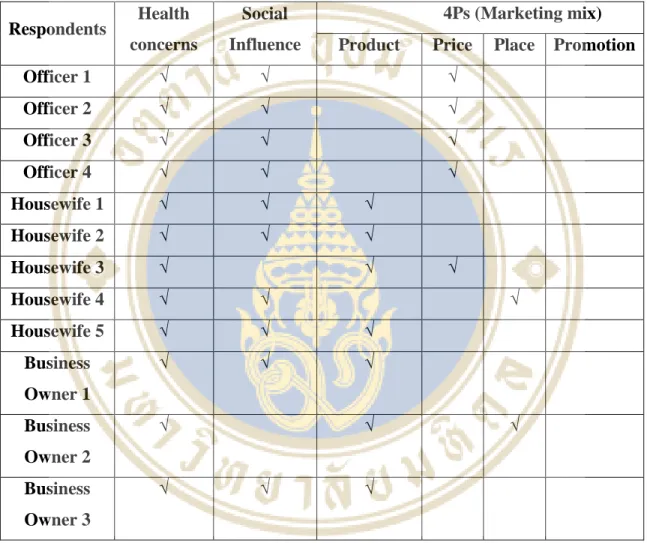
They feel safe to buy them to protect their baby, but some respondents buy them because their baby has allergic skin to conventional skin products. Based on the interview, the social impact is the second place that parents would worry about buying organic products. Most housewives and business owners intend to buy organic products by focusing on their standard or brand recognition, but officials would not care.
After getting the product recommendation combined with her experience, I decide to buy the product to trial with my baby. Qualitative method is used to collect data by interviewing 12 respondents in the range of 30-40 years who have experience of buying organic products for their baby. Moreover, it also accelerates the use of social media such as social networking sites and blogs among consumers who gather information about organic products to create more brand awareness and impulse purchase intention.
Last but not least, the study should explore other potential factors that influence consumer intention periodically, as organic products have just entered the Thai market and their results may differ as time changes. The questions are intended to identify the most important factors that influence parents to buy organic products for their children. How do you think health concerns might prompt you to buy organic products for your baby?
Let your friends or someone in the know share experiences of buying organic products for their baby.
FINDINGS AND DISCUSSION 14
Demographic Data 14
A total of 12 respondents in this study have experience purchasing organic skin care products for their child.
Data Analysis 14
Data Discussion 15
- Children’s health concerns 15
- Social Influence 16
- Product 17
- Price 18
- Place 18
- Promotion 19
And doctors couldn't find the cause, so I tried to use organic product for a while until my baby recovered." Business owner 1 commented that "I believed what my family member and close friends told me, especially those who had direct experience because they tried various products with their baby and what they suggested was a very fruitful recommendation that led has to guaranteed safety." While Housewife 3 disagreed with most parents, she argued that “I didn't believe what other people said because some products might be with one customer group but they might not suit another group .
I would try the product with my baby by starting with a small sample and monitoring every day if it caused any side effects.”. So whenever I see the USDA standard, I plan to buy the products instead of thinking about any factor”. I'm hesitant to buy an unknown brand because I'm not sure how good it is, so I wouldn't take any chances with my baby.”
While some disagree, business owner3 argues that “I would buy the expensive one because of my experience. So, I will buy more various items to keep as stock if I use them often with my baby.”. Business owner 3 said, "I feel attracted to have a chance to trial product if it's a free sample."
Even this factor is not a top priority reason for parents' intention to purchase organic products; it is said to be effective with frequent use. Interviews conducted show that all respondents prioritize their intention to purchase based on children's health concerns arising from their experience. This research aims to study influential factors that influence parents' intention to purchase organic skin care products for their babies.
According to recommendations for further study, the researcher should investigate other age groups to study whether other age groups focus on the same factors that make their intention to buy organic skin care products for their baby, which is to clarify better understanding about influential factors among other groups.
RECOMMENDATIONS AND LIMITATIONS
Conclusion 21
With regard to the conceptual framework, it states that the influential factors are health concerns, social influence, product, price, place and promotion respectively. The result of findings show that children's health concerns are prioritized as the most important factors due to allergy prevention, increasing frequency of contaminated chemical in baby products and weak immune system. Most of them are pressured by social influence such as family members, friends and experienced users, while two of them do not depend on others because they want to seek the information based on their own experience.
But they would focus on price instead, which is acceptable at the 10 to 50 percent level. Last but not least, the result of this paper can provide valuable information to existing businesses and new entrants seeking to improve strategy to influence customer intent, especially the age group between 30-40 years old in the Thai market.
Recommendations 21
In terms of product features, all officers would not care as their main reason, which differs from the housewife and business owner who care about the standard of ingredients and brand awareness. Marketers can hold activities in the place where it is easily accessible to create a sense of community among consumers, so that social pressure will influence, consciously or unconsciously, because of the high visibility offered. Finally, customers who are not dependent on social influence will be stimulated by promotion because they want to seek information themselves.
So, sample or keep informing about the products by personal selling would stimulate their interest in the long term.
Limitations of the study 22
Future Research 22
In addition, future research should use quantitative to get larger number of samples from prospective customers, leading to a better and more accurate indication. The framework is to focus on the most important factors that the consumers are concerned about, their attitudes and their expectations about each factor. How do you think about organic product can serve as preventive medicine against risk for baby health.