HEALTH TOURISM DEVELOPMENT IN THE NANNING CITY OF CHINA
LILING PU
MASTER OF ARTS IN TOURISM MANAGEMENT (INTERNATIONAL PROGRAM)
MAEJO UNIVERSITY
2022
HEALTH TOURISM DEVELOPMENT IN THE NANNING CITY OF CHINA
LILING PU
A THESIS SUBMITTED IN PARTIAL FULFILLMENT
OF THE REQUIREMENTS FOR THE DEGREE OF MASTER OF ARTS IN TOURISM MANAGEMENT (INTERNATIONAL PROGRAM)
ACADEMIC ADMINISTRATION AND DEVELOPMENT MAEJO UNIVERSITY 2022
Copyright of Maejo University
HEALTH TOURISM DEVELOPMENT IN THE NANNING CITY OF CHINA
LILING PU
THIS THESIS HAS BEEN APPROVED IN PARTIAL FULFILLMENT OF THE REQUIREMENTS FOR THE DEGREE OF MASTER OF ARTS
IN TOURISM MANAGEMENT (INTERNATIONAL PROGRAM)
APPROVED BY Advisory Committee
Chair
(Dr. Prayong Kusirisin) .../.../ ...
Committee
(Dr. Winitra Leelapattana) .../.../ ...
Committee
(Dr. Jirachai Yomkerd) .../.../ ...
Program Chair, Master of Arts
in Tourism Management (Dr. Winitra Leelapattana) (International Program) .../.../ ...
CERTIFIED BY THE OFFICE OF
ACADEMIC ADMINISTRATION (Associate Professor Dr. Yanin Opatpatanakit)
AND DEVELOPMENT Vice President
.../.../ ...
C
ABSTRACT (THAI)
ชื่อเรื่อง การพัฒนาการท่องเที่ยวเชิงสุขภาพในเมืองหนานหนิงของประเทศจีน ชื่อผู้เขียน Mrs. Liling Pu
ชื่อปริญญา ศิลปศาสตรมหาบัณฑิต สาขาวิชาการจัดการการท่องเที่ยว (หลักสูตร นานาชาติ)
อาจารย์ที่ปรึกษาหลัก อาจารย์ ดร.ประยงค์ คูศิริสิน
บทคัดย่อ
การสร้างจีนที่เข้มแข็ง ซึ่งเป็นแนวคิดเน้นสุขภาพเพื่อราษฏรเป็นหลักได้รับการยกระดับ เป็นยุทธศาสตร์ระดับชาติ ในฐานะที่เป็นการสนับสนุนที่สำคัญสำหรับสาเหตุด้านสุขภาพของชาติ
อุตสาหกรรมสุขภาพขนาดใหญ่จึงเกี่ยวข้องกับหลายสาขา รวมถึงการดูแลผู้สูงอายุ การท่องเที่ยว การ รักษาพยาบาล กีฬา และสาขาอื่นๆ กว่างซีเป็นเขตปกครองตนเองที่มีกลุ่มชาติพันธุ์จำนวนมากอาศัย อยู่ มีภูเขาที่สวยงามและน้ำทะเลใส สภาพภูมิอากาศที่น่ารื่นรมย์ ทรัพยากรที่อุดมสมบูรณ์ และ โอกาสในวงกว้างสำหรับการพัฒนาอุตสาหกรรมด้านสุขภาพขนาดใหญ่ ในปี 2560 เมืองหนานหนิง ได้รับมอบหมายจากสำนักงานการท่องเที่ยวแห่งชาติและสำนักงานการแพทย์แผนจีนแห่งรัฐให้เป็น หนึ่งใน 15 เขตสาธิตการท่องเที่ยวเชิงสุขภาพ TCM แห่งชาติแห่งแรกในประเทศ วิธีการพึ่งพา นโยบายของรัฐบาลที่เกี่ยวข้องเพื่อส่งเสริมการพัฒนาอุตสาหกรรมการท่องเที่ยวเชิงสุขภาพของเมือง หนานหนิงเป็นหัวข้อที่คู่ควรแก่การวิจัย ดังนั้นงานวิจัยนี้จึงเลือกเมืองหนานหนิงเป็นขอบเขตการวิจัย ใช้ลำดับชั้นของความต้องการและแนวคิดของความพึงพอใจเป็นตัวแปรในการวิจัยเพื่อสำรวจอิทธิพล ของความตั้งใจเชิงพฤติกรรมของนักท่องเที่ยวในการท่องเที่ยวเชิงสุขภาพของหนานหนิง จากนั้นจึง นำเสนอการพัฒนาอุตสาหกรรมการท่องเที่ยวเชิงสุขภาพของเมืองหนานหนิง กลุ่มตัวอย่างวิจัยคือ นักท่องเที่ยวที่เดินทางไปเมืองหนานหนิง ใช้วิธีแบบสอบถามในการสำรวจแบบสอบถามนักท่องเที่ยว ที่เมืองหนานหนิงจำนวน 535 คน และข้อมูลที่ได้รับได้รับการวิเคราะห์โดยใช้ขั้นตอนทางสถิติ
SPSS การวิเคราะห์ข้อมูลแบ่งเป็น 2 ส่วนหลักๆ ขั้นแรก ใช้วิธีสถิติพรรณนาเพื่ออธิบายลักษณะทาง ประชากรของผู้ตอบในเชิงปริมาณ ประการที่สอง ผ่านการวิเคราะห์ความน่าเชื่อถือ การวิเคราะห์
ความถูกต้อง การวิเคราะห์ความแตกต่าง การวิเคราะห์สหสัมพันธ์ และการวิเคราะห์การถดถอย เพื่อ กำหนดความสัมพันธ์และความหมายของแต่ละแนวคิด ในขณะเดียวกันก็มีการทดสอบสมมติฐานการ วิจัย
ผลการวิจัยพบว่าสมมติฐานทั้งหมดเป็นที่ยอมรับโดยการทดสอบแบบจำลอง ความ
D ต้องการในการตระหนักรู้ในตนเองของนักท่องเที่ยว มีผลกระทบเชิงบวกอย่างมีนัยสำคัญต่อความเต็ม ใจของพฤติกรรมการท่องเที่ยวเชิงสุขภาพของเมืองหนานหนิง สถานที่ท่องเที่ยว การบริการด้านการ ผลิต ราคาสินค้า และวิธีการทางการตลาดมีผลในเชิงบวกอย่างมากต่อความเต็มใจของพฤติกรรมการ ท่องเที่ยวเชิงสุขภาพของหนานหนิง จากข้อสรุปที่ได้จากการวิเคราะห์ข้อมูล SPSS ผู้เขียนเสนอ ข้อเสนอแนะต่อไปนี้สำหรับการพัฒนาอุตสาหกรรมการท่องเที่ยวเชิงสุขภาพของเมืองหนานห นิง 1) รัฐบาลควรปรับปรุงระบบนโยบายที่เกี่ยวข้องและเพิ่มประสิทธิภาพแผนพัฒนาอุตสาหกรรม การท่องเที่ยวเชิงสุขภาพขนาดใหญ่ 2) ขยายการส่งเสริมการท่องเที่ยวเพื่อสุขภาพของเมืองหนานหนิง อย่างแข็งขันและเพิ่มการส่งเสริมการลงทุน 3) สร้างสรรค์รูปแบบอุตสาหกรรมการท่องเที่ยวเชิง สุขภาพขนาดใหญ่ และสร้างแบรนด์การท่องเที่ยวเชิงสุขภาพขนาดใหญ่ และ 4) ปรับปรุงระบบการ จัดการบริการ และปรับปรุงคุณภาพบริการสนับสนุนการท่องเที่ยวเชิงสุขภาพ
คำสำคัญ : อุตสาหกรรมการท่องเที่ยวเชิงสุขภาพ, การพัฒนาในเมืองหนานหนิง, พฤติกรรมการ ท่องเที่ยวเชิงสุขภาพ
E
ABSTRACT (ENGLISH)
Title HEALTH TOURISM DEVELOPMENT IN THE
NANNING CITY OF CHINA
Author Mrs. Liling Pu
Degree Master of Arts in Tourism Management (International Program)
Advisory Committee Chairperson Dr. Prayong Kusirisin
ABSTRACT
The construction of a healthy China has been elevated to a national strategy. As an important support for the national health cause, the big health industry involves many fields, including elderly care, tourism, medical care, sports and other fields. Guangxi is an autonomous region inhabited by many ethnic groups, with beautiful mountains and clear waters, pleasant climate, rich resources, and broad prospects for the development of a large health industry. In 2017, Nanning was designated by the National Tourism Administration and the State Administration of Traditional Chinese Medicine as one of the first 15 national TCM health tourism demonstration zones in the country. How to rely on the relevant government policies to enhance the development of Nanning's health tourism industry is a topic worthy of research. Therefore, this research takes Nanning City as the research scope, takes Hierarchy of Needs and Concepts of Satisfaction as research variables to explore the influence of tourists' behavior intentions in Nanning's health tourism, and then proposes the development of Nanning's health tourism industry. The research sample group is tourists who travel to Nanning City. The questionnaire method was used to conduct a questionnaire survey of 500 tourists to Nanning, and the data obtained were analyzed using SPSS statistical procedures. Data analysis is mainly divided into two parts. First, use the method of descriptive statistics to quantitatively describe the Demographic Characteristics of the Respondents. Secondly, through reliability analysis,
F determine the relationship and meaning of each concept. At the same time, the research hypothesis is tested.
The results show that all hypotheses are accepted by the model test. The physiological needs, safety needs, respect needs and self-realization needs of tourists have a significant positive impact on the willingness of Nanning City's health tourism behavior. Tourist locations, production services, product prices and marketing methods also have a significant positive impact on the willingness of Nanning's health tourism behavior. Based on the conclusions drawn from SPSS data analysis, the author puts forward the following suggestions for the development of Nanning's health tourism industry. 1) The government should improve the relevant policy system and optimize the development plan for the big health tourism industry. 2) Actively expand the promotion of Nanning's health tourism and increase investment promotion. 3) Innovate the big health tourism industry model and build a big health tourism brand. 4) Improve the service management system, and improve the quality of supporting services for health tourism.
Keywords : Health Tourism industry, Development in the Nanning City, Health Tourism Behavior
G
ACKNOWLEDGE MENTS
ACKNOWLEDGEMENTS
In August 2019, through the promotion of Guangxi University of Foreign Languages, it was learned that the International College of Meizhou University in Thailand offers a master's program in tourism management. Foreigners can sign up and use the winter and summer vacations to complete the courses. This is excellent news for the teachers working in the school, which will not affect the work, but also help to improve their academic qualifications. So I signed up for a master's program in tourism management and started my master's career. Special thanks to Associate Professor Dr.
Weerapon Thongma, President of Meizhou University in Thailand, for giving me the opportunity to study and research, as well as the care and assistance in all aspects of the whole study process.
I sincerely thank my main tutor, Dr. Prayong Kusirisin, who is an amiable, patient, meticulous, and knowledgeable professor. In the process of writing my graduation thesis and participating in the defense, he gave me many meaningful suggestions and patiently answered all my doubts.
I like to thank all the professors who gave me generous guidance during the defense process and generously put forward meaningful suggestions to make my graduation thesis clearer and richer in content: Dr. Winitra Leelapattana, Dr. Jirachai Yomkerd, Dr. Suthira Sitthikun.
I like to thank all the professors who taught me the courses, they taught me a lot of professional knowledge and research methods: Associate Professor Dr. Suphat Sukamonson, Professor Dr. Chin-Fa Tsai, Professor Dr. Joan Ying-Hsun Chen, Professor Dr.
Bada Mohamed.
I like to thank the staff of Meizhou University for their help in my life and study during my studies at Meizhou University: Mr. Olalekan Israel Aiikulola, Miss Kannika Hongphong.
I would also like to thank the doctoral and master students who are studying at Meizhou University. They have given me a lot of help in my study and life. Especially in
H and are willing to help. Discuss together and tide over the difficulties together: Mrs.
Yangyang Li, Mrs. Haiyan Luo, Mrs. Fang Yang, Mrs. Lin Li and Mrs. Yan Peng.
In addition, I would like to thank the chairman and school leaders of Guangxi University of Foreign Languages for giving me the opportunity to study in Thailand while teaching at Guangxi University of Foreign Languages. Finally, I will thank my family for their support and understanding, allowing me to study smoothly and peace of mind.
Once again, I sincerely thank everyone for their help and support in all aspects.
Liling Pu
TABLE OF CONTENTS
Page ABSTRACT (THAI) ... C ABSTRACT (ENGLISH) ... E ACKNOWLEDGEMENTS ... G TABLE OF CONTENTS ... I List of Tables ... K List of Figures ... L
CHAPTER I INTRODUCTION ... 1
Background of the Study ... 1
Research Problem ... 2
Objective of the Study ... 3
Expected the Results ... 4
Scope of the Study ... 4
Limitation of the Study ... 4
Definition of the Terms ... 5
CHAPTER II LITERATURE REVIEW AND RELATED STUDY ... 6
Theory ... 6
Theoretical framework ... 8
Related Study ... 8
Conceptual framework ... 9
Research Hypothesis ... 10
J
Locale of the Study ... 12
Population and Sampling Procedures ... 12
Variable of Measurement ... 12
Research Instrument ... 15
Pretesting of the Instrument ... 15
Data Gathering ... 15
Analysis of Data ... 16
CHAPTER IV RESULT AND DISCUSSION ... 17
Demographic Characteristics of the Respondents ... 17
Reliability Analysis ... 20
Validity Analysis ... 21
Variation Analysis ... 24
CHAPTER V SUMMARY IMPLICATION AND RECOMMENDATIONS ... 39
Summary ... 39
Implication ... 40
Recommendations ... 42
REFERENCES ... 45
APPENDICES ... 50
CURRICULUM VITAE ... 61
List of Tables
Page
Table 1 Demographic Factors ... 13
Table 2 Consumer Behavior Scale ... 13
Table 3 Marketing Mixes Strategy ... 14
Table 4 Tourism Behavior ... 15
Table 5 Frequency ... 17
Table 6 Descriptive Analysis ... 19
Table 7 Cronbach Alpha ... 20
Table 8 KMO and Bartlett test ... 21
Table 9 Total Variance Explained ... 22
Table 10 Factor loading (Rotated) ... 22
Table 11 Independent t test ... 24
Table 12 ANOVA- Age ... 24
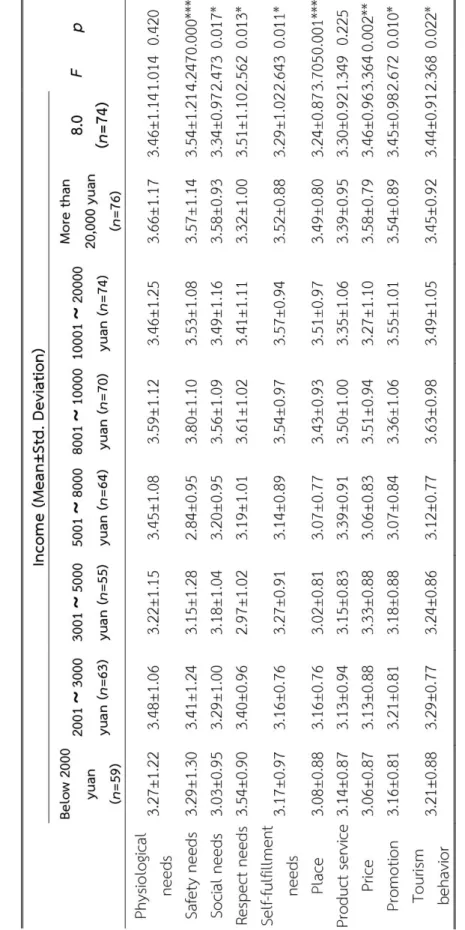
Table 13 ANOVA- Age ... 26
Table 14 ANOVA-Education ... 28
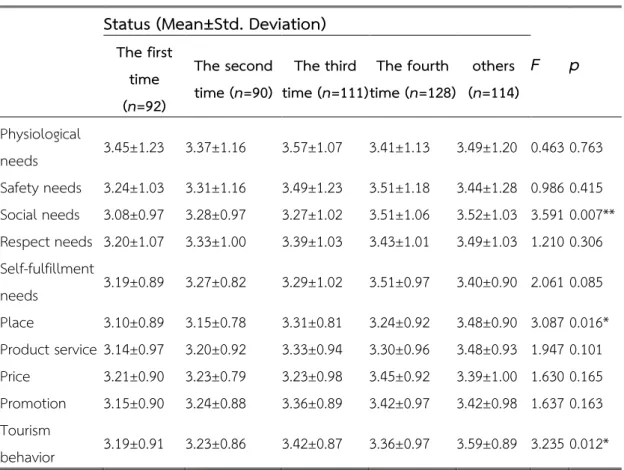
Table 15 ANOVA- Status ... 31
Table 16 Pearson Correlation-1 ... 32
Table 17 Pearson Correlation-2 ... 33
Table 18 Parameter Estimates (n=535)-1 ... 35
Table 19 Parameter Estimates (n=535)-2 ... 37
List of Figures
Page Figures 1 Maslow’s Hierarchy of Needs Theory ... 7 Figures 2 Theoretical framework ... 8 Figures 3 Conceptual framework ... 10
CHAPTER I INTRODUCTION
Background of the Study
Since the end of 2019, Coronavirus disease 2019(COVID-19) outbreak in global, Cities with severe epidemics have taken measures to close the city, such as Wuhan in China. By March 2020, the pandemic situation in foreign countries became more and more serious, and some countries also borrowed from China's experience to fully protect. As of July 15, 2020, According to CCTV News and other domestic authoritative media, official websites of mainstream health departments and mainstream media overseas, the cumulative number of confirmed cases worldwide is 13,234,871, and the existing confirmed cases are 5,518,343. COVID-19 ruthlessly ravages people's health and even life. Health issues have once again become a hot spot and have been paid attention by the people of the world.
Since the 18th National Congress of the Communist Party of China in 2012, The Party Central Committee with Comrade Xi Jinping at its core attaches great importance to health issues, The NPC Standing Committee (China) passed legislation to provide legal support for the development of the health industry, Healthy China construction has risen to national strategy. The great health industry is based on medical and health and biotechnology, life sciences, with the purpose of maintaining, improving and promoting the health of the people, providing the public with a collection of production activities that are directly or closely related to health. The laegr health industry, as an important support for the national health cause, involves many fields, including pension, tourism, medical care, sports and other fields, and will surely become a new engine for economic growth.
Guangxi zhuang autonomous region is a place where many ethnic groups live together and is the province with the most longevity towns in China. The scenery is beautiful, the climate is pleasant, and the natural resources are rich. Great health industry has broad development prospects. Since 2019, a series of documents including "Several Opinions on Accelerating the Development of Great Health Industry"
have been issued. Focus on building a "3+3" large health industry system centered on the Health Medical, health-Provide for the aged, health tourism industries, and the joint development of health medicine, health sports and health food industry with radiation. Guangxi should give full play to the advantages of the ecology, resources,
2 industry, seize multiple opportunities, deepen reform and innovation, and cultivate the big health industry into a strategic pillar industry and an emerging industry that the people are satisfied with. New kinetic energy for Guangxi's economic growth.
In 2017, Nanning City was designated by the National Tourism Administration and the State Administration of Traditional Chinese Medicine as one of the first 15 national Chinese medicine health tourism demonstration areas in the country. Nanning City is the permanent host of the China-ASEAN Expo, using its own advantages to organize various international cultural exchange activities to promote tourism cooperation between China and Southeast Asian countries. According to statistics, from January to September 2019, the total number of tourists in Nanning increased by 14.34% year-on-year, and tourism consumption increased by 23.58% year-on-year.
Based on the advantages of the development of the large health industry, Nanning will comprehensively promote the creation of a large health tourism Industrial Development.
Research Problem
Combined with the above situation, Nanning, as the capital of Guangxi, has been identified as one of the first 15 national Chinese medicine health tourism demonstration zones in the country. The research on the development of the big health tourism industry is of great significance. Nanning faces good opportunities in the development of medical tourism, but also faces some problems and challenges.
Nanning should seize the good opportunity of the development of the big health tourism industry, promote the organic integration of the big health industry and the tourism industry, and effectively promote the development according to the relevant policies and plans that have been issued.
"The 70 common indicators in the nine healthy city indicator systems are divided into six categories: environmental indicators, social indicators, service indicators, crowd indicators, healthy places, and public opinion indicators." (Wenjie Huang, 2016)
It can be seen that the main research issues of this paper are to understand the behavioral willingness of domestic tourists to the health tourism in Nanning, to find the influencing factors for the development of the health tourism industry, and to provide suggestions for improving the development of the health tourism in Nanning.
This study uses "Hierarchy of Needs" and "Marketing Mix" as the main research variables to explore the influence of "Hierarchy of Needs" and "Marketing Mix" on the behavioral intention of domestic tourists to Nanning's health tourism, in order to infer the improvement of Nanning's health Recommendations for the development of tourism.
As the construct, the research problem will be addressed as follow:
Will the physiological needs of tourists have the positive effect on the willingness of Nanning's health tourism behavior?
Will the safety needs of tourists have the positive effect on the willingness of Nanning's health tourism behavior?
Will the social needs of tourists have the positive effect on the willingness of Nanning's health tourism behavior?
Will the respect of tourists have the positive effect on the willingness of Nanning's health tourism behavior?
Will the tourists’self-realization have the positive effect on the willingness of Nanning's health tourism behavior?
Will the tourist location have the positive effect on the willingness of Nanning's health tourism behavior?
Will the production services have the positive effect on the willingness of Nanning's health tourism behavior?
Will the product prices have the positive effect on the willingness of Nanning's health tourism behavior?
Will the marketing methods have the positive effect on the willingness of Nanning's health tourism behavior?
Objective of the Study
Under the background of the national strategy of "Building a Healthy China", the big health industry, as an important support for the health of the whole people, will surely become a new engine driving economic growth. Nanning has been identified as one of the first 15 national TCM health tourism demonstration areas in the country.
This research will elaborate on Maslow’s concept of hierarchy of needs and the concept of marketing mix, and explore its impact on domestic tourists who go to Nanning for health tourism, and then conduct research on the development of the health tourism industry in Nanning.
4 The main purposes of the research are as follows:
1. Explore level of tourists hierarchy of needs theory and marketing mix.
2. Investigate the result of hierarchy of needs and marketing mix forward healthy tourism behavior.
3. Provide data as a vehicle to develop healthy tourism in Nanning City.
Expected the Results
The results obtained through the analysis of quantitative research can be used as the research results of this article:
Consumer needs and tourism locations, production services, product prices, and marketing methods in marketing theories have a positive impact on tourists' willingness to travel healthily, which will be verified through data analysis.
Scope of the Study
About the scope of the study, that will take domestic tourists traveling to Nanning as the research object. Visitors are not limited by gender, age, education and income. Nanning is the capital of Guangxi. As the permanent venue of the China-ASEAN Expo, Nanning uses its own advantages to organize various international cultural exchange activities to promote tourism cooperation between China and Southeast Asian countries. In addition, Nanning was designated by the National Tourism Administration and the State Administration of Traditional Chinese Medicine as one of the first 15 national TCM health tourism demonstration zones in the country.
Limitation of the Study
The research objects involved in this study are mainly domestic tourists traveling to Nanning. If it can be expanded to international tourists traveling to Nanning, it will be able to understand the needs of tourists for health tourism on a larger scale, and thus contribute to optimizing the development of health tourism in Nanning.
Come for greater reference value. In addition, the research starts in June 2020 and lasts until June 2021. One year is spent on preliminary research, designing questionnaires, how to issue questionnaires, and data analysis. Time is limited and the depth of research is not enough. In the future, More extensive and complete research needs to be carried out.
Definition of the Terms
The general health industry is a collection of production activities based on medical and health, biotechnology, and life sciences, with the purpose of maintaining, improving and promoting the health of the people, and providing the public with products and services directly or closely related to health. As an important support for the national health cause, the general health industry involves many fields, including elderly care, health preservation, medical care, culture, sports, tourism and other fields.
The big health tourism industry refers to the organic integration of the tourism industry and the big health industry, which is an inevitable trend for the high-quality development of the tourism industry.
6
CHAPTER II
LITERATURE REVIEW AND RELATED STUDY
Theory Maslow’s Hierarchy of Needs Theory
American psychologist Maslow is the founder of humanistic psychology. He put forward the hierarchy of needs in his book "Theory of Human Motivation" published in 1943. In order to understand people's behavior in society, Maslow believes that it is necessary to do some preliminary understanding of people's basic needs and internal driving forces. Therefore, he divides people's basic needs into several levels, that is, from elementary needs to advanced needs, in order of echelon: physiological needs, safety needs, social needs, respect needs and self-realization needs. Maslow's theory was fully expressed in his 1954 book Motivation and Personality. These five levels can be classified in this way. Physical needs and safety needs are basic needs, social needs and respect needs are psychological needs, and the last level is Self-Fulfillment needs needs. The hierarchy remains a very popular framework in sociology research, management training (Kremer, William Kremer; Hammond, Claudia., 2013) and secondary and higher psychology instruction. Therefore, the introduction of this theory in this study helps to understand the needs of consumers. Consumer needs reflect the needs of the tourism market to a large extent. This is self-evident for the development of the health tourism industry. By analyzing the tourism market demand, understanding tourists' travel motives and interest preferences, combining the health tourism resources and environmental status, clarifying the influencing factors of the health tourism industry, and optimizing the future development path of the health tourism industry.
Figures 1 Maslow’s Hierarchy of Needs Theory Marketing Mix 4ps Theory
The 4Ps of marketing is a model for enhancing the components of your
"marketing mix" – the way in which you take a new product or service to market. It helps you to define your marketing options in terms of price, product, promotion, and place so that your offering meets a specific customer need or demand.
The marketing mix and the 4Ps of marketing are often used as synonyms for one another. In fact, they are not necessarily the same thing.
"Marketing mix" is a general phrase used to describe the different kinds of choices organizations have to make during the process of bringing a product or service to market. The 4Ps is one way – probably the best-known way – of defining the marketing mix, and was first expressed in 1960 by E. J. McCarthy in his book, "Basic Marketing – A Managerial Approach."
The 4Ps are:
Product (or Service).
Place.
Price.
Promotion.
8 Theoretical framework
Through an overview of the theoretical framework, a new model of industrial development is proposed. The model diagram includes four aspects of Maslow's demand level, consumer behavior, stakeholders and industrial development.
Figures 2 Theoretical framework Related Study
The domestic health industry is in its infancy. Compared with the United States, the structure of the health industry is relatively simple, with hospital medical services accounting for 95%. as follows.
The broad health industry has broad prospects for development. The reason lies in the national strategy of "Building a Healthy China" and the current market situation facing the aging of the population, environmental pollution, economic development, rising health awareness and changes in medical costs.
The scale of the pension industry market has increased. In 2020, the number of elderly people aged 66 and above will account for 10.1% of the country's total population, which is approximately 137 million. The elderly care industry chain will involve daily consumption, medical care, life security, leisure and entertainment, etc.
The scale of health tourism market will reach hundreds of billions.
China has begun to pay attention to the construction of health industrial parks, especially in developed areas. For example, Suzhou City, Zhejiang Province has built a Global International Health Industrial Park, which is the only international industrial park in China with the theme of the integration of the health industry chain. Zhuhai
Demographic Factors
Hierarchy of Needs
Marketing Mix
Health Tourism Behavior in Nanning
Propose approaches to development of
the province as a center of health tourism
in the upper Nanning of
China
City, Guangdong Province has built the World Health Industry Raw Material City, which is currently the only professional health industry raw material market in the country.
Beidaihe, Qinhuangdao City, Hebei Province, plans to build the first national-level life and health industry innovation demonstration zone, forming a five-in-one life and health industry cluster of "medicine, medicine, nourishment, health, and tourism".
Shaoxing City in Zhejiang Province will plan to build a health-preserving city. Wuhan City, Hubei Province will plan to build Longyang Lake Health Valley to pre-cultivate leading domestic pharmaceutical e-commerce companies. In addition, Guangxi mainly builds "five areas (corridors)", namely, the Xijiang Traditional Chinese Medicine Health Tourism Corridor. The second is the ecological landscape vacation and health tourism area in northeast Guangxi. The third is the seaside leisure and health tourism area of Beibu Gulf. The fourth is the longevity health resort tourism area in northwest Guangxi.
Fifth, the ecological and folk custom experience health tourism area in Central Guangxi.
In Nanning, the Evergrande Cultural Tourism Health City has been built. It is located in the national airport economic zone and is close to Wuxu Airport. It covers an area of 500,000 square meters. It is a collection of "super large water world, children’s world, tourism world, and customs an all-round cultural, tourism and health resort that integrates hot springs, gourmet food, themed cultural park, health valley, and modern intelligent agricultural sciences. Also planned are Nanning Wanyou International Tourism Resort and Nanning Guiken International Health City.
Conceptual framework
On the basis of the above theoretical framework, combined with theoretical concepts and dimensions, the conceptual framework of this article is constructed. The independent variables are Demographic Factors, Hierarchy of Needs and Marketing Mix, and the dependent variable is Health Tourism Behavior in Nanning. as follows:
10
Figures 3 Conceptual framework Research Hypothesis
According to the conceptual framework, this research proposes 9 hypotheses.
The reasoning process and assumptions will be explained in the following content.
Consequences of Hierarchy of Needs
From Maslow’s hierarchy of needs theory, it can be seen that the hierarchy of human needs is mainly divided into five levels, namely, physiological needs, safety needs, social needs, respect needs and self-realization needs. The higher the level of
Demographic Factors - Sex
- income - education -age -occupation -status
Hierarchy of Needs - physiological needs - safety needs - social needs - respect needs - self-realization needs
Marketing Mix - Place
- Product Service - Price
-Promotion
Health Tourism Behavior in
Nanning
Propose approaches to development of
the province as a center of health tourism in the upper
Nanning of China
consumer demand and the more comprehensive, the broader the service scope of the health tourism industry and the higher the service quality requirements.
H1: The physiological needs of tourists have a significant positive impact on the willingness of Nanning's health tourism behavior.
H2: The safety needs of tourists have a significant positive impact on the willingness of Nanning's health tourism behavior.
H3: The social needs of tourists have a significant positive impact on the willingness of Nanning's health tourism behavior.
H4: The respect of tourists needs to have a significant positive impact on the willingness of Nanning's health tourism behavior.
H5: Tourists’self-realization needs to have a significant positive impact on the willingness of Nanning's health tourism behavior
Consequences of Marketing Mix Strategy
H6: The tourist location has a significant positive influence on the willingness of Nanning's health tourism behavior.
H7: Production services have a significant positive impact on the willingness of Nanning's health tourism behavior.
H8: Product prices have a significant positive impact on the willingness of Nanning's health tourism behavior.
H9: Marketing methods have a significant positive influence on the willingness of Nanning's health tourism behavior.
12
CHAPTER III
RESEARCH METHODOLOGY
Locale of the Study
The location of this study is concentrated in Nanning, Guangxi Zhuang Autonomous Region, China. The target population is concentrated in domestic tourists visiting Nanning City.
Population and Sampling Procedures Population
This research focuses on domestic tourists visiting Nanning.
Sampling
This study uses a simple random sampling method to collect data on domestic tourists who go to Nanning to participate in health tourism. Due to the large number of tourists, precise estimates cannot be made, therefore, data are collected from a sample. Select the Cochran formula to calculate the sample size. Investigators can obtain information on people of different ages and strata, can estimate sampling error, and survey results can be used to infer general conditions.
Variable of Measurement
The independent variables of this study are consumer demand, consumer behavior and related stakeholders, and the dependent variable is Health Tourism Industry. In order to further understand the influencing factors of the development of Nanning's big health tourism industry and optimize the development of the industry, this study uses questionnaires to survey tourists who travel to Nanning. The questionnaire uses Likert scale to design options. Each item is set up according to the level of very approved, approved, general, disapproved, and very disapproved, which are checked by the respondents, and the scores are "5", "4", "3", "2", and "1" to indicate the tourist's Recognition, the closer the value is to 5, the higher the recognition; the closer the value is to 1, the lower the recognition. In addition, it also involves the basic information of the respondents, including basic information, education level and
income structure, etc. The variable of each concept and the items in every concept will be discussed in the following.
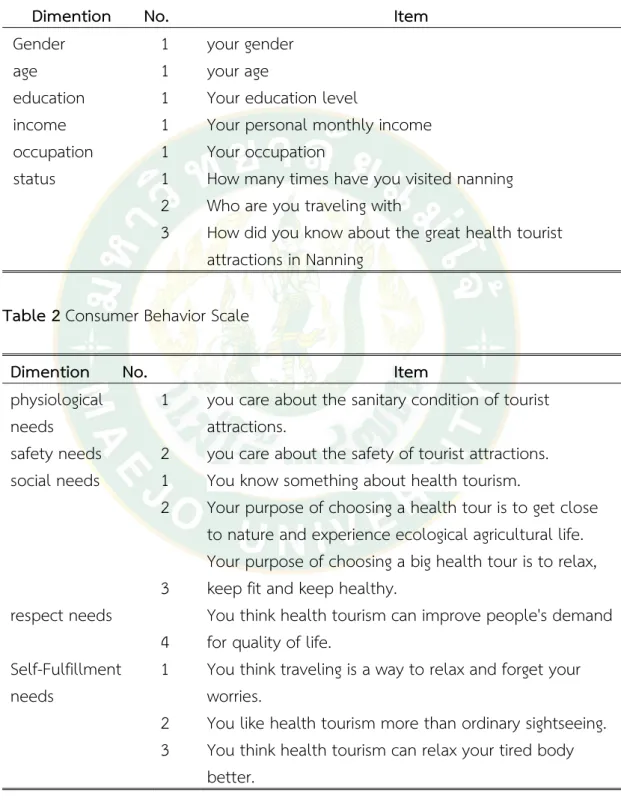
Table 1 Demographic Factors
Dimention No. Item
Gender 1 your gender
age 1 your age
education 1 Your education level
income 1 Your personal monthly income occupation 1 Your occupation
status 1 How many times have you visited nanning 2 Who are you traveling with
3 How did you know about the great health tourist attractions in Nanning
Table 2 Consumer Behavior Scale
Dimention No. Item
physiological needs safety needs
1 you care about the sanitary condition of tourist attractions.
2 you care about the safety of tourist attractions.
social needs
respect needs
1 2
3 4
You know something about health tourism.
Your purpose of choosing a health tour is to get close to nature and experience ecological agricultural life.
Your purpose of choosing a big health tour is to relax, keep fit and keep healthy.
You think health tourism can improve people's demand for quality of life.
Self-Fulfillment needs
1 You think traveling is a way to relax and forget your worries.
2 You like health tourism more than ordinary sightseeing.
3 You think health tourism can relax your tired body better.
Source: Abraham H. Maslow (1943)
14 Table 3 Marketing Mixes Strategy
Dimention No. Item
Place 1 You think it is important to have convenient traffic conditions around the health and wellness tourist attraction.
2 You think the basic public facilities in tourist attractions should be complete.
3 4 5
You prefer to travel to health-preserving tourist attractions with cultural brands..
You are satisfied with the natural landscape of the health and wellness tourist attraction
You are satisfied with the humanistic landscape of the health and wellness tourist attraction.
Product Service 1 2 3
You are willing to purchase health care products and services during the health care travel process.
you think the service quality of tourist attractions affects your travel experience.
You are satisfied with the service attitude of the staff in the health and wellness tourist attraction.
Price 1 Your opinion on the ticket price of health and wellness tourist attractions.
2 Your opinion on the price of souvenirs in health and wellness tourist attractions.
3 Your opinion on the price of meals in health and wellness tourist attractions.
Promotion 1
2 3
You think health tourism should focus on health care products and health care services.
You think health tourism promotion should adopt the
"online + offline" advertising model.
You think that the external publicity of health and wellness tourist attractions is strong.
Table 4 Tourism Behavior
Dimention No. Item
Tourism Behavior 1 In the future, you will travel to Nanning Health Tourism Scenic Area again.
2 In the future, you recommend relatives and friends to local health tourism.
Research Instrument
In the initial stage of the research, exploratory methods are used to describe the research questions, that is, to answer the research questions. Secondly, before the theory is formed, collect data and use explanatory methods to answer "how to carry out" and "why to study". Finally, use descriptive methods to present information about the research phenomenon. Therefore, this research mainly adopts exploratory methods, collecting raw data in the form of questionnaire survey.
Pretesting of the Instrument
According to Narins (1999) pointed that it is difficult to say how many participants to have per pretest. A rule of thumb is a sample of 25 to 75 for a large- scale study. And on the book “Making Health Communication Programs Work: A Planners Guide” has the chapter to discuss about the planning and pretest, it mentions that in pretest the sample size should be large enough, however, to give the confidence that have sampled a range of opinions. A reasonable and adequate sample size is 50 participants typical of the target audience. In order to test the effectiveness of the quality of the survey, it is necessary to conduct a preliminary survey before the actual survey. First issue 50 preliminary survey samples. Through empirical analysis, the reliability of the method is verified.
Data Gathering
Data collection refers to the collection of relevant data according to the needs of the system itself and the needs of users to describe the process of collecting data.
16 make decisions on important issues and pass the information to others (Weller &
Romney 1988), and to make some calculations have a basis.
Pre-collection data activity: Obtain target data for pre-testing and ensure analysis methods.
Specific collection: Collect data by sampling.
In accordance with the sampling method and data collection plan, this research adopts the form of questionnaire survey.
Analysis of Data
In terms of data analysis, this study uses SPSS (Statistical Product and Service Solutions) software for descriptive data analysis, T test, ANOVA regression analysis and factor analysis.
CHAPTER IV
RESULT AND DISCUSSION
In this research, there were 535 tourists as a sample. The sample is now analyzed, including: frequency analysis, descriptive analysis, reliability analysis, validity analysis, difference analysis, correlation analysis and regression analysis.
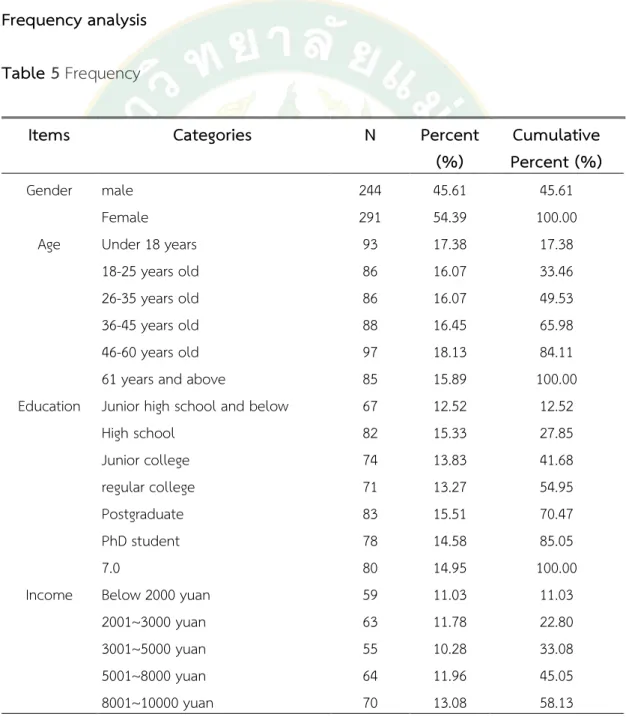
Demographic Characteristics of the Respondents Frequency analysis
Table 5 Frequency
Items Categories N Percent
(%)
Cumulative Percent (%)
Gender male 244 45.61 45.61
Female 291 54.39 100.00
Age Under 18 years 93 17.38 17.38
18-25 years old 86 16.07 33.46
26-35 years old 86 16.07 49.53
36-45 years old 88 16.45 65.98
46-60 years old 97 18.13 84.11
61 years and above 85 15.89 100.00
Education Junior high school and below 67 12.52 12.52
High school 82 15.33 27.85
Junior college 74 13.83 41.68
regular college 71 13.27 54.95
Postgraduate 83 15.51 70.47
PhD student 78 14.58 85.05
7.0 80 14.95 100.00
Income Below 2000 yuan 59 11.03 11.03
2001~3000 yuan 63 11.78 22.80
3001~5000 yuan 55 10.28 33.08
5001~8000 yuan 64 11.96 45.05
8001~10000 yuan 70 13.08 58.13
18 Table 5 (Continued)
Items Categories N Percent
(%)
Cumulative Percent (%)
10001~20000 yuan 74 13.83 71.96
More than 20000 yuan 76 14.21 86.17
8.0 74 13.83 100.00
Occupation Civil servants / Staff of public institutions 51 9.53 9.53 Professional skill worker (Such as
teachers/doctors/lawyers, etc.)
40 7.48 17.01
Service industry personnel (Such as Catering clerk/driver/sales clerk, etc.)
57 10.65 27.66
Freelancer (Such as writer/artist/photographer /guide, etc.)
75 14.02 41.68
Worker (Such as factory workers/construction workers/urban sanitation workers, etc.)
47 8.79 50.47
Staff (Personnel engaged in general affairs) 31 5.79 56.26
Private business owner 41 7.66 63.93
student 39 7.29 71.21
housewife 52 9.72 80.93
Retirees 55 10.28 91.21
others 47 8.79 100.00
Status The first time 92 17.20 17.20
The second time 90 16.82 34.02
The third time 111 20.75 54.77
The fourth time 128 23.93 78.69
others 114 21.31 100.00
With whom Family or relatives 115 21.50 21.50
friend 155 28.97 50.47
Tour group 143 26.73 77.20
personal 122 22.80 100.00
Way to understand
friend 111 20.75 20.75
advertising 111 20.75 41.50
Travel agency 108 20.19 61.68
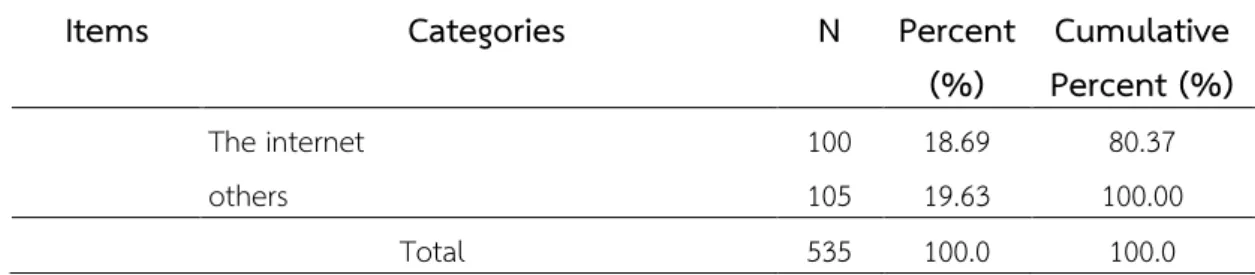
Table 5 (Continued)
Items Categories N Percent
(%)
Cumulative Percent (%)
The internet 100 18.69 80.37
others 105 19.63 100.00
Total 535 100.0 100.0
It can be seen from the above table: From the perspective of gender, more than 50% of the sample persons in the sample are women. Another 45.61% of the sample persons are men. In terms of age, 18.13% of the age distribution in the sample is concentrated in “46-60 years old”. In terms of education level, 15.51% of the sample personnel are "master students". In terms of income, the highest proportion of “over 20,000 yuan” is 14.21%. In terms of occupational distribution, most of the samples are
"freelancers (such as writers/artists/photographers/guides, etc.)", with a total of 75.0, accounting for 14.02%. More than 20% of the travel times selected the "4th time".
From the perspective of travel companions, there are relatively more people with
"friends", the proportion is 28.97%.20.75% of people learned travel information from
"friends".
Descriptive analysis
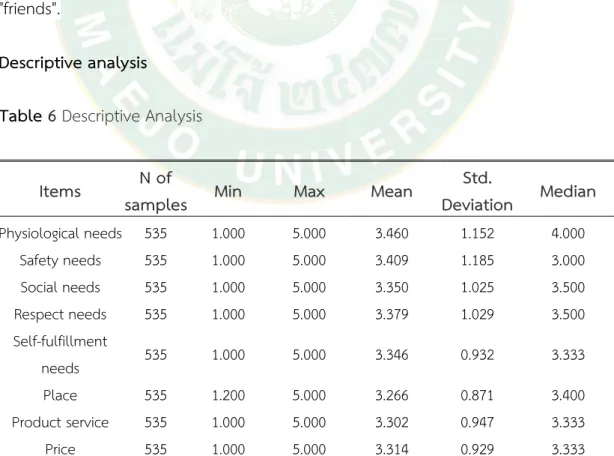
Table 6 Descriptive Analysis
Items N of
samples Min Max Mean Std.
Deviation Median Physiological needs 535 1.000 5.000 3.460 1.152 4.000
Safety needs 535 1.000 5.000 3.409 1.185 3.000
Social needs 535 1.000 5.000 3.350 1.025 3.500
Respect needs 535 1.000 5.000 3.379 1.029 3.500
Self-fulfillment
needs 535 1.000 5.000 3.346 0.932 3.333
Place 535 1.200 5.000 3.266 0.871 3.400
Product service 535 1.000 5.000 3.302 0.947 3.333
Price 535 1.000 5.000 3.314 0.929 3.333
20 Table 6 (Continued)
Items N of
samples Min Max Mean Std.
Deviation Median
Promotion 535 1.000 5.000 3.331 0.932 3.333
Tourism behavior 535 1.000 5.000 3.369 0.910 3.500
Through descriptive analysis, among the dimensions in the above table, the sample size is 535, the dimension with the largest average value is Physiological needs, and the average value is 3.460; the dimension with the smallest average value is Place, and the average value is 3.266. This measurement form requires the respondent to provide an answer in the range of 5 points from 1 to 5 on each item. Based on the average score of each item, respondents tend to strongly agree that sanitary conditions affect tourists’ satisfaction with healthy tourist attractions (mean 3.460, SD 1.152), This is most likely due to the impact of the new crown epidemic in 2020 and people's emphasis on health. Among the above factors, the one that respondents paid the least attention to was the place-related elements.
Reliability Analysis Table 7 Cronbach Alpha
Items N of Items n Cronbach α
Social needs 2 535 0.823
Respect needs 2 535 0.841
Self-fulfillment needs 3 535 0.854
Place 5 535 0.900
Product service 3 535 0.868
Price 3 535 0.857
Promotion 3 535 0.863
Tourism behavior 2 535 0.787
Cronbach's alpha is usually used to test the reliability of the questionnaire.
When the Cronbach's alpha index of the scale is lower than 0.7, it indicates that the consistency of multiple indexes of the constructs measured by the scale is poor, and the scale needs to be re-edited; When the Cronbach's alpha index of the scale is higher
than 0.7, it indicates that the multiple indexes of the construct measured by the scale are in good agreement.; When the Cronbach's alpha index of the scale is higher than 0.9, it indicates that the consistency of multiple indexes of the constructs measured by the scale is very good, and the measurement reliability is very high.
It can be seen from the table that the Cronbach's Alpha coefficient values corresponding to the eight dimensions of the scale are all greater than 0.7, indicating that the internal consistency of the questionnaire is good, so the reliability of the results of this survey is very good. At the same time, the deleted Cronbach's Alpha value of most items is lower than the overall Cronbach's Alpha reliability coefficient.
Therefore, all the questions are the measurement of the same concept, and there is no need to delete the question items.
Validity Analysis Table 8 KMO and Bartlett test
KMO 0.906
Bartlett test
Approx. Chi-Square 7640.507
df 300
p value 0.000
Use factor analysis for information enrichment research, first analyze whether the research data is suitable for factor analysis. It can be seen from the above table:
KMO is 0.906, which is greater than 0.6, Meeting the prerequisites of factor analysis means that the data can be used for factor analysis research. And the data passed the Bartlett sphericity test (p<0.05), indicating that the research data is suitable for factor analysis.
22 Table 9 Total Variance Explained
Factor
Eigen values % of variance (Initial) % of variance (Rotated)
Eigen % of Variance
Cum. % of
Variance Eigen % of Variance
Cum. % of
Variance Eigen % of Variance
Cum. % of Variance
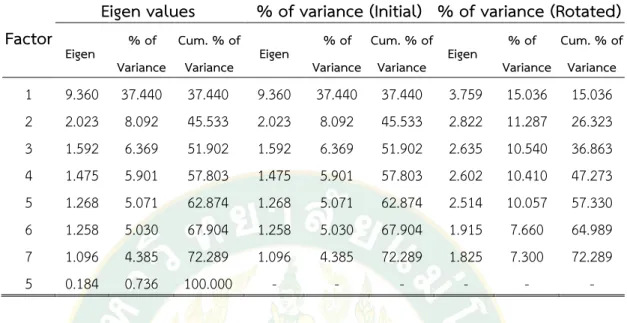
1 9.360 37.440 37.440 9.360 37.440 37.440 3.759 15.036 15.036 2 2.023 8.092 45.533 2.023 8.092 45.533 2.822 11.287 26.323 3 1.592 6.369 51.902 1.592 6.369 51.902 2.635 10.540 36.863 4 1.475 5.901 57.803 1.475 5.901 57.803 2.602 10.410 47.273 5 1.268 5.071 62.874 1.268 5.071 62.874 2.514 10.057 57.330 6 1.258 5.030 67.904 1.258 5.030 67.904 1.915 7.660 64.989 7 1.096 4.385 72.289 1.096 4.385 72.289 1.825 7.300 72.289
5 0.184 0.736 100.000 - - - - - -
The above table analyzes the factor extraction situation and the amount of factor extraction information. It can be seen from the above table that the factor analysis has extracted a total of 7 factors, and the characteristic root values are all greater than 1. The variance interpretation rates of the 7 factors after rotation are 15.036%, 11.287%, 10.540%, 10.410%, 10.57%, 7.660%, and 7.300%, respectively. The cumulative variance interpretation rate after rotation is 72.289%.
Table 10 Factor loading (Rotated)
Items Factor loading Commu
nalities Factor 1 Factor 2 Factor 3 Factor 4 Factor 5 Factor 6 Factor 7
Q9 0.097 0.280 0.258 0.234 0.218 0.163 0.131 0.300
Q10 0.142 0.319 0.207 0.285 0.134 0.141 0.219 0.332
Q11 0.147 0.116 0.128 0.100 0.173 0.073 0.870 0.854
Q12 0.192 0.143 0.194 0.137 0.084 0.086 0.845 0.843
Q13 0.189 0.103 0.118 0.111 0.111 0.878 0.044 0.858
Q14 0.202 0.157 0.151 0.113 0.136 0.838 0.103 0.833
Q15 0.119 0.147 0.109 0.065 0.881 0.077 0.097 0.843
Q16 0.186 0.160 0.136 0.128 0.780 0.082 0.143 0.731
Q17 0.188 0.073 0.167 0.161 0.802 0.141 0.053 0.760
Q18 0.890 0.103 0.054 0.136 0.084 0.094 0.085 0.847
Table 10 (Continued)
Items Factor loading Commu
nalities Factor 1 Factor 2 Factor 3 Factor 4 Factor 5 Factor 6 Factor 7
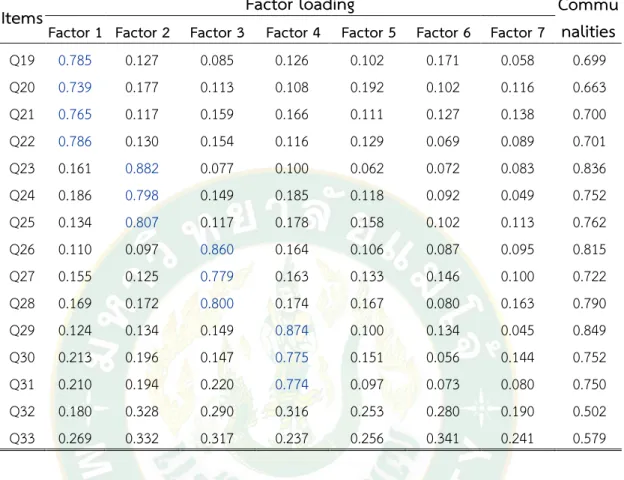
Q19 0.785 0.127 0.085 0.126 0.102 0.171 0.058 0.699
Q20 0.739 0.177 0.113 0.108 0.192 0.102 0.116 0.663
Q21 0.765 0.117 0.159 0.166 0.111 0.127 0.138 0.700
Q22 0.786 0.130 0.154 0.116 0.129 0.069 0.089 0.701
Q23 0.161 0.882 0.077 0.100 0.062 0.072 0.083 0.836
Q24 0.186 0.798 0.149 0.185 0.118 0.092 0.049 0.752
Q25 0.134 0.807 0.117 0.178 0.158 0.102 0.113 0.762
Q26 0.110 0.097 0.860 0.164 0.106 0.087 0.095 0.815
Q27 0.155 0.125 0.779 0.163 0.133 0.146 0.100 0.722
Q28 0.169 0.172 0.800 0.174 0.167 0.080 0.163 0.790
Q29 0.124 0.134 0.149 0.874 0.100 0.134 0.045 0.849
Q30 0.213 0.196 0.147 0.775 0.151 0.056 0.144 0.752
Q31 0.210 0.194 0.220 0.774 0.097 0.073 0.080 0.750
Q32 0.180 0.328 0.290 0.316 0.253 0.280 0.190 0.502
Q33 0.269 0.332 0.317 0.237 0.256 0.341 0.241 0.579
Remark Blue indicates that the absolute value of loading is greater than 0.4, and red indicates that the communality is less than 0.4.
Overall, the results obtained by rotating the component matrix are consistent with the scale and dimensions of the research design division. At the same time, the load value of each item of each dimension is greater than 0.5. Therefore, the validity of the questionnaire is high, the questionnaire is valid, and subsequent research and analysis can be carried out.
24 Variation Analysis
Table 11 Independent t test
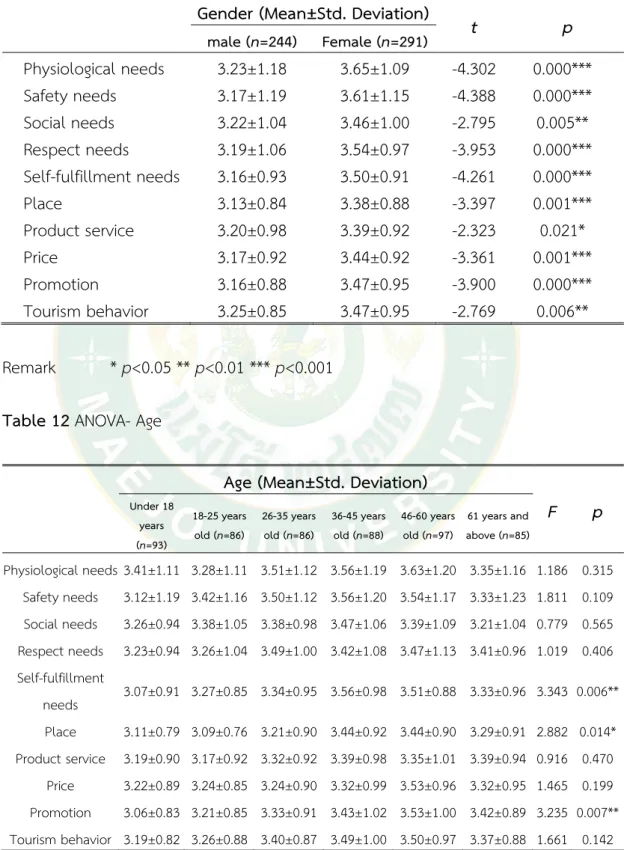
Gender (Mean±Std. Deviation) t p male (n=244) Female (n=291)
Physiological needs 3.23±1.18 3.65±1.09 -4.302 0.000***
Safety needs 3.17±1.19 3.61±1.15 -4.388 0.000***
Social needs 3.22±1.04 3.46±1.00 -2.795 0.005**
Respect needs 3.19±1.06 3.54±0.97 -3.953 0.000***
Self-fulfillment needs 3.16±0.93 3.50±0.91 -4.261 0.000***
Place 3.13±0.84 3.38±0.88 -3.397 0.001***
Product service 3.20±0.98 3.39±0.92 -2.323 0.021*
Price 3.17±0.92 3.44±0.92 -3.361 0.001***
Promotion 3.16±0.88 3.47±0.95 -3.900 0.000***
Tourism behavior 3.25±0.85 3.47±0.95 -2.769 0.006**
Remark * p<0.05 ** p<0.01 *** p<0.001 Table 12 ANOVA- Age
Age (Mean±Std. Deviation)
F p
Under 18 years (n=93)
18-25 years old (n=86)
26-35 years old (n=86)
36-45 years old (n=88)
46-60 years old (n=97)
61 years and above (n=85)
Physiological needs 3.41±1.11 3.28±1.11 3.51±1.12 3.56±1.19 3.63±1.20 3.35±1.16 1.186 0.315 Safety needs 3.12±1.19 3.42±1.16 3.50±1.12 3.56±1.20 3.54±1.17 3.33±1.23 1.811 0.109 Social needs 3.26±0.94 3.38±1.05 3.38±0.98 3.47±1.06 3.39±1.09 3.21±1.04 0.779 0.565 Respect needs 3.23±0.94 3.26±1.04 3.49±1.00 3.42±1.08 3.47±1.13 3.41±0.96 1.019 0.406 Self-fulfillment
needs 3.07±0.91 3.27±0.85 3.34±0.95 3.56±0.98 3.51±0.88 3.33±0.96 3.343 0.006**
Place 3.11±0.79 3.09±0.76 3.21±0.90 3.44±0.92 3.44±0.90 3.29±0.91 2.882 0.014*
Product service 3.19±0.90 3.17±0.92 3.32±0.92 3.39±0.98 3.35±1.01 3.39±0.94 0.916 0.470 Price 3.22±0.89 3.24±0.85 3.24±0.90 3.32±0.99 3.53±0.96 3.32±0.95 1.465 0.199 Promotion 3.06±0.83 3.21±0.85 3.33±0.91 3.43±1.02 3.53±1.00 3.42±0.89 3.235 0.007**
Tourism behavior 3.19±0.82 3.26±0.88 3.40±0.87 3.49±1.00 3.50±0.97 3.37±0.88 1.661 0.142
Remark: * p<0.05 ** p<0.01 *** p<0.001
As can be seen from the above table, using the analysis of variance (the full name is one-way analysis of variance) to study Age for Physiological needs, Safety needs, Social needs, Respect needs, Self-fulfillment needs, Place, Product service, Price, Promotion, Tourism behavior total 10 The difference of items, It can be seen from the above table that different Age samples will not show significance for 7 items of Physiological needs, Safety needs, Social needs, Respect needs, Product service, Price, Tourism behavior (p>0.05). It means that different Age samples show consistency for Physiological needs, Safety needs, Social needs, Respect needs, Product service, Price, Tourism behavior, and there is no difference. In addition, the Age sample is significant for the three items of Self-fulfillment needs, Place, and Promotion (p<0.05), which means that different Age samples are different for Self-fulfillment needs, Place, and Promotion. Specific analysis shows that:
Age shows significance at the level of 0.01 for Self-fulfillment needs (F=3.343, p=0.006), and the difference in specific comparison shows that the comparison result of the average scores of the groups with more obvious differences is "26-35 years old>
18 years old ; 36-45 years old> below 18 years old; 46-60 years old> below 18 years old; 36-45 years old> 18-25 years old".
Age is significant for Place at the 0.05 level (F=2.882, p=0.014), and the specific comparison difference shows that the comparison result of the average scores of the groups with more obvious differences is "36-45 years old> 18 years old; 46- 60 years old>under 18 years old; 36-45 years old>18-25 years old; 46-60 years old>18-25 years old".
Age shows a significance level of 0.01 for Promotion (F=3.235, p=0.007), and the specific comparison difference shows that the comparison result of the average scores of the groups with more obvious differences is "26-35 years old> 18 years old;
36- 45 years old> below 18 years old; 46-60 years old> below 18 years old; 61 years old and above> below 18 years old; 46-60 years old> 18-25 years old".
The summary shows that different Age samples do not show significant differences in the 7 items of Physiological needs, Safety needs, Social needs, Respect needs, Product service, Price, and Tourism behavior. In addition, Age samples have a total of Self-fulfillment needs, Place, and Promotion. Three items showed significant differences.
26
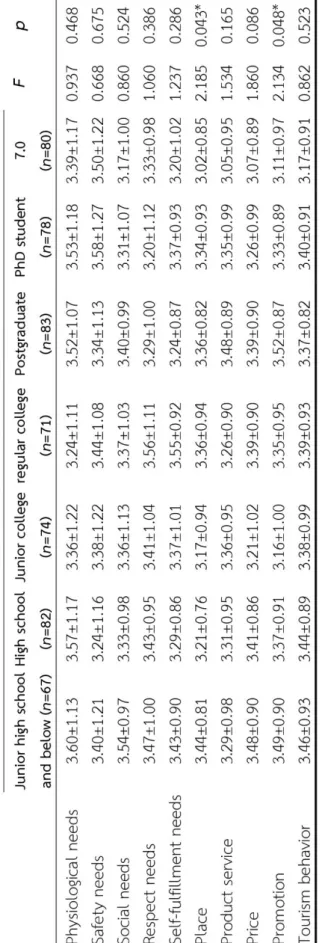
Table 13 ANOVA- Age
As can be seen from the above table, using analysis of variance (the full name is one-way analysis of variance) to study Education for Physiological needs, Safety needs, Social needs, Respect needs, Self-fulfillment needs, Place, Product service, Price, Promotion, Tourism behavior total 10 The difference of items, It can be seen from the above table that different Education samples will not show significance for 8 items of Physiological needs, Safety needs, Social needs, Respect needs, Self- fulfillment needs, Product service, Price, Tourism behavior (p>0.05). It means that different Education samples show consistency for Physiological needs, Safety needs, Social needs, Respect needs, Self-fulfillment needs, Product service, Price, Tourism behavior, and there is no difference. In addition, the Education sample is significant for two items of Place and Promotion (p<0.05), which means that different Education samples are different for Place and Promotion. Specific analysis shows that:
Education showed 0.05-level significance for Place (F=2.185, p=0.043), and the specific comparison difference shows that the comparison results of the average scores of the groups with more obvious differences are "junior high school and below&g