Unsurprisingly, Thai people spend an average of 3 hours and 46 minutes each on social media, which is more time than watching television. Social media are the means of interaction between people in which they create, share and exchange information and ideas in virtual communities and networks, either in the form of images or messages. Look at the Thailand Zocial Awards 2016 Seminar: In 2015, there were 2.6 billion public lectures on social media, which equates to 7 million lectures per day, 5,200 lectures per minute, or 82 lectures per second.
It is further emphasized that social media is taking an important role in the information search and decision-making behaviors of restaurants.
Problem Statement
It is perceived that this communication channel between restaurants and their customers will continue to grow and support the restaurant's strong performance during the forecast period. There are lots of restaurants information on the internet as a community in Thailand such as Pantip.com, Wongnai, OpenRice, Eatigo, Edtguide, BKKmenu, Chillpainai and many more on Facebook food/restaurant review fan pages and food/restaurant review Instagram accounts. These communities share information about the restaurant between past customers who have been to the restaurant and other people who are interested in the restaurant.
Customers will know what other people experience and think about the restaurant they visited while restaurants owner could maintain relationships with customers through those communities.
Research Objectives
It starts with the background of social media about blog, Facebook page and Instagram account to set the context for this study. The theoretical background of Millennial characteristics and behavior in relation to social media and eating out is explained next. Emphasis is also placed on characteristics of online review and WOM, and factors influencing their credibility.
Literature Review
- Social Media usage and benefits
- Millennial and their social media usage
- Electronic Word of Mouth (eWOM)
- Online Reviews
- Eating Out Behavior
- Restaurant Selection
A need to interact with others is a key reason for their use of social media (Palfrey and Gasser, 2008). They are also more likely to value others' opinions in social media and feel important when they give feedback about the brands or products they use (Bolton, Parasuraman, Hoefnagels, Migchels, Kabadayi, Gruber, Loureiro, Solnet, 2013). Previous study suggests that consumers use social media primarily to connect with others and gather information.
Social media can be a great place for spreading information; for example, create electronic word-of-mouth advertising, promote new products, answer questions, etc.
Hypotheses Development
Study Framework
The data is collected through online questionnaires distributed to 200 respondents through various online channels such as Facebook, Email and Line, which are able to receive many and fast responses at the same time. Since this study aims to identify the impact of online reviews on restaurant choice of millennial Internet users, the questionnaire will be distributed to young people who enjoy dining out and normally use social media to gather information from online food and restaurant reviews.
Research Design
Population Size and Sampling
However, in this study, the random sample focuses on Generation Y, born between 1980 and 2000 and raised in the age of social media.
Research Instrument
Questionnaire Structure
The even-point scale was chosen for this study with the aim of removing the midpoint or neutral option because the neutral option is considered the easiest way to answer when respondents feel unsure about the answer.
Data Analysis Method
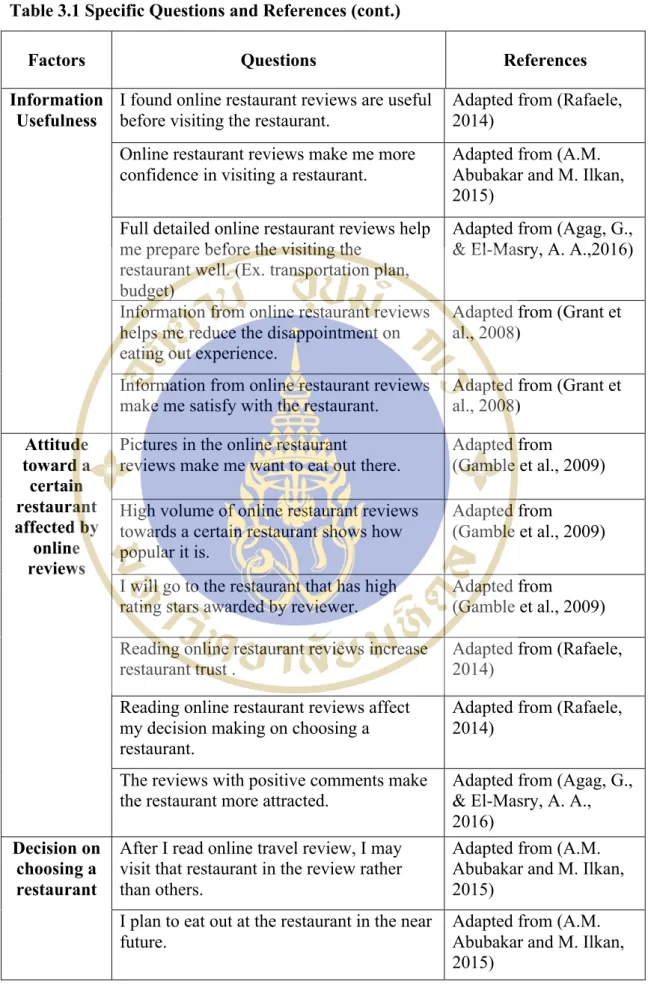
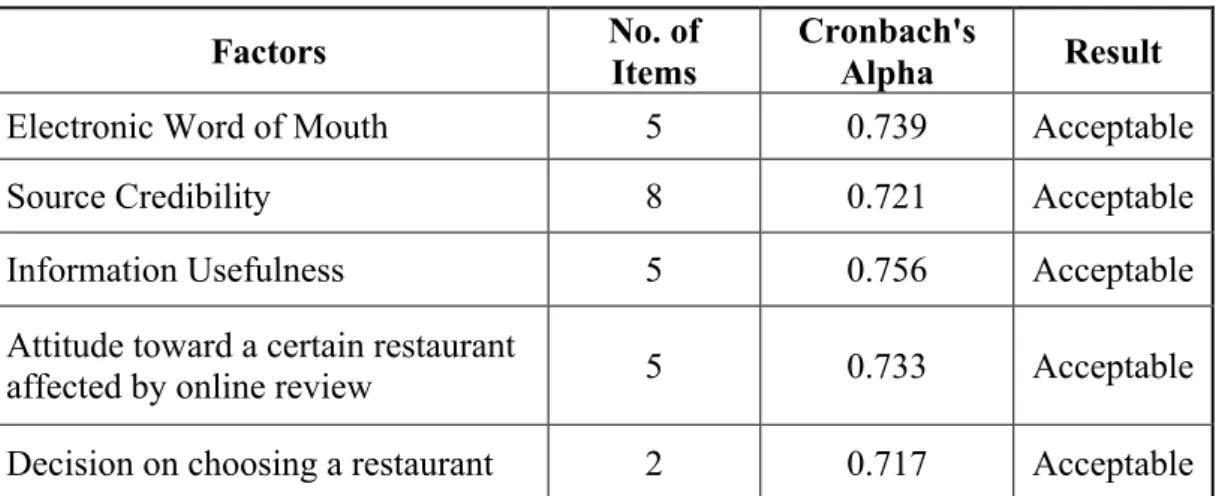
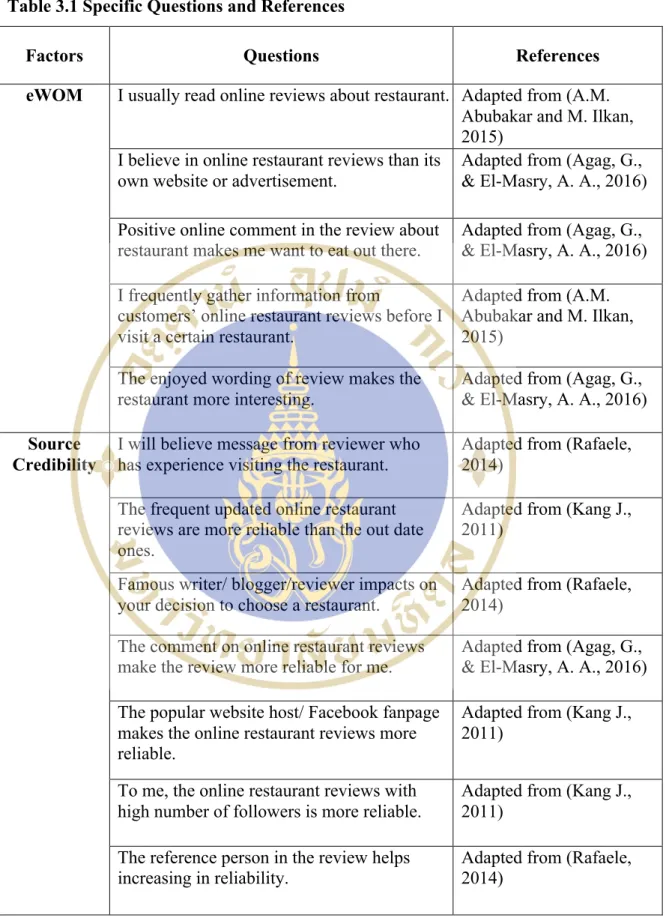
Full detailed online restaurant reviews help me prepare before I visit. amp; El-Masry, A. A., 2016) Information from online restaurant reviews. it helps me reduce the frustration of the dining out experience. Gamble et al., 2009) High volume of online restaurant reviews. towards a particular restaurant shows how popular it is. rating stars given by the reviewer.
Data Analysis
- Descriptive Analysis
- Correlation Analysis
- Multiple Linear Regression Analysis
- One-way ANOVA analysis
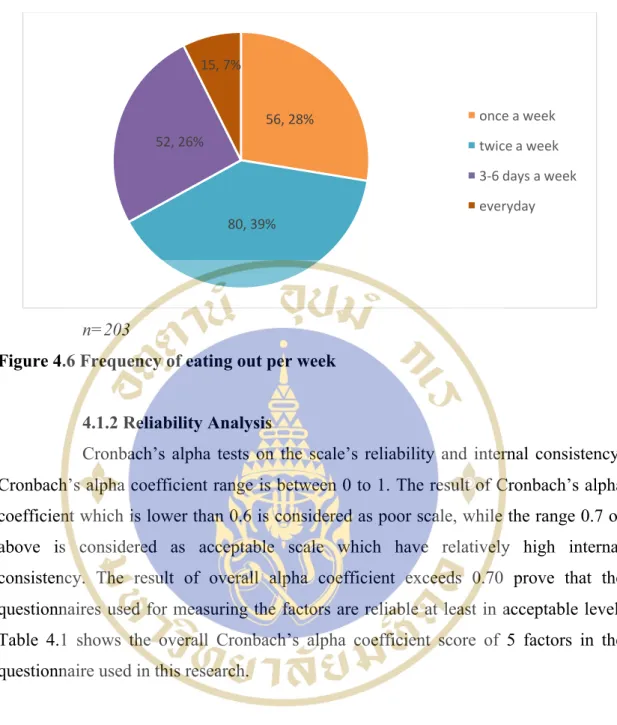
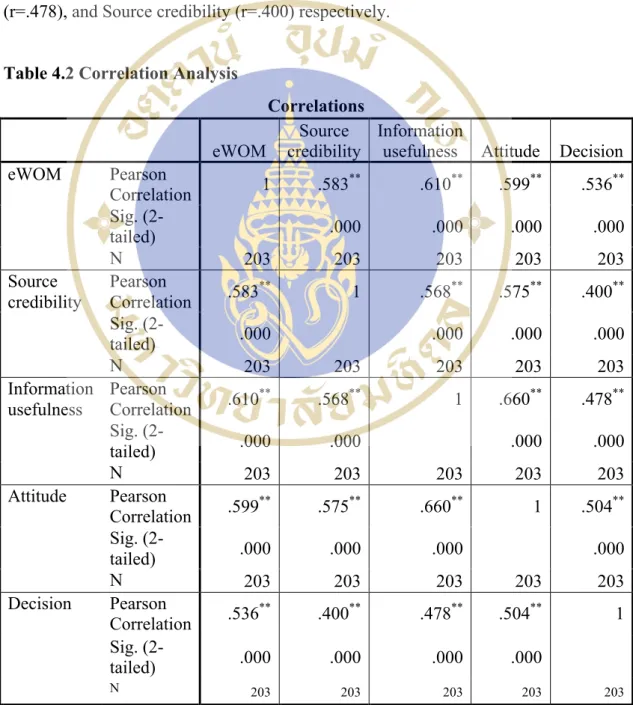
Research also examines the general information of respondents who have had experiences with gathering information from online restaurant reviews to make decisions about choosing a restaurant in terms of reasons why they use online restaurant reviews and the frequency of dining out per week. The result shows that all factors are significantly and positively correlated with decision about choosing a restaurant at 99% confidence level. Electronic word-of-mouth (eWOM) has the highest correlation with Decision about choosing a restaurant (r=.536), followed by Attitude towards a certain restaurant (r=.504), Information usefulness (r=.478 ) and Source Credibility ( r=.400) respectively.
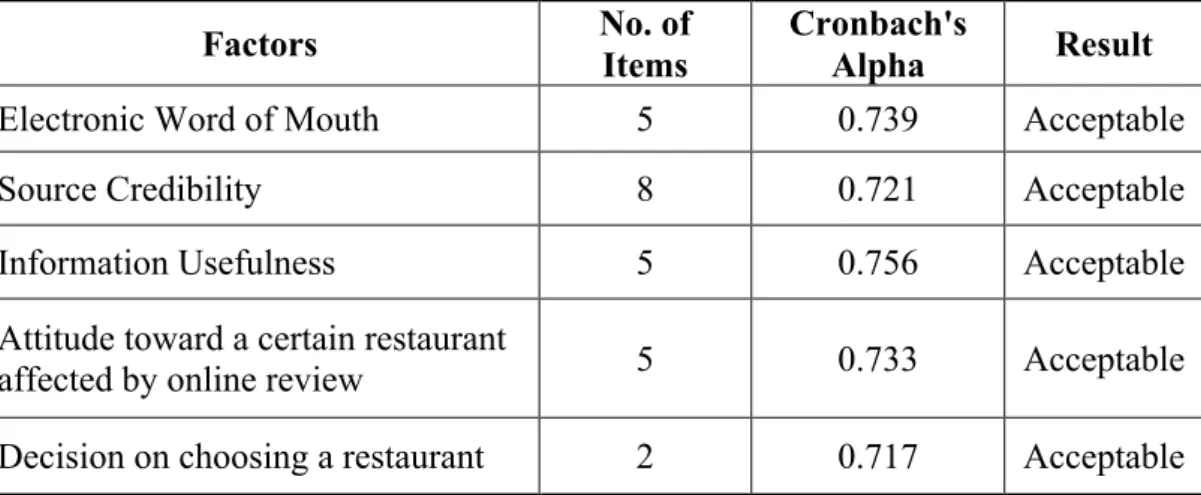
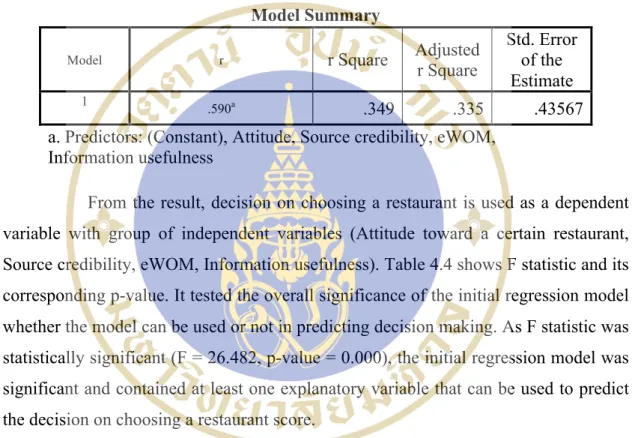
From the result, the decision to choose a restaurant is used as a dependent variable with set of independent variables (Attitude towards a particular restaurant, Credibility of the source, eWOM, Usefulness of information). Since the F statistic was statistically significant (F = 26.482, p-value = 0.000), the initial regression model was significant and contained at least one explanatory variable that could be used to predict the decision to choose a restaurant outcome. Then, testing the coefficient of the 4 factors with the decision to choose a restaurant explained the significant factors when running the multiple regression.
The result in Table 4.5 shows that there are only 2 factors; eWOM and attitude towards a particular restaurant; which are statistically significant at the 95% confidence level, as the p-values were lower than 0.05. According to the unstandardized and standardized coefficients, eWOM is the most influential factor (b = .341) influencing the decision to choose a restaurant of Thai Millennials, followed by Attitude towards a particular restaurant (b = .282). Researchers could use this model to predict respondents' restaurant choice decision if the scores of each predictor in the model were known.
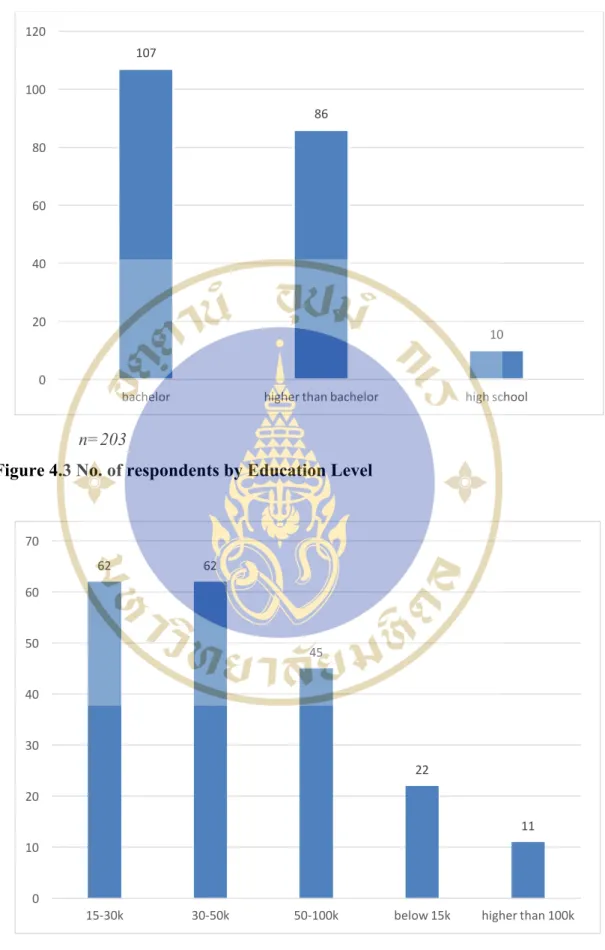
The ANOVA result by gender (Table 4.6) shows that the result is statistically significant at a significant level of less than 0.05 for eWOM (sig. 0.001) and source credibility (sig. 0.002), while the other two factors show an insignificant show result as the significant level more than 0.05. It means that the differences in age, education level and personal monthly income do not influence the decision-making process of choosing a restaurant.

Discussion
The main objective of this study is to identify the impact of online reviews on the decision to choose a restaurant by Thai Millennial. From the overall analysis, electronic word of mouth (eWOM) and attitude towards restaurant influenced by the online reviews show positive and significant influence on the decision to choose a restaurant by Thai Millennial. Electronic Word of Mouth (eWOM) has been found to be the most important factor influencing the decision to choose a restaurant by Thai Millennial.
This research shows that most respondents read online reviews before visiting the restaurant, positive online comments in the restaurant review make them want to eat there and that they believe online restaurant reviews more than their own website or advertisement. Attitudes towards restaurants influenced by online reviews are also found to have a positive and significant impact on Thai Millennial's restaurant choice decision. It was said that online reviews reveal the real customer feedback that influences the consumer of readers.
According to the data collection, reading online restaurant reviews influences the Thai Millennial's restaurant selection decision. Other 2 factors; Credibility of the source and usefulness of the information; show an insignificant influence on Thai Millennial's restaurant choice decision. This research shows that a well-known writer/blogger/reviewer does not have a significant impact on the Thai Millennial's restaurant choice decision and a reference person in the evaluation does not significantly help to increase their trustworthiness.
The researcher found that different genders have different attitudes towards eWOM and the credibility of the source, which affects the decision to choose a restaurant. However, different age, level of education and personal monthly income do not influence the respondents' decision to choose a restaurant.
CONCLUSION
- Conclusion
- Recommendations and Practical Implications
- Limitation
- Future research
Therefore, this research used online survey because it is able to get many answers at once and focused only Thai Millennial who have ever used social media containing restaurant online reviews to make decisions about choosing a restaurant to to determine the respondents according to age and characteristics. . To develop future research, the following researcher can include people who have not used social media with restaurant online reviews to make decisions about choosing a restaurant as target respondents to compare the behavior and attitude of the two groups of respondents. Finally, this research question can be applied to other industries such as travel, clothing, jewelry, etc. as online reviews are widely used as a marketing tool these days. 2010), “Consumers' ideal dining out experience as it relates to restaurant style: a case study”, Journal of Retail & Leisure Property, Vol. 2010), "The Fortune 500 and Social Media: A Longitudinal Study of Blogging, Twitter and Facebook Use by America's Largest Companies", Retrieved from Society for New Communications Research (accessed March 6 Culture, Class, Distinction, Routledge, London .
Cheung, Cindy Man-Yee; Sia, Choon-Ling; and Kuan, Kevin K. A study of factors influencing the credibility of online consumer reviews from an ELM perspective", Journal of the Association for Information Systems: Vol. 2004), "Factors influencing restaurant selection in Dublin", Journal of Foodservice Business Research, Vol. 2004), "Electronic word of mouth through consumer opinion platforms: what motivates consumers to articulate on the Internet. Journal of Interactive Marketing, Vol. 2003), Electronic word of mouth: motives for and consequences of reading customer articulations on the Internet, International Journal of Electronic Commerce differences in user information sharing on social commerce websites", Information Technology and People, Vol. 2011), “Images of foodscapes: an introduction to foodscape studies and their application to the study of healthy eating environments outside the home”, Perspectives in Public Health, Vol. Pedro Longart What drives word of mouth in restaurants?", International Journal of Contemporary Hospitality Management, Vol.
Peter De Maeyer The Impact of Online Consumer Opinions on Sales and Pricing Strategies: A Review and Directions for Future Research", Journal of Product. Richard Ghiselli, Jing Ma Restaurant's Use of Social Media in China: A Study of Industry Practices and Consumer Preferences", Worldwide Hospitality and Tourism Topics , vol. Parasuraman, Ankie Hoefnagels, Nanne Migchels, Sertan Kabadayi, Thorsten Gruber, Yuliya Komarova Loureiro, David Solnet Understanding Generation Y and their use of social media: a review and research agenda, Journal of Service Management, vol. 2010), The Social Media Bible : Tactics, Tools and Strategies for Business.
Success, John Wiley & Sons, Hoboken, NJ. 2003), “Customer expectation factors in restaurants: the situation in Spain”, The International Journal of Quality and Reliability, Vol. 2014), Consumer Behaviour, Oxford: Oxford University Press. Yuki Hattori, Akiyo Nadamoto Tip information from social media based on topic detection", International Journal of Web Information Systems, Vol.
Screening Questions
General Questions
Specific Questions
Personal Information