KEYWORDS: Thai textile and clothing industries / Thai clothing wholesalers / Thai cloth suppliers / Chinese cloth suppliers. According to a report on ASEAN: "Although Thailand is usually seen as an agricultural powerhouse, its textile and clothing industry continues to make a major contribution to the country's economic growth (Source: SourceAsean.com, thaitextile.org 11 August 2010). Thailand has a fully integrated textile and apparel industry, and is one of the few countries worldwide with capabilities to supply the entire textile industry chain from natural and man-made fiber and yarn manufacturing through weaving, knitting, dyeing, printing and finishing; to textile - and clothing design, production and sales (Source: Insight Alpha, 2011).
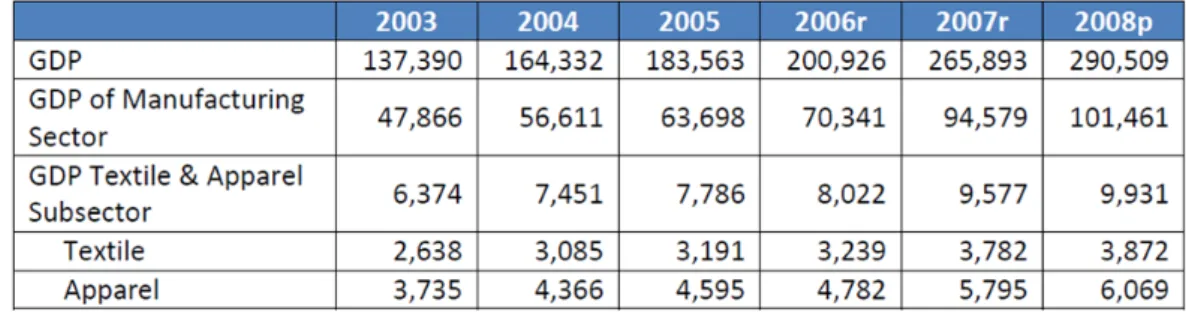
Thailand's textile and apparel industry accounted for 3.4% of the country's gross domestic product (GDP) in 2008 (Source: THTI's Thai Textile Statistics), its textile and apparel industry continues to contribute greatly to the country's economic growth, as shown in Table 1. However, the Thai textile and clothing industry lacks skilled workers with experience in technology, fashion and management, which limits the variety and quality of products due to the dominance of small and medium-sized enterprises, which means they often lack the resources to improve technology or invest into superior engineering (Thailand Textile Institute, 2010). Pongpun Gearaviriyapun, Deputy Director General of the Ministry of Foreign Trade, also stated that from 2011 to 2012, the value of textile and clothing imports from China to Thailand increased to 16.33% (Source: Insight Alpha).
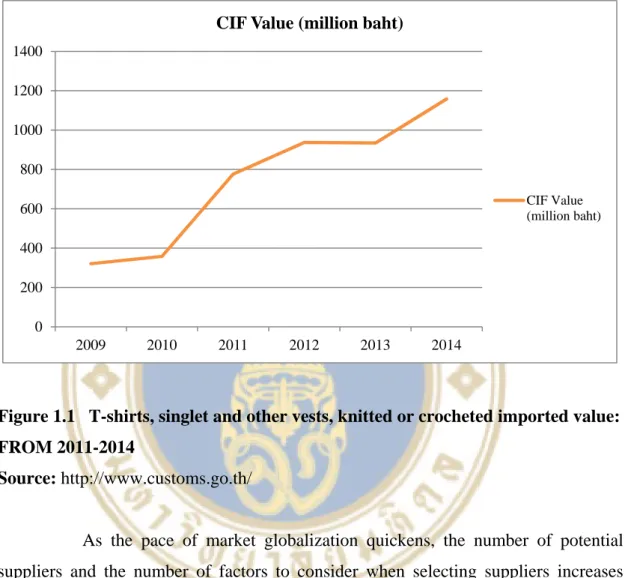
Since there are no sources that provide the sum of the total textile and clothing import value from China, the author therefore chose to select one category of textile and clothing product to show the trend volume, HS - 61.10 T-shirts , singlet and other jackets, knitted or crocheted.
Research Questions
LITERATURE REVIEW
- The expectation of wholesaler purchasing
- Supplier Selection
- Dickson’s vendor selection criter
- Weber’s vendor selection criteria
- Contemporary researches
- The Impact of the Internet on the Supplier Selection
- Data/Model analysis
- Conceptual Framework
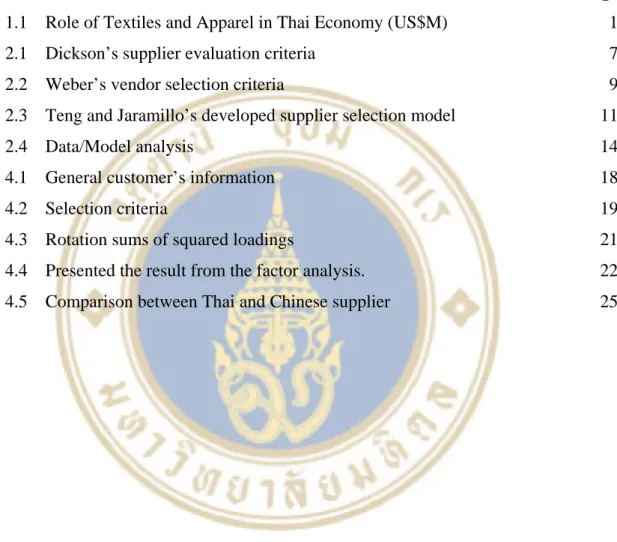
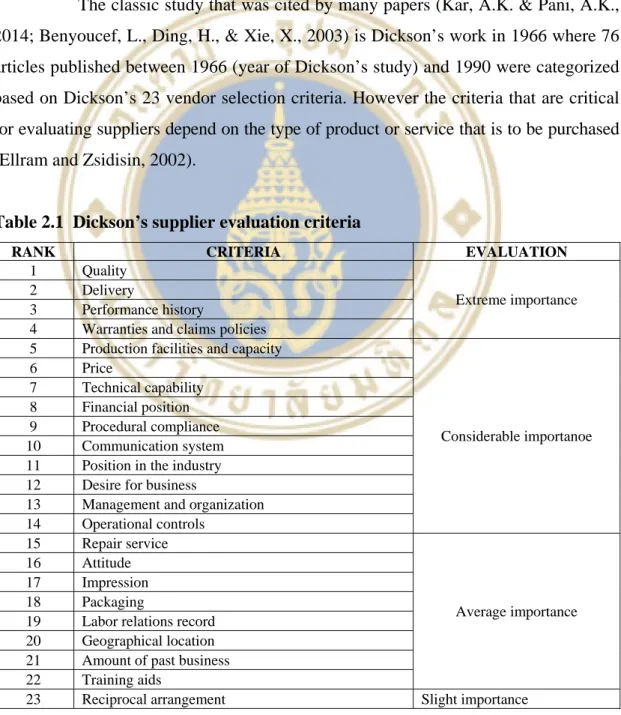
As shown above, the aggregate factor ratings (Dickson, 1966) and supplier selection criteria that were of extreme importance were product quality, on-time delivery, performance history and warranties and claims policies, while price was considered less important at a significant level of importance. The increased competition and globalization of markets, enabled by Internet-based technologies, have led to a dramatic change in the ranking of factors while at the same time introducing new criteria into the supplier selection process (Cheraghi, 2011). These developments strongly call for a more systematic and transparent approach to purchasing decisions; especially in the area of supplier selection (see for example Carter et al., 1998).
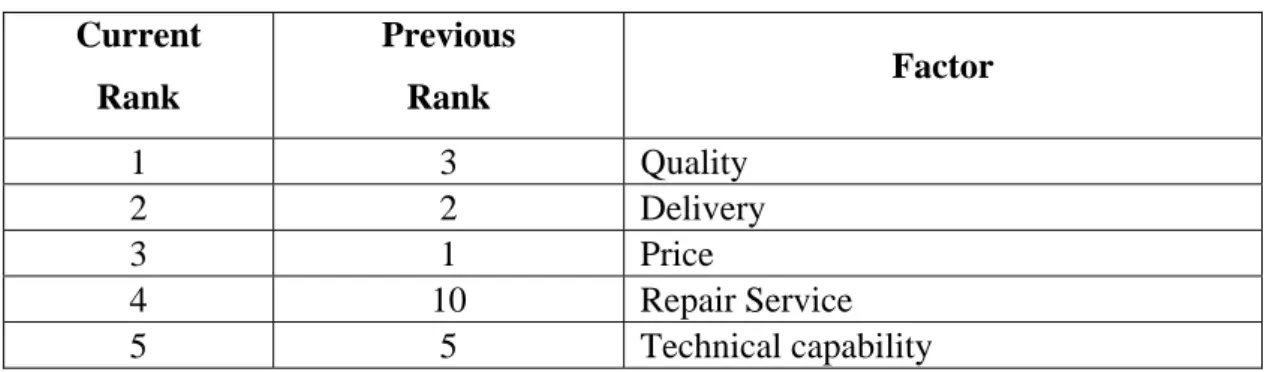
Dixon's pioneering work was revisited by Weber et al. 1991) where the results were expanded to include research on the supplier selection decision problem published between 1990 and 2001. The "Current Rank" column shows the position each criterion holds in this study (based on the number of papers that criterion has occurred) and the "Previous Rank" column refers to the rank that the criterion holds in Weber et al. Reliability, Flexibility, Consistency and Long Term Relationships are four important new entries on the list of critical success factors for supplier selection.
Products related to Corporate Social Responsibility (CSR), such as green environmental products can influence supplier selection (Lee, Le, Andrea, & S.C., 2012). Different products have different demand and market characteristics, which affect the strategy for supplying the stock. Therefore, the importance of supplier selection criteria may vary for different products (Jin & Farr, 2010).
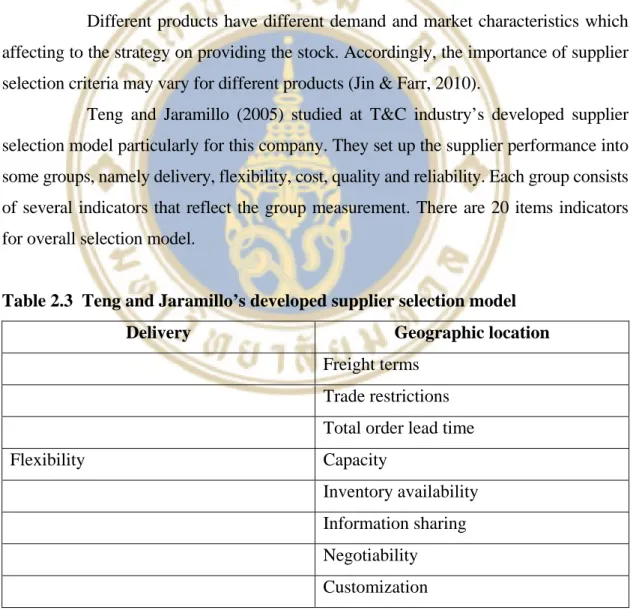
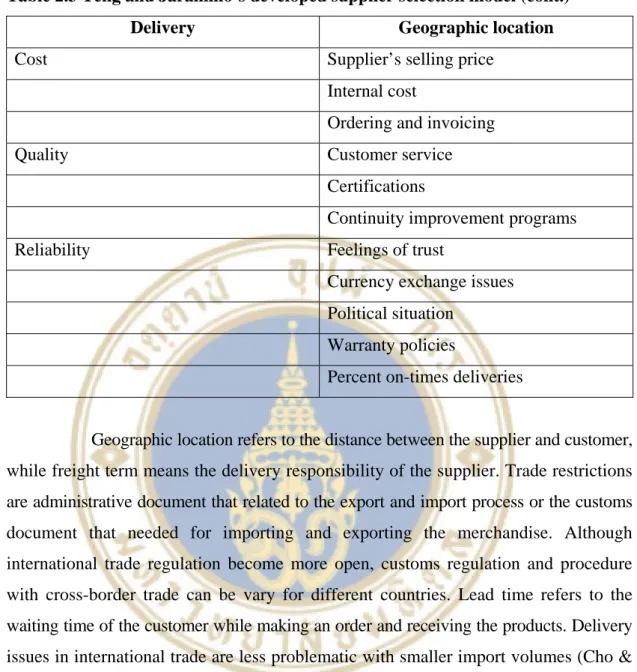
Teng and Jaramillo (2005) studied a supplier selection model of the T&C industry that was developed specifically for this company. Geographical location refers to the distance between the supplier and the customer, and the term freight refers to the supplier's responsibility for delivery. Delivery time refers to the customer's waiting time between placing the order and receiving the products.
Information exchange is evaluated based on the level of information exchange between the customer and the supplier, and negotiability refers to the level of mutual advantage and trust of the supplier and customers. Due to the advancements and adoption of information technology and electronic data exchange, the Internet has become a marketplace that enables efficient negotiation between buyers and suppliers, including e-catalogue, e-request and e-order, e-payment, etc.
RESEARCH METHODOLOGY
Sample size and Qualification
Data collection method
For specific questions, a section was divided into two main questions, selecting 23 variables in the conceptual framework, which were presented in statements for specific questions as one variable, one question. The first question asked respondents to rate the importance of each variable on interval scales of 10 degrees of importance. The questionnaire is designed so that it can be used widely to clearly see the level of importance assigned to each variable.
In the second question, respondents were asked to rate the preference of each variable on 5-point preference interval scales, with 1 representing the least preference and 5 the highest preference, comparing a local versus a Chinese supplier. The questionnaire also allowed respondents to add their own characteristics that they thought were important but were not included in the questionnaire in order to explore possible other criteria. The interviewees can help recommend which suppliers are suitable for the Thai apparel business by identifying the factor that influences the Thai apparel wholesaler in selecting suppliers; the strengths and weaknesses of each supplier, the main decision criteria from the perspective of a Thai fabric wholesaler, which will be through analysis from semi-structured interviews (Bernard, 1988).
RESEARCH FINDINGS
Characteristics of respondents
Finally, it was reported that 66.4 percent of the customers claimed to have an average purchase in terms of value per month higher than 300,001 baht.
Supplier Selection Criteria
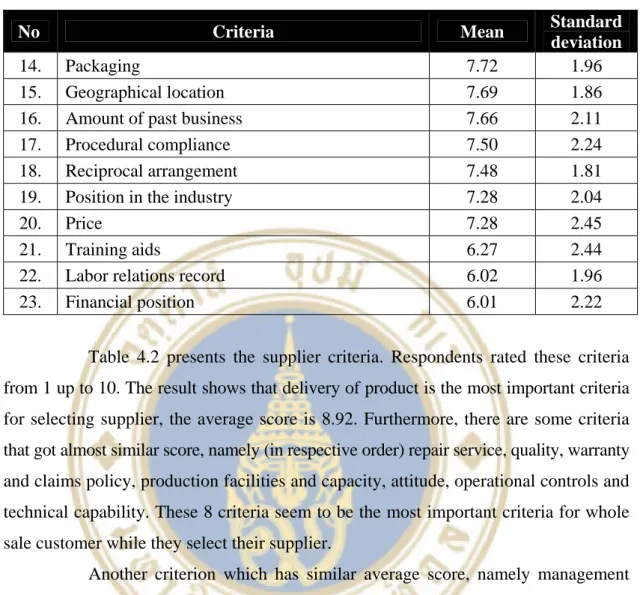
The result shows that delivery of product is the most important criterion when selecting supplier, the average score is 8.92. Since these components were related to business operations and management, the author named these components “Management and Performance”. These criteria appear to be related to competitiveness in terms of price. That's why we named the third component 'product competitiveness'.
Since the impression is the most important in this component, the author named this component as "company impression". The last component consists of 2 criteria, namely desire for business and repair service, since this component is related to the willingness of the company to engage in the market and the after-sales service, so the author wants to call this component as "service" . . It can be related to the internal operational control and also how to manage a relationship with a customer, how to achieve company objective.
The delivery service has the biggest impact on quality and performance with the load factor. On the contrary, this study found that technical capacity is ranked 8th, so the importance of these factors is almost similar to Dickson and Weber's model. The most important factor of product competitiveness (the third component) is the packaging, followed by the communication system.
The Dickson model included the packaging to average importance, while the communication system was included to significant importance. The amount of previous business, training aids and mutual arrangement become the most important factors in the transaction component. However, this does not correspond to the Dickson's model in which the reciprocal arrangement is included according to minor importance criteria.
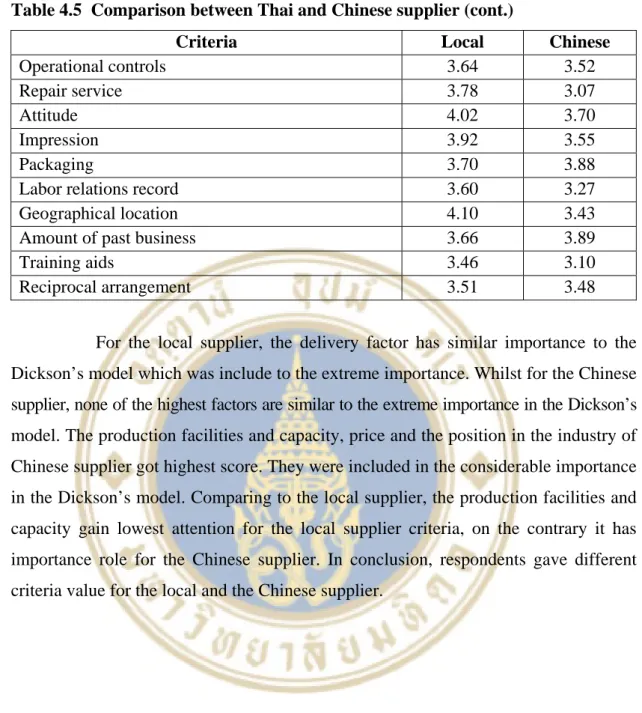
Comparison between Thai and Chinese supplier
In other words, the customer's impression of a supplier is an important dimension for selection criteria. For the local supplier, the delivery factor is of similar importance to Dickson's model, which was included in extreme importance. While for the Chinese supplier, none of the top factors are similar to extreme importance in Dickson's model.
The Chinese supplier's production capacity and capabilities, price and position in the industry received the highest rating. Compared to the local supplier, production capacity and capacity gain the least attention in the criteria of the local supplier, but on the contrary, they play an important role in the Chinese supplier.
DISCUSSION & CONCLUSION
Conclusions
Recommendations
- Management and performance
- Quality and capability
- Product competitiveness
- Transaction
- Company impression
- Service
Guarantee that their order will come with their order and the most important thing is if the goods are not produced as well as their order, it will be easy for the customer to claim for exchange with the good one. The capability component is not only related to the way a product is manufactured, but also to the way the product is delivered after-sales service. It is also related to training aids, qualified training aids will develop a skill of the staff.
In conclusion, the production facilities and capacity and the training tools will lead to the good quality and fulfill the quantity of production. This variable is related to the customer who has done business with a supplier in the past. If a supplier is sufficiently able to deliver the amount ordered by a customer, this will increase reliability for a customer.
The customer's way to evaluate the supplier's performance is by reading or looking for the supplier's company profile. The ordering system enables the customer to order a product in terms of order amount, payment and delivery method. The transaction dimension describes the amount of the sale and purchase between the customer and the supplier and also the mutual arrangement of the company's resources.
For the wholesale business, the transaction amount between customer and supplier shows the relationship between customer and supplier. Even if the after-sales service in the whole sales cloth is not urgent, unlike the car or real estate industry. The after-sales service throughout the sales cloth can take the form of a warranty and complaints policy if there is a defect in the product.
Limitations
Service refers to how the wholesale supplier provides after-sales service and stock availability if the product is out of date.
Meeting customer expectations: The effect on conflict and repurchase intentions in industrial marketing channels,” Journal of the Academy of Marketing Science. Supplier Selection Criteria and Perceived Strengths and Challenges of Global Apparel Suppliers in the United States. Factor influencing positive word of mouth and repurchase intention: A case study of clothing retailers in Bangkok.
International Journal of Production Research, Taylor & Francis: STM, Behavioral Science and Public Health Titles. A framework for determining qualitative and quantitative supplier selection criteria considering buyer-supplier integration strategies.
APPENDICES
Appendix A: Questionnaire
Screening Question
General Question
Specific Question