THE MAIN FACTORS AFFECTING Y GENERATION'S DECISION AND MOTIVATION OF FAMILY BUSINESS LEGACY IN THAILAND TANIKA KIERASAWAT 6149183. One of the keys to maintaining family businesses is the smooth succession of transmission from generation to generation. Moreover, motivation is an important dimension that cannot be ignored when it comes to success in the early stages of family business sustainability.
Family members of the next generation must decide whether to inherit the family business or not. Some people choose to work for other companies or some to work in their family business. Therefore, I am interested in studying and learning more about the factors that influence Generation Y's decision to inherit the family business.
This research aims to find the key factors behind the decision and motivation of Generation Y to inherit a family business from the first generation. This research will focus on the group of Generation Y, people born between 1960 and 1979, who are the second generation of the family business and are currently in the process of deciding whether or not to inherit their family business.

LITERATURE REVIEW
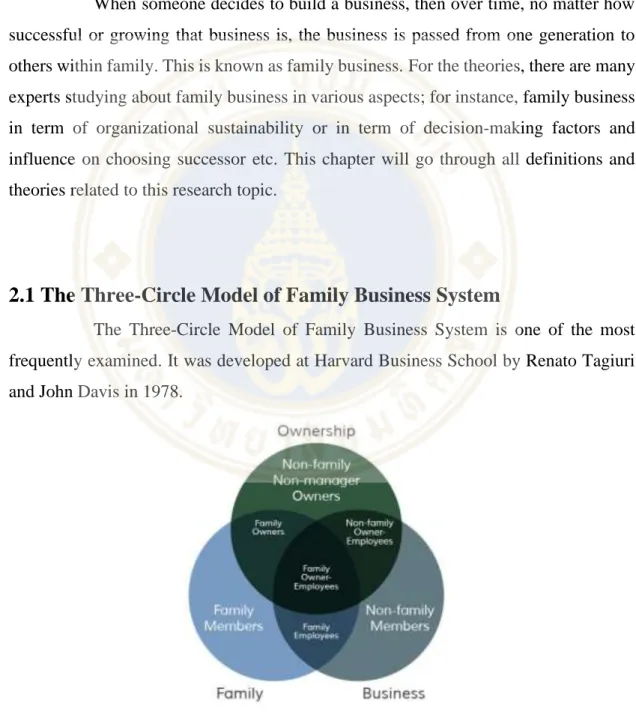
The Three-Circle Model of Family Business System
The framework clarifies the interdependence of the three parts in simple terms consisting of Family, Business and Ownership. In 1978 at Harvard Business School, Professor Renato Taguiri and PhD student John Davis explained the dynamics, roles, issues and tensions in family business systems. This model, today, remains the widely used paradigm for understanding and analyzing family business systems.
Family members who are not involved in the business, but who are descendants or spouses/partners of owners. The family business system model shows three overlapping circles or subsystems that are interconnected, indicating that what happens in one circle affects the others. If one circle, say the family, is in conflict or stuck, it can detract from the performance of the other circles and stunt the development of the entire family business system.
On the other hand, a high performing business can create pride in a family and build unity in the ownership group (Tagiuri and Davis, 1978.). For this research, even this model was created for more than 40 years, but it still helps not only to identify where in the family business system problems arise, but also helps to diagnose why problems have arisen or spread from a circle to another. Moreover, it is interesting to observe whether the transfer of family business to the next Y generation, which stands at different positions in the cycle, has different factors in deciding whether or not to inherit.
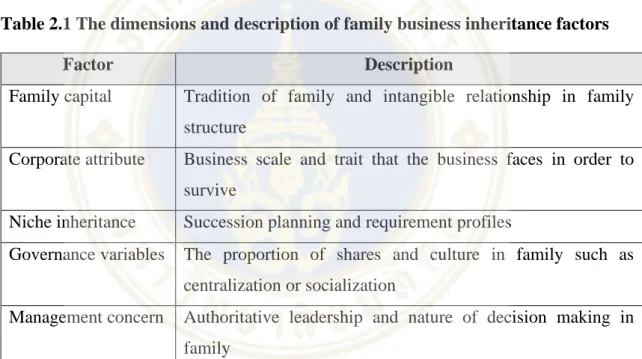
Key factors influencing family business inheritance
Jau Liu, 2018) Nevertheless, this study is considered from the perspective of Taiwan, which is interesting whether the factor would be the same in other countries or not. These may be the same factors, but different prioritization, because there may be more important factors to worry about or some dimensions may not need attention when it comes to different contexts in different countries. Moreover, we probably find additional factor with different prioritization if it is performed in other countries and other generations.
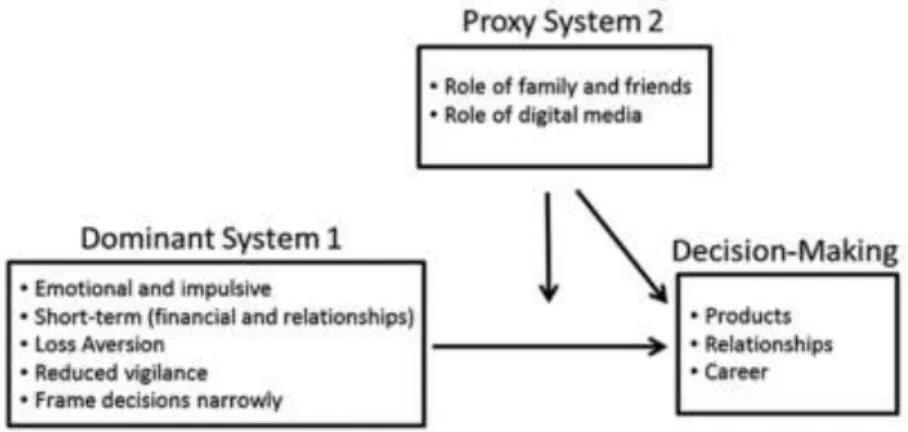
A dual-system approach to understand “generation Y” decision making
This framework was used to develop a better understanding of how Generation Y makes decisions. The conclusions in Figure 2.2 are the research conducted in two cities in India, namely Mumbai and Bangalore. The discussions focused on the characteristics of Generation Y on topics such as their independence, aspirations, influence of peers and friends, role of family, impact of religion and monetary perspective (Viswanathan, V., & Jain, V., 2013). clarify how one generation group differs from another generation in terms of decision-making. The result is that the decisions of the Y generation differ significantly from the X generation and other generations.
Generation Y is more likely to use System 2 to make decisions because they grew up in a much more protective environment and technology-based environment than previous generations. However, this study was conducted using foreigners as an example and it is clear that different cultures, social conditions and circumstances lead to different results on how to make decisions, especially to make decisions about the inheritance of family businesses. It is a good opportunity to study factors affecting the decision of Y Generation in different provinces from new perspectives. The topic of the research focuses on the legacy of family-owned small and medium-sized enterprises in Thailand.
RESEARCH METHODOLOGY
Data collecting method
According to the main objective of identifying factors that influence the decision of the Y generation to inherit the family business and to understand the motivation that drives them to run the business, at least 30 interviews will be conducted within two weeks. The interview method will be a face-to-face interview or an online video conference depending on the time and convenience of the interviewees. The estimated time of each interview session is approximately 30 minutes, as gathering the information should not be too long or too short.
Interview Questions
Data Analysis
RESEARCH FINDING
Key factors influencing family business inheritance
- Corporate attribute factor
- Management concern factor
- Passion in business factor
- Governance variables factor
- Family capital factor
The Corporate attribute dimension means the level of business performance compared to other competitors in the same industry taking into account the business characteristics and external factors that the family business is facing. Whether they decide to run the family business or not because the group we choose to study is an SME business. An individual who decided to inherit the family business mentioned “I consider this factor first because I don't want to waste my time.
An individual who decided not to inherit the family business mentioned "I consider this factor in terms of external features if there are too many obstacles, either due to the factors of the era or due to the change of market competition, we should not continue the business …” – ND01. The person who will be the main decision-maker for an important decision in the family business will be the head of the family, i.e. the husband or the father. Her family business runs factories that produce machines, whose main task was to run the factory.
Being the eldest daughter of the family herself, she was expected to inherit the family business. Now let's look at another case that decided not to inherit the family business, even though the company's performance is very high. Person who decided not to inherit family business mentioned “When I made my decision, I asked myself what I was interested in and the answer was that I prefer to do other things.
A person who decided not to inherit the family business said: “It is true that the family business is everyone's property, but for me the monthly income and annual bonus are also important…” – ND02. One person who decided to inherit the family business said: “Our family has a clear arrangement of finances, salaries, bonuses, assets and individual responsibilities. One person who decided not to inherit the family business said, “I have a good relationship with my family and can discuss all matters.
This result shows that second generation group of people who decided to continue their family business and group who decided to do their own business have a greater sense of intimacy and have more communication with their families. For the second generation who decided not to inherit the family business, most of them rated less intimacy.
Goal and motivation that drive to work or do the business
In their opinion, they consider the relationship in the family in such a way that working with family members will affect the relationship.
CONCLUSION AND RECOMMENDATION
- Conclusion
- Recommendation
- Limitation
- Future Research
The result of this study shows three different points from the previous study mentioned in the literature review, Jau Yang Liu 2018, studying the sustainability of family business by analyzing the main factors affecting family business from the perspective of Taiwan. Most of the first generation want to pass the baton to the successor, but they hardly have a clear plan or demand profile of what is right for the business. The first group would like to inherit the family business because they wanted to help their aging parents.
The outstanding family business performance usually manages and balances these two systems in the middle. For the first generation of family businesses in Thailand, this research provides an example of the perspective of the second generation. Therefore, when you transfer the business to the next generation, the first thing is to prepare a succession plan.
Secondly, no matter how small the organization, all stakeholders need a clear responsibility or position in the company to be able to make a clear work evaluation that can create a trustworthiness of the heir. Obviously, you don't have to live in the shadow of the first generation. While the research was being conducted, we interviewed 30 participants, who belong to the second generation of family businesses, but the way people make decisions is different.
This research aims to study the key factors that influence decision makers in family business inheritance and what are the motivations to work in professional life that drive to work or do the business focusing on group of Y generation, people born between 1979 to 1994 and second generation of family business and are currently at the point of deciding whether they want to inherit their family business or not. For future research, the study can be extended to various ways to fulfill the knowledge in family business. Second, quantitative method can be used to survey a larger number of people to confirm the results.
Finally, the scope of the research can be expanded by adding additional scopes such as family business strategy and family business sustainability or compare the factors of decision makers between two different generations in terms of ages and business generations.
Who are we?" Understanding the influence of family business identity on the development of individual and family identity in business families.
APPENDICES
If you rate 1-5 (5 being the highest), how close do you think you are to your family?