Since the environmental problem is becoming a big problem all over the world and also in Thailand where single use plastic bags are widely used. Many organizations, both the government and the public have launched a campaign to reduce the use of single-use plastic bags. Single-use plastic bags were widely used all over the world for the purpose of transporting things from stores to the consumer's destination.
Since the plastic bag is reusable, light, strong and cheap, one trillion plastic bags are consumed every year (Earth Policy Institute, 2014). To react to this plastic issue, many companies have created an activity and campaign to reduce the use of plastic bags. Balls offering a 'green checkout bank' for people who bring their own bag or don't take the plastic bag (Jitpleechep, 2018) 7-Eleven launched the 'reduce and stop' plastic bag use campaign in all stores and encourages people to join with by donating to Siriraj Hospital in every transaction the customer says no to plastic bags.
Die Thaiger, 2019) Tesco-Lotus not only gives more membership points to consumers who refuse to receive the plastic bag, but also provides paper grocery bags on the 4th of every month in all branches and in some specific branch is a 'plastic bag free branch' ' where no plastic bag is used or given to the consumer. The 'plastic bag free branch' of Tesco Lotus is selected by location. located near the universities because the young generation tends to understand more about the waste and environmental issues. As mentioned in the Background section, there is currently more concern about the environmental problems among Thai people and one of the obvious actions and campaigns to respond to the plastic environmental issues is to reduce the use of single-use plastics.
Do consumers view the use of single-use plastic bags from the supermarket in Bangkok as a threat to the environment?
LITERATURE REVIEW
- Green behavior
- Environmental concern
- Attitude
- Store Policy
- Contextual factors
- Conceptual framework
The study's focus on attitudes towards using recyclable paper bags or reusable bags (such as cloth bags) instead of single-use plastic bags is one of the factors the study aims to identify in order to link with green behavior. Ertz, Karakas & Sariöllü, 2016) Situational or contextual factors such as affordability, product availability or economic constraints can be barriers to green behavior. The problem or unavailability of a substitute for single-use plastic bags can be a barrier to green measures.
For rejected single-use plastic bag for a visit to supermarket stores that need time for preparation to bring your own bag, the paper considers the time to preparation as one of the contexts that can influence the green behavior. Fig.1 presents the research conceptual model of 'green behaviour' or using the reusable bag instead of receiving single-use plastic bag from supermarkets or convenience stores. Also one of the factors that influence the green behavior is store policy as a persuasion and incentive to do the green behavior.
H2: The greater the attitude towards the environmental issue and single-use plastic bags, the more frequent the green behavior. H3: The more effective the store policy (as successful in consumer perception), the more frequent the green behavior.
RESEARCH METHODOLOGY
Methodological Approach
Sample and Data Collection
Follow up by asking about the store's policy implementation to gauge which policies would be the most palatable from the customer's point of view. 5-Likert scale to find the degree of agreement or disagreement in the implementation of the store policy.
Data Analysis
DATA ANALYSIS
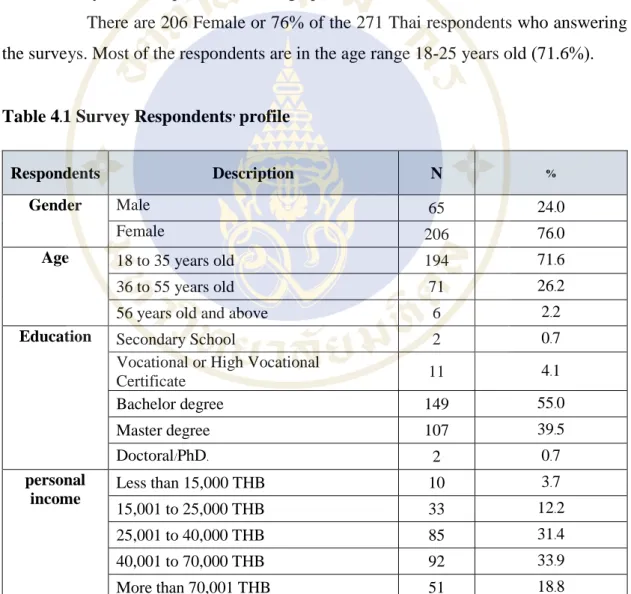
- Sample profile
- Descriptive statistic and interval scale for 5-Likert scale
- Environmental concern
- Attitude
- Store policy
- Contextual factors (Availability and effort)
- Green behavior
- Pearson’s Correlation coefficient
- Regression analysis on Green behavior
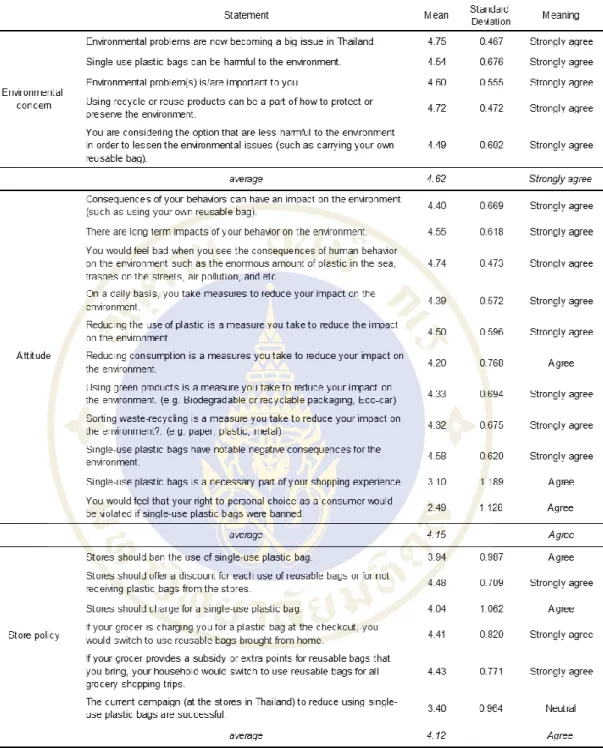
On average, participants strongly agree (mean = 4.62) with all statements asking for environmental care. Thai people had poor attitudes towards the impact of human behavior on the environment and viewed single-use plastic bags as a threat to the environment and recognized its long-term effects on the environment. On average, participants agree on the statements asking about store policies regarding the use of green bags.
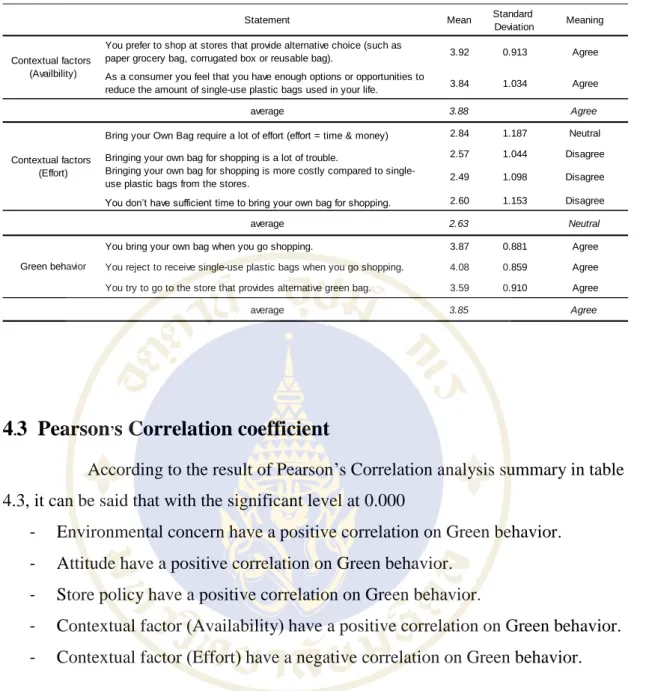
Stores must offer a discount for any use of reusable bags or for not taking plastic bags from stores.' had the highest score (mean = 4.48, SD = 0.709) on the entire store policy statement. For the contextual factor effort, the mean score on statements about effort is neutral (mean = 2.63). The participants felt that they had an opportunity to perform the green action, but 27.7% considered that they required an effort to perform the green behavior.
Correlating the green behavior consensus scores with environmental concern and attitude, green behavior was averagely agreed, although there were much higher scores for all statements about environmental concern and some statements about the consequences of human behavior and single-use plastic bags. According to the Pearson correlation analysis summary results in Table 4.3, we can say that the significant level is at 0.000. The hypotheses were tested based on the information in Table 4.3 Correlation Analysis of Green Behavior and explained as below.
The Pearson correlation of environmental concerns and green behavior is 0.501, environmental concern has positive correlation with green behavior. Pearson's correlation of attitude and green behavior is 0.426, Attitude has positive correlation with green behavior. The Pearson correlation of store policy and green behavior is 0.527, store policies have positive correlation with green behavior.
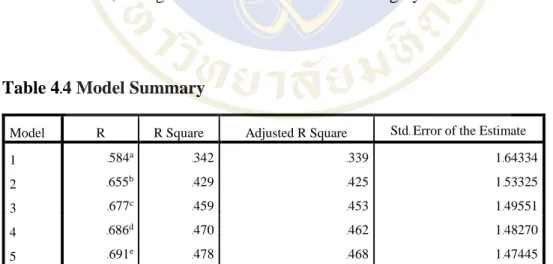
The Pearson correlation between availability and green behavior is 0.582. Availability has a positive correlation with green behavior. Pearson's correlation between effort and green behavior is -0.282. Effort has a negative correlation with green behavior. From Table 4.4 Model Summary, predictors, which have an effect on green behavior at a significant level of 0.001, consist of five predictors as contextual factor (Availability), environmental issues, shopping policy, contextual factor (Effort) and attitude respectively.
From standardized coefficients or beta data in table 4.5 Regression analysis of predictors of green behavior, it shows that the relationship between Contextual Factor (Availability), Environmental Issues, Store Policy and attitude has positive relationships with green behavior. If environmental concerns increased by 1 unit, the green behavior would increase by 0.161 units.
CONCLUSIOM AND RECOMMENDATION
Conclusions
Recommendations
Limitation and Future Research
Shops pledge to cut plastic bag use (2018, December 5) Retrieved from https://www.bangkokpost.com/business/1587694/shops-pledge-to-cut-plastic-bag-use. Student attitude and action regarding the single-use plastic shopping bag on the University of Alabama campus (Doctoral dissertation, University of Alabama Libraries). Environmental Concern in Global Perspective: Exploring the Relationships Between Periphery, Vulnerability, Environmental Problems, Post-Materialism, and Environmental Concern.
Retrieved from https://www.bangkokpost.com/thailand/general/1478049/8kg-of-plastic-garbage-found-in-dead-whale. Retrieved from https://bk.asia-city.com/city-living/news/can-thailand-ever-turn-tide-single-use-plastic-waste. Retrieved from https://thethaiger.com/hot-news/plastics/shoppers-said-no-to-237-million-plastic-bags-at-7-11-in-three-months.
APPENDICE
Appendix A: Questionnaire
- Screening question
- General overview about environmental concerns
- Information on the single-use plastic bag and consumer behavior 14) Single - use plastic bags have notable negative consequences for the
- Demographic Information What is your gender?
You would feel that your right to personal choice as a consumer would be violated if single-use plastic bags were banned. If your grocer asks you for a plastic bag at checkout, you'll switch to reusable bags brought from home. As a consumer, you feel that you have enough options or opportunities to reduce the amount of single-use plastic bags used in your life.