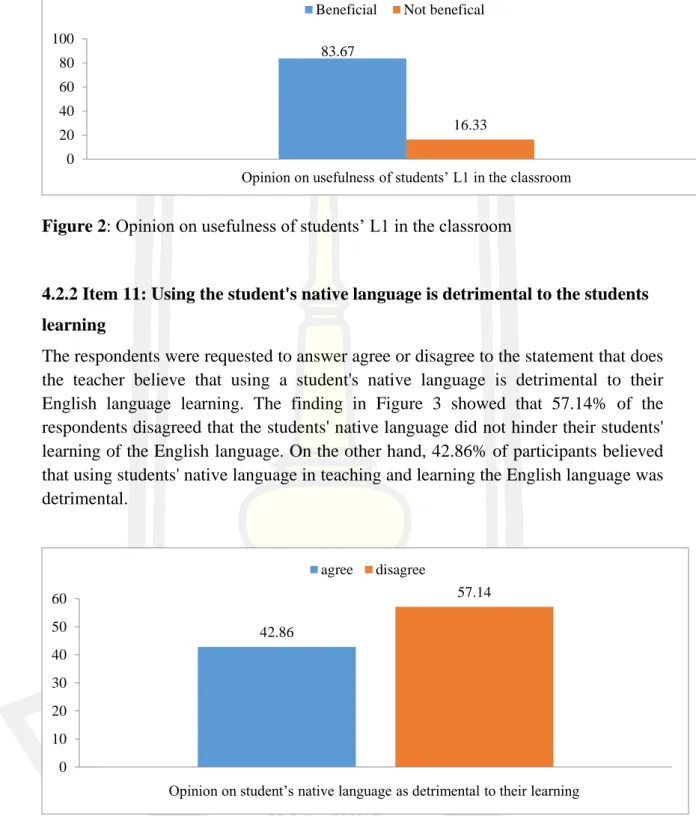
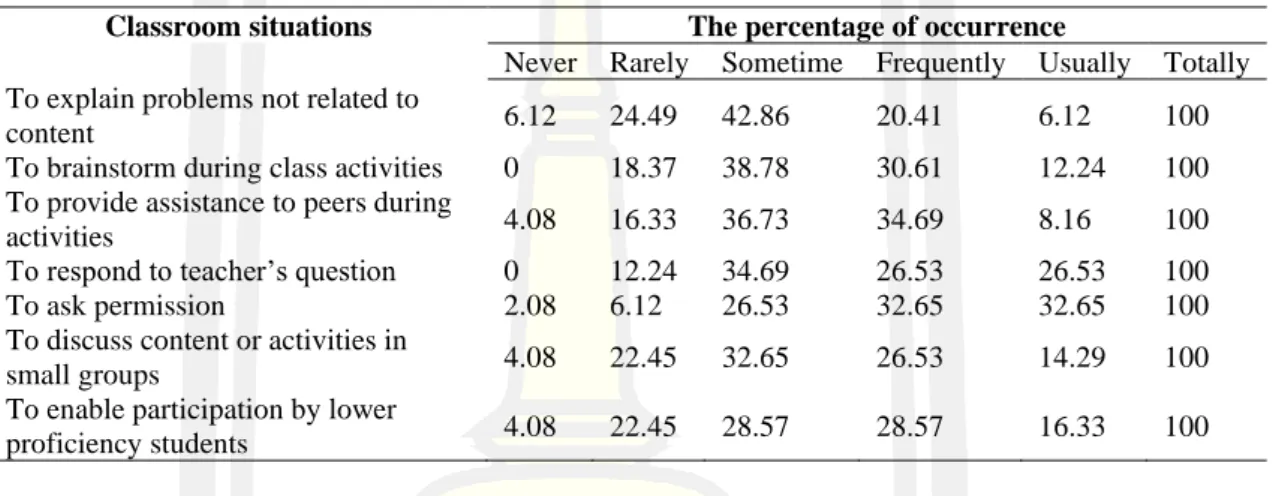
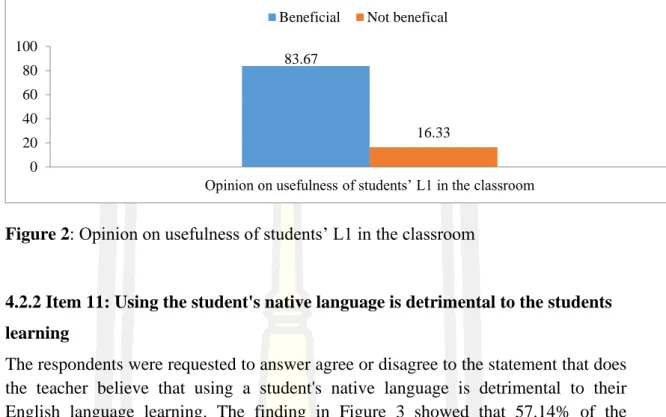
The results of the data analysis revealed that the teachers incorporated the translation teaching strategy into their EMI classrooms, as most of the Thai primary language EFL teachers had a positive belief in the use of translation for teaching and learning in the EMI classrooms (83.67%). 41 Table 4 Frequency of improving the use of English in different situations in the classroom 43 Table 5 Importance of using the mother tongue of students in the classroom in different contexts.
INTRODUCTION
- Origin of the study
- Justification and purpose of the study
- Research questions
- Significance of the study
- Scope of the study
- Definition of key terms
- Translanguaging
- Bilinguals and multilinguals
- Perceptions
- Thesis structure
- Chapter summary
Based on this observation, the current study is limited to Thai ELF primary school teachers in Northeast Thailand. This chapter has discussed and presented the origins of the study motivated by the observation of translation practices in Thai English language classrooms in Northeast Thailand.
LITERATURE REVIEW
- Sociolinguistic landscape of Thailand
- English in Thailand
- English language teaching in Thailand
- Language practices in Thai EFL classrooms
- Translanguaging
- Translanguaging in the classroom
- Benefits of translanguaging
- Challenges of translanguaging practice
- Chapter summary
Cen, however, proves that translation is beneficial to students because it makes them comfortable in the classroom and promotes student learning (Nagy 2018; Baker 2001; Garcia & Wei, 2014). Classroom translation practices offer many opportunities that go beyond the English-only model, such as the possibility of using students' language resources in the classroom.
RESEARCH METHODOLOGY
- Research design
- Piloting of the study
- Participant
- Research instruments
- Questionnaire
- Semi-structured interview
- Data collection and procedure
- Validity, trustworthiness and research positionality
- Chapter summary
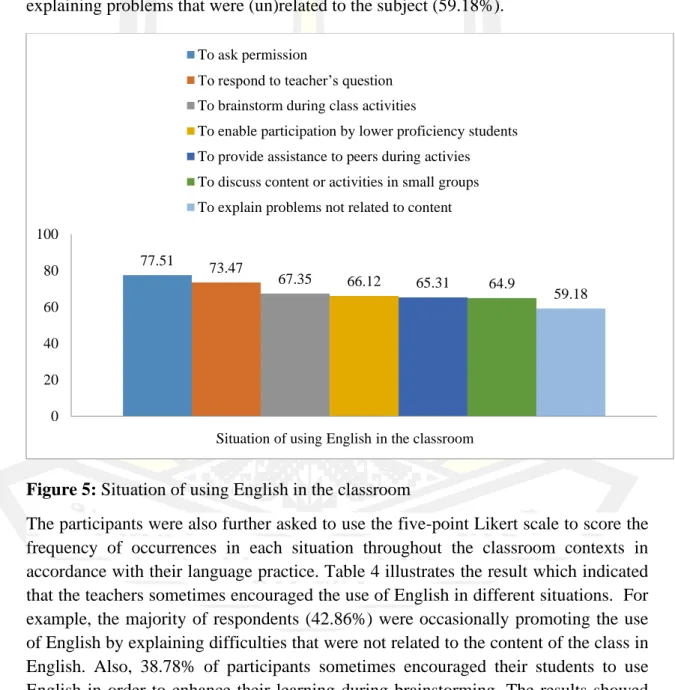
The last section will present the benefits (see 4.3.1) and challenges (see 4.3.2) of the teachers using the translingual approach in the classroom. Furthermore, according to the data presented, approximately 80 percent of the teachers reported that they encouraged participation in the students. Furthermore, 66.12% of the teachers reported that they encouraged students to use English to encourage weaker students' cooperation in the classroom.
In addition, more than 30% of the teachers gave a high score for each cross-linguistic situation in the classroom (see 4.2.1). Only less than 10% of the teachers rated each situation as unnecessary in the classroom, as shown in the findings in Table 7. The results of the current study show that the teachers' perceptions of the translation strategy in the classroom are in good agreement. with the principles of García (2009) and Alexis et al.
RESULTS
Participants' background information
- Background information
- Nature of the classroom and learners
This section will cover the first part of the online questionnaire (items 1–9), which attempts to gather general information about the teachers (see 4.1.1) and the nature of their classrooms and students (see 4.1.2). Of the 48 Thai primary school EFL teachers who participated in the online survey, most participants had approximately 1 to 5 years of teaching experience. More than half of the teachers (61.22%) indicated that they could use Thai (in addition to English as the main medium of instruction).
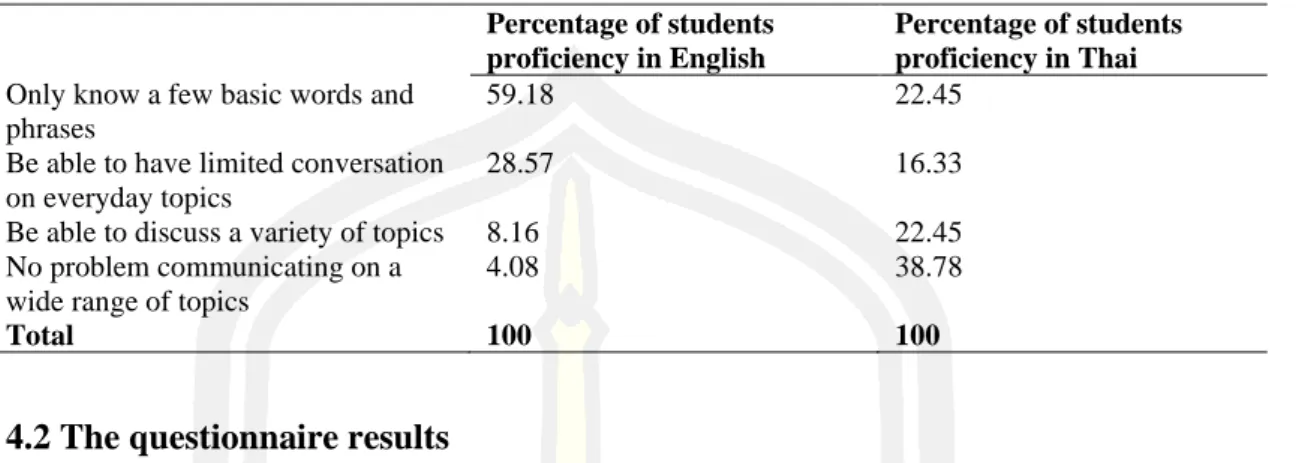
The majority of participants worked in EMI (English as medium of instruction) classes (83.30%), which had 40 or more students in each class. According to the data presented in Table 2 about their learners' language ability, most participants reported that their students knew only some basic vocabulary in English (59.18%) while 28.57% of the teacher reported that their students had a limited conversation about everyday topics. in the target language. Furthermore, 8.16% of respondents revealed that their learners have the ability to discuss a wide range of topics in both English and Thai, while only 4.08% reported that their students had difficulty communicating through either using any topic.
The questionnaire results
- Item 10: Teachers’ belief on the use of students’’ L1 in the classroom
- Item 11: Using the student's native language is detrimental to the students
- Item 12: Contextual situations rating of teachers use of students’ L1 in the
- Item 13: Situations in which teachers frequently encourage the use of
- Item 14: Teachers’ beliefs on students use of their native language in the
- Item 15: Teachers use of students' L1 in different classroom situations
- Item 16: Teachers’ beliefs on using student’s native language in the
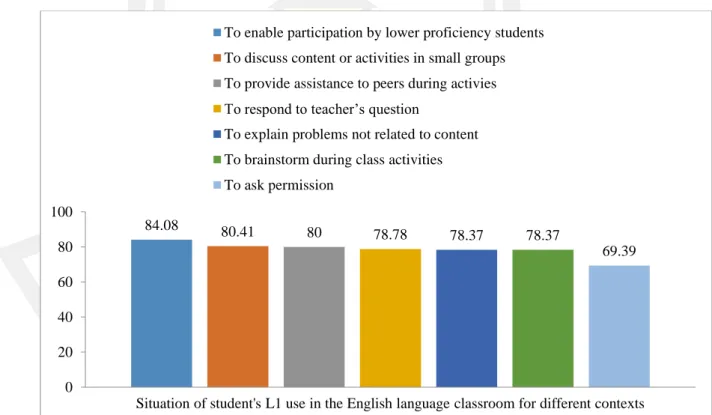
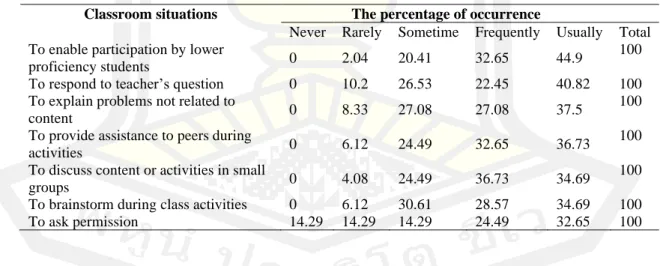
Almost 65% of them also revealed that they promote the use of English through discussions of the lesson content or activities in small groups. However, 8.16% of the teachers were of the opinion that it was not necessary to use students' L1 to respond to the teacher's questions. According to the findings, it was pointed out that 80% of the teachers used students' mother tongue to assist other lower-skilled students.
In addition, 37.50% of the teachers admitted that they often support the use of the students' L1 in learning through on-the-spot interpretation during activities. Thus, about 39.58% of the teachers felt that they often use the students' L1 to facilitate class management. Interestingly, the data show that none of the participants rated that they never use the student's L1 to build a good relationship with the students.
Qualitative results
- Teachers' perceptions on the benefits of classroom translanguaging
- Teachers' perceptions on the challenges of classroom translanguaging
In the following scenario, participants claimed that they used English and Thai in the classroom to help stabilize classroom management by complimenting their students. In the final setting that emerged from the analysis of the interview data, it emerged that the classroom teachers deliberately used both English and Thai to familiarize students with these languages. In situations 1–3, participants responded to the emphasis on allowing students to use Thai, and in situations 4–7 to the overuse of only English in the classroom.
The limitation of allowing too much Thai in the classroom is that students always expect the teacher to speak Thai whenever they do not understand. Students are less likely to learn the language as a result of excessive use of Thai in school.” (Participant 6). It would be difficult for students to maintain their concentration when English is always used as the language of communication in the classroom.” (Participant 4).
Chapter summary
According to the results in Chapter 4 (Section 4.3.1), it was found that the teachers recognized the importance of using translation as a practical approach to teaching in the classroom. Teachers identified students' difficulties in knowing the target language and their lack of confidence to use languages in the classroom as some of the problems with the translation approach. However, teachers in the current study reported that over-reliance on one language can cause classroom tension among students.
For the teachers who participated in the study, there appeared to be a consistency in their attitudes and practices of translation in the classroom. Teachers' and students' use of code-switching in the English as a foreign language classroom: a qualitative study. English teachers' perceptions of the use of mother tongue in teaching English as a foreign language.
DISCUSSION AND CONCLUSION
Teachers’ perception of their classroom language practice
In response to Research Question 1 which sought to determine how Thai EFL primary school teachers perceive their classroom language practice, the results show that the teachers portray a positive perception in their use of languages (in this case English and Thai) in the classroom. Regarding the teachers' opinions about their learners' ability towards the teachers' use of both the L1 (Thai) and the target language (English) in the classroom, more than half of the teachers claimed that the students only know a some essential words and phrases in English. This result indicates that the teachers are aware of their students' level of competence in both languages and the regulation of the classroom policy in terms of language use.
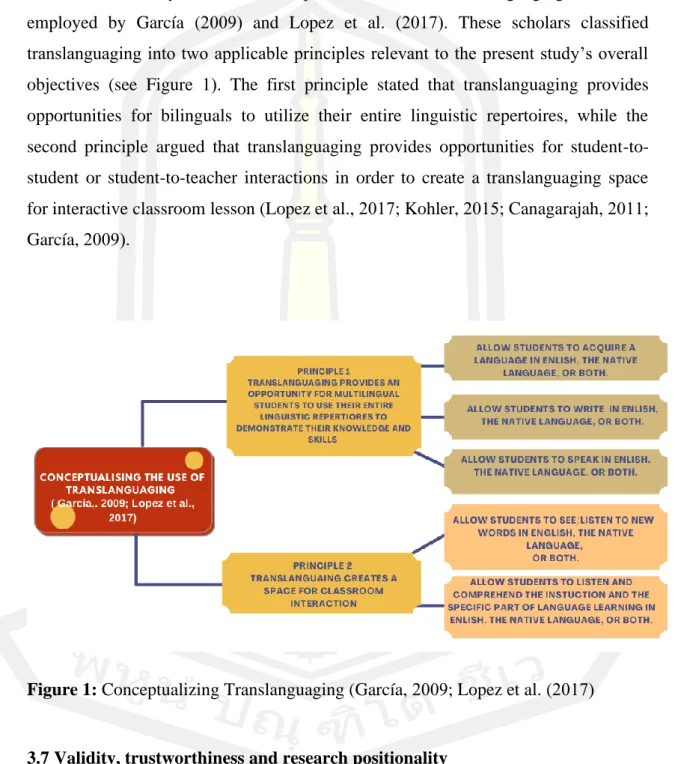
But with the desire to help their students learn both the content and the language, the teachers reported to. Interpreting based on the teachers' perceptions and practice based on the result, it can be said that the teachers are comfortable using it. With the idea of the limitlessness of language (Li Wei, 2017), the findings from this study seem to adhere to the concept of translanguage pedagogy, as the teachers reported that in a classroom like theirs, there are no linguistic boundaries (Canagarajah, 2011). The idea of García (2009) and Alexis et al. 2017) translanguaging framework and Li Wei (2017) limitlessness of language clearly explain why and how the teachers show a positive perception of their translanguaging practices in the classroom.
Benefits of translanguaging from the teachers’ perspectives
This principle enables students to see/hear and understand English, their mother tongue, or both. Grenner and Josson (2020), Pinto (2020) and Yuwayapan (2019) also reported that this practice, with the effective use of a translation strategy, can promote the creation of a classroom environment that is hospitable to academic achievement, a space for students to freely use languages without hesitations or unnatural pauses. Broadly speaking, it could still be interpreted that translation is done by both students and teachers, as both are involved in teaching/learning activities.
Thus, it is interesting to note that language translation can also benefit students by creating a safe environment and motivating students with lower language skills to participate more actively and be involved in the learning of them (Garcia, 2009). It also helps students with lower abilities to learn and explain the meaning of vocabulary during discussions. Since it was extremely useful and can be used as a strategy in classroom situations, such as teachers and students trying to develop relationships with each other, teachers encouraging students to participate in activities or interaction, students answering questions and instructors giving compliments, thus, implies that teachers' attitudes in using this practice are mostly positive as they allow students to use their repertoire language to achieve classroom tasks.
Challenges of translanguaging from the teachers’ perspective
Implications of this study
In this case, students would personally benefit more from the existence of translanguage practices because it is a tool to help students better understand and interact with content knowledge. Nevertheless, EFL classrooms have demonstrated the enviable bilingual practice that teachers encounter every day when teaching. Therefore, these teachers should be aware of which situation and when to use L1 and L2 in a flexible and balanced way, despite minimizing their negative consequences in teaching.
So this practice can be evidence that EFL classrooms like in Thailand should raise awareness of the importance of maintaining the whole language repertoire to provide positive consequences to reach an effective standard of English. Moreover, this aforementioned policy and curriculum can encourage teachers in a holistic reconceptualization of bilingual/multilingual practices, which engage a positive mindset of English language teachers in making good decisions regarding the integration of translation strategy in class to benefit students. Also, this redesigned policy and curriculum can provide students and parents with a better understanding of what it means to learn English by connecting L1 and L2 in teaching and learning.
Limitations and recommendations for future studies
Conclusion of the study
Kuwait Chapter of Arabian Journal of Business and Management Review Foundations of Bilingual Education and Bilingualism, 3rd edn (Cleefon, UK: Multilingual Matters). The role of translanguaging in improving Thai students' interactive competence in dyadic tutorials on “English as a foreign language”. Conceptualizing the use of translanguaging in initial content assessments for newly arrived emergent bilingual students.
Perceptions of Thai teachers of English versus English medium instruction: A case study of a local primary school.
Questionnaire
Interview questions
Ethics approval