THE EFFECT OF EXPERIENTIAL AVOIDANCE AND COMMITTED ACTION ON THE RELATIONSHIP BETWEEN ANXIETY AND QUALITY. THE EFFECT OF EXPERIENTIAL AVOIDANCE AND DEDICATED BEHAVIOR ON THE RELATIONSHIP BETWEEN ANXIETY AND QUALITY OF LIFE IN CHRONICLY ILLNESS AND. This thesis is submitted in partial fulfillment of the requirements for the degree of Master of Science in Clinical Psychology.
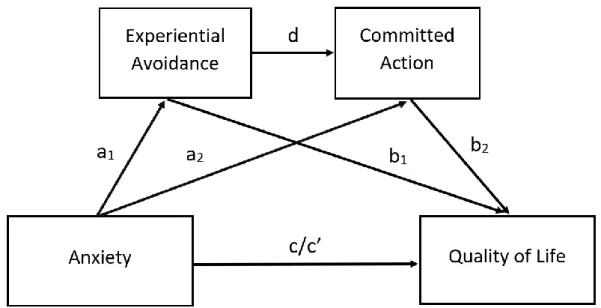
A proposed mediation model of the relationships between anxiety, experiential avoidance, committed action and quality of life. Chronic illness and anxiety are two factors that have been shown to negatively affect quality of life. In order to better understand the impact of chronic diseases on quality of life, researchers have been interested in studying the effects of experiential avoidance and committed action.
This thesis aims to examine the roles of experiential avoidance and committed action as potential mediators in the relationship between anxiety and quality of life. 547 participants from two Arab universities completed self-report measures assessing their anxiety levels, quality of life, experiential avoidance, and committed actions. Results revealed that experiential avoidance and committed action partially mediated the relationship linking anxiety to quality of life.
Introduction
- Overview
- Statement of the Problem
- Relevant Literature
- Experiential Avoidance and Chronic Illness
- Committed Action and Chronic Illness
- Committed Action, Experiential Avoidance, and Chronic Illness
- Research Objectives
- Hypotheses
In addition, research studies have explored the mediating role of several core processes of Acceptance and Commitment Therapy (ACT), such as experiential avoidance and committed actions (e.g., Trindade et al., 2016). In addition, students with chronic illnesses are more likely to report poor psychological functioning and adaptability than healthy students (Johnston et al., 2021). Researchers believe that the difficulties associated with diagnoses are likely due to processes of psychological inflexibility (Castro et al., 2021).
Experiential avoidance has also been shown to mediate the impact of IBD symptoms on levels of stress, anxiety and depression (Trindade et al., 2021). On the contrary, high levels of experiential avoidance can be a barrier to change during treatment for people with chronic pain (Gilpin et al., 2019). When it comes specifically to women with breast cancer, experiential avoidance has been associated with reduced quality of life (Han et al., 2021) along with poor emotional well-being (Aguirre-Camacho et al., 2017).
It was also proven to be significantly associated with greater levels of anxiety, depression, insomnia, fatigue, cognitive impairment, and fear of cancer recurrence (Guimond et al., 2019). Similar results were observed among patients with hematological diseases where experiential avoidance was strongly associated with higher levels of anxiety and lower levels of QoL (Corman et al., 2021). In a study conducted with individuals with chronic abdominal pain, findings revealed that action taken was significantly associated with anxiety, depression, psychological and physical disability (Yu et al., 2020).
Also, in a comparison between healthy and chronically ill individuals, Matos-pina et al. 2022) reported that those without chronic diseases were more engaged in committed action than those with chronic diseases. In addition, the process is thought to influence improvements in depression and pain interference among chronic pain patients (Akerblom et al., 2021). It is also believed to have a positive impact on the self-efficacy of people with chronic pain (Casey et al., 2022).
Important relationships between experiential avoidance and committed action were also identified among cancer patients showing that the latter has a mediating effect on the relationship between experiential avoidance and depressive symptoms (Trindade, Marta, et al., 2018). Therefore, according to researchers, interventions targeting the two processes can improve the well-being of cancer patients (Hulbert et al., 2015).
Methods
Procedure and Participants
Measures
- Demographic Information Questionnaire
- The Acceptance and Action Questionnaire-II (AAQ-II)
- The Committed Action Questionnaire-8 (CAQ-8)
- The Depression, Anxiety, and Stress Scale-21 (DASS-21)
- The World Health Organization Brief Quality-of-Life Assessment Scale
Examples of the scale's items include "My painful memories prevent me from having a fulfilling life" and "Worries get in the way of my success". Previous studies have shown good internal consistency (Cronbach's alpha=.84) and predictive validity for the instrument (Bond et al., 2011; Masuda et al., 2017) (Appendix B). The CAQ-8 (McCracken et al., 2015) (Appendix C) is an 8-item scale used to assess levels of committed actions.
Existing literature has shown that the scale has adequate internal consistency (McCracken et al., 2015; Yu et al., 2022). The DASS-21 (Lovibond & Lovibond, 1995) is a self-report scale designed to assess depression, anxiety, and stress. Responses are rated on a 4-point scale ranging from "0=does not apply at all" to "3=applies to me most of the time".
The subscale included statements such as “I felt I was close to panic” and “I felt scared for no good reason”. The instrument's subscales have shown good internal consistency with a Cronbach's alpha of .82 for the anxiety subscale (Lovibond. & Lovibond, 1995) (Appendix D). It is a 26-item scale that measures four domains of QoL: physical health, psychological well-being, social relationships, and.
It also includes items that assess overall quality of life and general health (e.g. “How would you rate your quality of life?” and “How satisfied are you with your health?”). Based on the available evidence, the instrument appeared to have acceptable discriminant validity, content validity, internal consistency and test-retest reliability (The WHOQOL Group, 1998).
Data Analysis
Results
Descriptive Analyses of Study Variables
Correlational Analyses
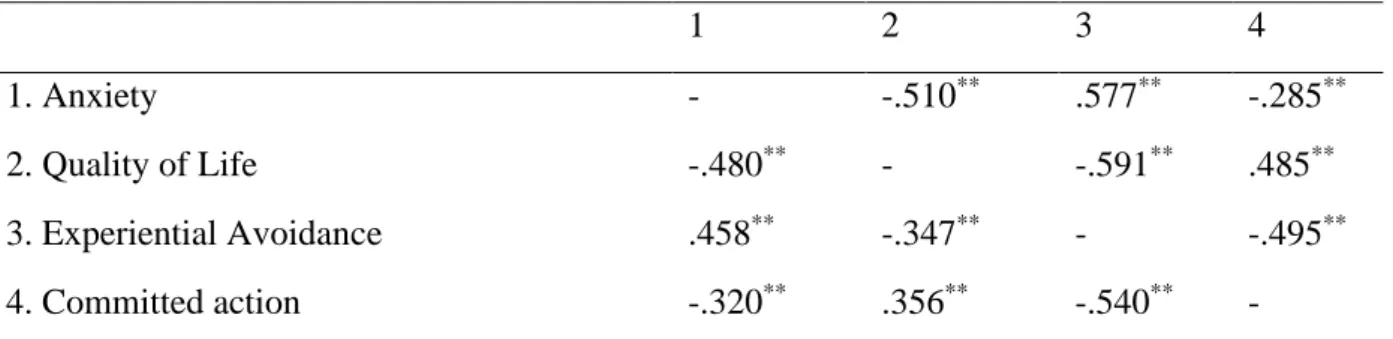
Note: The results of the healthy sample are shown above the diagonal and the results of the chronically ill sample are shown below the diagonal.
Mediation Results
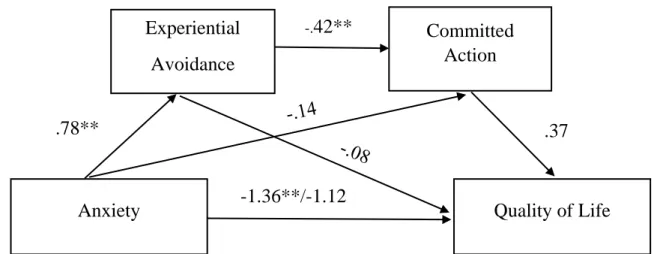
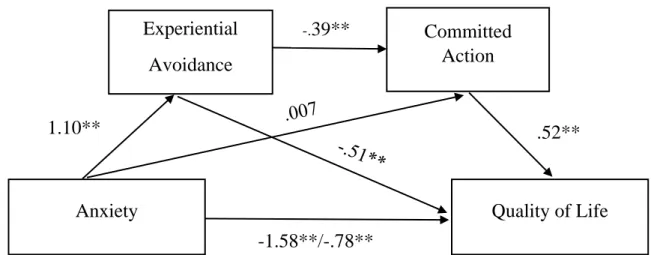
Anxiety was significantly associated with experiential avoidance (path a1) and both mediators were significantly associated with each other (path d). Path a2 (anxiety and committed action), b1 (experiential avoidance to QoL) and b2 (committed action to QoL) were all not significant.
Discussion and Conclusions
Summary and Explanation of Results
Another point to consider is that according to Hayes et al. 2012), knowing and living in accordance with values are two intertwined aspects that make up the entire engaged action. Values clarity describes the degree to which individuals are aware of their chosen values and can articulate them (Hayes et al., 1999). Their results suggest that committed action alone without an understanding of one's own values is unlikely to influence performance.
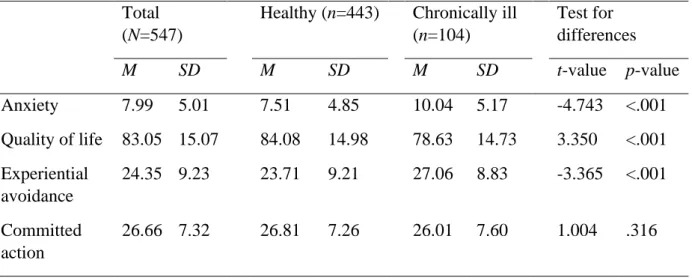
Therefore, it should be important to consider the impact of clear values on one's ability to behave in accordance with valued goals. Consistent with and confirming Hypothesis 2 and previous research (Coutinho et al., 2021), results from both groups showed that anxiety was negatively associated with quality of life and committed action, and positively associated with experiential avoidance. There was also a negative relationship between experiential avoidance and both committed action and quality of life for both groups.
Consistent with the existing literature, these findings provide further evidence for the negative effects of experiential avoidance on psychological health (Corman et al., 2021; Han et al., 2021; Trindade et al., 2018). This explains why acceptance-based therapies, such as ACT, are useful in reducing the negative impact of experiential avoidance. Such a result indicates that the relationships between anxiety, quality of life, experiential avoidance, and engaged action are robust enough correlations that they remain significant regardless of a person's characteristics.
Further, it emphasizes the importance of addressing experiential avoidance and committed actions in both healthy and chronically ill students. Path analysis results showed that experiential avoidance and committed action partially mediated the impact of anxiety on QoL in healthy students, which was consistent with previous research by Coutinho and colleagues (2021). Although it is possible that further studies will disprove this result, this may suggest that the relationship is influenced by mediators other than experiential avoidance and committed actions in individuals with chronic illness.
However, given the strong associations observed between acceptance, cognitive defusion and lack of value clarity with the psychological functioning of chronically ill individuals (Castro et al., 2021; Kibbey et al., 2020; Merwin et al., 2021) , these ACT processes may demonstrate mediating effects on the relationship in this population. Three recent studies have examined the use of ACT in Saudi (Bahattab. & AlHadi, 2021), Egyptian (El Ashry et al., 2021), and Jordanian participants (Katatbh, 2021) and demonstrated its effectiveness in producing beneficial outcomes for various mental disorders.
Limitations
Recommendations
Implications
Conclusion
It gets into your head as well as your body': Patients with cancer experiences during oncological treatment with curative intent. Preliminary psychometric properties of the Acceptance and Action Questionnaire-II: A revised measure of psychological inflexibility and experiential avoidance. Mental health and quality of life in patients undergoing hematopoietic stem cell transplantation (HSCT) before.
Perceived stigma, disease incidence and quality of life in men and women with irritable bowel syndrome. The mediating effect of positive illness cognitions on experiential avoidance and quality of life in breast cancer patients. Psychometric properties of the Palestinian version of the Acceptance and Action Questionnaire-II (AAQ-II) applied in the Gaza Strip.
Impact of chronic illness on subjective quality of life: A comparison between the general population and inpatients with somatic and psychiatric illnesses. Mood, disability, and quality of life among a subgroup of rheumatoid arthritis individuals with experiential avoidance and anxiety sensitivity. Somatic symptoms mediate the relationship between health anxiety and health-related quality of life over eight weeks.
A comparison of quality of life, anxiety and depression in children with cancer and healthy children, Kermanshah-Iran. Resilience to health challenges is related to different ways of thinking: Mediators of physical and emotional quality of life in a heterogeneous rare-disease cohort. Impact of anxiety and depression on disease control and quality of life in asthma patients.
Spiritual well-being can reduce the negative impacts of cancer symptoms on quality of life and the desire for hastened death in terminally ill cancer patients. Project title: Effect of experiential avoidance and committed action on the relationship between anxiety and quality of life in chronically ill and healthy subjects. The impact of anxiety on quality of life among college students appears to be influenced by levels of experiential avoidance and committed action.
Therefore, this project aims to study the role of experiential avoidance and committed action in the relationship between anxiety and quality of life among students from Arab universities.