BRAND LIVINGTHE
This page is intentionally left blank
BRAND LIVINGTHE
3rd edition
Nicholas Ind
how to transform every member of your organization into a brand champion
IN ASSOCIATION WITH
London and Philadelphia
Publisher’s note
Every possible effort has been made to ensure that the information contained in this book is accurate at the time of going to press, and the publishers and author cannot accept responsibility for any errors or omissions, however caused. No responsibility for loss or damage occasioned to any person acting, or refraining from action, as a result of the material in this publication can be accepted by the editor, the publisher or the author.
First published in Great Britain and the United States in 2001 by Kogan Page Limited Second Edition 2004
Third Edition 2007
Apart from any fair dealing for the purposes of research or private study, or criticism or review, as permitted under the Copyright, Designs and Patents Act 1988, this publica- tion may only be reproduced, stored or transmitted, in any form or by any means, with the prior permission in writing of the publishers, or in the case of reprographic repro- duction in accordance with the terms and licences issued by the CLA. Enquiries con- cerning reproduction outside these terms should be sent to the publishers at the undermentioned addresses:
120 Pentonville Road 525 South 4th Street, #241
London N1 9JN Philadelphia PA 19147
United Kingdom USA
www.kogan-page.co.uk
© Nicholas Ind, 2001, 2004, 2007
The right of Nicholas Ind to be identified as the author of this work has been asserted by him in accordance with the Copyright, Designs and Patents Act 1988.
ISBN 978 0 7494 5083 0
British Library Cataloguing-in-Publication Data
A CIP record for this book is available from the British Library.
Library of Congress Cataloging-in-Publication Data Ind, Nicholas.
Living the brand : how to transform every member of your organization into a brand champion / Nicholas Ind. -- 3rd ed.
p. cm.
Includes index.
ISBN 978-0-7494-5083-0
1. Brand name products. 2. Business names. 3. Management--Employee participation.
4. Corporate image. I. Title.
HD69.B7I533 2007 658.8927--dc22
2007036040 Typeset by Saxon Graphics Ltd, Derby
Printed and bound in Great Britain by MPG Books Ltd, Bodmin, Cornwall
Contents
Introduction 1
1 I’m genuinely feeling groovy 3
2 Living brands 15
3 Why people need vision and values 27
4 Why organizations need purpose and values 41
5 Defining the brand 71
6 Bringing the brand to life 105
7 Sustaining the brand: stories and myths 137
8 Measuring success 155
9 Managing the brand 171
10 Conclusion 181
Index 187
This page is intentionally left blank
A CarbonNeutral® publication
To soak up the carbon dioxide emissions generated in the production of this book and to help protect our climate, native trees have been planted with Future Forests.
Future Forests is a UK-based company with a global vision: to protect the earth’s climate.
This page is intentionally left blank
Introduction
Living the Brand is about how organizations empower and enthuse their employees. The core argument is that this is best achieved by articulating a sense of the organization that is credible and motivating both internally and externally. However, simply stating the organization’s purpose and values by themselves is not enough. Organizations need to build meaning into the ideas so that employees can genuinely live the brand in their day- to-day lives. This is increasingly important if businesses and government and voluntary organizations want to make best use of the intellectual resources of all of their employees; to capture the most innovative ideas; to build strong and lasting relationships with customers; to use the enthu- siasm and imagination of people.
The book is aimed at communication and marketing professionals and human resources personnel who are interested in the potential benefits of engaging the employees of an organization in the imaginative pursuit of a common cause. It demonstrates why this is important to individuals and organizations and how it can best be delivered. The idea of engaging employees may seem a simple one but it is hard to achieve in practice because it cannot be ordered and controlled. Rather it requires practi- tioners to work within the cultural framework of the organization; it involves the creation of a rational and emotional idea that enthuses employees and helps deliver organizational goals.
One of the keys to a book of this sort is to find good and interesting examples. Overall, I have tried to avoid the frequently cited organizations that appear in most business texts. Instead I have sought out organizations that I believe give some real insight into the problems of articulating and then delivering brands through people. To provide a flavour of the power of a company that seems to do this well, the book starts with a story about a
very distinctive organization – Patagonia – which believes that business should be used to further environmental causes. However, this alternative stance is not the rationale for its inclusion. Rather the example shows how values emerge out of a founder’s beliefs and an organization’s memory.
When values are deep rooted – as they seem to be at Patagonia – they have the power of authenticity. They guide decision making from the funda- mental (the policy on quality) to the incidental (organic food in the canteen) not because there is some command and control structure that dictates it but because people believe in the ideas behind the values.
Having used a specific example to illustrate the general concept, the book will look at the nature of branding and why people have become such important definers of the brand. Underlying this discussion is the sense that both individuals and organizations need values. It is essential to their wellbeing and their sense of worth.
The final part of the book looks at the best methods for articulating brand ideas and for embedding them into the organization. This section, in particular, will cite examples of best practice from around the world and provide readers with ideas and templates that they can adapt to their own organizations.
In this third edition of Living the Brand I have updated facts and figures and introduced some new examples that exemplify the core principles.
Overall I have not changed the substance of the arguments since the first edition although some of my ideas and views have evolved. I have also retained the story of Patagonia as the first chapter in the book. This is essentially unchanged. I could have re-written it, but the story of my per- sonal interaction with the company when I first encountered the people there retains its original power for me.
I’m
genuinely feeling
groovy
Meet Chip Bell: 11 times world freestyle Frisbee champion, occasional surfing instructor and receptionist for outdoor clothing company Patagonia. Based in Ventura, California, Patagonia is an organization with a very distinctive culture. Not only does it employ a world Frisbee cham- pion to answer the phone and greet people – it also has a clear philosophy, born out of the organization’s earliest days. This is a $267 million turnover company (2006), where the founder and chief executive conducts job interviews while surfing and employees are trained to abseil from building tops unfurling environmental protest banners. A company where workers leave their desks for the beach when the waves are over six feet and where the stores have been picketed by the Christian Action Council. It is a pow- erful brand that has a demonstrable commitment to quality, an idiosyn- cratic point of view, devoted customers and devoutly passionate employees. It has an influence, particularly in the United States, far larger than its size would suggest and serves as a model for how business can have a genuine and positive impact on the environment. Patagonia is a standard bearer for an ‘employee centric approach’ that stresses the value
1
of engaging people with the organization they work for and stimulating them to live the brand.
The story of Patagonia
Yvon Chouinard, a French Canadian who grew up in Burbank, California, founded the company that became Patagonia in 1958. As a young man he was a keen surfer and climber. He also taught himself to be a blacksmith.
Using his forging skills, at the age of 18 he started out in business making climbing pitons for himself and then selling a few to friends. This was a job that required absolute precision. Produce a flawed piton and you endanger someone’s life. It was not surprising that the young Chouinard had an early obsession with safety and quality. That obsession remained as the company’s range of products grew. However, for Chouinard, the business retained a hobbyist culture, albeit a passionate one. The company’s first mail order sheet in 1966 noted ‘Don’t expect speedy delivery in the months of May, June, July, August and September.’ This was when Chouinard would close down the forge and go climbing. Winter deliveries could also be interrupted if the surfing was good. Despite this whimsical approach to business, his passionate beliefs helped to galvanize the company and by 1970 it had become the largest supplier of climbing hardware in the United States. This was when Chouinard had his first crisis of conscience. After climbing a peak in Yosemite, called El Capitan, Chouinard recognized the damage that climbers were doing. Pitons have to be hammered in and out of cracks, which disfigures the rockface. On well-trodden routes the envi- ronmental damage was clearly noticeable. Chouinard decided that he should set an example to others and he pulled out of the piton business and instead began offering aluminium chocks that could be wedged in by hand. These had long been used by British climbers but were virtually unknown in the United States. Chouinard became an evangelist for ‘clean climbing’. The 1972 catalogue contained a 14-page essay on chocks by climber Doug Robinson, who noted, ‘Clean is climbing the rock without changing it; a step closer to organic climbing for the natural man.’
In the mid-1970s, the company moved out of climbing equipment and into outdoor clothing, but the personal philosophy of Chouinard remained a dominant influence. As with climbing gear, Chouinard’s clothing was highly engineered and built to last and there was a distinctive commitment to environmentalism. There was also an ethical stance that encouraged putting principle before profit. This created a corporate culture that was and is against consumption for its own sake. The notion of in-built obsoles- cence would be anathema to Patagonia. The company actively encourages people to send their clothing in to be repaired when damaged – generally
for free – rather than encouraging replacement purchases. Of course, there is a contradiction here in that Patagonia does persuade people to buy its products in the first place and to experience the outdoors – both of which create environmental damage. Chouinard sometimes bemoans the overuse of the wilder areas of the world and the despoliation that occurs but the company tries to have a positive approach to the environment. For example, when Patagonia was concerned about wasting the scraps left over from the pattern cutting of garments, it created a range of children’s clothes from the offcuts. The pieces were oddments so nothing matched, but customers liked the story behind the idea and the range was a success.
Most organizations would have capitalized on this, but Patagonia capped its sales and refused to produce additional product to meet demand. Chris Van Dyke, Marketing Director at Patagonia, says:
As a small company we have the leverage to move a large company, because we don’t compromise. That creates an incredible power, grossly disproportionate to the revenues we generate. Yvon has always known that being a business model is a huge reason to grow. He’s always said that if you do the right thing you’ll make money and you also become more powerful.
The environmental cause
Just as Chouinard was an early proselytizer for clean climbing, Patagonia has always been an advocate for the environment and for persuading other businesses of the importance of environmentalism. This is a company that is not short of opinions and is quite happy about the divisive effect they can have. By having a clear point of view the company creates a closer bond with its customers and employees. There is a sense of active participation in an important cause that matters not just to Patagonia but has the potential to influence the way that people live. This is a campaigning company with a campaigner’s zeal. Fostering this seems to be related to the nature of the company’s business and the way in which it was founded. Climbing, like many of the outdoor sports with which Patagonia is connected, involves much waiting and then a burst of adrenalin-filled activity. Waiting for salmon to bite, waiting for weather to clear and waiting for the surf is when stories are told. Then, because of the blurring of the boundaries between Patagonia and its climbing, canoeing and surfing customers, the stories get retold in Patagonia shops; they get retold in Ventura where employees are passionate sports people; they get retold in advertising; and they get retold in the catalogue in the form of field reports. Here’s Gretel Ehrlich, a canoeist, writing from the field:
I am lying on a sled on the frozen strait just off Cornwallis Island in the Canadian High Arctic. The sun is out; it’s always out in May. I’m at the camp of an American seal biologist, Brendan Kelly. We have just been through a three-day storm that almost blew us away. Our water-closet tent vanished first, our food cache is buried deep, our insulated tent is leaning hard though the wind has now calmed. All that is left is ice and light.1
This dialogue generated by the relationship with customers is interesting because it is something that happens naturally when companies are small and the managers of a business interact with their customers through their day-to-day work, but it is often hard to sustain as organizations grow.
Managers become removed from the day-to-day realities of a business and as a consequence they lose the direct dialogue and the sense of identifica- tion. As Larry Keeley of the Chicago-based innovation consultancy Doblin Group says:
What they’re managing [executives] in their heads is an abstraction – some- thing they remember from their one day out in the field in 1968. Or an abstract understanding of what they think they want a programme to achieve.
People within Patagonia maintain the dialogue naturally because their interests are their customers’ – employees are both the producers of goods and active consumers. Stories flow into the company anecdotally or in writing and then flow back out. The stories are not designed to directly sell more products: they’re much more to do with building a deep sense of identification with the soul of a sport – for the people ‘who know the differ- ence between winning and achieving grace’.
Creative Director Hal Arneson says:
We have our songlines2– they’re passed on and they’re very seldom written down. They run through generations and they extend out into the customer base. We definitely include our customers as part of that tribal culture.
Patagonia is not afraid to involve its customers in what it does. One of the contradictions is that the output of the company is the production of expensive garments largely made from carbon-based, non-renewable petrochemicals, which take thousands of years to degrade. Rather than trying to rationalize this dilemma internally, the company raised the issue on the web and asked people what it should do. A cynical attempt to build support for an impossible situation or a genuine desire to involve its cus- tomers? The history of Patagonia would suggest the latter. However, what- ever the motivation, the request generated a lot of comment and helped
the company to decide that the only solution was to build clothing of the highest quality while causing the least possible harm in doing so. The view was that the better the quality, the longer the garment would last. Instead of a one-year fashion purchase a product should have a 10-year-plus life at the end of which customers could return it so that the base layers could be recycled, generating significant savings in energy and CO2emissions com- pared to creating fibre from new material.
In 1996, nearly 40 years after Yvon Chouinard first started black- smithing, the company decided it should formally articulate its overall purpose and values. This wasn’t about creating something new, but was about drawing out and defining the philosophy that had long steered people’s behaviour. A cross-functional group of some 30 people talked about the company and its beliefs and came to the following definition.
Our purpose (where we mean to take the company):
To use business to inspire and implement solutions to the environmental crisis.
Our core values (the characteristics that define the company):
Quality: pursuit of ever-greater quality in everything we do.
Integrity: relationships built on integrity and respect.
Environmentalism: serve as a catalyst for personal and corporate action.
Not bound by convention: our success – and much of the fun – lies in developing innovative ways to do things.
Typically for Patagonia the purpose and values were given context by writing a 28-page book called Defining Quality, which talks through the history of the company and recounts the seminal moments in its develop- ment. As suggested in the purpose statement, environmental concerns loom large in Patagonia’s thinking. This is not a tool to create a point of dis- tinctiveness, but something that is a genuine principle. For Patagonia, envi- ronmentalism has long been part of the lifeblood of the company and, given the nature of the company’s products, something that Patagonia’s people encounter in a very direct way. The benefit to Patagonia is not so much in the marketing of products, as Patagonia feels uncomfortable with the very idea. Chris Van Dyke, who joined Patagonia from Nike, says:
When I joined, Yvon was very anti-marketing, but I presented marketing to him as a way of relationship building; a way of creating a friendship…the great thing is it’s a culture that is so rich in stories.
The real value of environmentalism in an organizational sense is that it is the glue that binds the organization. It engages the people who work for the company and it is a clear aid to decision making, such that when both tactical and strategic decisions have to be made there is a clear reference point. People simply have to ask themselves: ‘Are we being true to the brand?’ The more precise the brand idea the easier it is to use it as a means of accountability. In particular, the greater the authenticity of the brand the easier it will be for the organization to be consistent, especially when con- fronting adversity. For example, the Patagonia catalogue is always printed on chlorine free and recycled paper. Yet when the paper for a summer cat- alogue arrived at the printer it was an unusable batch. There were only two possible alternatives available for such a large print run. One was a paper that passed the environmental standards that Patagonia set, but was poor for reproducing photographs. The other paper contained chlorine and was not recycled, but was a high-quality material that was very good for reproducing images. When the problem was discussed, everyone agreed that going for the inferior paper would lose sales but that the high-quality paper would undermine the integrity of the company. The choice to accept lost sales was apparently an easy one.
One might imagine that the environmental emphasis is constraining. It certainly cuts out certain activities but it also provides a focus for innova- tion. As the explicit purpose of Patagonia has permeated the whole busi- ness, so the company’s commitment to environmentalism has been extended. The company now gives away 1 per cent of sales revenue to non- profit groups, mostly locally based environmental bodies; it has converted the company’s cotton products to organic even though production costs went up 25 per cent and sales went down 20 per cent; it developed a poly- ester fleece made from recycled bottles, which has diverted 86 million bottles from landfill (2006); it trains people in non-violent civil disobedi- ence and posts bail for those arrested; it provides employees with time off to work for an environmental group; and it works with its suppliers and other companies to reduce environmental impacts.
Chip is the brand
The clarity of the Patagonia brand would count for little if it remained the preserve of Yvon Chouinard and his senior managers. However, its real power is the way in which it seems to permeate the organization. In this sense Chip is an exemplar of the brand and all that it stands for. The choice to investigate Patagonia as a brand for this book was based largely on two initial interactions: purchasing and being impressed by the quality of the products and reading the organizational stories. Patagonia’s distinctive
business model and its search for a principled approach make for intriguing reading. However, it was visiting Patagonia’s offices in California that was most persuasive and, as a testament to word-of-mouth communi- cation, it is a story I have since told anecdotally to individuals and in pre- sentations. When I contacted the PR Director Lu Setnicka and asked how to get to the offices, she described the directions and then said go into the building and meet Chip. I thought it strange that I should be given the name of the receptionist. Chip was sitting in the entrance next to a notice- board with a chalked ‘welcome to Nicholas Ind’, alongside the latest surfing report. Chip stood up, smiled, shook my hand, introduced himself and welcomed me to Patagonia. If I wanted a coffee or any refreshments he suggested I go and help myself in the staff canteen. Then, as I sat in recep- tion, Chip answered the phone and greeted new visitors in the same way he had me, stopping to chat about the surfing and Patagonia, if he had time between calls. What struck me was that he was perfectly natural with everyone he met. If he could convey that attitude in all the phone calls he received every day and to the stream of visitors to the offices, Chip would be a vital component in Patagonia’s image. Afterwards, when I thought of all the office receptions I’ve been into in the last 20 years, I couldn’t recall anyone as positive as Chip. The question that intrigued me afterwards was:
why? Sitting on reception must involve a high level of repetition. So to find the answer I spoke to Chip again and asked him whether he had been told to behave in a certain way. Were there rules or did he just do what he thought appropriate? This is Chip’s reply:
I ride my bike to work every day, some of my children come to the childcare programme here. It seemed that when I arrived at work not only was I in a good mood, it was easy to work with our customers and our guests. It’s an image that comes naturally – standing up, shaking hands, smiling. I’m gen- uinely feeling groovy. It’s seamless for me to give customer service and interact with people and to give them a feeling that it is a different place;
that it is a business where you can be yourself – caring and giving top-notch customer service. It’s easy for me.
Every store whether you’re in Atlanta or New York or Ventura or whether you call over the phone in Reno, the people at the other end are focused on cus- tomer service. It’s a fun, outdoor company. It’s easy for a retail sales asso- ciate to give customer service, because for the most part they just got back from a great trip and they did something exciting and they’re able to convey not only the good times but the gear to wear, the products to use.
They have first-hand experience of a lot of the sports.
I answer most of the calls, although I have wonderful back-up staff. The company is flexible if I want to go on a long vacation or just have a day off to be with my children.
I encompass every value of the company. We have speakers in to talk about the environment and you also see there’s no compromise on quality. It’s so neat to be involved with those things. It reinforces my integrity as an employee and as a person. We’re not bound by convention.
I’m 11 times world Frisbee champion. I do surfing and I’ve developed a surf class so I teach surfing to employees and also private lessons. I’m respon- sible for putting the surf report up on the board – we have people all over Ventura County telling us what the surf is like.
My reactions come naturally from absorbing all of our values – environ- ment, integrity, quality – all of that is relayed back out when I’m on the phone. When I’m on the phone, I want to know what the person at the other end is going to feel; what the picture is in their mind. It’s the image they have of Patagonia that equals a strong brand.
The best bit is working with our customers and working with our vendors;
being the image and the voice of Patagonia. I think my job is one of the most important in the company and I’m well respected within our commu- nity of employees. Everybody respects me. I feel special and I take my job seriously and I love every aspect of it.
In Patagonia
In 1968, when Yvon Chouinard should have been making pitons, he chose instead to drive a van with some climbing friends south from California through Central and South America to Patagonia. Chouinard fell in love with this elemental place and its fjords, glaciers and mountains;
where the winds blow powerfully for six months of the year (the writer and aviator Antoine de Saint-Exupéry found his plane flew backwards instead of forwards in Patagonia). It is also isolated and inspiring: ‘…trav- ellers from Darwin onwards noted how this bleakness seized the imagina- tion.’ When, a few years later, Chouinard moved into outdoor clothing, he named the new company after the region. It was an apt metaphor for Chouinard’s company. Not only did it represent, in a practical sense, the type of location where Patagonia’s clothing was designed to be function- ally effective, it also stood for the imagination that is at the heart of the Patagonia brand. Commentators often talk about brands as experiences – and Patagonia is certainly that – but this brand is more profoundly about imagination. ReadPatagonia’s Notes from the Field– a collection of customer and employee stories from the Patagonia catalogue – and you are trans- ported to high peaks, frozen waters and running rivers. You imagine yourself riding a wave, climbing a rock face, or wandering through a
desert. Although there is an element of New Ageism in some of Patagonia’s ideas, they undoubtedly capture the imagination. The brand, from Chip to the advertising to the products, encourages dreams. For employees too, there is the opportunity to dream; to imagine different ways of doing things. Partly this is to do with the blurring of the bound- aries between the outside of the organization and the inside – a small but apposite example of this is the way I was invited by Chip to help myself to food and drink in the staff canteen. The employees of the company are also the consumers of the environmental vision, the company’s products and its advertising. An employee can be the same person outside of the organization and inside. This enables the creative department to develop marketing communications that derive from the imagination of both cus- tomers and employees. This union is the central tenet in the authenticity of Patagonia. As Hal Arneson says:
Most of the people here are risk athletes. They’re outdoor people working in an indoor environment that allows them to work here because it respects that about them. People are passionate about their sports and they bring that into the workplace. People spend time here agonizing over whether what they do has meaning.
The freedom to use imagination might be seen by many organizations as a licence for organizational anarchy. The value of tapping into the collective imagination and ideas of an organization could be outweighed by the diffi- culty of maintaining focus. This is where articulating and embedding the organization’s purpose and values creates real benefits. Employees can be
‘unbound by convention’ if there is clarity about what the idea means.
Take, for example, the idea of quality. This is an overused word in value statements, but Patagonia’s view of quality is ‘specific and opinionated’ and based on:
ɀ fulfilling a functional need (otherwise the product shouldn’t exist);
ɀ paring a product down to its essence;
ɀ tested performance;
ɀ durability;
ɀ environmental responsibility.
The importance of specificity is that quality moves from being a vague idea to something that has a real impact on organizational decision making. It means that the materials used are effective, the design is driven by the function of the product and the testing procedures are robust, if not extreme. One can see the hand of Yvon Chouinard in this thinking and echoes from the early days of piton making, which is perhaps why cus-
tomers and employees not only trust Patagonia but are powerful advocates of the brand.
Summary
Yvon Chouinard would be described by some as an idealist – in the deroga- tory sense of the word. However, Chouinard’s idealism, which seems shared in large measure by the employees and loyal customers of Patagonia, has created a brand that has sincerity and authenticity. The company does not try to appeal to everyone and the potential for identifi- cation that this nurtures helps to create a strong bond. For risk athletes and environmentalists it provides the opportunity to find meaning through work, which is perhaps part of the reason why the company has been listed in Fortune’s 100 best companies to work for in the United States and enjoys a low employee turnover rate of 4.5 per cent per annum. Others might argue that the Patagonia model is only sustainable for a private company.
Certainly, sports companies such as Quiksilver and Nike in their early days exhibited many of the same Robin Hood, anti-establishment characteristics of Patagonia – something they found harder to sustain as they grew and became publicly quoted companies with a new set of audiences. Now that Patagonia has made a clear commitment to growth, the task will be to main- tain its principles as it gets larger. Will compromises have to be made? Will Patagonia be able to keep its close relationship with customers when its circle of friends widens? We should hope that Patagonia manages these potential contradictions. We need mavericks who question the way things are done; who wear their principles on their sleeves; who truly fulfil employees’ working lives.
The story of Patagonia is the opening chapter in this book because it demonstrates many of the themes that will be explored in subsequent chapters. Specifically, it suggests:
ɀ employees flourish in organizations where they identify with the brand;
ɀ organizations flourish when the brand has relevance and creates meaning;
ɀ purpose and values are not created – they exist; the issue is how well they are articulated and embedded;
ɀ brand clarity creates freedom;
ɀ brands come to life when the boundaries between the internal and external blur;
ɀ stories and myths are important for sustaining brands;
ɀ living the brand requires imagination.
Notes
1 Gallagher, Nora (ed) (1999) Patagonia – Notes from the Field,Chronicle Books, San Francisco, p 63.
2 A songline is an Aboriginal concept that was popularized by the writer Bruce Chatwin in his book The Songlines. It is an inner guide, which forms the basis of an Aborigine’s spiritual life. An outsider cannot understand its truth.
This page is intentionally left blank
Living brands
Following on from the specific example of Patagonia, this chapter will investigate the nature of branding and the important role that employees play in brand formation. Although the primary emphasis here will be on businesses, voluntary organizations and governmental organizations can also be seen as brands – although they sometimes feel uncomfortable with the word, associated as it is with consumerism.
The primary function of brands is to reduce our anxiety in making choices. The very fact we are anxious indicates that we have freedom to choose. The more we sense we know about a product, the less anxiety we feel. When we know less about a product, then our uncertainty rises. This axiom is demonstrated by the correlation that exists between familiarity and favourability. We would tend to trust an established car brand such as BMW or Mercedes, more than a car brand we have never heard of. The more we think we know, the more comfortable we are. However, this is not a purely rational process where we can quantify the specific benefits. Much of the time we are making guesses based on imperfect information and on a range of rational and emotional factors. For example, choosing to donate money to WWF rather than Amnesty International or Save the Children is a mixture of the emotional, the rational and the comparative. In this instance we will identify with the cause, as we understand it, believe in the benefits our money can deliver and make a mental comparison of the rela- tive impact of the different organizations. We will not conduct a cost benefit analysis, which leads to the ‘right’ decision. Rather, we rely on the brand idea as a proxy. The organization – through its reported activities, commu- nications and employee behaviour – provides us with an approximation of the organizational reality. Then, if the signals we receive are proven by experience, our anxiety is reduced in subsequent interactions and we may
2
come to trust the brand and even become advocates for it. The only danger with reducing anxiety and taking the risk out of the things we do and buy is that we can become bored.1 As we become ever more confident as con- sumers – a fact long observed by the Henley Centre for Forecasting – we sometimes yearn for adventure and for novelty; for actively experiencing anxiety. This willingness, which varies from individual to individual, leads to a consequent reduction in consumer loyalty. People are more willing to experiment with different products and with different channels of delivery.
To meet this need the brand needs to balance continuity of experience with innovation – to provide unpredictability within a framework of predictable values. Think back for a moment to the constant innovation of Patagonia.
There are always new products in the range, but they always conform to the organization’s ideas of integrity, environmentalism and quality. Values are the defining guide.
Defining brands
In the marketing arena, there are almost as many definitions of branding as there are books on the subject. I do not intend to add to the confusion.
The definition I have found to work best comes from advertising planner Paul Feldwick, who says ‘At its simplest, a brand is a recognisable and trust- worthy badge of origin and also a promise of performance.’2
Feldwick goes on to point out that brands also transform experiences and provide a means of differentiation. Many of the ideas about branding, however, Feldwick’s included, are derived largely from manufactured goods, whereas increasingly we work in and consume services rather than products. In most Western economies services have long dominated, such that in France 73 per cent of the economy is service based and even in Germany – the largest export economy in the world – it is 68 per cent (2004). Equally in the UK, it is retailers rather than manufacturers that predominate. Tesco, for example, has a 30 per cent plus market share (2005) of supermarket retailing, profits of £2 billion and accounts for £1 in every £8 spent in shops. In services the behaviour of employees is the prime determinant of value creation. As Thomson and Hecker argue, the willingness of employees to engage with customers ‘has a significant impact on customer loyalty more so than many traditional marketing tools’3and it is brand aligned individuals that are particularly effective in generating service innovations. Even in product-based businesses it is increasingly the service element that creates the point of difference. This suggests that while Feldwick’s definition holds up, the implications extend beyond it.
A badge of origin
Organizations spend large sums of money generating names, developing visual identities and designing packaging, all of which can be a valuable means of signifying what to expect from an organization. We buy the Nike Swoosh as opposed to the adidas Triple Stripe, or vice versa, because we have an idea of what to expect, derived from advertising, from the styling and from endorsements. We have a mental picture of the brand and what it might say about us. Nonetheless, we should not mistake the sign for the sub- stance. The swoosh sets up the expectation, but if the product fails to deliver, we will begin to change our perceptions of the badge of origin. A similar sit- uation occurs with a service-based brand or a corporate brand, where there are multiple audiences. The British Airways badge of origin comprising pri- marily the name, the ribbon and the Nelson’s flag tailfins encourages us to believe in the company as a professional and truly global brand. However, the trust in that badge can easily be undermined by encounters with cabin or ground crew. Consequently brands are not easy to manage.
Companies often communicate their brand messages through a variety of conduits. Just think of a brand you know well and consider how you form your opinion of it. The process is multifaceted. It is about the interactions with people, what you read in the press, the ease of use and content on the website, the style of the advertising, the quality of the product and the effi- ciency of the after-sales service. The company may try to control all of these outputs, but it is only the visual presentation that is truly policeable. Content is not. Even in the tightest structures you cannot create an Orwellian world where every employee thinks and talks in the same way. Nor would it be desirable to do so. The power of a brand lies in giving employees the freedom to use their imaginations within the constraints set by the organiza- tion’s values. So the badge is just a badge. If the design of the badge is good then it can help an organization stand out from its competitors and indicate its provenance. But the badge is not the brand. In fact the truism is that the brand exists in the minds of stakeholders – they, rather than the company, determine the nature of the brand relationship. The inference is that although the company intends to communicate an idea of brand through its signs and symbols, there is no guarantee that consumers and other audiences will read them in the intended way.4People cannot help using their different personal and cultural experiences to decipher what they see.
A promise of performance
A promise is implicit in a brand. From the combination of corporate mes- sages and experience we believe that we will receive a certain experience from a brand. The Patagonia name on a garment promises me quality and
environmental responsibility. It also has a transformational quality, as observed in the last chapter, in that it captures my imagination and con- jures up pictures of skiing or climbing. It also makes me feel more profes- sional and adventurous because I associate the product with the experienced sports people I see wearing the clothes, the knowledgeable staff in the stores and the images in the catalogue. Whether the promise of performance is delivered or not defines my evolving relationship with the brand. If each interaction – whether it is through products or people or communications – confirms my idea about the brand, then the relation- ship gets stronger. This is why there needs to be a tonal consistency to the brand; that the experiences I have support each other. This does not suggest that each interaction carries the same weight. A media commen- tary in a respected journal might have a greater, or at least different, influ- ence than an advertisement. A leaked document might have a greater legitimacy than the annual report. What we are seeking to establish is the authenticity of the brand. Can it be trusted? Insights gained from objec- tive third parties or from unguarded comments undesigned for general consumption can enable us to see behind the brand façade; to discover the truth. This is a journey of deconstruction. As consumers, or indeed citi- zens, we have become more cynical and less trusting. Generally we don’t believe what politicians tell us, nor do we have much faith in the press or business. In a consumer context this lack of faith has spawned organiza- tions that survey products and services and provide us with more objective evaluations of brands. Similarly, there are large numbers of web commu- nities and blogs that provide forums for discussing the truth about brands.
If you want to buy a new product you can read reviews, do research, discuss user experiences and publish your own views. This makes it harder for companies to hide their failings. When consumers start seeing inconsistency, they start questioning. For example, if the Patagonia recep- tionist had been rude and aggressive, I might have started to question the brand; to wonder whether the company is well managed and takes care of its staff.
There seems little point in spending large sums promoting an idealized picture through advertising, if the brand itself cannot deliver. This seem- ingly simple premise is ignored with surprising regularity. Managers still believe that advertising and promotions are the most important marketing activity and that internal brand-building is the least important,5 even though brand strength is largely determined by experience of products and services. This point is exemplified by the investment of airlines in cre- ating and implementing new visual identities and then undermining the expenditure by failing to invest sufficiently in customer service. This is in spite of the fact that empirical studies have shown that the interaction with personnel, and cabin crew in particular, is a prime determinant of cus- tomer satisfaction.
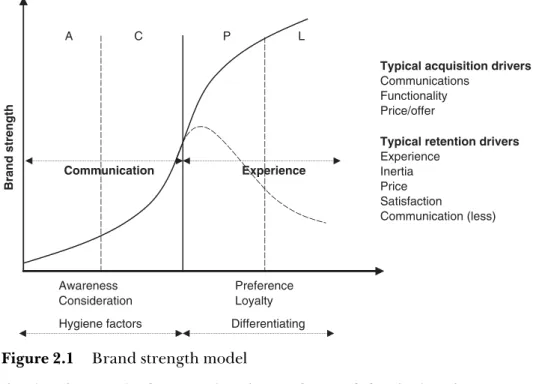
Rather than adopting narrow measures of performance, it is important to evaluate the overall strength of the brand. This suggests that the organi- zation has to understand not only such marketing communication indica- tors as awareness and consideration, but also the likely long-term loyalty of buyers. In Figure 2.1, brand strength can seem quite powerful merely on the basis of communication. People get to hear about a brand through advertising and PR, and awareness and consideration indicators score highly. However, it is the repeat purchase action of buyers over time that is truly important. This is largely defined by experience – by the design of the product, by the interaction with employees and the quality of service.
These are cross-organizational measures that require the integration of such areas as marketing, human resources, research and development, and operations, and importantly they require a widespread understanding of the organizational ideology. If however a key part of the offer such as logistics fails, people will not return. In this instance brand strength will decline. Alternatively, if buyers enjoy the purchase experience they will return. Even if the brand occasionally fails, we can be forgiving especially if most of the experiences we have are positive. But sometimes the one expe- rience we have is very bad and we then infer the general from the partic- ular. As the writer Iris Murdoch notes:
We see parts of things, we intuit whole things. We seem to know a great deal on the basis of very little…we fear plurality, diffusion, senseless acci- dent, chaos, we want to transform what we cannot dominate or understand into something reassuring and familiar.6
A point of difference
When we choose to buy a product or a service, both positive and negative reasoning influences us. The degree of consideration given will depend on the complexity and the size of the purchase but the factors will tend to be similar. The first (though not necessarily dominant) factor is functionality.
‘Does the product do what I need it to do?’ The second is ‘Does it appeal to me emotionally? Does the product tap into my needs and desires and sense of self?’ The third is differentiation. ‘What is the context for this product and how is it different from the other products that I could substitute for it?’ In a sense, ‘What is it not?’ Strong brands tend to be opinionated. They clearly stand for something and provide a positive reason for choice. Many brands do not have this clarity. Partly this is because genuine product inno- vation has become more difficult. A technical innovation, unless it has the protection of patents, is often easily replicable, while stylistic innovation tends to bring plagiarists in its wake. Services are even easier to copy. For example, a new financial product is easily replicable. The only problem is
the time lag required structuring the product and developing the neces- sary promotional material. In the internet world each market has multiple competitors that offer broadly similar services. Just key ‘pets’ into a search engine and see how many sites come up, all offering broadly similar con- cepts. If the choice of site is to be anything other than serendipity, then there needs to be a relevant point of difference.
As the designer Peter Saville says, ‘the best brands are constantly mor- phing packages’.7 Brands need to keep giving people new reasons to choose them. Innovation of itself is not enough. Innovation has to focus on delivering functional and emotional benefits to consumers. The brand is thus a combination of interactions that collectively differentiate it. As Stephen King in Developing New Brandssays: ‘A product is something that is made in a factory; a brand is something that is bought, by a customer. A product can be copied by a competitor; a brand is unique.’8
Corporate brands
Branding is more complex at the corporate level. The organization not only has to manage its relationship with consumers – it has to take into account all the other stakeholders such as investors, media, government, suppliers, buyers and employees. Each of these will have a different expectation and
Brand strength
Awareness Consideration
Communication
Typical acquisition drivers Communications
Functionality Price/offer
Experience
Preference Loyalty
A C P L
Hygiene factors Differentiating
Typical retention drivers Experience
Inertia Price Satisfaction
Communication (less)
Figure 2.1 Brand strength model
understanding of the brand. Investors will be interested in strategy and per- formance whereas customers will be interested in price and product quality.
Each audience will be working to deconstruct the organization but they will often be searching for different things. What unites them is a common interest in ‘seeing backstage’ – seeing the people behind the brand. This opening up to the world can be a daunting prospect for businesses. In the past there was security in erecting barriers between the organization and its stake- holders. This has become far harder to sustain. Partly this is because, if organ- izations are to gain competitive advantage, they need to interact with and learn from their stakeholders. Ideas need to be shared and knowledge needs to be acquired. As The Cluetrain Manifesto says ‘Not only do your customers want to talk with real people inside your organisation, but your employees are desperate to talk with real customers. They want to tell them the truth.’9
Partly it is because the near universal access to the web makes the bar- riers themselves permeable. ‘Challenge is in the air because the digital world removes the emperor’s clothes. It makes Bill Clinton transparent, GE transparent, the UN transparent. And you, too, are transparent.’10
The organization therefore needs to structure its brand to meet this trans- parency. It cannot make claims without substantive evidence and it cannot engage in wishful thinking about its status in or influence upon people’s lives.
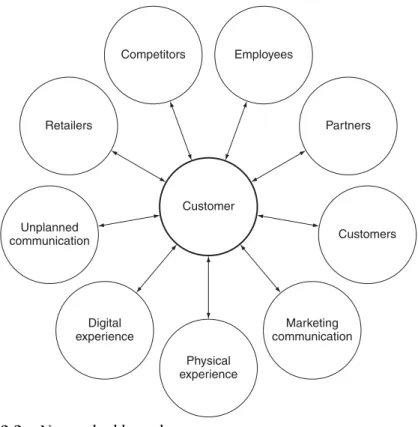
Figure 2.2 conveys two key concepts in this regard: the image that consumers have of a brand cannot be controlled in any absolute sense – several different elements impact on consumer perceptions – and many of the impacts are outside of the organization’s structure.
Consumers interested in buying a specific computer brand, for example, will perhaps be influenced by advertising, press reviews, interaction with employees, their overall perceptions of computer manufacturers, other owners of this computer (virtual and actual word of mouth), software manu- facturers and retailers. The computer manufacturer may make an excellent product, but the actions of partners, retailers and other manufacturers could all have negative impacts. As services and products are increasingly delivered by networked organizations, there is potential for others to either add to the perception of the value of the brand or to detract from it. As with employees, partners and other brand participants need to be engaged with the idea of the brand in a genuine way. Often there are simply too many people involved in the formation of the brand image for anything but authenticity to be valid.
Clarity can only be achieved if the brand idea is credible and comprehen- sible. As a result we may start to see a more authentic, less exaggerated lan- guage entering the realm of brandspeak.
Another corollary of this brand transparency is that although stake- holders seek different information there are increased possibilities for overlap. Information on the web that is aimed at shareholders will be acces- sible to employees, and consumer information can readily be scrutinized in unforeseen ways by an investor.
People
There is a tendency to talk about brands in an abstract way. They are seen as things that have value. Coca-Cola is worth $67.0 billion, Microsoft $59.9 billion, IBM $56.2 billion, GE $48.9 billion and Intel $32.3 billion.11 However, brands are created and consumed by people. The managers of a business formulate strategies, communications people write briefs and help develop advertising and design programmes, sales people build relation- ships with customers, industrial designers create new products and recep- tionists greet people. Consumers are not target markets devoid of any persona; they are individuals, some of whom act in similar ways when encountering a brand. The relationship between employees and consumers is therefore at the heart of the brand experience. Just as in any successful relationship, the employee/consumer relationship needs honesty, openness and a unity of interest. Where the unity is intuitive, with employees and con- sumers sharing the same passions, it is particularly powerful.
In traditional marketing and advertising thinking, communications people would talk about owning the relationship with consumers. This is fundamentally flawed. The prime mover in the relationship is the con- sumer, not the marketing department or the advertising agency. Even within the organization, the relationship with the consumer is one that the whole enterprise must embrace, otherwise it does not have a relationship;
it has one-way communication, much of which is probably ill-targeted and consequently wasted.
The failure of much marketing is its seller-centricity. It is wedded to the needs of the company, not the desires of consumers. The result is the urge to insert ‘buy-me’ messages into the consumer’s mind. But unlike Alice in Wonderland, who believed the ‘drink me’ message, increasingly consumers are not swallowing this imperative. Alan Mitchell, author of the book Right Side Up, says, ‘the source of marketing ineffectiveness and waste, therefore, lies in its seller-centric preoccupations. Marketers say the acid test of good value is find out what your customer wants and needs and give it to them.
When it comes to marketing communications, this is the one thing mar- keters do not do. Marketers seem to believe that the only people who do not need to practice what marketing preaches is … themselves.’12
For the organization to move to a stance where the consumer is the focus of its attention does not require archery target charts with the word
‘consumer’ in the middle. It necessitates an orientation where everyone thinks and acts like the consumer. This humanistic approach seems to have been lost in the often militaristic jargon of business and the abstrac- tion that stems from ever-larger organizations.
However, there are important opportunities for change. Some organiza- tions build cells that are never allowed to grow too large. Richard Branson
argues that when companies are successful, their first instinct is to do more of the same and pursue growth as an end in itself. However, this instinct is not always correct because the change in size impacts on the ‘firm’s prime asset, its people’. To maintain the enthusiasm and commitment of people and to retain the entrepreneurial spirit of the company, Virgin has consis- tently broken its businesses down into small, people focused units. This small scale keeps the business focused on customers; they don’t become abstractions. Equally, some organizations have worked to break down the boundaries that exist between the inside and the outside. Patagonia has worked to achieve an entrainment13 with customers by encouraging employees to take part in the sports they serve and by employing sports and environmentally oriented people. Similarly the online encyclopaedia Wikipedia uses the knowledge and commitment of enthusiasts to build its resource. Entries are submitted by individuals, argued over, questioned and corrected by subsequent contributors. There is no central body con- trolling content (although sometimes calm and reflection will be urged on contributors when a subject generates too much heat) and everything grows organically.
Customer
Employees
Partners
Customers
Marketing communication Digital
experience Unplanned
communication Retailers
Competitors
Physical experience
Figure 2.2 Networked brands
Summary
Brands should be both a source of differentiation and a promise of per- formance. The presentation of the brand is an element in the way cus- tomers see a brand, but it is not the brand itself. Rather, a brand is something that exists in people’s minds. The company may seek to influ- ence that mental image but success can be only relative. Planned and unplanned communications are received all the time and consequently the brand is a loose collation of fact and myth.
The best way to develop a brand that has a high degree of relevance and consistency is to ensure that the employees of an organization understand and believe in the values of the organization. These cannot be invented – they have to come from the essence of the organization and lived sincerely if they are to meet the deconstructivist gaze of consumers and other audi- ences. Living brands have to be built on solid ground but they also have to be capable of evolution and change.
Notes
1 Read Anne Tyler’s book The Accidental Tourist(Vintage, 1995) for an example of a risk-free life. The central character writes travel guides for Americans who would rather not travel. The purpose of the guides is to insulate people against risk. For example, he advises travellers always to have a good book with them so that they don’t have to talk to the person next to them on the plane.
Similarly, the restaurants he recommends in Paris are all American.
2 Feldwick, P (1991) Defining a brand, in Understanding Brands, ed D Cowley, Kogan Page, London, p 21.
3 Thomson, K and Hecker, LA (2000) The business value of buy-in: how staff understanding and commitment impact on brand and business performance, in R Varey and B Lewin (eds) Internal Marketing: Directions for management, Routledge, London.
4 The American pragmatist philosopher CS Peirce has argued that one combi- nation of signs has to be interpreted by another set. Thus when we see a logo or brand name, we use a set of linguistic ideas, such as caring, reputable, exciting. Not only is there no guarantee that the next person will use the same linguistic ideas, but also there is no certainty that they would mean the same things by them, even if they did use the same ideas.
5 Research by Research International in the UK and US among 1,000 employees and managers. ‘Marketing in the spotlight: what people really think of marketing’, The Economist Marketing Directors’ Summit, March 2004.
6 Murdoch, Iris (1992) Metaphysics as a Guide to Morals, Penguin, Harmondsworth.
7 Interview at Belgrade design and branding week, 20 May 2006.
8 King, Stephen (1984) Developing New Brands, JWT, London, p iii.
9 Levine, Rick et al(1999) The Cluetrain Manifesto, Perseus Books, Cambridge, MA, p 94.
10 Ridderstråle, Jonas and Nordstrom, Kjell (2000) Funky Business, ft.com, London p 46.
11 Interbrand brand valuations, 2006.
12 Mitchell, Alan (2001) Right Side Up: Building brands in the age of the organized con- sumer, HarperCollins Business, London.
13 Entrainment is the process whereby two connected oscillating systems, having similar periods, fall into synchrony. The system with the greater frequency slows down, and the other accelerates. Christiaan Huygens, a notable physicist, coined the term after he noticed, in 1666, that two pendulum clocks had moved into the same swinging rhythm, and subsequent experiments duplicated this process. The accepted explanation for this is that small amounts of energy are transferred between the two systems when they are out of phase in such a way as to produce negative feedback. As they become more in phase, the amounts of energy gradually reduce to zero. In the realm of physics, entrainment appears to be related to resonance (from www.wikipedia.org). In a brand-building context, entrainment means achieving a synchronicity between the organiza- tion and its customers.
This page is intentionally left blank
Why people need vision and values
‘There is now, more than ever, some need for Utopia, in the sense that men need – as they have always needed – some vision of their potential, some manner of fusing passion with intelligence.’
So wrote Daniel Bell in The End of Ideology. He was proclaiming that the central rivalry between the political left and right was over. Bell’s view was that, even if political ideas were dead, people need an outlet for their pas- sions and their intellect. One outlet can, and indeed should be, the world of work. Brands can come to life if organizations engage with people’s deeper needs and if they help to fill the vacuum that has emerged within the lives of many. However, to achieve this, business leaders need to understand what motivates employees to join a business, what makes them stay and what encourages them to identify with organizational goals. Armed with this understanding, organizations can build people-centred businesses where the full intellectual capacity of individuals is used. Rather than employees who are represented in body but not spirit, you can create
‘brand evangelists’: people who believe and will preach for the organiza- tion.
Why we go to work
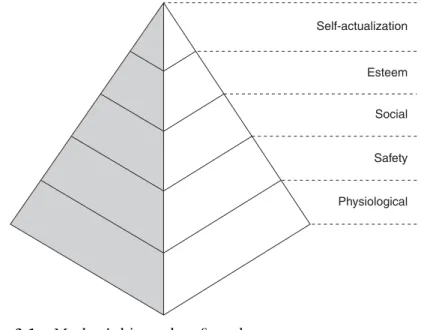
As Abraham Maslow pointed out in his famous hierarchy of needs (see Figure 3.1), we work because we have basic needs of safety and security. For
3
anyone who has spent time unemployed or has felt uncertain about their position within an organization, there is a real fear of not being able to afford the necessities of life: clothing oneself properly, eating well enough and caring for one’s family.
These basic needs are formidable drivers, but they do not of them- selves encourage people to identify with organizations or create what Bartlett and Ghosal refer to as ‘the extraordinary effort and sustained commitment required to deliver consistently superior performance’.1 However, the safety-and-security view of life and indeed work prevailed for the first half of the 20th century and it led to ideas of scientific man- agement: that people were cogs in the production process and could be ordered and managed. Not surprisingly, this helped to create uncer- tainty and adversarial relationships between management and workers.
Management would try to extract the maximum production for the least payment and workers and their unions would try to negotiate the maximum payment for their efforts. There was little sense of a commonly pursued agenda.
Maslow, with his belief in humanistic psychology, recognized that, although people do have basic needs, they also have social needs, and needs for esteem and self-actualization. He believed that each person’s task is to be the best person they can. Not everyone can become an astronaut or US President or head of a multinational organization, but they can make the most of their individual potential. As Sartre argues, ‘No one can be alive without creating himself, that is going beyond what others made of him.’2
Self-actualization
Esteem
Social
Safety
Physiological
Figure 3.1 Maslow’s hierarchy of needs
Most people do want to build relationships; they do want to be recognized by others for their worth and they do want a sense of fulfilment.
Self-actualization
A musician must make music, an artist must paint, a poet must write, if he is to be ultimately at peace with himself. What a man can be, he must be. This need we may call self actualisation…It refers to man’s desire for self-fulfil- ment, namely to the tendency for him to become actually in what he is potentially: to become everything that one is capable of becoming.3
Of course the reality of the world is that not everyone does achieve their potential. Some people underachieve. Yet Maslow would argue that they do not do so willingly. Even when people fail, they still have the desire to achieve – to ‘experience higher values’. This can be seen in those charities that work with disadvantaged youth. In the UK, with its problems of youth unemployment, teenage pregnancies, drug abuse and crime, there is a periodic hand wringing about the underachievement of Britain’s teenagers. However, one of the charities – Fairbridge – which works with the most difficult cases, has a workforce of which 30 per cent are these sup- posed no-hope teenagers. Fairbridge employs them not as an act of charity but because these are people who are best able to relate to other young people. Others go on to employment and higher education. Yet when these teenagers first arrive at Fairbridge they are sometimes third-generation unemployed, unable to read and write properly and incapable of commu- nication. How is this transformation achieved? First, the organization is non-judgmental – anyone is welcome. Second, it provides a supportive environment and mentoring. Third, it encourages people to set their own objectives in life – and to then take a series of small steps to achieve them.
Lastly, it celebrates their successes. What Fairbridge gives these disadvan- taged teenagers is confidence and the motivation to succeed in what they choose to do. The teenagers do the rest. It is an example of the innate desire of people for fulfilment.
The other key inhibiting factor in our ability to achieve self-actualiza- tion is a failure of imagination. Being a musician, a poet or an artist requires imagination, creativity and innovation. Work in a corporate environment has traditionally discouraged these attributes. Creativity is seen as the realm of the marketing department and innovation is the responsibility of management. Encouraging people to express their cre- ativity in whatever they do runs contrary to the idea of order and nor- mality. This was something that worried Maslow. He asked ‘Why do people not create?’ The reason is that neither management nor society
encourages it. Gordon MacKenzie, who worked at Hallmark Cards for 30 years as a creative director, recounts a story that aptly demonstrates this. One of his activities was to go into schools and teach children about creativity – to foster the sort of ‘disruption’ he created in the institutional environment at Hallmark. When he arrived at a school, he would always tell the children that he was an artist and he would then observe the beautiful pictures the children had produced. He’d say that the pictures made him realize there must be lots of artists in the schoolroom. He’d ask ‘How many artists are there in the room? Would you please raise your hands?’
The response was always the same:
First grade: En mass [sic] the children leapt from their chairs, arms waving wildly, eager hands trying to reach the ceiling. Every child was an artist.
Second grade: About half the kids raised their hands, shoulder high, no higher. The raised hands were still.
Third grade: At best, 10 kids out of 30 would raise a hand. Tentatively.
Self-consciously.
And so on through the grades. The higher the grade, the fewer children raised their hands. By the time I reached sixth grade, no more than one or two did so and then only ever so-slightly – guardedly – their eyes glancing from side to side uneasily, betraying their fear of being identified by the group as a closet artist…The point now is:
Every school I visited was participating in the suppression of creative genius.
MacKenzie’s point is that creativity is about challenging norms and finding new and original ways of doing things and that society sup- presses this in the cause of sustainability and the protection of the status quo.4It’s the same reason why the Ancient Greeks found Socrates’ ques- tioning of their ideas so uncomfortable and why he was sentenced to death for corrupting the minds of the young. And why Galileo’s astro- nomical discoveries, which undermined the Biblical interpretation, led him to be tried by the Inquisition. Of course societies, like Imperial Spain – and business – which eschew creativity and suppress new ideas, tend to stagnate.
Despite these barriers to achieving self-actualization, Maslow’s ideas about this need are powerful. When we move from the question ‘Why do we work?’ to ‘Why do we choose to work where we do?’ the fulfilment need becomes more dominant. If we have the choice, we will opt to work for organizations and environments that provide the opportunity to nurture our imagination and creativity; which extend our idea of what we are as individuals. The negation of this choice causes us to feel dissatisfied with ourselves and, at the extreme, causes us psychological damage. At some