Page 1 of 51
Kingdom of Saudi Arabia Ministry of education Saudi Electronic University
SEU Manual for Designing and Reviewing Academic Program
(* The original document is in Arabic)
Page 2 of 51
First: Introduction:
The study plans and programs of higher education institutions are the tool through which the educational outcomes of the institution and the quality of its graduates are identified and measured. Therefore, the Saudi Electronic University attached great importance to the development and development of study plans and programs in the university’s faculties, and was keen on continuous evaluation and review of its programs to ensure the excellence of educational programs and the quality of study plans in line with the needs of the labor market and the requirements of local and international academic accreditation. The university also employs all its academic capabilities and expertise at all levels to produce study programs that achieve its mission and vision. In order to unify and consolidate the procedures for preparing, reviewing and developing study programs and plans, the University Vice Presidency for Educational Affairs has prepared this guide to document the requirements and procedures for preparing and developing study plans and programs in response to developments in the labor market and academic accreditation requirements that dictate that educational institutions periodically review, evaluate and develop their programs.
Second: Definition:
The following words and terms, wherever they appear, shall have the meanings below, unless the context indicates otherwise:
Ministry Ministry of Education in the Kingdom of Saudi Arabia University the Saudi electronic university
President University's president
Branch A branch of the Saudi Electronic University in the Kingdom of Saudi Arabia
Study program An academic major that determines the courses students study and the activities they practice that, upon completion, will qualify them to obtain an academic degree in that major Program
mission and goals:
A set of phrases that explain the program's mission, purpose and objectives.
Page 3 of 51
Program Description
An approved document that includes the components of the academic program: the name of the program, the degree it grants, the college it offers, its tracks, the study plan, the jobs that can be filled by those who qualify, learning outcomes and the number of approved teaching hours, learning and teaching strategies, academic and counseling support activities for students enrolled in it, and its quality management system.
Learning Outcomes
A set of knowledge, skills and values that the student acquires throughout the study period in the program and is able to demonstrate and employ them in his professional life.
Study plan A group of compulsory, elective, and free courses, whose units constitute the graduation requirements that the student must pass successfully in order to obtain the degree in the specified major.
Course A subject within the approved study plan in the major (program), and each course has a number, code, name, and a detailed description of its content and a specific level. Some courses may have previous requirements that the student must fulfill.
External/internal arbitration
Presenting the academic program to specialized academics or specialized scientific bodies in the program from outside/inside the Kingdom of Saudi Arabia or abroad to assess its quality and suitability of its content.
Academic accreditation references
Entities that determine the controls and standards of university educational practice. At the local level, the body accredited by the Ministry of Education is the National Commission for Academic Accreditation and Assessment (NCAAA), and at the international level, there are many accreditation references according to specializations.
Accreditation A process that is carried out according to arbitration and review mechanisms and procedures administered by specialized bodies, to ensure the quality of education
Page 4 of 51
received by students in higher education institutions wishing to ensure their compliance with quality standards.
Institutional Accreditation
It is concerned with evaluating the quality of work in the educational institution in terms of resources, procedures, and outputs, according to specific standards from local or international academic accreditation bodies.
Program accreditation
It is concerned with evaluating the quality of a specific educational program for a specific stage, according to the standards of the target body for academic accreditation.
Benchmarking Comparisons
Indicators and standards of performance in academic programs or corresponding and leading universities globally or locally, which represent the best practices in the field of knowledge and can be considered as a guiding reference for preparing the study plan as a reference.
Semester A period of time not less than fifteen weeks, during which the academic courses are studied, and the registration and final examination periods are not included in it.
Study unit The weekly theoretical lecture or clinical lesson of no less than fifty (50) minutes duration, or practical or field lesson of no less than one hundred (100) minutes.
Academic Department
The academic department that does not award a degree and is satisfied with providing a number of courses that the student studies in an accredited educational program in one of the university’s colleges according to the approved study plan
Track The specialized track within the framework of an educational program chosen by the student to determine an exact specialization for the qualification he obtains
University requirements
Compulsory and elective courses that all university students study in all accredited educational programs
Page 5 of 51
College
Requirements
Common compulsory and elective courses taught by students of a particular college
Specialization Requirements
Compulsory courses, elective courses, graduation project (if any), and field training (if any) administered by students of a particular specialization.
Compulsory courses
Courses that all students of the program must study.
Elective Courses A set of courses that the student of the program can choose with a number of units of study specified in the study plan of the program, and these courses can be elective college courses, or elective program courses.
Reviewing and evaluating
academic programs
A process of regular and regular review and evaluation of all academic programs and study plans at the university periodically and within specified periods of time.
Academic year Two main semesters and a summer semester, if any
Sumer season A period of time not exceeding eight weeks, not including the registration period and final exams, during which the period allotted for each course is doubled.
Third: Basic principles for creating, reviewing and developing study plans and programs at the university
When creating, reviewing or developing study plans and programs, the following principles should be observed:
1. Its consistency with the development plans in the Kingdom of Saudi Arabia
2. Its compatibility with the vision, mission, and objectives of the university and its educational system
3. It meets the requirements of the national framework, quality and academic accreditation
Page 6 of 51
4. Keeping abreast of the latest successful practices in the teaching and learning process
5. Subject to arbitration by specialists in the field
6. Guided by benchmarking comparisons (Benchmarking) for leading educational institutions.
7. Guided by stakeholders (such as representatives of departments and colleges, students, graduates, employers of the labor market, etc.).
8. Professional ethics and practice behaviors.
Fourth: Criteria for creating and developing study programs
When creating or developing an academic program, it is necessary to verify the applicability of the following criteria:
1. The program’s mission is compatible with the university’s mission and strategic goals, and the mission and objectives of the college to which the program is affiliated.
2. Its compatibility with the education policy in the Kingdom,
3. His contribution to the realization of the national development plans and the vision of the Kingdom 2030,
4. Include twenty-first century skills.
5. Harmonize it with the university's education system "blended education".
6. It meets the local academic accreditation standards issued by the National Assessment and Accreditation Commission (NCAAA).
7. It meets the international academic accreditation standards related to the major.
8. His commitment to the requirements of the National Qualifications Framework.
9. Determining the qualitative specifications of the graduate and the expected learning outcomes.
Page 7 of 51
10. Taking into account the needs of society and the labor market (a feasibility study).
11. Keeping abreast of recent trends and developments in the field.
12. It is based on local, regional and international reference comparisons of leading educational institutions in the same field.
13. Keeping abreast of modern educational means and techniques in the process of teaching, learning and assessment
14. Determining the human requirements of faculty members, equipment, facilities...etc.
15. Determining a clear mechanism used to review and develop programs on a periodic basis, subject to arbitration by internally specialized bodies or personalities.
16. Subject to arbitration by three externally specialized parties or persons, one in eLearning.
17. Determining graduation requirements the number of academic units 18. It includes a number of course units that reflect the effort allocated to
each course.
19. Benchmarking of comparable and pioneering educational institutions in the same field.
Fifth: Criteria for creating and developing study plans
The study plan for academic programs is the main pillar upon which the educational process is built. The process of building study plans or developing the existing ones is of paramount importance in the Saudi Electronic University, as it largely determines the quality and efficiency of learning outcomes. To ensure the quality of the study plan, the following criteria should be taken into account:
1. Aligning the study plan with the goals and mission set for the academic program.
2. Taking into account the diversity and integration of the plan's courses to ensure the achievement of the learning outcomes of the program.
Page 8 of 51
3. Distributing the courses on the levels, determining the minimum and maximum units of study for each course, determining the previous requirements for the courses, and clarifying the total number of units for graduation from the academic program.
4. The procedure for basing the study plan on local, regional and international references or what is called benchmarking for at least (2- 3) study plans in universities that have academic accreditation, or a good reputation in the field of study plans and programs that are intended to be developed or established
5. It observes the balance between the theoretical and practical aspects in the decisions of the plan. Depending on the nature of the academic program.
6. Classification of courses based on the various requirements at the university (university requirements, college requirements, specialization requirements)
7. Academic departments’ commitment to the updated forms approved by the National Center for Academic Accreditation and Assessment in describing courses.
8. Numbering the courses according to the pattern in force in the Saudi Electronic University, where the course number consists of three components (college number - scientific department number - course serial number).
9. The absence of duplication in the courses mentioned therein with the courses offered within the college or colleges in the same field within the university.
10. It includes a training, co-op or summer program in addition to field training.
11. Taking into account the sequence of courses and determining the previous requirements, if any.
12. Subject to arbitration by external arbitrators by parties outside the university, as follows:
Page 9 of 51
A. The specialized scientific department nominates the names and addresses of two external arbitrators or specialized scientific bodies.
B. The Permanent Committee of Study Plans and Programs has the right to add arbitrators outside the list nominated by the academic department. It adds a third arbitrator to the list who is specialized in eLearning or distance education.
C. The specialized scientific department prepares the plan for dealing with the arbitrators’ comments (Plan Action), with a separate report attached to the plan, including the methodology for dealing with the arbitration reports and the notes they contain, whether they were taken or not.
Sixth: Linking the mission, goals and learning outcomes
The program’s mission and goals should be aligned with the university’s mission and goals. The program should define a set of graduate attributes, which should be aligned with the University’s graduate attributes, and should imbed them in program learning outcomes to enhance their achievement.
Seventh: Justifications for the creation and development of study programs and plans
A. Justifications for introducing a new academic program at the university:
1. Responding to the economic, social, cultural, technical, developmental or integrative requirements with the local community of the university based on scientific foundations and reports issued by reliable authorities.
2. Keeping abreast of new developments in modern scientific fields as well as the results of research and studies in various scientific fields and their recommendations.
B. Justifications leading to the development of an existing academic program at the university:
Page 10 of 51
1. The periodic evaluation of the program and the resulting recommendations or proposals, according to the annual reports of the programs and the decisions reports.
2. Opinions of the Permanent Committee of Study Plans and Programs regarding approving the development and modification of the program.
3. The developments that occurred in the field of the program in the scientific and technical aspects.
4. Labor market variables, available jobs and their requirements
5. Results of opinion polls from employers about university graduates.
6. Requirements for national development, academic accreditation at the local and international levels.
7. Bridging the gap between educational outcomes and labor market requirements.
Eighth: The steps for developing academic programs at the university
The process of creating academic programs proceeds according to the following steps:
1. Feasibility study for the academic program.
2. Defining the vision and mission of the program to be:
a) Clear, comparable and measurable.
b) Alignment with the Kingdom's vision and aspirations.
c) Alignment with the vision and mission of the university and the college.
3. Defining the program objectives, provided that they are linked to the university’s goals, values, and strategic plans and describe the results achieved from the program, provided that the program objectives are aligned with:
a) The objectives of the Ministry of Education in the Kingdom of Saudi Arabia.
b) Other academic programs within the college.
c) The university's electronic and human resources.
Page 11 of 51
4. Making the necessary reference comparisons with similar academic programs in distinguished universities at the local and international levels.
5. Preparing the program output matrix according to the latest models at the National Center for Academic Accreditation and Assessment. The program outputs should be aligned with:
a) The objectives of the program.
b) The educational objectives of the college.
c) Other academic programs within the college.
d) The requirements of the local market and the goals of human development in the Kingdom
6. Determining the characteristics of the graduate and the fields of employment.
7. Preparing the program's study plan, which includes the program's credit hours and academic courses, taking into account the requirements of the courses and their scientific and logical sequence.
8. Description of academic courses according to the latest models of the National Center for Academic Accreditation and Assessment.
9. Determine the appropriate training courses to develop the student's skills in order to contribute to his preparation for the labor market.
10. Program description according to the latest models of the National Center for Academic Accreditation and Assessment.
Ninth: Criteria for preparing a program description
Program descriptions refer to general descriptive information about the program, the expected educational outcomes from the students of the program, the teaching method and strategies, and methods of student assessment to develop and improve educational outcomes.
When preparing the program description, it should be taken into account the use of the modern models of the National Center for Evaluation and Accreditation for the description of the program, which includes all the main elements of the definition of the program and the following elements:
A. Program name and code
B. The total number of credit hours required to complete the program.
C. The degree awarded upon completion of the program.
D. The main tracks or specializations covered by the program.
E. Program admission requirements.
Page 12 of 51
F. Program courses and study plan.
G. Teaching and learning strategies used to achieve the learning outcomes of the program.
H. Exit points between the program and the degree awarded (if any).
I. Occupations or jobs that are suitable for graduates of the program.
J. Program learning outcomes.
K. Characteristics of graduates.
L. List of entities that carried out program reviews or accreditations.
M. Faculty members in the program.
N. Methods and tools for evaluating the learning outcomes of the program.
O. Evaluation of program quality.
Tenth: The parties involved in approving the creation/reviewing/development of study plans and programs at the university.
Approval of the introduction or development of new study plans and programs in academic colleges is based on integrated and consistent efforts, starting from the specialized academic department in the college to the University Council, according to the sequence, tasks and responsibilities related to each entity for approving study plans and programs, as follows:
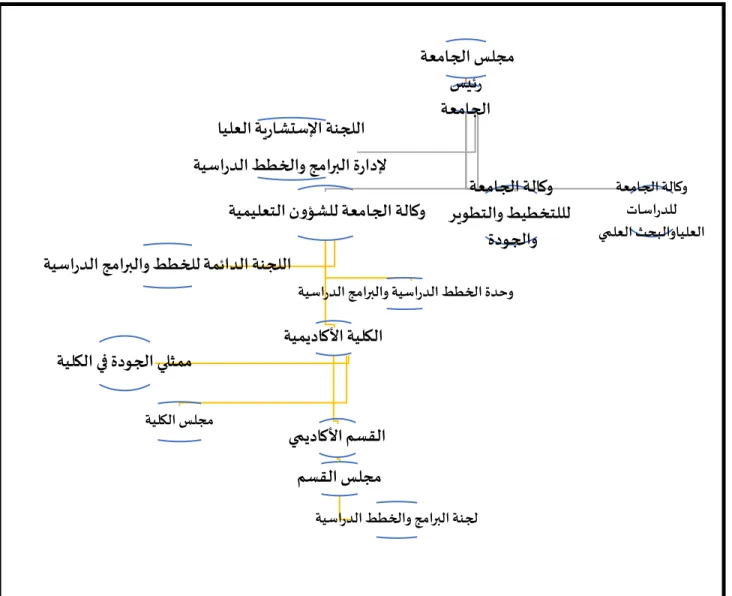
University Council
University's president The Higher Advisory Committee for the
Management of Programs and Study Plans
University Vice Presidency for Postgraduate Studies and
Scientific Research University Vice Presidency
for Planning, Planning and Quality University Vice Presidency
for Educational Affairs
Study plans and study programs unit
Standing Committee for Study Plans and Programs
Academic Department College Council
Quality Representatives in
the College
Academic College
Section Council
Study Programs and Plans Committee
Page 13 of 51
Figure No. (1): Entities involved in creating, reviewing and developing study plans and academic programs at the university
1. Study Programs and Plans Committee in the Academic Department A. Composition of the Committee, criteria for selecting its members and
method of work:
1. The committee is formed by an administrative decision from the department council.
ةعماجلا سلجم سيئر ةعماجلا
ةيميلعتلا نوؤشلل ةعماجلا ةلاكو
ةيميداكلأا ةيلكلا
يميداكلأا مسقلا مسقلا سلجم
ةيساردلا ططخلاو جماربلا ةنجل ةيلكلا سلجم
ةيلكلا يف ةدوجلا يلثمم
ةيساردلا جماربلاو ةيساردلا ططخلا ةدحو
ةيساردلا جماربلاو ططخلل ةمئادلا ةنجللا
ةعماجلا ةلاكو ريوطتلاو طيطختللل
ةدوجلاو
ةعماجلا ةلاكو تاساردلل يملعلا ثحبلاوايلعلا
ةنجللا ايلعلا ةيراشتسلإا
ةيساردلا ططخلاو جماربلا ةرادلإ
Page 14 of 51
2. The committee shall carry out its duties and responsibilities for a full academic year, starting from the date of the issuance of the decision to form it.
3. The committee is headed by the head of the academic department, or whoever is chosen by the department council, and the committee is linked to the academic department council administratively.
4. The committee is composed of two members from each major/sub- specialty in the academic program with a rank of no less than an assistant professor, provided that the committee members have the appropriate experience and qualifications related to the committee’s tasks, responsibilities and the nature of its work.
5. The committee has the right to choose a secretary from among its members or from others who are assigned to prepare the minutes of its meetings and undertake the administrative work of the committee.
6. The Committee shall meet at least four times a year or whenever the need arises; At the invitation of the Chairman of the Committee.
7. For the validity of the committee's meeting, the presence of the majority of its members is required, and its decisions are issued by a majority vote of those present, and when the votes are equal, the side with which the committee chair voted shall prevail.
8. The committee has the right to seek the assistance of experts and specialists inside or outside the university, when needed, regarding the implementation of its tasks.
9. The committee's deliberations and decisions are documented in official minutes approved by the department head, and the minutes are submitted to the department council for approval.
B. Duties and Responsibility of the Committee:
1. Following up the academic programs and study plans in the academic department; and reviewing them to ensure that they meet the requirements of the university, keep pace with scientific development, and comply with quality requirements, academic accreditation standards from local and international bodies, and the requirements of the labor market.
2. A proposal to develop or create the department's existing academic programs based on a comprehensive analytical study that explains the
Page 15 of 51
justifications for development or creation and the necessary reference comparisons.
3. Preparing files for the proposal to create or develop the academic program, to include all requirements (the program’s vision and mission, benchmarking comparisons, program objectives, expected learning outcomes, program description, course descriptions, teaching strategies, evaluation strategies) according to the National Center for Assessment and Academic Accreditation models and to ensure that the requirements of the Saudi Qualifications Framework are met.
4. Submitting the minutes of the committee meeting to the head of the academic department for approval and presenting the academic program or the proposed study plan to the department council.
5. Submit the minutes of the department council to the dean of the college in the event of a recommendation to approve the proposal by the majority of the academic department members.
6. In the event that amendments were received from the Academic Department Council, or comments were received during the process of approving the creation, review and development of the program from (external arbitrators, the Permanent Committee for Programs and Study Plans, the Higher Advisory Committee, the University Council) the committee in the academic department shall make the incoming amendments, provided that it does not conflict with the standards and controls of the National Qualifications Framework.
7. Preparing annual reports for the academic programs and courses in the department.
2. Quality representatives in academic colleges Selection of members and the way they work:
The quality representatives in the faculties technically follow the vice-rector for planning, development and quality. The unit submits periodic reports related to quality and academic accreditation and administratively follows the dean of the academic college. The representatives may be one of the faculty members and heads of academic departments and programs who have the appropriate experience and qualifications related to the unit’s tasks, responsibilities and the nature of its work.
Page 16 of 51
Rules and responsibilities : 1. Planning, including:
➢ Participation in the annual plan of the practical departments and the academic college to ensure that quality standards and academic accreditation are met.
➢ Supervising the creation/reviewing/development of study plans, programs and courses.
➢ Supervising the examination review and evaluation process.
➢ Supervising the process of formulating and modifying learning outcomes.
➢ Overseeing the effectiveness of education strategies in achieving the targeted learning outcomes.
➢ Following up the implementation of the proposed improvement plans for the teaching, learning and assessment process with the academic departments in the college, which are developed after the results appear.
➢ Overseeing the academic program quality process on an annual basis and developing proposed improvement plans.
➢ Develop a procedures manual that describes the operations and activities that take place within the college to ensure their quality, conduct internal audits, follow up on learning outcomes and study plans, and report courses and study programs.
2. Execution, including:
➢ Holding training workshops related to quality requirements and academic accreditation for faculty members in the college.
➢ Providing the required forms for applying quality standards through communication with the Agency for Development, Planning and Quality at the university (course description, course report, program description, program report, program quality indicators) according to the requirements and forms of the National Center for Academic Accreditation and Assessment.
Page 17 of 51
➢ Determining the training, material, human, and technical needs in the academic departments as reflected in the periodic quality reports, soliciting opinions and submitting them to the concerned authorities.
➢ Review the test question forms that were prepared by the examination preparation committee in the academic department.
➢ Reviewing the learning outcomes that will be measured within the evaluation process in their various fields of knowledge, skills and behavior.
➢ Ensure that the examination preparation committee for the courses chooses appropriate assessment methods to evaluate the various educational outcomes, so that each educational output corresponds to an assessment method in line with the educational objective, and measures it accurately.
➢ Measuring the effectiveness of the test after the end of the testing period.
➢ Preparing and following up the performance measurement indicators for the tests and making their reference comparisons.
➢ Evaluation and review of the outputs by reviewing each learning output formulated for the purpose of improvement if necessary, taking into consideration the characteristics and competencies of the graduates, and the target to be reached by the student after the successful completion of the program and graduation.
➢ Presenting the learning outcomes to assessors or external advisory committees so that the comments of all concerned are taken and studied, and the learning outcomes issued in their final form and submitted for accreditation.
➢ Submitting the final formulation of the learning outcomes for the purpose of reviewing and approving them by the College Council, then submitting it to the Study Plans and Programs Development Unit at the Vice Dean for Educational Affairs for approval and submission to the Higher Advisory Committee for review and accreditation by the University Council.
Page 18 of 51
➢ Considering the topics referred to the unit and taking the necessary recommendations in this regard.
3. Follow-up, including:
➢ Follow up on the tasks assigned to it by the University Vice Presidency for Planning, Development and Quality.
➢ Preparing and following up on self-evaluation processes.
➢ Supervising and following up on requirements for preparing reports and documents related to quality and accreditation, as follows:
1) Software configuration file.
2) Program report file.
3) Plans file, which includes all plans at the college/department/program quality level.
4) Course file, self-study report.
5) Benchmarking file.
6) The file of the faculty members and all documents related to them.
7) Alumni file and all documents related to graduates such as their data/employment agencies/opinion polls.
8) The quality reports file, which includes everything that proves the completion of the quality check in the college from the development processes and utilization of evaluation tools and the results of the internal audit and the operational plan of the college.
➢ Supervising the analysis of questionnaires related to the quality of courses and programs and developing the necessary improvement plans based on the results of the questionnaires.
➢ Spreading the culture of quality and academic accreditation in the college.
Page 19 of 51
➢ Supervising the follow-up of the implementation of the college's operational plans.
➢ Follow up the implementation of the quality of the educational process in the college.
4. Documentation, including:
➢ Documenting quality files, organizing them in a unified manner, and constantly updating them to be submitted to the Planning, Development and Quality Agency.
➢ Reviewing performance reports in the college, including data of performance indicators, benchmarking and standards approved by the National Center for Evaluation and Accreditation.
➢ Supervising the preparation of periodic reports and studies for all academic programs in the college.
3. The Standing Committee for Study Plans and Programs.
A. Composition of the Committee, criteria for selecting its members and method of work:
1. The committee is formed by an administrative decision from the university vice president for educational affairs.
2. The duration of the committee's work is an academic year, starting from the date of issuing the decision to form it.
3. The committee is chaired by the university’s vice-rector for
educational affairs, and the committee is administratively linked to the university’s vice president for educational affairs.
4. The committee is composed of:
a) Vice Rector for Educational Affairs
b) Agent for Planning, Development and Quality
c) Representatives of relevant colleges, departments and deanships d) Head of the Academic Plans and Programs Development Unit.
e) Heads of the quality unit in academic colleges.
Page 20 of 51
5. The Committee shall meet at least four times a year or whenever the need arises; At the invitation of the Chairman of the Committee.
6. For the validity of the committee's meeting, the presence of the majority of its members is required, and its decisions are issued by a majority vote of those present, and when the votes are equal, the side with which the committee chair voted shall prevail.
7. The Secretary of the Committee documents the meetings of the Committee, prepares its minutes, including decisions and recommendations, and signs them by all members of the Committee.
8. The committee secretary is responsible for following up on the implementation of the committee's decisions and recommendations, and submitting periodic reports to the committee chairman, including the status of the implementation of decisions and recommendations.
9. The committee has the right to seek assistance when needed from experts and specialists inside or outside the university to carry out its tasks in a manner that does not conflict with the applicable rules and regulations.
B. Duties and Responsibility of the Committee:
1. Providing scientific advice and studied proposals to the Vice Dean for Educational Affairs, including:
a) Introducing/developing study programs and plans in accordance with the requirements of quality, academic accreditation bodies, national development and the needs of the labor market.
b) Evaluate and review the implementation of the university's study programs and plans.
c) Determining the colleges' requirements for the teaching staff
2. Overseeing the periodic updating of the procedural guide for preparing, creating, reviewing and developing academic programs.
3. Follow up the process of developing colleges and departments for their programs and study plans.
Page 21 of 51
4. Coordination with representatives of local authorities to organize workshops in the field of study programs and plans.
5. Ensuring the participation of employers and graduates in expressing views and suggestions that enhance integration between programs and the requirements of the labor market.
6. Unification of programs and study plans at all university headquarters.
7. Setting and developing local and international arbitration standards for university programs.
8. Consider the issues referred to the committee and take the necessary recommendations in this regard.
9. Submitting the committee's recommendations to the Vice Rector for Educational Affairs for approval.
C. Subjects referred to the Standing Committee for Study Plans and Programs
All topics related to the creation and development of academic programs and study plans are referred to the committee, which include:
1. Request to establish a new college.
2. Request to establish a new scientific department.
3. Request to amend the name of a college.
4. Request to amend the name of a scientific department.
5. Request to amend the title of the major in the graduation certificate.
6. Request to create a new study plan.
7. Request to update an existing study plan.
8. . Request to change or cancel the previous study requirements for a course.
9. Request course equivalency.
10. Request to add an elective course to the current plan.
11. Request to calculate the teaching load for the courses.
12. Modify the level of a course in an approved plan.
Page 22 of 51
4. The Higher Advisory Committee at the University:
A. Composition of the committee, criteria for selecting its members and method of work:
1. The committee is formed by an administrative decision from the university president.
2. The duration of the committee's work is an academic year, starting from the date of issuing the decision to form it.
3. The committee is chaired by the president of the university, and the committee is composed of: university vice deans, deans, and
whomever the committee deems to be experts and specialists from inside or outside the university in relation to the implementation of its tasks.
4. The Committee shall meet whenever necessary, based on an invitation from the Chairman of the Committee.
5. For the validity of the committee's meeting, the presence of the majority of its members is required, and its decisions are issued by a majority vote of those present, and when the votes are equal, the side with which the committee chair voted shall prevail.
6. Membership of the committee expires at the end of its term.
7. The Secretary of the Committee documents the meetings of the Committee and prepares its minutes, including decisions and recommendations, and is signed by all members of the Committee.
8. The committee secretary is responsible for following up on the implementation of the committee's decisions and recommendations, and submitting periodic reports to the committee chairman, including the status of the implementation of decisions and recommendations.
B. Duties and Responsibility of the Committee:
1. Providing scientific advice and studied proposals to the University Council.
2. Considering the issues referred to the committee and making the necessary recommendations in their regard
Page 23 of 51
3. Submitting the committee's recommendations and approved topics to the University Council for approval.
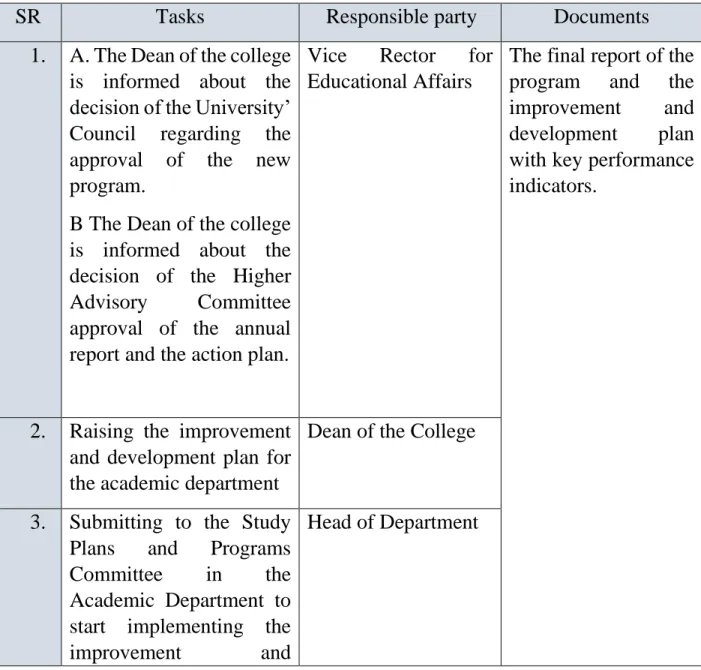
4. Reviewing and approving program’s annual reports.
Eleventh: Executive Procedures for Developing Study Plans and Programs The process of developing study plans and study programs begins with the concerned academic college by following up on the economic, social, cultural, and technical developments that show the need to create a new academic program. Accordingly, the concerned college forms the department council and the college council at the beginning of each academic year and work as follows:
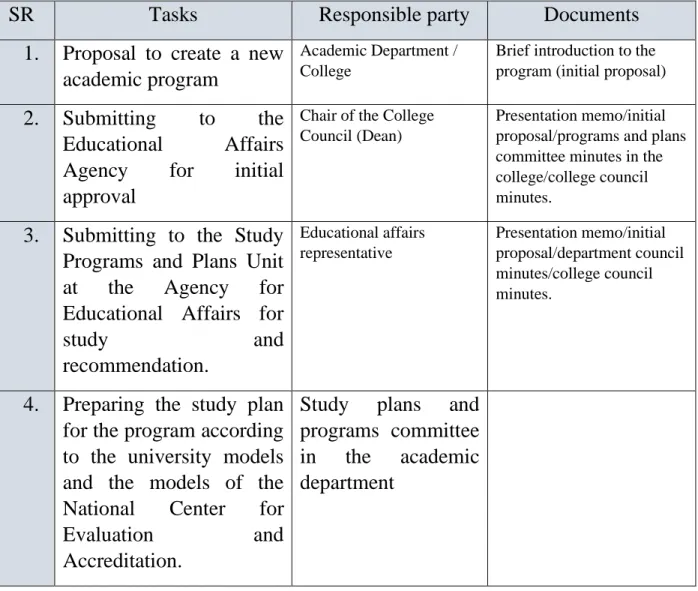
Table No. (1) Executive Procedures for Developing Study Programs and Plans
SR Tasks Responsible party Documents
1. Proposal to create a new academic program
Academic Department / College
Brief introduction to the program (initial proposal)
2. Submitting to the Educational Affairs Agency for initial approval
Chair of the College Council (Dean)
Presentation memo/initial proposal/programs and plans committee minutes in the college/college council minutes.
3. Submitting to the Study Programs and Plans Unit at the Agency for Educational Affairs for
study and
recommendation.
Educational affairs representative
Presentation memo/initial proposal/department council minutes/college council minutes.
4. Preparing the study plan for the program according to the university models and the models of the National Center for
Evaluation and
Accreditation.
Study plans and programs committee in the academic department
Page 24 of 51
5. Submitting to the department council for discussion and approval
Study plans and programs committee in the academic department
Study plan structure proposal / course description / program description / academic department transcript 6. Submitting to the Dean of
the College to discuss the proposal in the College Council and for accreditation.
Head of the academic department
Study plan structure proposal/course description/program description/academic department
transcript/proposal of (3) external arbitrators
7. Submitting to the College Council
Dean of the College
8. Submitting it to the Vice Dean for Educational Affairs to present it to the Standing Committee of Study Plans and Programs for review and to ensure that the proposal meets the university's
requirements.
Vice Rector for Educational Affairs
A proposal for the structure of the study plan / course
descriptions / program description / academic department minutes / college council minutes.
9. Reporting to the Agency for Planning,
Development and Quality to ensure that the program is aligned with the
university’s strategic plan, the quality system and the regular
procedures followed
Vice Rector for Educational Affairs
Standing Committee approval
10. Submitting to the Higher Advisory Committee for the Management of Plans
Agency for Development,
Planning and Quality
The approval of the University Vice Presidency for
Page 25 of 51
and Programs at the University
Planning,
Development and Quality.
11. Submitting to the university council for approval in case the proposed program is one of the university’s bachelor’s degree programs.
Submitting it to the Vice Dean for Graduate Studies and Scientific Research and then to the University Council in case the proposed program is one of the graduate studies programs.
educational affairs representative
Structure of the study plan / course descriptions / program description / academic department minutes / college council minutes / standing committee minutes / higher advisory committee minutes.
In the event that there are observations or visions at any stage of the preparation and approval of the study plan, they are returned to the previous stage for consideration and opinion before being passed to the next stage.
Twelfth: Courses for the Programs.
A. Conditions and Standards for Preparing Courses
The course refers to the specific study subject within the approved study plan in each major; Each course has a number, code, name and detailed description that distinguishes it in terms of content and level from other courses, and a special file that is kept for the purpose of follow-up, evaluation and development. Some courses may have previous or simultaneous prerequisites or requirements. To ensure the quality of courses, the following matters must be taken into account:
1. The existence of a detailed plan for each course that includes: the general description of the course, the language of instruction,
Page 26 of 51
objectives, learning methods and strategies, assessment methods, learning resources, and development and improvement processes.
2. Alignment of the educational outcomes of the courses with the outcomes of the program
3. Align content with program objectives and approved learning outcomes 4. Aligning the content with the main scientific concepts in the course, in
order to serve other courses in the specialization B. Types of courses:
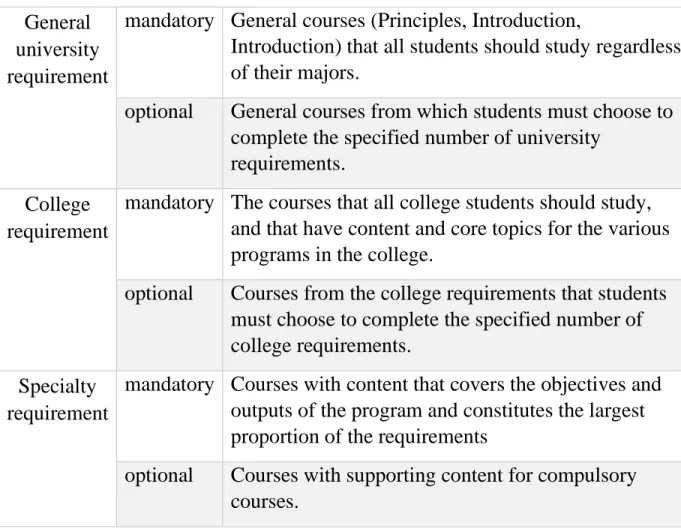
Table No. (2): Types of courses, which are divided into (general university, college, and specialization)
General university requirement
mandatory General courses (Principles, Introduction,
Introduction) that all students should study regardless of their majors.
optional General courses from which students must choose to complete the specified number of university
requirements.
College requirement
mandatory The courses that all college students should study, and that have content and core topics for the various programs in the college.
optional Courses from the college requirements that students must choose to complete the specified number of college requirements.
Specialty requirement
mandatory Courses with content that covers the objectives and outputs of the program and constitutes the largest proportion of the requirements
optional Courses with supporting content for compulsory courses.
Page 27 of 51
C. Mechanism for developing existing program courses
Based on the mechanism used in the academic departments, each of the courses is managed by a coordinator at the university level who handles all matters related to the course (faculty members, students, assessment……..etc), coordination at the level of the course results in the emergence of the need to develop the course or replace the course, while retaining the name, code and number of the course. The proposed changes for development include one of the following elements, according to the mechanism mentioned in Table (3):
1. Course description.
2. Vocabulary of the course.
3. The educational outcomes of the course in a way that serves the most educational outcomes of the program to which the course belongs and the requirements of the labor market.
4. The credit hours of the course.
5. Educational resources (textbook and references.
6. Teaching strategies in the course.
7. Assessment strategies and measure student performance in the course.
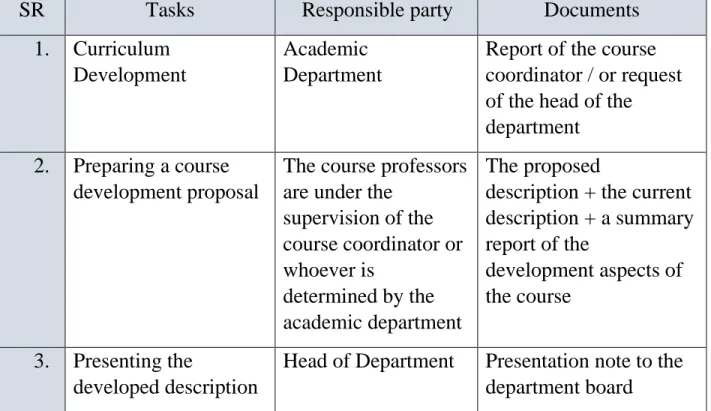
Table No. (3): Mechanism for developing curricula
SR Tasks Responsible party Documents
1. Curriculum Development
Academic Department
Report of the course coordinator / or request of the head of the department
2. Preparing a course development proposal
The course professors are under the
supervision of the course coordinator or whoever is
determined by the academic department
The proposed
description + the current description + a summary report of the
development aspects of the course
3. Presenting the
developed description
Head of Department Presentation note to the department board
Page 28 of 51
to the department board for approval 4. Presenting the
developed description to the College Board for accreditation
Head of Department Memorandum presented to the college council
5. Discussion and approval of the description
college Council College council minutes
6. Submitting the department's study plan, including the developed description in the department's study plan, and
starting work with it as directed by the
department.
Head of Department Approved description + department council minutes + college council minutes
7. Submit the approved proposal in the
department to the college to update the college study plan
Head of Department Minutes of the
department council + the proposal
8. Submit the updated plan to the Study Plans and Programs Unit
Dean of the College Updated plan + department board minutes + assignment letter
Thirteenth: Learning Outcomes.
Education at the present time has become centered around the student rather than the teacher, where the focus is on the learning outcomes expected to be carried out by the student at the end of the course or educational program,
Page 29 of 51
which helps to define the main objectives of the course and academic program and choose the appropriate assessment methods and tools for them.
In this context; The National Center for Assessment and Accreditation has set a framework for learning outcomes so that student learning outcomes are specific, accurately, and consistent with the National Qualifications Framework.
A. Importance of Learning Outcomes:
1. The quality of the educational process and the guarantee of the university’s educational outputs:
Learning outcomes are one of the main axes for achieving institutional quality assurance, and it works to unify the efforts of employees from various academic and administrative departments by achieving specific goals and contributing to the achievement of the university's mission.
2. Defining a general framework within which to prepare, design, evaluate and develop courses, curricula and academic programs:
The importance of learning outcomes lies in their ability to draw a clear and scientific roadmap for academic program design and development; It helps in achieving integration and coherence between the program's courses, and improving the teaching and learning processes by evaluating teaching strategies and methods. In addition to directing the student to learn in the light of specific and clear objectives that explain what is expected of him precisely after completing the course or study program; and assessment of learning outcomes using assessment methods and methods that help to realistically judge the extent to which learning outcomes have been achieved.
3. An effective tool for planning, improving and developing the educational process:
It helps those concerned in academic colleges and faculty members to plan and implement the course/program as it should by choosing appropriate teaching methods and methods that contribute to achieving the targeted learning outcomes.
4. It contributes to increasing the community’s confidence in the university’s outputs and creating a kind of competition and comparison between higher education institutions and their various programs
Page 30 of 51
B. Learning Outcomes Framework:
The Saudi Electronic University has been keen on formulating and evaluating learning outcomes at the level of the course, program and university, and it has become one of the most important process of institutional and program quality, while adhering to the instructions of the National Center for Academic Accreditation and Assessment, and ensuring its compatibility with the National Qualifications Framework and making reference comparisons to ensure its suitability with the labor market.
The National Center for Academic Accreditation and Assessment has developed a set of documents related to the formulation of learning outcomes, the most important of which are (course description, program description), these documents present a general framework for learning outcomes at the program and course level. This framework covers the three areas of learning outcomes: knowledge, skills, and values.
Fourteenth: Linking learning outcomes.
Figure above shows the types of learning outcomes, and these types are divided into three main levels, including learning outcomes at the level of the institution, the program, and the course. As follows:
• Institution Learning Outcomes :-
The learning outcomes at the university level are related to the general culture and the main characteristics of the student’s personality that all university
Types of Learning Outputs (SLOs) Institutional Student Learning Outcome (ILO)
Program Level Student Learning Outcome (PLO)
Course Level Student Learning Outcome (CLO)
Figure 3: Types of learning outcomes according to the National Center for Academic Accreditation and Assessment
Page 31 of 51
students should achieve, for example: the acquisition of religious values, national values and belonging, the student’s mastery of the English language, the use of information technology and communication skills.
• College Learning Outcomes:-
The college sets its mission, educational objectives and the characteristics of its graduates for all students enrolled in its academic programs.
• Program Learning Outcomes:-
For each academic program, it sets the intended learning outcomes of the program, which the student is expected to know, understand and be able to carry out after completing the academic program, and they are determined in light of the academic standards or professional levels of qualifications.
• Course Learning Outcomes :-
The learning outcomes at the course level seek to achieve the learning outcomes of the program, whereby learning outcomes are developed for each of the program’s courses and are linked to the scientific content of the course, so they are derived from the targeted learning outcomes at the program level.
Each learning outcome of the course is linked to teaching methods and assessment methods that are appropriate to it and ensure its achievement and measurement.
From all of the above, it is clear that the learning outcomes at the level of the course work to achieve the learning outcomes of the academic program and its educational goals, which works to achieve the program’s mission, and thus the educational goals and mission of the college are achieved, which contributes to shaping the characteristics of university students and achieving its mission.
Fifteenth: Formulating learning outcomes.
The process of formulating learning outcomes must be carried out in an organized manner and involve all faculty members at the level of the course and program, and there are a set of principles and characteristics that must be taken into consideration when formulating learning outcomes.
A. Characteristics of Learning Outcomes:
Page 32 of 51
The learning outcomes must be clear and understandable to students, faculty members and the rest of the beneficiaries of the educational process,
precisely defined and measurable, and must cover knowledge, cognitive skills and general skills. The characteristics of learning outcomes are summarized in the word (SMART) as follows:
Table No. (4): Characteristics of Learning Outcomes
(Specific) Learning outcomes describe what the learner will be able to do.
(Measurable) Written learning outcomes enable the measurement and observation of the impact on learning as a result of knowledge and skills acquisition.
(Achievable) Learning outcomes are appropriate to the level of the learner and what they can achieve
(Relevant) The learning outcomes of each course are related to the field of study, as well as the knowledge and skills that will benefit the student and have importance in the field he is studying.
(Time-bound) Learning outcomes are formulated in such a way as to determine when and when knowledge and skills are acquired.
B. Standards for preparing and formulating learning outcomes:
When preparing and formulating educational outcomes, the following matters should be taken into account:
1. The learning outcomes should aim at achieving the mission, goals and objectives of the academic and university programs.
2. Academic and professional standards and tests at the level of the Kingdom, such as (achievement, aptitude, and bodies) tests, must be taken into account.
3. It should study the requirements and needs of the labor market.
Page 33 of 51
4. Learning outcomes should help students acquire the characteristics of graduates defined by the program, the college, and the university.
5. Academic experts and relevant professionals should be involved in the learning outcomes.
6. It must be consistent with the National Qualifications Framework.
7. Reference comparisons should be made with educational programs and institutions that are similar in mission and goals.
8. A sufficient number of learning outcomes should be formulated,
ranging between (3-5) outputs to give an opportunity for improvement and the possibility of evaluation and measurement.
9. Learning outcomes must be aligned and linked with teaching strategies and assessment methods (the Program Outcomes Measurement Matrix).
Sixteenth: Formulating learning outcomes at the academic program level The learning outcomes at the academic program level determine what the student is expected to know and understand in terms of cognitive and general knowledge and skills or be able to do work after completing the academic program successfully, and the characteristics and criteria
mentioned in the above item (fifteen-b) must be taken into consideration, with the need to ensure that they are compatible with the National
Qualifications Framework.
A. Aligning the learning outcomes at the university level with the learning outcomes at the academic program level
To achieve the characteristics of graduates at the university level, the achievement of the learning outcomes of the academic program must result in the achievement of the learning outcomes at the university level. To this end, the learning outcomes of the academic program must be aligned with the learning outcomes at the university level. By achieving alignment, it is intended that the achievement of the learning outcomes of the academic program will result in the achievement of at least one learning outcome for each of the graduates' characteristics, including the total outputs achieved by the institution.
Page 34 of 51
B. Participants in the formulation of learning outcomes at the program level.
The learning outcomes are formulated at the program level through faculty members in the program who have specialized and academic experience with the participation of all beneficiaries such as students, faculty members, alumni, employers, committees of academic departments, colleges and advisory committees from inside and outside the university, emphasizing the need to prepare benchmarks with similar programs in other universities.
C. Steps to formulate learning outcomes at the academic program level.
The National Center for Academic Accreditation and Assessment has developed a special model for the description of the academic program, which includes an item on formulating learning outcomes according to the three areas of learning outcomes according to the National Qualifications Framework. The model includes a table containing the learning outcomes of the program and appropriate teaching strategies to achieve each learning outcome, in addition to assessment tools that suit each learning output.
When starting to define and formulate learning outcomes at the academic program level, the following steps are taken:
1. Studying the learning outcomes of the program, through:
a) Reviewing the vision, mission, and learning objectives at the university and college levels to take them into consideration when formulating learning outcomes.
b) Review the college and university learning outcomes.
c) Review the standards of the National Center for Evaluation and Accreditation for the formulation of learning outcomes.
d) Review the National Qualifications Framework to ensure that learning outcomes are consistent with it.
e) Preparing benchmarks to study learning outcomes for programs from similar colleges and universities.
2. The initial formulation stage of the learning outcomes, which includes:
Page 35 of 51
a) The Study Plan and Curricular Committee at the academic department level determines and formulates the learning outcomes by setting the initial formulation of the outcomes based on what was reached in paragraph No. (1) above, taking into consideration the characteristics and competencies of the graduates, and the target that the student will reach after successfully completing the program and graduating.
b) Determining the knowledge, skills and qualities that employers need and that the student should be able to do upon completion of the academic program.
c) Writing the learning outcomes in their initial form, so that the outcomes are formulated for each of the three areas of learning (knowledge, skills, and values).
3. The stage of reviewing and evaluating the formulation of learning outcomes:
a) After completing the initial formulation of the Learning Outcomes, the Study Plan and Curricular evaluates and reviews the Outcomes by measuring the points below on each Learning Outcome formulated for improvement if necessary, as follows:
• The learning output reflects the vision and mission of the university, college and program.
• The learning output is linked to the requirements of the labor market.
• The learning outcome is consistent with the National Qualifications Framework.
• The learning output is formulated in a broad and comprehensive format so that it covers a number of courses in the program.
4. The stage of evaluation of beneficiaries and external opinion:
a) At this stage, the learning outcomes of the program are presented to the beneficiaries, and they are also presented to an external assessor or advisory committees so that the comments of all concerned are taken
Page 36 of 51
and studied, and the learning outcomes are issued in their final form and submitted for accreditation.
5. The stage of approving the final formulation of the outputs:
The Study Plan and Curricular submits the final formulation of the learning outcomes for the purpose of review and approval by the department and college councils, then it is submitted to the Study Plans and Programs Development Unit at the Vice Dean for Educational Affairs for approval and submission to the Higher Advisory Committee for review and accreditation by the University Council.
Seventeenth: Linking the learning outcomes of the program with the academic courses.
After completing the stage of formulating the learning outcomes at the program level, these outcomes are linked with teaching strategies and assessment tools, where the course learning outcomes work to achieve the program's learning outcomes.
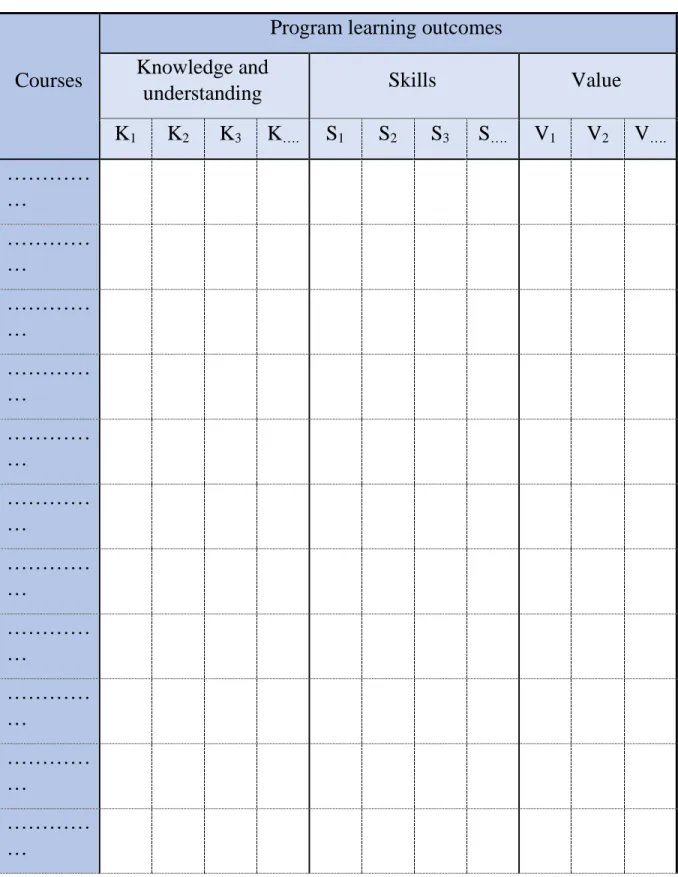
To link the learning outcomes of the program with the courses, the matrix of linking the learning outcomes of the program and the courses contained in the program description form developed by the National Center for Academic Accreditation and Assessment can be used, where the course codes are used and the level of each course is determined in terms of achieving learning outcomes in the three areas (knowledge, skills, and values) according to the following classifications of levels:
زمرلا قيقحتلا ىوتسم
Level of the achievement Symbol
س سيسأتلا ىوتسم
Introduction I
ر ةسرامملا ىوتسم
Proficient P
ت ىوتسم
نيكمتلا Advanced
A
Page 37 of 51
Table No. (5): The learning outcomes matrix for the program
Courses
Program learning outcomes Knowledge and
understanding Skills Value
K1 K2 K3 K…. S1 S2 S3 S…. V1 V2 V….
…………
…
…………
…
…………
…
…………
…
…………
…
…………
…
…………
…
…………
…
…………
…
…………
…
…………
…
Page 38 of 51
Courses
Program learning outcomes Knowledge and
understanding Skills Value
K1 K2 K3 K…. S1 S2 S3 S…. V1 V2 V….
…………
…
Eighteenth: Formulating learning outcomes at the level of academic courses in the academic program.
After defining and formulating the learning outcomes at the program level, the process of formulating the outcomes of the courses offered by the program begins, which describes what the student is expected to know, acquire, understand and be able to do after the successful completion of the course.
The course learning outcomes are formulated through the course description form from the National Center for Academic Accreditation and Assessment and according to the three learning areas of the learning outcomes in the National Qualifications Framework, taking into consideration the characteristics of the learning outcomes and the method of formulation.
Therefore, the following criteria must be taken into account when formulating the course learning outcomes, as follows:
1. Demonstrate the course's distinctive characteristics that work to achieve the course's learning outcomes.
2. Choosing the appropriate teaching and learning strategies for the learning outcome and in harmony with the teaching philosophy at the university.
3. Linking the course learning outcomes with the program learning outcomes.
4. Linking the course outcomes with evaluation methods and teaching strategies (the course outcomes measurement matrix).
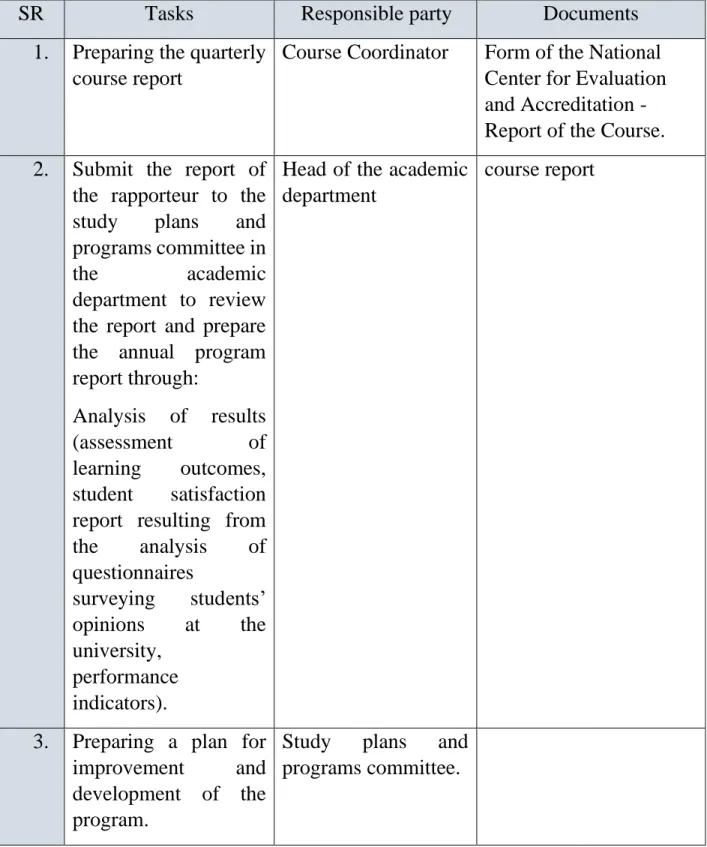
5. Periodically review and amend learning outcomes, teaching strategies, and assessment methods through the use of the course report approved by the National Center for Academic Accreditation and Assessment.
Page 39 of 51
Nineteenth: The mechanism for modifying the learning outcomes of the courses.
The mechanism for modifying the learning outcomes of the courses is carried out through coordination at the level of the course (the course coordinator) and the department council. When a need arises that requires modification of the learning outcomes of the courses, it is carried out based on the following steps:
1. Documenting the proposed modification to the learning outcomes of the course according to the models approved by the course
coordinator.
2. Approval of the Plans and Programs Development Committee in the Academic Department on the proposed amendment to the learning outcomes.
3. The approval of the College Council on the proposed amendment to the learning outcomes.
Twentieth: Teaching methods and strategies
A. Standards for preparing teaching methods and strategies for programs and courses.
Teaching methods are forms that organize the process of teaching or providing training (eg a lecture, theoretical or practical training). Teaching methods differ from teaching strategies that are described as procedural steps to develop student learning such as the use of advanced systems to help memorize and retrieve information, and so on from other strategies.
When preparing teaching methods and strategies for programs and courses, the following matters should be taken into account:
1. Harmonizing teaching methods and strategies with the university's education system, which adopts the "blended learning" method.
2. Aligning teaching methods and linking them to the program/course outcomes.
3. Alignment of teaching methods with the content of the course/program.
4. Alignment of teaching strategies with the program outputs (a matrix of strategies for achieving program outputs).