Sustainability of the Indian auto rickshaw sector:
identification of enablers and their interrelationship using TISM
Abhishek Behl*
Shailesh J. Mehta School of Management, Indian Institute of Technology,
Bombay, India
Email: [email protected]
*Corresponding author
Paridhi Rathi
Meghnad Desai Academy of Economics, India Email: [email protected]
V.V. Ajith Kumar
Skyline University College, Sharjah, UAE
Email: [email protected]
Abstract: The present study is an attempt to identify the enablers to the sustainability of the auto rickshaw sector in India and model them using interpretive structural modelling (ISM) in order to establish inter relationships among them. Matriced’ Impacts Croises-Multiplication Appliqué an Classment (MICMAC) analysis has been applied to identify the most dominant enabler(s).
A total of 11 enablers have been identified from the extant literature. The resultant ISM model with four levels of hierarchy reveals that not all enablers require the same attention – the four enablers at the very bottom, namely
‘Fleet-based operations’, ‘Adequate transport infrastructure’, ‘Robust planning and regulatory structure’ and ‘Adequate enforcement and monitoring’ are the ones that drive most other enablers. Accordingly, the mix of fleet-based operations along with information and communications technology (ICT) infrastructure assumes urgency for enhancing door to door mobility and first and last mile connectivity of auto rickshaws. In addition, regulations pertaining to permits, emissions and safety also need urgent attention.
Keywords: enablers; total interpretive structural model; TISM; MICMAC;
sustainable transportation; AutoRickshaw; India; urban transportation.
Reference to this paper should be made as follows: Behl, A., Rathi, P. and Kumar, V.V.A. (2018) ‘Sustainability of the Indian auto rickshaw sector:
identification of enablers and their interrelationship using TISM’, Int. J.
Services and Operations Management, Vol. 31, No. 2, pp.137–168.
Biographical notes: Abhishek Behl is a Research Scholar at Department of Management, IIT, Bombay and is pursuing his second PhD. He has taken corporate training in the areas of statistics and market research as well and his research interests are in empirical domain in the predictive modelling, financial engineering and sustainability. He has won the Junior Research Fellowship and selected as the Emerald Research Scholar from Emerald Publishing House, UK.
Paridhi Rathi is a young research enthusiast currently pursuing her post-graduate Diploma in Economics from the Meghnad Desai Academy of Economics, University of Mumbai. She graduated from Symbiosis School of Economics in 2016 with a BSc Economics and was consistently a merit holder in her program. Her research interests include sustainable development, international capital flows and monetary economics.
V.V. Ajith Kumar is working as an Assistant Professor at Skyline University College, Sharjah, UAE. He currently teaches human resource management, strategic management and business ethics to management students. His areas of research are leadership, human resource flexibility and corporate governance.
He believes in the core values of teamwork and trust.
1 Introduction
1.1 Prologue
With the rapid urbanisation and private vehicle ownership in India, it is crucial to enhance the sustainability of the public transport modes, especially that of the intermediate public transport (IPT) modes, which serve the important function of first and last mile connectivity in public transport. Auto rickshaws are an important mode of IPT in India, not only because they are the most common feeder service, but also because they are a common means of livelihood of many low income households. Further, it is important to note that the mass transit modes of a city can be made weaker if its IPT modes are not efficient. With auto rickshaws being the most common mode of IPT in India, enhancing the transport sustainability of the auto rickshaw sector assumes critical urgency. It is thus important to make a systematic attempt to study the Indian auto rickshaw sector, understand the potential enablers to enhance its sustainability and get insights on how policy makers and practitioners can prioritise their efforts into implementing such enablers.
1.2 Background
India is experiencing an urban sprawl with a fast peripheral expansion of cities, especially the metros. The urban population in India is estimated to grow from 330 million in 2008 to 590 million by 2030 (Sankhe et al., 2010). This colossal growth in urbanisation implies an increased commutation demand, both in terms of private as well as public transportation (Raut et al., 2011). In order to sustain this mammoth urbanisation, sustainability of the urban public transportation scene assumes urgency.
Urban public transport is complex to understand because of its multi-modal nature.
Public transportation can be classified into – Mass Transit System and IPT. Mass transit system refers to commutation modes that carry a large number of commuters across the city (like city buses, metros and local trains). IPT or para-transit system, on the other hand, refers to modes that fill the gap between private transport and the modes of mass transit, and typically includes cycle rickshaws, auto rickshaws, four wheeler taxis, etc.
(Mani et al., 2012; Luthra, 2006). A report by National Transport Development Policy Committee (NTDPC, 2013) mentions the interdependency of each mode and discusses that a highly efficient mass transit system could be made weaker if the links to the mass transit systems (which are essentially the IPT modes) are inefficient.
1.3 Significance of the study
Auto rickshaws are the most common, indispensable and ubiquitous form of IPT in India.
However, far from being efficient, this sector faces both passenger-centric woes in the form of whimsical fares, refusals and erratic accessibility, as well as, driver-centric woes in the form of poor public image, cumbersome permit process, empty runs, excessive haggling, unsustainable source of income and financial exclusion. The sector is largely unorganised and of fragmented nature, with individual operators operating with blatant disregard to regulations (Harding and Hussain, 2010; Vaidya et al., 2014; Mani et al., 2012; Mani and Pant, 2012; Garg et al., 2010; Ghate et al., 2013). This inefficiency also has a bearing on safety and environmental issues and thus on the overall sustainability of the sector, which in turn entails significant costs for the whole public transportation ecosystem of a city. It is therefore important to understand the factors that would address the sustainability challenges that this sector poses.
This study is an attempt to identify the enablers to the sustainability of the auto rickshaw sector in India and model them using interpretive structural modelling (ISM) in order to establish inter-relationships among such enablers. We also identify the most dominant enabler(s) (which drive other enablers) through Matriced’ Impacts Croises-Multiplication Appliqué an Classment (MICMAC) analysis. Owing to the profuse interactions among the identified enablers, an assessment of these enablers in isolation may give specious, pre-mature and incomplete conclusions. This necessitates the identification of a well-established hierarchical structure through a methodology that imposes order and direction on the complex interactions among these sustainability enablers. A well-organised hierarchy of enablers along with their power of dominance/
dependence will not only help policy makers and practitioners gain efficiency in decision-making by allocating their limited resources towards implementing the most dominant enabler(s) first, but will also add to the existing body of literature in the domain of transport sustainability of IPT modes. ISM is a methodology that enables us to build such a comprehensive hierarchy of enablers and helps us identify the most dominant enablers, which drive other enablers. Such identification will generate clearer insights for policy makers and practitioners into prioritising the implementation of enablers of transport sustainability of the Indian auto rickshaw sector.
Hence, to summarise, the main objectives of this research are:
1 to identify the enablers of transport sustainability of the Indian Auto Rickshaw sector through an extensive literature review
2 to establish inter-relationships among the identified enablers and develop a well defined hierarchy of enablers using ISM
3 to establish four-category taxonomy of the enablers on the basis of their respective driving and dependence power using MICMAC analysis to understand which enablers need the maximum attention.
The rest of the paper is organised as follows – the next section presents the literature review and discusses the enablers to transport sustainability of the sector as churned out from the available literature. This is followed by a discussion on the ISM methodology and development of ISM model and MICMAC analysis. Finally, the results and discussion are presented, followed by managerial implications. The paper wraps ups with the conclusion and future research directions.
2 Literature review
In order to appreciate with clarity the sustainability challenges of the auto rickshaw sector, the available literature has been studied and synthesised. This section presents the enablers of the transport sustainability of the Indian auto rickshaw sector as identified from the literature. A wide range of sources – research papers, reports, journal articles, news reports, case studies and expert interviews have been used for this purpose.
The literature review has been divided into three sections. Section 2.1 expounds the concept of sustainable urban transport through exploration of its definition from several sources, with the intent to evaluate the factors enabling the sustainability of the auto rickshaw sector, in light of a definite framework. The important elements of the three pillars of urban transport sustainability have been identified so that they may serve as a yardstick to assess the factors enhancing the sustainability of the auto rickshaw sector.
Section 2.2 reports the enablers as identified from the available literature and expert interviews/discussions. Section 2.3 presents the research gap that this research proposes to address.
2.1 Exploring the yardstick – the concept of sustainable urban transport
Following the formal origin of the concept of Sustainable Development in Our Common Future by the United Nations Commission on Environment and Development (1987), the concept of sustainability was soon extended to transport. Several definitions exist for Sustainable Transport, and most of them embrace the three pillars of sustainability – social, economic and environmental. The most comprehensive definition is provided by the European Union Transport Council, 2001, which defines sustainable transport as a system that:
x “Allows the basic access and development needs of individuals, companies and societies to be met safely and in a manner consistent with human and ecosystem health, and promises equity within and between successive generations;
x Is affordable, operates fairly and efficiently, offers choice of transport mode, and supports a competitive economy, as well as balanced regional development; and
x Limits emissions and waste within the planet’s ability to absorb them, uses renewable resources at or below their rates of generation, and, uses non-renewable resources at or below the rates of development of renewable substitutes while minimizing the impact on land and the generation of noise.” (Goldman and Gorham, 2006; Wolfram, 2004)
The report ‘Sustainable Urban Transport in Asia’ by the Partnership for Sustainable Urban Transport in Asia (PSUTA, 2005) describes sustainable urban transport as one that eases access and mobility for all groups of the society in a manner that is within the carrying capacity of the environment and is affordable to both the transport providers as well as the transport users. While from the user’s perspective, a transport system should be quick, affordable, safe, reliable, comfortable, energy efficient and environmentally benign for every category of traveller, from the perspective of the operator, it must be profitable in meeting mobility requirements of various income groups and gender (Kayal et al., 2014).
Sustainable urban transportation is often explained with reference to the ‘triple bottom line’ of economic, environmental and social sustainability (Ali et al., 2014;
Richardson, 2005; Black et al., 2002; PSUTA, 2005). The three pillars of sustainability in context with sustainable urban transport need a further exposition. An attempt has been made to study the elements of these three pillars.
x Economic sustainability of transport implies the overall cost effectiveness and efficiency of operations, both for operators as well as commuters, in terms of fares, commute times, facility and resource costs and external costs of congestion and accident damages (PSUTA, 2005; Litman and Burwell, 2006).
x Environmental sustainability of transport implies efficiency of energy use along with minimisation of emissions, noise, reduced dependence on fossil fuels and
maintenance of ecosystem integrity to preserve environmental quality and public health (Wiederkehr et al., 2004; OECD, 1996; TERI, 2011; Wolfram, 2004).
x Social sustainability of transport implies that transport should provide equitable access to urban opportunities, minimise social exclusion, and improve or not overly diminish an individual’s quality of life (Boschmann and Kwan, 2008; PSUTA, 2005;
TERI, 2011). For example, when private vehicles monopolise streets, it penalises pedestrians, cyclists, and the handicapped, leaving them with lesser road space and also exposing them to greater accident risk and the worst quality of air (PSUTA, 2005). Similarly, poor people with lesser accessibility to transport may find it difficult to reach their employment destinations as fast as the rich with private vehicles (PSUTA, 2005). Similarly, it is socially unsustainable if women face harassment in certain public modes (PSUTA, 2005). Also, since numerous social systems have sprung up around both mass transit and para-transit modes in India, with para-transit modes generating employment for thousands of families, transport solutions that leave these groups at disadvantage are not socially sustainable (PSUTA, 2005). Thus, in short, social sustainability of transport implies that transport must create equity of access, opportunity and choice for all.
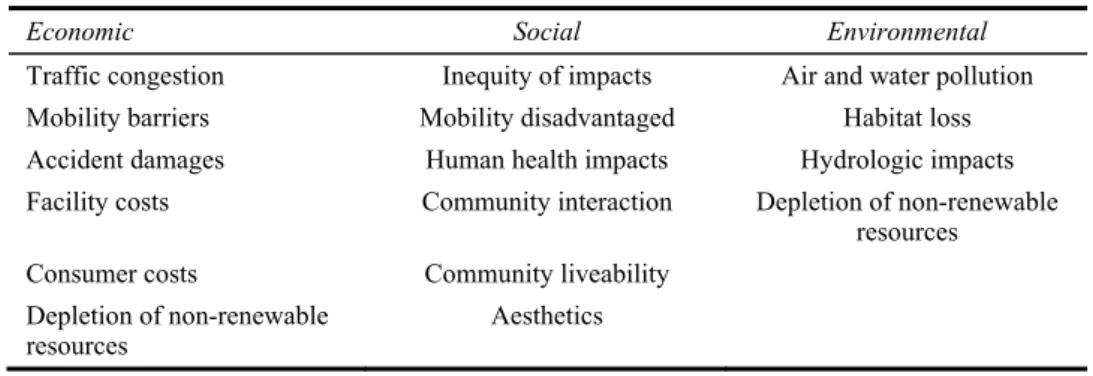
The transport sustainability impacts across these three categories have been summarised in Table 1 (Litman and Burwell, 2006).
Table 1 Transportation Impacts on sustainability
Economic Social Environmental
Traffic congestion Inequity of impacts Air and water pollution
Mobility barriers Mobility disadvantaged Habitat loss
Accident damages Human health impacts Hydrologic impacts
Facility costs Community interaction Depletion of non-renewable resources
Consumer costs Community liveability
Depletion of non-renewable
resources Aesthetics
Source: Litman and Burwell (2006)
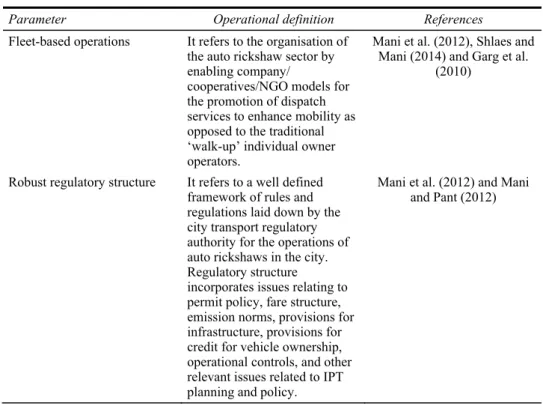
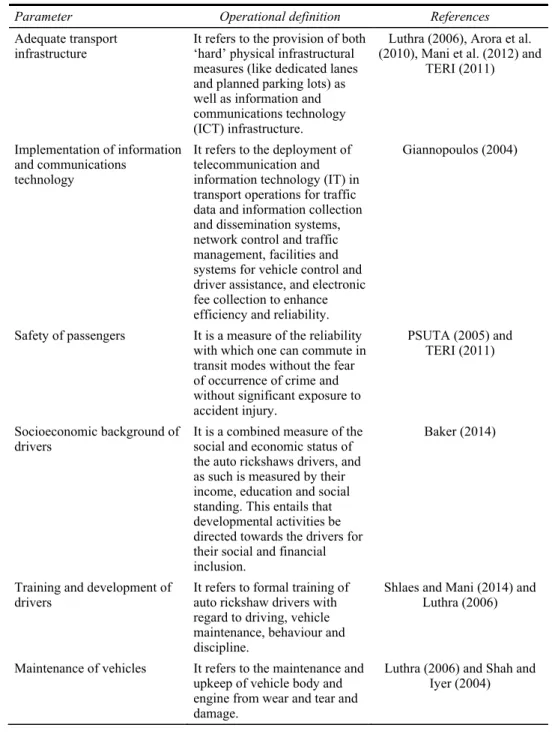
Before delving into the identification of the enablers to sustainability of the Indian auto rickshaw sector, it would be prudent to delve into the operational definitions of the key parameters in context of how they appear in this study.
Table 2 Operational definitions
Parameter Operational definition References
Fleet-based operations It refers to the organisation of the auto rickshaw sector by enabling company/
cooperatives/NGO models for the promotion of dispatch services to enhance mobility as opposed to the traditional
‘walk-up’ individual owner operators.
Mani et al. (2012), Shlaes and Mani (2014) and Garg et al.
(2010)
Robust regulatory structure It refers to a well defined framework of rules and regulations laid down by the city transport regulatory authority for the operations of auto rickshaws in the city.
Regulatory structure incorporates issues relating to permit policy, fare structure, emission norms, provisions for infrastructure, provisions for credit for vehicle ownership, operational controls, and other relevant issues related to IPT planning and policy.
Mani et al. (2012) and Mani and Pant (2012)
Table 2 Operational definitions (continued)
Parameter Operational definition References
Adequate transport
infrastructure It refers to the provision of both
‘hard’ physical infrastructural measures (like dedicated lanes and planned parking lots) as well as information and communications technology (ICT) infrastructure.
Luthra (2006), Arora et al.
(2010), Mani et al. (2012) and TERI (2011)
Implementation of information and communications
technology
It refers to the deployment of telecommunication and information technology (IT) in transport operations for traffic data and information collection and dissemination systems, network control and traffic management, facilities and systems for vehicle control and driver assistance, and electronic fee collection to enhance efficiency and reliability.
Giannopoulos (2004)
Safety of passengers It is a measure of the reliability with which one can commute in transit modes without the fear of occurrence of crime and without significant exposure to accident injury.
PSUTA (2005) and TERI (2011)
Socioeconomic background of
drivers It is a combined measure of the
social and economic status of the auto rickshaws drivers, and as such is measured by their income, education and social standing. This entails that developmental activities be directed towards the drivers for their social and financial inclusion.
Baker (2014)
Training and development of
drivers It refers to formal training of auto rickshaw drivers with regard to driving, vehicle maintenance, behaviour and discipline.
Shlaes and Mani (2014) and Luthra (2006)
Maintenance of vehicles It refers to the maintenance and upkeep of vehicle body and engine from wear and tear and damage.
Luthra (2006) and Shah and Iyer (2004)
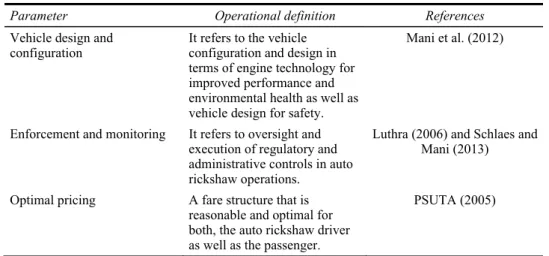
Table 2 Operational definitions (continued)
Parameter Operational definition References
Vehicle design and
configuration It refers to the vehicle configuration and design in terms of engine technology for improved performance and environmental health as well as vehicle design for safety.
Mani et al. (2012)
Enforcement and monitoring It refers to oversight and execution of regulatory and administrative controls in auto rickshaw operations.
Luthra (2006) and Schlaes and Mani (2013)
Optimal pricing A fare structure that is reasonable and optimal for both, the auto rickshaw driver as well as the passenger.
PSUTA (2005)
2.2 Enablers of transport sustainability of the urban Indian auto rickshaw sector
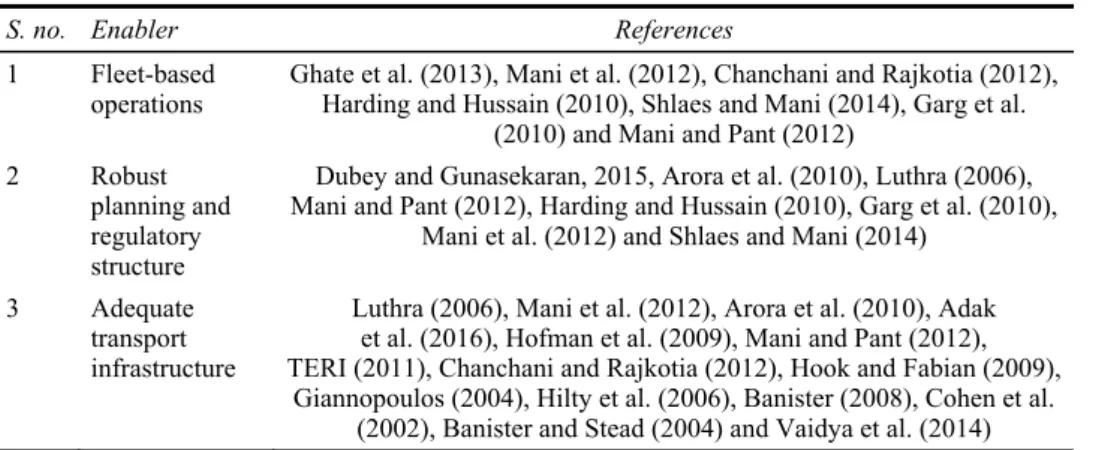
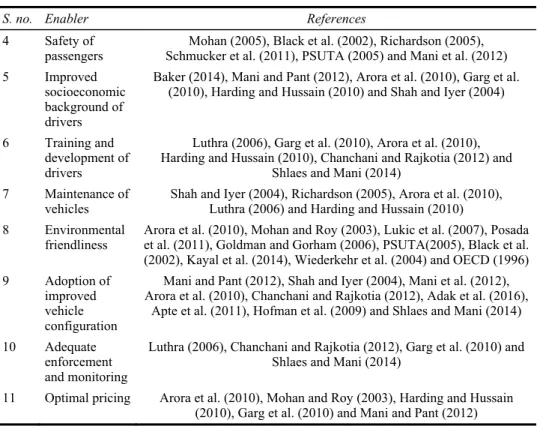
An exhaustive literature review was carried out and based on the extant literature in the domain of transport sustainability of the auto rickshaw sector in India; an attempt was made to group enablers of sustainability. A wide range of sources have been used for review including research papers, journal articles, conference papers, reports, white papers, case studies and news articles. The identified enablers were then discussed with experts and finally, a list of 11 enablers was finalised.
2.2.1 Fleet-based operations
The Indian auto rickshaw sector is largely unorganised with services being provided by individual owner-operators rather than fleet-based operations (Mani et al., 2012). Case studies suggest that owing to individually owned operations of the auto rickshaws, there is lack of accountability, resulting in safety issues for the passengers, violation of regulations, and bad behaviour among drivers (Chanchani and Rajkotia, 2012; Ghate et al., 2013; Shlaes and Mani, 2014). Fleet-based operations through company/
cooperatives/NGO model, instead of an informally operated sector would improve:
a vehicle maintenance, leading to reliable, safe and less polluting trips b driver training, eliminating bad behaviour and poor driving
c sustainable stable income for drivers with formal sector social security benefits, eliminating the need for haggling and overcharging (Harding and Hussain, 2010;
Shlaes and Mani, 2014).
Garg et al. (2010) through a case study of Chennai suggest that company models to organise the sector will lead to the elimination of whimsical prices as multiple players operating in the market will lead to market competition, increase efficiency and would improve the quality of services. Not only this, fleet-based operations would enable implementation of technology for dispatch services, ultimately, enhancing the ‘door to
door connectivity’ function of auto rickshaws and reducing empty rides (Mani et al., 2012; Harding and Hussain, 2010). Advocating for a two tier permit framework to serve both fleet-based operations as well as individually managed operations (termed as ‘walk up’ operations since passengers can walk up to get an auto rickshaw from the stand), Mani and Pant (2012) contend that this will ensure that auto rickshaw services at high demand walk up locations such as airports, railway stations and other throbbing activity centres can be provided without creating an oversupply of auto rickshaws, while low demand areas can be served effectively based on the availability of dispatch services.
Hence, it is argued that fleet-based operations must be considered as an enabler in enhancing transport sustainability of the auto rickshaw sector.
2.2.2 Robust planning and regulatory structure
Government policy and guidelines formulated by relevant ministries and agencies are critical in achieving sustainable transportation (Dubey and Gunasekaran, 2015). The literature in general argues for the need of a robust regulatory structure governing the operations of the auto rickshaw sector, in terms of permit policy, fare structure, emission norms, safety norms, and other relevant areas related to planning and operations. This is a critical enabler for the sustainability of the Indian auto rickshaw sector, since currently the regulatory structure is weak and informal (Arora et al., 2010). Luthra (2006) suggests that formalising operational matters by relevant authorities will help in improving safety, efficiency and environment. Mani and Pant (2012) posit that it is imperative to have a robust policy framework to promote auto rickshaw’s role in sustainable urban transport mix.
As far as permits and fares are concerned, ill defined permit policy, bureaucratic complexities for permits and licenses, lack of standardised procedure for fare revisions, and lack of reliable cheap credit provisions are some regulatory pitfalls which translate into problems like overcharging, bad behaviour and overloading by the auto rickshaw drivers (Mani and Pant, 2012; Harding and Hussain, 2010; Garg et al., 2010; Luthra, 2006; Shlaes and Mani, 2014). Schaller (2007) as cited by Mani et al. (2012) contends that planning and regulation must be such that there should be two sets of permits – one set for ‘walk up’ services and another set for fleet operations. Regulations pertaining to permits and fares need to be made robust by the Regional Transport Authorities (RTA) established by the respective State Governments (Mani and Pant, 2012). This will lead to efficiency in economics of operations.
Furthermore, as far as emission regulations are concerned, Mani and Pant (2012) argue for the need of effective emission norms like separate emission norms for hydrocarbon (HC) and nitrogen oxides (NOx), rather than the current combined emission standard, emission norms for particulate matter (PM) emissions from gasoline auto rickshaws, and GHG emission norms for all auto rickshaws. These emission standards need to be made robust by the Central Pollution Control Board (CPCB) under the Ministry of Environment and Forests (MoEF), Government of India. This will lead to environmentally sustainable outcomes.
In addition to this, Mani et al. (2012) advocate for vehicle related safety regulations for auto rickshaws in terms of review of vehicle design to improve safety of auto-rickshaw occupants. Mani and Pant (2012) also report that urban roadways regulatory reforms in current motor vehicle safety regulations should be pursued to either
bring in vehicle design improvements in auto rickshaws or to move to safer vehicles. This will lead to safety in transport.
Other relevant areas identified in the literature, where planning and regulation must be made strong, include planning for the provision of transport infrastructure for auto rickshaws and organisation of formal training camps for drivers (Arora et al., 2010;
Luthra, 2006).
In light of the above, it is argued that Robust Regulatory Structure must be identified as an enabler for transport sustainability of the auto rickshaw sector.
2.2.3 Adequate transport infrastructure
Transport infrastructure, both ‘hard’ (physical infrastructure) and ‘soft’ (Information and communications technology, or ICT infrastructure), is an important enabler of transport sustainability of the auto rickshaw sector. Physical infrastructural measures like dedicated/priority lanes and planned official parking lots should be incorporated for the organised flow of auto rickshaws, efficient traffic management, reduction of congestion, and enhancement of road safety (Luthra, 2006; Mani et al., 2012; Arora et al., 2010). The absence of such transport infrastructural measures leads to unplanned and abrupt stoppages, resulting in traffic congestion and chaos (Luthra, 2006; Adak et al., 2016).
Congestion reduces travel speed, lengthens travel time, and consequently causes greater emissions (Hofman et al., 2009; Adak et al., 2016). In addition to this, creation of physical infrastructure in Indian cities to integrate auto rickshaws with larger mass transit modes is also needed to promote the function of auto rickshaws as feeder services (Arora et al., 2010; Mani and Pant, 2012; TERI, 2011; Chanchani and Rajkotia, 2012).
The provision of ICT infrastructure has wide applications in passenger transport like:
1 traffic data and information collection and dissemination systems (furnishing information about congestion areas, accidents and incidents, road works, weather conditions, information on other public modes, etc.)
2 network control and traffic management (emergency response management,
congestion management systems, demand responsive transport enabling door to door mobility solutions, etc.)
3 facilities and systems for vehicle control and driver assistance (speed control, collision warning and avoidance, lane keeping support, automatic vehicle location through GPS, etc.)
4 electronic fee collection (use of smart cards to pay for services and act as identity systems) (Giannopoulos, 2004).
ICT infrastructure for transport leads to significant cost savings in terms of time, energy use and emissions, thus, enhancing reliability and efficiency, and ultimately enabling sustainable mobility (Hilty et al., 2006; Banister, 2008; Cohen et al., 2002; Banister and Stead, 2004; Giannopoulos, 2004; PSUTA, 2005). The absence of route planning and unorganised nature of the Indian auto rickshaw sector leads to arbitrary self-planned routes by drivers, often resulting in high volumes of auto rickshaws in certain rush areas without a corresponding travel demand, leading to empty trips, which affects operating costs and leads to higher emissions (Luthra, 2006; Hook and Fabian, 2009; Mani and
Pant, 2012). Trip assignment modelling for auto rickshaws by implementation of ICT platform to connect drivers to passengers can bring in efficiency, both in terms of economics of operations and environmental sustainability (Luthra, 2006; Mani et al., 2012; Chanchani and Rajkotia, 2012). Vaidya et al. (2014) posit how the implementation of technology like GPS can lead to increased accessibility, affordability, time savings and safety for passengers on one hand and greater operational efficiency for drivers with a drastic reduction in empty trips on the other.
Thus, the provision of such adequate transport infrastructure (both hard as well as soft) is identified as an enabler.
2.2.4 Safety
Road traffic crashes and crimes in transit are serious problems for sustainability of urban transport, and therefore, transport safety has been identified as critical to ensure sustainability (Mohan, 2005; Black et al., 2002; Richardson, 2005; PSUTA, 2005). In order to enhance the sustainability of the auto rickshaw sector, it is critical to ensure that the risk of crimes in transit, and accident and injury risk of auto rickshaw occupants, is minimised. Multi vehicle collisions are the leading cause of injury for auto rickshaw occupants and prevention of such injuries is important to enable sustainability in the sector (Schmucker et al., 2011; Mani et al., 2012).
2.2.5 Improved socioeconomic background of drivers
Socio economic status is defined as a measure of one’s combined economic and social status and is a combined measure of income, education and occupation (Baker, 2014).
The literature reports that auto rickshaw drivers in India mostly belong to low socio economic backgrounds, and are socially and financially excluded. Owing to their marginalised, illiterate and low income backgrounds, most auto rickshaw drivers simply cannot afford to buy auto rickshaws by themselves and have to often rent out a rickshaw on daily basis or buy it via obtaining loans from private financers who charge exorbitantly high interest rates (Mani and Pant, 2012; Arora et al., 2010; Garg et al., 2010; Harding and Hussain, 2010). Mani and Pant (2012) note that rental costs can be as high as 50% of the daily revenues. As a result, profit margins for such drivers become low (Harding and Hussain, 2010; Arora et al., 2010). Thus, it can be argued that improvements in socio economic background are essential to enhance social sustainability of auto rickshaws.
High rental costs and interest costs lead to higher cases of refusals (for short trips) and the practice of overcharging by drivers (Mani and Pant, 2012; Harding and Hussain, 2010). In addition to this, low incomes also compel drivers to spend as little as possible on the vehicle maintenance, which is associated with safety and emission issues (Mani and Pant, 2012; Shah and Iyer, 2004). Low income is also a reason why drivers overload the vehicle in an attempt to earn a little extra, which bears significant risk of accident injury (Arora et al., 2010). Improvements in socio economic background of the drivers by way of developmental and welfare schemes will help mitigate problems of overcharging, overloading, vehicle maintenance and thus enhance transport sustainability on all fronts – social, economic and environmental.
2.2.6 Training and development of drivers
Owing to lack of formal training, auto rickshaw drivers display bad behaviour, reckless driving, indiscipline, often violate traffic rules and regulations, maintain vehicles poorly, use adulterated fuel, use excess lubricants (thinking that it will provide them greater protection from piston seizure) in ignorance of the adverse effects of such use and indulge in overcharging and overloading (Luthra, 2006; Shah and Iyer, 2004; Garg et al., 2010; Arora et al., 2010; Harding and Hussain, 2010; Chanchani and Rajkotia, 2012).
This impinges sustainability in all respects – social, economic and environmental. Thus, in order to enhance sustainability, it is important that formal training be imparted to drivers to make them skilled, organised and disciplined (Luthra, 2006). Shlaes and Mani (2014) argue that training programs for drivers could help overcome problems like overcharging, refusals, tampered meters, driver behaviour and driver-passenger tension.
2.2.7 Maintenance of vehicles
Vehicle maintenance is an important enabler for transport sustainability, since it enhances fuel efficiency, safety, and leads to lesser pollution (Shah and Iyer, 2004; Richardson, 2005; Arora et al., 2010; Luthra, 2006; Harding and Hussain, 2010). It is important that drivers spend adequately on vehicle maintenance, use recommended oils instead of low cost adulterated oils that exacerbate emissions and refrain from using shoddy unauthorised repair parts (Shah and Iyer, 2004; Luthra, 2006; Arora et al., 2010).
2.2.8 Environmental friendliness
Auto rickshaws in India are generally looked at with disparaging attitude and considered to be highly polluting in terms of emissions and noise (Arora et al., 2010; Mohan and Roy, 2003; Lukic et al., 2007; Harding and Hussain, 2010; Posada et al., 2011).
Environmental friendliness is a critical dimension for a transport mode to be sustainable (Goldman and Gorham, 2006; PSUTA, 2005; Black et al., 2002; Kayal et al., 2014;
Wiederkehr et al., 2004; OECD, 1996). Environmental friendliness entails that auto rickshaw trips cause less pollution and noise and use energy resources efficiently. Hence, environmental friendliness is identified as an enabler.
2.2.9 Adoption of improved vehicle configuration
Vehicle configuration includes two aspects – vehicle design and engine technology.
As far as engine configuration is concerned, auto rickshaws run on both two stroke and fours troke engine technology. Two stroke auto rickshaws dominate the Indian market (Mani and Pant, 2012). However, these two stroke engines are the worst polluters of cities, with their principal pollutants being PM10, HC, and CO2 emissions. They also produce louder noise. PM10 emissions are believed to be the most hazardous in terms of health impact and are responsible for pre-mature deaths and illness and respiratory problems (Shah and Iyer, 2004; Mani et al., 2012; Arora et al., 2010; Chanchani and Rajkotia, 2012; Adak et al., 2016). A shift to four stroke engines, use of alternative fuels like CNG and LPG, introduction of electric vehicles, etc., are instrumental in reducing emissions from the two stroke gasoline engines (Mani et al., 2012; Shah and Iyer, 2004).
Not only does efficient engine technology result in controlling pollution, but also in fuel
economy for drivers, enhancing their incomes (Mani et al., 2012; Apte et al., 2011;
Hofman et al., 2009).
As far as vehicle design is concerned, Mani and Pant (2012) report that auto rickshaw occupants face significant injury risk under multi vehicle collisions owing to limited crash worthiness of auto rickshaws. Schmucker et al. (2009) as cited by Mani et al.
(2012) suggest design improvements like provision of seat belts and padding of stiff surfaces to overcome this and to ensure for the safety of occupants.
Hence, adoption of improved vehicle configuration is an important enabler for transport sustainability of the auto rickshaws sector.
2.2.10 Adequate enforcement and monitoring
Strong enforcement and monitoring is important to ensure that planning and regulations are not rendered meaningless. Poor execution of regulation and controls results in poor driving skills and violation of traffic regulations and controls, signs and signals, pollution control measures, overcharging, refusal to go by meters, problems of vehicle condition, etc. (Luthra, 2006; Shlaes and Mani, 2014; Chanchani and Rajkotia, 2012; Garg et al., 2010). Adequate enforcement and monitoring will lead to safe, convenient and less polluting trips and hence it has been identified as an enabler.
2.2.11 Optimal pricing
A pricing structure that is reasonable to both, the auto rickshaw drivers as well as the passengers, is important to ensure the sustainability of the auto rickshaw sector. Auto rickshaws are licensed as contract carriage, which should charge the passengers rates that have been fixed by the Regional Transport Office (RTO). However, they typically charge more than the fare stipulated by the contract (Arora et al., 2010). Literature, in general, points out how overcharging as well as haggling have become quintessential to the auto rickshaw sector and a common public woe (Mohan and Roy, 2003; Harding and Hussain, 2010; Garg et al., 2010; Mani and Pant, 2012). While drivers complain of lack of fare upgradation in accordance with costs of living and fuel, commuters complain that drivers charge whimsically. Optimal pricing is important to ensure sustainable income and livelihood for drivers on one hand, and affordability and convenience for commuters on the other hand, hence is identified as an enabler.
Table 3 Summary of enablers
S. no. Enabler References
1 Fleet-based
operations Ghate et al. (2013), Mani et al. (2012), Chanchani and Rajkotia (2012), Harding and Hussain (2010), Shlaes and Mani (2014), Garg et al.
(2010) and Mani and Pant (2012) 2 Robust
planning and regulatory structure
Dubey and Gunasekaran, 2015, Arora et al. (2010), Luthra (2006), Mani and Pant (2012), Harding and Hussain (2010), Garg et al. (2010),
Mani et al. (2012) and Shlaes and Mani (2014) 3 Adequate
transport infrastructure
Luthra (2006), Mani et al. (2012), Arora et al. (2010), Adak et al. (2016), Hofman et al. (2009), Mani and Pant (2012), TERI (2011), Chanchani and Rajkotia (2012), Hook and Fabian (2009),
Giannopoulos (2004), Hilty et al. (2006), Banister (2008), Cohen et al.
(2002), Banister and Stead (2004) and Vaidya et al. (2014)
Table 3 Summary of enablers (continued)
S. no. Enabler References
4 Safety of
passengers Mohan (2005), Black et al. (2002), Richardson (2005), Schmucker et al. (2011), PSUTA (2005) and Mani et al. (2012) 5 Improved
socioeconomic background of drivers
Baker (2014), Mani and Pant (2012), Arora et al. (2010), Garg et al.
(2010), Harding and Hussain (2010) and Shah and Iyer (2004)
6 Training and development of drivers
Luthra (2006), Garg et al. (2010), Arora et al. (2010), Harding and Hussain (2010), Chanchani and Rajkotia (2012) and
Shlaes and Mani (2014) 7 Maintenance of
vehicles Shah and Iyer (2004), Richardson (2005), Arora et al. (2010), Luthra (2006) and Harding and Hussain (2010) 8 Environmental
friendliness Arora et al. (2010), Mohan and Roy (2003), Lukic et al. (2007), Posada et al. (2011), Goldman and Gorham (2006), PSUTA(2005), Black et al.
(2002), Kayal et al. (2014), Wiederkehr et al. (2004) and OECD (1996) 9 Adoption of
improved vehicle configuration
Mani and Pant (2012), Shah and Iyer (2004), Mani et al. (2012), Arora et al. (2010), Chanchani and Rajkotia (2012), Adak et al. (2016),
Apte et al. (2011), Hofman et al. (2009) and Shlaes and Mani (2014) 10 Adequate
enforcement and monitoring
Luthra (2006), Chanchani and Rajkotia (2012), Garg et al. (2010) and Shlaes and Mani (2014)
11 Optimal pricing Arora et al. (2010), Mohan and Roy (2003), Harding and Hussain (2010), Garg et al. (2010) and Mani and Pant (2012)
2.3 The research gap
The available literature was extremely resourceful to identify the enablers to sustainability of the urban Indian auto rickshaw sector. However, the enablers so identified are closely inter-related and hence studying their effect in isolation on the sustainability of the sector may prove to be both specious as well as incomplete. In order to appreciate a holistic integrated picture, it is important that the contextual relationships among the identified enablers be recognised and the most dominant enabler(s) be established so that clear insights into prioritising the implementation of enablers can be gained by policy makers, practitioners and future researchers. There has been no systematic attempt to model the inter-relationships among the enablers to identify the hierarchical levels of these enablers. This is a significant gap which the present study attempts to bridge through modelling of the barriers via ISM and MICMAC analysis.
3 Research design
With reference to the objectives of the proposed research, ISM suits as a methodology.
ISM is a powerful qualitative tool created by Warfield (1974) to study complex issues and structure them systematically in terms of words and directed graphs which can be
easily understood with greater clarity (Talib et al., 2011; Poduval and Pramod, 2015;
Attri et al., 2013; Ramesh et al., 2010). Farris and Sage (1975) define ISM “as a process aimed at assisting the human being to better understand what he/she believes and to recognize clearly what he/she does not know” (Attri et al., 2013).
It is difficult for the human mind to grasp ill-defined elements that are related in a complex system/issue (Bolanos et al., 2005). This complexity and lack of well defined relationships may impinge on the effectiveness of decision-making. Also, when a large number of factors exist in a system, the inter-relationships between the factors, direct or indirect, describe the situation far better than the individual factors taken in isolation.
ISM structures a set of directly and indirectly related elements of a complex system into a comprehensive systematic structural model (Attri et al., 2013; Mishra et al., 2012;
Routroy and Kumar, 2015; Chand et al., 2014).
The concerned study of the enablers to the sustainability of the auto rickshaw sector is a complex one owing to the sheer number of such factors and the profuse interactions among these factors. Assessing these enablers in isolation may give specious, pre-mature and incomplete conclusions, non-representative of the actual results. This necessitates the identification of a well established hierarchical structure through a methodology that imposes order and direction on the complex interactions among these sustainability enablers. ISM is such a methodology (Khan and Haleem, 2015; Thakkar et al., 2006;
Satapathy, 2014; Debata et al., 2012; Behl et al., 2016; More and Babu, 2010; Ravikumar et al., 2015). Given the suitability of the technique for modelling and analysing the influence of inter-linked variables, ISM is proposed as the suitable methodology for this research.
ISM as a methodology has found its place in social science research and is one of the most cited methodologies in recent years, particularly important where there is dearth of literature in terms of relationship among variables (Dubey and Ali, 2014).
The steps in conducting ISM are:
1 identification of elements relevant to the problem/issue/system through a survey, literature review or expert opinions
2 establishing a contextual pairwise relationship between elements by experts in the field
3 developing a structural self-interaction matrix (SSIM) of elements indicating the established contextual pairwise relationship between the elements
4 developing a reachability matrix from the SSIM and checking for transitivity 5 partitioning of reachability matrix into different levels
6 based on the relationships in the reachability matrix, developing of a directed graph (DIGRAPH) and removal of transitivity links
7 conversion of the digraph into an ISM, by replacing element nodes with statements 8 review of the ISM model to check for conceptual inconsistency in order to make
necessary modifications (Attri et al., 2013; Al Zaabi et al., 2013; Singh et al., 2003;
Kannan and Haq, 2007).
4 Development of the model
4.1 Structural self-interaction matrix
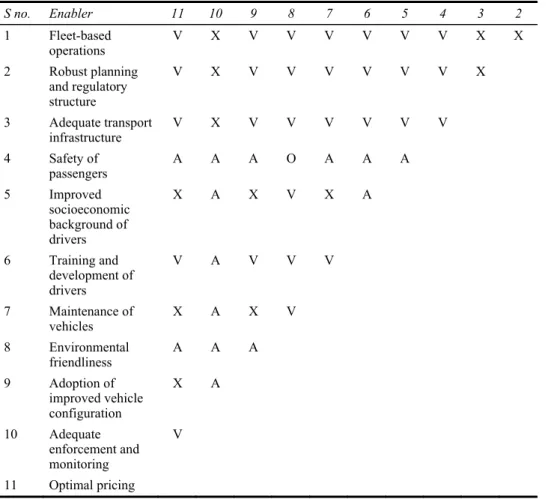
The next step in the technique was to develop a SSIM, which required contacting experts from academia and industry. The primary objective of SSIM is to find out relationships between the variables. For the development of SSIM, a matrix with all the variables was written on the columns and rows. The matrix was further split into two diagonal matrices and the respondents were asked to fill the relationship between the distinct pairs in the upper triangular matrix. This matrix was sent to 40 experts from industry and academia.
The experts from academia were a mixture of faculty members who teach subjects related to sustainable transportation/policy issues, had a minimum ten years of teaching experience and were no less than Associate Professor in their designation. A different section of people (researchers) who have contributed or are currently working in areas closely related to transportation and sustainability in local transportation were also contacted. The researchers were selected on the criterion of having published papers in renowned databases like Scopus/Web of Science, etc. The upper triangulation matrix was sent to industry experts who have been associated with the R&D department in related industry for at least five years. The experts from government machinery that have been in policy making wing for more than five years and have contributed to published government reports were contacted as well. A last set of experts, whose papers were used to draw variables in the present study, were also approached for filling up the matrix. The questionnaire was tested for content validity. The instrument developed in this study demonstrates that the content validity was based on both, an exhaustive review of the literature and detailed evaluations by academicians, industry driven executives and government officials during pre-testing.
In order to analyse the enablers, a contextual relationship of ‘leads to’ or ‘helps achieve’ was chosen. Keeping in mind this relation, the following symbols were used to denote the contextual relationship among the enablers.
a ‘V’: Enabler ‘i’ ‘leads to’ or ‘helps achieve’ enabler ‘j’.
b ‘A’: Enabler ‘j’ ‘leads to’ or ‘helps achieve’ enabler ‘i’.
c ‘X’: Both enablers ‘i’ and ‘j’ ‘lead to’ or ‘help achieve’ each other.
d ‘O’: Enablers ‘i’ and ‘j’ are independent of each other/no relationship exists between enablers ‘i’ and ‘j’.
Based on these relationships, SSIM has been developed, which was further discussed with experts and was finalised. The SSIM is presented in Table 4. Transitivity principle has been included in the reported SSIM.
Table 4 Structural self-interaction matrix
S no. Enabler 11 10 9 8 7 6 5 4 3 2
1 Fleet-based
operations V X V V V V V V X X
2 Robust planning and regulatory structure
V X V V V V V V X
3 Adequate transport
infrastructure V X V V V V V V
4 Safety of
passengers A A A O A A A
5 Improved socioeconomic background of drivers
X A X V X A
6 Training and development of drivers
V A V V V
7 Maintenance of
vehicles X A X V
8 Environmental
friendliness A A A
9 Adoption of improved vehicle configuration
X A
10 Adequate enforcement and monitoring
V
11 Optimal pricing
4.2 Reachability matrix (final)
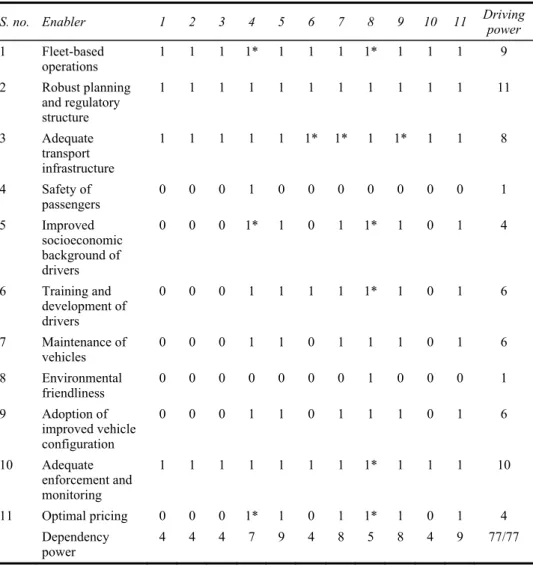
From the SSIM, a reachability matrix was constructed by substituting each pairwise entry into binary digits (0 s and 1 s) according to the following rule:
a if the (i, j) entry in the SSIM is V, then the (i, j) entry in the reachability matrix becomes 1 and the (j, i) entry becomes 0
b if the (i, j) entry in the SSIM is A, then the (i, j) entry in the reachability matrix becomes 0 and the (j, i) entry becomes 1
c if the (i, j) entry in the SSIM is X, then the (i, j) entry in the reachability matrix becomes 1 and the (j, i) entry also becomes 1
d if the (i, j) entry in the SSIM is O, then the (i, j) entry in the reachability matrix becomes 0 and the (j, i) entry also becomes 0 (Attri et al., 2013).
Since transitivity has been included in the VAXO grid itself, the reachability matrix so formed is the final reachability matrix. In order to highlight the transitivity links, the entries with transitivity links have been marked as 1*, to distinguish between initial entries and inferred entries. 1* entries are the ones where transitivity has been incorporated to fill the gap and ensure consistency. Table 5 presents the final reachability matrix.
Table 5 Final reachability matrix
S. no. Enabler 1 2 3 4 5 6 7 8 9 10 11 Driving
power 1 Fleet-based
operations 1 1 1 1* 1 1 1 1* 1 1 1 9
2 Robust planning and regulatory structure
1 1 1 1 1 1 1 1 1 1 1 11
3 Adequate transport infrastructure
1 1 1 1 1 1* 1* 1 1* 1 1 8
4 Safety of
passengers 0 0 0 1 0 0 0 0 0 0 0 1
5 Improved socioeconomic background of drivers
0 0 0 1* 1 0 1 1* 1 0 1 4
6 Training and development of drivers
0 0 0 1 1 1 1 1* 1 0 1 6
7 Maintenance of
vehicles 0 0 0 1 1 0 1 1 1 0 1 6
8 Environmental
friendliness 0 0 0 0 0 0 0 1 0 0 0 1
9 Adoption of improved vehicle configuration
0 0 0 1 1 0 1 1 1 0 1 6
10 Adequate enforcement and monitoring
1 1 1 1 1 1 1 1* 1 1 1 10
11 Optimal pricing 0 0 0 1* 1 0 1 1* 1 0 1 4
Dependency
power 4 4 4 7 9 4 8 5 8 4 9 77/77
4.3 Level partitioning
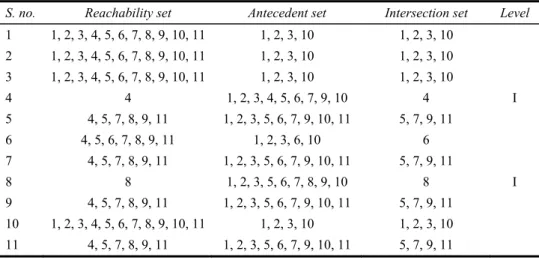
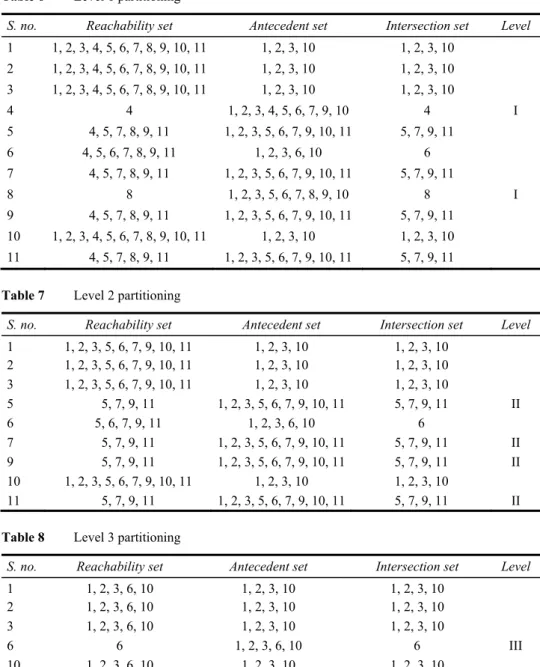
From the final reachability matrix, the reachability set and the antecedent set for each variable was found out. While the reachability set consists of the variable itself and the other variables that it may help achieve, the antecedent set consists of the variable itself
and the other variables that might help in achieving it. Intersection set was then found out between these two sets. Those enablers, for whom the intersection set and the reachability set coincide, occupy the top level in the ISM hierarchy. These variables will not help achieve other variables in the hierarchy. After identifying the top level variables, they are excluded and a similar process is repeated. Iterations keep continuing until all the enablers are accorded a hierarchy level. Tables 6, 7, 8, 9 report the hierarchical levels.
Table 6 Level 1 partitioning
S. no. Reachability set Antecedent set Intersection set Level 1 1, 2, 3, 4, 5, 6, 7, 8, 9, 10, 11 1, 2, 3, 10 1, 2, 3, 10
2 1, 2, 3, 4, 5, 6, 7, 8, 9, 10, 11 1, 2, 3, 10 1, 2, 3, 10 3 1, 2, 3, 4, 5, 6, 7, 8, 9, 10, 11 1, 2, 3, 10 1, 2, 3, 10
4 4 1, 2, 3, 4, 5, 6, 7, 9, 10 4 I
5 4, 5, 7, 8, 9, 11 1, 2, 3, 5, 6, 7, 9, 10, 11 5, 7, 9, 11
6 4, 5, 6, 7, 8, 9, 11 1, 2, 3, 6, 10 6
7 4, 5, 7, 8, 9, 11 1, 2, 3, 5, 6, 7, 9, 10, 11 5, 7, 9, 11
8 8 1, 2, 3, 5, 6, 7, 8, 9, 10 8 I
9 4, 5, 7, 8, 9, 11 1, 2, 3, 5, 6, 7, 9, 10, 11 5, 7, 9, 11 10 1, 2, 3, 4, 5, 6, 7, 8, 9, 10, 11 1, 2, 3, 10 1, 2, 3, 10 11 4, 5, 7, 8, 9, 11 1, 2, 3, 5, 6, 7, 9, 10, 11 5, 7, 9, 11 Table 7 Level 2 partitioning
S. no. Reachability set Antecedent set Intersection set Level 1 1, 2, 3, 5, 6, 7, 9, 10, 11 1, 2, 3, 10 1, 2, 3, 10
2 1, 2, 3, 5, 6, 7, 9, 10, 11 1, 2, 3, 10 1, 2, 3, 10 3 1, 2, 3, 5, 6, 7, 9, 10, 11 1, 2, 3, 10 1, 2, 3, 10
5 5, 7, 9, 11 1, 2, 3, 5, 6, 7, 9, 10, 11 5, 7, 9, 11 II
6 5, 6, 7, 9, 11 1, 2, 3, 6, 10 6
7 5, 7, 9, 11 1, 2, 3, 5, 6, 7, 9, 10, 11 5, 7, 9, 11 II
9 5, 7, 9, 11 1, 2, 3, 5, 6, 7, 9, 10, 11 5, 7, 9, 11 II
10 1, 2, 3, 5, 6, 7, 9, 10, 11 1, 2, 3, 10 1, 2, 3, 10
11 5, 7, 9, 11 1, 2, 3, 5, 6, 7, 9, 10, 11 5, 7, 9, 11 II
Table 8 Level 3 partitioning
S. no. Reachability set Antecedent set Intersection set Level
1 1, 2, 3, 6, 10 1, 2, 3, 10 1, 2, 3, 10
2 1, 2, 3, 6, 10 1, 2, 3, 10 1, 2, 3, 10
3 1, 2, 3, 6, 10 1, 2, 3, 10 1, 2, 3, 10
6 6 1, 2, 3, 6, 10 6 III
10 1, 2, 3, 6, 10 1, 2, 3, 10 1, 2, 3, 10
Table 9 Level 4 partitioning
S. no. Reachability set Antecedent set Intersection set Level
1 1, 2, 3, 10 1, 2, 3, 10 1, 2, 3, 10 IV
2 1, 2, 3, 10 1, 2, 3, 10 1, 2, 3, 10 IV
3 1, 2, 3, 10 1, 2, 3, 10 1, 2, 3, 10 IV
10 1, 2, 3, 10 1, 2, 3, 10 1, 2, 3, 10 IV
4.4 Construction of the ISM model
A node for each variable is drawn according to the hierarchy of levels identified and these nodes are connected by arrows according to the direction of the relationship, to reach a digraph. After validating for transitivity, the digraph is converted into an ISM model. Figure 1 shows the resultant ISM model.
The resultant ISM model represents the enablers to transport sustainability of the auto rickshaw sector in a five level hierarchical order. The enablers, ‘Fleet-based operations’,
‘Robust planning and regulatory structure’, ‘Proper enforcement and monitoring’ and
‘Adequate transport infrastructure’ assume the bottom level of the hierarchy, implying that these are the enablers which have the maximum influence on other enablers and hence require the most attention. The top level has been assumed by the enablers ‘Safety’
and ‘Environmental friendliness’, implying that these enablers would not help achieve any other enablers, instead are influenced by lower level enablers. The second and third level hierarchy from the top are occupied by mediating variables, which respectively include’ Adoption of improved vehicle configuration’, ‘Improved socioeconomic background of drivers’, ‘Optimal pricing’, and ‘Maintenance of vehicles’; and ‘Training and development of drivers’. These variables help in achieving the variables above their hierarchical level and in turn are achieved by the variables below their hierarchical level.
Figure 1 ISM model for enablers to the transport sustainability of the urban Indian auto rickshaw sector
4.5 MICMAC analysis
In developing an ISM, one might also be interested in analysing the drive power and the dependence power of each variable. This task is accomplished by MICMAC analysis.
The MICMAC analysis classifies the factors into four categories based on their drive/
dependence power – autonomous factors, linkage factors, dependent factors and independent factors (Warfield, 1994; Mandal and Deshmukh, 1994; Jharkharia and Shankar, 2005; Dubey et al., 2016). Not all enablers to the sustainability of the auto rickshaw sector require the same amount of attention. The enablers with high driving power and low dependence require the maximum attention. The four category taxonomy of enablers developed through MICMAC analysis will help policy makers, practitioners and researchers to differentiate between dependent and independent enablers. Figure 2 represents the position of each variable based on its driving and dependence power.
Figure 2 MICMAC analysis (see online version for colours)
a Independent variables: These are variables which demonstrate strong drive power, but weak dependence power. Such variables drive the other variables in the model and hence are the most important requiring much attention. In our model, the enablers ‘Fleet-based operations’, ‘Robust planning and regulatory structure’,
‘Adequate transport infrastructure’, ‘Adequate enforcement and monitoring’ have been identified as independent variables.
b Linkage variables: These variables demonstrate strong driving as well as strong dependence power. Such variables are unstable and any action on them will have an effect on others that will further have a feedback effect on them. In our model, the enablers ‘Improved socioeconomic background of drivers’, ‘Maintenance of vehicles’, ‘Adoption of improved vehicle configuration’ have been classified as linkage variables. These connect the independent and dependent variables by serving as mediators.
c It needs to be noted that the enabler ‘Training and development of drivers’ lies close on the boundary between independent variable and linkage variable.
d Dependent variables: As the name suggests, these variables exhibit weak driving power but strong dependence power. The enablers ‘Optimal pricing’, ‘Safety of passengers’ and ‘Environmental friendliness’ have been classified as dependent enablers. The implementation of these enablers is dependent on the key enablers, i.e., the independent and linkage variables.
e Autonomous variables: These are variables disconnected from the overall model owing to weak drive and dependence power. In the present model, no autonomous variables have been reported.
Based on the ISM and MICMAC analysis, a theoretical framework for the sustainability of the auto rickshaw sector has been laid down, which is discussed in the next section.
4.6 Total interpretive structural model (TISM)
Although ISM is a powerful methodology, it is not free from limitations. Scholars have argued that ISM suffers from subjectivity and does not provide explanation on interpreting the links between variables, and as such, ISM model lacks complete transparency (Sushil, 2012; Dubey and Ali, 2014; Singh and Sushil, 2013; Dubey et al., 2016). Hence, in order to overcome these limitations of ISM, total interpretive structural modelling (TISM) is adopted, which is an extension of ISM (Sushil, 2012; Dubey et al., 2015; Dubey and Ali, 2014). TISM helps in further interpreting the structural model completely since it provides the expert explanation of the interpretive logic behind the links in ISM (Dubey and Ali, 2014). The application of TISM as a methodology is rapidly growing and many studies have used TISM. For example, scholars have used TISM in diverse fields like total quality management (Singh and Sushil, 2013); flexible manufacturing system (Dubey and Ali, 2014); sustainable supply chain management (Dubey et al., 2016); higher and technical education sector (Prasad and Suri, 2011);
sustainable manufacturing (Dubey et al., 2015); flexible green supply chain management (Shibin et al., 2015); behavioural science (Wasuja et al., 2012), etc. As per our knowledge, this study will be the first one to apply TISM to transport sustainability in auto rickshaw sector.
TISM modelling entails the following steps (Dubey et al., 2016; Dubey and Ali, 2014; Sushil, 2012):
x Identification of variables by systematic literature review on the topic under investigation.
x Approaching experts to fill the matrix by using V, A, X and O letters to define the inter-relationship among two variables of the matrix.
x Contextual relationships among the variables that are derived through brain storming technique. The association between the two variables is checked with ‘yes’ or ‘no’
questions. So, the total number of paired comparisons required is nC2, i.e., a total of 55 comparisons for 11 variables. Further, in order to upgrade it to TISM, the experts are required to explain the interpretive logic behind the dominance of one factor over the other (Dubey and Ali, 2014):
x Converting the SSIM first to a binary matrix and then incorporating transitivity to reach to a final reachability matrix;
x Partitioning of the levels of variables depending on the dependence power and driving power of the variable from the final reachability matrix;
x Conversion of the reachability matrix into DIGRAPH based on the identified levels of variables;
x Conversion of the DIGRAPH into structural model;
x Finally, TISM model is built in which links are also interpreted and interpretation is written along the side of respective links (Dubey and Ali, 2014).
Figure 3 presents the TISM model so developed.
Figure 3 TISM model