Rows in tables have been omitted in those cases where no data is available for any of the elements in the row. Starting with a statistical overview of investment disputes, the analysis then examines the main issues that have arisen in the interpretation of IIAs over the past decade, covering aspects both procedural and substantive.
TRENDS IN INTERNATIONAL INVESTMENT RULEMAKING: TREATY CONTEXT
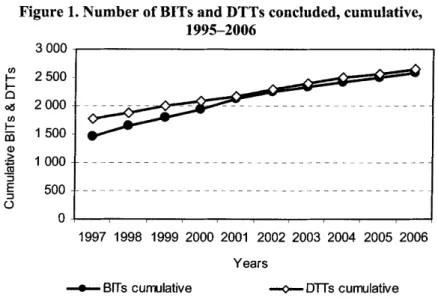
Growing universe of agreements
For example, China, the Republic of Korea and Malaysia have all signed more than 40 BITs with other developing countries. In fact, each of those three countries has signed more agreements with other developing countries than with developed countries (UNCTAD 2006b).
Expanded range of issues
There is a trend towards increased South-South cooperation in the conclusion of inter-institutional agreements (UNCTAD 2005b). The move towards greater South-South cooperation in investment matters is also evident in the conclusion of environmental impact assessments with investment provisions.
Increased sophistication and complexity
TRENDS IN INTERNATIONAL INVESTMENT RULEMAKING
Developments in investor-State dispute settlement over the last decade
At least 70 governments - 44 of them in the developing world, 14 in developed countries and 12 in South-Eastern Europe and the Commonwealth of Independent States - are involved in investment treaty arbitration. Second, the increase in the number of investment disputes poses a particular challenge for developing countries.
Interpretation of IIAs: Dispute settlement procedural issues
Thus, Egypt argued that the claimants held dual nationalities, one of which was Egyptian, and therefore could not be considered "nationals of the other Contracting State" for the purposes of Article 25(2)(a) of the ICSID Convention. The plaintiffs argued that the Egyptian citizenship of the three individual plaintiffs did not meet the prevailing definition of citizenship in international law.
Trends in International Investment Rulemaking: Arbitration Practice 1 1
Although Article 25(2)(a) of the ICSID Convention does not require the claimant to have the nationality of the particular Contracting Party to the IIA whose protection is being invoked, it does require the investor to be a national of a Contracting State. of the Convention. The other situation deals with the case where the legal person, despite having the citizenship of the host country, is nevertheless treated as a foreigner as a result of control by foreigners.
Trends in International Investment Rulemaking: Arbitration Practice 13
Egypt, one of the corporate plaintiffs, Champion Trading Co., is incorporated in the state of Delaware. The Tribunal therefore considers that it does have jurisdiction over the claims of the two corporate ~ l a i m a n t s.
Trends in International Investment Rulemaking: Arbitration Practice 17
In this context, ISDS jurisprudence has dealt with whether, and under what circumstances, the behavior of the latter entities can be attributed to the host country and thus become the basis for a claim under an IIA. However, the Maffezini Tribunal stated that the "structural test" was only one of the elements to be taken into account.
Trends in International Investment Rulemaking: Arbitration Practice 19
The importance of this issue was particularly important for cases submitted to ICSID, as Article 25 (1) of the ICSID Convention expressly states, among other things, that "L. This is the third requirement in Article 25 (1) of the Convention - the condition that a dispute must arise.
Trends in International Investment Rulemaking: Arbitration Practice 21
The logic behind this approach is the assumption that the concept of "investment" is left to the discretion of the parties in their framework of consent to a r b i t r a t i ~ n. Over the past 10 years, several arbitral tribunals have stated that the term "investment" as used in Article 25(1) of the Convention has certain objective limits that must be respected in order to allow ICSID tribunals to have jurisdiction to decide a dispute .
Trends in International Investment Rulemakine: Arbitration Practice 23
The risks of the transaction may thus depend on the contributions and the duration of the execution of the contract. The development of ICSID jurisprudence regarding the definition of "investment" under Article 25(1) of the Convention. 1, has significant practical implications for the negotiation and implementation of numerous IIAs.
Trends in International Investment Rulemaking: Arbitration Practice 27
Pakistan ruled that it had no jurisdiction over claims based on alleged breach of contract that did not amount to breach of the substantive obligations in the BIT. In that dispute, the plaintiff invoked the broad scope of the ISDS provision contained in Article 8(1) of the BIT between Algeria and Italy (1991).
Trends in International Investment Rulemakine: Arbitration Practice 29
Of particular concern is the possibility that the investor may bring a dispute before the host country's national courts and simultaneously or subsequently bring the same dispute before international arbitration. 34; When the investor has submitted the dispute to the competent court of the contracting party in whose territory the investment is made, or to international arbitration, this choice is final."
Trends in International Investment Rulemaking: Arbitration Practice 31
Matters related to the conduct of the dispute settlement process a. Consolidation of proceedings
Given the multitude of existing inter-institutional agreements, and given that the same set of measures taken by the host country may affect many foreign investors, it is not unusual for different investors to deal with the same facts and circumstances in different courts. The conflicting outcomes in the Lauder cases are often cited as an illustration of this potential problem.117 In these disputes, two different arbitral tribunals ruled that parallel proceedings on the same facts on the ground were admissible.
Trends in International Investment Rulemaking: Arbitration Practice 33
An issue giving rise to the invocation of a provision of Section A of Chapter 11 of NAFTA must be common in Article 1120 arbitrations. A determination that an issue of law or fact is common requires a further determination that the resolution of this issue is in the interest of the fair and efficient resolution of claims.
Trends in International Investment Rulemaking: Arbitration Practice 35
34;Article 15(1) is intended to provide the widest possible procedural flexibility within basic safeguards, to be applied by the arbitral tribunal to the specific needs of the specific arbitration. However, as a procedural provision, it cannot confer on the Tribunal any power to add further disputing parties to the arbitration or to grant to persons who are not parties the substantive status, rights or privileges of a disputing party .
Trends in International Investment Rulemaking: Arbitration Practice 37
Interpretation of IIAs: Substantive issues
- Right of establishment
Pre-establishment rights granted in IIAs extend certain treaty protections – in particular most favored nation (MFN) and national treatment – to the stage where an investor invests in the host country. Thus, the provisions of the IIA set limits on the degree of liberalization and protection they provide with regard to pre-establishment issues.
Trends in International Investment Rulemaking: Arbitration Practice 39
Fair and equitable treatment, and full protection and security
In these circumstances, the content of the minimum standard today cannot be limited to the content of customary international law, as was recognized in arbitral awards in the 1920s. Inter-institutional agreements provide only "fair and equitable treatment"174 without reference to international law or any other criteria to determine the content of the standard.
Chapter 11. Trends in International Investment Rulemaking: Arbitration Practice 45
While not an obligation of result, recent cases have essentially established a good faith obligation to protect foreign-owned property, with no particular regard to the resources available to do so. due diligence” of the host country. Traditionally, the standard of complete protection and safety has been identified as part of the minimum standard of treatment (UNCTAD 1999~); nevertheless, it has remained a clear and distinct standard with a precise content: the "due diligence" duty mentioned above.
Trends in International Investment Rulemaking: Arbitration Practice 47
National treatment
Here, the concept of "similar circumstances" becomes an important premise of the application of the national standard of treatment. Regarding the first step of the analysis, most arbitral tribunals have recognized from the outset that national treatment is a relative rather than a conditional standard.
Trends in International Investment Rulemaking: Arbitration Practice 49
Most-favoured-nation treatment
First, he noted that the scope of MFN treatment should be based on the text of the applicable agreement. Regarding the application of the MFN standard, two main trends are evident in recent ISDS practice.
Expropriation
Another element that ISDS practice consistently refers to is the materiality of the interference with property rights. According to the court, items such as goodwill and market share [..l "can represent .
Other provisions
Trends in International Investment Rulemaking: Arbitration Practice 61
In this regard, "[ ..l any reasonable determination of the nationality of legal persons contained in national legislation or in a treaty must be accepted by an ICSID commission or tribunal" (Schreuer 200 1). Article 1, paragraph 3, of the Agreements provides as follows: a) natural persons who have the citizenship of that Contracting Party;
Trends in International Investment Rulemaking: Arbitration Practice 63
34; The Consolidation Tribunal concludes that all four conditions of Article 1126(2) of the NAFTA are met in the current proceedings. Unlike in the case of the standard for fair and equitable treatment, the content of the principle of full protection and security is more precisely defined.
Trends in International Investment Rulemaking: Arbitration Practice 67
Other elements of public policy that limit the operation of the clause will no doubt be determined by the parties or the courts. The backlash against extending MFN treatment to dispute settlement procedures is illustrated by a proposal by several countries participating in the then-active Free Trade Agreement of the Americas (FTAA).
Trends in International Investment Rulemaking: Arbitration Practice 69
Greater precision in the scope of the definition of investment
Subsequently, several countries often used a "closed list" approach when defining "investment" in inter-institutional agreements. In addition to maintaining a broad concept of "investment," countries are seeking—as shown in Article 96 of the Japan-Mexico Free Trade Agreement—to include clarifications and additional language to make the definition of "investment" more precise.
Clarification of the meaning of several key obligations
- International minimum standard of treatment
- Expropriation
As explained above (in subsection II.C.5), one of the most controversial issues during the past decade (UNCTAD 2000). The second situation addressed by section 1 O.9(1) is indirect expropriation, where an action or series of actions by a Party has an effect equivalent to direct expropriation without formal transfer of property or outright seizure. a) The determination of whether an action or series of actions by a Party, in a specific factual situation, constitutes an indirect expropriation requires a case-by-case, fact-. based investigation which takes into account, among other factors: the economic impact of the government action, although the fact that an action or series of actions by a Party has an adverse effect on the economic value of an investment does not, in itself, establish that an indirect expropriation has occurred;. the extent to which the government action interferes with clear, reasonable investment-backed expectations; and. the character of the government action.
Clarification that investment protection should not be pursued at the expense of other public policy objectives: Non-lowering-of-standards clause
Do these clauses reflect the intention of the contracting parties to "correct" some particular trend in judicial interpretation of expropriation clauses. Among other things, it is clearly stated that the promotion of investment and liberalization will not reduce the ability of the parties to protect the environment or labor rights in their territories.
Promotion of greater transparency between the contracting parties and in the process of domestic rule-making
The obligation therefore applies not only to the contracting parties in respect of the investors of the other contracting party, but also between each contracting party and its own citizens. On the other hand, if those adjustments are necessary, it is because the countries concerned do not have a modern body of administrative law and implementation procedures, which is a prerequisite not only for the modernization of the administration of justice, but also for the strengthening of democratic institutions in general. .
Innovations in ISDS procedures
- Greater control by the contracting parties over arbitration procedures
- Promotion of judicial economy
- Promotion of a consistent and sound jurisprudence on international investment law A third category of innovation in investor-State arbitration provisions in IIAs is geared towards
- Promotion of the Iegitimacy of investor-State arbitration within civil society
The Commission must present its interpretation in writing to the Tribunal within 60 days of delivery of the request. However, the provisions do not require the parties to make any settlement discussions public, nor with the confidentiality of the tribunal's deliberations.
Promotion of investment protection and gradual liberalization of investment
- IMPLICATIONS AND CONCLUSIONS
For example, Article 10 of the BIT between Uruguay and the United States (2005) states the following: This also applies to the free trade agreements between the United States and Singapore and Peru respectively.
Legal perspective
Second, what this practice means in relation to the functioning of the system as a whole. Another lesson from ISDS practice is that when negotiating IIAs, states should not only pay attention to the specific wording of the agreement, but also consider the future interaction between the IIA and the arbitration convention(s) to which the latter refers , especially ICSID.
Systemic perspective
As discussed above (in section 11), for a dispute to fall within ICSID jurisdiction, the objective jurisdiction requirements of Article 25 of the ICSID Convention must be met. Thus, anything that the parties agree to be subject to arbitration under the Inter-Institutional Agreement does not actually fall within the jurisdiction of ICSID.
Implications for development
Mana Murtii Ol’iyyannoo, Istookhoolm, Siwiidin, Dhimma lakk. Dhaabbata Bishaanii Aconquija & Vivendi duraan Dhaabbata Bishaanii Gkkrale) v. Arjentiinaa, ICSID Lakk. ARBl9713, Badhaasa, Adoolessa 21, 2000;. Rippabiliika Islaamaa Iraan, Mana Murtii Himannaa Iraan-Ameerikaa, Badhaasa, Adoolessa 3, 1987 (Gabaasa Mana Murtii Himannaa Iraan-Ameerikaa, Lakk. 17).
SERIAL PUBLICATIONS World Investment Reports
International Investment Policies for Development (For more information visit http://www.unctad.org/iia) Maintaining flexibility in ZIAs: The use of reservations. Issues in International Investment Treaties (For more information visit http://www.unctad.org/iia) International Investment Treaties: Key Issues, Volumes I, 11 and III.
ASIT ADVISORY STUDIES (Formerly Current Studies, Series B)
INDIVIDUAL STUDIES
JOURNALS
To improve the quality and relevance of the work of the UNCTAD Division for Investment, Technology and Enterprise Development, it would be useful to receive the views of readers on this publication. If you have read other publications of the UNCTD Division on Investment, Enterprise Development and Technology, what is your overall assessment of them.