Leif Mejlbro
Complex...
Download free books at
Real Functions in One Variable Complex Numbers Examples
Calculus 1c-4
© 2007 Leif Mejlbro & Ventus Publishing ApS ISBN 978-87-7681-244-7
Contents
Preface
1. Calculation of complex numbers 2. Geometry of complex numbers 3. The equation of second degree 4. The binomial equation
5. The complex exponential 6. Roots in a polynomial
5 6 18 34 47 63 86
www.sylvania.com
We do not reinvent the wheel we reinvent light.
Fascinating lighting offers an infinite spectrum of possibilities: Innovative technologies and new markets provide both opportunities and challenges.
An environment in which your expertise is in high demand. Enjoy the supportive working atmosphere within our global group and benefit from international career paths. Implement sustainable ideas in close cooperation with other specialists and contribute to influencing our future. Come and join us in reinventing light every day.
5
Preface
In this volume I present some examples of Complex Numbers, cf. alsoCalculus 1a, Functions of One Variable. Since my aim also has been to demonstrate some solution strategy I have as far as possible structured the examples according to the following form
A Awareness, i.e. a short description of what is the problem.
D Decision, i.e. a reflection over what should be done with the problem.
I Implementation, i.e. where all the calculations are made.
C Control, i.e. a test of the result.
This is an ideal form of a general procedure of solution. It can be used in any situation and it is not linked to Mathematics alone. I learned it many years ago in the Theory of Telecommunication in a situation which did not contain Mathematics at all. The student is recommended to use it also in other disciplines.
One is used to from high school immediately to proceed to I. Implementation. However, examples and problems at university level are often so complicated that it in general will be a good investment also to spend some time on the first two points above in order to be absolutely certain of what to do in a particular case. Note that the first three points, ADI, can always be performed.
This is unfortunately not the case withCControl, because it from now on may be difficult, if possible, to check one’s solution. It is only an extra securing whenever it is possible, but we cannot include it always in our solution form above.
I shall on purpose not use the logical signs. These should in general be avoided in Calculus as a shorthand, because they are often (too often, I would say) misused. Instead of ∧I shall either write
“and”, or a comma, and instead of ∨ I shall write “or”. The arrows ⇒ and ⇔ are in particular misunderstood by the students, so they should be totally avoided. Instead, write in a plain language what you mean or want to do.
It is my hope that these examples, of which many are treated in more ways to show that the solutions procedures are not unique, may be of some inspiration for the students who have just started their studies at the universities.
Finally, even if I have tried to write as careful as possible, I doubt that all errors have been removed.
I hope that the reader will forgive me the unavoidable errors.
Leif Mejlbro 27th July 2007
1 Calculation of complex numbers
Example 1.1 Write the following complex numbers in the forma+ib. It is latently given thataand b are real numbers.
1) (5 +i)(1 + 9i), 2) i+ 12+i3+i4, 3) 1
1 + 3i+ 1 (1 + 3i)2,
4) 1
(1 +i)4.
A. Simple exercises in complex numbers.
D. Calculate the numbers; in the case of the fractions in (3) we multiply the numerator and the denominator by the complex conjugated of the denominator.
I. 1) (5 +i)(1 + 9i) = 5−9 + 45i+i=−4 + 46i. 2) i+i2+i3+i4=i−1−i+ 1 = 0.
3) From 1
1 + 3i =1−3i 10 we get 1
1 + 3i+ 1
(1 + 3i)2 = 1−3i 10 +
1−3i 10
2
= 1
100{10−30i+ 1−9−6i}= 1 50− 9
25i.
4) From (1 +i)4= (2i)2=−4 we get 1
(1 +i)4 =−1 4.
Example 1.2 Write
1 + 3 1 +i
2
in the forma+ib. A. Simple exercise in complex numbers.
D. There are several possible solutions. The safest method is first to get rid of the denominator 1 +i. I. By a straight forward calculation,
1 + 3
1 +i 2
=
1 + 3(1−i) (1 +i)(1−i)
2
=
1 +3 2{1−i}
2
= 1
4{2 + 3−3i}2= 1
4(5−3i)2= 1
4(25−9−30i)
= 16−30i
4 = 4−15 2 i.
7
Example 1.3 Write the following complex numbers in the forma+ib: 1) (3 + 2i)(1 +i)2+ (5 +i)(1 + 9i);
2) 1
1 + 3i + 1
(1 + 3i)2 − 9 25i.
A. Simple calculations of complex numbers. Some of them have already been calculated in Exam- ple 1.1.
D. Calculate (without using Example 1.1).
I. 1)
(3 + 2i)(1 +i)2+ (5 +i)(1 + 9i)
= (3 + 2i)·2i+ (5−9 + 5i+ 45i)
=−4 + 6i−4 + 50i
=−8 + 56i.
2)
1
1 + 3i+ 1
(1 + 3i)2 − 9 25i
= 1−3i
10 +(1−3i)2 100 +9i
25
= 1
100{10−30i+ 1−9−6i+ 36u}
= 2 100
= 1 50.
Example 1.4 Write the following complex numbers in the forma+ib:
1) i
(1 +i)4+1 2
1
√3−i− 1
√3 +i
, 2) 1 +i+i2+i3.
A. Simple manipulations with complex Numbers. Notice that (2) is the same as Example 1.1 (2).
D. Just calculate.
I. 1) Da (1 +i)4={(1 +i)}2= (2i)2=−4, f˚as 1
(1 +i)4 +1 2
1
√3−i− 1
√3 +i
=−1 4 +1
2·(√
3 +i)−(√ 3−i)
3 + 1 =−1
4+1 4i.
2) i+i2+i2+i4=i−1−i+ 1 = 0.
Example 1.5 Write each of the following complex numbers in the forma+ib: 1) (1 + 2i)2+1
2(1 +i)(1 +i8), 2) 2 + 5i
(3−7i)2 + (2 + 3i)(3−4i).
A. Simple manipulations with complex numbers.
D. Just calculate.
I. 1)
(1 + 2i)2+1
2(1 +i)(1 +i8)
= 1−4 + 4i+1
2(1 +i)·2 =−2 + 5i.
360° thinking .
360° thinking .
Discover the truth at www.deloitte.ca/careers
360° thinking .
360° thinking .
Discover the truth at www.deloitte.ca/careers
9 2)
2 + 5i
(3−7i)2 + (2 + 3i)(3−4i)
= 2 + 5i
(9 + 49)2(0−49 + 42i) + 6 + 12−8i+ 9i
= 1
582(2 + 5i)(−40 + 42i) + 18 +i
= 1
582(−80−210 + 84i−200i) + 18 +i
= 1
582(−290−116i) + 18 +i
=−5 58− 1
29i+ 18 +i
= 1039 58 +28
29i.
Example 1.6 Write the following complex numbers in the forma+ib: 1) (4)−π,
2) (2)4π 3 , 3) (6)21π
4 .
A. Simple manipulations with complex numbers.
D. Just calculate.
I. 1) (4)−π = 4{cos(−π) +i sin(−π)}=−4.
2) (2)4π 3 = 2
cos
4π 3
+isin
4π 3
= 2
−1 2 −i√
3 2
=−1−i√ 3.
3)
(6)21π
4 = (6)5π
4 = 6
cos 5π
4
+isin 5π
4
= 6
−
√2 2 −i
√2 2
=−3√ 2−3√
2i.
Example 1.7 Find modulus and the principal argument of the following complex numbers:
1) 2 + 2i, 2) √
3−i, 3) −1
6+ i 2√
3.
A. Simple manipulations with complex numbers.
D. Find the modulus and then the corresponding angle in the interval ]−π, π].
I. 1) It follows immediately from 2 + 2i= 2√
2· 1
√2+i 1
√2
= 2√ 2
cosπ
4 +isinπ 4 , that
r= 2√
2 og Θ = π
4. 2) It follows immediately from
√3−i= 2 √
3 2 −i1
2
= 2
cos −π
6
+isin −π
6 ,
that
r= 2 og Θ =−π 6. 3) Here,
r= −1
6+i 1 2√ 3
= 1
36+ 1 12 = 1
3, thus
−1 6+i 1
2√ 3 =1
3
−1 2+i
√3 2
= 1 3
cos
2π 3
+isin
2π 3
. Hence,
r= 1
3 og Θ = 2π
3 .
11
Example 1.8 Write the following complex numbers in the form rv, where v denotes the principal argument.
1) −4−4i, 2) 2√
3−6i, 3) 4
1 +i.
A. Simple manipulations with complex numbers.
D. First find the modulus, then the argument.
I. 1) Mental arithmetic:
−4−4i= 4√ 2
− 1
√2 −i 1
√2
= (4√ 2)−3π
4 . 2) Here,
2√
3−6i= 4√ 3
1 2−i
√3 2
= (4√ 3)−π3.
3) From 1 +i= (√ 2)π
4 follows that 4
1 +i = (2√ 2)−π
4.
Example 1.9 Write the following complex numbers in the forma+ib: 1) 63π
2 , 2) 1415π, 3)
1 4
−13π 6
,
4) 2−π8.
A. Simple manipulations with complex numbers.
D. Just calculate.
I. 1) It follows from the definition that 63π
2 = 6
cos 3π
3
+isin 3π
2
=−6i.
2) Similarly, we get 1415π = 14π =−14.
3) Here, 1
4
−13π6
= 1
4
−π6
=1 4
cos
−π 6
+isin −π
6
= 1
4 √
3 2 −i1
2
=
√3 8 −i1
8. 4) Applying
cosu 2 = +
1 + cosu
2 , sinu
2 = +
1−cosu
2 , u∈[0, π],
We will turn your CV into
an opportunity of a lifetime
13 whereu=π
4, we get 2−π
8 = 2
cos
−π 8
+isin −π
8 = 2
cosπ
8 −isinπ 8
= 2
⎧⎪
⎪⎨
⎪⎪
⎩
1 + cosπ 4
2 −i
1−cosπ 4 2
⎫⎪
⎪⎬
⎪⎪
⎭
= 2
⎧⎪
⎪⎪
⎨
⎪⎪
⎪⎩ 1 +
√2 2 2 −i
1−
√2 2 2
⎫⎪
⎪⎪
⎬
⎪⎪
⎪⎭
=
2 +√ 2−i
2−√
2.
Example 1.10 Calculate(1 +i)8. (Consider the various possibilities of calculation).
A. Calculation of a complex number, where it is indicated that there way of calculation is not unique.
D. Perform the following variants:
1) Apply the modulus and the argument.
2) Apply that (1 +i)8={(1 +i)2}4, etc.
3) Apply the binomial formula.
4) Try some other methods.
I. 1) From 1 +i=√ 2
cosπ
4 +isinπ 4 = (√
2)π
4, we get (1 +i)8=
(√
2)8
8·π4 = (24)2π = 16. 2) By a small manipulation we get
(1 +i)8=
(1 +i)24
= (2i)4= 24i4= 16.
3) Using the binomial formula we get the following rather ridiculous variant, (1 +i)8 =
8 n=0
8 n
in
= 1 + 8i+ 28i2+ 56i3+ 70i4+ 56i5+ 28i6+ 8i7+i8
= 1 + 8i−28−56i+ 70 + 56i−28−8i+ 1
= 1−28 + 70−28 + 1 = 72−56 = 16. 4) Finally, one may of course successively calculate
(1 +i)2= 2i, (1 +i)3=−2 + 2i, . . . , (1 +i)8= 16,
which is even worse than the application of the binomial formula, though one finally gets the right result.
Example 1.11 Reduce the expression (√
3 +i)6 (2−2i√
3)3
by using the modulus and the argument.
A. Simple manipulations with complex numbers.
D. Find modulus and argument for√
3 +iand 2−i2√
3, and then calculate the quotient.
I. We get
√3 +i= 2 √
3 2 +i1
2
= 2 cosπ
6 +isinπ
6 = (2)π
6, and
2−i2√ 3 = 4
1 2−i
√3 2
= 4
cos −π
3
+isin −π
3 = (4)−π3. Hence
(√
3 +i)6= 26
6·π6 =−64, (2−i2√ 3)3=
43
−π3·3=−64, from which we conclude that
(√ 3 +i)6 (2−i2√
3)3 = 1.
Example 1.12 Find the modulus of the complex number (2−3i)2
(8 + 6i)2.
A. Simple manipulations with complex numbers.
D. Find the absolute value of numerator and denominator and then just calculate.
I. We get immediately (2−3i)2
(8 + 6i)2
=|2−3i|2
|8 + 6i|2 = 4 + 9 64 + 36 = 13
100.
15
Example 1.13 In former days (i.e. before the 1950s) one used tables for addition of complex numbers.
Suppose e.g. that a=rv andb=sw are two given complex numbers, written in the form of modulus- /argument. We shall also express the complex numbera+bin the form of modulus-/argument. Assume that we have a table of1 +ϕ for given modulusrand principal argumentv, when andϕare given.
Describe how one can apply such a table to find the modulus and argument of the sum rv+sw. A. Addition of complex numbers given in the form of modulus-/argument, assuming that the function
(R)α= 1 + ()ϕ is given in a table.
Adverse element. The description is not possible in a simple way, because one shall encounter a similar problem without being able to solve the problem.
It is historically not correct to claim that one before the 1950s only added complex numbers in this way. I do not remember where I found this claim, but I must say that I feel that the usage belittles without justification all mathematicians before 1950.
D. Multiply 1 + (r)v and 1 + (s)w and analyze.
Click on the ad to read more Click on the ad to read more Click on the ad to read more Click on the ad to read more
Maersk.com/Mitas
�e Graduate Programme for Engineers and Geoscientists
Month 16 I was a construction supervisor in the North Sea
advising and helping foremen solve problems I was a
he s
Real work International opportunities
�ree work placements al
Internationa or
�ree wo
I wanted real responsibili�
I joined MITAS because
Maersk.com/Mitas�e Graduate Programme for Engineers and Geoscientists
Month 16 I was a construction supervisor in the North Sea
advising and helping foremen solve problems I was a
he s
Real work International opportunities
�ree work placements al
Internationa or
�ree wo
I wanted real responsibili�
I joined MITAS because
Maersk.com/Mitas
�e Graduate Programme for Engineers and Geoscientists
Month 16 I was a construction supervisor in the North Sea
advising and helping foremen solve problems I was a
he s
Real work International opportunities
�ree work placements al
Internationa or
�ree wo
I wanted real responsibili�
I joined MITAS because
Maersk.com/Mitas
�e Graduate Programme for Engineers and Geoscientists
Month 16 I was a construction supervisor in the North Sea
advising and helping foremen solve problems I was a
he s
Real work International opportunities
�ree work placements al
Internationa or
�ree wo
I wanted real responsibili�
I joined MITAS because
www.discovermitas.com
I. The most obvious would be to multiply (R)α= 1 + (r)v and (S)β= 1 + (s)w. This gives
(RS)α+β = {1 + (r)v}{1 + (s)w}
= 1 + (rs)v+w+{(r)v+ (s)w}
= (T)γ+{(r)v+ (s)w},
where (T)γ = 1 + (rs)v+w is known in its form of modulus-/argument by the assumption. This gives apparently the result
(r)v+ (s)w= (RS)α+β−(T)γ.
The problem here is that we on the right hand side shallsubtract two complex numbers written in the form of modulus-/argument, thus in principle the same task as our starting poin, so we have ended in a vicious circle.
Example 1.14 Write each of the following complex numbers in the form a+ib, where a and b are real numbers.
1) 1 +i2+ 2i4, 2) 1 + 3i
2−i + (2 + 3i)(3−4i), 3) 2 + 5i
(3−7i)2, 4) 6 + 7i
7i−3 −2 + 5i 3 + 7i.
A. Simple manipulations with complex numbers.
D. Reduce; in fractions we multiply the numerator and the denominator by the complex conjugated of the denominator.
I. 1)
1 +i2+ 2i4= 1−1 + 2 = 2. 2)
1 + 3i
2−i + (2 + 3i)(3−4i) = 1 + 3i 2−i ·2 +i
2 +i+ 6 + 12−8i+ 9
= 1
5(2−3 + 6i+i) + 18 +i
= 89 5 +12
5 i.
17 3)
2 + 5i
(3−7i)2 = 2 + 5i
(3−7i)2 ·(3 + 7i)2
(3 + 7i)2 =(2 + 5i)(9−49 + 42i) (9 + 49)2
= 1
582(2 + 5i)(−40 + 42i)
= 1
582(−80−210 + 84i−200i)
= 1
582(−290−116i) =− 5 58− 1
29i.
4)
6 + 7i
7i−3 −2 + 5i
3 + 7i =6 + 7i
7i−3 ·−3−7i
−3−7i−2 + 5i
3 + 7i ·3−7i 3−7i
= 1
49 + 9{−18 + 49−42i−21i} − 1
49 + 9{6 + 35−14i+ 15i}
= 1
58(31−63i−42−i) =−5 29−32
29i.
Click on the ad to read more Click on the ad to read more Click on the ad to read more Click on the ad to read more Click on the ad to read more
2 Geometry of complex numbers
Example 2.1 Show that if x−iy
x+iy =a+ib, then a2+b2= 1.
A. Show that the absolute value of the fraction is 1. We must of course assume that (x, y)= (0,0).
D. Find the moduli of numerator and denominator separately.
I. The claim follows from the calculation a2+b2=|a+ib|2=
x−iy x+iy
2= |x−iy|2
|x+iy|2 = x2+y2 x2+y2 = 1.
Example 2.2 Letz0= 0be a given complex number. Indicate the complex number which corresponds to the mirror image of z0 in
1) the origo, 2) the real axis, 3) the imaginary axis,
4) the liney=xin the first and third quadrant.
Let z0=a+ib. Express all the mirror images mentioned above bya,bandi, as well by z0,z0 andi. Sketch a figure.
A. Mirror images in the complex plane.
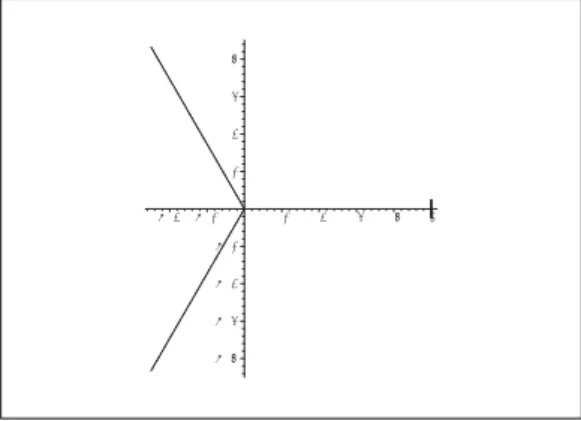
D. The sketch of the figure is left out, due to some failure in the programme. Analysis.
I. 1) Mirror image in the origo.
z0=a+ib is transferred into −z0=−a−ib.
2) Mirror image in the real axis:
z0=a+ib is transferred into z0=a−ib.
3) Mirror image in the imaginary axis:
z0=a+ib is transferred into−z0=−a+ib.
4) Mirror image in the liney=x:
z0=a+ib is transferred into b+ia=iz0.
19
Example 2.3 Let z and w be two complex numbers, of which at least one of them has modulus 1.
Assume that zw= 1. Prove that z−w
1−zw = 1.
A. Manipulations with modulus.
D. Consider the cases|z|= 1 and |w|= 1 separately. Calculate.
I. 1) If|z|= 1, then zz=|z|2= 1, and z−w
1−zw = 1
|z|· |z−w|
1−zw| = |z−w|
z−zzw| = |z−w|
|z−w| = 1.
2) If|w|= 1, then also|w|= 1 andww=|w|2= 1. In general we have|ζ|=|ζ|for every ζ∈C. Thus
z−w 1−zw
= 1
|w|· |z−w|
|1−zw| = |z−w|
w−zww| =|z−w|
z−w| = |z−w|
|z−w| = 1.
Example 2.4 Prove that if|z|= 1, then az+b
bz+a = 1
for all complex numbersa,b, for whichaz+b= 0.
A. Manipulations with complex numbers.
D. Note thatzz= 1.
I. A division by|z|= 1 gives az+b
bz+a
= |az+b|
|bz+a|· 1
|z| = |az+b|
|bzzz+az| = |az+b|
|az+b| = 1.
Example 2.5 Prove that if|z|=r >0, then Re(z) =1
2
z+r2 z
, Im(z) = 1 2i
z−r2
z
. A. Manipulation with modulus.
D. Use that
r2=|z|2=zz >0, and
Rez=1
2(z+z), Imz= 1
2i(z−z).
I. We find immediately that 1
2
z+r2 z
= 1 2
z+zz
z
= 1
2(z+z) = Rez, and
1 2i
z−r2
z
= 1
2i(z−z) = Imz.
Example 2.6 Find all complex numbersz= 1, for which Re
z+ 1 z−1
= 0.
Find all complex numbersz= 1, for which Im
z+ 1 z−1
= 0.
A. Calculations with the real and imaginary part.
D. Multiply both the numerator and the denominator by z−1 = 0 and then split into real and imaginary part.
I. By using the trick we get z+ 1
z−1 = z+ 1 z−1 ·z−1
z−1 = 1
|z−1|2{zz+z−z−1}
= 1
|z−1|2
|z|2−1−2iImz .
Ifz= 1, then Re
z+ 1 z−1
= 0, if and only if|z|= 1, z= 1, i.e. the unit circle without one point.
Ifz= 1, then Im
z+ 1 z−1
= 0, if and only if Imz= 0, i.e. z∈R\ {1}.
Example 2.7 Letz=x+iy. Prove that|x|+|y| ≤√ 2|z|.
A. An estimate of modulus.
D. Square and use an inequality for real numbers.
21 I. Ifa, b∈R, it is well-known that
0≤(a−b)2=a2+b2−2ab, thus
2ab≤a2+b2. Hence,
(|x|+|y|)2=x2+y2+ 2|xy| ≤2(x2+y2) = 2|z|2, from which we get
|x|+|y| ≤√ 2|z|.
Click on the ad to read more Click on the ad to read more Click on the ad to read more Click on the ad to read more Click on the ad to read more Click on the ad to read more
STUDY AT A TOP RANKED
INTERNATIONAL BUSINESS SCHOOL
Reach your full potential at the Stockholm School of Economics, in one of the most innovative cities in the world. The School is ranked by the Financial Times as the number one business school in the Nordic and Baltic countries.
Visit us at www.hhs.se
Sweden Stockholm
no.1
nine years in a row
Example 2.8 Apply the interpretation of a complex number as a point in the complex plane to sketch each of the following point sets on a figure:
1) M1={z∈C| |z−i|<2}. 2) M2={z∈C| |z−i|=|z+ 1|}.
3) M3={z∈C| |z−3|+|z+ 4i|= 5}.
It is here useful to consider |a−b| as the distance between the two points in the complex plane, corresponding to the numbers aandb.
A. Point sets in the complex plane.
D. Interpret|a−b|as the distance betweenaandb, and sketch the point sets.
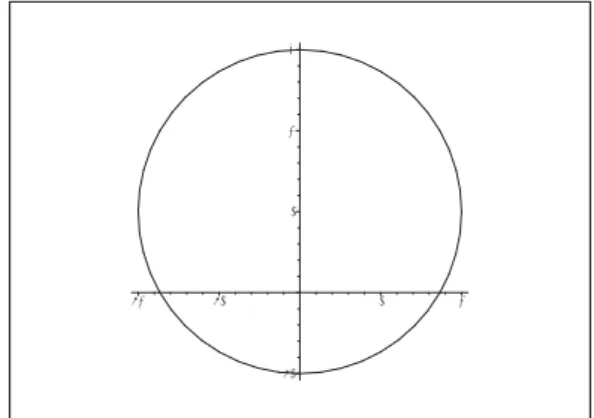
–1 0 1 2 3
–2 –1 1 2
Figure 1: The point set in (1) is the open disc.
I. 1) The setM1 is the open disc of centrez=i and radius 2.
–2 –1 1 2
–2 –1 1 2
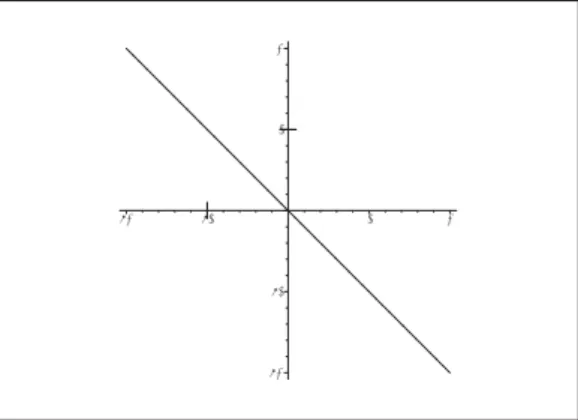
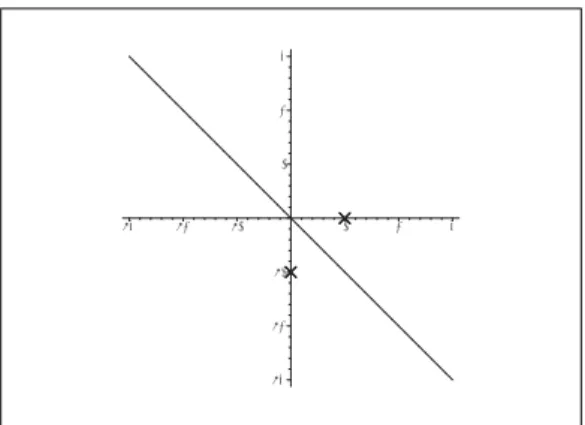
Figure 2: The point set in (2) consists of the points on the liney=−x.
2) The set M2 consists of the pointsz, which lie at the same distance from the pointsiand −1, i.e. the setM2 consists of the points on the liney=−x.
23
–4 –3 –2 –1 0
0.5 1 1.5 2 2.5 3
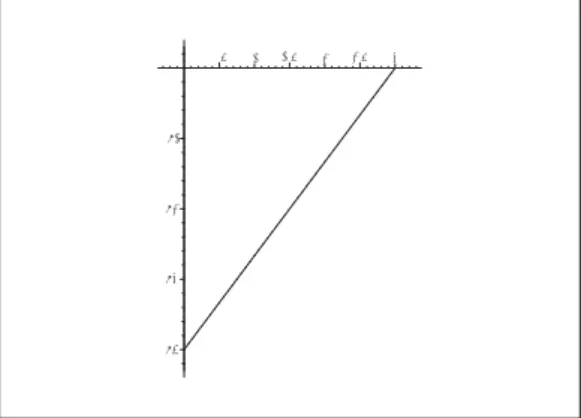
Figure 3: The point set in (3) consists of the line segment from−4ito 3.
3) The set M3 consists of the points z, for which the sum of the distances from z to either 3 or
−4iis 5. This is either an ellipse, a straight line segment of the empty set. Since the distance between 3 and−4i is 5, the setM3 is the line segment between 3 and−4i.
Example 2.9 Find in each of the following cases the set of complex numbers z, which satisfy the given condition. Sketch figures, which show these sets.
(1) |z−1|= 3, (2) |z−1|=|x+i|, (3) |2z−1|=|z−i|.
A. Point sets in the complex plane.
D. Give the equations a geometric interpretation.
–3 –2 –1 0 1 2 3
–2 –1 1 2 3 4
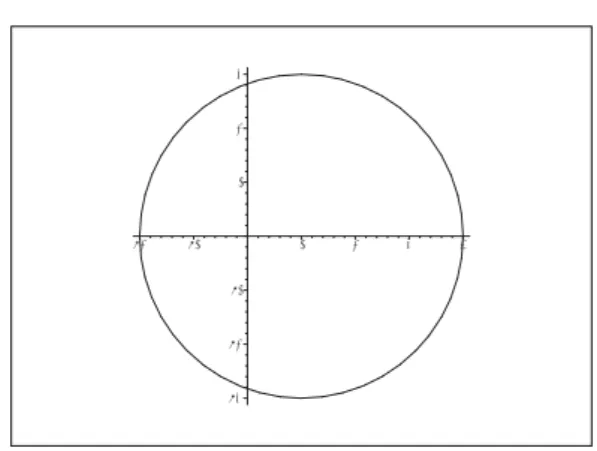
Figure 4: The point set, for which|x−3|= 3.
I. 1) The pointsz, which satisfy |z−1|= 3, have all the distance 3 from 1, i.e. they are the points of the circle of centre 1 and radius 3.
2) The points z, which satisfy|z−1|=|z+i|, have the same distance from the points 1 and−i. They lie on the line described byy=−x.
–3 –2 –1 1 2 3
–3 –2 –1 1 2 3
Figure 5: the set of pointsz, which has the same distance to 1 and −i.
–1 –0.5 0 0.5 1
0.2 0.4 0.6 0.8 1 1.2 1.4
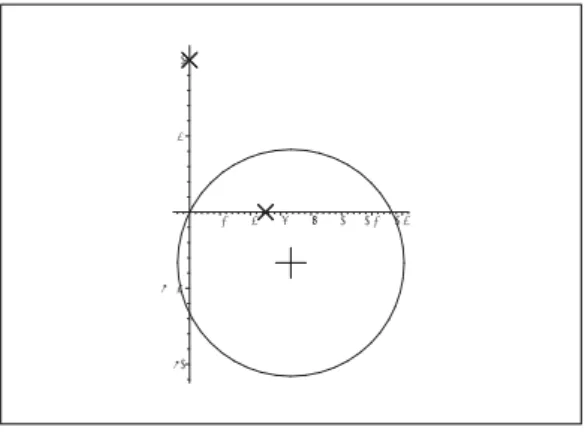
Figure 6: The set of pointsz, which satisfy|2z−1|=|z−i|.
3) The points z, which satisfyr |2z−1| = |z−i|, describe a circle. This is easily seen by the calculation
|2z−1|2=|2x−1 + 2iy|2=|z−i|2=|x+i(y−1)|2, i.e.
(2x−1)2+ 4y2=x2+ (y−1)2, hence
0 = (2x−1)2−x2+ 4y2−(y−1)2
= 3x2−4x+ 1 + 3y2+ 2y−1
= 3
x2−2·2 3x+4
9+y2+ 2·1 3y+1
9−5 9
which can be written as the equation of a circle,
x−2 3
2 +
y+1
3 2
= 5 9,
25 where the centre is
2 3,−1
3
, and the radius is
√5 3 . Remark. It follows from the rearrangement
2 z−1
2
=|z−i|
that the point set can be described as the points z, the distances os which to z1 = i is the double of the distance toz2= 1
2. ♦
Click on the ad to read more Click on the ad to read more Click on the ad to read more Click on the ad to read more Click on the ad to read more Click on the ad to read more Click on the ad to read more
Example 2.10 A complex number A= a1+i a2 may be considered as a vector, which we here for clarity denote by A. Let ·denote the scalar product of vectors, and let Aˆ denote the vector which is obtained by rotating Athe angle of π
2. 1) Prove that ifB=i A, thenB= ˆA.
2) Prove that for complex numbersA andB we have A B=A·B−i(A·Bˆ).
3) What is the geometric interpretation of
|Im(AB)|? 4) Show that
Re(AB−BA) = 0. 5) Show that
Re{(A+B)(A−B)}= 0 if and only if |A|2=|B|2.
6) The results in (5) and (2) give a geometric theorem of parallelograms. Which theorem?
A. Correspondence between the complex plane and vectors in the Euclidean plane.
D. Calculate; if necessary, sketch a figure; analyze.
I. 1) Since we obtain the vector ˆAby rotatingAthe angle +π
2, we get B= ˆA∼A·(1)π
2 =iA=B.
2) Straight forward calculations give
AB= (a1−i a2)·(b1+i b2) =a1b1+a2b2−i{a1(−b2) +a2b1}, and
A·B−i(A·Bˆ) = (a1, a2)·(b1, b2)−i(a1, a2)·(−b2, b1)
= a1b1+a2b2−i{a1(−b2) +a2b1}=AB.
3) From (2) follows
|Im(AB)| = |A·B|ˆ =|A| · |B| ·cos π
2 +θ
= |A| · |B| · |sinθ|, whereθ is the angle betweenAandB.
This number is equal to the area of the parallelogram, which is defined byAandB. 4) From (2) follows
Re{AB−BA}=A·B−B·A= 0.
27
0 0.5 1 1.5 2
–1.5 –1 –0.5 0.5 1 1.5
Figure 7: The parallelogram defined byAandB, and the corresponding vector ˆB.
5) By a calculation,
(A+B)(A−B) = (A+B)(A−B)
= |A|2− |B|2−(AB−BA), thus, according to (4),
Re{(A+B)(A−B)}=|A|2− |B|2. It is immediately seen that
Re
(A+B)(A−B)
= 0 if and only if |A|=|B|.
6) According to (2),
(A+b)(A−B) = (A+B)·(A−B)−i((A+B)·(A−ˆ B)), hence,
Re
(A+B)(A−B)
= (A+B)·(A−B).
According to (5) this expression is equal to 0, if and only if|A|=|B|.
It follows from the above that (A+B)·(A−B) = 0,
if and only if|A|=|B|, i.e. if and only if the parallelogram defined byAandBis a en rhombus.
The condition is also equivalent to that the parallelogram defined byA−B and A+B is a rectangle, and thus equivalent to the theorem that the diagonals, 2|A|and 2|B|, have the same length.
0 0.5 1 1.5 2 2.5 3
0.5 1 1.5 2 2.5 3
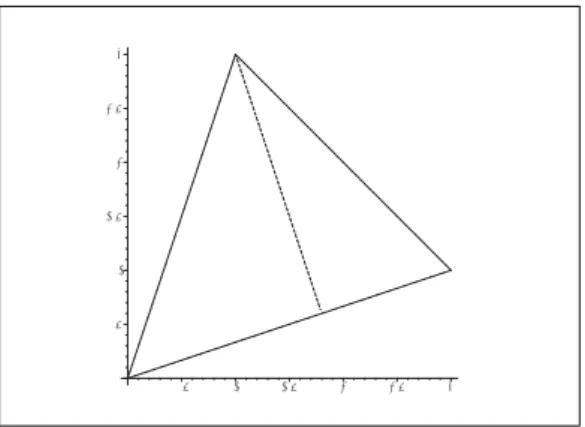
Figure 8: The triangleT with its corners 0,aandb, and with the heighthfromb onto the line 0a.
Example 2.11 In the complex plane we choose two complex numbers a and b, which together with 0 form the three corners of a triangle T. The angle from atob measured in the positive direction is called θ.
1) Show that
ab=|a||b|cosθ+i|a||b|sinθ.
2) Apply (1) to prove the cosine relation
|a−b|2=|a|2+|b|2−2|a||b|cosθ.
Hint: Start e.g. by proving that ab+ab= 2Re(ab).
3) Apply (1) to prove that the areaA(T)of the triangleT can be expressed by A(T) =
1
2Im(ab) .
4) Let z1, z2, z3 be three complex numbers in the complex plane, and let T denote the triangle of cornersz1,z2 andz3. Prove that the area ofT is given by
A(T) = 1
2Im{z1z2+z2z3+z3z1} .
A. Triangle in the complex plane. Area of this triangle.
D. Sketch a figure. Use polar coordinates. Follow the guidelines.
I. 1) Ifa=r eiϕ andb=R ei(ϕ+θ), then
ab = r e−iϕ·R ei(ϕ+θ)=|a| · |b| ·eiθ
= |a| · |b| ·cosθ+i|a| · |b| ·sinθ.
29 2) It is immediately seen that
ab+ab=ab+ab= 2 Re(ab). Combining this result with (1) we get
|a−b|2 = (a−b)(a−b) =|a|2+|b|2−ab−ab
= |a|2+|b|2−2|a||b|cosθ.
3) The area ofT is given by 1
2|a| ·h, where a geometric consideration shows thath=|b||sinθ|is the length of the height fromb onto the side 0a. When we apply the imaginary part from (1), we get
A(T) = 1
2|a| · |b| · |sinθ|= 1
2Im(ab) .
Click on the ad to read more Click on the ad to read more Click on the ad to read more Click on the ad to read more Click on the ad to read more Click on the ad to read more Click on the ad to read more Click on the ad to read more
0 1 2 3 4 5
1 2 3 4
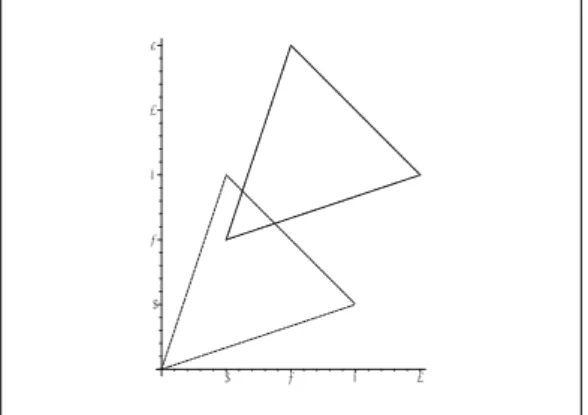
Figure 9: The triangleT and the translated triangleT with one of its corners in 0.
4) By a parallel transform of the amount−z1 we see that A(T) =A(T),
whereT is the triangle given by 0,z1−z1andz3−z1. Then it follows from (3) that A(T) = A(T) =
1
2Im{(z2−z1)(z3−z1)}
=
1
2Im{z2z3−z2z1−z1z3+z1z1}
=
1
2Im{−z1z2+z2z3−z1z3} , becausez1z1=|z1|2 is real.
Then note that Ima=−Ima, thus
Im(−z1z2) = Im(z1z2), Im(−z1z3) = Im(z3z1), hence by insertion,
A(T) =A(T) = 1
2Im{z1z2+z2z3+z3z1} .
Example 2.12 Show that for every pair of complex numbersz1 andz2,
||z1| − |z2|| ≤ |z1+z2| ≤ |z1|+|z2|.
A. Estimates of the absolute value of a sum.
D. Calculate |z1+z2|2and estimate.
I. First calculate
|z1+z2|2 = (z1+z2)(z1+z2)
= |z1|2+|z2|2+z1z2+z2z1
= |z1|2+|z2|2+ 2 Re(z1z2).
31 From
−2|z1||z2| ≤2 Re(z1z2)≤2|z1||z2|, we get
(|z1| − |z2|)2 = |z1|2+|z2|2−2|z1||z2|
= |z1|2+|z2|2+ 2 Re(z1z2) =|z1+z2|2
≤ |z1|2+|z2|2+ 2|z1||z2|= (|z1|+|z2|)2, i.e.
(|z1| − |z2|)2≤ |z1+z2|2≤(|z1|+|z2|)2. Finally, by taking the square root,
||z1| − |z2|| ≤ |z1+z2| ≤ |z1|+|z2|.
Click on the ad to read more Click on the ad to read more Click on the ad to read more Click on the ad to read more Click on the ad to read more Click on the ad to read more Click on the ad to read more Click on the ad to read more Click on the ad to read more
“The perfect start of a successful,
international career.”
CLICK HERE
to discover why both socially and academically the University
of Groningen is one of the best places for a student to be
www.rug.nl/feb/education
Excellent Economics and Business programmes at:
Example 2.13 Let a=bbe complex numbers, and letk be a positive real number,k= 1. Prove that {z∈C| |z−a|=k· |z−b|}
describes a circle in the complex plane. Specify the centre and the radius of the circle.
A. Point set in the complex plane.
D. Square the condition and then reduce.
I. The condition is equivalent to
|z−a|2=k2|z−b|2. In general,
|z−c|2 = (z−c)(z−c) (1)
= |z|2−z c−z c+|c|2
= |z|2−2 Re(z c) +|c|2. Puttingc=a, resp.c=b, we get
|z|2−2 Re(z a) +|a|2=k2
|z|2−2 Re(z b) +|b|2 , which can be written
(1−k2)|z|2−2 Re z
a−k2b
+|a|2−k2|b|2= 0. Division by 1−k2= 0, followed by a rearrangement, gives
|z|2−2 Re
z· a−k2b 1−k2
+
a−k2b 1−k2
2= a−k2b
1−k2
2−|a|2−k2|b|2 1−k2 , hence by (1),
z−a−k2b 1−k2
2
= 1
(1−k2)2
|a−k2b|2−(1−k2)|a|2+k2(1−k2)|b|2
= 1
(1−k2)2
|a|2+k4|b|2−2 Re k2a b
−(1−k2)|a|2+ (k2−k4)|b|2
= 1
(1−k2)2
k2|a|2+k2|b|2−k2·2 Re(ab)
= k2
(1−k2)2|a−b|2. This shows that
{x∈C| |z−a|=k|z−b|}
=
z∈C
z−a−k2b 1−k2
= k|a−b|
|1−k2|
,
33 and the set is a circle with the complex centre
a−k2b 1−k2 and of radius
r= k
|1−k2||a−b|.
Click on the ad to read more Click on the ad to read more Click on the ad to read more Click on the ad to read more Click on the ad to read more Click on the ad to read more Click on the ad to read more Click on the ad to read more Click on the ad to read more Click on the ad to read more
89,000 km
In the past four years we have drilled
That’s more than twice around the world.
careers.slb.com
What will you be?
1 Based on Fortune 500 ranking 2011. Copyright © 2015 Schlumberger. All rights reserved.
Who are we?
We are the world’s largest oilfield services company1. Working globally—often in remote and challenging locations—
we invent, design, engineer, and apply technology to help our customers find and produce oil and gas safely.
Who are we looking for?
Every year, we need thousands of graduates to begin dynamic careers in the following domains:
n Engineering, Research and Operations n Geoscience and Petrotechnical n Commercial and Business
3 The equation of second degree
Example 3.1 1) Find the complex numbers z, which satisfy the equationz=z2. 2) For which complex numbersz isz2=|z|2?
A. Solution of non-typical equations.
D. Compare the moduli and the arguments.
I. 1) Obviously,z= 0 is a solution.
When z = 0, the moduli must still be identical, thus |z| = |z|2, i.e. |z| = 1. Then by a multiplication byz,
z3=zz=|z|2= 1 = (1)2pπ, z= (1)2pπ 3 , and we see that the solutions are
z= 0, z= 1, z=−1 2 +i
√3
2 , z=−1 2 −i
√3 2 .
Notice that we obtainfoursolutions, which isnot a contradiction to the fundamental theorem of algebra, becausez2−z isnot a polynomial inZ.
2) By puttingz=x+iy we immediately get x2−y2+ 2ixy=x2+y2,
and then by a splitting into real and imaginary part, 2y2= 0 and 2xy= 0.
Hence,y= 0 andx∈R, i.e.z∈R.
C. We see in both cases that the found solutions are in fact correct.
Example 3.2 Find in the formz=a+ib,a,b∈R, the solutions of the equation z2+ 2z−2−4i= 0.
A. Equation of second degree.
D. Solve the equation. This can be done in more than one way, although the methods in principle rely on the same idea.
I. First variant. From (z+ 1)2 =z2+ 2z+ 1, we get the inspiration of performing the following rearrangement,
0 = z2+ 2z−2−4i= (z2+ 2z+ 1)−(3 + 4i)
= (z+ 1)2−(4 +i2+ 4i)
= (z+ 1)2−(2 +i)2= (z+ 3 +i)(z−1−i). It is immediately seen that the roots are−3−i and 1 +i.
35
Second variant. An unconscious application of the solution formula from high school gives the awkward solutions
z=−1±√
1 + 2 + 4i=−1±√ 3 + 4i.
We assume that√
3 + 4i=a+ibfor somea,b∈R. Then by squaring, a2−b2+i2ab= 3 + 4i, i.e. a2−b2= 3, 2ab= 4,
thus
(a2+b2)2= (a2−b2)2+ (2ab)2= 9 + 16 = 25,
from whicha2+b2= 5. Together witha2−b2= 3 this givesa2= 4 and b2= 1. Now,ab >0, soaandbhave the same sign, i.e.√
3 + 4i=±(2 +i). Then by insertion z=−1±(2 +i) =
−3−i, 1 +i
C. The solutions ofnormed equations of second degree are checked by using that the sum of the roots is the coefficient ofzwith opposite sign, and the product of the roots is equal to the constant term.
In the present case we get (−3−i) + (1 +i) =−2,
(−3−i)(1 +i) =−3 + 1 +i(−3−1) =−2−4i.
Q.E.D.
Example 3.3 Find in the formz=a+ib,a,b∈R, the solutions of the equation z2−(5 + 5i)z+ 13i= 0.
A. Complex equation of second degree.
D. Apply the solution formula from high school in its complex form.
I. We get by the solution formula,
z = 1
2
5 + 5i± 52(1 +i)2−4·13i
= 1
2
5 + 5i± 52·2i−52i
= 1
2
5 + 5i±√
−2i = 1 2
5 + 5i± (1−i)2
=
⎧⎪
⎪⎨
⎪⎪
⎩ 1
2(5 + 5i+ 1−i) = 3 + 2i, 1
2(5 + 5i−1 +i) = 2 + 3i.
C. The sum of the roots is (3 + 2i) + (2 + 3i) = 5 + 5i,
i.e. the coefficient of zof the opposite sign, The product of the roots is
(3 + 2i)·(2 + 3i) = 6−5 + 4i+ 9i= 13i, i.e. equal to the constant term. Q.E.D.
Example 3.4 Find in the formz=a+ib,a,b∈R, the solutions of the equation iz2−(2 + 3i)z+ 1 + 5i= 0.
A. A non-normed complex equation of second degree.
D. First multiply by−i; then solve the equation.
I. When we multiply by−iwe obtain the equivalentnormed equation (2) z2−(3−2i)z+ 5−i= 0.
Then by the usual solution formula known from high school,
z = 1
2
3−2i± (3−2i)2−4(5−i)
= 1
2
3−2i±√
9−4−12i−20 + 4i
= 1
2
3−2i±√
−15−8i
= 1
2
3−2i± (4i)2+ 1−2·4i·1
= 1
2
3−2i± (1−4i)2 = 1
2 {3−2i±(1−4i)}
=
2−3i, 1 +i.
C. The sum of the roots is (2−3i) + (1 +i) = 3−2i,
which is the coefficient ofz of the opposite sign in thenormed equation (2).
The product of the roots is
(2−3i)·(1 +i) = 2 + 3−3i+ 2i= 5−i, which is equal to the constant term in (2).
Thus, the solutions are correct for (2). Finally, when (2) is multiplied byi, we obtain the equivalent original equation.
37 Example 3.5 Find the solutions of the equations 1) (z+ 1)2= 3 + 4i.
2) (z+ 1)4= 3 + 4i.
A. Two disguised binomial equations which can be solved by taking a square root.
D. Solve the equations, where the second equations can be derived from the first one.
I. 1) From
(z+ 1)2= 3 + 4i= 4−1 + 2·2·i= (2 +i)2, we getz+ 1 =±(2 +i), hence
z=
1 +i,
−3−i.
Click on the ad to read more Click on the ad to read more Click on the ad to read more Click on the ad to read more Click on the ad to read more Click on the ad to read more Click on the ad to read more Click on the ad to read more Click on the ad to read more Click on the ad to read more Click on the ad to read more
American online LIGS University
▶ enroll by September 30th, 2014 and
▶ save up to 16% on the tuition!
▶ pay in 10 installments / 2 years
▶ Interactive Online education
▶ visit www.ligsuniversity.com to find out more!
is currently enrolling in the Interactive Online BBA, MBA, MSc,
DBA and PhD programs:
Note: LIGS University is not accredited by any nationally recognized accrediting agency listed by the US Secretary of Education.
More info here.
2) As above, (z+ 1)4= (2 +i)2, hence by (1), (z+ 1)2=
2 +i,
−2−i.
The four roots are z=−1±√
2 +i, og z=−1±√
−2−i=−1±i√ 2 +i.
Remark. Let√
2 +i=a+ib, whereaandb∈R. Then we get by a squaring, a2−b2= 2 and 2ab= 1,
from which
(a2+b2)2= (a2−b2)2+ (2ab)2= 5, i.e.
a2+b2=√
5 and from previously a2−b2= 2. This gives
a=±
!√ 5 + 2
2 , b=±
!√ 5−2
2 , ab >0, hence,
√2 +i=±
⎧⎨
⎩
!√ 5 + 2
2 +i
!√ 5−2
2
⎫⎬
⎭. We can therefore write the four roots,
−1 +
!√ 5 + 2
2 +i
!√ 5−2
2 , −1−
!√ 5 + 2
2 −i
!√ 5−2
2 ,
−1 +
!√ 5−2
2 −i
!√ 5 + 2
2 , −1−
!√ 5−2
2 +i
!√ 5 + 2
2 . ♦
39 Example 3.6 Let ±√
w denote the two solutions of the equation z2 = w. Find the values of the following expressions written in the forma+ib:
1) ±√ 1 +i, 2) ± 1±√
i, 3) ± ±√
i.
A. Splitting into real and imaginary part by a square root. A very difficult example!
D. Letz2 =wfor given w. Insertz=a+iband find two equations for aandb. Then find in each case the corresponding equation without the symbols±√
·.
I. First some general theory.
Let z2 = w = u+iv, where u and v are given real numbers. If we put z = a+ib, we get by insertion and separation into real and imaginary parts that
a2−b2=u og 2ab=v.
Then
(a2+b2)2= (a2−b2)2+{2ab}2=u2+v2, and thus
a2+b2= u2+v2=|w|.
Since we already have thata2−b2=u, we get a2= |w|+u
2 , b2= |w| −u
2 , 2ab=v,
and we can findz =a+ib. The latter equation is used to check whetheraand b have the same or opposite sign.
1) z=±√ 1 +i.
Here, z2= (a+ib)2= 1 +i, thus u= 1 and|w|=√
2, andab >0. It follows from the above that
a=±
!√ 2 + 1
2 , b=±
!√ 2−1
2 , ab >0, hence
±√
1 +i=±
⎧⎨
⎩
!√ 2 + 1
2 +i
!√ 2−1
2
⎫⎬
⎭. C.Test. We get by a squaring
⎧⎨
⎩
!√ 2 + 1
2 +i
!√ 2−1
2
⎫⎬
⎭
2
=
√2 + 1
2 −
√2−1 2 + 2i
!√ 2 + 1
2 ·
√2−1
2 = 1 +i. Q.E.D.
2) z=± 1±√ i. Let us first find±√
i. Sincei= (1)π
2, it should now be well-known that
±√ i=±
1
√2 +i 1
√2
=± √
2 2 +
√2 2 i
.
For the first one of the two possibilities of 1±√
iwe get a)
w= 1 +
√2 2 +i
√2
2 , |w|=
1 +1 2 +√
2 + 1 2 =
2 +√
2,
u= 1 +
√2
2 =2 +√ 2
2 , 2ab=
√2 2 >0, a2=1
2
2 +√ 2 + 1
2(2 +√ 2)
= 1 4
2
2 +√
2 + (2 +√ 2)
, b2= 1
4
2
2 +√
2−(2 +√ 2)
, thus
z=±
1 2
2
2 +√
2 + (2 +√ 2) + i
2
2
2 +√
2−(2 +√ 2)
.
b) For the second one we have instead w= 1−
√2 2 −i
√2
2 , |w|=
1 +1 2 −√
2 + 1 2 =
2−√
2,
u= 1−
√2
2 =2−√ 2
2 , 2ab=−
√2 2 <0, a2=1
2
2−√ 2 + 1
2(2−√ 2)
= 1 4
2
2−√
2 + (2−√ 2)
, b2= 1
4
2
2−√
2−(2−√ 2)
, thus
z=±
1 2
2
2−√
2 + (2−√ 2)− i
2
2
2−√
2−(2−√ 2)
.
41 Hence the four roots are
1 2
2
2 +√
2 + (2 +√ 2) + i
2
2
2 +√
2−(2 +√ 2),
−1 2
2
2 +√
2 + (2 +√ 2)− i
2
2
2 +√
2(2 +√ 2), 1
2
2
2−√
2 + (2−√ 2)−i
2
2
2−√
2−(2−√ 2),
−1 2
2
2−√
2 + (2−√ 2) + i
2
2
2−√
2−(2−√ 2).
Click on the ad to read more Click on the ad to read more Click on the ad to read more Click on the ad to read more Click on the ad to read more Click on the ad to read more Click on the ad to read more Click on the ad to read more Click on the ad to read more Click on the ad to read more Click on the ad to read more Click on the ad to read more
.
C. It is possible to perform the test by noting that z =± 1±√
i are the four roots of the equation (z2−1)2=i.
a) If
z=±1 2
2
2 +√
2 + (2 +√ 2) +i
2
2 +√
2−(2 +√ 2)
, then
z2 = 1 4
2(2 +√ 2) + 2i
4(2 +√
2 =)−(2 +√ 2)2
= 1 +1 2
√ 2 +i
8 + 4√
2−4−2−4√ 2
= 1 + 1
√2(1 +i), hence
(z2−1)2=1
2(1 +i)2= 1
2·2i=i. Q.E.D.
b) If
z=±,1 2
2
2−√
2 + (2−√ 2)−i
2
2−√
2−(2−√ 2)
, then
z2 = 1 4
2(2−√ 2)−2i
4(2−√
2)−(2−√ 2)2
= 1 +1 2
−√ 2−i
8−4√
2−4−2 + 4√ 2
= 1− 1
√2(1 +i), hence
(z2−1)2=1
2(1 +i)2=i. Q.E.D.
3) z=± ±√ i.
In this case,z2=±√ i, i.e.
z4=i= (1)π
2+2pπ, p∈Z, and
z= (1)π
8+p·pi2, p= 0, 1,2,3,
43
where we have solve the equation as a binomial equation. Here, (1)π8 = cosπ
8 +isinπ 8
=
1 + cosπ4
2 +i
1−cosπ4 2
= 1
2
2 +√ 2 + i
2
2−√ 2, (1)π+π2 = (1)π8 ·i=−1
2
2−√ 2 + i
2
2 +√ 2, (1)π8+π = −(1)π8 =−1
2
1 +√ 2− i
2
2−√ 2, (1)π
8+3π2 = (1)π
8 ·(−i) =1 2
2−√
2− i 2
2 +√
2. All things put together we see that for± ±√
iwe get
±1 2
2 +√
2 +i
2−√ 2
, ±1
2
2−√ 2−i
2 +√
2
.
Example 3.7 Solve the equation of second degree,z2−4iz−1 + 4i= 0. Then find the roots of the polynomial
P(z) =z4−4iz2−1 + 4i.
A. An equation of second degree and another one in disguise.
D. Solve the equations, either by means of a formula or by inspection.
I. 1) We get by inspection,
z2−4iz−1 + 4i= (z2−1)−4i(z−1) = (z−1)(z+ 1−4i), so the first polynomial has the roots−1 + 4iand 1.
2) When we here replace z2 by z, we obtain the equation in (1). We therefore conclude that P(z) = 0, if and only if either
(i) z2= 1, or (ii) z2=−1 + 4i.
a) Whenz2= 1, the roots are±1.
b) Then we solvez2=−1 + 4i. If we putz=a+ib, we get a2−b2=−1, 2ab= 4, a2+b2=√
17, hence
a=±
!√ 17−1
2 =±1 2
2√
17−2,
b=±
!√ 17 + 1
2 =±1 2
2√
17 + 2.
Sincea·b >0, the roots are
±1 2
2√
17−2 +i
2√ 17 + 2
. C. Test.
1) Ifz=±1, thenP(±1) = 1−4i−1 + 4i= 0. Q.E.D.
2) If
z=±1 2
2√
17−2 +i
2√ 17 + 2
, then
z2 = 1 4
2·(−2) + 2i√
4·17−4
= 1
4{−4 + 2i·4·2}=−1 + 4i, hence by insertions,
P(z) = (−1 + 4i)2−4i(−1 + 4i)−1 + 4i
= (−1 + 4i)· {−1 + 4i+ 1−4i}= 0. Q.E.D.
Example 3.8 Find the solutionsz of the equation z2−z+ 1−i= 0.
Then find all complex solutions y of the equation e2y−ey+ 1−i= 0.
A. Complex roots.
D. One may either use the solution formula, or find a root by inspection.
I. 1) By a small inspection we see that
0 =z2−z+ 1−i= (z2+ 1)−(z+i) = (z+i)(z−1−i), thus the roots are 1 +iand−i.
2) If we instead apply the solution formula, we get
z = 1
2± 1
4−1 +i= 1 2 ±1
2
√−3 + 4i
= 1
2±1 2
√−4 + 1 + 2·2i·1 = 1
2 ± (1 + 2i)2
= 1
2{1±(1 + 2i)}=
1 +i,
−i.