Tourism and Sustainability
In a report published by Oxfam in January 2014 it was noted that the world’s richest 85 people have as much wealth as the poorest 50 per cent of the world’s population. A year later that figure had been updated to just 80 people. It is a global unevenness through which the barriers to in-migration of Third World migrants to wealthy First World nations go ever higher, while the barriers to travel in the reverse direction are all but extinct.
So how exactly does tourism contribute to narrowing this glaring inequality and gap between the rich and the poor? Are ever-expanding tourism markets – and the new, responsible, forms of tourism in particular – a smoke-free, socioculturally sensitive form of human industrialisation? Is alternative tourism really a credible lever for lifting poverty-stricken countries out of the mire of global inequality, setting them on the right track to ‘development’ and eliminating poverty?
Tourism and Sustainability critically explores and challenges what have emerged as the most significant universal geopolitical norms of the last half century – development, globalisation and sustainability – and through the lens of new forms of tourism demonstrates how we can better understand and get to grips with the rapidly changing new global order. The fourth edition has been extensively revised and updated, and benefits from the addition of new material on climate change and tourism.
Drawing on a range of examples from across the Third World, Mowforth and Munt expertly illustrate the social, economic and environmental conditions that continue to affect the tourism industry. With the first edition hailed by Geoffrey Wall as ‘one of the most significant books produced on tourism [since the turn of the millennium]’, Tourism and Sustainability remains the essential resource for students of human geography, environmental sciences and studies, politics, development studies, anthropology and business studies as well as tourism itself.
Martin Mowforth is a freelance researcher specialising in issues of environment, development, sustainability and human rights in the region of Central America. He is also a part-time associate lecturer in human geography at Plymouth University, UK.
Ian Munt is a freelance human settlements specialist and has worked on projects with UN agencies, bilateral donors and non-governmental organisations in Central America, Africa, Asia and the Pacific, and Europe.
‘This book should be compulsory reading for all those engaged in tourism research.’
Erlet Cater, In Focus, Tourism Concern
‘One of the most significant books produced on tourism in the past few years.’ Geoffrey Wall, Annals of Tourism Research
‘A valuable and overdue contribution to a multi-disciplinary area. This book meets the challenge to say something clear and interesting in a quicksand of ambiguities.’ Professor John Lea, University of Sydney
‘Informative, stimulating and provocative, the book deserves to be read by a wide audience … It is absolutely essential reading for all those serious scholars of tourism studies wishing to appreciate “the bigger picture”.’ Brian Wheeller, Annals of Tourism Research
‘The book is quite simply one of the most important theoretical contributions to the growing subdiscipline of tourism geography and is likely to be a mainstay for many years to come.’ Keith Debbage, Annals of the Association of American Geographers
‘A far-reaching, timely and quite penetrating critique of some of the forms of tourism that have emerged as a direct response to the clarion call for sustainable tourism development.’ Michael Parnwell, Journal of Development Studies
Tourism and Sustainability
Development, globalisation and new tourism in the Third World
Fourth edition
Martin Mowforth and Ian Munt
by Routledge
2 Park Square, Milton Park, Abingdon, Oxon OX14 4RN, and by Routledge
711 Third Avenue, New York, NY 10017
Routledge is an imprint of the Taylor & Francis Group, an informa business
© 2016 Martin Mowforth and Ian Munt
The right of Martin Mowforth and Ian Munt to be identified as authors of this work has been asserted by them in accordance with sections 77 and 78 of the Copyright, Designs and Patents Act 1988.
All rights reserved. No part of this book may be reprinted or reproduced or utilised in any form or by any electronic, mechanical, or other means, now known or hereafter invented, including photocopying and recording, or in any information storage or retrieval system, without permission in writing from the publishers.
Trademark notice: Product or corporate names may be trademarks or registered trademarks, and are used only for identification and explanation without intent to infringe.
First edition published by Routledge 1998 Third edition published by Routledge 2009 British Library Cataloguing in Publication Data
A catalogue record for this book is available from the British Library Library of Congress Cataloging in Publication Data
Mowforth, Martin.
Tourism and sustainability / Martin Mowforth and Ian Munt. -- Fourth edition.
pages cm
Includes bibliographical references and index.
1. Tourism--Developing countries. 2. Sustainable development--Developing countries. I. Munt, Ian. II. Title.
G155.D44M69 2016 338.4’791091734--dc23 2015024606
ISBN: 978-1-138-01325-4 (hbk) ISBN: 978-1-138-01326-1 (pbk) ISBN: 978-1-315-79534-8 (ebk)
Typeset in Times New Roman and ITC Franklin Gothic by Saxon Graphics Ltd, Derby
and for Matthew and Joseph
List of figures xi
List of tables xiii
List of boxes xv
Preface to fourth edition xvii
Acknowledgements xix
Chapter 1 Introduction 1
Purpose and limits of the book 1
Tourism as a multidisciplinary subject 2
Key themes and key words 3
Tourism and geographical imagination 7
Layout of the book 8
Chapter 2 Globalisation, sustainability, development 12
Tourism in a shrinking world 13
Uneven and unequal development 15
Sustainability and global change 20
Development and the Third World 34
Conclusion 48
Chapter 3 Power and tourism 51
Power play 52
The political economy of Third World tourism 56
Tourism as domination 57
Alternative critiques for alternative tourism? 65
Conclusion 84
Chapter 4 Tourism and sustainability 86
Mass tourism and the origins of new forms of tourism 87 Resulting problems and the rise of new forms of tourism 98
Terminology 100
Defining the ‘new’ tourism 101
The principles of sustainability in tourism 104 Agenda 21 and sustainable development in tourism 112
The tools of sustainability in tourism 113
Whither sustainability in tourism? 121
Contents
Chapter 5 A new class of tourist: trendies on the trail 124
Class, capital and travel 125
A new class of tourist? 135
The scramble for Third World destinations 146
Conclusion 152
Chapter 6 Socio-environmental organisations: where shall we save next? 154
New socio-environmental movements 155
Environmentalism and new tourism 159
Environmentalism and power 176
Conclusion 181
Chapter 7 The industry: lies, damned lies and sustainability 182
Trade and tourism 182
Size and structure of the industry 189
Redefining sustainability 196
New personnel and features of the new tourism industry 218
Conclusion 225
Chapter 8 ‘Hosts’ and destinations: for what we are about to receive … 227
Local participation in decision-making 228
Government control/community control 242
Displacement and resettlement 253
Visitor and host attitudes 261
Conclusion 268
Chapter 9 Governance, governments and tourism: selling the Third World 270
The politics of tourism 271
Assessing the politics of tourism 274
Tourism as politics 276
Globalisation and the politics of external influences 279 Sustainable tourism as political discourse 296
Conclusion 311
Chapter 10 Climate change and new tourism: the elephant in the room 314
Mitigating the impact of new tourism 317
Cutting back new tourism: the degrowth agenda 323 Adapting to climate change: can new tourism destinations
survive? 325
Conclusion 331
Chapter 11 New tourism and the poor: making poverty history? 333
Understanding poverty 333
The Millennium Development Goals and tourism 336
Pro-poor tourism 342
Migration and remittances 353
Human security 358
Conclusion 365
Chapter 12 Cities and new tourism: guess who’s coming to town? 368 Urbanisation as the antithesis of development 371
Cities as economic machines 374
Recycling places: heritage and the urban poor 376
Pro-poor city tourism? 383
Slum tourism: aestheticising the poor or taking control? 385
Conclusion 393
Chapter 13 Conclusion 395
Key themes and key words 395
New forms of Third World tourism 397
Globalisation, sustainability and development 399
Sustainability and power 400
New tourism, new critiques 401
Whither new forms of tourism? 402
Appendix 1 Travel and tourism-related websites 405
Appendix 2 Websites relating to carbon budgets and carbon offsetting 408
References 410
Index 441
1.1 Key themes and key words 4
2.1 Globalisation and the tourism industry 15
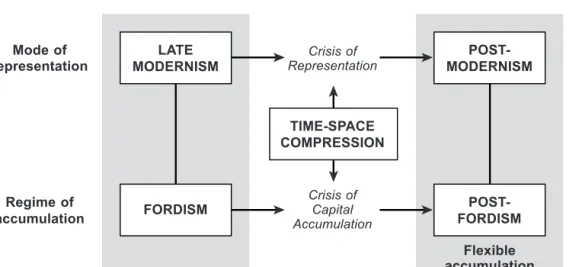
2.2 Transition in late 20th century capitalism 27
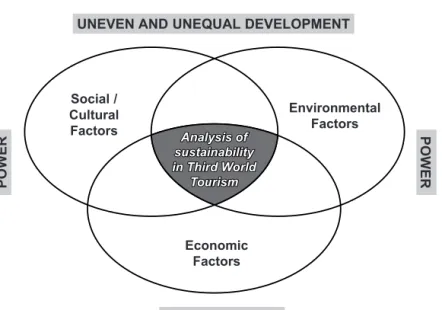
2.3 Tourism, sustainability and globalisation 33
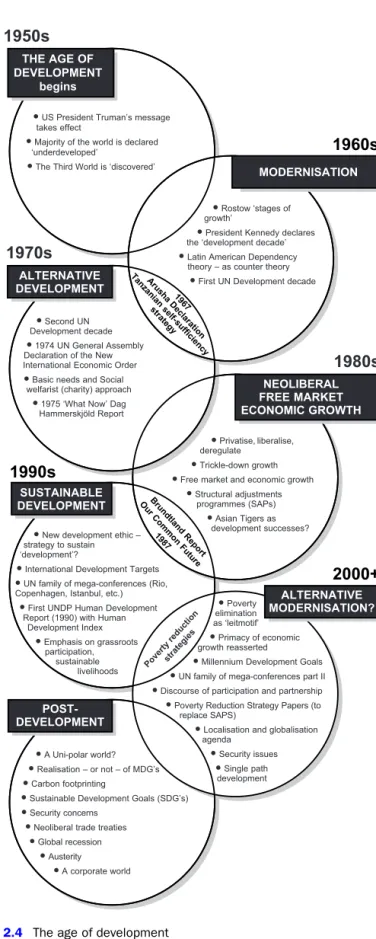
2.4 The age of development 36
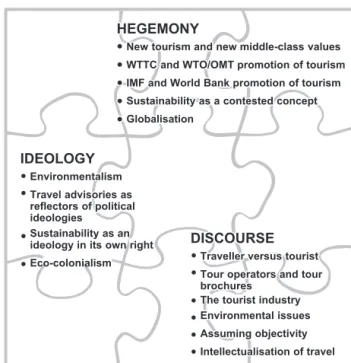
3.1 The power jigsaw 52
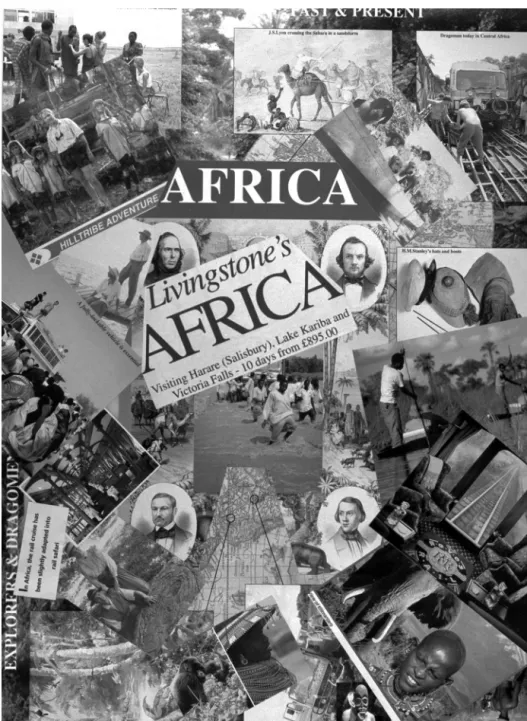
3.2 Neo-colonial discovery? 70
3.3 An alternative tourist’s guide to an exciting region 76
4.1 History of the tourism industry 88
4.2 Ethics and the industry 93
4.3 Global tourist arrivals 96
4.4 Criteria often used for sustainability in tourism 105
5.1 The culture of travel 126
5.2 Self-discovery and the social field 134
6.1 Global distribution of Survival International’s membership 158
6.2 The global growth of protected areas 173
7.1 Elements of the tourism industry 190
7.2 Consultancies and forms of consultation 210
8.1 Participatory community development – there you go! 230
8.2 Number of visitors to the Galapagos Islands 242
8.3 The TEA guesthouse in Laguna, Toledo district, south Belize 244
8.4 Inside the Laguna guesthouse 245
8.5 The Hotel San Blas, Panama 252
9.1 Tourist arrivals and receipts, Egypt, 1994–2012 272
9.2 Poverty and the ‘hard-line market bolsheviks’ of the IMF 284
9.3 Regulating the Third World 293
9.4 National protected areas of Belize 297
9.5 Tourist arrivals and receipts, Belize, 2001–12 298
9.6 Ecotourism on Ambergris Caye – or not? 301
9.7 The Burma boycott debate 310
10.1 Tourism-related water conflicts 327
11.1 The drive towards the MDGs 342
11.2 Greater Mekong Subregion tourism sector problem tree 352 11.3 Tourist arrivals to and migrants from Latin American and Caribbean
countries 355 12.1 Slum dwellers as a percentage of urban population by region 369 12.2 Heritage hotspots: historic city centres on new tourism circuits 378
Figures
12.3 Luang Prabang 379
12.4 Slum tourism in the Global South 389
13.1 Tourism, sustainability and globalisation 398
Tables
2.1 International tourist arrivals and receipts from selected First World
countries 17 2.2 International tourist arrivals and receipts from selected Third World
countries 18
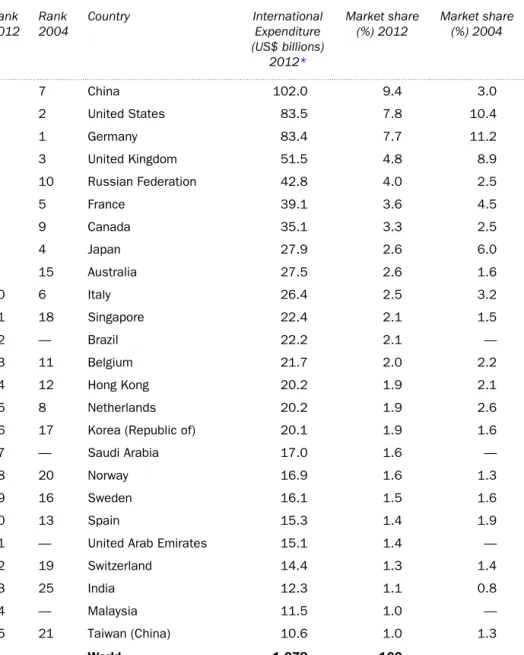
2.3 The world’s top tourism spenders, 2004 and 2012 19
2.4 Post-Fordism and tourism 25
2.5 The UN’s Millennium Development Goals 39
6.1 Tourism and the spectrum of environmentalism 161
6.2 Protected area categories 173
7.1 A qualitative assessment of some differences between a conventional
mass tourist package and a typical trekking package 197 7.2 Selected characteristics of ‘new’ and specialised tour operators 199
8.1 Pretty’s typology of participation 232
8.2 Doxey’s levels of host irritation extended 267
9.1 Tourism interest groups 276
9.2 Agenda 21: responsibilities of governments 291
10.1 CO2 emissions of selected countries, 2010 319
11.1 MDGs and the travel and tourism industry 337
11.2 Pro-poor tourism 343
11.3 Pro-poor tourism strategies 344
11.4 What 10 per cent of a country’s tourism receipts might mean to the
poorest households 347
13.1 Key themes and key words 396
Boxes
2.1 The Three Rio Summits 21
2.2 Have mouse will travel 26
2.3 Shifts in contemporary tourism 29
3.1 The ‘new imperialism’ 59
3.2 Tourism in metamorphosis? 63
3.3 Tourism and the development of capitalism 64
3.4 Elements of a new tourism critique 66
3.5 Global porters 72
3.6 Focus on truck travels 74
3.7 Travels in authenticity: the evolution of the concept 78
4.1 Studies in tourism 90
4.2 Package holidays 94
4.3 The growth of tourism in Tanzania and Eastern Africa 97
4.4 An A–Z of new tourism terminology 100
4.5 Tourism and development: defining new tourisms 103
4.6 Carrying capacity calculations for the Guayabo National Monument,
Costa Rica 106
4.7 Social divisions in the Bay Islands of Honduras 108
4.8 The tools of sustainability 114
5.1 Ecotourists: a personal profile 128
5.2 Voluntourism and gappers 131
5.3 Orphanage tourism 132
5.4 The Mountain Kingdoms Team: tour leader profiles 138
5.5 On tourism and travelling 142
5.6 Paradise lost: Bali and the new tourist 148
5.7 Himalayan Kingdoms Treks and Tours 2008 brochure 151 6.1 Big International Non-Governmental Organisations (BINGOs) 156 6.2 He’s destroying his own rainforest. To stop him, do you send in the
army or an anthropologist? 169
6.3 Diamonds are forever – the Bushmen, the ecologist and the
government of Botswana 170
6.4 WWF bankrolled rhino mercenaries 172
6.5 Conservation and imagination: clash on environment 175
6.6 Tourism development in Mexico 177
7.1 Fair, fairer, just and ethical tourism 186
7.2 Fair Trade in Tourism South Africa (FTTSA) 188
7.3 Five major forms of TNC participation in the Third World hotel
industry 192
7.4 Categories of international regulation and control of relevance to the
travel and tourism industry 202
7.5 British Airways and environmental strategy 215
7.6 Offshore real estate – Third World for sale 220
7.7 The Illusig family in Costa Rica 222
7.8 OPIC’s ecotourism standards 223
7.9 Academic tours 225
8.1 The curse of the tourism industry 234
8.2 Finca Sonador, Costa Rica 235
8.3 Recruiting a PRA team for Ecuador 237
8.4 An illustration of the Delphi technique 239
8.5 Types of tourist carrying capacity 241
8.6 A letter from Belize 247
8.7 A photo-tourism partnership in the CAMPFIRE scheme 249
8.8 Cruising round the Choco and Kuna 251
8.9 Displacement of the Maasai 254
8.10 The cultural effects of trekking 263
8.11 Tourists and tribal peoples 265
9.1 Guatemala’s protected areas 275
9.2 Grenada’s tourism development 278
9.3 The World Bank and IMF 280
9.4 Policies and conditions associated with structural adjustment
programmes/poverty reduction strategy papers 282
10.1 Implications for tourism from climate change 316
10.2 Naturetrek’s carbon offsetting policies 321
10.3 Estimates of and conclusions about the likely costs of adapting to
climate change in Caribbean countries 329
10.4 Adapting to climate change in the Pacific islands 330 10.5 Adapting, or not, to climate change at the local level 330 11.1 Sustainable Tourism – Eliminating Poverty (ST–EP) 340 11.2 The story so far: dynamic effects on macro and local economies 349
11.3 Pro-poor and equitable tourism development 353
11.4 Principles and practice: the case of the Greater Mekong Subregion 354 11.5 Human development, human rights, human security: what’s the
difference? 359 11.6 A tsunami exclusion zone for some, but not for others 360 11.7 Using the crisis of the tsunami to spearhead a whole island’s cultural
revival 362
11.8 The Trujillo Project 363
12.1 Restoring Old Havana 381
12.2 Kenya Slum Tours 386
12.3 ‘Slum tourism’ stirs controversy in Kenya 387
12.4 Tourist guesthouses in Rio’s shantytowns 391
It is now well over twenty years since we started talking about and writing the first edition of this book, first published in 1998. As authors, we first ‘bumped into’ one another in Belize City in 1992 – and the seeds of ‘Tourism and Sustainability’ were planted while enjoying Caribbean White – the local rum. We shared a measured scepticism to what appeared to be at the time a rather uncritical approach to the expansion of tourism, but more especially the somewhat sanctimonious view that new tourism was intrinsically good, and that mass tourism was unequivocally bad.
New editions provide an opportunity to take a hard and critical look at what we have got wrong and what we believe still holds good. We have been lucky enough to receive the feedback of colleagues and students in many different countries, some supportive, others challenging us where they think we are off target. On its seventeenth birthday we have retained much of the original argument for this fourth edition. Of course, some of our original categorisations may have been offered as a challenge rather than as exhaustively and scientifically researched typologies: educated hunches designed to provoke critical discussion rather than prescriptive conclusions. And our seemingly pessimistic outlook may remain overcooked. And yet, the progress in promoting more locally rooted, more equitable, and environmentally responsive forms of tourism in the past twenty years has been painfully slow. Understanding why this is so, and overcoming obstacles to change, remains a fundamental challenge.
Some of the issues that we covered, at least briefly, in the first edition but that were relatively ‘silent’ in the public realm are now right at the top of the global political agenda. Climate change and the need to end poverty, for example, are now daily topics of media discussion and central targets for the United Nations and member governments.
The UN-led ‘development goals’ coupled with global campaigns against poverty have imprinted this global challenge in the consciousness of many, and have demanded a response of agencies such as the World Tourism Organization.
Some have drawn the parallels between these monumental challenges and demanded that it is this generation’s duty to step up to the mark to ‘make poverty history’. And yet in a world where the jewels of new tourism from the Maldives to Kiribati and Tuvalu in the Pacific are in danger of literally disappearing beneath the waves, and where global inequality is rapidly accelerating (not slowing down or reversing), these issues will be at the forefront for our and subsequent generations. Unless western consumption practices are reined back, and their rapid global spread (through for example the breathtaking industrialisation of China and India) is not tempered, the implications will be potentially disastrous. Tourism needs to take its temperature within this broader global context and judge its part in averting or encouraging the onset of crisis.
Much has changed since the first, second and third editions of Tourism and Sustainability. The growing identification, at least in the western world, of the G8
Preface to the fourth edition
countries as the single imperial power and the spread of the consumerist lifestyles associated with their political and economic platforms have given rise to a number of counter-balancing movements. Prime among these has been the anti-globalisation movement that makes its presence felt at each meeting of the G8 powers. Also of potentially considerable significance as a counter-balance to the G8’s power is the so- called ‘Pink Tide’ of Latin America – the rise of governments that question and challenge the wisdom and appropriateness of the Washington Consensus. Additionally, the so- called war on terror, resulting from the 9/11 attacks on New York, has brought about major changes in our patterns of behaviour and movement along with the global economic recession caused by the financial crisis of 2008. All of these events, movements and trends have had direct and indirect effects on the development of tourism.
The core of our argument, however, remains unchanged. Development is an inherently unequal and uneven process, symbolised arguably by the diasporic and increasingly thwarted movements of Third World migrants to the First World, starkly contrasted to the accelerating movements of relatively wealthy western tourists to the Third World and the ideology of freedom of movement that supports this.
The question with which we embarked our journey in 1992 on a hot and humid Belizean evening remains unchanged: can new forms of tourism become a significant force in global development? In the context of increasing global inequality and poverty, the overall size of the tourism industry (a point that tourism advocates invoke to explain why it should be a major force for development) and the advances made, our conclusions remain cautious. Indeed, as we write, Oxfam analysis suggests the share of global wealth of the richest 1 per cent has increased from 44 per cent in 2009 to 48 per cent in 2014, and is set to be more than half by 2016. Virtually all the remaining global wealth (52 per cent) in 2014 was owned, Oxfam conclude, by the rest of the richest one-fifth of the world’s population. Global inequality appears to be accelerating and progress on reducing global poverty has slowed depressingly to a ‘snail’s pace’. Without starting from an assessment of the structures and relationships of power that influence the fate of tourism, it is, perhaps, a little too easy to be seduced by the possibilities inferred from what remain relatively few examples of positive change. To re-emphasise, however, this is not a ‘do- nothing’ manifesto. Far from it, we hope. Never has practical action been of such importance (at all scales). Rather, it remains a contribution to understanding the wider global context within which tourism operates and from which responses must be forged.
Martin Mowforth and Ian Munt May 2015
We should like to acknowledge the work of and extend our gratitude to all those already acknowledged in the first, second and third editions of the book for allowing us to draw on their material. For this fourth edition, we wish to make special acknowledgement of the work completed by Nichola Harmer in updating many of our statistical tables and data and in reviewing and revising our analysis of numerous case studies and issues.
Without her very considerable input, it is doubtful whether we would have managed to prepare this fourth edition. Similarly, the work of the Cartography Unit of Plymouth University, and in particular of Tim Absalom, deserves special mention for its professionalism and high quality. Tim’s patience and acceptance of all the changes we required in the maps, graphs, tables and drawings were remarkable and much appreciated by us.
Also for this edition, we wish to make specific acknowledgement of the permissions granted by the following persons and organisations to use extracts from their work:
Survival International for material in Boxes 3.1, 6.2, 6.3 and 8.11, for the data used in Figure 6.1 and for use of a cartoon image from Oren Ginzburg’s book ‘There You Go!’
(Figure 8.1); J. & C. Voyageurs for the photograph in Box 3.5; the Guardian for extracts of an article by Alex Hamilton (1995) (Box 8.8), Pass Notes 223 (1993) (Box 4.2) and for the cartoons by Biff in Figures 4.1 and 9.7; the Independent for permission to use extracts from an article by S. Boggan and F. Williams in Box 6.4; Tirso Maldonado and the Fundación Neotrópica (San José, Costa Rica) for extracts from their work on carrying capacity calculations (Box 4.6); Paul Fitzgerald (the cartoonist Polyp) for Figure 5.2;
Prof. Jules Pretty for his typology of participation (Table 8.1); the Panos Institute for material from their Media Briefing no. 14 (1995) for our Box 5.1; the International Tourism Partnership for Table 11.1; the Overseas Development Institute for Tables 11.2 and 11.3; the Asian Development Bank for Figure 11.2, Boxes 11.3 and 11.4; Tourism Concern for permission to reproduce ‘A letter from Belize’ (Box 8.6); Earthscan for permission to reproduce Figure 12.1 using data from UN-Habitat; and Reuters for permission to use extracts from an article by Andrew Cawthorne on slum tourism (Box 12.3). We should also acknowledge the work of Brian Rogers (formerly of the Cartography Unit at Plymouth University) for the creation of Figure 11.1 and Figure 2.1.
We are grateful to Terry Wright (of sustainabletourismbz.org) and Michael Arana (of the Belize Tourism Board) for the provision of statistics on tourist entries into Belize (Figure 9.5) and for their insightful commentaries on this data.
We owe much to the work of the following organisations which have produced reports of special relevance and significance for this field of study: Progressio (formerly known as the Catholic Institute for International Relations, London); the International Institute for Environment and Development (IIED), London, especially the work of Jules Pretty on local participation; the Panos Institute, London; Survival International, London, for
Acknowledgements
their reports on tourism and tribal peoples; the New Internationalist, especially for their work on BINGOs (Big International NGOs) but also for many other extracts from their articles; and the Overseas Development Institute, especially in the persons of Jonathan Mitchell and Caroline Ashley, for their excellent work on pro-poor tourism. Two organisations deserve special mention: the TIM-Team (Tourism Investigation &
Monitoring Team) in Bangkok, especially in the person of Anita Pleumarom, who makes available a constant stream of stimulating material on tourism and development; and Tourism Concern, London, without whose reports, assistance and advice our analysis would be considerably weaker.
We express our gratitude to two former students from Plymouth University: in summer 2007 on our behalf Elizabeth Elliott and Matthew Lane carried out a long and detailed study of the tourism-related activities and policies of a wide range of governmental and supranational agencies, the results of which we used in Chapter 9, and for which we are extremely grateful to them. For this edition Nichola Harmer updated their work.
Many thanks go to Alison Stancliffe who supplied the material for the case studies of Bali and served as our internal reviewer and extremely helpful critic for the first edition.
For this edition Alison’s work was updated by Nichola Harmer. Thanks also go to the invisible external reviewers of the fourth edition proposal, whose insightful and encouraging comments made our revisions more purposeful, and to all those who took the time to review the first, second and third editions and whose praise and criticisms have helped us to formulate this fourth edition. Our editors at Routledge, Andrew Mould and Sarah Gilkes, have constantly urged us onwards with the work for this edition, their encouragement growing ever more urgent as we slipped effortlessly past several deadlines.
June and Diana deserve more than gratitude for their patience and encouragement.
Every effort has been made to contact copyright holders for their permission to reprint material in this book. The publishers would be grateful to hear from any copyright holder who is not acknowledged and will undertake to rectify any errors or omissions in future issues of this book.
1
In recent years the image of the Third World in western minds has emerged in part from that of cataclysmic crisis – of famine and starvation, deprivation and war – to represent the opportunity for an exciting ‘new style’ holiday. Offering the attraction of environmental beauty and ecological and cultural diversity, travel to many Third World countries has been promoted, especially among the middle classes, as an opportunity for adventurous, ‘off-the-beaten-track’ holidays and as a means of preserving fragile, exotic and threatened landscapes and providing a culturally enhancing encounter. At the same time, many Third World governments have seized upon this new-found interest and have promoted tourism as an opportunity to earn much-needed foreign exchange – another attempt to break from the confines of ‘underdevelopment’.
There is something contradictory in viewing the Third World through an analysis of tourism. At one extreme there is the association of the Third World with fundamentalist terrorism, a risk to the security of the West, or overpopulation, poverty and disease. At the other there are also more subtle manipulations by the tourism industry of friendly and culturally diverse Third World peoples, natural and pristine environments and ecological variety. Both extremes, we will argue, form an important element in understanding contemporary Third World tourism. Importantly, and central to the line of argument developed in the following chapters, tourism is a way of representing the world to ourselves and to others. It cannot be understood as just a means of having some enjoyment and a break from the routine of every day, an entirely innocent affair with some unfortunate incidental impacts. Rather, a deeper understanding of tourism is needed to appreciate fully its content and expression as well as its potential impact.
Primarily, this is a book about development and its reflection in tourism; tourism is a metaphorical lens that helps bring aspects of development into sharper focus. It is not just about the role and impact of tourism in Third World development, but also about the roles of First World people and organisations (operators, tourists, non-governmental organisations, etc.) in the manufacture of ‘development’ as an idea, project or end state.
Purpose and limits of the book
This book focuses on new and purportedly sustainable forms of tourism to Third World destinations in the context of a world undergoing accelerated processes of globalisation.
The focus is relatively tight in two important respects. First, there are now many studies of tourism, especially tourism in the Third World, that catalogue and discuss its growth and impacts. In particular, studies have tended to highlight the economic, environmental and sociocultural impacts of conventional package tourism.1 Rather than adding to this body of work, we focus particularly on the under-researched ‘new’ forms of tourism
Introduction
promoted in the First World and patronised mainly by North Americans, Europeans and Australasians (and with increasing participation of the middle classes in some Third World, so-called middle income countries that have rapidly industrialised and within which pockets of substantial wealth are concentrated). Although proportionately small relative to all forms of Third World tourism, the new forms of tourism are significant in terms of both the claims that are made about them and the rate at which they are growing.
Second, we do not seek to add to the growing number of accounts which attempt to identify sustainable tourism development (in terms of the environment, economy and culture) or prescribe good practice methods and tools for achieving this goal. Many of these have emerged from First World sources and necessarily involve judging the sustainability or otherwise of varying types of Third World tourism development.
Instead, we explore the ways in which the claim, or discourse, of sustainability is used and applied to new forms of tourism (for example, the way in which ecotourism – a now not-so-new form of tourism – is premised upon the notion of sustainability). One way of capturing this important difference in our approach is to state that this is a book about sustainability and Third World tourism, rather than sustainable Third World tourism.
The former approach, adopted here, signals the need for a critical analysis of the issues, while the latter implies the need to define and prescribe models of good practice.
Tourism as a multidisciplinary subject
Rather than commencing a study of Third World tourism with the environmental, economic and sociocultural impacts of tourism (worthy though these are as research considerations in themselves), the starting point here involves seeking to understand how sociocultural, economic and political processes operate on and through tourism. In other words, it is necessary to take a step back in the analysis of tourism. This stems in part from the weaknesses present in the tourism literature. As Britton observes:
Although over-simplifying, we could characterise the ‘geography of tourism’ as being primarily concerned with: the description of travel flows; microscale spatial structure and land use of tourist places and facilities; economic, social, cultural, and environmental impacts of tourist activity; impacts of tourism in third world countries;
geographic patterns of recreation and leisure pastimes; and the planning implications of all these topics … These are vital elements of the study of travel and tourism. But these sections are dealt with in descriptive and weakly theorised ways.
(1991: 451) This problem is of fundamental importance as it has led to an absence of an adequate theoretical critique for understanding the dynamics of tourism and the social activities it involves.
There are, therefore, two identifiable groups of tourism research. The first is concerned primarily with auditing, categorising, listing and grouping the outputs or consequences of tourism; the second approach is concerned primarily with conceptualising the forces which impact on tourism and, through an analysis of these forces, providing a broader context for understanding tourism. The crucial difference in the latter approach is that tourism is seen as a focal lens through which broader considerations can be taken into account, and it confirms the multidisciplinary foundation upon which tourism research is built; and it is in our opinion the only way in which tourism can be comprehended. As a personal activity, tourism is practised by a diverse range of the population; as an industry,
it is multi-sectoral; and as a means of economic and cultural exchange, it has many facets and forms. Any comprehensive analysis of the field must therefore be multidisciplinary;
and of necessity a study of tourism must be a net importer of ideas, themes and concepts from the broader social sciences.
Accordingly, our discussion draws on economics, development theory, environmental theory, social theory, politics, geography and international relations, for example.
Inevitably, this breadth of consideration will mean that a number of relevant aspects are not examined in depth, and do not necessarily cover the complexity of the matters under discussion. We hope, however, that the discussion will serve as a stimulant to further thinking, discussion, research and study.
At the same time as using the concepts of a range of academic and intellectual fields in order better to understand tourism, the study of tourism helps us to illuminate more general economic, political, social, geographical and environmental processes. We try not to see tourism as a discrete field of study. Rather, it is an activity which helps us to understand the world.
Key themes and key words
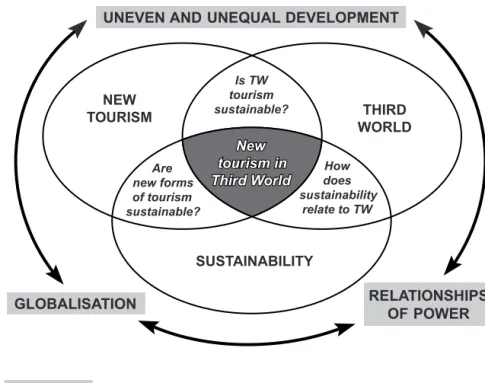
We have attempted to draw attention to the principal components of the discussion under the banners of key themes and key words. The relationships between the analysis and the key themes and key words are summarised diagrammatically in Figure 1.1. In reality these ideas are interconnected and dialectic; it is, therefore, principally a means of trying to organise our thoughts and approach. In very broad terms, these ideas respectively are shorthand for the rapid pace of global change and interdependence, an increasing global environmental awareness and a heightened concern with global inequalities and protracted structural poverty. The point we wish to emphasise is that such is the scale, nature and depth of the processes and problems assumed within globalisation, sustainability and development, three of the most significant drivers and reflectors of change, that they should therefore hold the centrepiece of our analysis. Chapter 2 is dedicated to analysing these formative ideas. Noteworthy here are the increasing concern and processes of change associated with each of these notions since the 1950s and of their accelerated significance since the 1980s – so much so that it is difficult to consider one without the other: sustainable development, global sustainability, global development, and so on.
Three themes seek to underpin the discussions throughout the book. The first, and most significant, theme is the uneven and unequal development which underlines the relationship especially between the First World and Third World (but also at inter- and intra-regional and intra-national levels), and through which we argue all forms of tourism are best understood. At its most basic level this theme is reflected in the fact that, for the time being (and notwithstanding the rapid growth of tourists generated from China and Russia in particular), it is still people from the First World who make up the significant bulk of international tourists and it is they who have the resources to make relatively expensive journeys for pleasure. Equally, processes of uneven development are reflected through the growing elite and newly wealthy classes in some Third World countries who are now able to participate in tourism. And of course tourism development is also highly uneven geographically. Areas that are in fashion today may fall from grace tomorrow.
Uneven and unequal development seeks to demonstrate why a critical understanding of tourism can be expanded through an analysis that places relationships of power, the second of the key themes, at the heart of the enquiry. These relationships range from the
UNEVEN AND UNEQUAL DEVELOPMENT
SUSTAINABILITY GLOBALISATION
KEY THEMES KEY WORDS
RELATIONSHIPS OF POWER TOURISMNEW
Is TW tourism sustainable?
new formsAre of tourism sustainable?
doesHow sustainability
relate to TW THIRD WORLD tourism inNew
Third World tourism inNew Third World
Figure 1.1 Key themes and key words
political, economic and military power of First World countries in contrast to Third World countries, the power wielded by international multilateral donors (from the World Bank to the European Union), the power of local elites in contrast to the local populations in tourist destination communities, and the power invested in tourists themselves. Our contention is that an analysis of tourism must start from an understanding and critical assessment of the relationships of power involved.
The final key theme is globalisation, a notion that at its core attempts to capture the idea that we are living in a shrinking world, a world in which places (countries, cities, communities, tourist resorts and so on) are increasingly interdependent.
In addition to these three themes which inform the analysis of Third World tourism, there are a number of key words which will recur throughout the book and which structure our discussion. As Figure 1.1 records these are sustainability, tourism and the Third World. The idea of a key word is used here because it alerts us to the fact that words are open to debate and differing interpretations; and that, consequently, there are problems in attaching uncontested meanings to words. As Williams (1988) suggests, the meanings of key words are closely related to the problems they seek to discuss. Take the idea of sustainability for example. The very many meanings and interpretations of this idea are often a direct reflection of the explicit and implicit connections that people make (Williams, 1988: 15). For environmentalists, for example, the problem is one of the degradation of the world’s natural resources that activities such as tourism have caused.
And the meaning attached to sustainability in this case is, at its core, ecological: the need to preserve and protect the natural environment. To industrialists by contrast, sustainability may represent the opportunity to reduce costs, increase or retain market share, win new customers and increase profit margins. In the former, there is an assuredly ethical dimension associated with the sustenance of the environment for all; in the latter, a primary concern to protect and enhance shareholder interest. Arguments contesting
sustainability have become more intense as the global tourism industry’s dependence on air travel has become clearer for all to see. Nowhere has the intensity of this contest been stronger than at the Rio + 20 Earth Summit (the UN Conference on Sustainable Development) held in Rio de Janeiro in June 2012. Here the International Civil Aviation Organization (ICAO) launched its controversial ‘Sustainable aviation for generations to come’ initiative. The issues associated with the key word sustainability are explored in greater depth in the new Chapter 10 (Climate Change and New Tourism), although as a key word it permeates all our discussions throughout the book.
In the context of this book, tourism itself is, of course, the most obvious key word. For the purposes of this discussion, the term ‘new tourism’ has been adopted. While this is a rather broad term, it helps to indicate that a variety of tourisms have emerged and that in some important respects these seek to distinguish themselves from what is referred to as mainstream or conventional mass tourism – the type of tourism that has attracted the most academic attention and the wrath of many commentators. It will be argued later that the ‘new’ in tourism also helps us to trace the relationships with new types of consumer (known as the new middle classes), new types of political movements (ranging from new socio-environmental movements to the so-called anti-globalisation movements) and new forms of economic organisation (known as post-Fordism).
The meanings attached to tourism are many and varied, and ‘tourism’ and ‘tourist’
have in some quarters become derided and ridiculed. How often are people heard to describe their holidays as being ‘well away from tourists and the main tourism areas’? In other quarters, Third World tourism is regarded negatively, and the word symbolises a range of problems: environmental degradation, the distortion of national economies, the corruption of traditional cultures, and, on a trivial level for the individual, unsanitary conditions and food poisoning. The emergence of new forms of tourism (prefixed with sustainable and eco-, for example) is testimony to the identification of the problem and the attempt to signal that these new forms aim to overcome the problem and to be something that plain old ‘tourism’ is not.
The final key words are the geographical focus of the analysis, the so-called Third World. The history of development studies has thrown up a variety of terms that attempt to represent and categorise countries according to their wealth and social well-being. In particular, the terminology attached to countries lower down the ‘human development index’ (a widely adopted index ranking countries on a number of criteria) has been keenly disputed – should they be described as ‘poorer’, ‘lower income’, ‘developing’,
‘under-developed’, ‘the South’, ‘Third World’, or indeed ‘non-viable economies’ (de Rivero, 2001) or ‘slow economies’ (Toffler, quoted in Sachs, 1999)? All such terms possess their advocates and detractors, reflect political priorities and dispositions, and no one term will suit all audiences. The problem of definition is made more acute when rapidly changing economic factors mean that old categories no longer hold good, and the meaning of development is constantly contested (Nederveen Pieterse, 2001).
Principally, in this book, we refer to Third World and First World as general shorthand (and a generalisation) for the spatial and socio-economic inequality and unevenness between and within regions, countries, and cities: an expression of contrast for example between inclusion and exclusion, the empowered and disempowered, the haves and have-nots. Other terminology is used only where direct quotes from other sources necessitate this or where the meaning conveyed by the alternative term is distinctly different from these two terms (for example, in a differentiation between those relatively wealthy countries with significant new middle classes with a taste for new forms of tourism and those countries where the middle classes are currently demanding conventional forms of tourism, especially those in South Asia and the Pacific Rim).
Occasionally, we also refer to the West and the Rest, where the ‘West’ represents the First World advanced capitalist economies promoting western materialistic lifestyles;
and the ‘Rest’ seeks to emphasise the inherent inequality in global development.
‘Third World’ also helps to reflect on and convey the way in which we are using this term in relationship to the notion of development. For example, the word ‘developing’ is avoided, because it implies that there is an end state to the process of development and that all countries will eventually reach a ‘developed’ state. By contrast, there are strong grounds for arguing that the process of development is one which actually causes underdevelopment elsewhere and at the very least is a state of never-ending flux to the extent that all countries are ‘developing’. The term ‘Third World’, in other words, helps to emphasise the ways in which power, resources and development are unequally and unevenly shared globally – if anything, the very term ‘Third World’ requires an acknowledgement that despite sixty years of ‘development’ activity, profound global inequalities both persist and are increasing. Importantly this is not to say that the Third World is easily defined as a neat geographical entity coterminous with nation states. The basis of our argument is that it certainly is not. Inequality and poverty are of course not only manifest on a global scale; they occur within and between countries and in relation to a variety of characteristics, particularly sex, ethnicity and class. As Dodds comments:
‘Put simply, there are parts of the Third World in the First World and vice versa’ (2002:
6; Nederveen Pieterse, 2001). Indeed, one of the arguments promoted in the book, is that analysis of the economies, societies and the tourism sector at the scale of the ‘nation state’ (the predominant imagination conjured by the label ‘Third World’) is inadequate for understanding the spatial expression of contemporary globalisation. In Chapters 5 to 12 we examine a number of examples of inequalities at various different scales.
Although strict geographical divisions along national borders are increasingly meaningless, as a generalisation in talking of the First World we are referring to the power vested in the nation states and institutions of North America, Europe, Australasia and Japan. The Third World refers to those nation states and institutions that make up large parts of Latin America, the Caribbean, Africa and parts of Asia, although it is necessary to acknowledge the increasing wealth of some countries in South Asia and the Pacific Rim, and of course, the breathtaking pace of industrialisation and wealth accumulation in the so-called BRICs (Brazil, Russia, India and China) and the rapidly emerging markets termed the MINTs (Mexico, Indonesia, Nigeria and Turkey).
After the 11 September 2001 terrorist attacks on the USA, this simplistic division into two distinctly different worlds was redefined along even more simplistic lines by President George W. Bush’s declaration that the world was ‘either with us or with the terrorists’ – with the ‘free’ capitalist world’s economic fundamentalism or with the fundamentalist jihad. The act itself and President Bush’s reaction to it drew more sharply than ever the lines dividing the First World capitalist economies and those which seek a different path of development and between the apparently ‘civilised’ world and the
‘uncivilised’ world, as it rapidly became labelled. Bush’s declaration and the war that followed it have been referred to as ‘the final stage of globalisation’ (Montero Mejía, 2001), in which a global world with a global army aggressively enforces and imposes the First World’s economic agenda on the rest of the world. The events of 11 September 2001 had immediate and drastic consequences for the tourism industry, but despite subsequent related events such as the bombings in Bali, the wars in Iraq and Afghanistan and the so-called ‘Arab Spring’, the effects have not been long-lasting. Nevertheless, any analysis of tourism should pay some attention to the global impacts on the industry of such events, and we briefly investigate the effects again in Chapter 11.
Tourism and geographical imagination
Tourism is one of the principal ways through which our ‘world-views’ are shaped. This not only results from our holidays but also from the way destinations are represented through travel reviews, travel programmes and documentaries, travel brochures and guides, advertising and the way in which we describe and exchange our holiday experiences.
It is important to note at the outset that we are dealing with the nature of representation.
Some geographers have adopted the term ‘geographical imagination’ as shorthand for these processes: the ‘way we understand the geographical world, and the way in which we represent it, to ourselves and to others’ (Massey, 1995c: 41). It is also shorthand for emphasising that activities, issues, places and so on, are subject to competing interpretations.
There are as many ways to see, explain and interpret as there are positions to view ‘reality’.
Benidorm, Bangkok and the Himalayas, for example, conjure up very different sorts of representations in our minds. As the geographer David Harvey suggests, the ‘eye is never neutral and many a battle is fought over the “proper” way to see’ (1989a: 1).
It is necessary to acknowledge this and work through the complexities rather than taking things for granted. Much of the argument presented in this book concerns the way in which tourism is a contested activity and how the field of tourism must be as concerned with the nature of representation and interpretation as describing a reality. This involves the way in which we represent both our own activities (how we define ourselves as, for example, tourists, travellers, visitors, and what each of these categorisations entails)2 and the places in which we holiday (for example, built-up beach resorts or remote regions).
We all have our individual geographical imaginations and these are formed from a variety of factors – sex, age, class, ethnicity, culture, the media and many others. As authors, both white males, writing about Third World tourism from the ‘privilege’ of our comfortable First World lifestyles, our interpretation of the issues may differ markedly from the interpretation of others who are experiencing very different circumstances.
Similarly, tourists interpret and represent their experiences in ways that may be fundamentally opposed to the experience of those being visited; and these interpretations and representations will differ between different types of tourists. Even the World Bank and International Monetary Fund (IMF) have a particular geographical imagination of the Third World. Their representation of tourism and sustainability may also differ sharply from those of local communities in the countries where the policies of these supranational institutions are applied.
These differing geographical imaginations emphasise that representations of the world are socially and politically constructed and that there is an array of factors that contribute to our understanding of the world; Benidorm, Bangkok and the Himalayas are, so to speak, the social products of tourism. Take, for example, the following extract discussing the impact of tourism in the mountainous regions of South Asia. This helps to emphasise that First World views of tropical environments or mountainous regions as those of unrestrained beauty and natural bounty, to be revered and mythologised, may not be held by all. It also suggests that what is seen as worthy of tourism changes over time.
Mountains for the local mountaineers have obtained an aura of mysticism acquired from the Western ideal … The typical attitude of the mountaineer toward the mountains once was ‘if only they were flat, I could plough them’, has changed through working and guiding Western Alpinists. This Western attitude is reinforced when the elite local porters and climbers are taken to Western countries for climbing
workshops and tours. Gradually other notions that Westerners have about mountains such as conservation … seep into the vocabulary and thoughts of the local mountain populations as interaction with the tourists becomes more frequent and intense.
(Allan, 1988: 14) This example of once divergent imaginations helps to emphasise two other points. First, some individuals, companies, institutions and countries will be better able to diffuse their particular imaginations to others. When we think of Bali, Goa or Hawaii for example, the images and representations that are called forth are less likely to be of local people struggling to maintain cultural identity in the wake of mass tourism development and more likely to be of palm-fringed beaches and crystal blue waters (often the products of travel brochures, travel reviews and holiday programmes). In short, some imaginations are more powerful than others (Allen and Massey, 1995).
Second, and related to this exercise of power, differing and highly divergent geographical imaginations imply that there is a high level of contest as dominant forms attempt to impose themselves on subordinate imaginations. The core of the argument in this book is about these contested views as they are expressed through tourism, ranging from the struggles between multinational tourism corporations and environmentalists, and the divergent understandings and definitions of sustainability, to the social struggle between so-called ‘travellers’ and tourists.
Finally, geographical imagination also makes a very distinctive contribution to our understanding of globalisation and its impacts (Allen and Massey, 1995). There is a sense that we are living in a smaller, more compressed and interconnected world, and tourism is often invoked in this process of globalisation, a process perceived differently by different people in different places. On the one hand, places are drawn into the sphere of global tourism and the feeling of a smaller world encourages consumption of further places. On the other hand, some places deemed unattractive to tourism are marginalised from the processes of global interdependence. The relationship is rather a complex and symbiotic one. Tourism is both cause and consequence within globalisation.
Layout of the book
The book aims to present many of the issues and debates associated with different aspects of new tourism as questions. To some of these questions we give our own interpretations;
to others we do not respond, choosing instead to leave the issue open for you to examine further through the references provided.
Given our approach to the study of tourism and the multidisciplinary approach that we feel tourism studies demand, there is clearly a myriad of non-tourism sources that inform the debates and issues within and surrounding tourism. In addition, with a growing interest in and popularity of tourism studies, in recent years there has been a large and growing number of works written on tourism itself. Inevitably, therefore, the references provide but a sample of the breadth of writing on this subject. (It should also be noted that for some authors we have for practical reasons cited a number of works, to enable you to access the range of resources; this does not necessarily indicate that each piece of work develops a discrete and unique argument.)
It should also be noted that we have attempted to introduce useful tools and methods at various points in the book. These techniques are regularly used by development agencies and their partners, consultants and researchers, and help to provide practical measures to complement more critical approaches to the field of tourism and development.
Examples vary from a listing of the tools of sustainability and how carrying capacity is calculated in Chapter 4, to the application of ‘problem tree’ analysis (in this case to pro- poor tourism development in the Greater Mekong Sub-region) in Chapter 11. More broadly, some boxed readings such as the reporting of slum tourism in Kenya (Chapter 12) also helps demonstrate the importance and effectiveness of presenting arguments and geographical imaginations through journalistic formats.
The book is in three parts. The first, commencing with Chapter 2, attempts to critically discuss the multiple meanings and interpretations of sustainability, globalisation and development, picking up on the relationships between these words and ideas and how in a number of important ways this triumvirate is blended into one interchangeable notion.
The discussion also seeks to suggest how and why new forms of tourism have emerged and how they are related to sustainability. Central to this chapter is a consideration of power and the ways in which globalisation, sustainability and development are used to convey the interests of different groups; these include international agencies, national governments, new social movements, tour operators, tourists and the local communities which receive tourists.
Chapter 3 builds upon this notion that power must lie at the heart of tourism analysis.
Initially, it considers the tools for analysing and discussing power: ideology, hegemony and discourse. It looks at the existing political economy critiques of tourism and argues that the majority of these are set within the context of mass international tourism. It is suggested that a critique of these forms of tourism is still necessary and a number of characteristics of such a critique are set out.
Chapter 4 looks specifically at the emergence of new forms of tourism and the terminology and definitions associated with them. Principles of ‘sustainable’ tourism are examined critically along with the tools generally used to define, assess and measure sustainability in tourism. We briefly speculate on how the role of sustainability in tourism will develop in future.
Chapters 2 to 4 therefore provide a conceptual framework within which the remainder of the book is developed. The second part of the book extends the relationships between sustainability, development and new forms of tourism as they apply to the major players and issues: the tourists, the socio-environmental movement, the operators in the industry, the communities at the destination end, and the national governments and international consortia which make decisions affecting the development of tourism.
Chapter 5 examines the motives, the role and characteristics of those tourists (mostly from the First World) who take part in the new forms of tourism. Building upon the earlier discussion regarding the relationship between the new middle classes and new tourism, we suggest why new forms of tourism are of importance to the new middle classes of the First World and how they protect and enhance this activity.3
Many of the ‘new’ tourists are also represented by new social organisations (or what are referred to in this book as new socio-environmental organisations) which mobilise around issues such as ecology, the environment, human rights and, most recently, anti- globalisation, or more positively, as Susan George argues, ‘global justice’ (Bygrave, 2002). Chapter 6 seeks to explore how new forms of tourism can be positioned in a discussion of environmentalism. A number of forms of environmentalism are presented and the ways in which sustainability and new tourism are related to them are assessed.
The relationship between First World and Third World socio-environmental organisations represents a struggle for power and control over problem interpretation and policy. The charge that global environmental organisations often intervene in ways which can be seen as eco-colonialist is also considered.
Chapter 7 analyses the way in which the tourism industry, in all its guises and facets, absorbs and adapts itself to the notion of sustainability. Different players in the industry react in different ways, but they all attempt to define sustainability in a way that reflects their particular interest; and we look at the ways in which this process of self-adjustment and subsumption of the notion of sustainability by different sectors of the industry occurs. This chapter also places the industry within the broader framework of trade, reviews current changes in global trade policy and examines the possibilities for ‘fair trade’ tourism. It includes a brief investigation into some of the new features associated with the new forms of the tourism industry.
Chapter 8 defines what is implied by the term ‘host’ populations and examines the importance of local participation (and the notion of ‘participatory development’) in the activity of tourism. A spectrum of meanings of the word ‘participation’ exists and a number of case studies are presented and set within this continuum. The techniques for measuring and improving local participation in planning, decision-making and implementing tourism schemes are assessed. Examples of the displacement of local populations by tourism developments are given, and it is clear that area protection measures (such as the designation of national parks) are often implicated in these displacements and subsequent resettlements. The formation of local elites in exploiting the techniques and benefits of both tourism research and tourism activity is examined.
Chapter 9 looks at the role of governments and supranational institutions in tourism.
The importance of political analysis in tourism studies and of analysis of the range of external influences on national governments is noted. With new forms of tourism emerging, many Third World countries have identified the opportunity of developing tourism around notions of ecology and environment, and the adoption of discourses of sustainability by governments is described.
The third part of the book introduces three issues of significance not just to global tourism but also to global development and global sustainability. Widely perceived as the most urgent of these is the issue of climate change, and this is covered in Chapter 10 along with carbon accounting. The relationship of these features of the sustainability of the planet with the global tourism industry is examined and it is clear that climate change is ‘the elephant in the room’ to many industry and governmental actors and agencies.
Because of its dependence on air travel, mass tourism is often considered to be the most culpable contributor to climate change, but we question whether new forms of tourism are any less culpable than the conventional form given the long haul travel required for many new forms of tourism.
Chapter 11 addresses the second most pressing challenge of our contemporary world:
poverty and deprivation. As consistently argued throughout the book, new tourism is promoted primarily as a means of obviating the negative impacts of conventional mass tourism and as offering a vehicle for development. The emergence of pro-poor tourism initiatives is the most pronounced movement in attempting to demonstrate how new tourism can contribute to the broader pro-poor development agenda. The chapter sets new tourism in the broader context of understanding the ‘poor’ and ‘poverty’, and the most significant global framework for addressing poverty, the United Nations Millennium Development Goals.4 The main part of the chapter then discusses the meaning and content of pro-poor tourism and its applications, and reviews some of the up-to-date analyses of its efficacy in addressing poverty. The chapter provides a number of detailed case studies of the fragility of tourism and the primary need for human security.
Much research and discussion in new tourism focuses on environmental and ecologically based tourism predominantly in rural areas. Chapter 12 challenges the bias in this analysis, arguing that the phenomenal growth of cities and the urbanisation of
poverty require that new forms of pro-poor urban tourism need far greater attention.
More broadly, the chapter considers why there is such a prevalent anti-urban bias in development theory and practice, and traces this broader lineage in the emergence of new tourism. Two of the more prevalent forms of urban tourism are discussed. The first is the cultural heritage tourism that is found in the Third World’s architectural gems, and we consider the degree to which the harnessing of these urban resources and assets can provide benefits but also serious detrimental effects caused by creeping gentrification.
The second is so-called slum tourism that exposes new tourists to the ‘reality’ of informal urban settlements and we assess the degree to which this benefits local communities and raises awareness of such areas or represents a more pernicious and voyeuristic nature of some forms of tourism.
In the final chapter, we draw several general conclusions from the discussion, and indulge in some crystal ball gazing about the future development of new tourisms and their relationships with the economic, social, cultural, political and geographical aspects of development.
Notes
1 Equally, this critique of First World package tourism and its effects on the Third World has not accounted for the phenomenal growth of package tourism demanded by the burgeoning middle classes in South Asia (including Indonesia and Malaysia: see Economist, 1995; Ghimire, 2001;
Hitchcock et al., 1993). However, this is not the focus of debate in this book.
2 Where categorisations and tables of data are used in this book we adopt the standard definitions given by the World Tourism Organization (Tourism Market Trends (annual), Madrid: UNWTO) as follows: Visitor: any person who travels to a country other than that in which s/he has his/her usual residence but outside his/her usual environment for a period not exceeding twelve months and whose main purpose of visit is other than the exercise of an activity remunerated from within the country visited. Tourist: a visitor who stays at least one night in a collective or private accommodation in the country visited. Same-day visitor: a visitor who does not spend the night in a collective or private accommodation in the country visited. Arrivals: all data refer to arrivals and not to actual number of people travelling. One person visiting the same country several times during the year is counted each time as a new arrival. Likewise, the same person visiting several countries during the same trip is counted each time as a new arrival.
3 It should be noted that the growth of the middle classes in some countries, especially those in South Asia and the Pacific Rim and increasingly in Latin America, is also now of considerable significance. Most of the patterns of tourism arising from these countries resemble conventional mass forms of tourism rather than the new forms discussed in this book which are characteristic largely of the new middle classes of North America, Europe and Australasia.
4 At the Rio + 20 Summit, a process was initiated to follow the Millennium Development Goals (due to be realised or not in 2015) with Sustainable Development Goals. The Rio Summits and their Goals are outlined and discussed in Chapter 2.