ADOPTION AND ECONOMIC ASSESSMENT OF INTEGRATED Striga MANAGEMENT (ISM) TECHNOLOGIES FOR SMALLHOLDER MAIZE
FARMERS IN NORTHERN NIGERIA
By: Muhammad Bello Hassan
Submitted in fulfilment of the academic requirements of the degree Doctor of Philosophy in Agricultural Economics
School of Agricultural Earth and Environmental Sciences College of Agriculture, Engineering and Science University of KwaZulu-Natal Pietermaritzburg Supervisor: Dr Lloyd Baiyegunhi
Co-supervisor: Prof Gerald Ortmann
SEPTEMBER 2017
DECLARATION 1 – PLAGARISM
I, Muhammad Bello Hassan, declare that:
1. The research reported in this thesis is my original research work;
2. this thesis has never been submitted for any degree or examination at any other university or institution of higher learning;
3. This thesis does not contain other authors’ data, pictures, tables, graphs or other information, unless specifically acknowledged as being sourced from those authors.
Where other written sources were quoted:
a. they were rephrased and duly referenced;
b. general information attributed to them were duly referenced; and
c. phrases quoted verbatim were placed in quotation marks and duly referenced;
4. This thesis does not contain text, graphics or tables copied from the Internet without having been specifically acknowledged and the source details mentioned in the reference section.
Signed: Date: 06/09/2017
Muhammad Bello Hassan (PhD Candidate)
As supervisors, we agree to the submission of this dissertation.
Signed: Date:
Dr Lloyd J.S. Baiyegunhi (Supervisor)
Signed: Date:
Prof. Gerald F. Ortmann (Co-supervisor)
DECLARATION 2 – PUBLICATION MANUSCRIPTS
The following publications (submitted, in press, or under review) form part of the research presented in this thesis.
Publication 1 – Chapter 3 of the thesis
M.B. Hassan, L.J.S. Baiyegunhi & G.F. Ortmann (under review). Integrated Striga Management (ISM) Technologies Adoption and Diffusion: a case of smallholder maize farmers in Rural Nigeria. Submitted to Technology in Society (under review).
Publication 2 – Chapter 4 of the thesis
M.B. Hassan, L.J.S. Baiyegunhi, G.F. Ortmann & T. Abdoulaye 2016. Adoption of Integrated Striga (Striga hermonthica) Management technologies in northern Nigeria. Agrekon, 55(1-2):168- 188. (Published).
Publication 3 – Chapter 5 of the thesis
M.B. Hassan, L.J.S. Baiyegunhi, G.F. Ortmann & T. Abdoulaye. The impact of Integrated Striga Management (ISM) technologies on maize productivity in northern Nigeria: A treatment effect (TE) approach. Submitted to Food Security (revised and resubmitted).
Publication 4 – Chapter 6 of the thesis
M.B. Hassan & L.J.S. Baiyegunhi. Impact of Integrated Striga Management (ISM) technologies adoption on households’ income in northern Nigeria. Submitted to Technology Forecasting and Social Change (under review).
Publication 5 – Chapter 7 of the thesis
M.B. Hassan & L.J.S. Baiyegunhi. Economic Analysis of Integrated Striga Management (ISM) technologies in northern Nigeria. Submitted to International Journal of Innovation and Technology Management (under review).
Publication 6 – Chapter 8 of the thesis
M.B. Hassan, L.J.S. Baiyegunhi & G.F. Ortmann. An assessment of Integrated Striga hermonthica Management and its economic benefit to maize farmers in northern Nigeria. Submitted to Agro- ecology and Sustainable Food Systems (under review).
Publication 7 – Chapter 8 of the thesis
M.B. Hassan, L.J.S. Baiyegunhi & G.F. Ortmann. Striga management through herbicide resistant maize and its contribution to farm productivity in northern Nigeria. Submitted to Agricultural Systems (under review).
The data analyses and discussion of empirical results of all of the above publications were conducted in their entirety by M.B. Hassan, with technical guidance from Dr Llyod Baiyegunhi, Prof. Gerald Ortmann and Dr Tahirou Abdoulaye. All tables and figures were produced by M.B.
Hassan, unless otherwise referenced in the respective publications.
DEDICATION
This thesis is dedicated to the memory of my beloved late parents, Hassan and Khadija, whose love, care and morality inculcated in me will forever be remembered.
ACKNOWLEDGEMENT
This study would not have been possible without the support of my supervisor, Dr Lloyd Baiyegunhi, and co-supervisor, Prof. Gerald Ortmann. I am deeply grateful for the opportunity they afforded me to learn under their tutelage. The exciting discussions, constant guidance, critique, encouragement and especially the skills of writing since the early stages of this study, will never be forgotten. I also appreciate the support and encouragement I received from Dr Tahirou Abdoulaye, Dr M.S. Sagir, Nourou Abdou, the departmental staff and students of Agricultural Economics, especially Dr M.L. Mabuza, Dr Patrick Hitayezu, Dr Frank Mmbando, Dr Binganidzo Muchara, Dr Stanley Sharaunga and Dr Sikhulumile Sinyolo.
The research funding for the survey provided by the Bill and Melinda Gates Foundation (Grant No. OPP1006185-1 to IITA) in respect of the project which achieved sustainable Striga control for poor farmers in Africa, is gratefully acknowledged. I also acknowledge the significant support of the Tertiary Education Trust Fund (TETFUND) and Ahmadu Bello University (ABU) Zaria for providing the fellowship. I further acknowledge the technical support of Dr Alpha Kamara, Dr Mel Olouch, Prof. Odunze, and George, Kadafur, Reuben, Princess, Mbavai, Lucy, Mercy and others who are not mentioned but provided assistance in undertaking this survey. Furthermore, I acknowledge the participation of farmers, extension agents and local leaders from the study areas for providing considerable amounts of information during the survey.
I am grateful to Baba Dahiru Girei, my uncle, Engr. Sa’ad Abdullahi, Alhaji Magaji Muhammad, Prof. S.G. Ado, late Prof. Balarabe Tanimu, Prof. M.F. Ishiyaku, my former Head of Department, Prof. D.F. Omokore, my current Head of Department, Prof. Zakari Abdulsalam, and finally my big mentor, Prof. M.A. Damisa, and the entire staff for their encouragement and immense support to accomplish this study.
My special appreciation goes to my wife, Na’imatu, whom I cherish most, and my children, Ayyub, Khadijah, Muhammad Bello Jnr, Fatima Zahara, Zainabu Abu and Baba Hassan Jnr for their patience and endurance during my studies.
Finally, I am grateful to Almighty Allah, the Creator of all things.
ABSTRACT
The agricultural sector plays a crucial role in Nigeria. According to a recent report released by the Food and Agriculture organisation and the National Bureau of Statistics (NBS), the agriculture sector contributed only 20% to Nigeria’s gross domestic product (GDP) in the year 2014. The sector remains critical to national food security, wealth creation, employment generation and above all poverty reduction, as over 70% of the workforce is engaged in the sector either directly or indirectly. However, the sector is being constrained by many factors. Significant among them are the infestation of the parasitic weed, Striga, drought, low soil nitrogen and climate change.
Globally, the estimate of the land area affected and under threat by Striga spp. is about 44 million hectares (ha) of cultivable land. This weed impinges on the livelihoods of more than 100 million smallholder farmers. Striga mostly affects land planted with cereals, which lead to a substantial loss of cereal yield ranging between 10% and 100%, depending on crop and variety. Host plants severely affected are cowpea and cereals like rice and sugarcane. Cereal is usually the most severely damaged crops, followed by cowpea. The African Agricultural Technology Foundation (AATF) estimated that over 822,000 ha of maize farms in Nigeria is infested by Striga, which represents about 34% of the total farmland in Africa. Striga decreases maize productivity by 20%
to 100%, sometimes leaving farmers with no harvest and little or no food. Based on the initial study output obtained in the Bauchi and Kano states, the major constraints plaguing maize and cowpea growing areas in the study region were identified to be Striga, stem borers, termites, storage insects, low and erratic rainfall, water logging, and low input. The majority of farmers (over 80%) in the surveyed states reported Striga as the most important constraint upon maize production. As a result of the intensity of Striga’s occurrence in northern Nigeria and its damaging effect on cereal and legume crops, the International Institute of Tropical Agriculture (IITA) commissioned and initiated an Integrated Striga Management in Africa (ISMA) project in collaboration with the Ahmadu Bello University (ABU), the Bayero University Kano (BUK), the Institute for Agricultural Research (IAR), the Kano State Agricultural and Rural Development Authority (KNARDA) and the Bauchi State Agricultural Development Programme (BSADP). The ISMA is an extension project being implemented in two states, Kano and Bauchi, with a lag period of four years, starting from 2011-2014. Specifically STR varieties and other Striga management technologies needed to be developed in order to curb with Striga problems. This action was
essential considering the economic importance of cereal production, particularly maize, and the magnitude of investment made towards improving maize production such as doubling the maize project via the Federal Government and donor agencies in northern Nigeria. There is a need to understand why many farmers are not adopting the ISM technologies despite its suitability and ease of application.At this stage, there is also a lack of research on the prospect of adoption and the economic benefits of using ISM technologies in northern Nigeria. This study was, therefore, an attempt to address these knowledge gaps. Furthermore, it provided an opportunity to draft relevant policy and management implications to inform future strategies in the agricultural sector, particularly in maize production. The specific objectives of the study were (i) to identify the socioeconomic characteristics of maize-producing households and their perceptions of ISM technology attributes in the study area; (ii) to determine factors influencing farming households’
potential adoption and intensity of adoption of ISM technologies in the study area; (iii) to estimate the potential impact of ISM technology adoption on livelihood improvement, income and food security of maize-farming households in the study area; and (iv) to assess the financial and economic profitability, and identify the constraints upon the adoption of ISM technologies at smallholder farm level in the study area.
The data used for this study were collected by means of a multi-stage sampling procedure from a cross-section of 643 respondents selected from 80 communities (353 adopters and 290 non- adopters from both project intervention areas (PIAs) and non-project intervention areas (NPIAs).
The results revealed a significant overall adoption rate of 55% of the targeted population in the study area. The difference in performance in terms of adoption between PIAs and NPIAs was 11%.
The results demonstrated the effectiveness of on-farm trial evaluations with farmers through organized field days. Thus, the scaling out of the technologies to NPIAs will help potential adopters to make more informed decisions in eliminating Striga. In addition to on-farm trials and field days, the improvement of public knowledge about ISM technologies can be achieved through mass public education and awareness programmes.
Results from the double hurdle regressions showed that the estimated coefficients of exogenous income and distance to extension office had a negative impact on adoption. Higher total farm income, polygamous households, past participation in on-farm trials, awareness of the technology, contact with extension agents and access to cash remittances had a positive impact and are the
most significant factors likely to influence ISM technology adoption. Marital status, household size, farm size and access to cash remittances are the most significant factors influencing adoption intensity. Maize farmers in the study area, who adopted ISM technologies, were found to have obtained higher output than non-adopters, resulting in a positive and significant effect on their total farm income. Hence, policies targeted at increasing maize productivity through Striga management need to include ISM technologies as a potentially feasible option. This study recommends actions to improve farmers’ access to financial services in order to increase their liquidity. Nevertheless, immediate action will be an improvement in farmers’ access to extension services, as they have demonstrated to be a reliable source of information in rural areas. Results from the TE regression model indicated that adoption of ISM technologies played a positive role in enhancing farm productivity of rural households, with adopters producing about 47% higher maize output than that of non-adopters (p<0.001) after controlling for selection bias and endogeneity. Also, the result from the Foster-Greer-Thorbecke (FGT) index showed that adopters are not as poor in terms of household income per adult equivalent when compared to non-adopters.
The result from the endogenous switching regression (ESR), which accounts for heterogeneity in the decision to adopt or not, indicated that ISM technologies have a positive effect on farmers’
income, as measured by farm income levels per adult equivalent. It was also found that ISM adoption increased farming income by 66%, although the impact of technology on farming income was smaller for farm households who did adopt the technology than for those who did not adopt it. In the counterfactual situation, however, if non-adopters had adopted the technology, they would have gotten more benefit than adopters. It implies that the integrated approach to Striga management is beneficial to smallholder farmers and need to be scaled out to other areas prone to Striga. Results from the economic impact analysis also indicated that gross margins (GM), benefit- cost ratio (BCR), and net benefit per capita for the ISM technologies are all positive across all locations. Therefore, farmers can recover their costs and maintain a positive balance. The highest GMs made ISM technologies a viable, profitable, bankable and potential option for northern Nigeria which is prone to Striga. ISM technologies guarantee significantly higher yields than local practices. Thus, the long-term economic worth indicators showed that ISM technologies could lead to increased income and poverty reduction. Also, its net present value (NPV), BCR and net benefits per capita are attractive. ISM technologies, especially maize-legume rotation with STR maize and Imazapyr-resistant maize (IRM), should occupy a central role in the design of Striga eradication
campaign initiatives and sustainable management in maize fields. ISM technologies should therefore be prioritised, particularly in the Striga-infested areas of northern Nigeria.
In general, findings from the study proved the need to support the provision of extension services, on-farm trials and field demonstration to remote areas, as the results suggest that distance to the extension office do influence adoption of ISM technologies. In an effort to enhance farmers’ access to ISM technologies, the public sector needs to take the lead in technology promotion and dissemination at the initial stages and create an enabling environment for effective participation of the private sector. Awareness campaigns for ISM technologies, combined with the improvement of appropriate access to these technologies and corresponding inputs, and accessible rural micro- finances at reasonable costs will offer the most likely policy mix to accelerate and expand the adoption of ISM technologies. While awareness of ISM technology is a major problem, it is clear that the availability of seed (for seed-based technologies) is a serious issue. Therefore, improvement in the Nigerian seed sector is required to boost adoption. High risk and fear of failure are related to farmers’ risk aversion. All technologies requiring cash investment reflect a face of fear and risk constraint for most farmers.
TABLES OF CONTENTS
DECLARATION 1 – PLAGARISM ...i
DECLARATION 2 – PUBLICATION MANUSCRIPTS ... ii
DEDICATION ... iv
ACKNOWLEDGEMENT ... v
ABSTRACT ... vi
TABLES OF CONTENTS ... x
LIST OF TABLES ... xvi
LIST OF FIGURES ... xix
LIST OF APPENDICES ... xx
LIST OF ABBREVIATIONS AND ACRONYMS... xxi
CHAPTER 1 ... 1
INTRODUCTION ... 1
1.1 Background ...1
1.1.1 Importance of maize crop and Striga ...3
1.2 Problem statement ...5
1.3 Research objectives ...8
1.4 Hypotheses ...8
1.5 Rationale behind the study ...9
1.6 Policy relevance ...10
1.7 Plan and structure of the study ...11
CHAPTER 2 ... 13
LITERATURE REVIEW ... 13
2.1 Introduction ...13
2.2 Economic importance of Striga and control management ...13
2.2.1 Agricultural significance of Striga and yield losses ...13
2.2.2 Current status of Striga problems worldwide ...14
2.2.3 Striga parasitism ...15
2.2.4 Emerging technologies for effective Striga control ...16
2.2.5 Striga inhibitions using Desmodium intercropped ...18
2.3 Farmers’ perceptions and adoption of new agricultural technology ...20
2.4 Determinants of technology adoption ...23
2.4.1 Farm size ...27
2.4.2 Human capital ...28
2.4.3 Risk and uncertainty about technology ...30
2.4.4 Family size and labour availability ...31
2.4.5 Credit limitations ...32
2.4.6 Land tenure ...33
2.4.7 Commodity market access ...34
2.4.9 Age ...35
2.5 Technology adoption intensity ...36
2.6 Agricultural technology adoption and impact...37
2.7 Profitability assessment ...40
CHAPTER 3 ... 43
INTEGRATED STRIGA MANAGEMENT (ISM) TECHNOLOGY ADOPTION AND DIFFUSION: A CASE OF SMALLHOLDER MAIZE FARMERS IN RURAL NORTHERN NIGERIA ... 43
3.1 Introduction ...43
3.2 Research methods ...43
3.2.1 Conceptual framework ...43
3.2.2 Empirical model ...45
3.2.2.1 Analysis of household characteristics ...45
3.2.2.2 Adjustment of household size by composition ...45
3.2.2.3 Adjustment of household size by sex and age weight ...45
3.2.2.4 Performance index ...47
3.2.2.5 Penetration index ...47
3.2.2.6 Description of the study areas ...48
3.2.2.7 Field data collection, data entry and database management ...52
3.3 Results and discussion ...53
3.3.1 Farmer’s socioeconomic characteristics ...53
3.3.2 Age and farming experience of household head ...53
3.3.3 Household size ...54
3.3.4 Distance to market ...54
3.3.5 Distance to extension office ...54
3.3.6 Human capital ...54
3.3.7 Difference in characteristics between adopters and non-adopters ...57
3.3.8 Farmers’ perception of ISM technology advantages ...58
3.3.9 Performance of ISM technologies ...61
3.3.10 Adoption rate ...61
3.3.11 Performance index ...65
3.3.12 Diffusion index ...67
3.3.13 Performance difference ...67
3.3.14 ISM technologies diffusion ...68
3.3.15 Factors militating against the adoption of Striga-management technologies ...68
3.4 Conclusions ...69
CHAPTER 4 ... 71
ADOPTION OF STRIGA (Striga hermonthica) MANAGEMENT TECHNOLOGIES IN NORTHERN NIGERIA ... 71
4.1 Introduction ...71
4.2 Research methods ...71
4.2.1 Conceptual and empirical models ...71
4.2.2 The empirical model ...74
4.3 Results and discussion ...76
4.3.1 Specification tests ...76
4.3.2 Double-hurdle (DH) model results of determinants of ISM technology adoption and intensity 77 4.4 Summary and conclusions ...83
CHAPTER 5 ... 85
THE IMPACT OF INTEGRATED STRIGA MANAGEMENT (ISM) TECHNOLOGY ADOPTION ON AGRICULTURAL PRODUCTIVITY IN NORTHERN NIGERIA: A TREATMENT EFFECT (TE) APPROACH ... 85
5.1 Introduction ...85
5.2 Methodology ...85
5.2.1 Empirical models ...85
5.2.1.1 The treatment effect (TE) model ...85
5.3 Results and discussion ...89
5.3.1 Some welfare indicators of sampled households ...89
5.3.2 Descriptive analysis of maize productivity impact of ISM technologies based on adoption status ...90
5.3.3 Empirical results of the treatment effect (TE) regression ...91
5.3.3.1 The determinants of ISM technology adoption in the study areas...91
5.3.3.2 The impact of ISM technology adoption on household farm productivity ...95
5.4 Summary and conclusion ...98
CHAPTER 6 ... 101
THE IMPACT OF INTEGRATED STRIGA MANAGEMENT (ISM) TECHNOLOGY ADOPTION ON HOUSEHOLDS’ INCOME IN NORTHERN NIGERIA ... 101
6.1 Introduction ...101
6.2 Methodology ...101
6.2.1 Econometric model and estimation strategies ...101
6.2.2 Conditional expectations, treatment and heterogeneity effects ...105
6.2.3 The Foster, Greer and Thorbecke (FGT) indices for poverty measurement ...106
6.3 Empirical results and discussions ...108
6.3.1 The empirical results and discussion of maximum likelihood estimates of household income effect of ISM technology adoption ...110
6.3.2 Results of the Foster-Greer-Thorbecke approach for poverty indices ...116
6.5 Summary and conclusion ...117
CHAPTER 7 ... 119
ECONOMIC ANALYSIS OF INTEGRATED STRIGA MANAGEMENT (ISM) IN NORTHERN NIGERIA ... 119
7.1 Introduction ...119
7.2 Analytical framework on economic performance of the maize enterprise by using net present value and benefit:cost ratio ...119
7.2.1 Gross margin (GM) analysis ...119
7.2.2 Profitability assessment of integrated Striga management (ISM) technologies ...120
7.3 Results and discussions ...123
7.3.1 The benefit-cost computations ...123
7.3.2 Economic evaluation of ISM technologies and local variety options ...127
7.4 Summary and conclusion ...129
CHAPTER 8 ... 131
AN ASSESSMENT OF INTEGRATED Striga hermonthica MANAGEMENT AND ITS ECONOMIC BENEFITS TO MAIZE FARMERS IN NORTHERN NIGERIA ... 131
8.1 Introduction ...131
8.2 Methodology ...132
8.2.1 Experimental design ...132
8.2.2 Sampling strategies ...133
8.2.3 Statistical and economic analysis ...135
8.3 Results and discussions ...136
8.3.1 Net income per hectare from different treatments across locations ...139
8.4 Summary and conclusions ...142
CHAPTER 9 ... 144
STRIGA MANAGEMENT THROUGH HERBICIDE RESISTANT MAIZE AND ITS CONTRIBUTION TO FARM PRODUCTIVITY IN NORTHERN NIGERIA ... 144
9.1 Introduction ...144
9.2 Background ...144
9.2.1 Imazapyr-resistant maize (IRM) trials and dissemination in Africa ...146
9.3 Methodology ...148
9.3.1 Experimental design ...148
9.3.2 Source of data ...148
9.3.3 Analytical methods ...149
9.4 Results and discussions ...150
9.4.1 Socioeconomic characteristics of households ...150
9.4.2 Cropping patterns, cropped area and traditional methods of Striga control ...150
9.4.3 Distribution of land based on maize under cultivation ...152
9.4.4 Economic assessment of the different maize enterprises ...152
9.4.5 Economic viability of IRM technologies using dominance analysis ...155
9.4.6 Analysis using residuals of on-farm trials in the Bauchi and Kano States ...155
9.5 Summary and conclusion ...157
CHAPTER 10 ... 158
SUMMARY, CONCLUSIONS, RECOMMENDATIONS AND AREAS FOR FURTHER RESEARCH ... 158
10.1 A recap of the research ...158
10.2 General conclusions ...162
10.3 Recommendations for policy ...166
10.4 Limitations of the study ...168
10.5 Directions for future research ...168
REFERENCES ... Error! Bookmark not defined. APPENDICES --- 199
LIST OF TABLES
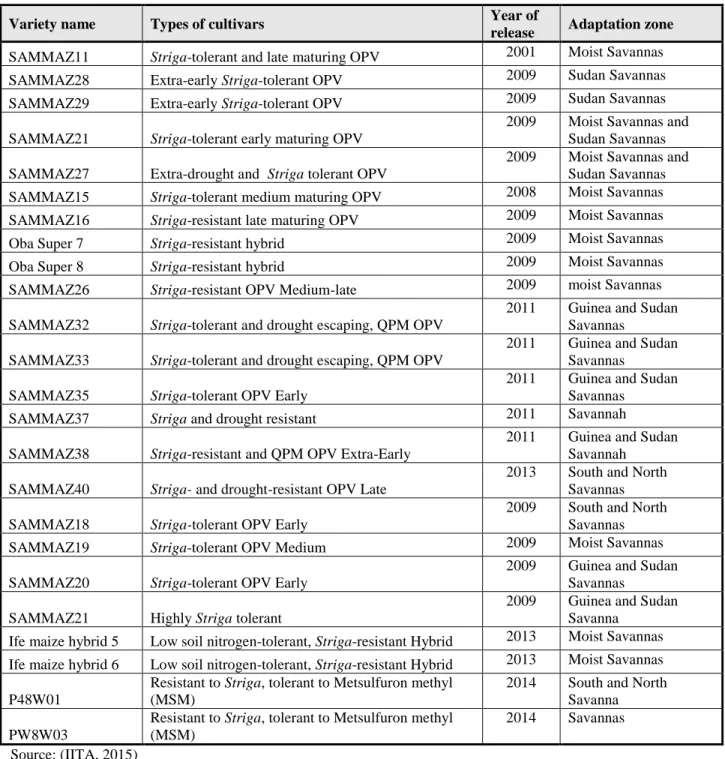
Table 2.1: Striga-tolerant and -resistant maize varieties developed and release in Nigeria ...17 Table 3.1: Adult equivalent scales for adjusting aggregate household size ...46 Table 3.2: Contingency table ...48 Table 3.3: Number of sampled households and their adoption status by local government areas
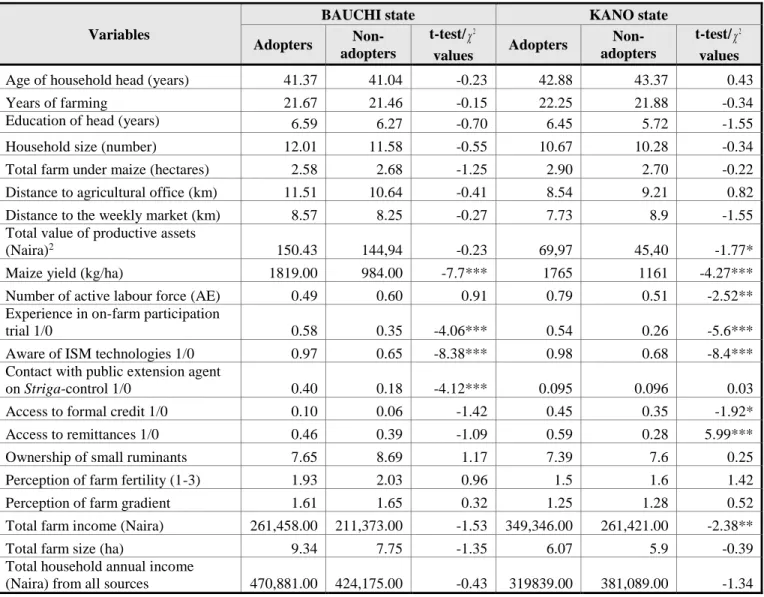
(LGAs), Bauchi and Kano states, northern Nigeria ...51 Table 3.4: Varieties of maize and soybean used under ISM on-farm trials in the study areas ...52 Table 3.5: Characteristics of respondents in PIAs and NPIAs ...56 Table 3.6: Difference in characteristics of adopters and non-adopters (sample mean), the Bauchi
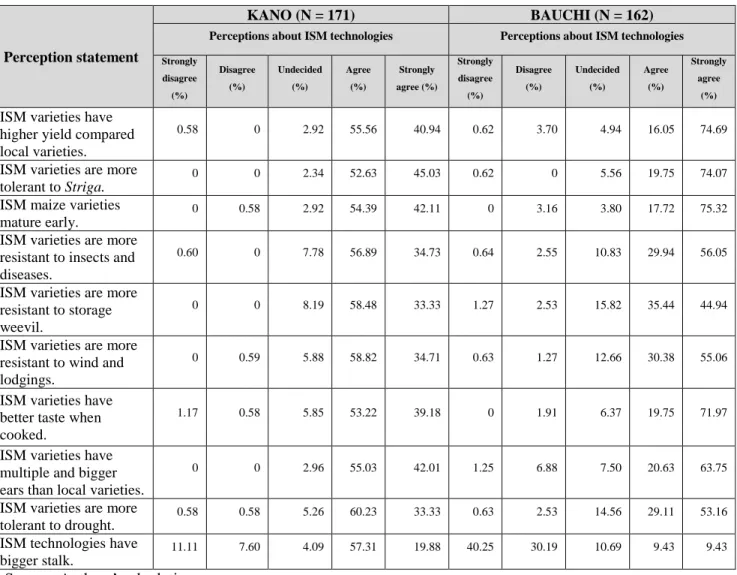
and Kano states, northern Nigeria ...58 Table 3.7: Frequency distribution of farmers’ perceptions about ISM technologies in ISM
PIAs ...59 Table 3.8: Frequency distribution of farmers’ perceptions about ISM technologies in ISM
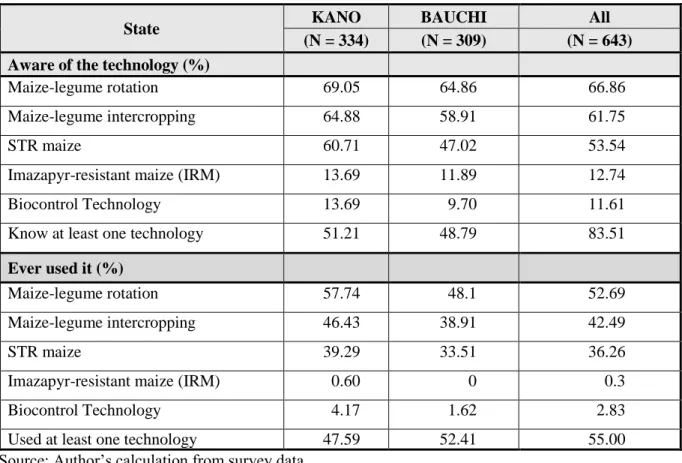
NPIAs ...60 Table 3.9: Farmers’ perception of performance of ISM technologies ...61 Table 3.10: Exposure and adoption of ISM technologies in the study areas, 2013/14 ...62 Table 3.11: Comparison of adoption rates between exposed sub-sample and the entire sample ..63 Table 3.12: Performance and diffusion index of ISM technologies ...63 Table 3.13: Contingency table showing performance difference ...68 Table 3.14: Factors militating against adoption of integrated Striga-control (ISC) technologies,
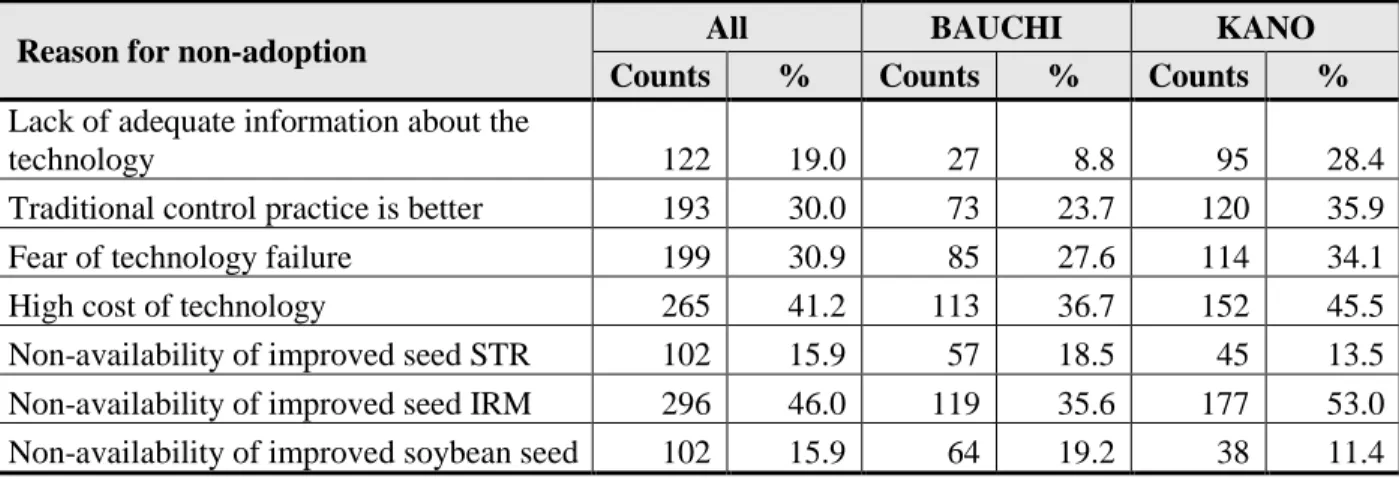
northern Nigeria, 2013/14 ...69 Table 4.1: Results of the multicollinearity diagnoses ...76 Table 4.2: Double-hurdle model results of determinants of ISM technology adoption and intensity,
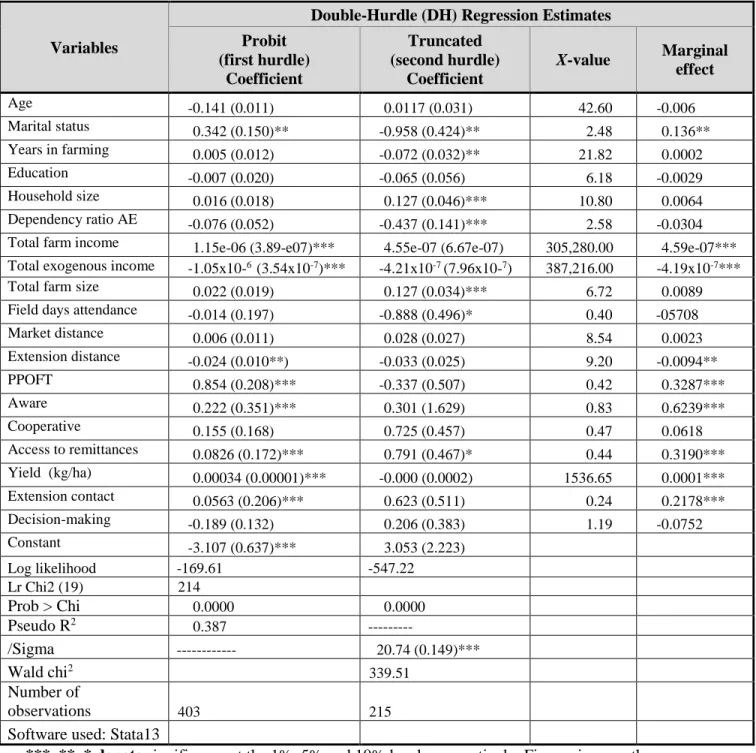
Bauchi and Kano states, northern Nigeria ...78 Table 5.1: Showing some welfare indicators of sampled households by adoption status ...90 Table 5.2: Comparative maize productivity differences between ISM technology adopters and non- adopters ...91
Table 5.3: Factors influencing households’ adoption of ISM technologies: Probit model results 93 Table 5.4: Treatment effect (TE) regression – dependent variable: log maize productivity (yield
kilogram per hectare) ...96
Table 6.1: Conditional treatment, expectations, and heterogeneity effects ...105
Table 6.2: Definition and summary statistics of selected variables used in the estimations ...108
Table 6.3: Parameter estimates of ISM technology adoption and household income equations .110 Table 6.4: Average expected household income per AEU ISM technology adopters and non- adopters ...113
Table 7.1: Summary of benefit-costs analysis of crop technologies by project and NPIAs of ISM technologies in the Kano State. ...124
Table 7.2: Summary of benefit-costs analysis of crop technologies by project and non-project intervention areas of ISM technologies in Bauchi State ...126
Table 7.3: Comparison of investment options in ISM technologies and local varieties...128
Table 8.1: Trial locations and number of sampled participating farmers, northern Nigeria, 2012/13 ...135
Table 8.2: Grain yield of improved Striga-resistant maize varieties under rotation with soya beans, when compared to farmer variety in the study area, 2012/13 ...136
Table 8.3: Partial budget (PB) comparing STR maize varieties in rotation with soya and farmer variety in the study areas, 2012/13 ...138
Table 8.4: Paired t-test of the two technologies between plots across locations in the study area, 2012/13 ...139
Table 8.5: Results of the paired t-test for mean income, obtained from the yield per ha between plots across locations in the study area, 2012/13 ...140
Table 9.1: Striga-distribution yield and economic loss in Africa’s maize cropland for selected countries ...145
Table 9.2: Study location and sample size for the survey aspect...149
Table 9.3: Socioeconomic characteristics of sample households ...150
Table 9.4: Trend of cropped land area and land infested with Striga ...152
Table 9.5: Distribution of farmers based on perceived level of Striga damage ...152
Table 9.6: Results of the on-farm trials across the Kano State ...153 Table 9.7: Results of the on-farm trials across the Bauchi State ...154 Table 9.8: Results of the dominance analysis of the on-farm trials in the Bauchi and Kano
States ...155 Table 9.9: Results of the on-farm trials using residuals analysis in the Bauchi and Kano
States ...156 Table 9.10: Results of the marginal analysis of on-farm trials across the Kano and Bauchi
States ...156
LIST OF FIGURES
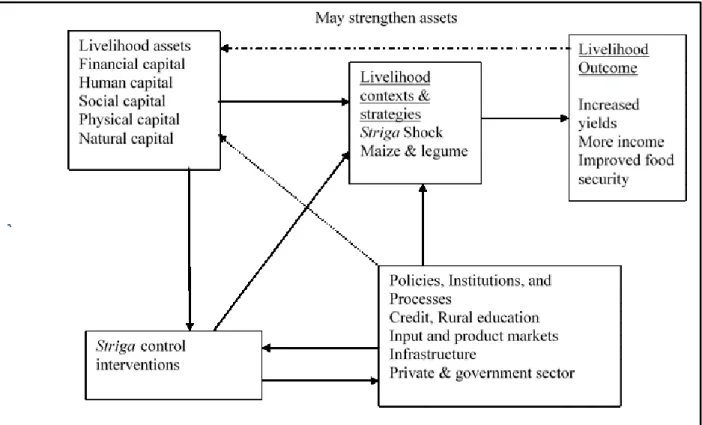
Figure 3.1: Sustainable Livelihood Framework (SLF) ...44
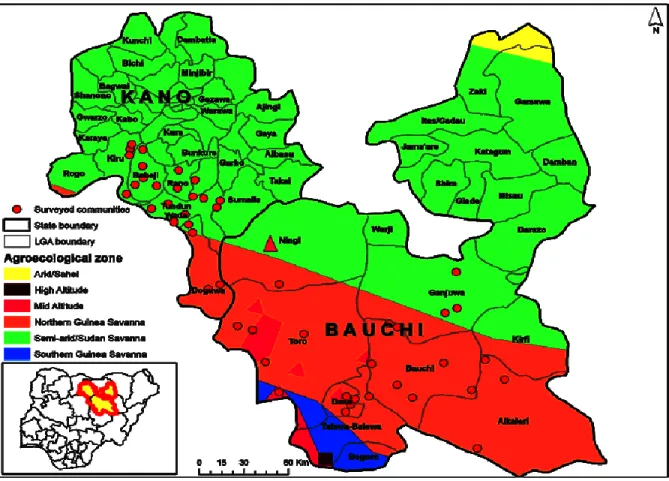
Figure 3.2: Map of the Bauchi and Kano states showing areas of study ...51
Figure 3.3: Adoption rates of ISM technologies per LGA of intervention and counterfactual in the Kano and Bauchi states of northern Nigeria (2014) ...64
Figure 3.4: Comparison of adoption rates of ISM technologies before ISMA project intervention (2010) and current mid-term period (2014). Source: Survey data (2014) ...66
Figure 8.1: Income per ha per farmer in the Bauchi State, northern Nigeria, 2012/13 ...140
Figure 8.2: Income per ha per farmer in the Kano State, northern Nigeria, 2012/13 ...141
Figure 9.1: Cropping pattern coverage in hectares ...151
Figure 9.2: The percentage distribution of traditional ways of Striga control...151
LIST OF APPENDICES
APPENDIX 1: Cash Flow Analysis of integrated Striga management technologies in northern
Nigeria ...196
APPENDIX 2: Cash Flow Analysis of Local maize production under Striga in northern Nigeria (annual yield decrease of 10%) ...197
APPENDIX 3: List of states, LGA and Communities where farmers were interviewed ...198
APPENDIX 4: Household survey questionnaire ...199
APPENDIX 5: Checklist for community surveys ...215
APPENDIX 6: Survey instrument administer at field days ...220
APPENDIX 7: Simplified survey questionnaire for on-farm trials for integrated Striga control...224
LIST OF ABBREVIATIONS AND ACRONYMS
AATF : African Agricultural Technology Foundation
ABA : abscisic acid
ABU : Ahmadu Bello University
ADP : Agricultural Development Programme
AE : Adult equivalent
AM : arbuscular mycorrhizal
ATA : Presidential Initiatives Agricultural Transformation Agenda ATE : average treatment effect
ATET : average treatment effect on the treated ATT : average total of treatment
BCR : benefit-cost ratio
BOA : Bank of Agriculture
BSADP : Bauchi State Agricultural Development Programme
BUK : Bayero University Kano
CDF : cumulative distribution function
CIMMYT : International Maize and Wheat Improvement Centre DFID : Department for International Development
DFRRI : Directorate of Food Roads and Rural Infrastructure
DH : Double-hurdle
DT : Drought tolerant
ESR : endogenous switching regression FAO : Food and Agriculture Organization
FAOSTAT : Food and Agriculture Organization Statistics FFS : farmers’ field schools
FGD : focus group discussion
FGT : Foster-Greer-Thorbecke
FIML : full information maximum likelihood
GDP : gross domestic product
GM : gross margin
GPS : Global Positioning System
GR : gross revenue
HND : Higher National Diploma
HYV : high-yielding varieties
IAR : Institute for Agricultural Research
IITA : International Institute of Tropical Agriculture IRM : Imazapyr-resistant maize
IRR : internal rate of return ISC : integrated Striga control
ISM : Integrated Striga Management
ISMA : Integrated Striga Management in Africa JSS : junior secondary school
KII : key informant interviews
KNARDA : Kano State Agricultural and Rural Development Authority
LGA : local government area
MLE : maximum likelihood estimator MSM : metsulfuron-resistant maize N : Naira (Nigerian currency) symbol
NACB : Nigerian Agricultural and Cooperative Bank
NALDA : National Agricultural Land Development Authority NARI : National Agricultural Research Institute
NBS : National Bureau of Statistics NCE : Nigerian Certificate in Education
NEPAD : New Partnership for Africa’s Development
NER : National Economic Research
NERICA : New Rice for Africa
NIP : National Implementation Plan
NPB : net present benefit
NPC : National Planning Commission NPC : National Population Commission NPIA : non-project intervention area
NPV : net present value
OFN : Operation Feed the Nation OND : ordinary national diploma OLS : ordinary least squares OPV : open pollinated variety
PB : partial budget
PIA : project intervention area PSM : propensity score matching
SLF : Sustainable Livelihood Framework
SSA : sub-Saharan Africa
SSCE : Senior Secondary Certificate of Education
TE : treatment effect
TEST : on-farm test
TETFUND : Tertiary Education Trust Fund TFP : total factor productivity TVC : total variable cost
UNDP : United Nations Development Program UNSD : United Nations Statistical Division
US$ : United State Dollar
USDA : United States Department of Agriculture
VC : variable cost
VIF : variance inflation factor
CHAPTER 1 INTRODUCTION
1.1 Background
This chapter is divided into eight sections. After the introduction, the second section presents a general background of the thesis, focusing on agricultural development and production of staple foods (e.g., maize and beans) in Nigeria. The third section describes the problem statements of the study, including a brief description of the extent of Striga distribution, the economic damage associated with Striga infestation in Nigeria and the reason for conducting this study in brief. The fourth section discusses the research questions and objectives, while the fifth section describes the hypothesis testing. The sixth section describes the rationale for the study. The seventh section describes the policy relevance of the study and the last section describes the expected output of the study.
Nigeria, with a total land mass of 92.4 million hectares (ha), comprises 1.3 million ha of various water bodies and 91.1 million ha of land. The agricultural land area consists of about 83.6 million ha, comprising 33.8% arable land, 2.9% land permanently under crops, 13% forest or woods, 47.9% pasture and 2.4% irrigable land or fadama (NEPAD, 2004; Adetunji, 2006; FAO, 2009).
Livestock and poultry production account for about 10% of the gross domestic product (GDP).
Major crops include maize, rice, sorghum, millet, cowpeas, soybeans, cassava, yams, groundnut, cocoa, palm kernel, palm oil, sesame, cashew nuts, gum Arabic, kola nut, melon, plantains and rubber.
Agriculture remains the backbone of Nigeria’s economic growth. It is composed of four sub- sectors: arable crops, forestry, livestock and fisheries. Like in other developing countries, particularly those in sub-Saharan Africa (SSA), the agricultural sector plays a major role in the development of the Nigerian economy. According to data released by the National Bureau of Statistics (NBS, 2013), the agricultural sector contributed 41% on average to Nigeria’s GDP and employed around 70% of its total workforce during the 2001-2009 period. The contribution of the agricultural sector to Nigeria’s GDP in 2013 was 20% and represents an area that embraces high prospects for diversifying the economy away from oil revenues (NBS, 2013). However, despite its
growth potential, Nigeria’s agricultural sector’s contribution to the GDP has been on the decline from 41% in the last eight years (2001-2009), while it has only recorded about 30% of the growth in non-oil output (National Planning Commission, 2009). Despite the potential of the agricultural sector, Nigeria’s cereal import ratio is at a very high 21.7%. While its continued significant stake in the GDP is an indicator of underdevelopment in the economy (because of weak expansion in the industrial sector), the significance of the agriculture sector to Nigeria’s national development cannot be emphasised enough. Considering the Nigerian vision of becoming one of the 20 largest economies in the global arena by the year 2020, a strong, technology-enabled agricultural sector is necessary to grow its national output. The development of agriculture will help grow the industrial sector through the release of excess labour, thereby supporting the industrial expansion and raising foreign exchange earnings. Above all, making food available for the fast-growing population and making provision for gainful employment along the agricultural value chain may ultimately lead to wealth creation and, on a sustainable basis, bring about remarkable reduction in poverty. The agricultural sector can play a major role in the attainment of the nation’s economic transformation blueprint, Vision 20:2020, namely "optimizing the key sources of economic growth to increase productivity and competitiveness, regarding growth in national output, and total factor productivity (TFP). Under the 1st National Implementation Plan (NIP), the policy thrust was on enhancing TFP (that is a reasonable increase in output per unit input) in the agricultural sector through the application and diffusion of technology and improvement in the knowledge base,"
(National Planning Commission, 2009).
Despite agricultural sector contribution to the GDP, the sector remains weak, which, according to records, is brought about by the mere increase in hectarage under cultivation rather than by efficient productivity gains. This situation does not differ from the finding of De Janvry et al.
(2010) on agricultural production in SSA. Low input (seeds and fertiliser) characterises this inefficient agricultural production that results in:
yields below the average African production system (World Bank, 2013);
weak intersectoral linkages;
aging farmers;
an informal production that is not accompanied by efficiency; and
poor marketing structure.
Governments have, at various times and stages, made all possible efforts through the formulation and implementation of various programmes and projects to improve the sector and come up with a feasible option to address some of the growth bottlenecks in the sector. These programmes and projects include Green Revolution, Operation Feed the Nation (OFN), National Agricultural Land Development Authority (NALDA) and National Food Security Programme (NFSP). Other agricultural programmes of government include National Accelerated Food Production Programmes, River Basin Development Authority, Agricultural Development Programme (ADP), Directorate of Food Road and Rural Infrastructures (DFRRI), Nigerian Agricultural and Cooperative Bank (NACB), now Bank of Agriculture (BOA), Presidential Initiatives Agricultural Transformation Agenda (ATA), etc. The agricultural sector is considered to be critical to the attainment of the nation’s vision of boosting the vital sources of economic growth and development in order to increase productivity and competitiveness. However, among many others, the parasitic weed Striga spp. have become one of the major biotic constraints to grapple with in achieving the sector’s goals. Other constraints include poor market demand and low market price for produce. The high cost of labour, inputs such as fertiliser, seeds, and agrochemicals, and transportation of farm produce to distant markets significantly reduce farmers’ net income (African Fertilizer Summit, 2006; Amaza et al., 2007; Hassan and Sanni, 2011; Mignouna et al., 2013).
1.1.1 Importance of maize crop and Striga
Maize is a major staple food crop grown across many agro-ecological zones and production systems. It is consumed by diverse communities in different forms among different socio-cultural backgrounds in SSA. The place of maize in SSA as staple food can be compared to that of rice or wheat in Asia. Maize is grown on over 34 million hectares in Africa with a corresponding output of about 70 million tonnes, making it the highest among the cereals. Out of the 22 countries globally where maize constitutes the highest proportion of the diet in terms of calorie intake, 16 of those countries are in Africa. One fifth of the calories and protein consumed in West Africa are from maize (FAO, 2015). About 208 million people in SSA depend on maize as their source of food and well-being. In SSA, 200 millions hectares of cultivable land, more than 33 million hectares are occupied by maize (FAO, 2015). Nigeria produces more 43% of maize grown in West Africa (Kudi et al., 2011).
According to the African Agricultural Technology Foundation (AATF (2006), and Woomer and Savala (2007), an estimated 823,000 ha of maize fields in Nigeria are infested by Striga, implying that about 34% of farmland in Africa is under Striga threat. Especially the rural communities among the smallholder farmers in northern Nigeria, are severely affected by Striga infestation, with reported yield losses of between 70% and 100% (Emechebe et al., 2004; AATF, 2008a).
Hence, there is an urgent need for effective control of these parasites to enhance higher yields.
In Nigeria, only three of the Striga species were found to be affecting crops: Striga hermonthica (sorghum, rice, millet and maize), Striga aspera (rice) and Striga gesnerioides (cowpea) (Dugje et al., 2006). Across the different communities, Striga species are known as wuta-wuta, kudiji, makasa or kanjamau and may occur in the same field because of intercropping. Several years of research on Striga management have resulted in identifying some range of control technologies.
Examples of these are Striga-tolerant and Striga-resistant varieties of maize (Zea mays), sorghum (Sorghum bicolour) and millet (Pennisetum glaucum), which proof to be an effective way of reducing Striga seed bank and damage (Kling et al., 2000). Currently, many Striga-resistant maize varieties have been developed by IITA in collaboration with the National Agricultural Research Institutes (NARIs). They have also been approved and released after satisfying the release requirement by the National Variety Release Committee in Nigeria.
Striga strains, however, may show some resistance to Striga-resistant cereal varieties due to future evolutionary adaptation. The use of legume trap crops, which can stimulate the suicidal germination of Striga is another technology to help control Striga. Trap crops include varieties of cowpea (Vigna unguiculata), sesame (Sesamum indicum), soybean (Glycine max) and groundnut (Arachis hypogaea) (Hess and Dodo, 2004). Due to the poor soil condition on farms, the application of nitrogenous fertiliser to cereals on fields with low fertility can reduce crop damage caused by Striga (Joel et al., 2007). Farmers have developed a range of mitigative measures on their own to control Striga. These include the use of manure or compost, hand-rogueing and incessant hoe-weeding (Emechebe et al., 2004). However, none of these individual technologies can, on its own, provide adequate Striga management across the wide range of socioeconomic and biophysical environments. The majority of farmers in Africa have failed to manage Striga on cereals fields, even with various released Striga management technologies that have demonstrated to be successful on-farm and on-station. Hence, an integrated Striga-management (ISM)
technology that is adjustable and healthy enough to meet the wide range of farming environments have been suggested (Chikoye et al., 2006).
As a result of the intensity of Striga occurrence in northern Nigeria, the IITA initiated an Integrated approach to Striga management dubbed the Integrated Striga Management in Africa (ISMA) project. That is jointly implemented by Ahmadu Bello University (ABU), the Bayero University Kano (BUK), the Institute for Agricultural Research (IAR), the Kano State Agricultural and Rural Development Authority (KNARDA) and the Bauchi State Agricultural Development Programme (BSADP). The ISMA project was an extended project implemented in the two states (Kano and Bauchi) in northern Nigeria, with a project life cycle of four years, from 2011-2014. Its aim is to increase productivity, the income of households and food security. The project aimed to achieve these goals via project farmers delivering improved extended services to farmers participating in the project and to increase adoption, commercialisation and marketing of improved STR and suppressive varieties through a community seed-production approach.
Achieving affordable and sustainable Striga management for poor farmers in Nigeria through the ISMA project comprises two parts: the inception stage, followed by the impact study stage. During the inception stage, the IITA conducted a baseline study in areas that were to benefit from Striga- control interventions, by measuring the key economic and social indicators before implementing the major components of the project. The baseline study was specifically aimed at understanding the production systems; identifying maize varieties grown and farmers’ preferences; determining constraints and opportunities; establishing Striga incidence and severity on the two crops; and, moreover, assessing yield levels (Mignouna et al., 2013). After that, the ISM technology on-farm trials, which represents the impact study stage, began in the affected communities.
1.2 Problem statement
An estimated 70% of Nigeria’s population are directly or indirectly engaged in agriculture and the poverty level is rising, with almost 100 million people living below $1 a day. Based on a recent survey of 20 million households across the country, 112,519 million Nigerians live in poverty (NBS, 2013). According to the record issued by the NBS, the northwest and northeast geo-political regions had the highest rates of poverty in the country in 2010, namely 77.7% and 76.3%,
respectively. Co-incidentally, Kano and Bauchi fall within these geo-political zones where the Striga incidence is so severe.
Maize and cowpea (Vigna unguiculata) are two major staple food crops from cereals and legumes that are widely produced and consumed throughout Nigeria. They provide sources of income to smallholder households in rural areas. An estimated 90% of the country’s maize is produced in the northern region, which is the most suitable and agriculturally productive region of the country. In Nigeria, for instance, maize and sorghum are the two primary crops that occupy about 40% of the total cultivable land. Nigeria accounts for about 43% of the maize production in West Africa (Smith et al., 1997; Phillip et al., 2009). Among the different income groups, maize forms an important source of both protein and calories among the poorer population of consumers, including HIV/AIDS-affected families, who cannot afford foods such as bread, milk or meat that are considered more expensive (Byerlee and Heisey, 1996; Byerlee and Eicher, 1997). About 3.5 million people in Nigeria are infected with HIV/AIDS, which makes out about 9% of the global infection (FAO, 2015). Therefore, maize production is considered significant for national food security and the socioeconomic stability and well-being of Nigeria. However, recurring droughts, insurgent activities (Boko Haram) and Striga infestation, among others, are continuous challenges for the production of these important crops in Nigeria, since they drastically reduce yields and livelihoods. The average maize yield in Nigeria was 2,000 kg/ha in 2012 (USDA, 2014), being far below the potential yield of 7,000 to 9,000kg/ha. Recent findings from the biophysical and baseline surveys in the Kano and Bauchi states reveal that the Striga hermonthica incidence in maize fields ranged from 0%-100% in the Kano state, and varied among communities and Local Government Areas (LGAs) (Ekeleme et al., 2014). Striga incidence ranged from 63%-100% in 77% of the sampled communities. In the Bauchi state, the Striga hermonthica incidence in maize and sorghum fields was 100% in all the communities. Striga gesnerioides was prevalent in more than 95% in both of the states. The Striga incidence in Bauchi and Kano was negatively correlated with maize, sorghum and cowpea yields (Ekeleme et al., 2014). Average households’ maize yield was very low, ranging from 1,430 kg/ha (local variety) to 2,317 kg/ha (hybrid), compared to 4,000 and 9,000 kg/ha obtained in South Africa and the USA, respectively (Mignouna et al., 2013; USDA, 2014).
The cowpea yield in the study area ranged between 323 kg/ha to about 900 kg/ha where improved varieties were used (Mignouna et al., 2013), with cowpea being an integral component of ISM technologies. The development, deployment and cultivation of Striga-control technologies and
Striga-tolerant maize (STM) varieties, therefore, have the potential of reducing vulnerability, food insecurity and damage to local markets associated with food aid.
Based on the recent output obtained from the ISM biophysical and baseline study in the Bauchi and Kano states, the finding revealed that the major constraints identified as plaguing cereal and legume production in the study region, include Striga, stemborer, termites, storage insects, low and erratic rainfall, water logging, and low input. The majority of the farmers (more than 80%) in the Bauchi and Kano states reported Striga as the most significant constraint to maize and cowpea production (Mignouna et al., 2013). Striga infestation of cereal crops has had a negative impact on the livelihoods of smallholder farmers in Africa. In order to tackle this problem and improve the livelihoods of millions of smallholder farmers in northern Nigeria, the IITA initiated a project in 2010, tagged as ISMA and funded by the Bill and Melinda Gates Foundation. The project adopts and intensively promotes proven integrated Striga control (ISC) strategies in targeted areas in northern Nigeria, with the active participation of farmers, communities, extension workers, policy makers and researchers.
The immediate past Minister of Agriculture, Akinwumi Adesina (Daily Times, 2013) stated that the maize ‘Green Revolution’ would transform the maize industry and make farming more profitable. His agricultural reforms would target the raising of Nigeria’s annual maize production from the then 8 million tons to an annual 20 million tons. This revolution was part of the efforts to enhance food security, create jobs and, more importantly, cushion Nigeria from the effects of rising food prices. Increasing maize production and other crops would ensure food security and generate income and jobs, thereby alleviating the prevailing poverty condition. However, this could only be achieved if constraints to farmers’ productivity, such as Striga infestation, were drastically reduced or completely eradicated. While ISM technologies may raise farm household productivity through the reduction of the Striga count, another constraint may arise, such as getting corresponding inputs like STR seeds, Imazapyr-resistant maize (IRM), bio-control inoculums and other socioeconomic and institutional factors. These factors are, however, beyond the control of farming households and make it more important to recognise the degree to which farmers’
socioeconomic characteristics and other institutional and cultural constraints hinder farmers in adopting ISM technologies. Given the above scenarios, this study intends to provide answers to the following research questions:
i) What are the socioeconomic characteristics of maize-farming households and their perceptions of ISM technology attributes?
ii) What are the determinants of potential adoption and intensity of adoption of ISM technologies at farm level in the study area?
iii) What is the potential impact of ISM technology adoption on livelihood improvement, income and food security of maize farming households in the study area?
iv) What are the financial and economic benefits of ISM technologies in the study area?
1.3 Research objectives
The broad objective of the study is to assess farmers’ perceptions, and identify the adoption determinants and potential impact of adoption of ISM technologies on income and food poverty among farming households in northern Nigeria. The specific objectives of this study are to:
i) identify the socioeconomic characteristics of the maize-producing household and their perceptions of ISM technology attributes in the study area;
ii) determine the factors influencing the potential adoption and intensity of adoption of ISM technologies by farming households in the study area;
iii) estimate the potential impact of ISM technology adoption on the livelihood improve- ment, income and food security of maize-farming households in the study area; and iv) assess the financial and economic impact of ISM technologies in the study area.
1.4 Hypotheses
Given the objectives of the study, the hypotheses are presented as follows:
Hypothesis I: Households who adopted ISM technologies systematically do not have different characteristics to counterfactuals.
Hypothesis II: Households’ socioeconomic circumstances have no significant influence on the potential and intensity of adoption of ISM technologies.
Hypothesis III: There is no statistical difference in the average farm income of households using ISM technologies and the counterfactual (local or farmer practice).
Hypothesis IV: There is no significant difference in the profitability of ISM technologies and the counterfactual.
1.5 Rationale behind the study
Serious efforts in providing high yield varieties (HYV) and environment-friendly technologies are required to achieve sustainable agricultural growth and development, which will bring about an improvement in rural household income and possibly translate into improving household well- being. According to Asfaw (2010) and Di Falco et al. (2011), it is, in respect of increasing economic and climatic variability, especially in the semi-arid tropical countries of Africa where cereal production is grossly affected. Improvement in the production of legumes, such as cowpea, Bambara nut, green gram, groundnut and soybean, presents an opportunity to draw back trends in productivity, food insecurity and poverty. Because legumes have the capacity to incorporate atmospheric nitrogen into the soils, they improve soil fertility and possibly even reduce the quantity of fertiliser required in future cropping seasons. Also, leguminous crop can promote a more comprehensive and innovative use of land, especially in areas where there is a paucity of land. It is also possible to grow it as a second crop under residual moisture, such as planting cowpea as a relay crop in a maize field. Furthermore, eating legumes can reduce malnutrition and enhance human health improvement, especially for the poor who cannot afford animal protein. Finally, the growing demand for legumes in both local and international markets (Simtowe et al., 2011; Asfaw et al., 2012b) can provide a source of income for smallholder farmers and earn the country foreign exchange (AATF, 2008b). Therefore, agricultural research and technological development are vital to enhance agricultural productivity, thereby increasing household income and reducing poverty among smallholder farmers. However, the assessment of the impact of these technologies on rural household income was limited by the lack of appropriate approaches. Most of the past studies by Ellis-Jones et al. (2004) and Mignouna et al. (2011b), had thus failed to move beyond calculating economic surplus, particularly to Striga management technologies and returns to research investment.
Despite all the research efforts by the IITA and the NARIs to developed some Striga-resistant maize, soybeans and cowpea for the past decade and released by the variety release committee. To date, Striga persists as a major challenge to the northern Nigerian farmers, despite the release of the developed STR maize, improved soybeans and cowpea varieties, and using the legumes for rotation in maize-based farming systems to the farming communities in Nigeria’s Savannah.
Limited assessment had been made to document the likelihood of farmers’ adoption and
profitability of adoption of these technologies in northern Nigeria. The demand for STR varieties of maize and cowpeas is, however, likely to increase if varieties are designed to include end users’
preferred traits. Technologies in focus for economic assessment are:
i) maize-legume (soybean, STR cowpea, groundnuts) rotation;
ii) maize-legume (soybean, STR cowpea, groundnuts) intercropping;
iii) STR maize monocrop; and
iv) IRM monocrop (the IRM consists of dressing the seed of the IRM with the Imazapyr herbicide). By the time the maize seed germinates, it has absorbed the herbicide used to dress it. During germination, the Striga is stimulated to germinate too and attaches to the maize root, whereby the Striga plant gets killed by the action of the herbicide before it causes damage to the maize plant. The herbicide that is not absorbed by the maize plant then diffuses into the soil and kills the Striga seeds that have not germinated (CIMMYT, 2004; AATF, 2006).
In reviews of adoption studies in developing countries (Feder and Umali, 1993; Adesina et al., 2000; Mendola, 2007; Langyintuo and Mungoma, 2008; Bernard et al., 2010; Awotide et al., 2012;
Arslan et al., 2014). Many of these studies were found to have analysed the direct effects of farmers’ personal assessment of agricultural technology characteristics on adoption decisions, however, none had analysed the direct effects of farmers’ subjective assessment of ISM technologies. Therefore, this study was set out to examine this direct effect of farmers’ personal assessment of agricultural technology characteristics on adoption decisions, and evaluate the potential impact of ISM technologies on the welfare of smallholder farmers in the rural areas.
These effects were measured in terms of productivity and income, net present benefits (NPBs) and BCR in northern Nigeria.
1.6 Policy relevance
The goal of any food insecurity reduction strategy is to increase yield and revenue in order to improve the well-being of the client. Hence, understanding the factors influencing technology adoption, the intensity of adoption and the potential impact of technology adoption on farmers’
welfare is of paramount importance for policies that aim to increase farmers’ output, income and well-being to ensure the meaningfulness of target intervention (Adesina and Baidu-Forson, 1995;
Alene and Manyong, 2007; Mignouna et al., 2011a). This study also examined the income
portfolios of farmers in the study area, which provided an in-depth understanding of the different farming activities that rural farmers in the Striga-infested areas were engaged in. Moreover, the study examined how farmers’ socioeconomic characteristics affected their potential for and intensity of adoption.
1.7 Plan and structure of the study
This study contributes to the project databases through the analysis of cross-section survey data on production conditions, productivity impacts and adoption constraints. The analysis provided new insights into research and targeting activities, which can be used to maximise the adoption and resultant economic gains for poor and vulnerable households. The results will gradually inform and improve technology development and delivery activities, and contribute to the development of more relevant technologies, partnerships and institutional arrangements to, in turn, improve the transfer of Striga-control technologies. The study can also serve as a guide for the implementation of Striga-control measures in other areas of the sub-region, and Africa at large, which are constrained by Striga. Considering the economic importance of Striga and the quantum of grain loss due to Striga infestation, the study justifies the need for synergy between institutions in combating this pest and achieving a relative increase in the productivity of affected crops.
This dissertation is presented in ten chapters, including the introductory chapter. Chapter 2 discusses the literature review and presents key concepts and definitions. It provides an overview of the biotic plant parasite, Striga, and its economic importance in SSA. It also provides different technologies developed to manage Striga problems. Furthermore, the chapter provides theoretical and empirical evidence of the socioeconomic determinant of agricultural technologies, the intensity of adoption of these technologies, and the impact of its adoption on the welfare of farming households.
In Chapter 3, the socioeconomic characteristics of the farmers and their perceptions of ISM technologies, diffusion and adoption pathways in the study area are examined. Chapter 4 analyses the factors that influence ISM technologies among smallholder farmers and the factors that affect the intensity of ISM technology adoption. In Chapter 5, smallholder maize farmers’ productivity impact of ISM technology adoption at farm level is determined by measuring maize productivity and household welfare, expressed in poverty gap, index and severity. The impact of ISM
technologies on farm income (measured in per adult equivalent unit) is determined in Chapter 6, while Chapter 7 presents the economic analysis of ISM technologies and local practices in terms of financial and economic profitability. The results of two selected on-farm trial technologies are presented in Chapter 8 and Chapter 9, and the conclusion, some policy implications of the study findings, and measures for further research are presented in Chapter 10.
CHAPTER 2 LITERATURE REVIEW
2.1 Introduction
In this chapter, a review of relevant literature is undertaken as it relates to the agricultural significance of Striga and its parasitic nature on maize. A discussion on some of the emerging technologies for the effective control of Striga is also included. Furthermore, the chapter presents literature on the conceptualisation of technological adoption and factors that are associated with farmers’ adoption behaviours. These behaviours focus on their socio-demographic characteristics, institutional factors and perceptions; on technology characteristics; and on risks and constraints to agricultural technology adoption. Literature on the factors influencing the intensity of agricultural technology adoption and the economic attributes of technology adoption is reviewed as well.
Another focus in this chapter is the concept of technology adoption impact on household income, as well its economic profitability in the rural economy.
2.2 Economic importance of Striga and control management
This section reviews some of the significance of Striga parasites and its devastating effect to cereal production. It also reviews some of the Striga-control management that is currently available and their mode of action.
2.2.1 Agricultural significance of Striga and yield losses
Striga, commonly known as witchweed, is a parasite that adversely constrain the production of cereal crops such as millet, maize, rice and sorghum across many agro-climatic regions of SSA.
Striga survives through absorbing nutrients and water from the host crop for its growth and survival (AATF, 2008a). It is very productive, with a single plant producing over 200,000 tiny, sticky seeds, which can remain dormant in the soil for longer than 20 years. Striga seeds can spread by the wind, water, humans, animals and farm implements (Gressel et al., 2004; AATF, 2006).
Their seeds can only germinate when they sense germination stimulants from a potential host crop, after which the parasite sucks nutrition from the host plant (De Groote et al., 2008). Striga causes severe injury to its host crop before appearing on the surface of the soil, through the production of phytotoxins which are harmful to the host crop. When Striga attaches to the roots of the plant and
extracts nutrients consisting of water and minerals, the plant appears like a ‘witch’ because of its retarded growth and withering (Diallo et al., 2007). Striga has persistently reduced farmers’
harvests for decades, leading to some farmers entirely abandoning maize cultivation (De Groot, 2007; Ejeta, 2007). According to Unicef (2015), about half of the population living in Striga- infested regions lives below the 1 US$ poverty line per day, and two-thirds of the countries in that region are classified as “weak” in the ranking of the human development index. Also, 40% of the girls and 30% of the boys in this region are not in school, resulting in the Sahelian region’s literacy level being far below that of coastal West and Central Africa. Similarly, according to the Joint United Nations Programme on HIV/AIDS (UNAIDS, 2014), around 24.7 million people of the population living in the regions are also infected with HIV, thus depriving farming households of much-needed labour and leading to a further reduction in staple crop yields. The cost of labour and drudgery, particularly for women associated with weeding prolific weeds such as Striga, only compounds an already grave situation for poor farming households.
2.2.2 Current status of Striga problems worldwide
Currently, there is no reliable estimate of the total area affected by Striga, however, it is believed that, in 1991, about 16 million hectares of land were considered to be under threat of Striga in the West Asia region and Mediterranean (Sauerborn et al., 1991). In Africa though, it is estimated that 44 million hectares are “endangered”, with a total estimated loss of $US 2.9 billion revenue from maize, pearl millet and sorghum in 1991. The latest records suggest that 300 million farmers and 50 million hectares in Africa are affected by Striga spp., with a total loss of $US 7 billion (Ejeta, 2007). According to Ejeta (2007), Striga hermonthica is the most destructive among all Striga spp., affecting mostly staple crops grown in Africa. This Striga expands from tropical and northern subtropical regions of Kenya, Tanzania and Ethiopia in the east to Gambia in the west.
According to (IITA, 2013), farmers expect an average maize yield of 1.5 tons/ha in the Nyanza Province of Kenya where maize is grown without Striga, whereas the expected yield is about 700 kg/ha in fields with moderate infestation and only about 20% in areas with severe infestation. I the case of the Western Province of Kenya, the corresponding figures are 1.8 t/ha, 50% and 20% yields, respectively (IITA, 2013). With the introduction of the novel technology of Imazapyr-treated seed of herbicide-resistant maize, the estimated yield per hectare of farmers’ field was double in those areas (De Groote et al., 2008). Past reviews (Elzein and Kroschel, 2003), however, suggested the
persistence of the problem and made no reference to its decreasing importance as a result of strong control management. In northern Ghana regions, it is estimated that about 70% Striga-infestation of all cereal fields do not suggest any over-all progress either.
However, to some extent, there is a little progress that indicate some reduction locally in the Striga problem. Reports from East Africa are favourable towards Striga hermonthica control applied by means of the Desmodium intercrop technique (Khan et al., 2006a; Khan et al., 2008a). This technique was estimated to be adopted by at least 7,000 farmers across Tanzania, Kenya and Uganda. Furthermore, the use of herbicide-treated maize seed (De Groote et al., 2007), or a combination of the two approaches (Vanlauwe et al., 2008) had also been fruitful. Farmers are using these two technologies and there seems to be a possibility of getting a remarkable result on farms that can afford them. Farmers using the push-pull (Desmodium cereal intercrop) technique are attaining twice the maize yields when compared with the farmer controls. The accrued benefit is mostly due to Striga control (Khan et al., 2008b; Khan et al., 2011).
2.2.3 Striga parasitism
Striga spp. is a plant parasite that limits cereal crop production in many parts of Asia and Africa.
The gathering of signals exchanged between Striga and a majority of its hosts that lead to success- ful parasitism is an interesting biological relationship. Some chemical substances produced by host plants are signs required to induce the germination of Striga plant seeds and trigger connection organ formation. Even though the Striga can photosynthesize, once it appears above the ground, it relies on host plants for a substantial part of its carbon supply (Cechin and Press, 1994); (Pageau et al., 1998). Apart from losing food and water to these parasites, host plants also suffer disorders like the symptoms of crops growing under drought, for example, the increased root:shoot ratios and leaf scorching (Rank et al., 2004). Th