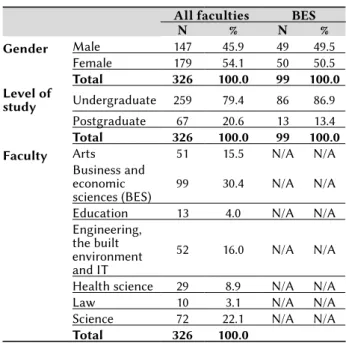
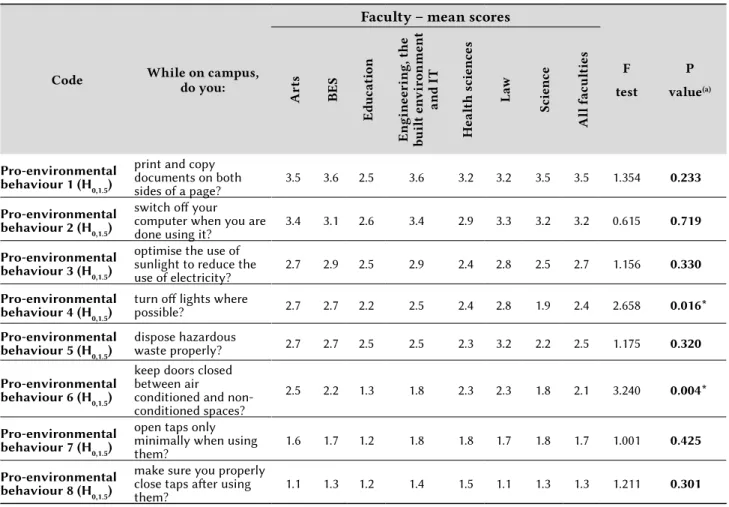
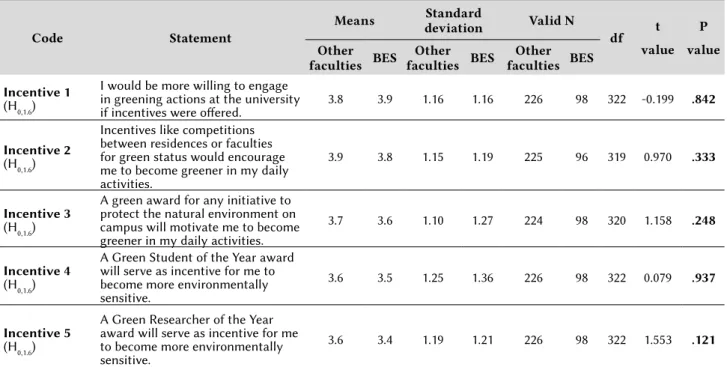
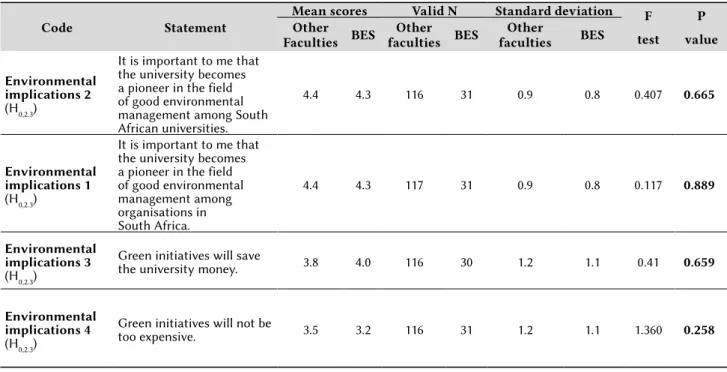
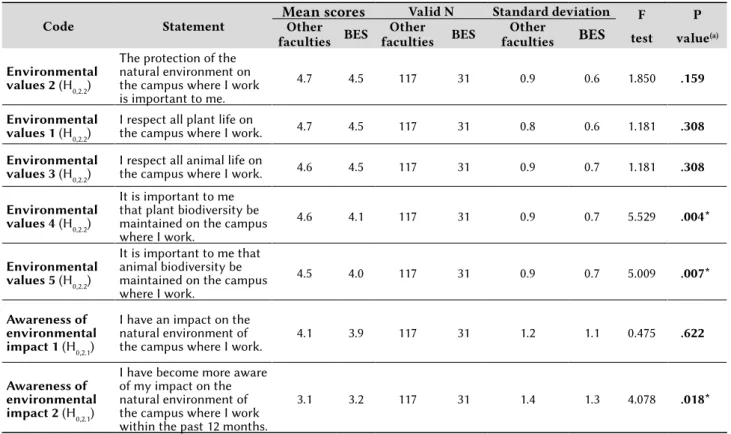
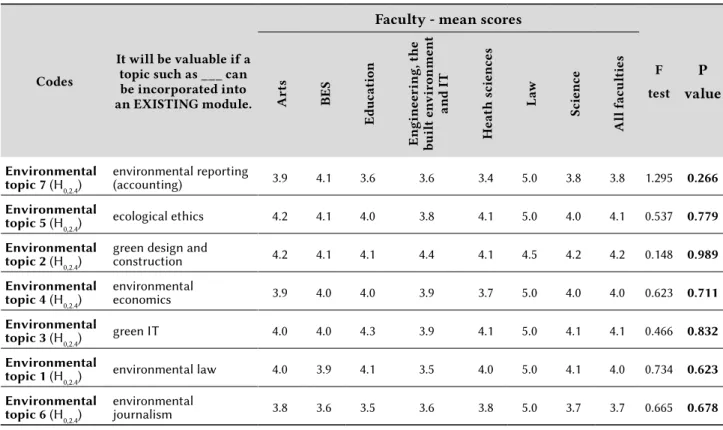
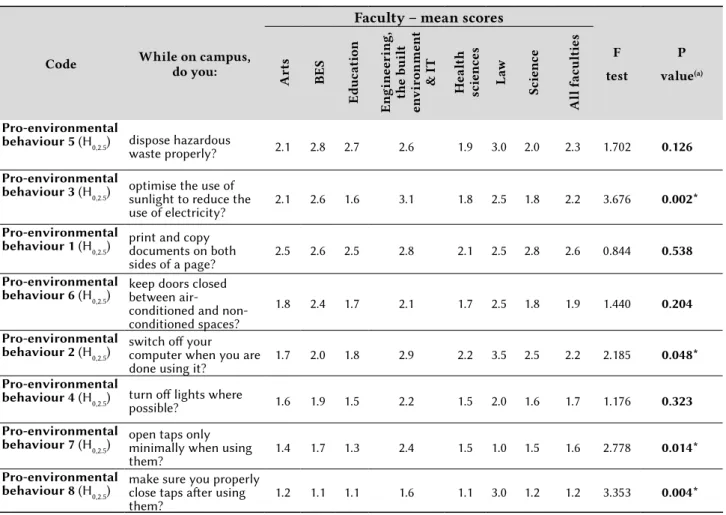
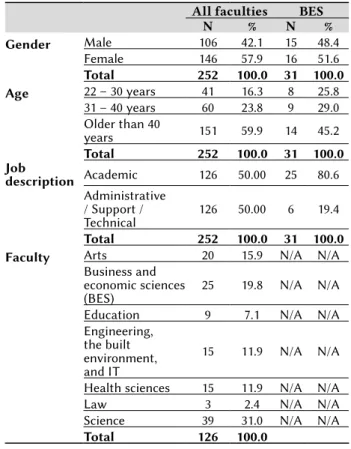
Are students and academics at BES faculty more or less motivated by incentives to go green than respondents at other faculties. Almost a fifth of the surveyed academics (19.8%) were employed at the ZŠU faculty. The statements are ranked from the highest to the lowest average score for respondents at the BES faculty.
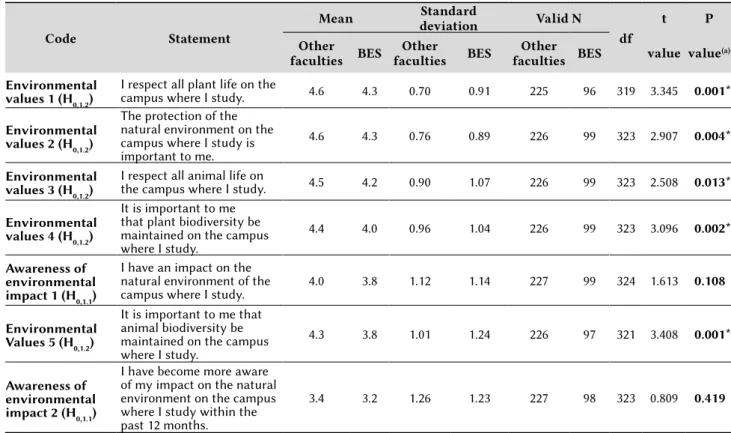
Students in other faculties considered the reputation of the university as a leader in the field of sound environmental management in South Africa to be more important than students in the BES faculty. Students in the BES faculty were not as convinced as their counterparts in other faculties that this would be the case. Regarding the environmental awareness of academics, BES and other academics were neutral regarding an increase in the awareness of their environmental impact.
As can be seen in Table 8, two statements dealing with environmental values showed statistically significant differences between academics at the BES faculty and those at other faculties. Since there was a significant difference in academics' perceptions of this issue, H0,2.4 can be rejected. The average grades of academics in the BES faculty were consistently higher (for all incentives) compared to those of academics in other faculties.
Significant differences were observed between BES and other academics in terms of the environmental values they display, their desire to include environmental topics in the module they teach, the extent to which they engage in pro-environmental behavior and the incentives they might motivated to engage in environmentally friendly behavior.
This article discusses the imperatives of human resource management (HRM) studies in the context of contemporary South Africa. The authors suggest that the content and processes of HRM education must prepare students for critical participation in contemporary South African society and the workplace. In 2011, he moved from teaching at the College of Social Sciences (UKZN) to the College of Management (UKZN).
This paper is an attempt to lead the debate on the role of CMS in the classroom. The authors reflect on these goals in the context of HRM education in contemporary South Africa. The exploration is situated within the ideas of CMS and emancipatory education, and the specific personal and political prompts for the inquiry are identified.
The dynamics in the South African context were exemplified in the fatal shooting of 42 miners in August 2012 at Marikana. This can encourage a shift towards a more social and critical perspective in the way the discipline is taught and research is generated. Students need to be presented with multiple perspectives on how economies work to promote a problem-solving approach in the classroom.
Inevitably, students will experience the contradictions between the imperative of the moral economy and that of the market economy. HRM is a social science, and there is a need to include social science perspectives in the teaching of HRM. In the context of this study, these components align well with the need to educate students to become active agents in their communities and whose education informs their engagement in economic, political and social environments.
Two broad shifts in the way teaching and learning are conducted can be helpful here. These shifts entail a reconceptualization of the teacher's role in the learning process, and approaching the learning materials through cases and problems. In order for students to develop a voice in learning, changes in teaching and learning cannot happen piecemeal, but must be built on a reconceptualization of the role of the teacher and a reconfiguration of learning spaces and the relationship in between.
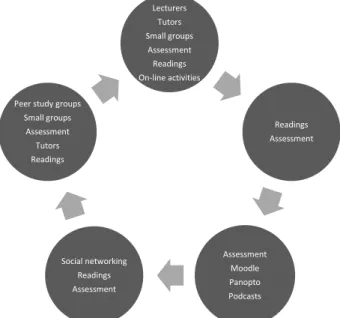
The teacher is conceptualized as "being a usefully ignorant employee in the middle of the action". As suggested in the diagram, learning can occur at a number of interconnected sites.
China and intellectual property
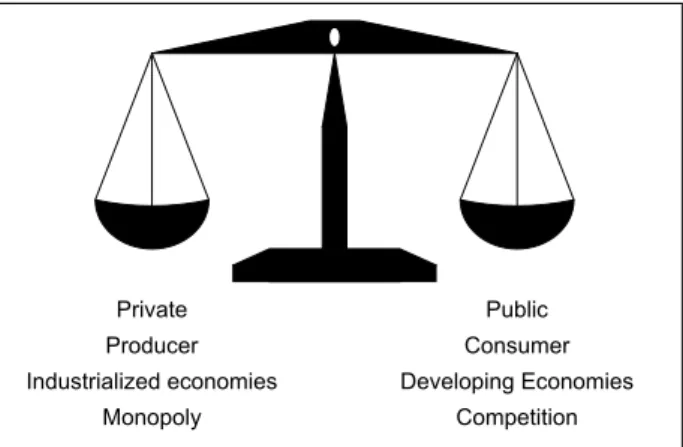
Economic development became the main focus of the country, and foreign direct investment (FDI) and technology transfer became the foundation of Sino-foreign relations (Yang, 2003:131). However, developing countries must find a balance between the protection of their national interests and the interests of the international community (Shen, 2005:197). La Croix and Konan argued that China's desire to become a member of the WTO fundamentally changed the nature of their approach to IP.
Bosworth and Yang argued that the protection of IP is now at the forefront of the globalization of markets in ideas, technology and economics. In the first index, the original four BRIC countries (Brazil, Russia, India and China) formed the lowest level for each of the individual indices and the combined GIPI by a considerable margin. Developing countries consider technology transfer as possibly one of the most important areas of interest (Mathur, 2007:3).
Other developing countries, such as Argentina, also experience difficulties in effectively enforcing IP laws and provisions of the TRIPS agreement (Czub, 2001:193). Significant changes as a result of the IP changes include the realignment of business strategies by companies in the above sectors. Another reason for Novartis to take this bold step is that the Chinese government is encouraging people to study natural sciences such as chemistry and engineering, a reversal of the declining trend seen in the West.
Before 1979, all aspects of the country, including business, were fully controlled by the government (Yang and Clarke, 2005:548). The economy of the country must also be strong enough to attract companies to do business in the country, i.e. In South Africa, the latest addition to the BRICS, a sharp decline in patent applications has coincided with the political change of the early 1990s, while.
Disappointingly, the number of applications from Brazil and the Russian Federation barely increased since the beginning of the decade. There are indications that this is indeed happening, mainly caused by China's desire to become a leader in the world economy and the resulting political and structural changes it brought about, in accordance with the provisions of the TRIPS Agreement. Argentina's New Standard for Intellectual Property Protection: A Case Study of the Underlying Conflicts Between Developing Countries, TRIPS Standards, and the United States.
Technology transfer and the economic consequences of the strengthening of intellectual property rights in developing countries. It also gives a clear account of the two main approaches to the purpose of studying business ethics and its sub-approaches.