An Afrocentric critique of China’s Foreign Policy towards Africa: Case studies of Angola and the Democratic Republic of Congo, 2010-2020
by
Makhura Benjamin Rapanyane Thesis
Submitted in fulfilment of the requirements for the degree of Doctor of Philosophy
in
International Politics in the
Faculty of Humanities (School of Social Sciences)
at the
University of Limpopo Supervisor: Prof. KB. Shai
2023
i Declaration
I, Makhura B. Rapanyane, hereby declare that this PhD thesis titled: An Afrocentric Critique of China’s Foreign Policy Towards Africa: Case Studies of Angola and the Democratic Republic of Congo, 2010-2020 is a by-product of my original work.
As such, it has equally never been submitted to the University of Limpopo or any other Institution of Higher Learning in South Africa and elsewhere. I also proclaim that all the primary and secondary sources of data collection in this study have been acknowledged properly.
……….. ………..
Rapanyane MB (Mr) Date
ii
Acknowledgements
My wholehearted acknowledgement and gratitude go to the support I have been receiving from God who is also known and praised as El Shaddai and Yahweh, the Most-high and Almighty. In the book of Genesis 2:2-3, the Bible says: “By the seventh day God completed His work which He had done, and He rested on the seventh day from all His work which He had done. Then God blessed the seventh day and sanctified it because in it He rested from all His work which God had created and made” and also adds in the book of Colossians 3:23 that: “Let your light shine before men in such a way that they may see your good works, and glorify your Father who is in heaven.” On that premise, I would like to also extend my acknowledgement and gratitude to the following people who contributed significantly towards the completion of this PhD project.
• Professor Shai KB– who was my PhD thesis supervisor for his uninterrupted astute scholarly and professional guidance. His strong scholarly views, academic and professional guidance made every step of this research project uncomplicated, educative, methodical, and eye-opening for me towards the completion of the entire research project. Likewise, his patience, diligence, and confidence in me motivated me to become a critical thinker and researcher.
• Family- remarkable appreciations also go to the Rapanyane family which has been extensively supportive in all the stages of this research project. This includes amongst others, my biological brothers and sister: Matome Frans, Nakedi Johannes, and Maropeng Evelyn Rapanyane who all made various considerable social and financial sacrifices to ensure that I complete my study on time. No amount of words can describe the type of support I have been continuously receiving from my mother, Doris Semadi Rapanyane who is also an inspirational figure beyond everything my imagination. It is through the motivational words of my mother that I can safely say that I have now made her proud. May God protect and keep you safe at all times.
iii
• My Friends- last but not least, I also wish to extend my special appreciation to the following people who have been my friends for at least 4 years. They have been reliable at all times when I needed their scholarly advice, guidance and motivations; they are Chuene Cedric Ngoepe, Lebogang Tiego Legodi, Dominic Maphaka, and Mathew Happy Tirivangasi. None of your profound and genuine support will go unnoticed.
• Colleagues: I would also like to express my special appreciation to colleagues within the School of Government Studies: Department of Political Studies and International Relations of the North-West University. These include amongst others: Prof Victor Ojakorotu, Prof Lere Amusan, Dr Oshupeng Maseng, Ms Naledi Modise and Mrs Mamokete Mokoko for having been available at all times when I needed additional scholarly guidance including technical aspects of this thesis. Their contributions in all the stages of this thesis will not go unnoticed and I pray and hope that their wonderful colleagiality can continue to support efforts towards producing more Afrocentric scholars.
• Subject Librarians: special thanks go to the University of Limpopo (UL)’
School of Social Sciences subject Librarian, Mr Rapau Mahlatse for his availability at all times and providing relevant scholarly information upon the researcher’s request.
iv Dedication
This research project is dedicated to my mother Doris Semadi Rapanyane who made everything possible for me by achieve this accolade. Her care and unconditional love served as a strong foundation in assisting and shaping me into being the independent adult I am today. For all the care, support, confidence, infinite love, advice, and her selfless attitude, I therefore, dedicate this PhD thesis to her.
v
Abbreviations
ACIDH Action Against Impunity for Human Rights AfDB African Development Bank
AFDL Democratic Forces for the Liberation of Congo-Zaire ANIP Angola National Agency of Private Investment
ASADHO African Association for the Defence of Human Rights
AU African Union
BCPSC Coordination and Monitoring of the Sino-Congolese Programme BNDES Brazil’s Banco Nacional de Desenvolvimento Económico e Social BRI Belt and Road Initiative
CABC China-Africa Business Council CADF China Africa Development Fund
CAQDAS Computer-Facilitated Qualitative Data Analysis Software CCCC China Communications Construction Company
CCT Congo Chine Télécoms CDB China Development Bank CDM Congo Dong Bang Mining
CGCD ChangDa Highway Engineering Corporation CIF China International Fund
CITCC China International Telecommunications Construction Corporation CNG Compressed Natural Gas
CNMC China Nonferrous Metal Mining Corporation CNOOC China National Offshore Oil Corporation CNPC Chinese National Petroleum Corporation
vi CPC China Petrochemical Corporation CREC China Railway Engineering Corporation CSIH China Sonangol International Holding CSR Corporate Social Responsibility DAC Development Assistance Committee DFA Department of Foreign Affairs
DRC Democratic Republic of Congo EEC European Economic Community EIA Energy Information Administration ESPO Eastern Siberia-Pacific Ocean
ES-TDB Eastern and Southern African Trade and Development Bank FBN First Bank of Nigeria
FDI Foreign Direct Investment
FNLA National Liberation Front of Angola FOCAC Forum on China-Africa Cooperation GDP Gross Domestic Product
GRULAC Group of Latin America and Caribbean Countries GTBank Guaranty Trust Bank
HIPCs Highly Indebted Poor Countries HRW Human Rights Watch
IFDI Inward Foreign Direct Investment IMF International Monetory Fund KBR Kellogg Brown and Root
KKIA Kenneth Kaunda International Airport
vii KMG Kazakhastan’s KazMunayGas LDCs Least Developed Countries LNG Liquid Natural Gas
LSE London Stock Exchange
MDGs Millennium Development Goals MNCs Multinational Corporations
MPLA People’s Movement for the Liberation of Angola MPTT Ministry of Post and Telecommunications
NAFTA North American Free Trade Agreement NATO North Atlantic Treaty Organisation
NDRC National Development and Reforms Commission NEPAD New Partnership for Africa’s Development
NGOs Non-Governmental Organisations NOCs China’s National Oil Companies
NOGCs Chinese National Oil and Gas Companies NTF Nigeria Trust Fund
NY New York
ODA Official Development Assistance
OECD Organisation of Economic Cooperation and Development OFDI Outward Foreign Direct Investment
OPEC Organisation of the Petroleum Exporting Countries PRC People’s Republic of China
PRP People’s Revolutionary Party
PRSPs Poverty Reduction Strategy Papers
viii PSA Production Sharing Agreement RI Regional Integration
SAPs Structural Adjustment Programmes
SASAC State Owned Assets Supervision and Administration Commission SEZs Special Economic Zones
SGR Standard Railway Gauge SOEs State-Owned Enterprises SSA Sub-Saharan Africa
SSE Shanghai Stock Exchange SSI Sonangol Sinopec International TCA Thematic Content Analysis
TREC Turfloop Ethics and Research Committee UBA United Bank for Africa
UL University of Limpopo
UNIPEC United Petroleum and Chemicals
UNITA Union for the Total Independence of Angola UNSC United Nations Security Council
USA United States of America WTO World Trade Organisation
ZESC Zambia Electricity Supply Corporation ZNBC Zambian National Broadcasting Corporation
ZTE Zhongxing Telecommunication Equipment Corporation
ix
List of Figures
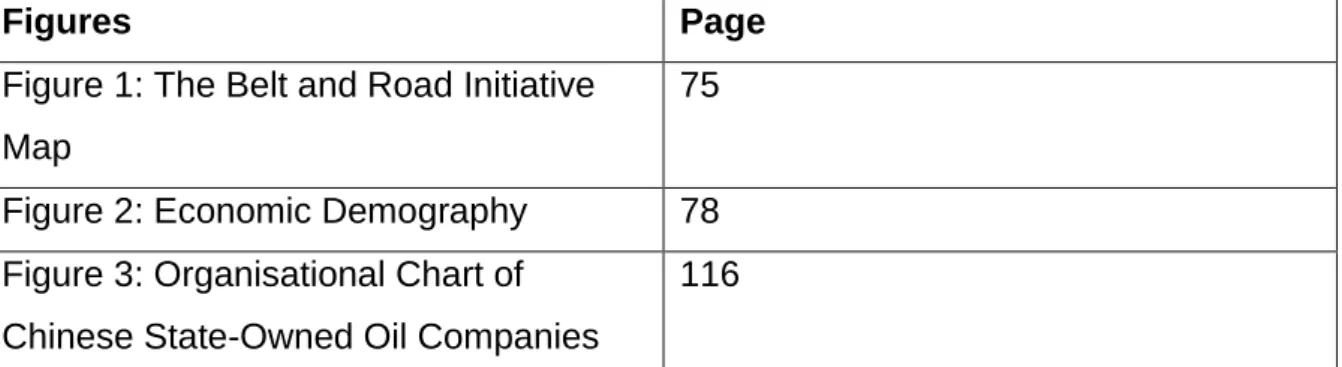
Figures Page
Figure 1: The Belt and Road Initiative Map
75
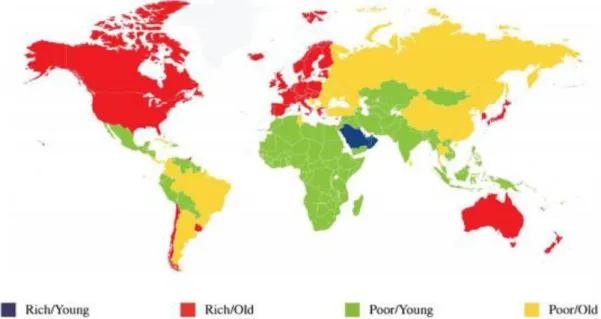
Figure 2: Economic Demography 78 Figure 3: Organisational Chart of
Chinese State-Owned Oil Companies
116
x
List of Tables
Table Page
Table 1: Sample summary 32
xi Abstract
The foreign policy of China which is also globally known as the People’s Republic of China (PRC) has in the recent past become a substantial subject of both policy and academic debates. This is mostly due to the attention that China has given to the African continent. The attention expanded through the formation of the Forum on China-Africa Cooperation (FOCAC) in the early 2000s. It is incontestable that FOCAC has been driving China-Africa political and economic relations, ultimately becaming the second biggest economy globally after the United States of America (USA).
Contextually, this study has employed a comparative case study design to critique China’s foreign policy towards the African continent. This case study design has utilised both Angola and the Democratic Republic of Congo (DRC) as test cases to critique the post-2010 foreign policy of China towards the African continent. This was done through critical analysis of China’s Africa policy, and therefore, unearthing China’s global engagement (herewith referred to as foreign policy) with reference to both Angola and the DRC. To this end, the current study provides historical sensibility by locating China’s global engagement with Africa, specifically the context of Angola and the DRC as far back as the colonial period. The exceptional acknowledgement of historicity in the current study extensively drew from the idea that the past customarily informs a vibrant premise for the understanding of the present and the future. In the current study, the researcher has championed the adoption and use of the Afrocentric theory as a replacement of the mainstream theories in interpreting the general foreign policy of China towards the African continent.
The adoption and the use of this theoretical lens in the study has been informed by its capacity to accentuate and underline China’s international relations with both Angola and the DRC. A scholarly understanding of China’s foreign policy on Angola and the DRC can be achieved when such analysis and interpretations are accurately located within the African continental context. Equally significant are the study’s objectives which are attained through the use of interviews and document review. This is a type of qualitative research approach that appreciates the use of interviews and document review to generate relevant primary and secondary information in the quest to answer the study’s main question. In consideration of the study’s comparative case study design, the foundational highlights from the study are that: China premises its
xii
international relations with African countries (Angola and the DRC) on several factors that include access to oil, copper, diamonds, cobalt, and other important mineral resources-for-infrastructural-loans. In addition, both Angola and the DRC’s slight stable economic and political environments have continued to play an important role in their continued engagement with China. This is the case, although there are various Chinese Multinational Corporations (MNCs) and State-Owned Enterprises (SOEs) with operations in both Angola and DRC that are still incompetent in the practice of Corporate Social Responsibility (CSR). Overall, the CSR concept should precede all the operations of Chinese companies in Angola and the DRC economic stakeholders.
Keywords: Afrocentricity, Angola, Democratic Republic of Congo, China, Corporate Social Responsibility, Belt and Road Initiative, Forum on China-Africa Cooperation, Infrastructural-loans-for-minerals, Oil, Copper, Cobalt, Credit lines policy.
xiii Table of Contents
Declaration ... i
Acknowledgements ... ii
Dedication ... iv
Abbreviations ... v
List of figures ... ix
List of tables ... x
Abstract ... xi
CHAPTER ONE ... 1
Introduction to the study ... 1
1.1. Background and motivation ... 1
1.2. Research problem ... 3
1.3. Definition of main concepts ... 3
1.3.1. Foreign olicy ... 3
1.3.2. Afrocentric critique ... 4
1.3.3. Corporate Social Responsibility ... 4
1.3.4. Debt Trap Diplomacy ... 4
1.4. Purpose of the study ... 5
1.4.1. Aim ... 5
1.4.2. Objectives ... 5
1.5. Research questions ... 5
1.6. Chapter breakdown ... 7
CHAPTER TWO ... 9
Literature review and theoretical framework ... 9
2.1. Introduction ... 9
2.2. Conceptual exploration ... 10
2.2.1. Foreign policy ... 10
xiv
2.3. A review of knowledge gaps ... 12
2.3.1. China-Africa relations ... 12
2.3.2. China-Angola relations ... 14
2.3.3. China-DRC relations ... 17
2.4. Theoretical perspectives ... 21
2.4.1. Realism ... 22
2.4.2. Idealism ... 22
2.5. The role of theory: Afrocentricity... 23
2.6. Modelled divergence between Realism, Idealism and Afrocentricity ... 26
2.7. Conclusion ... 27
CHAPTER THREE ... 29
Research methodology ... 29
3.1. Introduction ... 29
3.2. Research design ... 30
3.3. Sources of data ... 31
3.4. Sampling ... 31
3.4.1. Sampling technique... 31
3.4.2. Sample size ... 32
3.4. Data collection methods ... 35
3.4.1. Document study/review ... 35
3.4.2. Semi-structured interviews ... 36
3.4.3. Telephonic/email responses from Diplomats ... 37
3.4.4. Telephonic/email responses from active international relations scholars .... 38
3.5. Data analysis ... 39
3.6. Quality criteria ... 41
3.7. Ethical considerations ... 43
3.7.1. Permission to conduct the study ... 43
xv
3.7.2. Academic fraud ... 43
3.7.3. Informed consent and voluntary participation ... 43
3.7.4. Confidentiality and anonymity ... 44
3.7.5. No harm to the participants ... 44
3.8. Conclusion ... 45
CHAPTER FOUR ... 46
China’s historical relations with Angola and DRC ... 46
4.1. Introduction ... 46
4.2. China- Angola Relations ... 46
4.3. China- DRC Relations ... 50
4.4. China-Africa Relations ... 58
4.4.1. Beijing’s Rise in Africa... 58
4.4.2. Reasons for Beijing’s Africa Intervention: Poverty Reduction and Promotion of Prosperity ... 60
4.4.3 The Forum on China-Africa Cooperation ... 62
4.4.3.1 FOCAC Conferences: Asymmetric Relations ... 64
4.4.4 China’s General Africa Policy ... 70
4.5. Conclusion ... 73
CHAPTER FIVE ... 75
Key drivers of China’s foreign policy towards DRC and Angola within the broader context of the Belt and Road Initiative ... 75
5.1. Introduction ... 75
5.2. Belt and Road Initiative ... 75
5.2.1. History and Economic Geopolitics ... 75
5.2.2. Demography of the Economy ... 77
5.2.3. Globalising China: Unveiling the real drivers of Chinese BRI ... 80
5.2.3.1. China’s rise as a global economic power ... 80
5.2.3.2. China’s rise as a global investor ... 81
xvi
5.2.3.3 China’s heavy appetite for energy investment ... 83
5.2.4. China’s desire to influence the International Economic system ... 86
5.3. Key Drivers of China in Angola... 88
5.3.1. China in Angola; Oil Backed Loans for Infrastructural Development ... 88
5.3.2. Dismantling of Western Donors in Angola ... 93
5.3.3. Sinopec’s First Steps: Promotion of Credit lines ... 94
5.3.4. Small scale trade and restaurants ... 94
5.3.5 Access to Angolan Diamonds ... 95
5.3.6. Copper ... 95
5.3.7. Promotion of Debt ... 96
5.3.8. Desire to bring Chinese workers into Angola ... 98
5.4. Key Drivers of China in DRC ... 98
5.4.1. Promotion of Credit lines ... 98
5.4.2. Complete Realisation of the Sicomines Deal ... 99
5.4.3. Investment Drivers ... 102
5.4.3.1. Infrastructure ... 102
4.3.3.2. Telecommunications ... 103
4.4.3.3. Forestry Sector ... 104
5.4.4. Access to Mineral resources ... 105
5.4.5. Promotion of Chinese MNCs into DRC mining DRC ... 107
5.5. Conclusion ... 109
CHAPTER SIX ... 111
An Examination of Chinese companies operating in both Angola and DRC’s mining and Manufacturing sectors ... 111
6.1. Introduction ... 111
6.2. China Angola trade and economic agreements ... 111
6.3. China - DRC trade and economic Agreements ... 112
xvii
6.3.1. Characteristics of Chinese DRC trade and economic agreements ... 113
6.4. Chinese Companies in Angola ... 115
6.4.1. Chinese Oil Companies: Sinopec, China National Petroleum Corporation (CNPC) and the China National Offshore Oil Corporation (CNOOC) ... 115
6.4.2. Sinopec Operations... 118
6.4.3. Dongfang Nissan, Golden Nest, ... 119
6.5. Chinese Companies in DRC ... 121
6.5.1. Sinohydro and China Railway Engineering Corporation ... 121
6.5.2. Other Companies ... 121
6.5.3. Overview of Jia Xing Mining Industry Congo, Feza Mining and Metal Mines ... 122
5.3.2.1. Jia Xing Mining Industry Congo ... 123
5.3.2.2. FEZA MINING ... 123
5.3.2.3. Metal Mines ... 124
6.6. Conclusion ... 125
CHAPTER SEVEN ... 127
China’s adherence and practice of Corporate Social Responsibility in Angola and DRC ... 127
7.1. Introduction ... 127
7.2. The CSR Concept in the International Context: A brief on the true agenda .... 127
7.3. CSR: Interpretations and contours ... 130
7.3.1. Economic and legal Responsibilities ... 131
7.3.2. Ethical and Philanthropic responsibilities ... 134
7.4. CSR Policy Approaches in China, Angola and DRC ... 135
7.4.1. China ... 135
7.4.2. Angola ... 137
7.4.3. Democratic Republic of Congo ... 141
7.5. The Context of Chinese Adoption and Practise of CSR in Angola ... 143
xviii
7.6. The Context of Chinese Adoption and Practise of CSR in the DRC ... 145
7.7. Overall Analysis of the Low Chinese CSR Environmental and Social Standards in Africa ... 148
7.8. Conclusion ... 152
CHAPTER EIGHT ... 154
Neo-Colonial Steps taken by China when African countries (Angola and DRC) default in Loan repayment ... 154
8.1. Introduction ... 154
8.2. Overview of Chinese Aid and Loans as Part of the system of Unfair subsidies ... 154
8.3. The dynamics of China- Angola economic affair in perspective ... 156
8.3.1. The Angolan model: Mineral resources for loan repayment ... 156
8.3.2. Rogue Donor: Myths and/or Realities? ... 160
8.4. Revisiting the political economy of China-DRC’s engagement ... 163
8.5. Chinese Aid: Reflecting on General African and Western Concerns ... 165
8.6. Lessons from other countries ... 170
8.6.1. China’s disregard for Africa, Africans, and African Economies: A Miscalculation of Mutual Respect ... 170
8.6.2. Case Studies of Africa: Angola, Zambia, and Kenya ... 172
8.6.3. Lessons Learnt from Elsewhere: Debt-Trap Diplomacy in Ecuador, Venezuela, Sri Lanka, Pakistan, Nepal and Cambodia ... 174
8.6.4. Chinese Aid: It is all about Oil/Minerals/Resources ... 175
8.7. Conclusion ... 177
CHAPTER NINE ... 179
China’s foreign policy towards Angola and DRC: A comparative study... 179
9.1. Introduction ... 179
9.2. China’s Foreign Policy towards Angola ... 179
9.3. China’s foreign policy towards DRC ... 181
xix
9.4. Contrasting and Comparing China’s Foreign Policy Towards Angola and DRC
... 182
9.5. Conclusion ... 183
CHAPTER TEN ... 185
General Conclusion, Findings and Recommendations... 185
10.1. Summary of Findings ... 185
10.1.1. Location of China’s historical relations with both Angola and DRC ... 185
10.1.2. Identification of key drivers of China’s foreign policy towards Africa: Case study of Angola and DRC... 186
10.1.3. Broad examination of all the Chinese companies operating in both Angola and DRC’s mining and manufacturing sectors ... 187
10.1.4. Revisiting China’s adherence and practice of Corporate Social Responsibility in both Angola and DRC ... 188
10.1.5. Chinese reaction when Angola and DRC default on Chinese loan reimbursement ... 189
10.1.6. Comparing and Contrasting China’s Foreign policy towards Angola and DRC ... 190
10.2. Significance of the study ... 191
10.3. Delimitations for theory and practice ... 191
10.4. Limitations of the study ... 192
10.5. Recommendations ... 193
10.6. References ... 195
Annexure 1: List of interviewees ... 229
Annexure 2: Research interview guide ... 230
Annexure 3: Ethical clearance certificate ... 233
1
CHAPTER ONE Introduction to the study 1.1. Background and Motivation
The continent of Africa inhabits a calculated position in the foreign policies of the global major powers such as the United Kingdom of Britain, China, Russia, France and the United States of America (USA), amongst others (Raphala 2017). This is produced a complicated web of both current and historical ties that the major powers had and continue to have with the continent. The current research has selected the People’s Republic of China (PRC) also known as China to analyse its foreign policy towards the continent by refocusing on the test cases of Angola and the Democratic Republic of Congo (DRC).
To get a clear understanding of China’s relations with African nation-states under study, the current researcher firstly traces the China-Angola relations within a historical context and then proceeds to discuss the historical relations of China and DRC. This is done to capture the logical flow of the study since it is about critiquing China’s foreign policy towards both nation-states. While Angola and DRC have their foreign policies towards China, it is established that the latter’s relations’ with Angola and DRC are largely framed by Beijing (the capital and administrative hub of the government of China). The explanation of this situation lies in the unequal power relations between China and African nation-states such as Angola and DRC. Such unequal power relations produces asymmetrical relationships which reduce the foreign policies of small and weaker nation-states such as Angola and DRC to nothing more than an
“imperative” (Kapa 2007).
In over six decades, the relations of China with Angola have grown through the dynamics of the Cold War to the politics of the colonial and post-colonial struggles, reaching the juncture of having, and expanding their economic diplomacy with each other (Aidoo 2013). The relations between the two countries goes as far back as the period when most of the African nation-states began with their anti-colonial struggles, with China supporting such anti-colonial liberation activities and actions throughout Africa. In addition, by the year 2008 Angola was China’s biggest trading partner in
2
Africa and ultimately the third-largest oil supplier to China in the year 2016 (Khodadadzadeh, 2017).
On the other hand, diplomatic cooperation between China and the DRC begun around the 1970s. This was when both nation-states equated their reciprocal concerns in ensuring a balance of power between Western nation-states and the Soviet Union (Shinn, 2008a). When looking at the recent Chinese economic dynamics in DRC, which is healing from decades of violent confrontation over resources and its international standing as a failing state, the likelihood of effectual help on the part of its government and governmental institutions should not also be set aside (Putzel &
Kabuyaya, 2011).
The aforementioned analysis partially explicates the choice of Angola and the DRC as test cases for the current study on the foreign policy of China towards Africa. The year 2010 was used as the point of departure in the research due to the fact that it marked the time when the economy of China outperformed that of Japan in size and became the second biggest globally after the USA. The study ends in the year 2020, which served as a historical landmark of a decade since China ascended into being the second biggest economy globally. It also represents the year for hosting the 12th annual BRICS summit of the group of the Heads of Government and State held through a video conference due to the Covid-19 pandemic that made it impossible for leaders to physically meet (CGTN 2020). This is the same period whereby Afrocentric scholars deepened the scholarly debate on China’s neo-colonial practices in Africa and engage in China’s real intentions in Africa (Rapanyane & Shai 2020; Rapanyane
& Sethole 2020). Based on this, the ten year focus is deemed adequate for present a qualitatively rich picture of the phenomena under study.
Inasmuch as the primary focus of the current study is the period between the year 2010 and 2020, it is inevitable for a research of this nature to also reflect in passing on some of the key political and socio-economic developments that have affected the evolution of China’s foreign policy towards Angola and DRC during the period under review. In addition, Angola and DRC are strategically selected as case studies and
3
this is enriched by the location of this investigation within a broader historical and African continental context.
1.2. Research problem
The existing body of scholarly knowledge on China’s international relations with both Angola and DRC is under-researched and most of the already conducted studies have been framed from State Centric and Chinese theories and/or perspectives, mostly rooted within the Euro-American and Chinese worldviews. This tendency has furnished scholars and the society in general with Chinese, realist or idealist views, perspectives and critiques including liberal perspectives on this subject. This state of affairs has induced the dearth of uniform analysis and complete understanding of China’s international relations and foreign policy to a point wherein policy uncertainties are observed during the period under review. Most importantly, the existing body of scholarly literature on China’s foreign policy accessible to the current researcher greatly suffers from the shortage of an Afrocentric perspective.This implies that the existing scholarly discourse on this subject is unable to explain the realities and practicalities of China’s Africa policy as expressed through the African voices. The combination of the above views inaugurates an epistemic injustice by creating a false ideal that African theories, ideas, and concepts do not have a place in modelling the development of international politics scholarship and practice.
1.3. Definition of the main concepts
The study is tied up to the four concepts of CSR, Afrocentric critique, Debt- Trap Diplomacy and Foreign Policy. Due to their various roles within the study and their presumed different roles in international politics and their ensuing competing interpretations, this section, briefly presents their varying interpretations and explanations in the study’s setting.
1.3.1. Foreign policy
Foreign policy can be defined as the principal strategic plan of a government’s engagement in its various collaborations in international relations (Gold &
4
Pevenhouse, 2011: 78). Within the context of the current study, foreign policy and/or engagement together with international relations are utilised interchangeably to communicate the international collaborations of a nation-state in all socio-economic and political spheres for the protection and preservation of national interests.
1.3.2. Afrocentric critique
As explained broadly by Asante (2003), an Afrocentric critique is progressed by African scholars and is premised upon the elements of the Afrocentric theory. The principal analytic elements of the theory include “grounding, orientation and perspective”
composing of the main analytic classifications of the theory as argued by Modupe (2003: 62) and Shai (2016). Indifferently, the mainstream political theories of Marxism, idealism and realism’ elements are informed heavily by Euro-American value systems (Chilisa, 2012). Despite this propounded difference, an Afrocentric critique always embraces the use of progressive views in the interpretation and explanation of international relations (Rapanyane, 2020).
1.3.3. Corporate Social Responsibility
This is an embodiment of global private business self-regulation that intends to contribute to the societal objectives of activist, philanthropic and charitable behaviour through supporting and/or engaging in voluntarism or ethically-centred practices (Matten & Moon, 2004).
1.3.4. Debt trap Diplomacy
This explains a situation whereby a powerful politically and economically leading nation-state and/or institution seeks to over-burden a borrowing nation-state with huge debts to increase its leverage over it (Brautigam, 2020). Practically, this happens when a creditor nation-state offers excessive credit to a less-powerful indebted nation-state intending to extract political and economic concessions from the indebted nation-state in situations when it is unable to meet the skewed debt repayment obligations (Brautigam, 2020).
5 1.4. Purpose of the study
1.4.1. Aim
This study aimed to employ Afrocentricity as a theoretical and contextual lens to critique China’s foreign policy towards Africa looking at the case studies of Angola and the DRC between 2010 and 2020.
1.4.2. Objectives
To achieve the above aim, the study delved into the following objectives:
• To locate China’s foreign policy towards Angola and DRC within a historical and broader context of China's Africa policy;
• To identify key drivers of China’s foreign policy towards selected African states;
• To examine Chinese companies’ operations in both Angola and DRC’s mining and manufacturing sectors;
• To explain China’s adherence and practice of Corporate Social Responsibility in both Angola and DRC;
• To analyse the major steps undertaken by China when both Angola and DRC default on Chinese loan reimbursement; and
• To compare and contrast China’s foreign policy towards Angola and DRC.
1.5. Research questions
• What is the history of China’s relationship with both the DRC and Angola?
• What are the key drivers of China’s foreign policy towards Angola and DRC in the context of the Chinese Belt and Road Initiative international policy?
• To what extent are the Chinese mining and manufacturing companies’
operations in both Angola and DRC affecting Beijing’s engagement with these countries?
• How is China adhering to the international norm and practice of CSR in both DRC and Angola?
• What are major steps are often undertaken by China when selected African countries default on Chinese loan repayment?
6
• What are the similarities and differences of China’s foreign policy towards Angola and DRC?
• What is China’s general foreign policy stance towards Africa within the context of the cases of Angola and the Democratic Republic of Congo, 2010-2020
7 1.6. Chapter Breakdown
Chapter one: Introduction of the study
This chapter provides an orientation of the study. It covers the research aim and objectives of the study, research questions, research problem and definition of main concepts.
Chapter two: Literature review and theoretical framework
This chapter is an account of an overview of the existing body of literature regarding China’s foreign policy towards DRC and Angola, knowledge gaps, and theoretical framework.
Chapter three: Research methodology
This chapter outlines and justifies research methodological techniques used in the study.
Chapter four: China’s historical relations with Angola and DRC
This chapter focuses on the history of China’s international relations with both Angola and DRC.
Chapter five: Key Drivers of China’s Foreign Policy towards Africa: Angola and DRC within the context of the Belt and Road Initiative (BRI)
This chapter discusses the key drivers of the foreign policy of China towards both Angola and DRC and zooms into China’s recent international policy on the Belt and Road Initiative.
Chapter six: Chinese companies operating in both Angola and DRC’s mining and manufacturing sectors
This chapter examines some of the Chinese companies’ operations in both Angola and DRC’s two sectors of Mining and Manufacturing.
Chapter Seven: China’s adherence and practice of Corporate Social Responsibility in Angola and DRC
8
This chapter discusses Corporate Social Responsibility and the extent to which Chinese mining and manufacturing companies in Angola and DRC mining adhere and practice corporate social responsibilty.
Chapter Eight: Neo-colonial steps taken by China when African countries (Angola and DRC) default in loan repayment
This chapter exposes Neo-colonial Chinese activities undertaken when African countries such as Angola and DRC default in repayment of their respective loans obligations. This is accompanied by critical Afrocentric comparison and contrasting of China’s international relations towards both Angola and DRC.
Chapter Nine: A comparison and contrasting of China’s Foreign Policy towards Angola and the DRC
This chapter compares and contrasts the general foreign policy of China towards Angola and the DRC.
Chapter Ten: General conclusion, findings and recommendations
This chapter closes with general concluding remarks, sums up the research findings and provides both Angolan and DRC governments with counter neo-colonial policy recommendations and decolonial steps to strategically engage with China in an attempt to dismantle the debt-trap diplomacy in both Angola and DRC.
The next chapter presents a critical review of the academic literature related to the subject of this study. It also addresses the choice and rationale for the study’s theoretical framework, which is broadly considered as an integral part of the literature review.
9
CHAPTER TWO
Literature review and theoretical framework 2.1. Introduction
This section of the study has reviewed a considerable breath of academic materials relevant to the subject on China’s international relations with Africa, particularly Angola and the DRC. It did so by fully examining the foreign policy documents China towards the African countries under review. In addition, the current researcher has studied the results and limitations curbed out by relevant scholars and academics on the subject under review. This review of the relevant literature has immensely helped the current researcher in the identification of the existing gaps of knowledge on the subject and provided a satisfactory direction for the current study. The subject of China-Africa relations: test cases of Angola and the DRC has regrettably received little scholarly and/or academic awareness from scholars of various disciplines including those in Economics, Developmental Studies, International Relations (IR), Political Science, History, Peace Studies, and Econometrics.
For the current study, various scholarly works from the realm of Political science, IR, History and African Studies were reviewed as part of the literature review. These included the works of scholars such as Rapanyane and Shai (2019a), Rapanyane and Shai (2019b), Rapanyane and Sethole (2020), Rapanyane (2020a), Rapanyane 2020b), Shai (2016), Clarke and White (1989), Scott and Garrisson (2012), Viotti and Kaupi (2010), Dlomo (2010), Kiala (2010), Khodadadzadeh (2017), Nkrumah (1965), Tukumbi (2011), Corkin (2011), Kushner (2013), Kabemba (2016), Wu (2013), Ehrbar (2013), Mila (1992), Dunn (2004), McGowan and Nel (2006), Dunne and Schmidt (2008), Maphaka (2020), Asante (1980, 1983, 1988, 1990, 2003), Woodyard (1995), Gilroy (1993), Collins (1991), Aidoo (2013), Mthembu-Salter (2010, 2012), Taylor (2009), Brautigam (2009, 2011, 2020) and Kinyondo (2019).
Despite having refined the study’s conceptual framework, which focused on the foreign policy concept; it should equally be stated that the resultant literature review of the study has followed the elements of the scholarly and/or academic discussion and analysis addressed below. This means that the researcher in this PhD thesis could not
10
follow the incessant list indicated below in the review of the most relevant scholarly materials on the subject of the study. As such, the main organisation of this chapter has followed five satisfactory discussions and analyses (conceptual framework, identification of the existing gaps of knowledge on China-Africa affairs; China-Angola relations; and China-DRC relations. Theoretical perspectives, which involve the role of theory; drawn from varieties of mainstream theories and adopted theory of Afrocentricity) are dictated by the periodisation proposition adopted against the alphabetical order sequence of the revisited authors.
2.2. Conceptual exploration 2.2.1. Foreign policy
The concept of Foreign Policy is often understood to mean the “foreign relations policy”
and/or “International relations policy.” Simply put, foreign policy emphatically interjects the practice of how nation-states conduct their coordination of international relations matters (Shai 2016; Rapanyane 2020). Some politicians and analysts often draw themselves into unnecessary arguments on the adoption of the concept of “foreign”, leaving outside what we call foreign policy, which is principally found at the national level and that it shows itself as having nothing to do with a country’s internal and/or domestic policies. Even if different definitions and explanations are given for the comprehension of this concept (Clarke & White 1998; Rapanyane 2018), it remains important to take note that foreign policy in the current study is presented without any globally acceptable definition, therefore scrapping the unnecessary semantic questions in the current study. Both Scott and Garrison (2012: 138) understand that
“international policies affect relations between or among nations, such as trade, war, educational exchanges, and disaster relief efforts and so on.”
Equally significant, foreign policies are not the consequence of the subject of one person in national government (President) who often presides over various administrations that conceived and/or adopted them (Scott & Garisson, 2012). This is the reason why it is almost an impossible task to associate a nation-state’s foreign policy with one person, more like “Ramaphosa’s Zimbabwe policy” and/or “Jinping’s Angola policy” and “the foreign policy of Jintao” in books on Historical and International
11
Politics. Where found, such claims can be untrue and very much misleading as foreign policy is the consequence of the collection of people who come together in implementing national policies (Shai 2016). The collection mostly includes the President (Head of State and Government), Parliament (Legislative body), Department of Foreign Affairs (DFA) and/or International Relations and alternative concerned departments such as (Economy, Defence, etc.) (Clarke & White 1989).
The collaboration outlined above execute an integral role in the formation and execution of a foreign policy of a nation-state either from those of the third world and/or first world. The combination above remains the principal and formal drivers of domestic and foreign policymaking, tasked with executing domestic and foreign policy desires of the masses in the splendid possible matter (Viotti & Kaupi 2010). In the interval, it is not astonishing for International Relations and Political Science students and practitioners to disassociate international relations, foreign policy and diplomacy. This is due to the concepts being different even though they are linked intrinsically. In the current study, the concept of diplomacy is distinguished from all of them with a focus on the cunning and practice of negotiations between two or more representatives of different nation-states in the international political and economic system. Essentially, it is aligned with international relations’ simplification as a practice and phenomenon as opposed to the entire discipline. Shai (2016: 18) together with Dlomo (2010: 3) remind us that the practice of diplomacy in foreign policy has to do with being “a political instrument with which to maximise the national interest of States and to pursue foreign policy goals and objectives”.
The utilisation of capital letters (IR) ought not to be variated from the lower case (ir) that is extensively connected to the concerns harrowed from the desire to make a variance between the actual practice and academic discipline of international relations (Viotti & Kauppi 2010). The International Relations field offers much more than relations between nation-states. Several other actors are involved such as international organisations, terrorist groups and etc., which all form part of what is often referred to as “world or global politics” (Viotti & Kauppi 2010). Shai (2016: 19) complements the above views as correct and necessary to place the international relations field as one that is mixed with context inquiry. Additionally, Shai (2016: 19) says that this serves as the pursued usage of “politics” within the context of
12
“international politics” and “world politics” which are inter-dependent with international relations which “is devoid of the honest appreciation of the multi-dimension and complex character of this field”.
2.3. A Review of Knowledge Gaps 2.3.1. China-Africa Relations
Edoho (2011) wrote a very informative article titled “Globalization and Marginalization of Africa: Contextualization of China-Africa Relations” whereby a resource curse theory is deployed to provide a broader examination of the China-Africa relations within the context of economic engagements and implications of the emerging economic development engagements in African countries. Essentially, Edoho has centrally focused on the contributions of globalisation to the marginalisation of Africa in the world economy. As such, Edoho argues that China-Africa close relations are a consequence of the marginalisation of the latter in the globalisation context. This is with implications of China in Africa to fill the space left out by Imperial and Neo-colonial Western States since the end of the Cold War. Edoho shows that Africa’s embracing of China is greatly motivated by the issues of the post-colonial dependency engagements including harsh colonial experiences. Contextually, we can pick up the three pictorial eras shown in the article which are, first, that China is a progressive development partner with stiff strategic economic interests in Africa; the second being that of a voracious competitor, implying that China does not seek to assist Africa with real development, as it will neither promote governance and human rights in Africa within the process of its economic venture. The last one depicts China as the new colonizer that seeks to recolonise Africa.
Edoho has further demonstrated that there are more than 800 Chinese companies in Africa in full operation. This means that globalisation has not only disengaged Africa from the west, but further promoted resource-based relations at the heart of China- Africa relations thereby, promoting the voraciousness perspective. Most importantly, this article has projected that Chinese investment in Africa involves various areas of seaports, railroads, industrial infrastructure, road networks, telecommunications, and power generations. Although Edoho’s work has helped greatly in shaping the direction of the undertaking of this study from the continental level, it fell short of narrating the
13
globalisation process and/or role in the marginalisation of case-point countries such as Angola and DRC broadly.
We also have Mohan and Lampert (2013) who in their article “Negotiating China:
Reinserting African Agency into China-Africa relations” adopt a win-win game theory to provide a broader examination of the degree of agency needed on Africa’s engagement with China. Both projects are various phases of engagement, where African nation-states have modelled, bargained and drove political and economic engagements with China in various significant ways. Their discussion has placed focus on China-Africa political relations and showcased how the former is glorified as the commanding advocate with little respect for the African agency. Their article has gone deep into the investigation of the Africa agency placing the central focus on Chinese investments in Angola, Ghana, and Nigeria (with Zambia given little attention). Both also argue that there is a very indestructible interest-based class element to both political and social agencies in the China-Africa relations. They also add that within the context of various opportunities and threats brought about by China’s entry into Africa, the local civil society is often affected and forced to safeguard the privileges of the African elites who are at the forefront of letting China into Africa.
This is the case, because Chinese investment benefits are largely skewed towards these favourable select elites only. Mohan and Lampert have also referred to how the replacement of Western oil exploration companies in Angola by Chinese oil companies has not changed anything. It is also showcased that Chinese companies are searching deeply for markets in Nigeria and Ghana utilising the help of the local patrons aligned to their survival and prosperity to formulate what we understand as an African agency.
The sectional link captured from their discussion and analysis draws scholars to a broader understanding and acknowledgement of the African nation-states’ significant role in their international relations with China. However, this does not imply that African countries’ international relations with China are synonymous with those of the DRC.
Principally, the DRC and Angola in the current study are employed as test cases for comparison and contrast. This is because both countries have been victims of real Chinese nefarious fangs in Africa. Thus, their limitations to Angola, Ghana and Nigeria
14
could have motivated the undertaking of the current study to also include DRC in the discussion.
2.3.2. China-Angola relations
From a win-win perspective, the study of Kiala (2010) titled “China-Angola aid relations: Strategic cooperation for development?” explores the China-Angola aid relations. The undertaking of Kiala’s study was motivated by China’s aid that does not conform to the terms and standards of the Organisation for Economic Cooperation and Development (OECD) and Development Assistance Committee (DAC); which Beijing is not a member of. Firstly, in admission, Kiala has observed that Angola is at the centre of Chinese activity in the African Continent as poverty remains rampant in Angola whilst it is the largest African oil-exporting country. This study has instituted China’s emergence in the international donor community and how it has reconceived the aid parameters in Africa by indicating that, unlike the OECD that financially assists Highly Indebted Poor Countries (HIPCs), China also seeks to engage in the provision of aid to the Less Developed Countries (LDCs). Equally, most of the concessional loans from China are furnished by its Export-Import Bank (Exim Bank) going along with subsidy interest provided by the Chinese Ministry of Commerce.
This is followed by a strong quantification of Chinese aid to the African country around the reconstruction of the latter, especially of electrical systems in Namibe, Tombwa, Lubango and Luanda and different themes that were attached to the aid. Kiala (2010) also examined the risks of the credit line motivated by China in Angola which includes major concerns around China’s non-adherence to its policy of non-interference and condition of free loans as there are considerable risks attached to China’s unlimited credit to Angola. Despite its contribution to the current study, Kiala’s research article did not locate China’s historical relations with Angola nor provide a broader examination of the Chinese Belt and Road initiative.
From a Neo-Colonialism perspective, Khodadadzadeh's (2017)’s Master of Arts dissertation titled “China in Africa: A Modern Story of Colonization? A Case Study of China’s engagement in Angola” engages a descriptive analysis of China’s international relations with Angola and examines if there were any features of Neocolonialism between the years 2000 to 2017. The operationalisation of the concept of
15
neocolonialism into the five dimensions including economic influence, political interference, military appearances, culture/education reinforcement and financial dependence were done to understand how China is recolonising Angola. The adoption of Neo-colonialism itself as the established theoretical framework is understood better by Nkrumah who says that it consists of countries that are officially independent but still are economically dependent on the adopted political policy that is influenced by foreign economic and political forces. This is evident in his book “New Colonialism:
The Last Stage of Imperialism” (Nkrumah 1965: 7; Khodadadzadeh, 2017: 13).
Although Khodadadzadeh does not find any worrisome concerns regarding China’s engagement with Angola in the context of political interference, military appearances, and cultural/ education reinforcement, both economic and financial fields are purely characterised by extensive neo-colonial tendencies. In economic terms, Chinese companies including those in the mining industry tend to hire Chinese labour instead of Angolan workers (2017: 37). This study further makes a shocking revelation about China’s foreign aid policy as supported by Tukumbi (2011: 257) who noted that the latter in Angola comes with terms and notions that the aid should be utilised to “only hire Chinese workers and to only purchase Chinese products and equipment” (2017:
38). The other significant aspects relate to the unfair agreements as the Asian giant decides on the aid to purchase Chinese manufactured goods instead of those made locally.
The second dimension of financial dependence is shown by the economic prosperity of Angola which is heavily dependent on China as their biggest trading partner and infrastructural build-up pillar. Implying that a weaker China would mean less demand for Angola’s natural resources of gas, oil and copper and ultimately few investments in infrastructure, mining and other areas. Yuan has also been made the second legal tender in Angola through a monetary agreement that decreased Angola’s dependence on the dollar and increased China’s economic influence in Angola (Khodadadzadeh, 2017). Observably, Angola’s financial dependence on China comes from the Asian giant being the principal funder and responsible for “at least one-third of Angola’s GDP” (Khodadadzadeh, 2017: 43). With 40% of the total trade export from Angola, China is in charge of Angola’s financial support in terms of inflations and depreciation of the local currency or export products’ increasing or decreasing prices. In the final
16
analysis, China is depicted as a successful capitalist and colonialist even though it preaches mutual benefit in Angola.
The above scenario implies that China is not transparent with its activities in Angola, which leads to huge suspicions and mistrust as its organised system of economic exploitation and financial dependency in Angola is led by a pattern of unfair credit packages, infrastructural loans, aid in exchange for natural resources of gas and oil that contributes to the negative effects of labour and business markets in the African country. Admittedly, the study contains the most relevant and most updated neo- colonial practices in Angola which makes it very much important and analytically appropriate for the current study to build on. However, the study fell short of outlining the Chinese companies operating in Angola and their operations including the significant impact of the Chinese practice of dumping processed goods and services in Angola’s local industries such as the broader analysis of China’s Belt and Road Initiative.
Corkin's (2011) study titled “China and Angola Strategic partnership or marriage of convenience?” explores the oil-backed concessional loans provided by Chinese banks to Angola to counter check if the nature of China and Angola’s partnership is strategic with shared goals and/or an uneasy marriage of convenience. Corkin highlights that China-Angola relations can be traced from the anti-colonial struggle when China supported the liberation movements such as the People’s Movement for the Liberation of Angola (MPLA) although their official bilateral relations are of recent origin. He says that after the 2002 Angolan Conflict, China had shifted attention to economic collaboration with Angola based on the win-win strategy and the reconstruction and development of Angola including the exploration of the latter’s natural resources. As the largest Angolan trading partner, it also accounts for the largest Angolan oil imports.
After a synopsis of the historical relations between the two countries, Corkin examines how the China Exim Bank (policy bank) entered Angola as the key instrument of the facilitation of economic cooperation between the two countries.
The Chinese provision of loans are said to be more generous than European and American banks’ oil-backed financing. The loan terms stipulate that Chinese companies should be awarded 70% of the Angolan government’s public tenders in the
17
construction and civil engineering contracts approved by the government of China.
One of the major Chinese oil companies that is operating in Angola is the Sinopec which has historically been marred with controversy as its entry into Angola in the last two decades was accompanied by China Exim Bank’s US$2 billion loan facility awarded to the government of Angola to finance the reconstruction of their infrastructure. This is said to be a loan to support Sinopec’s entrance into a strategic African country.
Although this is the case, Sinopec had since experienced several challenges in bidding for other state-financed oil contracts over time as Angola sought to diversify its finance partners including the incorporation of the USA engineering firm Kellogg Brown & Root (KBR) for refinery purposes and competition and the China Sonangol international holding (CSIH), Canada’s Export Development Bank, Brazil’s Banco Nacional de Desenvolvimento Económico e Social (BNDES) to showcase the thawing of relations between international financial institutions and Angola. The trade relations between the two countries have over time shown that even if Angola is seen as a Chinese important source of oil, Angola is not regarded as an important strategic location of investment beyond the oil acquisition. This is in contrast to South Africa and DRC as important strategic locations of Chinese investment beyond the acquisition of minerals.
In the final analysis, Corkin indicates that Angola’s relations with China had matured from a heady embrace of “mutual convenience to a reassessment of each other’s strategic significance as partners” (2011: 4). This is because they both see each other as strategic allies for the foreseeable future. Notably, the study did not broadly examine China’s debt-trap diplomacy strategies and the key mineral resources that serve as China’s interests in Angola.
2.3.3. China-DRC Relations
Kushner (2013) contributed an online report on “China’s Congo Plan: What the Next World Power Sees in the World’s Poorest Nation”. Although the report focuses on the new style of investing that is helping Chinese companies take an economic edge over Africa, Kushner has addressed the latter through a win-win game theory. Kushner’s study is relevant in this study because it advances China’s Congo strategy. Central to his main assessment, Kushner asks if it is possible to align the success of China in
18
Africa with that of Europe, the USA and other western countries that have prospered there before? Kushner noted that in 1999, China introduced its Policy of ‘Going out’
which encouraged the businesses to go invest outside the country as well as families to open electronic businesses, restaurants and distribute medicines.
Kushner says that when there was an increase in the copper and cobalt value as well as other minerals, many Chinese businesses started their operations abroad such as in the province of Katanga in Congo to buy mineral processes dug by artisans in Congo mines. Kushner demonstrated that China saw Africa as a continent of mineral wealth needed for its economy, which is driven by manufacturing. According to Kushner, Congo has half of the world’s cobalt reserves and supplies cobalt with a high grade.
These minerals are what drove China to make the largest deal with Congo in its history known as Sicomines. This deal will ensure that China can extract 6.8 million tons of Copper and 427, 000 tons of cobalt. Kushner has observed that this new type of investment model led by China took Africa’s economic edge and replaced the USA as its largest partner in trade. He argues that China will strip Congo of its natural wealth as did the Belgians in colonial times. Despite the usefulness of his work in understanding what the dynamics and implications of Chinese investment in Congo could be; there was no attempt to project both countries’ historical relations. Equally, his report is too narrow to address all other fundamental aspects of both countries’
relations such as the key drivers of China’s foreign policy towards DRC and a broader explanation of all the trade and economic agreements of China with DRC.
Kabemba (2016) wrote a very informative article titled “China-Democratic Republic of Congo Relations: From a Beneficial to a Developmental Cooperation”. In this article he attempted to unpack whether a win-win cooperative relationship is possible between China and the DRC using a Neo-extractivism theory. Kabemba has placed much of his emphasis on the Sicomines deals, which were signed between China and DRC. Firstly, Kabemba argues that the deal does not represent straight-forwardness and equity. He says that this deal was met with castigations and doubts upon its implementation. Kabemba postulates that its secrecy encouraged the International Monetary Fund (IMF) and civil society’s suggestion for it to be made public. According to Kabemba, the Sicomines deals serve to increase DRC’s foreign debt to an unacceptable level.
19
Even after the IMF advised both countries to reduce its size, this deal could still not solve the imbalances it came with. This is because it did not address the reduction of China’s capital investment in DRC which comes with the reduction of DRC minerals for Chinese MNCs. Secondly, Kabemba argues that Sicomines is no different to the western mining companies in DRC. He stated that Sicomines has enabled Chinese companies to receive fiscal, holiday and customs exemptions, which generally strip resource rich African nation-states of their minerals. Kabemba argued this is the case as most of the companies are operating in the informal sector. Hence, Sicomines was meant to accelerate commercial ties between the two countries. Thirdly, he demonstrated that Sicomines does not address the political economy of costs and risks which means that mineral pricing and infrastructural costs have never been discussed and the main analysis presented agree that DRC is likely to lose.
Fourthly, the problem with the deal is that it is solely administered by China.
Gecamines which is the passive partner plays no administrative role and the decision making is left with Chinese companies especially in production and exports, equipment importation, and use of Chinese personnel. According to Kabemba, the discussion outlines the importance of taking into consideration that Sicomines has not changed the colonial extractivism approach of the west. Kabemba also asserts that despite China’s lies of a win-win partnership with DRC, this partnership, in reality, demonstrates the nature of international relations made in the pursuits of national interests through which the powerful nation-states dictate the terms of cooperation.
This situation, among others, serves as a fertile ground for this research and future studies in this area. It should be noted however that CSR as a key element in the current research has been overlooked in this work. There was no attempt to project China’s CSR in DRC. Unfortunately, Kabemba did not demonstrate the role of Chinese companies in ensuring corporate responsibility nor highlight the epoch in which such links can be traced including a broader analysis of some of the neo-colonial Chinese practices in DRC. Kabemba only gave a narrative of how both countries should strengthen their relations, China’s ambition in DRC, historical relations, DRC’s failure and its implications, reasons behind the non-interference policy of China and how it does not benefit DRC including how both countries' relations are not a win-win
20
scenario. There was no attempt to analyse the above-mentioned issues although the two former (China’s ambition in DRC and historical relations) are presented as key variables of the current study. Regardless of this, Kabemba (2016: 83) believes that China’s international relations with the DRC are to achieve two important things;
“support the building of a capable state and build an economy that is inclusive and sustainable”. The argument’s crux is ensuing in that; “as long as China does not help the DRC to achieve stability, the infrastructure development approach is not sustainable” (Kabemba 2016: 82). The DRC is massively losing its trade relations with China. The relations between China and DRC are not based on win-win cooperation.
Wu (2013) made a major contribution to this study through his online publication titled
“China’s Foreign Policy towards Africa”. Wu’s study provides insights into the status of the Sino-Africa relationship using a theory of comparative advantage. Although this publication is not based on the topic of the current research but around some of the crucial aspects shaping Chinese investment in Africa, Wu argues that China’s policy towards Africa has moved from unconditional assistance to mutual benefits, which is now a priority. Wu also argues that China’s policy towards Africa is not solely oil and mineral resources driven but the continent also plays a key strategic significance, premised on three considerations, namely diplomatic, commercial and resource imperatives. Wu stated that some African countries have become critical oil-exporters for China as extreme instability of the Middle East supply has increased.
Wu (2013) study is worth mentioning in the current study because it provides a rich existing knowledge of how Chinese foreign policy towards Africa is driven by oil, resource imperatives and Africa’s strategic importance. What is more relevant about his study is that it corrects the naïve claims, which show that Chinese investment in Africa is good. Even though Wu’s study concludes with the remarks that China and Africa’s cooperation is grounded on mutual respect and complementary trade, it also considers the influence of the developing countries in global affairs, especially the political economy. Despite his contribution, Wu did not channel his views towards the comparison or contrasting of China’s foreign policy relations with both Angola and DRC including a broader analysis of major steps undertaken by China when African countries like Angola and DRC default in their loan repayments.
21 2.4. Theoretical perspectives
Most of the already conducted studies are informed by the three predominant and/or mainstream theories of Marxism, Realism and Idealism. Correctly put, these theories have played a huge role in International Relations by theoretically and contextually guiding the analysis of the state behaviour; understanding of individuals and alternative actors in the international system. Equally, their reference to foreign policy analysis has also been very much helpful and cannot be easily overlooked as their significance is also catalogued. Accordingly, it is an almost impossible task to assess their significance individually as none is highly valued than another (Shai 2016).
Marxism which focuses on economic nationalism is also an honourable ally within the fraternity of the Social Sciences, but it is often claimed that this school of thought has been overhauled by realism. This simply means that the belief that “Karl Marx had followed realist principles way before critical realism gained the required recognition of a theory within the academic circles” may be true (Ehrbar, 2013).
In the same vein, both Rapanyane and Maphaka (2019) including Milan (1992) understand and recognise that Marxism would not be suitable for adoption in studies that are directly linked to the Africans. The sentiment insinuates that Marxism is broadly understood and suitably adopted within the European knowledge production fraternities where it can best be conceptualised. This is the case because it does not consider the African ground conditions, and value systems in any analysis (Rapanyane & Maphaka 2019). Therefore, in dissolving and disputing the adoption of the principles of these theories in the critical reflection of the Afrocentric phenomenon, Dunn (2004: 149) does not shy away from indicating that this undoubtedly shows that
“African experiences indicate a far more complicated picture of current international relations”. Put differently, any African study on the IR scholarship ought to make the most of the African evidenced perspectives (Dunn 2004).
22 2.4.1. Realism
Far different from Afrocentricity, Realism is an advocate of the following propositions:
The international system is anarchic. Sovereign states are the principal actors in the international system; States are rational actors acting in their national interests; The overriding goal of each state is its security and survival and State survival is guaranteed best by power, principally military (McGowan & Nel, 2006: 26-30).
As broadly explained, realism has been shaped and/or moulded with the trio elements of historical importance. One is classical realism which was advanced by Hans Morgenthau (renowned IR Scholar). The second is structural realism which was advanced by both Rousseau and Waltz. The last one was Neo classical realism that shaped the development of this theory. It is important to highlight that the theory’s key elements have been self-help and survivalism including statism which have all shaped the central features of the theory (Dunne & Schmidt, 2008).
2.4.2. Idealism
Far divergent from realism, idealism is also another assertive theory of International Relations that advocates for justice, tolerance, liberty and order in the international relations fraternity (Dunne 2008: 111). The theory’s proponents have advocated for the following propositions:
Absolute gains can be made through cooperation and interdependence, thus peace can be achieved; The international system presents plenty of opportunities for cooperation and broader notions o