
Fermentation of the food was considered to be a major contributing factor in the genesis of the disease in this outbreak. S ahnonellas usually preseut in these lesions, from where they find their way into the interior of the egg. Duck eggs were used as ingredients in the puff, but all the eggs from the suspected ducks tested gave negative results.
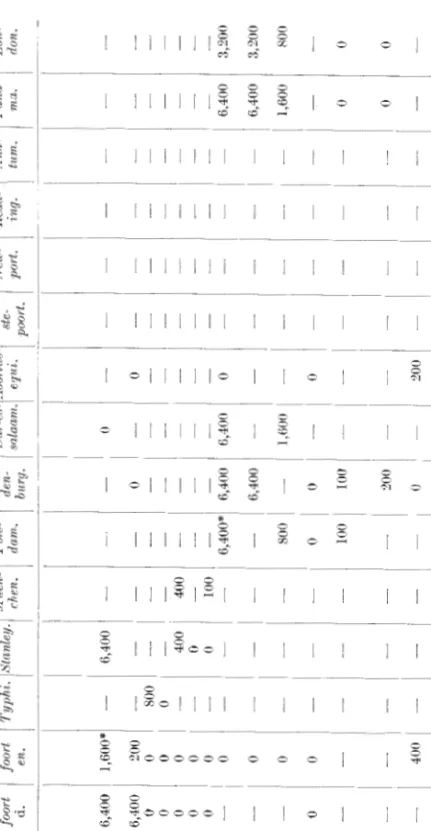
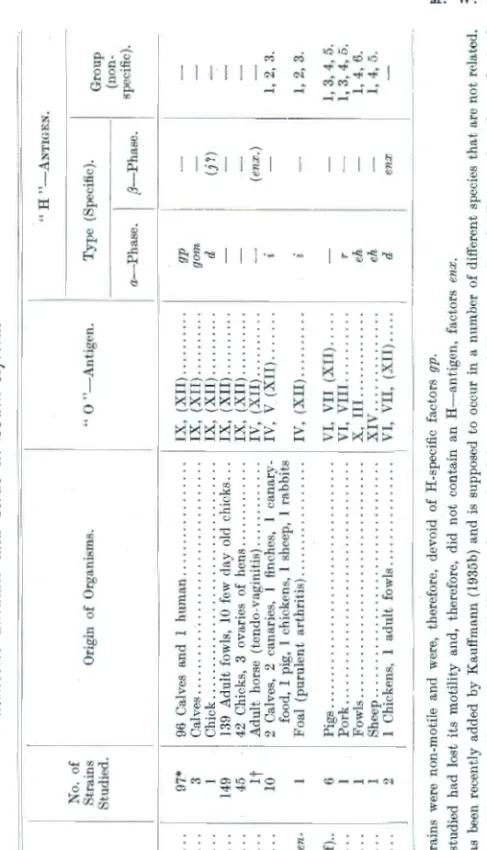
The organism incriminated was an immotile bacterium of the type "fmd-eholen1", obtained in pure culture from the blood and lungs. In one of the chicken epizootics, typhi-mn'fium was obtained from the cardiac blood and internal organs of the dead birds; in another When the growth obtained from each of the two types of colonies is obtained from one cell three successive times, both variants appear continuously in the cultures arising from the individual cells. An additional factor is probably responsible for the residue of agglutinins remaining for the first (en -) .antigen, {3 phase, after absorption of amersjo01·t serum by potsdam, b1·andenburg or dar-es-salaam; however, although the .1· abortus-equi factor clearly forms part of this additional factor, there may be another component that is not present in abortus-equi. It is not entirely clear what this residue can be attributed to; whether it must be regarded as an additional factor in the second (d-) antigen, phase, in addition to the d factor of Stanley, Munich, and typhus i, or it may be attributed to traces of the first (en - ) antigen, {3 phase, present in the emulsion of the second (d-) antigen, phase, amersfoort used for the test is not certain. If the latter interpretation is correct, it is probable that the agglutination which occurs in the ame1'Sfoort serum absorbed by aborths-equi is also due to the overflow of the second (d-) antigen, phase, in the emulsion of the first (en -) antigen, { 3 phase, after Amersfoort. Neither abortus-equi·i, ]Jotsdam, Brandenburg, nor Dar-es-Salaam produced any reduction in the amount of amersjoo1·t serum for the homologous second (d-) antigen complex, phase, or for the stanley, muenchen, and typhoid type phases. In the same way, stanley, m1tenchen, and typhi absorbed a significant amount of agglutinins from amet·sfoort serum for the homologous first (en-) antigen, {3 phase, or for bortus-equi, Potsdam, b1·andenburg, and dar-es-salaam. All small colonies tested readily agglutinated with gallinm·~vrn serum, but all large colonies did not react with this serum. No group sera showed agglutination, but some colonies flocculated when mixed with typhi and stanley type sera, while others agglutinated with type sera containing factors en.'V, enl1;, enlw and eh ( a bortus -eq1u:, potsdmn, dar-es-salaam, onde1'Stepo01't). To ensure that the culture used was unmistakably pme was unicellular. Furthermore, the single cell from the colon yielded:'i' which " ·a s fl.ocelled by type sem containing factor d yielded bacilli which on s u b-enlti Yation produced colonies occurring in both phases (d and enx) Some of the colonies ( approx. 90 per cent) are only agglutinated by sera containing factor d, while a smaller number were agglutinated by type sera. The bacilli in culture 359 therefore also occurred in t 1 Yo specific phases, t e and and (3 phases of Kauffmann and Mitsui (1930 ), the organisms appearing in the o:1e phase consistently dissociated into bacilli, which were present in both phases. Since the organism occurred only in the specific phase, the decomposition was limited to that phase; non-specific variants were not encountered at one time. To establish the identity of culture 359, agglutination and absorption were eliminated as shown in Table 20. But the original amersfoort (culture 336), was obtained in pure culture from dead chickens during a virulent outbreak of a septicemic disease in very old chickens. small in After several different pure-culture strains of typhi-murium (357) were obtained from a number of hens, this organism was considered as the etiological agent of isootia and attempts were made to identify it. my source of infection. Since the first deaths occurred only a few clays after hatching, 11·a:; although the infection was probably acquired from pregnant hens through the eggs. Two consecutive agglutination slides of Lesti were impregnated with the blood of the breeding ::;tod~; but both tests:;; " ·are negative and no carrier could be found among the heu. In the case of ducks \Yarrack and Da lling (1933) observed -that infected eggs help only when the titer of the affected biHls '"is so high and that the agglutination titer of the sera obtained n'adon, chopped considerably during the course of the lying sea::;op Coles again made agar cultures from the heart blood and spleen of the affected birds, and handed them over to me for further ,;tucly. One of the cultures yielded only lactose-fermenting colonies and was discarded; but of both the others are seYeial large and small non-lactose-fermenting colonies "·streaked", suggesting the existence of a mixed infection. Cultme·e 414 completely absorbed all the agglutinins type and groups) from anatun serum, as well as from the homologous serum, while anaturn completely depleted the sera of cult1'e 414 and of its Plf. Cdt~ue 414, obtained from the small colonies, was tested against gallinarwrn 40 serum and was agglutinated by it to full titer it also completely absorbed gallinat"'.tm 43 serum, showing that it contained the same antigeni c. the frequency of gallinaru?n infection, and owing to the predominance of gallinarum colonies in the first subcultures made, it seems probable, however, that the fowl typhoid organism was the principal agent in this outbreak. Some of the cultures were created by me personally, and culture 206 was obtained by Dr. Of the 139 outbreaks of avian typhus, 137 cultures were obtained from chickens and two from turkeys. Cultu1·es and 340 are therefore serologically similar to both gallinarum and p1dlo1·um, but their fermentation reactions (Table 25) were consistent with gallinarum snake, so they should be considered gall strains. · inarum. The remaining 135 cultures were used for unilateral absorption tests of galli narum serum and were found to remove all agglutinins from the serum; the fermentation reactions f) all these cultures also resembled those of gallinarum>. The extent to which agar discoloration occurred varied even among different strains of the same organism; Spike cultures were made and the discoloration started from the inoculum and spread from its point in all directions. Fifty strains labeled in the laboratory by Dublin gave negative tests with Bitter's rhamnose and Stern's glycerine-fuchsin broth; with the D-tartrate test of Jordan and H armon showed or turned yellow about half the tube (+ +) in 14 cultures and about one-fourth in the tube (+) in the remaining 36 cultures - 47 of these cultures were not tested with these the media. Since the completion of this paper, 10 more dublin strains and 17 gallinarum strains have been isolated from fowl typhus outbreaks. In their antigenic structure and biochemical reactions, the dublin strains correspond to the dublin strains described above, and the reactions of the gallinarurn strains were similar to the reactions of the gallinarurn cultures given above. The total number of dublin strains should therefore be 107 and of gallina,rum 166, and the total number of Salmonellas 345. Both strains of amwrsfom·t and that of ondeTst epoort were positive with Stern, Bitte r and d-tartrate. All cultures fermented rhamnose, but in the case of 17 strains fermentation was delayed. The original culture, obtained from :M:artinaglia, was found to be composed of a mixture of the two organisms when I received it; one non-mobile and the other mobile. However, the emergence reactions of the latter did not correlate at all with those of the stock strains of the type used. Four years of agriculture 208 f ermentec l dulc ite slowly, ancl maltose within 24 hours, but currently it fails to ferment e nt clul cite and the fermentation of m altose is delayed for about five clay. When the biochemical reactions of the different types of Salmonellas studied are compared with their serological reactions, very clear differences can be displayed by several strains belonging to the same serological type. For example, some striking variations in their fermentation reactions were manifested by the four strains of tifi·i-mu1·ium vaT. SUMMARY Sur L'Infection Paratyphique Spontanee dn Pigeon par los Bacilles clu Type .\<>rtryck du Breslan. Sulnwnella bovis mot!Ji- .fi,.uns (Bascnan) ist an einem Ausbruch einer Lebensmittelvergiftung erkrankt, teilweise in der Kapprovinz. Der Kult mt.'·p der Erreger der Typlms- l:'a-Ratypltus-Gruppe und seine Bedeutung für.ir rlic St,tnclortsgPinmdenlwit. TIGENlC STHRCCILF SAL~lONELAS. Paratyphoid-like fever in cbildr0n due to Salmonella suipestijer group. On tin, Forrsmnn antigens and B. paraf)/1Jhosus J. The number of infections in lHewpotamine due to the Gnertner-paratyphoid gronp bacillus. :J3).Bacteria of lhe intestinal group "long poultry. lt;"hraders of an anomalous member of the group parntyphoid met], i11 :Mesopotamia. Diseases of domestic animals in southern Africa due to organisms of tlw Salmo11C'iln group. liith i?Pfl. Die Bedeutung des Uefli.igels fiir di<· l•~nstel1ung ,·on LC'bl'nsnlitlel-vPrgiftungen. s on the etiology of epizooti· :dJortion in marl's. On a pathogenic Baeillus of Swine-cholern the group nssociated ll"itlt a fat Usense in Pigeons. G11inea pigs as a food poisoning group.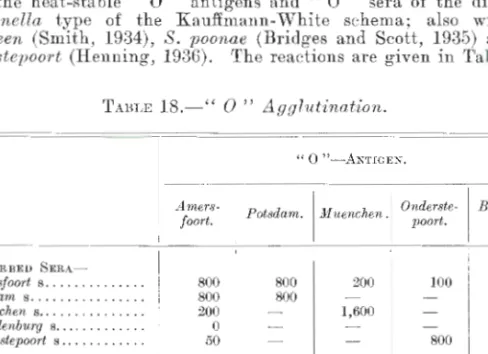
W . HENNIKG
W. H ENNIKG
W. HENNING
TAJJLE 23
ACKNOWLEDCM ENTS
