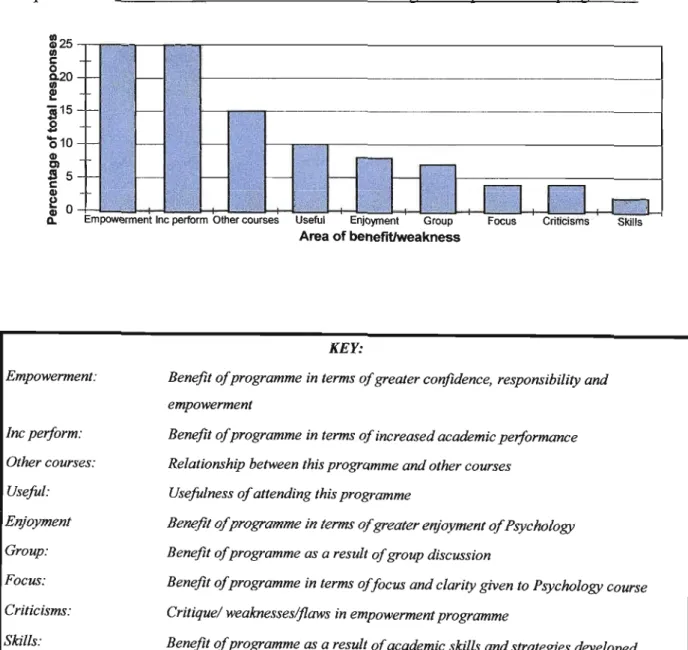
The study's contribution to the areas of academic development and empowerment is then discussed, and a set of recommendations for an empowering education is proposed. 160 Impact of empowerment on four areas (open question) 162 Areas considered the most valuable aspect of the program (open question).
CHAPTER ONE: INTRODUCTION
Observations from the empowerment programme, results from the current study and existing literature will then be used to propose a set of guidelines for empowerment education. Finally, we will discuss the study's impact on academic development and empowerment theory and propose a model of empowerment education.
CHAPTER TWO: INEQUITIES IN THE EDUCATIONAL SECTOR
SOUTH AFRICAN STUDIES
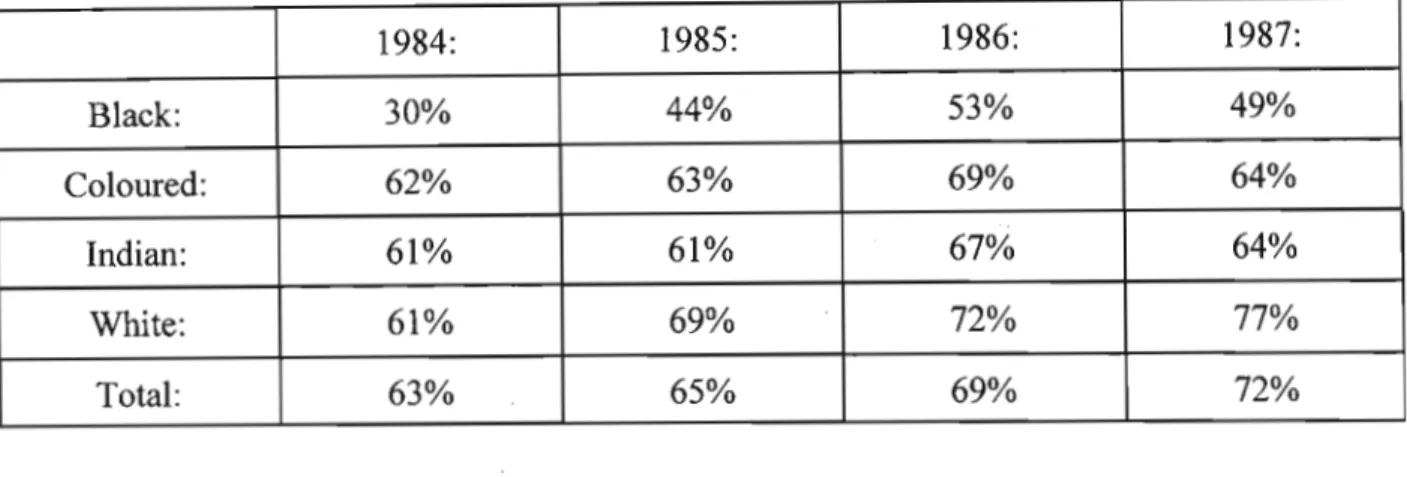
Although the following quote describes the world of the township child under the apartheid government in the mid-1980s, similarly high levels of violence were reported in the 1980s. The extension of the University Act of 1959 applied the policies of the Bantu Education Act of 1953 to the higher education sector.
INEQUITIES IN HIGHER EDUCATION - OTHER CONTEXTS
CHAPTER THREE: ADJUSTMENT DIFFICULTIES OF FIRST YEAR BLACK STUDENTS
SOCIO-POLITICAL FACTORS
At university, then, black students face two messages that suggest acceptance of the status quo—one resulting from their lecturer's higher education and the other resulting from their race. Recent transformation initiatives in South African universities are an attempt to address some of the above socio-political concerns.
CAMPUS ECOLOGICAL FACTORS
In an 11-year study of black students' adjustment problems on an American campus, June, Curry and Gear (1990) found that financial problems were consistently the top problem throughout all the years of the study, and that these problems were a had significant impact. on academic performance. In a comparison of the experiences of black and white students on predominantly black and white campuses, Westbrook, Miyores and Roberts, (1978) also found that lack of financial assistance was a significant problem for black students on both campuses, but was not reported as a problem by white students.
INTERPERSONAL FACTORS
Another interpersonal factor affecting Black students' adjustment is the issue of social support. Other studies find similarly high levels of cultural alienation and poor interracial interaction among black students.
INTRA-PSYCHIC FACTORS
Overreliance on rote learning leads to other weaknesses, including poor writing skills (Wood, 1998) and helps explain high levels of plagiarism among Black students. The former is perceived by both staff and students as one of the main causes of black student failure (Coleman, 1993), and forms the basis of many academic development interventions (Grewar, 1987; Pandor, 1991 and Starfield and Hart, 1991a). .
CRITIQUE
Gibbs (1973) identified the following problems among black students on predominantly white campuses: identity crises, interpersonal problems, poor. More local research is also needed to contrast the experiences of white and black students on historically white and black campuses.
CHAPTER FOUR: ACADEMIC SUPPORT AND DEVELOPMENT
ACADEMIC SUPPORT PROGRAMMES
At the level of the academic debate, several references referred to the role of non-cognitive factors in student development. From the early 1990s, therefore, critics began to advocate a shift from a peripheral approach to academic support to a mainstream, transformational approach that would place responsibility for academic support firmly within departments and curricula.
ACADEMIC DEVELOPMENT PROGRAMMES
As a result of the emphasis on transformation, a new view has emerged of academic development practitioners taking on an advisory role, helping departments and faculties to develop curricula relevant to the local context. At the University of Natal, academic development is widespread and departmental, with few centralized functions such as research, evaluation and resource development (Bulman, 1996).
EXAMPLES OF STUDENT DEVELOPMENT INTERVENTIONS
Similar lack of confidence to participate and passive dependence on the tutor to reteach the course was found in the evaluation of a Mathematics tutorial course at the University of the Witwatersrand (Lloyd, 1987). However, perhaps their peers became more motivated to attend because of the difficulty of the course, worked harder and thus improved their performance.
ACADEMIC SUPPORT AND DEVELOPMENT PROGRAMMES - CRITIQUE
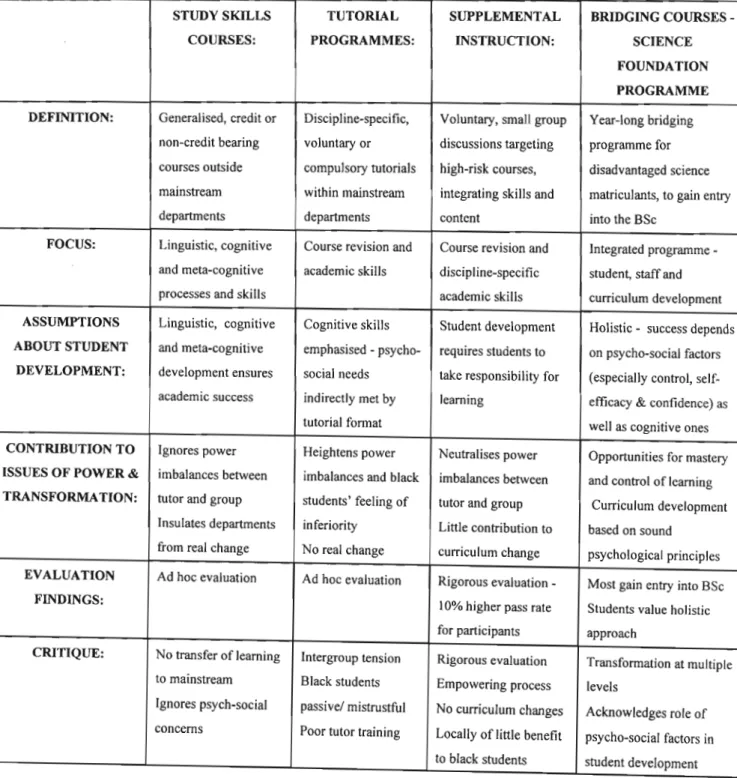
The focus of academic development on integration and wider processes of transformation therefore leaves out a crucial step, namely empowering students to take control of their own learning and contribute as equal participants in processes of change. 1994) and Masenya (1994) also criticize academic development for its silence regarding the power imbalance between educators and learners and between groups in the wider South African society. I agree with Masenya's contention that academic development seems somewhat silent on the role that the university power hierarchy plays in student development.
CHAPTER FIVE: EMPOWERMENT THEORY AND
PRACTICE
COMMUNITY PSYCHOLOGY - VALUES, GOALS AND THEORETICAL FOUNDATIONS
- Historical development and theoretical foundation
- Values and ethical principles of Community Psycholol:Yi
- A world view advocatin~ competence not deficit
Implicit in this value is a rejection of the dominant American position of liberalism, which espouses the supremacy of white middle-class values and seeks to distribute resources according to a single standard of normality and competence. While all of the above values underpinned the current intervention, the fifth value is perhaps most relevant to this study, that of promoting competence rather than correcting deficits. The goal of academic development has therefore been to provide these skills, bring students up to the predetermined standard and thus correct the deficit.
EMPOWERMENT THEORY AS COMMUNITY PSYCHOLOGY'S WORLD VIEW AND PHENOMENON OF INTEREST
- Models of empowerment
- Kieffer (1984)
- Zimmerman (1990a and 1995)
Thus, he proposes that empowerment brings together the best elements of the two models mentioned above (Rappaport, 1981). Empowerment theory is also ecological: it views the community as embedded in a dynamic context, resulting in ever-changing changes in community empowerment. Interventions are best when they are built around a common understanding of empowerment rather than the understanding of the expert or community leader (Strawn, 1994 in Foster-Fishman, Salem, Chibnall, Legler, and Yapchai 1998).
EMPOWERMENT'S LINKS WITH OTHER CONSTRUCTS
- Empowerment and personality constructs
Rappaport's definition (1987) includes a psychological sense of control as one of the two key aspects of empowerment. Zimmerman (1995) also includes locus of control as part of the intra-personal component of psychological empowerment, but combines it with interaction and behavior. Aspects of empowerment such as democratic participation in the community, and socio-political understanding of the obstacles to empowerment are not included in Bandura's collective efficacy concept.
CHAPTER SIX: APPLICATION OF EMPOWERMENT THEORY TO EDUCATION
COMMUNITY PSYCHOLOGICAL RESEARCH
- Principles and practices of community psycholo2ical research
- Community psycholoeica1 research methods - action research
Participation involves discussion between researcher and participants about how best to use the findings for the benefit of the community. Finally, action research advocates the value of collaboration between community and researcher to ensure the relevance of the research for solving community problems. The participation of the researcher in the community also allows the context to be experienced from within, thus providing more accurate information.
THE APPLICATION OF EMPOWERMENT THEORY TO THE CONTEXT OF EDUCATION
- Features of an empowerin2 education
- Personality aspects of educational empowerment
These are all features that have been incorporated into the design of the current program, which will be discussed in the next chapter. Two such efforts are the School Participant Empowerment Scale (Short and Rinehart, 1992) and the Self Empowerment Index (Wilson, 1993), measures of teachers' sense of empowerment to effect change in the school context. Similar games were used in the empowerment program on which this thesis is based.
EMPOWERMENT THEORY - CRITIQUE AND CONCLUSIONS
Each researcher should therefore provide a clearly operationalized definition of empowerment specific to the context being studied. Feminist writers (Bowen, Bahrick and Ens, 1991 and McWhirter, 1991) place more emphasis on the collective aspects of empowerment than on the empowerment of individuals. Focusing specifically on the application of empowerment theory to the educational context, there are also several areas that warrant further research.
CHAPTER SEVEN: METHOD
RATIONALE FOR TIDS STUDY
Empowerment theory also provided a set of practical strategies to inform the design of the intervention, as well as a participatory methodology of evaluation. The present study therefore sought to extend work in this area by evaluating the effects of the. A secondary aim of the research was to design and test a measure of students' academic empowerment which will hopefully differentiate between the empowerment levels of participants in the above program and non-participants.
AIMS AND HYPOTHESES OF THE PRESENT STUDY
Students who participate in the empowerment program are expected to find the program beneficial and report increased feelings of academic control and empowerment. Students who participate in the empowerment program score higher on the empowerment questionnaire than those who do not. Students who participate in sports, societies, and other extracurricular activities score higher on the empowerment questionnaire than those who do not.
RESEARCH METHODOLOGY
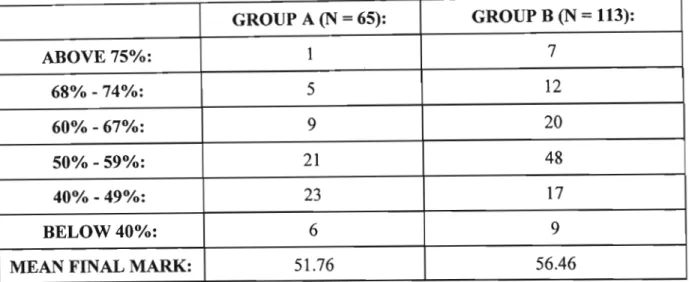
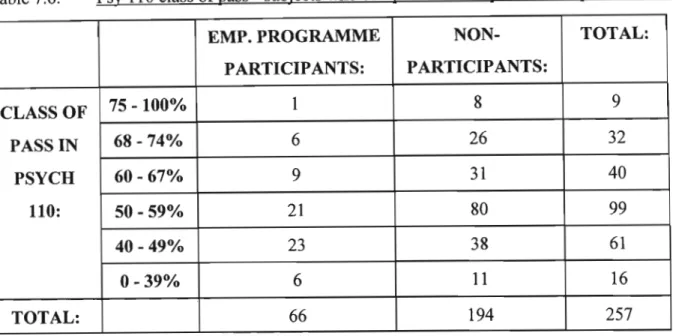
Students who scored 68% or higher on the Psychology 110 exam score higher on the empowerment questionnaire than those who scored below 68% on the Psychology 110 exam. To facilitate analysis and reporting, the two sections of the study will be treated separately. The second component focuses on the design and administration of the measurement of student empowerment (referred to as the empowerment questionnaire).
EMPOWERMENT TUTORIAL PROGRAMME
Students collaborated in the design of the program by determining its goals and selecting issues to be addressed. Students then determined areas to be evaluated and wrote some of the questions for the evaluation. The third handout provided notes relevant to each of the skills discussed in the tutorial.
EMPOWERMENT QUESTIONNAIRE
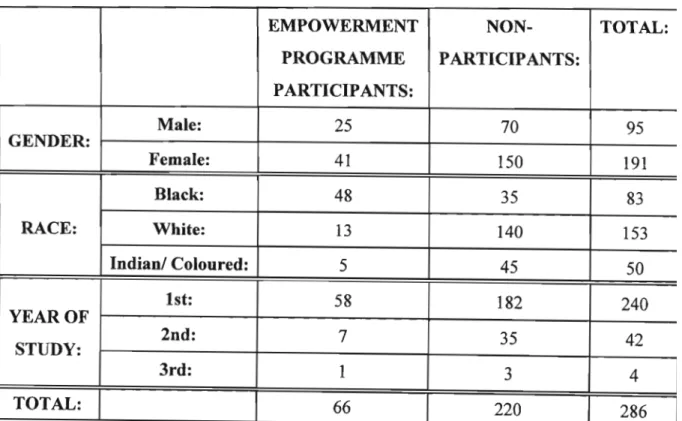
Students were given the entire 45 minute session to complete the questionnaire and all managed it in the time allowed. Subjects for this part of the research were all first-year students present at two Psychology 120 lectures (lectures are repeated due to large student numbers and thus both halves of the class were sampled). 148 of the 434 students registered for this course were not present on the day data was collected).
I TOTAL: I
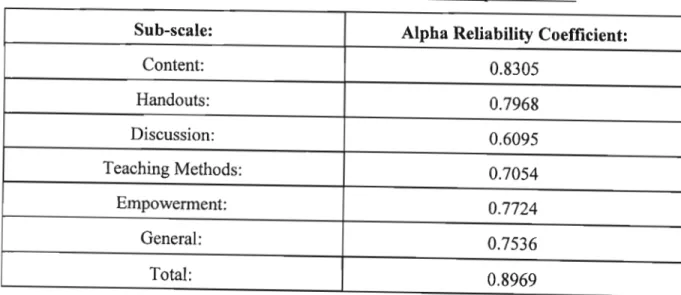
As a result of the pilot study, one item was deleted from the questionnaire and replaced with a new one and the wording of seven items was changed. Students completed the questionnaire during a lecture and all students who attended class on the day of data collection were included in the sample. After completing the questionnaire, students were given permission to leave the lecture hall quietly, so as not to disturb those students who were still busy.
CHAPTER EIGHT: RESULTS OF THE PROGRAMME EVALUATION
INTRODUCTION
QUANTITATIVE EVALUATION OF THE EMPOWERMENT PROGRAMME
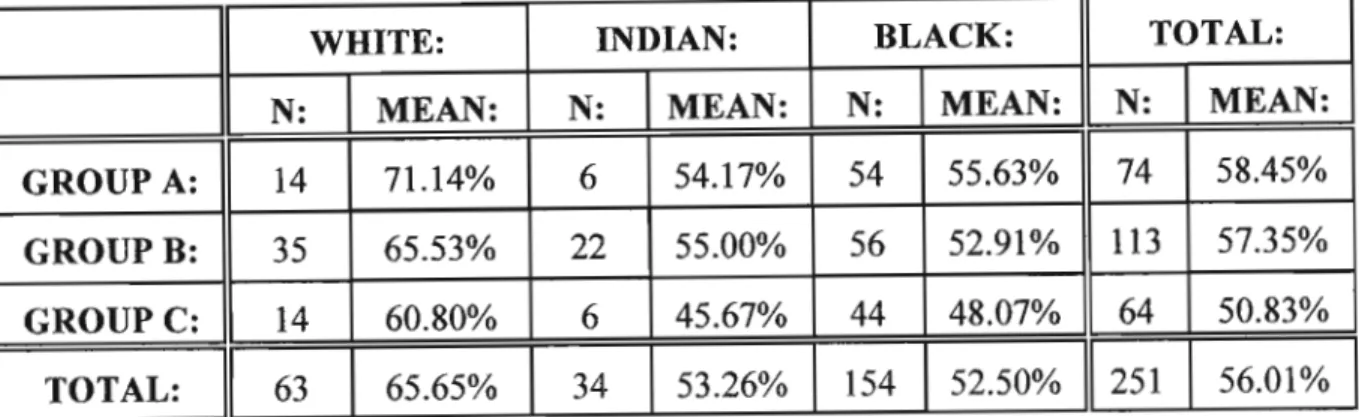
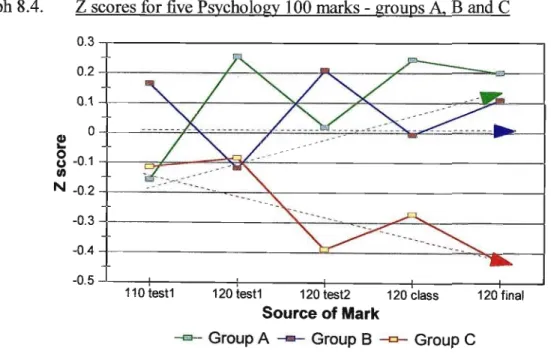
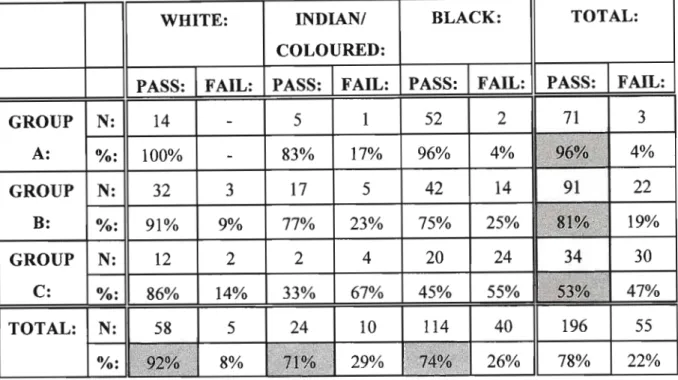
To determine whether there was any improvement in performance over time within any of the three groups, mean scores were calculated for several aspects of the Psychology 120 course as well as the first-grade test of the Psychology 110 course. Five sets of grades were compared—first-grade a Psychology 110 test, two Psychology 120 class tests, a Psychology 120 class grade (consisting of two class tests, five exercises, and homework), and a final grade for Psychology consisting of the exam grade and 25% of the class grade). A trend analysis was performed to determine whether there was a significant improvement or decline in performance over time in any of the three groups.
QUALITATIVE EVALUATION
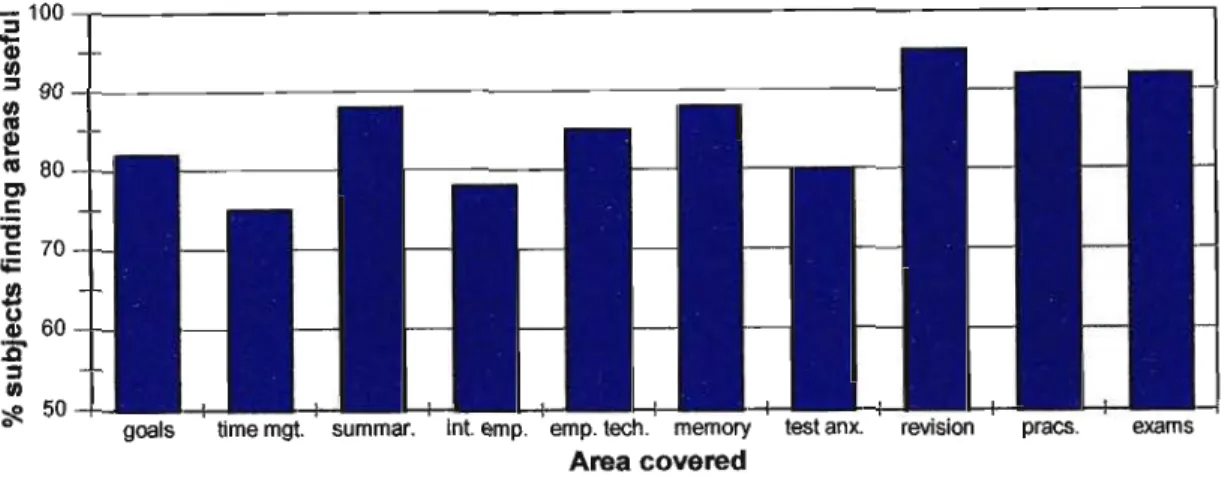
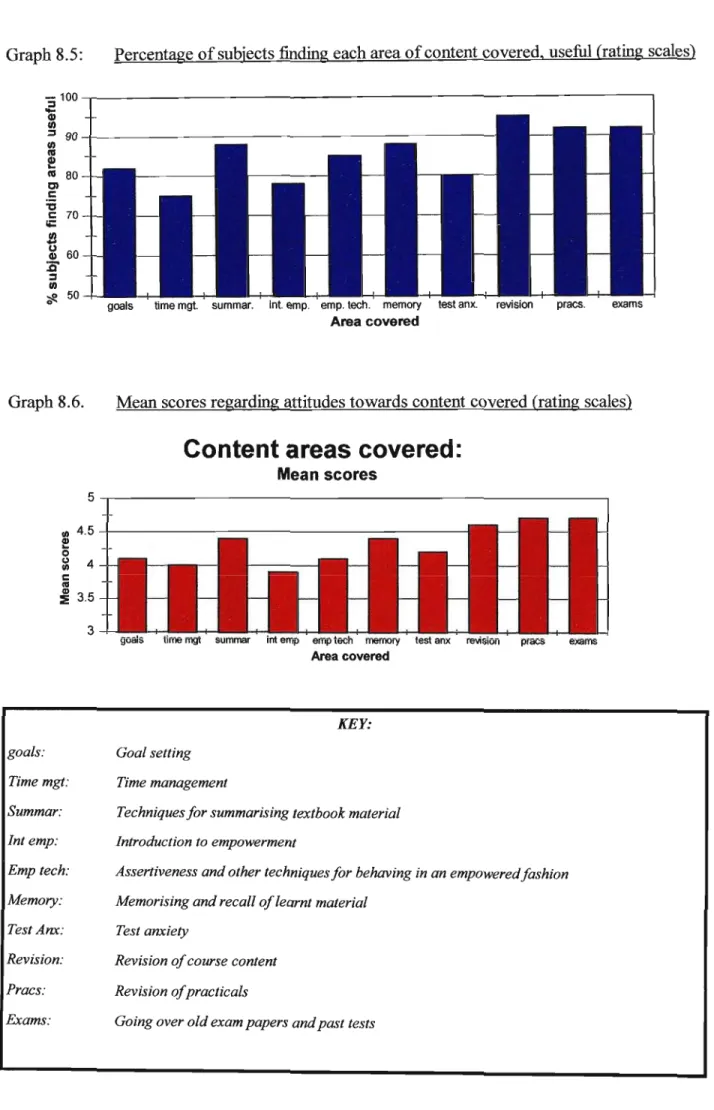
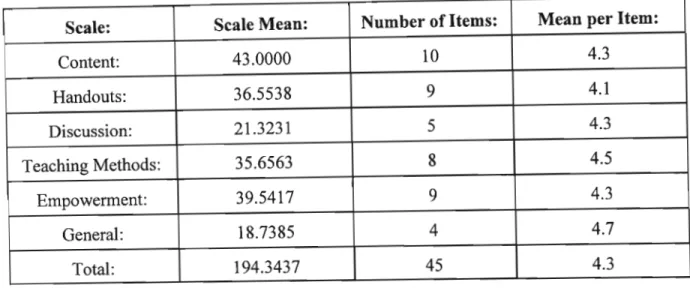
The most useful areas, both in terms of mean scores and the percentage of respondents who rated them as fairly or extremely useful (scores of 4 or 5), were the repetition of difficult lecture content (95% of medium-scoring subjects rated it as fairly or very useful out of 4, 6), revision of exercises (92% of subjects rated as useful with an average score of 4.7) and (review of exam questions from previous years (92% of subjects rated as useful with an average score of 4.7). The least useful areas were time management ( mean 4 and 75% of respondents rated as helpful) and introduction to empowerment (mean 3.9 and 78% of respondents rated as helpful).A session exploring empowered behavior techniques was rated as more useful than an introductory empowerment session (mean 4, 1 and rated as useful by 85% of the subjects).
Content areas covered
FOCUS GROUP DISCUSSIONS
Fourteen respondents (10%) claimed that the program was useful and helped them a lot. 36 responses were given of which 34 (94%) were positive comments and two (6%) were criticisms of the program. They appreciated the fact that participation was encouraged and that everyone contributed to the success of the program through discussions.