This thesis examines the Peace and Security Council (PSC) of the African Union (AU) in light of the continental challenges of peace and security. The study's central argument is that the SDK's ability to successfully tackle peace and security challenges depends largely on the cooperation of the fifteen members of the PSC as well as between the fifty-three members of the African Union and the international community in general, including the United Nations. The international community, especially the major players or countries in the international political spectrum, are challenged to work together with the PSC in its pursuit of peace and security in Africa.
Members of the international community are urged to suspend their parallel initiatives for peace and security in Africa in favor of supporting and strengthening the ongoing initiatives of the PSC. Another critical point raised in the study is that the UN's brief to cultivate world peace and security compels it to support PSC initiatives, locally developed regional solutions to Africa's inherent peace and security challenges. Finally, the study recommends greater coordination and cooperation between the PSC and key international actors, including the UN. i).
Introduction, Background and Methodology of the Study
Background and outline of the research problem
In addition, Tesi argues that the most affected part of the population is often the productive group, which ranges from 20 to 40 years. The eventual transformation of the OAU into the African Union (AU) in 2002 did not change the OAU's strategy of ensuring peace and stability to achieve continental development. The PSC (AU) is a body charged with the prevention, management and resolution of conflicts that continue to undermine Africa's vision and ambitions for a peaceful environment conducive to development.
Given the above factors, it can be assumed that lack of cooperation appears to be a critical challenge that eluded members of the OAU and thus significantly undermined the efforts of the organization to achieve peace and stability in the continent. The central argument is that effective cooperation between not only AU member states (especially the fifteen members of the SDK), but also between the AU and key international actors, will greatly contribute to the success of the SDK in carrying out its mandate. According to Koblentz, cooperation will first be hindered if the intentions of the states are uncertain and unpredictable.
Contextualising cooperation: PSC perspective
According to Mays, major international actors turned a blind eye when the Rwandan Hutus began an ethnic cleansing of the Rwandan Tutsis. According to Mays, this action was due to the fact that Rwanda was not in the interest of the major international players. While the US has seen Africa as a strategic partner in the fight against terrorism since September 11, 2001, the US has not taken note of the AU's existing counter-terrorism initiatives.
Instead, France supported the presidency of the opposition leader Allassan Outtara - thus undermining the AU's position on the matter. The commitment of Africans has been clearly signaled by the ratification and subsequent activation of the PSC Protocol. Furthermore, declarations by key international actors - be they from the G8 Gleneagles Summit in 2005, the African Commission or individual efforts such as those of America under the Global Peace Operations Initiatives (GPOI) - will aim to increase Africa's stabilization and capacity. must be carefully coordinated through the PSC to ensure harmonization.
Hypothesis
Therefore, the willingness of African states to relinquish part of their sovereignty in accordance with the Protocol for the sake of security and stability (as stipulated in Article 4 (h and j) of the Constitution) is a sign of the seriousness that Africans attach to the creation of security and stability on the continent. PSC members will need to work very closely together (and encourage a similar work ethic among other AU member states and international actors) to see the implementation of AU decisions and declarations. In this favorable context, the PSC will be able to decide when, why, where and how to call for predictable international support.
Significance of the Study
13 with the problems associated with non-interference (in particular with Article 4(h) of the Constituent Act and Article 4(j) of the PSC Protocol, which guarantee the right of the Union to intervene in the affairs of a Member State (according to the decision of the Assembly in relation to grave circumstances, namely war crimes, genocide and crimes against humanity) has therefore attracted the attention of many scholars (see van Nieuwkerk Field, 2004: 21 and Powell, 2005: 1). The PSC in 2003 led many hopeful individuals to believe that the problems of insecurity in Africa is now more effectively addressed (Kagwanja, 2004: 4). In essence, therefore, the PSC is an important attempt by Africans to deal with the issues of peace and security in the region.
It is hoped that the study will contribute to improving the success of the PSC in resolving conflict situations in Africa. More importantly, this study serves as an important pointer to the root of the challenge that could hinder the effectiveness and success of PSCs. The study's contention is that most of the challenges for PSCs could be mitigated through enhanced cooperation and coordination.
Research Objectives
14 by placing particular emphasis on collaboration as a perceived major contributing factor to such success. Deng and Zartman aptly stated, "If security, stability, and development form interconnected rings of values, cooperation is the calabash that holds them all." Indeed, Mays adds that it is in the interest of both Western and African states to cooperate and find a formula that will make what she calls the "Africanization of peace operations" a success.
This study supports Deng and Zartman's assertion above and its emphasis on the importance of cooperation in achieving stability in Africa. As an important contribution to the academic world, the study contributes to our understanding of regional efforts to promote political stability and economic development of the entire continent (so far unattainable) by nurturing peace and security through conflict prevention, resolution and management, and by peace-building and building. 15 1) Identification and evaluation of some key factors that will determine PSC. effectiveness as an instrument for managing conflict situations and establishing peace.
Research Questions
Theoretical Framework of the research project
17 In this study, particularly through the use of the constructivist approach, it is required that the AU be seen as an example of a developing security society. According to Adler and Barnett, there are two groups of security societies: pluralistic and amalgamated. It can be argued that the AU is an example of a pluralistic security society given that its member states retain a large degree of their sovereignty.
Adler and Barnett (1998: 7) claim that states within a pluralistic security community are compatible in terms of core values derived from common institutions and mutual responsiveness. According to Article 3 (b) of the AU Constitution 2000, one of the purposes of the AU is to defend the sovereignty, territorial integrity and independence of its member states. It can therefore be argued that there is a movement towards a security community, given the AU's commitment to protecting the sovereignty of its member states and its willingness to resolve conflict situations peacefully.
Research methodology and methods
The Burundian case was chosen because it is an example of the AU's first full peace support operation. 19 When the PSC intervened, it oversaw the process without tampering with the mediation efforts of those already involved in resolving the conflict. The PSC also oversaw the smooth transition from the African Mission in Burundi (AMIB) to the United Nations Operation in Burundi (ONUB).
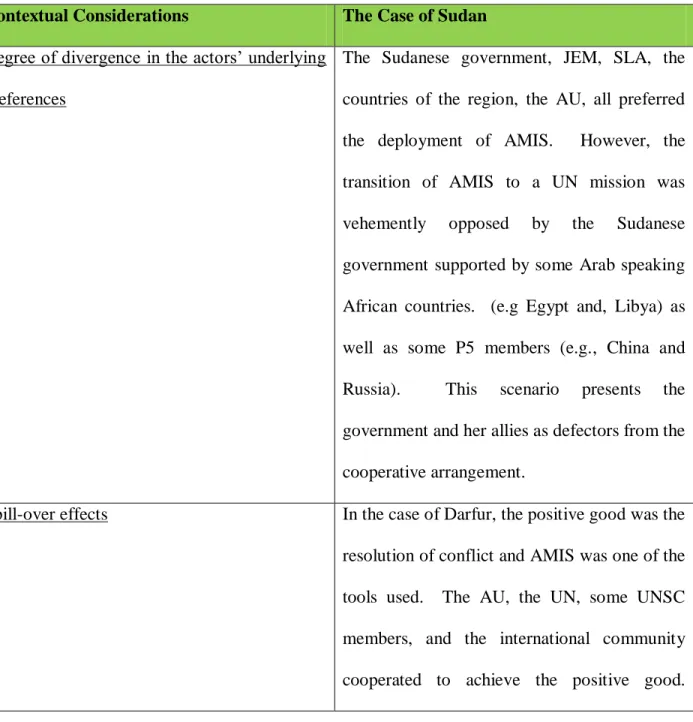
Some members of the Arab League, including Libya and Egypt, supported the Sudanese government's position. To collect the necessary empirical data, a series of interviews were conducted with relevant individuals and institutions. For official positions and statements, the following individuals were interviewed: members of the PSC (Algeria, Angola, Benin, Burkina Faso, Burundi, Chad, Ethiopia, Gabon, Nigeria, Rwanda, Swaziland, Tunisia and Zambia); the Permanent Five of the UN Security Council (China, France, Russia, Britain and the US); members of the AU Commission;.
Structure of the dissertation
Theoretical Framework
- Introduction
- Defining and contextualising cooperation in world politics
- What is cooperation?
- Cooperation and international relations: a theoretical perspective
- The neo-liberal institutionalism approach
- The neo-realist approach
- The social constructivist approach
- The African Union: an evolving security community?
- What is a security community?
- Can the AU be viewed as an example of a security community?
- Conclusion
23 explanation of why social constructivism is the best choice for understanding the AU in the context of contemporary international relations.
Literature review: An evolution of Africa’s Peace and Security Architecture
Introduction
Conflicts: definition of concepts
- Types of Conflicts
- Conflict management
The OAU and its approach to African conflict situations
- The OAU as a third-party intervener in African conflict
Assessing the OAU’s conflict management capability: what went wrong?
- The mandate of the MCPMR
- The structure of the MCPMR
- The OAU’s performance since the MCPMR
The Peace and Security Council of the African Union: A new beginning?
- PSC support structures and their functions
- The Continental Early Warning System (CEWS)
- The Panel of the Wise
- The African Standby Force (ASF)
- The Peace Fund
- The PSC’s expected operational method
Africa’s Challenge: the long road ahead
Conclusion
The Peace and Security Council and the Realities on the Ground
Introduction
The PSC and its formidable challenges
- Africa’s responsibility: a genuine commitment versus a political statement
- The phenomenon of unconstitutional changes of government: the PCS’s formidable
The PSC’s long and treacherous road
Africa’s growing realisation of the importance of cooperation
The international community: change of tactic but same objective
The United Nations African Operations: a disappointment from above?
Conclusion
An Assessment of the PSC’s Performance: the Case of Burundi
Introduction
Background to the African Mission in Burundi (AMIB)
- The deployment of AMIB
The transition from AMIB to the United Nations Operations in Burundi (ONUB)
AMIB: are there any prospects for PSC?
Conclusion
An Assessment of the PSC’s Performance: the case of Darfur (Sudan)
Introduction
Background of the African Mission in Sudan (AMIS)
- The deployment of AMIS
Transition from AMIS to the United Nations Mission in Darfur (UNAMID)
- The role of the International Criminal Court and the Darfur Crisis
- The role of the AUPD
AMIS: are there any prospects for PSC?
Conclusion
Dissemination, Interpretation and Analysis of Findings
Introduction
Identification and evaluation of some of the crucial factors that will determine the
- The PSC members
- The AU Commission
Determining the importance and nature of cooperation needed between key AU member
- The PSC members
- The AU Commission
- The Permanent Five Member of the UN Security Council
- Other Members of the international community (EU, G8 and UN)
- Views of the research institutes and think tanks
Underscoring the importance of buttressing Africa’s initiatives aimed at ensuring the
- PSC members
- AU Commission
- The Permanent Five Member of the UN Security Council
- Responses of the European Union
Highlighting the urgency of activating the PSC’s support structures
- PSC members
- AU Commission
Prospects for the PSC
Analysis of the Findings
- The PSC discharging its mandate as a political entity
- The AU Commission weak effort of discharging its mandate as the secretariat of the
- The involvement of some external players in Africa
- Proving or disproving the hypothesis of the study
- AMIB and AMIS lessons
Research limitations
Conclusion
The AU's objectives and principles are spelled out in Article 3 and 4 of the Constitution. The coordinating body of the SDK support structures is the AU Commission (which serves as the secretariat of the African Union in general). Instead, and according to a senior CISSA representative (S), CISSA provides intelligence to the AU Commission Chairperson through a structure called the Intelligence and Security Council (ISC) in the office of the Chairperson of the AU Commission.
Reporting to the AU Executive Council in January 2010, the Chairperson of the African Union, Dr. The chapter discussed the transition of the OAU to the AU - in particular the transformation of the MCPMR into the PSC. The responsibility to ensure peace and stability in the world remains a prerogative of the UN.
The international community, especially the EU, USA and France, cooperated in support of the AU (Albert, 2007: 61). The following section examines the role of the international community in relation to the AU's initiatives to bring stability to Africa through the PSC. The AU Commission (2003: 4) notes that "the Constitutive Act of the AU (made it necessary for the Union to assume its responsibility (in Burundi as a contribution to) the resolution of African conflicts".
The implementation of the phase was the exclusive responsibility of the AU and the UN in cooperation with Sudan. This decision allowed the joint deployment and operation of the UN and the AU in Darfur without the transfer of the mission to the UN. The panel further consulted with members of the international community (including Canada, Denmark, Germany, Italy, Japan, Norway, Qatar and Sweden).
It was forced to take note of the situation by virtue of its adherence to the AU Constitution Act and the PSC Protocol.