CHIEF EXECUTIVE OFFICER COMPENSATION AND THE EFFECT ON COMPANY PERFORMANCE IN A SOUTH AFRICAN CONTEXT
Thesis submitted in fulfillment of the requirements for the degree of
MASTER OF COMMERCE (ACCOUNTING) of
RHODES UNIVERSITY
by
SAMUEL BRADLEY
December 2011
ABSTRACT
The goal of this research was to determine, in a South African context, whether there is any correlation between chief executive officer compensation and the performance of the company.
For the purposes of the research, the compensation of chief executive officers was broken down into three components: salary, bonus and "other" remuneration, while company performance was measured on return on equity, return on assets and earnings per share figures. Studies on this topic have been carried out in other countries, most notably in the United States of America and the United Kingdom. It appears that no research of a similar nature has been carried out in South Africa.
Data in respect of the forty largest listed companies in South Africa were collected over a period of five years. The econometric models used for the research were based on models identified in the literature study. The data were then analysed for evidence of a correlation between chief executive officer compensation and the performance of the company. The results of this study indicate that there is no linear relationship between chief executive officer compensation and company performance variables. The econometric models did, however, show correlations between certain variables, taking into account the other predictor variables in the model.
Evidence of correlations between age and experience and compensation was also found, which may present potential avenues of research to scholars in the future.
Key words: Chief executive officer (CEO) compensation, remuneration, company performance, agency theory, managerial incentives
11
ACKNOWLEDGEMENTS
The author would to thank many people for their contributions to this work. The input and
guidance of my supervisors, Professor Rosenberg and Professor Stack (Rhodes University), are gratefully acknowledged, while their wisdom, commitment and professionalism displayed
throughout the duration of this thesis are highly valued.
In addition, the technical and statistical expertise of Professor Radloff (Rhodes University) was invaluable in completing this research. Her patience in explaining the technical aspects of the data, as well as her dedication in ensuring it was correctly documented and interpreted, are gratefully noted.
Finally, the author would like to thank Mrs. Harriet Dicks, Mrs. Candice Sephton and Miss Shandre Segal (Remuneration Department, Deloitte Johannesburg) for allowing the author to spend a few days in their department experiencing the practical side of executive remuneration. Their kindness, friendliness and willingness to share their expertise are much appreciated.
Samuel Bradley
Decem ber 2011
CONTENTS
Abstract ii
Acknowledgements iii
Contents iv
List of Tables viii
List of Graphs ix
Quote x
CHAPTER 1 INTRODUCTION
1.1 BACKGROUND 1
1.2 LITERATURE SURVEY 2
1.3 GOAL OF RESEARCH 4
1.4 RESEARCH METHOD AND DESIGN 4
1.4.1 Sample selection procedure 4
1.4.2 CEO compensation variables 5
1.4.3 Company performance variables 7
1.4.4 Grouping of companies 10
1.4.5 Statistical method 11
1.4.6 Limitations of the research design 11
1.5 CONCLUSION 12
IV
CHAPTER 2
2.1 2.2 2.3
2.4
CHAPTER 3
3.1 3.2
3 .3
3.4
CHAPTER 4
4.1 4.2 4.3 4.4
CONFLICTS CAUSED BY THE AGENCY PROBLEM
INTRODUCTION AND BACKGROUND THE AGENCY RELATIONSHIP
TRADITIONAL CONFLICT AREAS
2.3.1
Managerial opportunistic behaviour2.3.2
Managerial entrenchment CONCLUSIONCORPORATE GOVERNANCE MECHANISMS USED TO SOLVE THE AGENCY PROBLEM
INTRODUCTION AND BACKGROUND
CORPORATE GOVERNANCE MECHANISMS
3.2.1
External corporate governance mechanisms3.2.2
Internal corporate governance mechanisms THE USE OF COMPENSATION IN REDUCING AGENCY COSTS3.3.1
Optimal contracting approach3.3.2
Managerial power approach CONCLUSIONDESIGN OF THE MODELS
INTRODUCTION THE POPULATION THE DATA
THE VALIDITY OF THE DATA
13 13 14 15 16 17
18 18 20 22 29
30 30 31
32
32
34
34
4.5
ECONOMETRIC MODELS USED35 4.5.1
Company performance or other variables35
affecting CEO compensation
4. 5 .2
CEO compensation or any other variables35
affecting company performance
4.6
POSSIBLE ECONOMETRIC SPECIFICATION ERRORS36
4.6.1
Autocorrelation36
4.6.2
Heteroskedasticity36
4.6.3
Normality of the disturbances37
4.6.4
Multicollinearity37
4.7
DESCRIPTIVE STATISTICS37
4.8
CONCLUSION39
CHAPTER 5 ANALYSIS OF RESULTS
5.1
INTRODUCTION40
5.2
THE EFFECT OF CEO COMPENSATION ON COMPANY40
PERFORMANCE
5.2.1
Salary as dependent variable41
5.2.2
Bonus as dependent variable44
5.2.3
"Other" remuneration as dependent variable47 5.3
THE EFFECT OF COMPANY PERFORMANCE ON CEO50
COMPENSATION
5.3.1
ROE as dependent variable50
5.3.2
ROA as dependent variable53
5.3.3
EPS as dependent variable56
5.4
CORRELATION MATRIX TABLE59
vi
5.5
CONCLUSION 60CHAPTER 6 CONCLUSION AND SUGGESTIONS FOR FURTHER RESEARCH
6.1
INTRODUCTION61
6.2
GOALS OF THE RESEARCH61
6.3
RESEARCH METHOD AND DESIGN61
6.4
FINDINGS62
6.4.1
CEO compensation findings62
6.4.2
Company performance findings63
6.4.3
General findings64
6.5
SUGGESTIONS FOR FURTHER RESEARCH65
Further research in terms of the goal of this
6.5.1
study65
Further research in terms of the findings of this
6.5.2
study66
6.6
CONCLUSION66
REFERENCES 67
LIST OF TABLES
Table 1 A summary of previous studies on a similar topic, including the
3
author(s), the country of research and the year of publication
Table 2 A summary listing of the major corporate governance
19
mechanisms
Table 3 Disclosure requirements relating to executive compensation in
23
the King 11/ report
Table 4 Disclosure requirements relating to compensation in the
24
Companies Act 2008
Table 5 The leadership role of the board in terms of the King III report
25
Table 6 Responsibilities of the board in terms of the Companies Act
26
2008
Table 7 Guidelines concerning the Remuneration Committee in the
26
King 11/ Report
Table 8 Descriptive statistics of data collected for the year 2006
37
Table 9 Descriptive statistics of data collected for the year 2007
37
Table 10 Descriptive statistics of data collected for the year 2008
38
Table 11 Descriptive statistics of data collected for the year 2009
38
Table 12 Descriptive statistics of data collected for the year 2010
38
Table 13 Descriptive statistics for salary
41
Table 14 Econometric Model
1
showing salary as the dependent42
variable with lagged ROE, ROA and EPS
Table 15 Descriptive statistics for bonus
44
Table 16 Econometric Model
2
showing bonus as the dependent45
variable with lagged ROE, ROA and EPS
Table 17 Descriptive statistics for "other" remuneration
47
Vlll
Table 18 Econometric Model 3 showing "other" remuneration as the 48 dependent variable with lagged ROE, ROA and EPS
Table 19 Descriptive statistics for ROE 50
Econometric Model 4 showing ROE lagged as the dependent 51
Table 20 variable
Table 21 Descriptive statistics for ROA 53
Table 22 Econometric Model 5 showing ROA lagged as the dependent 54 variable
Table 23 Descriptive statistics for EPS 56
Table 24 Econometric Model 5 showing ROA lagged as the dependent 57 variable
Table 25 A correlation matrix using lagged performance measures 59
LIST OF GRAPHS
Graph 1 Average salary from 2006 to 2010 for each sector 42 Graph 2 Average bonus from 2006 to 2010 for each sector 45 Graph 3 Average "other" remuneration from 2006 to 2010 for each 48
sector
Graph 4 Average ROE from 2005 to 2009 for each sector 51 Graph 5 Average ROA from 2005 to 2009 for each sector 54 Graph 6 Average EPS from 2005 to 2009 for each sector 57
"True leadership must be for the benefit of the followers, not the enrichment of the leaders."
Robert Townsend (1920 - 1998)
x
CHAPTER ONE: INTRODUCTION
1.1 BACKGROUND
Executive compensation has been in the limelight recently and often for the wrong reasons (Ozkan: 2007). The financial crisis of 2008 has led to many national recessions, as well as retrenchments and other cost-cutting measures at companies. This situation has increased the awareness of the general public of the pay-cheques of the rich and powerful (Bognanno: 2010), with more and more fingers being pointed at these "outrageously high salaries for executives" (Sharma & Smith, 2001 :7). South Africans were reminded of this in July 2011 when a petroleum workers' strike caused fuel shortages. The strike took place to "protest against massive pay hikes of the executives at Sasol" (Khuzwayo & Matomela, 2011:1).
The amount of legislation dealing with executive compensation has also increased (Morrissey: 2009). In America the Troubled Asset Relief Program instituted legislation in an attempt to halt the increase in executive compensation, with measures such as "say on pay"
resolutions (non-binding advisory votes from shareholders) and increased disclosure requirements being instituted (Kim: 2010). Companies in South Africa are regulated by the King Code of Governance Principles and the King Report on Governance (2009) ("King III"), as well as the Companies Act 2008 (Act No. 71 of 2008) ("Company Act 2008").
Much criticism has been levelled at companies (and their remuneration committees in particular) for the increases in executive compensation in the face of disappointing financial results (Grunditz & Lindqvist: 2003). Ozkan (2007) stated that it is widely felt that the link between executive compensation and company performance is not strong enough, meaning that directors receive their compensation regardless of the results of the company. As stated by former American Securities Exchange Commission chairman Mr Andrew Levitt, the
"single greatest impediment to the restoration of confidence in corporate America is continuing instances of extravagant non-performance-based compensation" (Levitt, 2004: 1).
It is in this current economic climate that the present research is relevant. Research on Chief Executive Officer (CEO) pay has grown even faster than actual CEO pay (Murphy: 1999), and it is to this body of knowledge that this research attempts to add. South African disclosure requirements have increased due to the release of the King Code of Governance Principles and the King Report on Governance in 2009 (Temkin: 2009), and consequently the data necessary for this research should be readily available from companies' annual reports.
1.2 LITERATURE SURVEY
The aim of this research is to determine whether there is a correlation between CEO compensation and the performance of a company. International studies have been carried out on the same topic. with most studies finding no link between the two variables. Most of the research has been done in the United States of America (USA) and the United Kingdom (UK). Studies in the USA that have focused on the relationship between compensation and performance include Lambert and Larcker (1987), Jensen and Murphy (1990), Murphy (1999), Baber, Kang and Kumar (1999) and Ofek and Yermack (2000).
In the United Kingdom Conyon, Gregg and Machin (1995), Gregg, Jewell and Tonks (2005), and Girma, Thompson and Wright (2007) found weak relationships between compensation and performance, although Ozkan (2007:4) found "a positive and significant relationship"
between CEO compensation and firm performance. A study in Sweden by Grunditz and Lindqvist (2003) showed no link, while a Danish study by Eriksson and Lausten (2000) showed a weak link between executive compensation and company performance. A study in Australia and Canada by Sharma and Smith (2001 :6) failed to find a "robust relationship"
between company performance and base salary growth.
Swartz and Eitzen (2011 :3) stated that even though an increase in disclosure requirements in South Africa has resulted in more information being available regarding executive remuneration, South African researchers have "seemingly ignored this previously unavailable information." It is due to the availability of data, and the particular scarcity of such research in South Africa, that this research is undertaken.
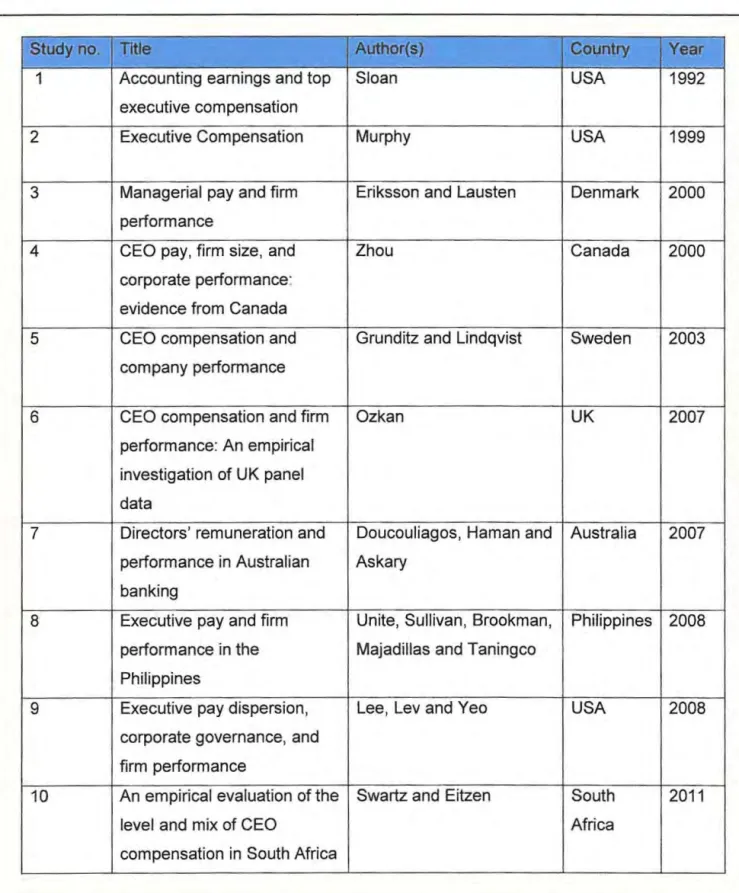
The table below provides a brief summary of some of the previous studies conducted on the correlation between CEO compensation and company performance which are similar to the present study.
2
Table 1: A summary of previous studies on a similar topic, including the author(s), the country of research and the year of publication
Study no. Title Author(s) Country Year
1
Accounting earnings and top Sloan USA1992
executive compensation
2
Executive Compensation Murphy USA1999
3
Managerial pay and firm Eriksson and Lausten Denmark2000
performance
4 CEO pay, firm size, and Zhou Canada
2000
corporate performance: evidence from Canada
5 CEO compensation and Grunditz and Lindqvist Sweden
2003
company performance
6 CEO compensation and firm Ozkan UK
2007
performance: An empirical investigation of UK panel data
7
Directors' remuneration and Doucouliagos, Haman and Australia2007
performance in Australian Askary banking
8
Executive pay and firm Unite, Sullivan, Brookman, Philippines2008
performance in the Majadillas and Taningco Philippines
9
Executive pay dispersion, Lee, Lev and Yeo USA2008
corporate governance, and firm performance
10
An empirical evaluation of the Swartz and Eitzen South2011
level and mix of CEO Africa
compensation in South Africa
(Own design)
1.3 GOAL OF RESEARCH
The goal of the research is to determine, in a South African context, whether there is a correlation between CEO compensation and the performance of the company. If such a correlation does exist, the secondary goal of the research is to analyse the effect that CEO compensation has on the performance of a company. The specific aims of the research are as follows:
• to determine whether there is a correlation between CEO compensation and company performance;
• to determine whether the relationship between CEO compensation and company performance is influenced by the industry in which the company operates;
• to determine whether variable compensation (for example bonuses) affects the performance of the company;
• and to determine whether CEO compensation is affected by variables such as the age and experience of the CEO.
1.4 RESEARCH METHOD AND DESIGN
A literature survey was carried out in order to identify the methodology that other researchers have applied in their research on the question to be addressed in the present research. This was used to design the methodology to be applied in the present research. Using a similar methodology facilitated both a comparison with other studies, as well as providing assurance that the methodology used in the present research is statistically sound.
As all the data for the present study are in the public domain, no ethical considerations arise.
1.4.1 Sample selection procedure
The research utilized the forty largest publicly listed companies on the Johannesburg Stock Exchange (JSE), measured by market capitalization on the 18th March 2010. The reason for selecting these companies as the sample is that because they are listed on the JSE, they are required to follow JSE listing requirements, and will therefore disclose the data that are needed for the study. Despite the fact that only the forty largest companies have been included in the sample, these companies have a combined market capitalisation of 66.70%
of the total JSE capitalisation. It is therefore concluded that this is a large enough proportion of the total capitalisation to be sufficient for the research.
4
The size of the company studied, and the possible effect that this would have on the compensation of the CEO, was deemed to be beyond the scope of this research topic. The fact that all the companies selected are large companies would therefore address the problem of company size as a threat to the validity of the research.
1.4.2 CEO compensation variables
Data was obtained from the companies' annual reports regarding compensation paid to CEOs of the companies selected. Despite the fact that this information is provided by the company itself and could therefore be manipulated, it is assumed that the fact that these annual reports have been audited reduces the risk of misstatement to an acceptable level.
Data was retrieved from the annual reports and categorized using the Microsoft Excel software program. Where figures are provided in a foreign currency, they were converted using the average exchange rate for that year. Other variable data which could affect CEO compensation, such as the age of the CEO and length of time the CEO has served in that capacity, were obtained and analysed for correlation to both company performance and CEO compensation.
Due to strict disclosure requirements in South Africa, companies are forced to disclose CEO and board members' compensation. It was hypothesized that certain components of CEO compensation would have a stronger correlation with company performance than others and it would therefore be appropriate to separate CEO compensation into separate components.
"CEO compensation is defined as the sum of base pay, bonuses, stock grants, stock options, other forms of compensation and benefits" (Bognanno, 2010:2). Based on past research, the components of CEO compensation to be analysed in the present research were split into four categories, consisting of base salary, bonus, benefits and long-term incentives. This decision was influenced by Sharma and Smith (2001 :2), who stated that:
[c]onsequently, executive compensation is constituted of three key components: cash compensation, typically consisting of a salary and bonus; a variety of perquisites and supplementary benefits such as insurance, club memberships, and other noncash rewards; and long-term incentives, which may include various forms of stock options and deferred compensation.
These components, identified by the researchers, were incorporated into this study, with the only difference being that a distinction was made between the salary and bonus components. The present research assumes that bonus pay will be more elastic than fixed salary and that
it should therefore be separately analysed. Murphy (1999) separates executive compensation into these same four components (salary, bonus, other payments and long- term payments) in his study on executive compensation.
a) Salary
Any fixed remuneration received during the year was included in the subtotal reflecting the salary. Director's fees, cash remuneration and any form of guaranteed compensation were also included.
b) Bonus
Short-term bonuses were deemed to include any unguaranteed forms of compensation. The salary was analysed separately from the bonus, as the bonus element of compensation is more likely to be dependent on performance than the salary element. All bonuses due in less than twelve months were categorized as 'short term,' and included as part of this component of remuneration.
c) "Other" Remuneration
As stated by Levit! (2004), many companies try to disguise the actual compensation paid to executives by including fringe benefits (such as corporate jets) in their compensation. This study aims to include these benefits in the research. "Other" remuneration includes all non- cash rewards, such as insurance payments, club memberships, retirement contributions and payments, contributions to defined contribution plans, pension contributions and any other benefits paid by the company on behalf of its Chief Executive Officer.
d) Long-term options
Currently there are various different long-term options or share schemes used by companies to reward their executive team. Calculating the value of options and shares awarded during a year, and putting the data into a standard format, is beyond the scope of this research. Most other research on this topic has excluded the value of long-term options from the data set. By excluding it from the present research, the findings are more readily comparable to other research. A study by Tower Perrin showed that with regard to CEO remuneration in the USA, stock options had fallen from 38% of total CEO remuneration in 2004 to 23% in 2008, making them less relevant to the study of CEO remuneration as time progressed (Farmer: 2008).
6
1.4.3 Company performance variables
Company performance is either measured using stock market indicators or accounting earnings measures (Eriksson & Lausten: 2000). In order to ensure that this study is comparable to similar studies, the variables chosen to measure company performance are widely known and commonly used. The data for the forty companies selected on the JSE also needed to be readily available for the measures chosen. Only accounting measures were therefore used, due to the fact that the data are "verifiable and widely understood (Murphy, 1999:2490)." Murphy also stated that the "the primary determinant of executive compensation is accounting profits" (1999:2490).
Using accounting variables to measure company performance has a few weaknesses. Dechow and Sloan (1991, in Murphy: 1999) stated that accounting profits are backward looking. They also noted that managers can become too focused on the short-term objectives, and may not be willing to reduce current profitability even if it would result in higher future profitability. Another weakness as noted by Healy (1985. in Murphy: 1999) is that accounting profits can be manipulated. This can be done in a variety of ways, such as adjusting discretionary amounts, or by moving earnings to different periods.
Another weakness was pointed out by Wernerfelt and Montgomery (1988) when they stated that:
accounting rates of return are distorted by a failure to consider differences in systematic risk, temporary disequilibrium effects, tax laws, and accounting conventions regarding R&D and advertising. These properties are likely to vary more across industries than across firms.
The fact that not all of the companies analysed trade in the same country could have an effect on the accounting variables. The systematic risk of doing business in a different economic climate may lead to differences when comparing the results of companies.
However it is believed that this weakness is mitigated to a large extent by the fact that all of the companies surveyed are conducting business in South Africa, and almost all are based in South Africa.
Despite these criticisms, it is believed that by using three measures, as opposed to only one, these weaknesses would be suitably reduced. These weaknesses were further mitigated by measuring and comparing company's performances within three different industries. This is because comparing companies which operate in the same business sector allows comparisons between companies to be made with greater reliability. It is also suggested that
because accounting standards are continually being tightened, the opportunity for profit manipulation continues to be reduced over time.
This view is similar to the view of Eriksson and Lausten (2000) who concluded that "we do not see the use of accounting profits as a performance indicator as any great disadvantage to our analysis." As stated by Murphy (1999:2496), "almost all companies rely on some measure of accounting profits."
Some measures were not suitable for selection. Total shareholder return was omitted due to the fact that it cannot be measured on an individual business level, as well as the fact that the performance may reflect the performance of the stock market rather than that of the company (Kozan: 2004).
Economic value added was not selected as a performance measure. Economic value added is defined by Tenneco (1995:3) as "a non-conventional measure of a company's after-tax profits, minus a total annual cost of capital." Due to the fact that data on each specific company's cost of capital is needed (and is not readily available), this measure was discarded as being too impractical to use.
"Tobin's q" was also not used because of its impracticality for a large sample size. Tobin's q
is defined by Wernerfelt and Montgomery (2000:247) as "the capital market value of the firm divided by the replacement value of its assets." The replacement value of all the assets held by a company is not disclosed, nor is the data readily available.
The following three measures were used:
a) Return on Equity
Return on equity (ROE) is a widely used performance measure both in evaluating management performance and in determining executive compensation (Pandya & Rao: 1998), and was described as a metric that is "most meaningful when evaluating publicly owned companies" (Siciliano, 2003:111). ROE is defined as net income (i.e. income distributable to shareholders) divided by shareholders equity (Pandya & Rao: 1998). Hagel, Brown and Davison (2010) suggest that it is logical that ROE has remained the most enduring and popular performance measure, as its focus is on shareholders returns, which is of primary importance to the investor. ROE is also a measure of how well a company uses debt in its capital structure in order to maximize shareholder returns.
8
ROE has been criticized due to the fact that it is an accounting figure and therefore could be manipulated by management to appear better than it actually is (Rosen: 1992). Due to the fact that the ROE figure for a company could be manipulated by unscrupulous managers, and in order to make this study more complete, two more variables were introduced. Using additional measures of performance also has the advantage of increasing the possibility of identifying a correlation between CEO compensation and company performance.
b) Earnings per Share
Earnings per share (EPS) is a commonly used performance measure, and is also very commonly used as a bonus base (Makelainen: 1998). It has been described as a "central performance indicator for shareholders" by Otley (2002: 1 0) and was described by Bunting (2009: 19/1) as a "fundamentally important performance indicator." This ratio is calculated by dividing the earnings (or profits) by the number of shares in issue (Bunting: 2009).
EPS also has the advantage of being widely recognised and accepted, which was shown by the fact that it was used as a performance measure in most of the ten previous research papers used for comparison (see table one). Kozan (2004) pOinted out that accounting measures (such as EPS) have many advantages: they are affected by both revenues and expenses, they force managers to focus on generating profits and they are easily measurable.
c) Return on Assets
Return on assets (ROA) measures the profits that a company generates with the assets that it controls. It is a good measure of the performance of management of the company, as it analyses how well assets are being utilized by management to generate accounting returns.
Hagel et al (2010) pointed out that ROA is a better measure of financial performance than income statement performance measures, as it explicitly takes into account the assets that are used to generate returns. There are a few variances of this formula, but it is suggested that the most commonly used formula is the "Return on Average Assets" formula, which is: ROA = profit after tax / average assets. Unlike ROE, the capital structure of debt and equity chosen by management does not affect the ROA measurement.
Some scholars have claimed that "Gross Rate of Return on Assets" is a superior measure to ROA because it is "less sensitive to depreciation and other noncash transactions" (Huselid, Jackson & Schuler, 1997: 177). Despite this, ROA was used because of its wide use and obvious recognition (Pandya & Rao: 1998). Another reason for its use is that ROA relies on
net profit, which is affected by decisions made by management. Due to the aim of the study being to identify a correlation between CEO compensation and company performance, using a measure that is affected by decisions made by management will increase the chances of identifying such a link.
1.4.4 Grouping of companies
It was decided that it would be beneficial to group the companies into sectors or industries.
This allowed for meaningful comparisons to be made within the sectors, and also ensured that the sample is well diversified and that each sector is represented in the research.
Various factors were considered when allocating companies to the three sectors which were chosen for the purposes of this research. The JSE formally recognises thirty sectors, which is too large to be practical for the purposes of this research. Murphy recognises four groups of industry, namely mining and manufacturing, financial services, utilities and other industries (1999). These sectors were slightly adapted for this research paper into three sectors, and are as follows:
• Mining - includes mining for any mineral, precious stone or raw material, or exploration for such materials;
• Financial services - includes banking, logistics, insurance and health care;
• Industrial - includes agriculture, building construction, processing and manufacturing of goods, pharmaceuticals, tobacco, jewellery, property, telecommunications, media, industrial goods, food and beverages, oil and gas, retail and personal and household goods.
The sample chosen has the following number of companies in the following sectors:
Sector Number
10
1.4.5 Statistical method
The company performance variables for a period of six years from 2005 to 2010 (inclusive) were used for the purposes of the study. Multivariate analysis was used to identify the independent variables that influence the dependent variable, with the CEO compensation variables initially assumed to be the independent variables. Data regarding CEO compensation were obtained for the five years from 2006 to 2010 (inclusive). The company performance variables are therefore assumed to be the dependent variables. The dependent variable has been included for an extra year in order to test whether there is a "lag-effect"
(i.e. the independent variables only change due to the current state of the dependent variable in the following year). The data has only been collected for this period due to the availability of data. Disclosure of sensitive information such as CEO compensation has improved during recent years in South Africa (van Zyl Smit & Nel: 2010) and this data has not been made available prior to 2006 by many of the companies selected.
There are reasons to believe that independent variables will be better correlated to dependent variables in the following year than in the current year (Doucouliagos, Haman &
Askary: 2007). Boschen and Smith (1995) stated that remuneration contracts often contain an element of deferred compensation, meaning that performance by a CEO in a current period will only result in a change in remuneration in a future period. Companies themselves seem to recognize the existence of a lag between remuneration and performance: many of the remuneration reports within the annual reports emphasized the aim to use compensation incentives to reward long term and sustainable grow1h rather than short term gains. Another possible reason for a lag between performance and remuneration could be due to the recent increased use of compensation consultants (Doucouliagos et a/: 2007).
1.4.6 Limitations of the research design
Certain limitations apply to the present research. The performance of a company can be influenced by all the employees and management of a company, not just the CEO. However, because the CEO is responsible for providing the vision and the business model for the company (as well as having the most easily accessible compensation figures), this study is focused solely on the CEO. Another reason for this is that prior studies have found that "pay performance association is stronger and more direct for CEO remuneration than it is for total directors' remuneration" (Doucouliagos et aI, 2007:1363).
The gathering of the source data has been done with as little bias as possible. Figures measuring company performance have been drawn from an independent and trustworthy source, namely the Profile's Stock Exchange Handbook (Profile Media: 2010). A small proportion of the data could not be obtained from this source and was calculated using figures from the companies' annual reports. Data relating to CEO compensation have been extracted from the annual reports of the company. While there may be motivation for the company preparing the annual report to manipulate these figures, it is believed that these figures are reliable. This is suggested due to the rigorous accounting statements which govern the preparation of financial standards, and the fact that the companies selected are all audited by independent professionals.
1.5 CONCLUSION
Chapter one described the background of the research, provided a literature survey and described the research methodology. The goal of the research. which is to determine whether there is a correlation between CEO compensation and company performance, was also set out. Chapter two describes the agency problem and chapter three discusses the corporate governance mechanisms used to mitigate the agency problem. The design of the model is described in chapter four, while the analysis of the findings presented in chapter five and chapter six set out the conclusions and suggestions for further research.
12
CHAPTER TWO: CONFLICTS CAUSED BY THE AGENCY PROBLEM
2.1 INTRODUCTION AND BACKGROUND
As discussed in chapter one, the goal of the research is to determine whether there is a correlation between CEO compensation and the performance of the company. The agency relationship explains the link between these variables: it is because the agency problem exists that directors will not always do their utmost for the sake of the company, and therefore need to be motivated through incentive based compensation to perform. To mitigate the risks posed by the agency relationship, CEO compensation is used as a means to regulate and motivate the performances of the directors (Shaw and Zhang: 2010). This research is seeking to evaluate the correlation between director's compensation and their performance, which will demonstrate whether CEO compensation can be used as an effective method for countering the agency problem, and thereby controlling director performance.
In order for this analysis to be done, a sound understanding of the agency relationship needs to be gained. Chapter two aims to define and discuss the intricacies of the agency relationship. This relationship is discussed in the context of a company, with the directors acting as the agents and the shareholders as the principal. Managerial opportunistic behaviour and management entrenchment (two common forms of the agency problem) are identified and discussed.
2.2 THE AGENCY RELATIONSHIP
Adam Smith outlined the agency relationship a few centuries ago in his book The Wealth of Nations (1776:607) as follows:
The directors of such companies, however, being the managers rather of other people's money than of their own, it cannot be well expected, that they should watch over it with the same anxious vigilance with which the partners in a private co-partnery frequently watch over their own. Like the stewards of a rich man, they are apt to consider attention to small matters as not for their master's honour, and very easily give themselves a dispensation from having it. Negligence and profusion, therefore, must always prevail, more or less, in the management of the affairs of such a company.
Jensen and Meckling (1976:308) defined an agency relationship as "a contract under which one or more persons (the principal(s)) engage another person (the agent) to perform some service on their behalf which involves delegating some decision making to the agent." Fama and Jensen (1983) described entities with an agency relationship as organizations which have separate ownership and control functions. They went on to state that this occurs when
"important decision agents do not bear a substantial share of the wealth effects of their
decisions" (1983: 1).
This agency relationship is relatively common and can be found in many relationships, from the sports field (where players may be tempted by make decisions which would increase their fame and reputation, rather than act in the team's interests) to that of a business entity.
It is found in all organizations, including universities, government bureaus, unions and real estate markets (Jensen & Meckling: 1976). The most common example is that of a company, with the shareholders being the principal and the directors or managers being the agents.
2.3
TRADITIONAL CONFLICT AREASThe agency relationship is often referred to as an "agency problem" due to the fact that the agent will not always act in the best interests of the principal. Agents often act as "utility maximizers," (Jensen & Meckling, 1976:310), with the result that if not monitored, they will place their own interests above those of the principal which they serve (Hope & Thomas:
2007). This agency problem is highly relevant to the business community, as its existence was not only important in the establishment of governance agencies, such as the Securities and Exchange Commission in the United States of America, but it is also at the root of the high emphasis which is placed on good corporate governance (Fama & Jensen: 1983).
Jensen and Meckling (1976) stated that it is impossible for the principal to ensure that the agent will act in the best interests of the principal without incurring costs. These costs are referred to as "agency costs," and are found by calculating the sum of monitoring costs, bonding costs and residual loss, as well as any output lost.
Agency costs = monitoring costs + bonding costs + residual loss + output lost
Monitoring costs are incurred by the principal in monitoring the activities of the agent to ensure that they are in the interests of the principal. An example of a monitoring cost would be audit costs. In some cases it will be in the interests of the agent to expend extra costs to satisfy the principal that the agent's actions are honest (Moloi: 2008). These costs are
14
referred to as bonding costs. An example of a bonding cost would be the cost incurred by management in preparing additional disclosures for the shareholders. Bonding costs, which are incurred by the agent, are more rarely incurred than monitoring costs, which are incurred by the principal.
Residual loss is the measurable difference in the decision which would be best for the principal less the decision actually taken by the agent (Jensen & Meckling: 1976). In some cases, the cost of enforcing a contract to its full extent exceeds the benefit to be obtained. Agency costs also include the value of this output lost (Fama & Jensen: 1983).
Bebchuk and Fried (2003) identified two common forms of managers acting in a self-serving manner: managerial opportunistic behaviour and management entrenchment.
2.3.1 Managerial opportunistic behaviour
Managerial opportunistic behaviour may occur when managers take on investment projects that may not be profitable for the shareholder, but are undertaken purely to increase the size of the company. This method of management, commonly referred to as "empire building,"
has become a "common problem" in large companies (Grunditz & Lindqvist, 2003: 15).
Hope and Thomas (2008) established that when executive directors are not monitored, they will maximize corporate wealth at the expense of shareholder wealth. There are various reasons why a manager may want to act in such a way and pursue a goal of "excessive grow1h" (Hope & Thomas, 2008:595). Jensen and Murphy (1990) showed that because executive compensation is often tied to measures such as firm size or sales, managers may seek grow1h as a path to personal riches. Stulz (1990) showed that in some cases, managers may want to control a larger empire due to the power and prestige that goes with the position.
Amihud and Lev (1981) argued that one of the main reasons why managers engage their entity in a conglomerate merger is to diversify operations and reduce their personal risk. A manager's career and salary is tied to the one firm that they work for, so it benefits them personally to diversify operations and thereby reduce the risk of liquidation. In a large percentage of cases these mergers do not benefit the shareholders, as the shareholders can reduce their risk simply by diversifying their portfolio. This value lost can be regarded as an agency cost (Amihud & Lev: 1981). It was empirically established by Mueller (1977:344, in Amihud & Lev, 1981 :605) that "[wJhatever the stated or unstated goals of managers are, the
mergers they have consummated have on average not generated extra profits for the acquiring firms [and] have not resulted in increased economic efficiency."
Shleifer and Vishny (1989. in Hope & Thomas: 2008) showed that managers may seek to grow a firm to a larger size as this makes them more indispensable to the firm. and therefore increases their job security. Finally. Hope and Thomas (2008) pointed out that managers may seek to grow the firm for personal promotion. This is because the board often has limited information on which to judge a manager's ability and growth in company size will more often than not cast the manager in a favourable light.
2.3.2 Managerial entrenchment
Managerial entrenchment is defined by Weisbach (1988:435) as follows: "[m]anagerial entrenchment occurs when managers gain so much power that they are able to use the firm to further their own interests rather than the interests of shareholders." This definition is similar to that of Florackis and Ozkan (2009:498). who define managerial entrenchment as
"the extent to which managers have the ability and incentives to pursue their self-interest and
expropriate wealth from shareholders." Managers are said to entrench themselves in their position by making it very difficult for boards to remove them. even due to poor performance.
The results of managerial entrenchment are generally negative for the principal. as it has been established that entrenched managers take fewer risks: they prefer a lower than optimal leverage ratio (Brounen. De Jong & Koedijk: 2006) as they prefer to hold onto more cash reserves (Yun. 2009: 1447) and payout lower dividends than non-entrenched managers do (Hu & Kumar. 2004). In addition. they seek less debt (Berger. Ofek & Yermack:
1997) or they choose debt with longer repayment terms (Datta. Iskandar-Datta & Aman: 2006). Significantly. firms with entrenched managers have also been shown to underperform in comparison to other firms, with lower sales growth and lower net profit margins (Gompers, Ishii & Metrick: 2003, in Hirschey, John & Makhija: 2009). Shleifer and Vishny (1989, in
Xuan: 2009) showed that managers overinvest in projects that require their specific human
capital, as this enhances their job security and lessens the chance of them being replaced.
Managers (i.e. agents) tend to act in this way for selfish reasons. As explained by Shleifer and Vishny (1989:123). "[b]y making manager-specific investments, managers can reduce the probability of being replaced, extract higher wages and larger perquisites from shareholders, and obtain more latitude in determining corporate strategy." Shareholders should also be aware of the possible effects of managerial entrenchment when deciding whether or not to liquidate their company: liquidation may be in the best interests of the
16
shareholders (as it could result in a cash pay-out before bankruptcy), but it is probably not in the best interests of the managers, who rely on the company for their employment and remuneration (Grunditz & Lindqvist: 2003). In this situation managers may be tempted to place their personal interests ahead of those of the shareholders. For the same reason, managers will often be opposed to hostile takeovers, even though this could be beneficial to the shareholders (Shleifer & Vishny: 1989).
2.4 CONCLUSION
The agency relationship is a problem which exists because of separation between the principal and the agent and the consequent separation of control. The interests of the principal and the agents will not always be aligned, and the conflict of interests which exists because of this has been shown to have negative consequences for the principal. The two common forms of agency problem, namely managerial opportunistic behaviour and managerial entrenchment, are both examples of this.
Assuming that Adam Smith was correct in his statement that "[n]egligence and profUSion, therefore, must always prevail" (Smith, 1776:607), the agency problem is a long-term problem, and one with no quick or easy remedies. Many solutions have been suggested as means of mitigating and reducing agency costs for companies and organisations. Chapter three analyses these solutions, focusing particularly on the use of executive compensation to align the interests of executives to those of the entity.
CHAPTER THREE: CORPORATE GOVERNANCE MECHANISMS USED TO SOLVE THE AGENCY PROBLEM
3.1 INTRODUCTION AND BACKGROUND
i.-·;: ( . .' ,~: '~(.: ( -", (' it " .. , , I , . (
: C !l "J ,I"." (".l ",;, .r· I. ", , c.,~
, -,
. : ! I ) 1\ ,. . .' 1: .. ~\, f' .. U~ r .. crrlO "ate L/C."E:rni-IfIC€ !~1el.:+' 1;"';01 .hich Dre L:tiiist"d
L y
COlT pc.r!ie!:> to n!iti~Att- thEao el ,cy ~.roblclll,
It i, sugv",:;.ted that in e>rder to dfecti\ely ",:aluat" \' he-Iher E.!L lnera\i( 11 Cfll1 be succ€sshillj'
u~Eod :;IE " corpcH,t€ gcveln<lnc~ mEchani,"l, it :s iilsl necessary Ic 8113iysE. ;Iher available corporaie g( vern,l l ce mechanisll1~ and evaluate their E'ftectiven6ss in :ontrolling exec.uliv,,"
lJehaviour, Due 10 1l1i'1f lagerial incenlivE~ <lnd $1
,"1''''
base' rCI111Jl'leralicl1 b"il1g tht" su 'jecl d thE. research It is analysed in nwre delail than thE (Ilher [e,m,s Cl corpol ale gov"rnancE,As~essin~ thE' ole of this ll1ec:hBnism 'n conlr"lIinp lhe acilon~ 01 1,1 nagement if , nECe%ill)' slep iii dE'lernlininp v'betlC!' 8xecut,ve cl'l11pens2tior, could b linke! to lhe
pert,,! III I":~ oj the. co n )2! ,y,
3.2 CORPORATE GOVERNANCE MECHANISMS
c..crporatf: 00Velll(;nCe ha, bE" n dE'iined a~ "'lie system of laws, rules, and factors that control operations at a company (Gillan & Starks, I098:'L3), SI,leifbl an Vishny (19[;7:',2"f) defined it as "th ways ill whiG!l supr.lrers of fil18nCtl to corporaiions assure themsbl e~ oi
pettinQ a elll1l1 OJ) iheir '11 e51m! nl." Due to " ftr ing of we!l·publiciz!:d scandal!;, corporate- ',overrlance rei olin h8, teE-I, ii', the s ctlight ("!~I the last deC8l1€ (Hauswald 8- r1arque
20(5), Farmer (2008:2) explained the renewal of global interest in corporate governance as being due to the USA administration's response to some cases of "sp"Uacdm cor oral"
ilur", '
Studies have shown that good corporate governance can also increase shareholder value, In 2000 a survey was done which found that "more than 84% of the investors would be willing to pay a premium for the shares of a well-governed company," (Swartz & Eitzen, 2011 :5) and that "three-quarters of these investors indicated that board practices were at least as important as financial performance,"
18
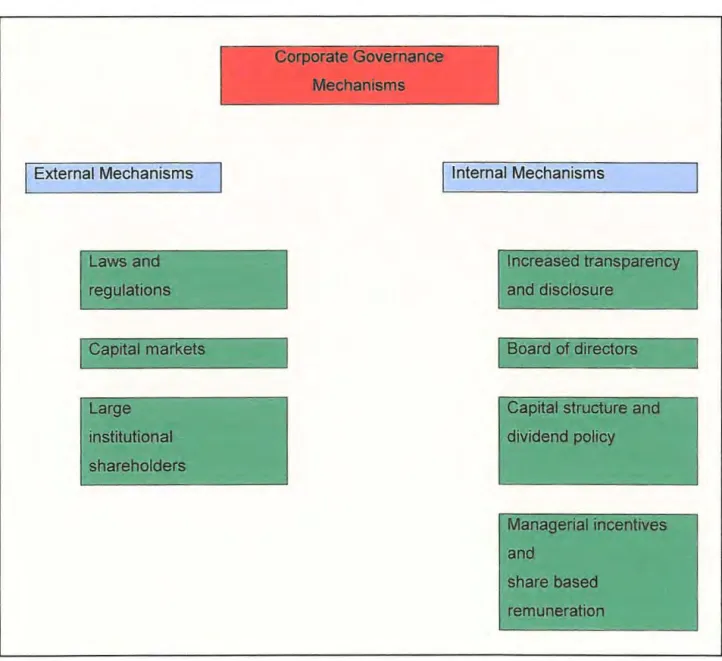
Daouk, Lee and Ng (2006, in Gillan: 2006) also examine the link between company performance and corporate governance. The study finds that better capital market governance results in better market pricing efficiency, higher market liquidity and a lower cost of equity. Corporate governance mechanisms are used to "realign the interests of agents and principals and so reduce agency costs" (McKnight & Weir, 2009:140). Oba (2004) notes that corporate governance mechanisms can be classified as monitoring mechanisms (mechanisms which observe the performance of agents) or bonding mechanisms (mechanisms which penalize or reward the agent depending on their actions). Alternatively, corporate governance mechanisms can also be separated into internal and external mechanisms (Gillan: 2006). The main internal and external mechanisms are discussed in this chapter. Executive remuneration, being the focus of the research, is analysed as a corporate governance mechanism in greater detail.
Table 2: A summary listing of the major corporate governance mechanisms
I
External MechanismsLaws and regulations
Capital markets
Large institutional shareholders
Corporate Governance Mechanisms
I
Internal MechanismsIncreased transparency and disclosure
Board of directors
Capital structure and dividend policy
Managerial incentives and
share based remuneration
(Table 2: own deSign, based on Figure 3 in Gillan, 2006:384)
3.2.1 External corporate governance mechanisms
a) Laws and regulations
Firms operate under legal constraints and are subject to various sources of oversight (Gillan:
2006). Many of the laws and regulations applicable to companies are aimed at controlling the behaviour of its management, and thereby reducing agency costs (Armour, Hansmann &
Kraakman: 2009). In the United States of America the Sarbanes-Oxley Act of 2002 was the most extensive set of business regulations passed since 1934 (Hansen: 2011), while in the United Kingdom the UK Corporate Governance Code, released in June 2010, (Financial Reporting Council: 2010) was brought about due to financial crisis of 2008 and 2009.
Corporate governance regulation in South Africa has followed the way of the United Kingdom and other commonwealth countries by implementing a principle based system, commonly known as the "comply or explain" system. This is in contrast to the United States of America, which has implemented its governance legislation on a statutory basis, known as the "comply or else" system (Institute of Directors Southern Africa: 2009). Companies in South Africa are regulated by the King Code of Governance Principles and the King Report on Governance (2009) ("King III Report"), as well as the Companies Act 2008 (Act No. 71 of 2008) ("Companies Act 2008"). In addition, public companies in South Africa that are listed on the Johannesburg Stock Exchange (JSE) need to continually meet the stringent listing requirements. These requirements, while only applicable to companies that choose to be listed on the JSE, are another set of regulations which control the activities of management.
b) Capital markets
The market for corporate control is described as the "ultimate corporate governance mechanism" (Gillan, 2006:391), while takeovers have been noted to be "the critical corporate governance mechanism in the United States, without which managerial discretion cannot be effectively controlled" (Shleifer & Vishny, 1997:756). The reason is that when a takeover occurs, whether hostile or friendly, companies are acquired by the managers that can extract the highest value from them. These acquisitions result in inefficient managers being removed from their position within the company and replaced by more skilled managers (Gillan: 2006).
This competition between managers, which exists through the threat of a company takeover, is a powerful motivator for managers to perform adequately.
Shleifer and Vishny (1997:756) stated that hostile takeovers operate as "rapid-fire mechanisms for ownership concentration." This opinion is similar to the hypothesis of the Market for Corporate Control. According to Tsagkanos, Georgopoulos and Siriopoulos
20
(2006: 183) this theory shows that takeover mechanisms "discipline and replace management teams who engage in inefficient behaviour." This hypothesis is argued due to the substantial evidence which shows that takeovers address many corporate governance problems (Shleifer & Vishny: 1997). In most cases, takeover targets are firms that are performing poorly (Palepu: 1985, in Shleifer & Vishny: 1997). This is shown by the fact that takeovers usually increase the combined value of the target firm and the acquirer firm (Ruback &
Jensen: 1983), as well as the fact that successful takeovers often result in the management team being replaced (Martin & McConnell: 1991).
Takeovers can also serve as a corporate governance mechanism by helping to solve the free cash flow problem. Free cash flow is defined as "cash flow in excess of that required to fund all projects that have positive net present values when discounted at the relevant cost of capital" (Jensen, 1986:325). Excess cash can be a danger for companies, as due to the agency problem managers may be tempted to waste this excess cash on unnecessary benefits. The free cash flow problem can be reduced by investment in value-maximizing mergers and takeovers (Jensen: 1986). It is therefore fair to conclude that the "corporate takeover market plays an important role in disciplining top managers" (Martin and McConnell, 1991 :672).
c) Large institutional shareholders
Gillan (2006) suggests that institutional investors playa role in reducing agency costs by monitoring the actions of management. Hartzell and Starks (2003:2351) also conducted research to show that:
institutional ownership concentration is positively related to the pay-per-performance sensitivity of executive compensation and negatively related to the level of compensation, even after controlling for firm size, industry, investment opportunities, and performance. These results suggest that the institutions serve a monitoring role in mitigating the agency problem between shareholders and managers.
The monitoring role played by large institutional shareholders is therefore believed to reduce agency costs as well as ensuring a greater link between executive compensation and company performance. This external corporate governance mechanism is only applicable to publicly listed companies, as only these companies would be in a position for large institutional shareholders to own a portion of the company.
The role that shareholders can play in reducing agency costs is limited, however. Salacuse (2002) pointed out the only decisions that shareholders can make, which could directly
influence corporate governance matters of the company, is electing directors to the board, approving items that require shareholder approval and, in extreme cases, using their legal rights against the directors.
3.2.2 Internal corporate governance mechanisms
A company may implement various internal mechanisms (also known as organisational mechanisms) in order to limit the potential for suboptimal managerial behaviour.
a) Increased transparency and disclosure
"Publicity is justly commended as a remedy for social and industrial diseases. Sunlight is said
to be the best of disinfectants; electric light the most efficient policeman" (Brandeis &
Hapgood, 1914:92). Despite being written almost one hundred years ago, it is suggested that these words are still true today, especially as it was a lack of disclosure that was one of the reasons given for the recent recession (Bertomeu & Magee: 2011). Hauswald and Marquez (2005:26) state that "[r]ecent regulation addressing perceived shortcomings in corporate governance has put a heavy emphasis on disclosure, improvements in firm transparency, and outsiders' access to information, as well as on board and CEO accountability."
Adequate disclosure is important to agency costs, as "[i]lncreased and improved disclosure is likely to reduce agency costs as better information flows from the company to the shareholder, which in turn reduces information asymmetry" (Solomon, 2007:144). Hauswald and Marquez (2005) stated that good disclosure can make external corporate governance mechanisms more effective. Their reason is that "when the quality of disclosure rises, external screening success increases and an outside bid for the company becomes more likely" (Hauswald & Marquez, 2005:8).
There are other benefits to good disclosure: it is the foundation of good governance, it gives a company a competitive advantage, it increases management credibility and it attracts long- term investors (Temkin: 2003). Good disclosure standards also result in lower costs of capital, a higher share price and a greater analyst following (Temkin: 2003). Using disclosure to minimize agency costs and control costly incentives of managers is perhaps best summed up by Warren Buffett who said that the best way "to get big shots to change their behaviour is to embarrass them" (McGurn: 2010).
Companies in South Africa are at the "forefront of corporate governance and requirements for disclosure" (Visser, 2009: 1). Specifically related to executive compensation in South
22
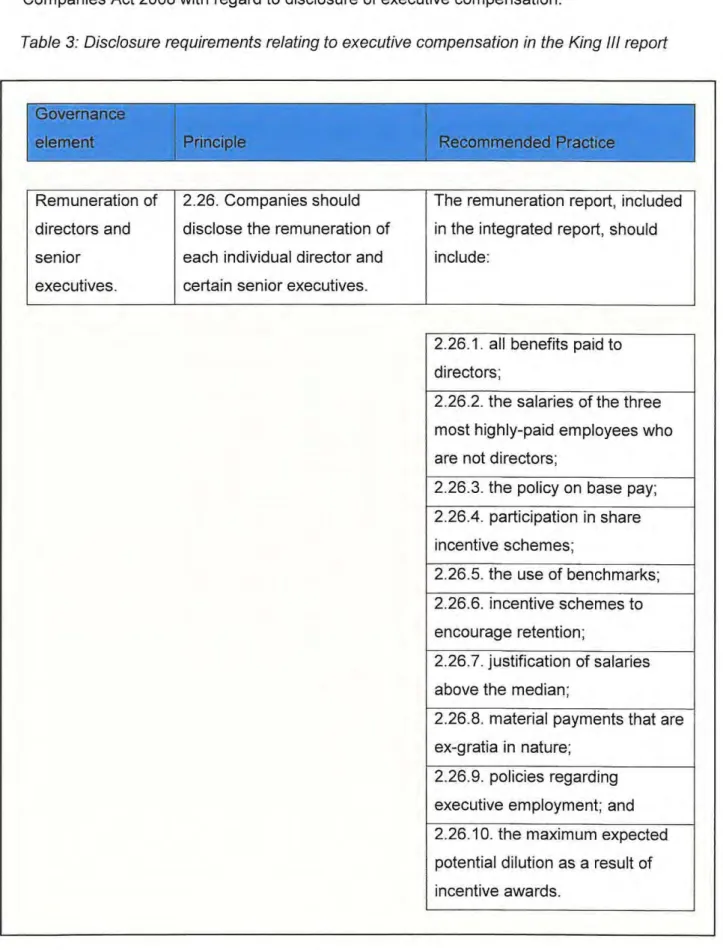
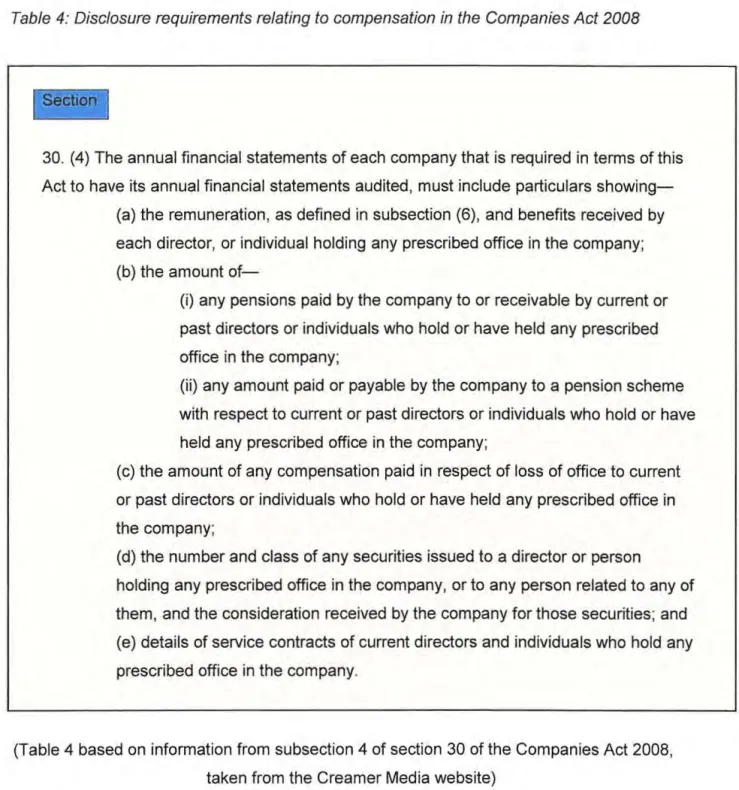
Africa, there is a strong focus on disclosure. King III refers to the following principle and recommended practices, shown in Table 3. Table 4 shows that requirements of the Companies Act 2008 with regard to disclosure of executive compensation.
Table 3: Disclosure requirements relating to executive compensation in the King III report
Remuneration of 2.26. Companies should The remuneration report, included directors and disclose the remuneration of in the integrated report, should senior each individual director and include:
executives. certain senior executives.
2.26.1. all benefits paid to directors;
2.26.2. the salaries of the three most highly-paid employees who are not directors;
2.26.3. the policy on base pay;
2.26.4. participation in share incentive schemes;
2.26.5. the use of benchmarks;
2.26.6. incentive schemes to encourage retention;
2.26.7. justification of salaries above the median;
2.26.8. material payments that are ex-gratia in nature;
2.26.9. policies regarding executive employment; and 2.26.10. the maximum expected potential dilution as a result of incentive awards.
(Table 3 based on information from King III Report, taken from the IODSA website)
Table 4: Disclosure requirements relating to compensation in the Companies Act 2008
30. (4) The annual financial statements of each company that is required in terms of this Act to have its annual financial statements audited, must include particulars showing-
(a) the remuneration, as defined in subsection (6), and benefits received by each director, or individual holding any prescribed office in the company;
(b) the amount of-
(i) any pensions paid by the company to or receivable by current or past directors or individuals who hold or have held any prescribed office in the company;
(ii) any amount paid or payable by the company to a pension scheme with respect to current or past directors or individuals who hold or have held any prescribed office in the company;
(c) the amount of any compensation paid in respect of loss of office to current or past directors or individuals who hold or have held any prescribed office in the company;
(d) the number and class of any securities issued to a director or person
holding any prescribed office in the company, or to any person related to any of them, and the consideration received by the company for those securities; and (e) details of service contracts of current directors and individuals who hold any prescribed office in the company.
(Table 4 based on information from subsection 4 of section 30 of the Companies Act 2008, taken from the Creamer Media website)
b) Board of directors
Boards of directors have been described by Gillan (2006:385) as the "Iynchpin of corporate governance." They are responsible for providing strategic direction to the company, they have a fiduciary duty to act in the interests of the shareholders and they are responsible for monitoring the management team (Gillan: 2006). Jensen (1993:874) described the board as
"the apex of the internal control system," and went on to state that it is the board that is responsible for hiring, firing and compensating the CEO.
24
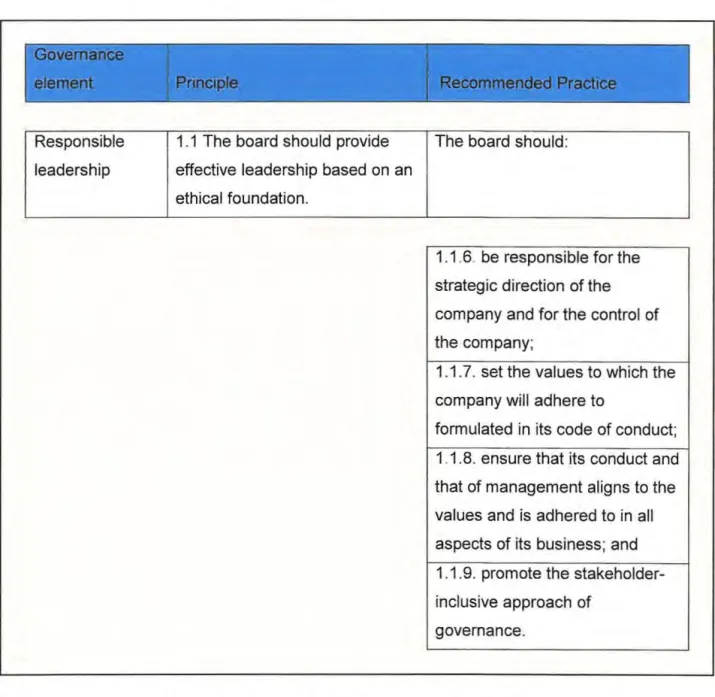
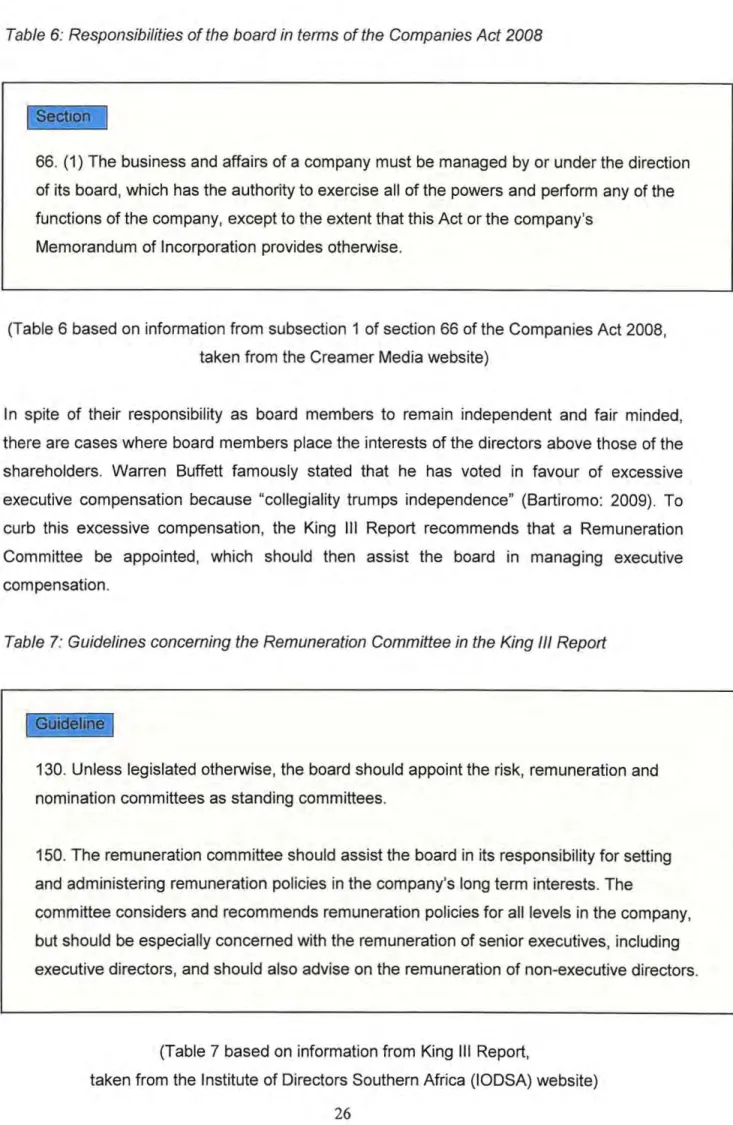
The board is responsible "to provide entrepreneurial leadership of the company within a framework of prudent and effective controls which enables risk to be assessed and managed" (Solomon, 2007:315). We is bach (1988) showed that monitoring by the board is more effective when the board of directors are controlled by independent directors, while Salacuse (2002:46) noted that when large institutional shareholders have a seat on the board it is harder for managers to "manipulate the machinery of corporate governance in their interests." In South Africa the roles and responsibilities of board members are laid out in the King III report and the Companies Act 2008.
Table 5: The leadership role of the board in terms of the King III report
Responsible 1.1 The board should provide The board should: leadership effective leadership based on an
ethical foundation.
1.1.6. be responsible for the strategic direction of the company and for the control of the company;
1.1.7. set the values to which the company will adhere to
formulated in its code of conduct;
1.1.8. ensure that its conduct and that of management aligns to the values and is adhered to in all aspects of its business; and 1.1.9. promote the stakeholder- inclusive approach of
governance.
(Table 5 based on information from King III Report,
taken from the Institute of Directors Southern Africa (IODSA) website)
Table 6: Responsibilities of the board in terms of the Companies Act 2008
if Sectio n :rl1
66. (1) The business and affairs of a company must be managed by or under the direction of its board, which has the authority to exercise all of the powers and perform any of the functions of the company, except to the extent that this Act or the company's
Memorandum of Incorporation provides otherwise.
(Table 6 based on information from subsection 1 of section 66 of the Companies Act 2008, taken from the Creamer Media website)
In spite of their responsibility as board members to remain independent and fair minded, there are cases where board members place the interests of the directors above those of the shareholders. Warren Buffett famously stated that he has voted in favour of excessive executive compensation because "collegiality trumps independence" (Bartiromo: 2009). To curb this excessive compensation, the King III Report recommends that a Remuneration Committee be appointed, which should then assist the board in managing executive compensation.
Table 7: Guidelines concerning the Remuneration Committee in the King 11/ Report
I K Gu iClelin ml
130. Unless legislated otherwise, the board should appoint the risk, remuneration and nomination committees as standing committees.
150. The remuneration committee should assist the board in its responsibility for setting and administering remuneration policies in the company's long term interests. The
committee considers and recommends remuneration policies for all levels in the company, but should be especially concerned with the remuneration of senior executives, including executive directors, and should also advise on the remuneration of non-executive directors.
(Table 7 based on information from