i
UNIVERSITY OF KWAZULU-NATAL
Business challenges faced by apiculture SMMEs in Northern, Swaziland
Brenda Samkelisiwe Masuku By 209510763
A dissertation submitted in partial fulfillment of the requirements for the degree of Master of Business Administration
Graduate School of Business Faculty of Management Studies
Supervisor: Dr. M.A. Phiri 2011
University of KwaZulu-Natal
Faculty of Management Studies
Graduate School of Business
iii
Acknowledgements
I wish to express my sincere appreciation and gratitude to the following individuals, without whose assistance, this study would not have been possible:
•
My supervisor, Dr. M.A. Phiri, who went above the call of duty for me.
•
Mduduzi Gladwin Nkosinathie Mtshali, without your unending patience, support and guidance, this dissertation would not have happened. Thank you for holding my hand through this.
•
The respondents, thank you for taking out time for my questionnaire.
•
My family and friends, thank you for the moral support you afforded me, where would I be without you.
•
Bongani Simon Masuku, you are the driving force behind all this.
•
Siyabonga’ukumukeliswa and Sentelwe’yinkhosi…….. What do you know for
sure? That I love you beyond human understanding. You are my inspiration to
be a better person. My purpose in life.
iv Abstract
Apiculture or beekeeping is a new initiative in Swaziland, aimed at improving livelihoods for rural people. There is a potential for growth in the industry, but the question is, “are the rural beekeepers gaining from this opportunity?” The aim of this study was to highlight business challenges that hinder rural beekeepers from exploiting the industry opportunities. In order to ascertain the challenges faced by the beekeepers, a sample of farmers from Northern Hhohho, Swaziland was studied.
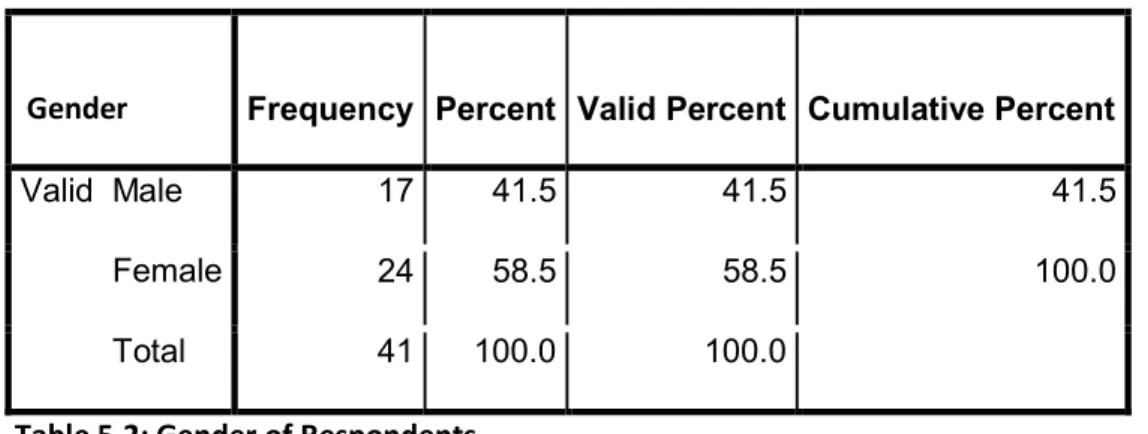
A probability sample of 41 rural beekeepers was drawn from a population size of 384 beekeepers. The sample composed of 58.5% females and 41.5% males, with a majority of them, 29.3% falling between the ages of 31 – 40 years. Results of the study show that 53.7%
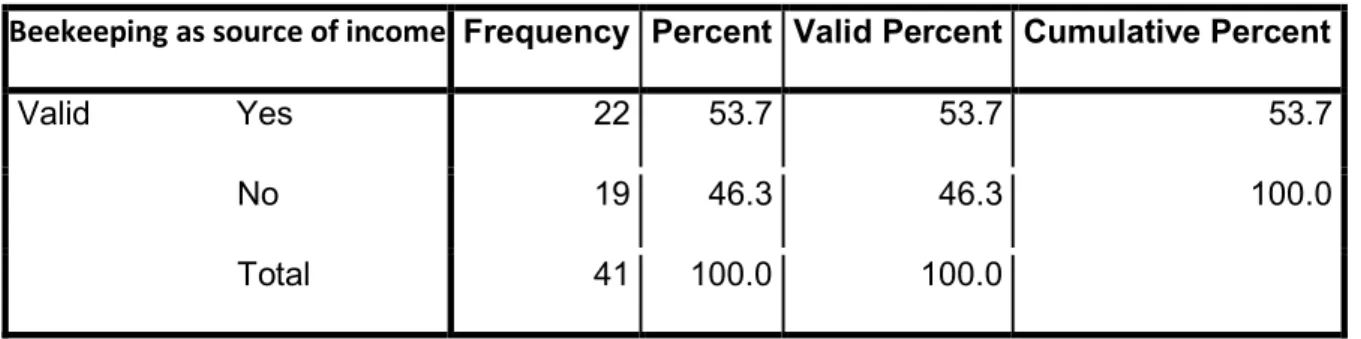
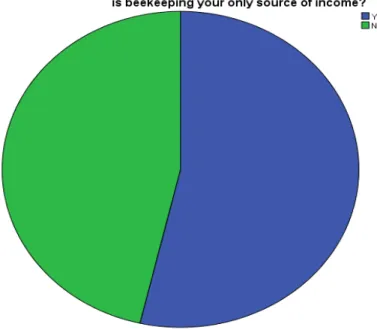
of the respondents relied solely on beekeeping as their source of income, or livelihood.
Northern Hhohho was chosen because of its natural vegetation and climate, which makes the area conducive for beekeeping. It is also a predominantly rural area. Data was collected through a questionnaire, developed for this research and administered to the beekeepers in that area. The study revealed that lack of input resources and an unstructured industry are the reasons for failure of the business ventures. A salient point is the lack of entrepreneurial skills of the beekeepers.
It is recommended that, improving entrepreneurial skills, for the SMME beekeepers and
Swaziland government intervention in facilitating input resources could benefit the rural
beekeepers, in terms of ensuring sustainability of their business. This would create value for
both beekeepers and the Swaziland economy.
v Description
TABLE OF CONTENTS
Page
Title Page i
Acknowledgements iii
Abstract iv
Table of Contents v
List of Tables x
List of Figures xi
CHAPTER ONE
INTRODUCTION
1
1.1 Introduction 1
1.2 Background of Study 1
1.3 Motivation of the Study 3
1.4 Problem Statement 3
1.5 Objectives of the Study 3
1.6 Research (Key) Questions 3
1.7 Research Problems and Objectives 4
1.8 Ethical Considerations 5
1.9 Limitations of the Study 5
1.10 General Structure of the Study 5
1.11 Conclusion 6
CHAPTER TWO
LITERATURE REVIEW
7
2.1 Introduction 7
2.2 Entrepreneurship 8
2.3 Creating Value Through Entrepreneurship 10
2.4 The Value Chain Approach 14
2.5 Brief History of Entrepreneurship 16
2.6 Job Creation 17
2.7 Rural Entrepreneurship Development as a Government Initiative 18
vi
2.8 The Role of Co-operatives in Rural Development 21
2.9 Conclusion 22
CHAPTER THREE
SWAZILAND BACKGROUND AND ECONOMY
23
3.1 Introduction 23
3.1.1 Geography and Climate 23
3.1.2 Context 24
3.2 Economy 25
3.2.1 Income Distribution 26
3.2.2 Incidence of Poverty 27
3.3 Agricultural Sector 27
3.3.1 Agriculture in the National Economy 27
3.3.2 Apiculture in Swaziland 28
3.3.2.1 Background on Beekeeping in Swaziland 28
3.3.2.2 Beekeeping History in Swaziland 29
3.3.2.3 Beekeeping Groups 30
3.4 Beekeeping Production
3.4.1 Commercial Beekeeping
30 31
3.4.2 Beekeeping Farmers 32
3.4.3 Beekeeping Training 32
3.4.4 Vegetation 32
3.4.5 Fruit Trees Production 33
3.4.6 Beekeeping Products 33
3.5 Marketing 33
3.6 Conclusion 34
CHAPTER FOUR
STUDY RESEARCH METHODOLOGY
35
4.1 Introduction 35
4.2 The Research Paradigm 35
4.3 Research Design 35
vii
4.4 Important Features of a Research Design 36
4.5 Methods of Data Collection 36
4.5.1 Quantitative Method 37
4.5.2 The Questionnaire 37
4.5.3 The Pilot Study 39
4.6 Location of Study 39
4.7 Population and Sampling framework 40
4.8 Coding and Data Entry 41
4.9 Editing Data 41
4.10 Data Processing 41
4.11 Computer Programming and Statistical Techniques 41
4.12 Conclusion 42
CHAPTER FIVE
PRESENTATION OF DATA
43
5.1 Introduction 43
5.1.1 Research Problem Statement 43
5.1.2 Research Objective 43
5.1.3 Research Questions 43
5.2 Demographic Profile 44
5.2.1 Age of Respondents 44
5.2.2 Gender 45
5.2.3 Educational Qualifications 47
5.2.4 Number of Years in Beekeeping 49
5.2.5 Beekeeping as a Source of Income 50
5.2.6 Other Sources of Income 51
5.2.7 Employment Before Beekeeping Business 51
5.2.8 Reasons for Leaving Previous Employment 52
5.2.9 Type of Business 52
5.3 Production Challenges 54
5.3.1 Land Issues 54
5.3.2 Access to Input 55
5.4 Marketing Challenges 57
viii
5.4.1 Pricing 57
5.4.2 Logistics 58
5.4.3 Market Accessibility 59
5.4.4 Product Diversification 61
5.5 Government Support 62
5.5.1 Government Ministerial Role 62
5.6 Consumers 64
5.7 Conclusion 65
CHAPTER SIX
DISCUSSION OF RESULTS
66
6.1 Introduction 66
6.2 Demographics of Beekeepers 66
6.2.1 Age 66
6.2.2 Gender 66
6.2.3 Educational Qualifications 66
6.2.4 Number of Years in Beekeeping 67
6.2.5 Beekeeping as a Source of Income 67
6.2.6 Other Sources of Income 67
6.2.7 Employment Before Beekeeping Business 68
6.2.8 Reasons for Leaving Previous Job 68
6.2.9 Type of Business 68
6.3 To Determine Production Challenges 68
6.4 To Establish Marketing Challenges 70
6.5 To Determine Government's Role 72
6.6 To Determine Consumers and Other End-users 74
6.7 Conclusion 74
CHAPTER SEVEN
CONCLUSION AND RECOMMENDATIONS
75
7.1 Introduction 75
7.2 General Structure of Study 75
ix
7.3 Recommendations Specific to the Study 76
7.4 Possible Future Research 77
7.5 Conclusion 78
REFERENCES
74
Appendix 1 Questionnaire
87
Appendix 2 Ethical Clearance
92
x
List of Tables
No.
5.1
Description
Age of Respondents
Page
44
5.2 Gender of Respondents 45
5.3 Highest Education Level 47
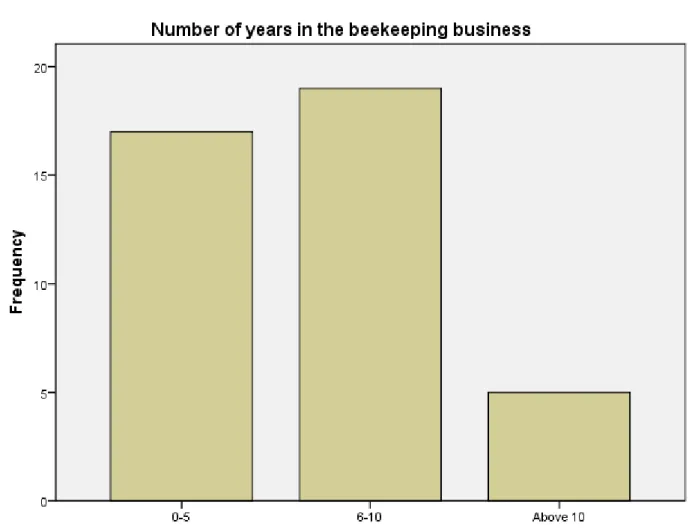
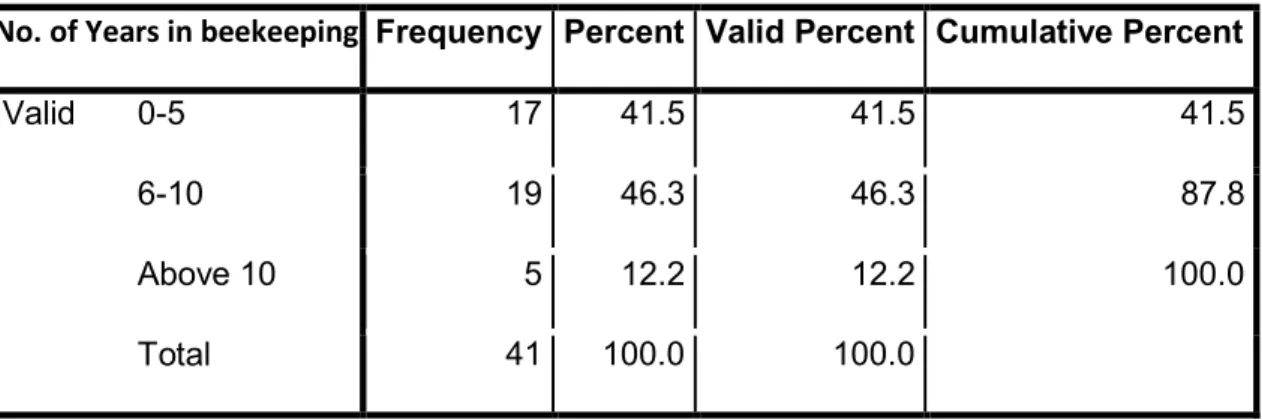
5.4 Years in Beekeeping 49
5.5 Source of Income 50
5.6 Previous Employment 51
5.7 Legal Forms of Business 53
5.8 Access to Land 54
5.9 Access to Bees and Equipment 55-56
5.10 Price Setting 57
5.11 Packaging and Distribution 58
5.12 Barriers to Entry 59-60
5.13 Products Sold by Beekeepers 61
5.14 Government Services 62
5.15 Buyers of End Product 64
xi
List of Figures
No.
5.1
Description
Respondents’ Age
Page
45
5.2 Respondents’ Gender 46
5.3 Highest Education Level 48
5.4 Years in Beekeeping 49
5.5 Source of Income 50
5.6 Previous Employment 52
5.7 Business Types 53
5.8 Access to Land 55
5.9 Access to Bees and Equipment 56
5.10 Price Setting 57
5.11 Packaging and Distribution 59
5.12 Barriers to Entry 60
5.13 Products Sold by Beekeepers 61
5.14 Government Services 63
5.15 Buyers of End Product 65
1 CHAPTER ONE INTRODUCTION
1.1 Introduction
The focus of the current study was to determine the challenges faced by apiculture SMMEs in Northern Hhohho region in Swaziland. According to Bradbear (2009), Apiculture is the science and practice of bee keeping. Bradbear further argues that these words ‘apiculture’ and
‘beekeeping’ tend to be applied loosely and used synonymously.
Hhohho region covers the western part of Swaziland from the north and running southwards towards the centre of the country. The SMMEs in various sectors of the economy globally are faced by quite a number of challenges and barriers that hinder them from growing their businesses further and compete effectively with their competitors. Apiculture SMMEs in Northern Swaziland are not immune to those challenges facing other SMMEs globally.
1.2 Background of Study
The reason for the focus on beekeeping (apiculture) SMMEs was that the Swaziland Government was faced with a major challenge of creating jobs, increasing income generation capabilities to reduce poverty and improve the food security situation of households and the country as a whole.
As a result, the Government considered agriculture as the main driver of the quest to address the above challenges. In addition, the Swaziland Government had selected beekeeping as the commodity to be promoted for the sub-sector to be able to derive the desired output and as a result the sub-committee on beekeeping had to be established (Ministry of Agriculture and Co-operatives, 2010).
In Swaziland where most of the SMMEs are in fact Micro-Enterprises (MEs), assistance to micro- enterprises as well as, small and medium-sized enterprises development is an integral part of overall economic reform together with enterprise development and sustainability, investment promotion and financial reform.
2
Apiculture is one of the most basic forms of subsistence farming. It has low start up costs, estimated to be SZL 2,270 and SZL 1,905 for Langstroth and Swazi Topbar hives respectively (Ministry of Agriculture and Co-operatives, undated). It requires little technical skills as well as labour, therefore has low operational skills. According to a study by Technoserve (2008), the annual local demand for honey is 156 tons yet supply, both in the formal and informal markets combined, is 83 tons per annum. Therefore, the current study sought to find out why, in the face of huge demand for the honey and other related products in local and international markets, Swaziland’s locally produced honey accounts for only one percent of the market demand, yet it is an easily accessible and economically viable industry. It also seeks to establish the challenges facing Apiculture (Beekeeping) SMMEs.
A lot has been said, in terms of the literature, about the challenges facing SMMEs in various sectors of the economy worldwide. But there is very little research being done specifically on the challenges facing Apiculture SMMEs in Swaziland. In a study conducted by Thwala and Mvubu (2008) on the
‘current challenges and problems facing small and medium size contractors in Swaziland’, they found that they are constrained by limited access and high cost of capital as well as weak support programmes from government. They also found that there is also a lack of skills and access to finance. What is lacking in most of the research that has been done on SMMEs in Swaziland is detailed focus on the challenges of Apiculture SMMEs. The first objective is to look at why, in the face of an increased demand for the honey and other related products in local and international markets, Swaziland’s locally produced honey accounts for only one percent of the market demand.
The review of literature, helped to ascertain if challenges faced by other SMMEs globally are the same as the challenges facing Swaziland Apiculture SMMEs. Previous research on apiculture SMMEs, in Swaziland, has not looked at the challenges facing Apiculture SMMEs using the value creation analysis. The current study used a value creation analysis approach with the aim of contributing new knowledge on the phenomenon under investigation. The limitation of the study is that it is a six months study, the time frame given is very short due to academic reasons and as a result, the researcher will focus only on beekeepers in one region rather than focusing on all four regions, of Swaziland.
3 1.3 Motivation of the Study
SMMEs play a crucial role in creating employment and contributing to the country’s economy. But there is very little attention given to Apiculture SMMEs in Swaziland in terms of scholarly work. The available literature on SMMEs in Swaziland focuses mainly on those SMMEs that are not in the Apiculture Industry. Therefore, the present research will add to the existing literature in the field of Apiculture. The contribution that this study will give is that it will offer information to the Swaziland Government and other relevant stakeholders on the challenges facing Apiculture SMMEs. This research will encourage other researchers to do more research on the issues researched here and come up with more advanced findings. Recommendations from this study are aimed at improving entrepreneurship among beekeepers, so as to create economic value for them.
1.4 Problem Statement
Can formulation of good business strategies enhance productivity, improve profitability thus ensuring sustainability, which will inevitably lead to improved livelihoods for SMME apiaries in northern Swaziland?
1.5 Objectives of the Study
•
To find out why the production levels of honey are significantly low and how productivity can be increased.
•
To establish the challenges faced by bee keepers in the marketing of honey.
•
To determine government’s involvement in the improvement and support of beekeeping industry, locally and internationally.
•
To determine whom the consumers and other end users are so as to align product with their needs.
1.6 Research (Key) Questions
• Why are the production levels of honey significantly low?
•
What are the challenges faced by bee keepers in the production and marketing of honey?
•
What is the government support service to the beekeeping industry in Swaziland?
4
•
Who are the consumers and other-end users of bee products?
1.7 Research problems and objectives: broader issues to be investigated
It is clear, by looking at the local and international literature, that there are quite a number of challenges facing SMMEs from various sectors of the economy (Thwala and Mvubu, 2008). These challenges are common to all SMMEs globally. Therefore, the objective of the current study is to look at the challenges facing the SMMEs in the beekeeping industry from Hhohho region in Swaziland. There is very little literature that focuses specifically on the challenges facing beekeepers.
The bulk of literature available, deals mainly with the challenges, barriers and problems facing SMMEs in all various sectors of the economy and there is not even one literature available that deals specifically with the challenges faced by Apiculture (Beekeeping) SMMEs in Swaziland and internationally.
Some of the studies that have been done in Swaziland were based on the production and economic situation of beekeeping in Swaziland to try and determine the potential opportunity for growing and up-scaling the contribution of this industry.
In a study conducted by Thwala and Mvubu (2008) on the ‘current challenges and problems facing small and medium size contractors in Swaziland’, it is found that they are constrained by limited access and high cost of capital and weak support programmes from government. They also found that there is also a lack of skills and access to finance. What is lacking in most of the research that has been done on SMMEs in Swaziland, is there is very little work on the challenges of Apiculture SMMEs. The first objective is to look at how productivity for local Apiculture farmers can be improved, in the face of an increased demand for the honey and other related products in local and international markets, as Swaziland’s locally produced honey accounts for only one percent of the market demand.
The international competitiveness of majority of SMMEs is seriously impaired by their disadvantageous economies of scale, lower technology level, limited domestic technological capacity, and limited access to financial and other input resources (Koirala, 2006). Based on what Koirala (2006) says, the second objective of the study would be to establish whether these challenges mentioned by Koirala are the same challenges facing Apiculture SMMEs in Swaziland. This
5
includes recommending measures which reduce costs and risks while increasing speed and reliability of supply and ultimately increase sales using a value chain approach.
1.8 Ethical Considerations
In line with the university requirements and standards on Ethics, the researcher obtained ethical clearance from the university ethical clearance committee. An informed consent form was developed by the researcher and approved by the institution’s ethics committee, this informed consent form was then attached to the questionnaires that were given to respondents (beekeepers). In the informed consent form, it was clearly spelt out that their participation was voluntary, no benefits will be given for participating in the study, and that they can withdraw from the study at any stage if they so wish and that anonymity will be maintained.
1.9 Limitations of the Study
There is very little literature broadly on apiculture in Swaziland, especially the challenges facing apiculture SMMEs in Swaziland. The respondents were hardly available, it took two full weeks for the researcher to complete data collection and had to rely on the services of the Ministry of Agriculture and Cooperatives’ Extension Officers, for identification and location of beekeepers. The time frame for this thesis was very limited, as only six months was given to complete it.
1.10 General Structure of the Study
This chapter was an introductory chapter that gave the overall summary of the study. The focus is on background of the study, objectives of the study, research (key) questions, research problems and objectives: broader issues to be investigated, principal theories upon which the research project will be constructed (research design), ethical considerations and limitations of the study.
Chapter 2
This chapter, which is literature review, focuses on value creation through entrepreneurship for SMMEs.
Chapter 3
This chapter discusses the background on the Swaziland economy, the need for SMMEs, as
6
means to create employment and reduce poverty.
Chapter 4
This chapter is based on research methods (quantitative methods) used in the present study, the instrument used to collect data and the statistical packages used in data analysis. A structured questionnaire was used as an instrument to collect data.
Chapter 5
The data collected is presented in chapter 5, through the use of descriptive statistics.
Chapter 6
This chapter is based on the discussion and analysis of results presented in chapter 5 with particular reference to the main objectives of the study. The results are discussed in relation to the literature given in chapter 2 and 3 of the study.
Chapter 7
Chapter seven focuses on the conclusions and recommendations of the study. The recommendations are based on the findings of the study and recommendations for future research in related fields are made.
1.11 Conclusion
This chapter contains the background of the study, objectives of the study, research questions, research problems and objectives, broader issues to be investigated, principal theories upon which the research project was constructed ( research design) with focus on value creation, followed by ethical considerations and the limitations of the study. The next chapter reviews literature in relation to the study and its main objective of improving entrepreneurship for Apiculture SMMEs in Northern Hhohho, Swaziland.
7 CHAPTER TWO LITERATURE REVIEW
2.1 Introduction
There is no consensus amongst scholars regarding the definition of entrepreneurship. In a nutshell, there is no single definition of what is entrepreneurship (Baron and Shane 2008). Baron and Shane (2008) have argued that although there is no agreed-upon single definition of entrepreneurship, but Shane and Venkarataman, quoted in Baron and Shane (2008), came up with a definition that has been increasingly accepted. Therefore, Shane and Venkataraman, quoted in Baron and Shane (2008) define Entrepreneurship “as a field of business, which seeks to understand how opportunities to create something new (e.g. new products or services, new markets, new production processes or raw materials, new ways of organizing existing technologies) arise and are discovered or created by specific individuals, who then use various means to exploit or develop them, thus producing a wide range of effects”.
Stokes and Wilson (2006) argue that although there is diversity of different definitions of entrepreneurship, there is a general consensus that the definition involves a transformational process of market change undertaken by a particular breed of manager. For Stokes and Wilson (2006) entrepreneurship is seen as a fundamentally important part of modern economic and social life. They argue further by saying that entrepreneurs play a key role in our lives and yet there is an extraordinary lack of clarity concerning both what entrepreneurship is and exactly what entrepreneurs do and sets them apart from other managers.
Baron and Shane (2008) argue that by implication, the definition suggests that entrepreneurship is identifying an opportunity that is potentially valuable in the sense that it can be exploited in practical terms and yield sustainable profits and the activities involved in actually exploiting or developing this opportunity.
According to Allen (2010), entrepreneurship is a mindset or way of thinking that is opportunity focused, innovative and growth oriented. He further argues that although entrepreneurship is most commonly thought of in conjunction with starting a business, the entrepreneurial mindset can be found within large corporations, in socially responsible non-profit organisations, and anywhere that
8
individuals and teams desire to differentiate themselves from the crowd and apply their passion and drive to executing a business opportunity.
2.2 Entrepreneurship
According to Baron and Shane (2008), entrepreneurship, as a field of study, seeks to understand how opportunities to create something new arise and are discovered or created by specific individuals, who then use various means to exploit or develop them, thus producing a wide range of effects. An opportunity to create something new could involve, new products, new markets, new processing of raw materials or production processes or new ways of using existing technology. Concurring with Baron and Shane, Allen (2010), states that entrepreneurship is a mindset, a way of thinking that is opportunity-focused, innovative and growth oriented as well as being a set of behaviours.
Baron and Shane (2008), further view entrepreneurship as a process, rather than a single event, that unfolds over time through the following key phases:
Opportunity recognition: an opportunity is the potential to generate economic value and is viewed as desirable in the society in which they occur.
Decision to Proceed and Assembling of Essential Resources: the decision to proceed means doing something active about the opportunity, and it relies on the motives of the entrepreneur.
Assembling essential resources involves business environmental analysis, and acquiring human and financial resources.
Launching a new venture: involves product development, as well as choosing the legal form of the new venture (The population demographics of the SMMEs in this study relate to four types of entrepreneurs, namely, the sole trader, partnerships, social entrepreneurship and cooperatives), and establishing roles of human resources.
A sole trader is a business form whereby the owner is the only person responsible for the activities
9
of the business and therefore is the only one who enjoys the benefits or profit and suffers the losses of the said business. It is the easiest and most inexpensive business form to create, yet the most risky as it has unlimited liability (Gartner and Bellamy, 2010). This is the case with most of the rural beekeepers.
Partnership is when two or more individuals join together and pool their capital and abilities, to form a business. These individuals should not exceed twenty people. The profits are shared amongst themselves at an agreed ratio and liability is assumed jointly or severally as per agreement of partnership (Gartner and Bellamy, 2010). With the population of the study, this form of business is mainly with family members. The main advantage of this business form is that business risks are not borne by one person, yet that could turn into a disadvantage in the sense that debts incurred by one partner results in the other partners being obligated to such debt (Gartner and Bellamy, 2010).
Social entrepreneurship, according to Gartner and Bellamy (2010), is an enterprise created to solve a social problem or address a market failure, while operating in a financially sound manner. The values of the organization focus on the community and the environment and are typically overseen by members of the community. These community members are accountable to a wider stakeholder group, which is concerned with making a social, environmental and economic impact on others.
ESwatini Kitchens, an organization in Swaziland that deals in processing honey, provides technical aid, free of charge, to rural farmers who supply it with honey. This is a typical example of social entrepreneurship.
Co-operatives, according to Gartner and Bellamy (2010), are legal entities typically formed by people with similar interests, to reduce costs and gain economic power. Profits are shared amongst members in proportion to their contribution an there is limited liability. The apiculture industry, in Swaziland, is more oriented towards seller co-operatives, which is individual beekeepers jointly supporting market development and other business activities, so as to effectively compete with large competitors.
Building success and managing growth: this involves developing effective strategies for encouraging and managing growth. The study is focused on beekeeping entrepreneurs and the challenges they face, that prevent their enterprises to develop and be growth oriented. In the study, focus will be on
10
value chain approach as means of developing an effective strategy to counter challenges faced by the apiculture SMMEs.
Harvesting the rewards: choosing the best way of reaping the rewards of hard work and commitment. This phase may also involve finding an exit strategy for the entrepreneur.
Of note though is that, Strydom, Nieuwenhuizen, Antonites, de Beer, Cant and Jacobs (2007), state that, not everyone who starts a new business, is in reality, an entrepreneur, as entrepreneurs habitually create and innovate to build and grow something of recognised value. Not every SMME achieves anything new or different, nor do they all grow and become successful, thus they may not be deemed to be entrepreneurial. The lack of entrepreneurship in SMMEs often results in the failure of the business venture.
2.3 Creating Value Through Entrepreneurship
Beekeeping, in terms of the literature, is very important in terms of job creation and income generation for the rural poor communities, especially in Africa. Most of the communities in the Third World countries (developing countries), especially African communities, use beekeeping as a source of income generation and livelihood. Swaziland is not an exception, (Swaziland: SADC Trade, Industry and Investment Review, 2006), like all other developing countries, is faced with the problem of high unemployment rate, currently estimated at 40%, with 69% of the population living below the poverty line, especially in the rural areas. This prevalent poverty contributes to social ills such as increased crime rates and illiteracy. The current dire financial strait, that the country is experiencing, has exacerbated the problem of economic underdevelopment. Beekeeping is an appropriate form of income generation for communities in some of the most economically disadvantaged areas of Africa.
Its role in promoting economic self-reliance and the need to enhance this role were identified in the important Banjul Bee Declaration of 1991 (Bees for Development 1991). Beekeeping is an on-farm diversification strategy that has significance to rural livelihoods in some of the most economically and environmentally marginalised regions of the world (Seagle, 2008).
Although beekeeping can only rarely become the sole source of income and livelihood for people in the Third World, its role as a source of supplementary earnings, food and employment should not be underestimated. Key points in the argument that beekeeping is a key element in promoting rural self-reliance are that:
11
Beekeeping promotes rural diversification and hence is an alternate source of income and employment, particularly in areas where arable land is restricted and demographic growth is resulting in insufficiently profitable landholdings. It is an activity that has successfully been adopted by women in many parts of the continent (Clauss 1992). Rodriguez, Riley, Shafron and Lindsay (2003) in Australia found that the majority of beekeepers operated from small holdings of land. The average area of land at the business premises was 42 hectares. This average was quite different across the states. New South Wales had the largest area of land with an average of 89 hectares, while Western Australia had the smallest with only 9 hectares. Rodriguez et al (2003) in their research findings further found that around 62% of beekeepers reported that they had used public land for honey production in the past five years. This proportion was 100% in Tasmania while in South Australia it was only 33%.
Beekeeping can reduce unemployment rates as it is an activity that can be done by people of employable age. In a study done by Moniruzzaman and Rahman (2009) in Bangladesh, they have found that 61% of the beekeepers in the study areas were between 31-59 years. The young people who were part of the study were between the ages of 15-30 years. These young people were about 37% of the total. There was only one beekeeper who above 60 years.
The economy of Swaziland is highly dependent on agriculture, with sugar cane being the major source of export income. Due to drought and loss of preferential trade agreements with the European Union, there has been an acute decline in export income. This has also resulted in job losses in the agricultural sector, as well as food shortage in the country. Efforts to increase direct foreign investment, especially in the manufacturing sector have been thwarted by companies’
preference to South Africa (Swaziland: SADC Trade, Industry and Investment Review, 2006).
Agricultural activities clearly have a key role to play in any rural development strategy: "Agricultural development is indispensable to guarantee local food security, to generate widespread employment and income sources and conserve environmental resources" (Gooneratne and Mbilinyi 1992).
Overpopulation, environmental degradation, drought, marginal farming conditions, and supplementary income needs require production that is more than just subsistence. Transportation and storage difficulties, however, work against the attempts of small-scale farmers to compete as major suppliers of food to external markets. Honey and beeswax, though, are a high-value commodity with which to complement existing agriculture, are easy to transport and store, and
12
provide subsistence farmers with a valuable source of income.
Beekeeping has considerable merit as a self-reliance strategy that can augment the income of small- scale farmers with only a minimal financial outlay. Traditional beekeeping is being enhanced as a form of rural activity and income through the introduction of small, technologically appropriate improvements. Often this is due to limited, no dictatorial support offered by aid agencies that acknowledge the considerable benefits which beekeeping offers. Intervention has been designed to remove obstacles and increase productivity and income, thereby improving rural community self- reliance. Evidence from countries such as Malawi illustrates how suitable interventions can address existing constraints (Mensing, 1993a).
Beekeeping is a mechanism that can help address the employment challenges created by a growing population and increasing landlessness (Ntenga and Mugongo, 1991). Employment opportunities are also formed for craftsmen who manufacture hives, smokers, gloves, and other beekeeping equipment (Sosu, 1991). The important role that beekeeping plays as a source of employment is clear: Of the approximately 400, 000 people in the North-Western Province of Zambia, nearly 15,000 are beekeepers. The significant and potential earning capacity of beekeepers is vividly illustrated by evidence from Tanzania, where the more successful beekeepers, can earn incomes of up to approximately $370 per year, compared with a state official, whose annual earnings average about
$56 per year. It is evident why "large-scale beekeepers in the villages have solid social and economic positions (Illgner, Nel and Robertson, 1998). This shows that in 1998, in Tanzania, income from beekeeping was approximately 6 times more than state officials’ earnings.
Messely (2007) argues that beekeeping is an important component of agriculture and rural development programmes in many countries. The role of beekeeping in providing nutritional, economic and ecological security to rural communities at the household level and is an additional income generating activity. This being a non-land-based activity does not compete with other resource demanding components of farming systems. Huge agricultural and agro-based opportunities exist in the rural areas to generate income and employment. Messely (2007) also states that beekeeping is a useful means of strengthening livelihoods and has been identified as a viable agriculture practice that could alleviate poverty and sustain rural employment.
13
According to Messely, beekeeping has the potential to help many people to increase their incomes and their crop yields. Beekeeping is ideal for people who have no land and little space and little money. Beekeeping has a chance for many landless peasants and small holders to improve their livelihoods. Beekeeping, Ntenga and Mugongo, (1991), is a mechanism that can help address the employment challenges created by a growing population and increasing landlessness. According to Sosu (1991) employment opportunities are also formed for craftsmen who manufacture hives, smokers, gloves, and other beekeeping equipment.
In Malawi, Apiculture has traditionally been an important activity for many decades and has been a source of food, income and employment for people in the rural areas. There are approximately 3,500 people employed in the bee-keeping sector in Malawi with over half of them in the northern region. Malawi’s economy is dependent on agriculture as explained above it follows that the role played by bees in pollinating crops is very crucial. The majority of people who are involved in agricultural production in Malawi are poor and live in the rural areas where large tracts of forests are found. As a result, the Government of Malawi has adopted poverty reduction as one of its development strategy, and apiculture is one of the industries that are being promoted in the rural areas to improve off farm incomes and employment (Situational Analysis of Beekeeping Industry, n.d.).
Berhane (2010:2) states that beekeeping is a good source of off-farm income to farmers in our country. It plays significant role in supplementing the annual income of the beekeepers through the sale of honey, wax, colonies and serving as a healthy food for the consumers. It almost requires no land, limited capital and does not take much of the farmer’s time, yet generates a sizeable income (FAO 1984). The net return from a well-managed beekeeping operation is thought to be significantly large. Berhane (2010) strongly argues that, although beekeeping can only rarely become the sole source of income and livelihood for people in the third world, its role as a source of supplementary earnings, food, and employment should not be underestimated. Key points in the arguments that beekeeping is a key element in promoting rural self-reliance are that:
• Beekeeping promotes rural diversification and hence is an alternative source of income and employment, particularly in areas where arable land is restricted and demographic growth is resulting in insufficiently profitable land holdings.
• Beekeeping allows for a degree of risk avoidance by providing a reliable, high value product
14
that enables rural farmers to survive in times of economic crisis.
• Beekeeping is a low cost, sustainable undertaking with a low environmental impact.
Research conducted by Gidey and Mekonen (2010) in the Tigray Region of Northern Ethiopia, 45.7%
of the bee keepers households responded “Yes” for the question “is beekeeping a major source of cash income supporting the family livelihood ?” and the majority (54.3 %) “No”. This suggests that beekeeping is not a major source of cash income for many of the farmers but as a supportive income to meet their demand for cash to pay debts and for their living conditions. The results also showed that the amount of money earned per year was generally low or too little to sustain the needs of the households. Coupled with the low local demand for honey, the respondents noted that the income from honey production is unsteady. Another problem of the respondents was related to the production, pricing and marketing of honey.
In Swaziland where most of the SMMEs are in fact Micro-Enterprises (MEs), assistance to micro- enterprises as well as, small and medium-sized enterprises development is an integral part of overall economic reform together with enterprise development and sustainability, investment promotion and financial reform (Ministry of Enterprise and Employment, 2005).
2.4 The Value Chain Approach
The focus of this study is to highlight business challenges, which threaten apiculture sustainability, for SMMEs, therefore it aims at creating value for the rural farmers. Value, as previously stated, for these farmers, means mainly the ability to generate income to meet basic needs and wants. To sustain the business, so as to have a dependable source of income, is therefore important for the beekeepers. This can be achieved if the beekeepers have entrepreneurial management strategies for their businesses. According to Stokes and Wilson (2006), entrepreneurial management involves the specific management behaviours which entrepreneurs must engage in, in order to drive the market process and produce innovation.
These specific management behaviours include:
• Opportunity discovery and exploitation, which requires the beekeeper to be alert for industry opportunities in terms of creating new business streams. New business streams could include, for example, product diversification and the success thereof comes from understanding the
15
market or consumer needs, as well as industry or business environment.
• Resource acquisition and co-ordination, which requires the ability to leverage resources from outside the business, so as to overcome internal resource constraints. In relation to rural beekeepers, it could mean, the use of the free technical aid from the Swaziland government, to enhance production and bee management skills.
In another study that was done by Abebe and Puskur (2010) on Beekeeping sub-sector challenges and constraints in Atsbi Wemberta District of eastern zone, Tigray Region, Ethiopia, they found that utilization of improved beekeeping practices were influenced by different constraints. The work done by Abebe and Puskur (2010) revealed that; drought, honeybee pests and disease, shortage of beekeeping materials, death of colony, lack of adequate extension support, marketing problem, shortage of bee forage, lack of beekeeping skill and reduction of honeybee colonies; were found to be the major constraints in the beekeeping development of the district, in their order of importance.
• Entrepreneurial networking, which involves gaining assistance from local institutions as well as other organizations, such as, in the case of Swaziland, donor agencies who support SMMEs.
• Entrepreneurial decision-making, which is the ability to make decisions irrespective of the limited decision making tools (for example, competitor analysis, historical trends), that rural SMMEs face.
Using the value chain approach, the study sought to improve entrepreneurial management strategies for apiculture SMMEs in Northern Hhohho, Swaziland. According to Ingram (2009), the
term “value chain” refers to the full range of activities needed to bring a product or service from conception, through production and delivery to final consumers (and ultimately disposal after use).
A value chain can be the way in which a firm develops a competitive advantage and creates shareholder value.
Value chain analysis encompasses issues such as organisation, co-ordination, power relationships between actors, linkages and governance aspects. These issues can be analyzed by individual organisations, as well as between actors within a chain. Drivers of value chain activities include economies of scale, learning, capacity utilisation, linkages among activities, the degree of vertical integration, timing of market entry, geographic location and institutional factors such as regulations,
16 union activity, or taxes (Ingram, 2009).
This approach suggested interventions aimed at addressing constraints and accelerating growth, thus ensuring sustainability. The focus being on marketing the available apiculture products as well as increasing the product base. The value chain concept, as developed by Michael E. Porter, seeks to identify ways of creating customer value, which would ultimately result in increased product demand and therefore create value for the business. Wheelen and Hunger (2010), define a value chain as a linked set of value-creating activities that begin with basic raw materials coming from suppliers, moving on to a series of value-added activities involved in producing and marketing a product or service and ending with distributors getting the final goods into the hands of the ultimate consumer.
According to Nieman and Bennett (2006), the value chain can be used as a systematic means of examining all the organization’s functional activities and their effectiveness in creating customer value. These activities are categorised into primary and support activities and an analysis of each can highlight challenges and strengths of the business.
2.5 Brief History of Entrepreneurship
Stokes and Wilson (2006) argued that entrepreneurship is not a new phenomenon, and people have been referring to entrepreneurs for hundreds of years. The word itself originated from the French,
which literally means someone who takes between or goes between. It is argued that the earliest use of the term reflected this sense of the middleman who directed resources provided by others. It is stated that in the Middle Ages, an entrepreneur was someone who managed large projects on behalf of the land owner or the church, such as building of a castle or a cathedral. In the seventeenth century, the concept was extended to include some element of risk and profit. In fact Entrepreneurs were those who contracted with the state to perform certain duties, such as collection of revenues or the operation of banking and trading services. As the price was fixed, the entrepreneur could profit or loose from performance of their contract (Stokes and Wilson, 2006).
A French Economist by the name of J.B. Say who wrote in the 1800s distinguished between the profits of those who provided capital and the profits of entrepreneurs who used it. Say defined
17
entrepreneurship as ‘someone who consciously moves economic resources from an area of lower, and into an area of higher productivity and greater yield’ (www.jstor.org). In simple terms, entrepreneurship takes existing resources, such as people, materials, buildings and money, and redeploy them in such a way as to make them more productive and give them greater value.
It is further argued by Stokes and Wilson (2006) that the above given definition implies changing what already exists, it sees the entrepreneur as an instrument of change, someone who does not seek to perfect, or optimise ways of doing things, but searches instead for new methods, and new markets. According to Stokes and Wilson (2006), in the mid-twentieth century, Joseph Schumpeter took up this theme of the entrepreneur as a necessary destabilising force. Schumpeter argues that economic equilibrium, which optimises what already exists, does not create healthy economies.
They further state that, in the 1980’s Peter Drucker developed these earlier ideas, seeing the emergence of an entrepreneurial economy in USA as a most important and hopeful event.
Drucker’s argument is that, an entrepreneur is someone who always searches for change, responds to it, and exploits it as an opportunity. It is argued that Drucker, like Schumpeter, made innovation a necessary part of entrepreneurship. He focused on the management processes involved in what an entrepreneur does while others have taken this theme of entrepreneurship as a process, an action- oriented management style which takes innovation and change as the focus of thinking and behaviour (Stokes and Wilson, 2006).
On a brief history of the entrepreneurial revolution, Allen (2010) argues that the term entrepreneurship has been in existence for more than two-hundred-and-fifty years.
2.6 Job Creation
Strydom, Nieuwenhuizen, Antonites, de Beer, Cant and Jacobs (2007) argue that economic development can be directly attributed to the level of entrepreneurial activity in a country. They further argue by saying that in a high-growth, globally competitive economies, the ability to nurture this entrepreneurial activity and grow businesses actually creates wealth and also sustain competitive advantage is very much important. Strydom et al. (2007) further argue by stating that this is because there is a direct correlation between job creation and the level of entrepreneurial activity in an economy, as well as positive, statistically significant association between national economic growth and entrepreneurship. In their view, taken from Kao (1993), entrepreneurial businesses ensure growth in the economy by doing something new and/or innovative to create
18
wealth for the entrepreneur and to add value to society. Stokes and Wilson (2006) concur with the view that entrepreneurship creates value, they both argue by saying that there is a general consensus that entrepreneurship involves some kind of transformative process of social and market change that creates value for individuals and society. They further argue that this process can take place in a wide variety of contexts, but follows a simple formula with the progression from opportunity identification through to realizing value. It is stated that this value can take many forms, that is, personal wealth, family security, social inclusion or perhaps cultural and aesthetic pleasure.
To support what has already been stated above, most of the findings from the various literature studies on beekeeping indicate that people engage in beekeeping for a variety of reasons. Those reasons are for family support financially, for personal wealth, and others do it as a hobby.
According to Allen (2009) entrepreneurial ventures are responsible for significant job creation. Allen says entrepreneurial ventures and small businesses are related, but they are not the same in most respects. They are both economically important but each provides different benefits and outcomes.
Allen (2010) quoted Schumpeter whereby he describes entrepreneurs as equilibrium disruptors who introduce new products and processes that change the way we do things, while small business owners typically operate a business to make a living, e.g. small businesses are shops, restaurants, and professional service businesses. It is stated further that they form what has been called the
“economic core.” Allen (2010) warned that it should not be forgotten that most entrepreneurial ventures start small.
It is argued by Allen (2010) that entrepreneurial ventures have three primary characteristics;
innovation, value-creating and growth oriented. From Allen’s view, an entrepreneurial venture brings something new to the market place, whether it is a new product or service, a new marketing strategy, or a new way to deliver products and services to consumers. According to Allen (2010), an entrepreneurial venture creates new value in a number of ways. In her view, entrepreneurs create new jobs that do not merely draw from existing businesses, and by finding niches in the market, entrepreneurs typically have a vision of where they want their businesses to go, and generally that vision is on a regional, national, or more often global level.
2.7 Rural Entrepreneurship Development as a Government Initiative
Research has shown that initiatives by government have a positive outcome for the rural beekeeping industry.
19
In Malaysia, rural entrepreneurship is recognised as a very important component that contributes to economic growth and development. Rural entrepreneurship is defined as the creation of a new organisation that introduces new product, serves or creates a new market, or uses a new technology in a rural environment. A rural entrepreneur is defined as someone living in a rural location and contribute to the creation of local wealth. Rural entrepreneurs can focus their attention on agriculture or areas that relates to natural resources. It is argued in Malaysia that entrepreneurship stimulates economic growth through the knowledge spill-over and increased competition of the entrepreneurs. In relation to rural entrepreneurship, it has been accepted as a central force of economic growth and development of a country. As a result of that, the Malaysian government has given much attention to ensure the success of the programme. The government, together with its institutions and individual citizens agree on the pressing need to promote rural enterprises as a huge employment potential and instrument to improve the well being of rural community (Ahmad, Yusoff, Noor and Ramin, 2011). This Malaysian way of supporting the introduction of rural entrepreneurship should be emulated by the Swaziland Government in helping beekeepers in the rural areas so they can surmount their challenges.
It is argued that rural entrepreneurship in its substance does not differ from entrepreneurship in the urban areas. The development of rural entrepreneurship programs started in the 1970s until today.
The main objective of the government in introducing the New Economy Policy (NEP) in the 1970’s was to reduce poverty and inequality amongst different groupings of the Malaysian population. The Ministry of Regional and Rural Development introduced various programmes and supports in order to enhance the development of rural entrepreneurship. Those programs included marketing programme, entrepreneurship training programmes, agriculture and tourism development programme, as well as financial schemes. The bold initiatives taken by the Malaysian government to boost income rural entrepreneurs is to facilitate the growth of One-District-One-Industry- programme in 2003 (Ahmad et al, 2011).
In Lesotho, it is stated that government support service to beekeeping industry in the country is through the Beekeeping Section of the Ministry of Forestry and Land Reclamation (MFLR). In Lesotho, the Beekeeping Section is manned by two people, that is, the Head of the Section and Conservation Officer. The Section offers training to prospective honey producers, they also assist in the importation of production inputs, assist in the extraction of honey as well as finding markets for honey. This is the support offered by the Section to beekeepers. The Section further assists in bee removals and elimination of destructive colonies. It also assists honey producers to source donor funds (Situation Analysis of the Beekeeping Industry, n.d.).
20
The literature also indicates that inadequate extension services and lack of skills training for beekeepers affects processing and packaging. Regarding packaging, there are just a handful of processors who package hive products in internationally approved and recommended materials. The most commonly used packaging materials are plastic jerry-cans and other plastic containers. Some industries have improved glass containers but these are only used by well organised processing plants like Reko Industries Ltd. For easy handling, transportation and grading, honey should be packaged in air-tight-lidded plastic buckets. The packaging materials for large-scale honey and other hive products for export are not readily available. It is said that those available are only affordable to large processors (Ugandan Apiculture Export Strategy, 2005).
In a situation analysis of the beekeeping industry that was done in South Africa, it is stated that most beekeeping training is done by white commercial beekeepers associations, sometimes they do it in partnership with tertiary education institutions. The training and development of black beekeepers is mainly done by the ARC through its Beekeeping Development Program which was initiated in 2003. This programme was aimed at targeting at least 5000 beneficiaries, and the aim was to address historical inequities within the South African beekeeping industry and also increase its size by 50%. According to the study that was done by the Agriculture Research Council (ARC), 97%
of smallholder beekeepers were trained and had gone through mentored beekeeper development programme. The training of smallholder beekeepers is very critical to the commercialization agenda.
It should be noted that these beekeeping training targeting smallholder producers are mainly government funded. There is very little technical support coming from the provincial Departments of Agriculture (Situation Analysis of the Beekeeping Industry, n.d.).
In Swaziland, The Ministry of Agriculture & Co-operatives (MOAC) supports the development of bee farming in the country. According to the Ministry’s Beekeeping Specialist, at least 3, 000 farmers were trained by the Ministry in the introduction to beekeeping. But out of this number it was found that less than 10% of them are still active in bee farming (Situation Analysis of the Beekeeping Industry, n.d.).
21 2.8 The Role of Co-operatives in Rural Development
The role played by SMMEs and Co-operatives is almost similar in the sense that both try to address the problem of the rural poor. Co-operatives together with SMMEs can contribute immensely to a country’s economy as well as improving the lives of its citizens in terms of poverty alleviation and creating employment.
According to the South African Integrated Sustainable Rural Development Strategy (ISRDS, 2000),
‘rural’ is characterized as an area where “populations are spatially dispersed. Agriculture is often dominant, and sometimes the exclusive economic sector and opportunities for resource mobilization are limited”. The strategy further states that South African rural areas are
“characterized by high levels of poverty”. Approximately 70% of South Africa’s poor people live in rural areas and about
70% of the rural residents are poor. Their incomes are constrained because the rural economy is not sufficiently vibrant to provide them with remunerative jobs or self-employment opportunities. Their cost of living is high because they spend relatively more on basic social services such as food and
water, shelter, energy and education, transport and communications service (ISRDS, 2000). The situation at rural level needs to be changed by way of improving the living conditions there and hence countries introduced the term ‘rural development’ to address the socio-economic conditions of rural populations that are largely poor.
Rural Development is viewed in different ways by different people. Petrin (1994), for example, sees entrepreneurship as a strategic development intervention that could accelerate the rural development process. He notes that, “the entrepreneurial orientation to rural development accepts entrepreneurship as the central force of economic growth and development, without it other factors of development will be wasted or frittered away” (Petrin, 1994).
India’s approach to rural development was aimed at provision of job opportunities to rural communities in order to raise their income. This was done by involving a number of programmes like poverty alleviation programme, Integrated Rural Development, development programmes for women and children, etc.
22 2.9 Conclusion
This chapter has focused on the role of entrepreneurship in creating value as well as employment creation. The focus was also on Co-operatives and SMMEs in relation to rural development, entrepreneurship, poverty alleviation and employment creation. This chapter has looked at the role the SMMEs and Co-operatives can play in the country’s economy and in relieving the plight of the rural poor people. It has also looked at beekeeping and the economic impact it has. The present chapter has also looked at the success stories of Malaysia in relation to the study at hand. The next chapter, chapter 3, focuses on Swaziland together with its socio-economic situation, as well as the challenges facing beekeepers.
23
CHAPTER THREE
SWAZILAND BACKGROUND AND ECONOMY 3.1 Introduction
3.1.1 Geography and Climate
Swaziland is one of the smallest countries in Africa, it’s the second smallest country, Gambia being the smallest. In terms of Swaziland’s location in the continent, it is a landlocked nation bordered by South Africa to the North, West and South and Mozambique to the East with an area of 17,364Sq Km, of which 15-20% is arable. The population has increased gradually, the current population is estimated to be 1,067,920 people with a growth rate close to zero due to HIV/AIDS.
This has had a tremendous impact on the child life expectancy since under five child mortality is 160/1000 according to UNICEF (2005). It is stated that life expectancy at birth is 37.5 years, the majority of deaths occurs among young people who are between 15 – 49 years of age (World Vision Swaziland,
2010:7). The population in the main areas is as follows: in Mbabane being the capital city, population was 61,400 in 2009, in Manzini the population is 93,400, Malkerns is 7,900 of the population, Nhlangano has a population of 7,000, Mhlume has also 6,900, Big Bend is at 6,800 of its population, Siteki has 5,900, Simunye is having 5,500, Hluti is having 5,400 of the population and Pigg’s Peak has got 4,500 of the population (The Commonwealth Yearbook 2011, Swaziland). Northern Hhohho includes a minor part of Mbabane and Piggs Peak, has approximately 10 000 population.
Using the agro-ecological zones, the country has four main agro-ecological zones, those are: the Highveld (high rainfall), the Middleveld (medium rainfall), the Lowveld (low rainfall), and the Lubombo Plateau. These four zones are said to run approximately parallel to one another, from west to east (Swaziland Rural Sector Review, 2011). It is worth mentioning that, though comparable to the Highveld and Lowveld in terms of total land area, the Middleveld represents a more important agricultural zone through its relatively higher crop yields and accommodation of the smallholder farms. Between 1994/95, 40% of the crop growing holdings were located in this zone as compared to 28% and 24% in the Highveld and Middleveld zones, respectively. The Lubombo Plateau, between 1994/95, is said to be located in only 8% of the total land area, and had only 9% of the small-scale holdings (Magagula and Faki 1999). According to the Swaziland Rural Sector Review (2011), the country is traversed by four major river systems, which have high hydroelectric potential and are
24
increasingly used for irrigation. In the past years, the rainfall pattern has reportedly become more and more uncertain, characterised by periods of drought and intense heat. This situation has contributed to crop failures.
Regarding climatic conditions, the climate is generally sub-tropical with a high degree of variability.
In terms of the temperatures, there are steep temperature and precipitation gradients correlating with the fall in altitude of 1200 metres over a distance of 80 kilometres. On average, the maximum and minimum monthly temperatures range from 22° C and 11° C in the Highveld and 29° C and 15° C in the Lowveld. Approximately 80% of the precipitation falls during the summer month that is October to March, as thunderstorms and frontal rains. It is estimated that the average annual rainfall in the Highveld is about 1,400 millimetres, in the Middleveld 860 mm, in the Lowveld about 560 mm, and on the Lubombo it is about 890 mm (World Vision Swaziland, 2010).
3.1.2 Context
Since Swaziland is predominantly a rural country, agriculture plays a very important role in the country’s economy. Agriculture plays a significant role in terms of its contribution to the country’s GDP and the majority of the population depends on agriculture as its primary livelihood source. As part of the National Development Strategy, the government has integrated agricultural and rural development as a central element of the National Development Strategy as a way strategic way of meeting the country’s developmental goals. On the other hand, through its Government Program of Action 2008-13 (GPA), the government places agriculture at the centre of the economic growth agenda, with much focus and emphasis on intensification and diversification of smallholder agriculture and food security as the pillars for poverty alleviation. This Government Program of Action of 2008-13 is aligned with the other two poverty alleviation strategies, that is, Poverty Reduction Strategy and Action Program (PRSAP) which were approved in 2007 (Swaziland Rural Sector Review, 2007).
Since agriculture plays an important role in the country’s economy, massive efforts have
been made by the government to increase investments in the agricultural sector. It is
argued that despite all of that, these investments have produced limited results. The
agricultural sector continues to face significant development challenges, those challenges
are that productivity
25
remains low, food production has failed to keep pace with population growth, and food
insecurity is rising, especially in rural areas. As a result, the World Bank committed itself to consider stimulating rapid and sustainable rural growth by carrying out a Rural Sector Review intended to identify actions that could contribute to broad-based agricultural development and poverty reduction in Swaziland. Swaziland government and World Bank also agreed to narrow the scope of the Rural Sector Review by focusing on promising opportunities for raising productivity in the small-scale farming sector and better integrating smallholder farmers into markets.
3.2 Economy
There are many developmental challenges facing the Swaziland government. The challenges range from poverty, HIV and AIDS, unemployment and the removal of international preferential markets for sugar and textiles. Further to that, the Swaziland economy has slowed down from 2.1% in 2004 to 1.8% in 2005, and predicted to decline further up to 2009 against the static population growth of 2.9% (Swaziland Industrial Development Company [SIDC], 2007). It is argued by the Ministry of Economic Planning and Development (2006) that this continuing trend is further complicated by the increasing poverty in the rural areas, where about two-thirds of the population, derive their living through agriculture. Only about 30% of the rural population have enough to eat and the other 70%
depends on off-farm income. As a result, the government of Swaziland has realised that rural development is a priority, as the rural residents are capable of agricultural and other activities for generating incomes and national broad-based growth. Huge investment now is on infrastructure, extension services and technology, markets, social and financial services. These huge investment strategies have focused on food security which is a key to alleviating poverty (Dlamini, Masuku and Dlamini, 2008).
In the Africa Research Bulletin (2011) it was reported that Swaziland’s gross national income per capita of US$2,600 (2008) qualifies it as a lower-middle-income country (LMIC). Swaziland is well- integrated economically, as a result, Swaziland benefits from a sub-r