1
CAPITAL FLOW VOLATILITY, FINANCIAL DEEPENING AND CAPITAL MARKET PERFORMANCE IN LOW-INCOME COUNTRIES
A thesis submitted in fulfilment of the requirements for the degree of Doctor of Philosophy (Finance)
University of KwaZulu-Natal Westville, Durban.
South Africa
KUZIVA MAMVURA (215081310)
Supervisor: Professor M. Sibanda Co-Supervisor: Dr R. Rajaram
May 2018
ii
DECLARATION
I Kuziva Mamvura (student number 215081310) declare the following;
1. I am aware of what plagiarism entails and am aware of the university’s policy in this regard.
2. I declare that this is my own original work. Due acknowledgement and referencing has been made in line with the department’s standards where other people’s work has been used.
3. I did not make use of another student’s previous work or submit it as my own.
4. I did not allow and will not allow anyone to copy my work with the intention of presenting it as his or her own work.
5. This work has not been submitted by me for a degree at this or any other tertiary institution.
6. I did not copy and paste any information directly from an electronic data source (e.g. a web page, electronic journal article or CD ROM) into this document.
……… ………19.06.2018………….
Kuziva Mamvura Date
iii
DEDICATION
This thesis is dedicated to:
My wife Isabel
My children Kuziva (jnr), Kudzai, Kupakwashe and Kundai
My Father and Mother
iv
ACKNOWLEDGEMENTS
I would like to extend my deep gratitude to my supervisors, Professor Mabutho Sibanda and Dr Rajendra Rajaram, for their wise guidance, critical comments and encouragement throughout the course of this study. Your continuous reviews, advice, support and unwavering commitment to my research made a significant contribution to my growth as an academic researcher.
Special thanks to my longtime friends in the academic field, Dr Farai Kwenda and Dr Kuziva Muganiwa for encouraging me to embark on a PhD. I thank them for their inspiration and for committing their precious time to my research as well as their analytical input.
I sincerely thank my entire family and relatives scattered around the world. While it was difficult for me to find time to be with you, you did not stop supporting and encouraging me throughout the study.
To all my good friends, you will never know how much you contributed to the successful completion of this study. I sincerely appreciate the time we spent together that helped me to remain on course during difficult times. Special thanks to Patrick Mupambwa and family for hosting me whenever I travelled to Johannesburg enroute to Durban.
To the staff of the School of Accounting, Economics and Finance at the University of KwaZulu- Natal, I thank you for your support and advice in this journey. I am also sincerely grateful to the school’s Macro-Economic Working Group for their critique.
v ABSTRACT
This study sheds light on the sources and impact of foreign capital flow volatility and its directional linkages with financial deepening and capital market performance in low-income Southern African Development Community (SADC) countries. It employs decomposed quarterly data on net foreign capital flows for a period spanning 16 years from 2000 to 2015. Decomposed net capital flows capture the dynamics of both inflows and outflows while taking domestic and foreign investors’
contribution to the dynamics of capital flow volatility into account. The study is unique in that it uses contemporary panel data regression methods to investigate the behavior of capital flow volatility, financial deepening and capital market performance in low-income SADC countries.
Firstly, the panel autoregressive distributed lag (P-ARDL) model reveals that both portfolio flow and remittance flow volatility are significantly determined by domestic price level, money supply, real Gross Domestic Product (GDP) and interest rates. Global GDP significantly affects portfolio volatility but has no significant effect on remittance volatility. Only domestic and global interest rates are negatively related to remittance and portfolio volatility in these economies. Secondly, the panel vector error correction model (P-VECM) investigation reveals a bi-directional relationship between remittance flow volatility and financial deepening and also indicates a one-way causal relationship from portfolio flow volatility to financial deepening. Finally, the panel vector auto regression (P-VAR) model finds that global shocks are rapidly transmitted to the domestic economy and not vice versa. Shocks in portfolio volatility account for significant variations in money supply and lead to a decline in general price levels from the short run to the long run.
Additionally, changes in remittance volatility impact directly and significantly on domestic interest rates and consumer price levels. Remittance volatility impacts positively on real GDP while portfolio volatility exert negative pressure in SADC countries. In order to achieve stable and constant capital flows, policy makers should adopt programs that lead to financial growth, price and interest rate stability. Given the paucity of macro-financial studies on the region, the study provides meaningful empirical evidence on the behavior and impact of portfolio and remittance flows in low-income SADC countries.
vi
Table of Contents
Declaration ... Error! Bookmark not defined.
Dedication ... iii
Acknowledgements ... iv
Abstract ... v
Table Of Contents ... vi
List Of Figures ... xiv
List Of Tables ... xv
List Of Acronyms ... xvii
Chapter 1 : Introduction ... 1
1.1 Introduction ... 1
1.2 Background And Context Of The Study ... 4
1.2.1 Capital Flows: A Historical Perspective ... 14
1.2.3 Important Definitions ... 17
1.2.4 Significance Of Capital Markets ... 17
1.2.5 Classification Of World Economies ... 18
1.2.6 Sadc Countries ... 19
1.3 Rationale For Research On Low-Income Sadc Countries ... 21
1.4 Statement Of The Problem ... 22
1.5 Aim And Objectives Of The Study ... 23
1.6 Research Questions ... 23
1.7 Significance Of The Study ... 24
1.8 Limitations And Assumptions Of The Study ... 26
1.9 Overview Of The Thesis ... 26
vii
1.10 Conclusion ... 27
Chapter 2 : Literature Review ... 28
2.0 Introduction ... 28
2.1 Neo-Classical Model Of Foreign Capital Flows ... 28
2.2 Portfolio Theory Of International Capital ... 29
2.3 The Portfolio Balance Framework ... 29
2.4 Disequilibrium Approach To Foreign Capital Flows ... 30
2.5 Capital Flow Liberalization ... 31
2.5.1 Merits And Demerits Of Capital Flow Liberalization ... 32
2.5.2 Rationale For Capital Controls And The Four Fears ... 35
2.5.3 Capital Flow Volatility Ranking ... 36
2.6 Capital Flow Problems: Theories ... 38
2.7 Private Capital Flows, Balance Of Payment And Financial Exposure ... 39
2.8 Globalization Of Financial Markets ... 40
2.9 Financial Deepening: Theory And Evidence ... 40
2.10 Theories Of Financial Deepening ... 45
2.10.1 Bank-Based Theory ... 45
2.10.2 Market-Based Theory ... 45
2.10.3 Financial Services Theory... 45
2.10.4 Law And Finance Theory ... 46
2.10.5 Financial Deepening: Pros And Cons ... 46
2.11 Capital Market Liberalization And Financial Deepening ... 47
2.12 Financial Deepening, Economic Stability And Growth ... 49
2.12.1Financial Deepening And Economic Growth: Recent Evidence ... 49
2.12.2 Challenges Of Financial Deepening In Developing Countries ... 52
viii
2.12.3 Financial Deepening And International Monetary Stability ... 52
2.12.4 Foreign Capital Flows And Financial Deepening ... 53
2.12.5Determinants Of Financial Deepening ... 56
2.13 Determinants Of Capital Market Performance... 57
2.14 Remittances And Financial Deepening ... 58
2.14.1 Foreign Remittances And The Composition Of Capital Flows ... 60
2.15 Cyclicality Of Remittance Flows ... 60
2.16 Foreign Remittances To Sub-Saharan Africa... 61
2.17 Foreign Remittances And Growth In Sadc Countries ... 63
2.18 International Capital Flow Volatility ... 66
2.18.1 Volatility: Net Capital Flows Versus Gross Capital Flows ... 69
2.18.2 Factors Affecting Capital Flow Volatility ... 77
2.18.3 Gross And Net Capital Flow Volatility Compared ... 81
2.18.4 Overreaction In Developing Markets... 81
2.18.5 Statistical Properties Of Capital Flows ... 82
2.19 Remittance Volatility ... 84
2.20 Foreign Portfolio Investment Volatility: Empirical Studies ... 87
2.21 Impacts Of Capital Flow Volatility ... 91
2.22 Volatility Estimation: Theory And Evidence ... 93
2.22.1 Moving Window Standard Deviation ... 95
2.22.2 Exponential Weighted Moving Average Standard Deviation ... 96
2.22.3 Garch Method ... 97
2.22.4 Engel And Rangel Method... 99
2.23 Gaps In The Literature ... 100
2.24 Conclusion ... 101
ix
Chapter 3 : Research Methodology... 102
3.1 Introduction ... 102
3.2 Method Of Analysis ... 103
3.1 Objective 1: ... 103
3.1.1 Data Description And Data Sources ... 104
3.1.2 Measuring Capital Flow Volatility ... 105
3.1.3 Estimation Technique ... 107
3.1.4 Why The Panel-ARDL Approach? ... 107
3.2 Objective 2: ... 108
3.2.1 Data Description And Data Sources ... 108
3.2.2 Panel Unit Roots ... 109
3.2.3 Panel Co-Integration Tests ... 109
3.2.4 Estimation Technique ... 111
3.3 Objective 3: ... 112
3.3.1 Data Description And Data Sources ... 112
3.3.2 Definition And Justification Of Variables ... 112
3.3.3 Model Specification ... 113
3.3.4 Justification For P-VAR ... 116
3.3.5 Lag Length Selection ... 117
3.3.6 Impulse Response Function (IRF) And Variance Decomposition ... 117
3.4 Conclusion ... 117
Chapter 4 : Predictors Of Foreign Capital Volatility ... 119
4.1 Introduction ... 119
4.1.1 Volatility Estimation Results ... 119
4.2 Panel Ardl Unit Root Results ... 120
x
4.3 The Test For Cross-Sectional Dependency ... 123
4.4 The Panel Ardl Lag Determination ... 124
4.5 Determining The Strength Of The Model Selection Criteria ... 125
4.6 The Panel Ardl Regression Model ... 126
4.7 The Panel Ardl Cointegration Test ... 128
4.8 The P-Ardl Error Correction Term (ECT) ... 129
4.9 Conclusion ... 130
4.10 Determinants Of Foreign Portfolio Investment Volatility ... 131
4.11 The Panel Ardl Regression Model ... 131
4.12 The Panel Ardl Cointegration Results ... 133
4.13 The P-Ardl Error Correction Term (ECT) ... 134
4.14 Conclusion ... 134
4.15 Inferences And Comparisons Between The Two P-Ardl Models In Sadc Countries ... 135
Chapter 5 : Capital Volatility, Financial Deepening and Capital Market Performance: … ... 138
5.1 Introduction ... 138
5.2 Descriptive Statistics ... 139
5.2.1 Summary Statistics... 139
5.2.2 Panel Unit Root Test ... 140
5.2.3 Optimal Lag Selection ... 142
5.3 Panel Cointegration Test ... 143
5.4 Panel Vecm Estimation ... 148
5.5 Granger Causality Estimation ... 152
5.5.1 Diagnostic Tests On The PVECM Model ... 156
5.6 Conclusions ... 157
5.7 Foreign Portfolio Investment Volatility, Financial And ... 159
xi
Capital Market Performance: Causal Linkages ... 159
5.7.1 Descriptive Analysis ... 159
5.7.2 Optimal Lag Selection ... 160
5.8 Panel Cointegration Test ... 161
5.8.1 Pedroni Adf Residual Cointegration Test ... 161
5.8.2 Johansen Fisher-Based Cointegration Test ... 162
5.8.3 Cointegration Equations ... 163
5.9 Panel Vecm Estimation ... 164
5.10 Granger Causality Estimation ... 168
5.10.1 Vecm Block Exogeneity Wald Test ... 168
5.10.2 Pairwaise Granger Causality ... 170
5.10.1 Diagnostic Tests On The PVEM Model ... 171
5.11 Conclusions ... 173
5.12 Inferences And Comparisons Between The Two Pvecms In Sadc Countries ... 174
Chapter 6 : Dynamic Effects Of Net Capital Flow Volatility ... 176
Introduction ... 176
6.1 Non Stationarity ... 176
6.2 The Lag Length ... 177
6.3 Diagnostic Tests On The PVAR Model... 178
6.4 The Impulse Response Functions ... 179
6.4.1 The Impulse Response Of Federal Fund Rates (FFR) ... 180
6.4.2 The Impulse Response Of Net Foreign Remittance (NFR) ... 182
6.4.2 The Impulse Response Of Real Gross Domestic Product (RGDP) ... 184
6.4.4 The Impulse Response Of Money Supply (MS) ... 186
6.4.5 The Impulse Response Of Consumer Price Index (CPI) ... 187
xii
6.4.6 The Impulse Response Of Interest Rates (IN) ... 190
6.5 The Variance Decomposition ... 192
6.5.1 The Variance Decomposition Of Federal Funds Rate (FFR) ... 192
6.5.2 Variance Decomposition Of Net Foreign Remittance Volatility ... 193
6.5.3 The Variance Decomposition Of Real Gross Domestic Product (RGDP) ... 194
6.5.4 The Variance Decomposition Of Money Supply (MS) ... 194
6.5.5 The Variance Decomposition Of Consumer Price Index (CPI) ... 195
6.5.6 The Variance Decomposition Of Interest Rates (IN) ... 196
6.6 Conclusions ... 197
6.7 Impacts Of Net Foreign Portfolio Investment Volatility ... 198
6.8 Diagnostic Tests On The PVAR Model………. ... 199
6.9 The Impulse Response Functions ... 201
6.9.1 The Impulse Response Of Federal Fund Rates (FFR) ... 201
6.9.2 The Impulse Response Of Net Foreign Portfolio Investment Volatility (NFPI) ... 203
6.9.3 The Impulse Response Of Real Gross Domestic Product (RGDP) ... 205
6.9.4 The Impulse Response Of Money Supply (MS) ... 207
6.9.5 The Impulse Response Of Consumer Price Index (CPI) ... 209
6.9.6 The Impulse Response Of Interest Rates (IN) ... 211
6.10 The Variance Decomposition ... 213
6.10.1 The Variance Decomposition Of Federal Funds Rate (FFR) ... 213
6.10.2 The Variance Decomposition Of Net Foreign Portfolio Investment (NFPI) ... 214
6.10.3 The Variance Decomposition Of Real Gross Domestic Product (RGDP) ... 214
6.10.4 The Variance Decomposition Of Money Supply (MS) ... 215
6.10.5 The Variance Decomposition Of Consumer Price Index (CPI) ... 216
6.10.6 The Variance Decomposition Of Interest Rates (IN) ... 217
xiii
6.11 Conclusions………. ... 218
6.12 Inferences And Comparisons Between The Two Pvar Models In SADC Countries . 219 Chapter 7 : Summary, Conclusions And Recommendations ... 221
7.1 Main Aim And Outline Of The Study ... 221
7.2 Summary Of The Literature Reviewed ... 222
7.2.1 Capital Flow Mobility Theories ... 222
7.2.2 Capital Market Liberalisation (CML) ... 223
7.2.3 Capital Flow Problems: Theories... 223
7.2.4 Financial Deepening ... 224
7.2.5 Foreign Remittances Volatility ... 224
7.2.6 Foreign Portfolio Investment Volatility ... 225
7.2.7 Volatility Estimation ... 225
7.3 Overview Of Research Methods ... 226
7.3.1 Panel Autoregressive Distributed Lag (P-ARDL) ... 226
7.3.2 Panel Vector Error Correction Model (P-VECM) ... 226
7.3.4 Panel Vector Autoregression (P-VAR) ... 227
7.3.5 Sample, Data And Data Sources ... 227
7.4 Summary Of Research Findings ... 227
7.4.1 Sources Of Net Capital Flow Volatility ... 227
7.4.2 Net Capital Flow Volatility, Finacial Deepening And Capital Market Performance 229 7.4.3 Dynamic Effects Of Net Capital Flow Volatility ... 230
7.5 Contribution To Knowledge... 232
7.6 Limitations Of The Study ... 233
7.7 Areas For Future Research ... 233
xiv LIST OF FIGURES
Figure 5.1: Graphical Representation of Co-integrating Equations ... 146
Figure 5.2: Graphical Representation of Co-integrating Equations ... Error! Bookmark not defined. Figure 6.1: The Impulse Response of Federal Fund Rates (FFR) ... 181
Figure 6.2: The Impulse Response of Net Foreign Remittance Volatility (NFR) ... 183
Figure 6.3: The Impulse Response of Real Gross Domestic Product (RGDP) ... 185
Figure 6.4: The Impulse Response of Money Supply (MS) ... 187
Figure 6.5: The Impulse Response of Consumer Price Index (CPI)... 189
Figure 6.6: The Impulse Response of Interest Rates (IN) ... 191
Figure 6.7: The Impulse Response of Federal Fund Rates (FFR) ... 202
Figure 6.8: The Impulse Response of Net Foreign Portfolio Investment (NFPI) ... 204
Figure 6.9: The Impulse Response of Real Gross Domestic Product (RGDP) ... 206
Figure 6.10: The Impulse Response of Money Supply (MS) ... 208
Figure 6.11: The Impulse Response of Consumer Price Index (CPI)... 210
Figure 6.12: The Impulse Response of Interest Rates (IN) ... 212
xv LIST OF TABLES
Table 1.1: SADC Development Indicators (2014) ... 17
Table 2.1: Determinants of Capital Flow Volatility ... 76
Table 3.1: Sample of low-income SADC countries... 98
Table 3.2: Explanatory Variables and Proxies ... 101
Table 4.1: Levin et al., IPS and Augmented ADF unit root tests ... 115
Table 4.2: Test for Cross-sectional Dependence ... 117
Table 4.3: Lag Length Determination and Selection for the P-ARDL Model ... 118
Table 4.4: The Criteria Graph ... 119
Table 4.5: The Panel ARDL Regression Model ... 120
Table 4.6: The Panel-ARDLCointegration Test ... 122
Table 4.7: The P-ARDL Error Correction Term (ECT) ... 123
Table 4.8: The Panel ARDL Regression Model ... 125
Table 4.9: The Panel ARDL Cointegration Test ... 127
Table 4.10: The P-ARDL Error Correction Term (ECT) ... 127
Table 5.1: Descriptive Analysis ... 133
Table 5.2: Panel Unit Root Tests ... 134
Table 5.3: VECM Lag Order Selection Criteria ... 135
Table 5.4: Pedroni ADF Residual-based Cointegration Test... 137
Table 5.5: Johansen Fisher-based Cointegration Test of Variables ... 137
Table 5.6: Cointegration Equations ... 139
Table 5.7: Vector Error Correction Estimates ... 148
Table 5.8: VECM Block Exogeneity Wald Test ... 152
Table 5.9: Pairwise Granger Causality Test ... 154
Table 5.10: Serial Correlation LM Test ... 149
Table 5.11: Heteroscedasticity Test ... 156
Table 5.12: The P-VECM Normality Test ... 150
Table 5.13: Descriptive Analysis ... 153
Table 5.14: VECM Lag Order Selection Criteria ... 154
Table 5.15: Pedroni ADF Residual-based Cointegration Test... 155
Table 5.16: Johansen Fisher-based Cointegration Test of Variables ... 155
xvi
Table 5.17: Cointegration Equations ... 156
Table 5.18: Vector Error Correction Estimates ... 165
Table 5.19: VECM Block Exogeneity Wald Test ... 168
Table 5.20: Pairwise Granger Causality Test ... 163
Table 5.21: Serial Correlation LM Test ... 165
Table 5.22: Heteroscedasticity Test ... 165
Table 5.23: The PVECM Normality Test ... 166
Table 6.1: The P-VAR Lag Order Selection Criteria ... 171
Table 6.2: The P-VAR Normality Test ... 172
Table 6.3: Heteroscedasticity Test ... 173
Table 6.4: Serial Correlation LM Test ... 173
Table 6.5: The Variance Decomposition of Federal Funds Rate (FFR) ... 183
Table 6.6: The Variance Decomposition of Net Foreign Remittance (NFR) ... 184
Table 6.7: The Variance Decomposition of Real Gross Domestic Product (RGDP) ... 185
Table 6.8: The Variance Decomposition of Money Supply (MS) ... 186
Table 6.9: The Variance Decomposition of Consumer Price Index (CPI) ... 187
Table 6.10: The Variance Decomposition of Interest Rates (IN) ... 188
Table 6.11: The P-VAR Lag Order Selection Criteria ... 190
Table 6.12: The P-VAR Normality Test ... 191
Table 6.13: Heteroscedasticity Test ... 191
Table 6.14: Serial Correlation LM Test ... 192
Table 6.15: The Variance Decomposition of Federal Funds Rate (FFR) ... 201
Table 6.16: The Variance Decomposition of Net Foreign Portfolio Investment (NFPI) ... 201
Table 6.17: The Variance Decomposition of Real Gross Domestic Product (RGDP) ... 202
Table 6.18: The Variance Decomposition of Money Supply (MS) ... 203
Table 6.19: The Variance Decomposition of Consumer Price Index (CPI) ... 204
Table 6.20: The Variance Decomposition of Interest Rates (IN) ... 205
xvii LIST OF ACRONYMS
ADF Augmented Dickey Fuller
AIC Akaike Information Criteria
AR Auto-Regression
ARCH Autoregressive Conditional Heteroskedacity
AREAR Annual Report on Exchange Arrangement and Exchange Restrictions ARIMA Autoregressive Integrated Moving Average
ARMA Autoregressive Moving Average
CBOE Chicago Board Options Exchange CML Capital Market Liberalization
CMP Capital Market Performance
CPI Consumer Price Index
CSD Cross Sectional Dependency
DOLS Dynamic Ordinary Least Squares
ECM Error Correction Model
EMDEs Emerging Markets and Developing Economies
EWMA Exponential Weighted Moving Average
FD Financial Deepening
FDI Foreign Direct Investment
FFR Federal Funds Rate
FPE Final Prediction Error
xviii
GARCH Generalized Autoregressive Conditional Heteroskedacity
GDP Gross Domestic Product
GFC Global Financial Crisis
HQIC Hannan Quinn Information Criteria IFS International Financial Statistics
IMF International Monetary Fund
IN Interest Rate
LLC Levin Lin and Chu
LM Lagrage Multiplier
LR Likelihood Ratio
MS Money Supply
MTO Money Transfer Operator
NFPI Net Foreign Portfolio Investment
NFR Net Foreign Remittance
ODA Official Development Assistance
OECD Organization for Economic Co-operation and Development
OLS Ordinary Least Squares
P-ARDL Panel Autoregressive Distributed Lag P-VAR Panel Vector Autoregression
P-VECM Panel Vector Error Correction Model
RGDP Real Gross Domestic Product
xix
RW Rolling Window
SADC Southern African Development Community SBIC Schwarz Bayesian Information Criteria
SSA Sub-Saharan Africa
SV Stochastic Volatility
TGARCH Threshold Generalized Autoregressive Heteroskedasticity
TSW Tramo Seats for Windows
US United States
VAR Vector Auto-Regression
VIX Volatility Index
WB World Bank
WGDP World Gross Domestic Product
1
CHAPTER 1 : INTRODUCTION
1.1 INTRODUCTION
This chapter lays the foundation for empirical investigation of the predictors of net foreign capital flow volatility and the dynamic causal linkages with financial deepening and the performance of capital markets in low-income SADC economies. It also presents the background and context of the study, including the research objectives.
The rapid expansion and dramatic reversal of foreign financial flows to emerging economies, particularly portfolio flows, since the early 1990s has renewed the discourse on the functions and performance of foreign capital flows at the global level (Kaminsky, 2007). Foreign capital flow volatility, particularly the sudden withdrawal of such capital, has caused widespread financial crises (Hegerty, 2011b). According to Bluedorn, Duttagupta, Guajardo and Topalova (2013), the variability of foreign capital flows is an unavoidable fact confronting economic policy makers in both emerging and advanced economies, and needs to be managed. The major concern is that the strong fluctuations in capital flows described in the literature as episodes can impact adversely on economies. Furthermore, an International Monetary Fund (IMF) conference stressed that the major vulnerabilities and risks in the global economy lie in foreign capital flows (Shinohara, 2013, Walker, 2013). Large and unpredictable waves of capital lead to excess or insufficient liquidity, currency mismatches, and exchange rate appreciation and inflation pressures in recipient countries (Forbes and Warnock, 2012, Ahmed and Zlate, 2014). Furthermore, Friedrich and Gueriu (2016) noted that strong fluctuations in capital flows cause economic distortions and policy challenges. The situation is exacerbated by significant changes in the composition and importance of capital flows (Becker and Noone, 2008, Pagliari and Hannan, 2017). Given this background, a detailed investigation of the variability of global financial flows and their impact in developing economies is required in order to provide meaningful information to economic policy makers. This need is more pronounced in low-income countries, which by their nature and categorization experience low standards of living, poverty, financial exclusion, and heavy reliance on donor and foreign capital flows for economic survival.
2
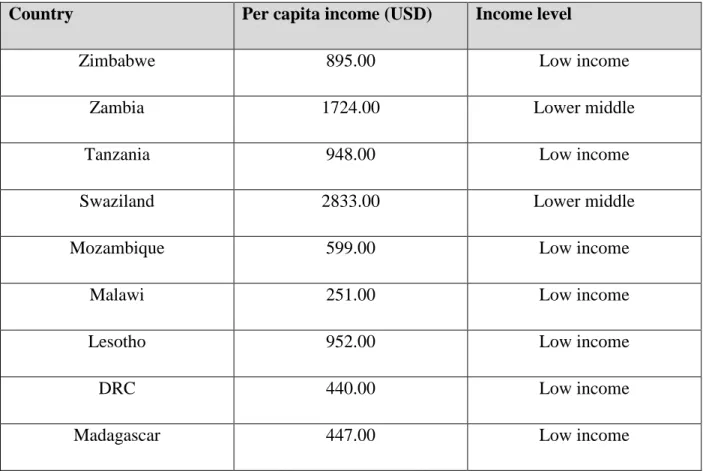
The focus on SADC low-income countries is motivated by the need to address the wide range of economic and financial challenges encountered in these economies. Low-income economies are confronted by high poverty levels as a result of low per capita income of less than USD1045.00 (World Bank, 2014), shallow and narrow financial markets (Allene and Giovannetti, 2011, Aye, 2013), high levels of public debt that rose from 34% of GDP in 2013 to 48% of GDP in 2016 and persistent current account deficits averaging 8% of GDP (IMF Regional Economic Outlook, 2017). While some SADC members are well-endowed with natural resources or are connected to regional trading routes and have the potential to become the financial hub of Southern Africa, others in this bloc such as Democratic Republic of Congo, Madagascar, Malawi and Zimbabwe are classified as fragile countries (IMF Regional Economic Outlook, 2017). Because of their fragile condition, they have low capital absorption capacity and low resilience to contain the pro- cyclical response of capital flows and economic shocks (Allen and Giovannetti, 2011). Although the region managed to escape the adverse effects of the global financial crisis (GFC) due to weak integration with global markets (Otchere, Senbet, and Simbanegavi, 2017), economic policy makers are concerned that another financial crisis might adversely affect it. These low-income countries have low financial depth and are highly vulnerable to capital fluctuations (Allen, Otchere, and Senbet, 2011). All these factors point to the need to establish how low-income countries in the SADC region respond to foreign capital flows and financial deepening.
More specifically, upward trends in fiscal and current account deficits as well as poverty and unemployment have presented significant challenges to low-income SADC economies. For instance, the deteriorating fiscal position surpassed 7% of GDP in Mozambique, Zimbabwe, Zambia and Swaziland, with only Lesotho recording a marginal surplus of 0.1% of GDP in 2017.
Based on the African Development Bank (AfDB) 2018 report, such deterioration is expected to continue in 2018 and 2019. In terms of current account deficits, Lesotho and Mozambique recorded the highest external imbalances of 15.9% and 30.9%, respectively. In both absolute and relative terms, these levels of fiscal imbalances are too high when compared to other economies in sub-Saharan Africa.
In addition, the SADC low-income markets are characterized by small size, poor liquidity, a lack of financial infrastructure and high concentration (Bundoo, 2017). The SADC Statistics Yearbook (2013), reveals increased reliance on migrant remittances and portfolio flows to bridge the
3
savings-investment deficit and drive economic growth. However, the region experienced a sharp decline in capital flows due to low commodity prices and liquidity crises. For instance, Mozambique experienced a 20% decline while Zambia recorded a 70% fall (World Investment Report, 2017). Capital flows to Southern Africa are expected to increase by 10% in the future, driven by non-foreign direct investment (FDI) flows. This segment in the SADC bloc can be used as a pilot case to understand the behavior of undeveloped and marginalised financial markets or economies.
This study is further motivated by the lack of development or sophistication of capital markets in low-income SADC countries that require long term funding to bridge the savings-investment gap.
According to Dahou, Omar and Pfister (2009), this situation needs to be addressed by policy makers and researchers as narrow and illiquid capital markets that lack varied financial instruments hamper access to long term finance. There is need to examine the impacts of financial development in attracting foreign investment flows and stabilising domestic markets. According to Nokaneng (2013) and Allen and Ndikumana (2000), the performance of the SADC economies is directly related to the performance of their capital markets. It is anticipated that further elimination of trade restrictions will broaden and deepen mobility of capital flows and financial integration. In contrast, Bara, Mugano and Le Roux (2016), state that financial development negatively affects the performance of SADC economies mainly as a result of undeveloped financial systems. There thus seems to be a lack of consensus on the role of financial development in economic performance in the SADC region.
Although the SADC capital markets are not fully integrated, the countries share a common objective as stipulated in the SADC Protocol on Finance and Investment which emphasises the need to develop capital markets and promote macro-economic stability (Bundoo, 2017). While Bundoo (2017) notes, that capital markets are an alternative source of long-term finance, African markets are perceived to be excessively risky, illiquid and undeveloped. However, Seleteng, Bittencourt, and Van Eyden (2013) observe that few macro-economic studies have focused on SADC members, particularly low-income countries.
Given the scarce literature on capital flow volatility, many questions remain unanswered. For instance, what are the effects of changes in volatility in low-income SADC countries and is there a stable and predictable relationship between volatility, financial deepening and the performance
4
of capital markets? The capital flow volatility, financial deepening and capital market performance nexus is important in order to determine how sudden and unpredictable changes in capital flow volatility impact adversely on low-income economies. To date no evidence has been produced that confirms the relationship between foreign capital flow volatility, financial deepening and the performance of capital markets, which is hypothesised in this study to be causal.
The behavior of the three concepts of capital flow volatility, financial deepening and capital market performance have not been previously studied together, but have been individually examined, mainly in relation to economic growth (Neumann, Penl, and Tanku, 2009, Broto, Díaz- Cassou, and Erce, 2011, Hegerty, 2011a, Wang, Marsh, Goyal, Raman, and Ahmed, 2011, Chakrobarty, 2014). To date no consensus has been reached on the nexus or lack thereof.
Furthermore, the respective influence of these three concepts on a range of economic and financial variables has been tested with considerable variation in results. Analysing the three concepts together is more informative to economic policy makers as capital flows have been observed to enter the economy via the stock or debt markets and affect the level of money in circulation.
This study is distinct in that it employs decomposed net portfolio and net remittance flows that capture the contribution of both domestic and foreign investment players to capital flow volatility dynamics. Gross capital flows have been identified as good for short-term predictions while net capital flows are long-term in nature and reflect the overall position of the balance of payment position (Milesi-Ferretti and Tille, 2011, Obstfeld, 2012, Bluedorn et al., 2013a). Based on Engle and Rangel (2008) and Broto et al. (2011), this study utilises a superior measure of variability derived from absolute values of model residuals, unlike most previous studies that adopted the rolling widow standard deviation (Engle and Rangel, 2008, Broto et al., 2011). Furthermore, it employs contemporary panel data analysis techniques such as the panel Auto Regressive Distributed Lag (P-ARDL) to identify the sources of volatility. Finally, the researcher is not aware of any study that has quantitatively examined the impact of changes in remittance and portfolio flow volatility, particularly in low-income SADC countries.
1.2 BACKGROUND AND CONTEXT OF THE STUDY
During the past two-and-a-half decades, foreign capital flows have fluctuated drastically across the globe, affecting both developed and developing countries, with volatility, particularly sudden
5
withdrawals, leading to worldwide crises (Hegerty, 2011a). Growth in capital flows and further integration of global financial markets have occurred simultaneously, with increased foreign capital flow volatility leading to serious policy challenges for the financial sector and overall economy (Forbes, 2012, Forbes and Warnock, 2012). This led to an increase in observed core movement across equity markets in most developing economies such as Asia (Forbes, 2012).
Between 1990 and 2010 several authors and policy makers lamented sudden increases in the magnitude and volatility of foreign capital flows, particularly those of a short-term nature across the world (Prasad, 2014, Bluedorn et al., 2013b, Forbes and Warnock, 2012, Sula, 2010, Becker and Noone, 2008, Caballero and Krishnamurthy, 2006). These fears were confirmed at the onset of the GFC in 2008 when sudden stops and reversal in foreign capital flows were experienced, initially in advanced economies, but spreading to the developing world. While capital flows regained upward momentum and started to recover in 2009, they once again fell heavily in late 2011 due to the intensification of the European sovereign crisis (Bluedorn et al., 2013a).
However, the behavior of net capital inflows was somewhat different among advanced and emerging market economies. It was observed that volatility in net capital flows tracks that of gross flows in developing economies, while in developed economies, net flows are fairly stable due to the offsetting effect of outflows (Bluedorn et al., 2013b). Similarly, Nakagawa and Psalida (2007) show that net capital flow volatility is lower in advanced economies than in developing countries where net flows track gross capital flows. Because inflows and outflows in developed countries are unconditionally correlated, they tend to offset each other. Furthermore, Sarisoy-Guerin (2003) stresses that inflows and outflows of foreign capital are unconditionally correlated in advanced economies; hence they offset each other.
The mobility of capital flows has been observed to be significantly influenced by the level of globalization and integration of domestic markets into global capital markets. Increased globalization and integration into international capital markets leads to some compromises among exchange rates, monetary policies and free capital mobility (Obstfeld, Shambaugh, and Taylor, 2005). Obstfeld and Taylor (2004) bemoaned this trilemma as major phases of capital mobility were experienced in developing economies. It was also observed that capital market liberalization leads to high mobility in capital flows since the government loses the ability to use exchange rates and monetary policy to pursue its economic and financial targets. In low-income SADC countries,
6
excessive booms and busts in capital flows can easily lead to bubbles and financial crises (Kaminsky, 2005). The major concern of policy makers, investors and scholars is that global capital flows are excessively sensitive to external variables that are outside the control of domestic policy makers (Bluedorn et al., 2013). Large phases of capital flow mobility have widespread repercussions in even the biggest economies such as the US, and have become a serious issue for policy makers and investors, particularly in low-income countries with shallow and narrow markets. For instance, sudden fluctuations in foreign capital flows in the presence of a managed exchange rate system can trigger inflation (Kaminsky, 2005). Increased uncertainty regarding the magnitude of fluctuations in foreign capital flows raises the need to develop a comprehensive model that can accurately predicate and explain the volatility as well as ascertain its dynamic impact in these economies. Deeper understanding of capital flow dynamics will enhance decision making and promote the development of sound investor friendly policies.
In the wake of economic and financial crises, such as the turbulence in East Asia and recent global financial crises, extreme volatility has been observed to be the most challenging behavior of global financial flows (Obstfeld and Taylor, 2004, Carp, 2014). Although large inflows of foreign capital signal a boom in domestic markets, they may also be a good recipe for a financial crisis, especially in developing economies with less developed financial markets that have limited absorption capacity. According to Carp (2014) and Forbes and Warnock (2012), large sudden inflows pose risks and financial instability problems when they reverse drastically. For instance, during the Asian crisis, reversal of capital flows was more severe, strong and identical in magnitude to that observed during the debt crisis when total flows to Latin America fell by 31% in 1998 and 47% in 1999 (Carp, 2014). In Asia the sudden stops and reversals were more acute as capital flows fell from a net inflow of USD120 billion in 1996 to net outflow of USD50 billion. Furthermore, short term flows decreased significantly from a positive net inflow of USD52 billion to a negative net inflow of USD92 billion in 1998. On the other hand, short term net flows to Latin America fell from positive USD30 billion to negative USD31 billion in 2000. While the earlier crises were very significant, the GFC (the subprime crisis) of 2007/8 was the most severe since the Great Depression (Carp, 2014). Serven and Nguyen (2010) note that it was very different from the crises of the 1980s or 1990s due to its higher magnitude, strong impact and geographical distribution.
The resultant global imbalances and instability could lead to substantial decline in foreign financial inflows followed by trade collapse and a decline in commodity prices. However, Carp (2014)
7
points out that global mismatches are also a result of economic policy failure and may cause volatility of foreign capital flows. Furthermore, volatility of global financial flows can be exacerbated by globalization and liberalization of domestic markets (Carp, 2014, Kaminsky, 2005), even though the efficiency and productivity of the financial and real sectors increase.
International capital flow variability is regarded as a very serious issue as it can significantly and adversely impact on the broad macro-economic and financial systems of both developing and developed countries (Pagliari and Hannan, 2017). Despite the limited empirical literature on this subject, the variability of international financial flows is one of the major threats to the efforts of policy makers and investors because it is not only difficult to estimate, but severely affects the macro-financial and real sectors of an economy (Broto et al., 2011, Neumann et al., 2009).
Furthermore, there is no global consensus on the drivers of foreign capital flow volatility among the global, financial and macro-economic variables. Research on volatility of foreign capital flows is confronted by several complicated challenges. For instance, Lo Duca (2012b) observes that the drivers of capital flow volatility are time varying as their level of significance changes across time and across sections. Alfaro, Kalemli-Ozcan, and Volosovych (2004) pointed out that the sources of volatility of capital flows vary depending on the sample and period studied.
Although capital account liberalization and the integration of domestic markets into global markets have been identified as drivers of volatility, a number of factors have been observed to cause extreme variability in both developed and developing countries (Pagliari and Hannan, 2017).
Firstly, emerging markets and developing economies (EMDEs) receive capital flows that are larger than their absorption capacity with regard to the depth and breadth of their financial markets (Pagliari and Hannan, 2017). Secondly, developing countries have smaller, less stable domestic economies and shallow, less diversified financial markets that are more vulnerable to shocks than advanced economies. Furthermore, due to the structural and institutional features of these countries, economic or financial shocks, whether positive or negative, domestic or global, are rapidly transmitted and amplified in developing economies. Finally, as a result of the recent GFC, concerns have been raised that foreign financial flows to developing economies are very sensitive to global or push factors beyond the control of domestic policy makers (Broto et al., 2011, Neumann et al., 2009).
8
In terms of the measurement of capital flow variability, previous studies used the rolling window standard deviation over some period of time (Neumann et al., 2009, Alfaro et al., 2004, Broner and Rigobon, 2004b). However, due to the increasing significance of capital flow volatility, approaches that assist in accurately predicting volatility are required to provide a deeper understanding of capital flow volatility dynamics, particularly in low-income countries. This study thus focuses on the volatility of some unique components of international capital flows, especially net foreign portfolio flows and net foreign remittance flows. It adopts a contemporary approach to estimate net capital flow volatility that uses the absolute values of residuals pioneered by Engle and Rangel (2008) and empirically proven by Broto et al. (2011).
Increased magnitude and volatility of foreign capital flows was observed in the run up to the 2008 GFC as sudden reversals were experienced across the globe because capital took safe haven in the US due to increased risk (Arora, Habermeier, Ostry, and Weeks-Brown, 2013, Ostry, Ghosh, Chamon, and Qureshi, 2012). Surges in inflows and disruptive outflows have increased significantly in both magnitude and volatility in recent times, contributing immensely to the global monetary system (Ostry et al., 2012). Rapid growth and a high degree of mobility in capital flows can pose serious policy challenges and dilemmas in developing countries since they also provide important benefits such as promoting financial sector competitiveness and efficiency, enhancing productivity and smoothing consumption (Arora et al., 2013). Due to rapid financial integration in recent years, both trade and capital flow linkages have increased drastically, leading to growth in financial flows among advanced, emerging and developing economies (Akçelik, Başçι, Ermişoğlu, and Oduncu, 2015). Overall, global capital flows have important, but varying effects and implications for economic and financial stability in individual countries and globally. According to Arora et al. (2013), capital flows carry risks which can be magnified by gaps in an economy’s financial and institutional infrastructure. Gross flows have been found to be of greater significance in advanced economies while net capital flows are key to both advanced and emerging economies (Arora et al., 2013). These economies have to manage the macro-financial stability risks associated with fluctuations in capital flows. Policy instruments that can be used to address such risks include monetary, fiscal and exchange rate management policies as well as sound supervision and regulation of institutions.
9
Regarding the impact of financial liberalization, the past two decades have witnessed rapid growth in domestic financial markets as a greater percentage of capital has crossed international boundaries (Ahmed and Zlate, 2014, Becker and Noone, 2008). At the same time, there has been a significant increase in both inflows and outflows of capital in both magnitude and as a percentage of GDP, and large variations in response to changes in international markets (World Bank Global Economic Prospects, 2014). Developing countries benefit immensely from an increase in capital flows and financial integration when they occur gradually over time. However, this has not been the case, as capital flows and global financial integration have occurred simultaneously with an increase in capital flow volatility, posing significant challenges to the financial sector and macro- economy. As a result, there is ongoing debate in policy and academic circles regarding the costs and benefits of globalization (Alfaro et al., 2007).
Although free capital flows across national boundaries have been deemed beneficial to both advanced and developing economies due to their effect on the efficiency of resource allocation and economic growth, they have largely been huge and volatile, causing distortions in financial markets and abrupt economic policy changes (Ahmed and Zlate, 2014, Becker and Noone, 2008, Alfaro et al., 2007, Sethi, 2013). It is against this background that John Maynard Keynes voiced concern over the benefits of free capital flow mobility during the introduction of the Bretton Woods system (Alfaro et al., 2007). A review of the crisis in Mexico in the early 1990s, followed by the Asian debt crisis of 1997 and the recent GFC revived debate on the merits of globalization and financial integration due to their implications for capital flow mobility and the stability of financial markets. These crises, particularly the GFC, raised important questions regarding the stability effects of financial deepening or financial development given that the GFC originated in developed economies where the financial sector is very large and complex (Sahay, Cihak, N'diaye, Barajas, Pena, Bi, Gao, Kyobe, Nguyen, and Saborowski, 2015).
Due to the potential harmful effects of free capital mobility, globally, more effort is now being directed towards stabilization of capital flows and capital markets (Alfaro et al., 2007). However, attaining such an objective requires the backing of sound scientific studies that can assist in quantifying and explaining the variability of international financial flows as well as ascertaining the dynamic effects of changes in capital flow fluctuations on the real economy or macro-financial environment. This is particularly important in low-income countries that cannot afford to be
10
burdened with more economic uncertainty. According to Lane and McQuade (2014), sudden fluctuations in global capital flows are harmful as they affect macro-financial stability, and transmission of monetary and fiscal policies. Furthermore, capital market liberalization opens a country’s economy up to foreign investment flows which may broaden and deepen domestic financial markets, but could expose the country to the fickleness of such flows (Bluedorn et al., 2013a).
As noted above, the GFC and the Asian debt crisis are notable examples of the adverse effects of the high degree of free capital mobility around the globe. Over time, the increase in capital flows and integration of global financial markets can provide significant benefits to host countries (Forbes and Warnock, 2012). However, policy challenges have emerged due to sudden surges in capital flows and increased global financial integration, which have occurred simultaneously with the increase in capital flow volatility in developing countries. Unstable capital flows are of great concern to policy makers as they can create serious problems and uncertainty in both domestic and global markets, particularly in low-income countries that are characterized by shallow and narrow markets. To this end, Forbes and Warnock (2012) articulated fluctuations in financial flows by identifying four episodes that are linked to extreme capital flow variability, that is, ‘surges’, a sharp increase in capital inflows driven by foreigners; ‘stops’, a sharp decrease in capital inflows driven by foreigners; ‘flight’, a sudden increase in capital outflows driven by domestic players and ‘retrenchment’, a sudden decrease in capital outflows driven by domestic players. Although sub-Saharan African (SSA) markets were spared the turbulence that affected other emerging and developed markets in the 2008/2009 GFC, the risk remains of foreign capital flow volatility that may overwhelm the relatively shallow SSA markets (Alleyne et al., 2014). Devereux and Saito (2006) note that, SSA countries experienced a massive build-up of external assets and liabilities denominated in different currencies, asset classes or maturity structures for both developed and to a lessor extent developing economies. In the US, the GFC led to a sudden and huge build up of foreign portfolio flows, pushing the treasury bill rate to an all time low and leaving economic policy makers or market players confused as to what really drives foreign capital (Egly, Johnk, and Liston, 2010).
Low-income countries require foreign private capital flows to finance the savings-investment gap (Karimo and Tobi, 2013) and ultimately boost economic growth and development. However,
11
studies have confirmed the destabilizing effects of capital flows that encompass widespread macro-financial implications such as exacerbating production and trade cycles, increasing fragility of financial markets, and fuelling the instability of the macro-economy (Forbes and Warnock, 2012, Mihaljek, 2008). Evidence that fluctuations in global capital flows are greater and more difficult to manage in developing than in developed economies (Broto et al., 2011, Broner and Rigobon, 2004b) further motivated this study. By focusing on net capital flow variability in low- income economies and its interaction with the financial and production sectors of the economy, the study complements and updates the limited literature on foreign capital flows.
Until very recently, some scholars were of the view that low-income and African economies receive very insignificant foreign capital flows (Bhinda and Martin, 2009). Although such flows are small relative to global figures, ranging between 5 and 20% of total developing country inflows (Singh et al., 2008), the amounts that they receive are large relative to the size of their economy and are as unstable as they are in major developing markets such as Argentina, Brazil, Russia and Turkey (Bhinda and Martin, 2009, Martin and Rose-Innes, 2004). Given this, emerging countries have been affected by capital flow induced financial crises and low-income countries cannot be insulated from the effects of capital flow volatility, especially given their shallow and narrow financial markets.
Bhinda and Martin (2009) note that in March 2009, G20 leaders pledged anti-shock financing of USD1.1 trillion with USD50 billion targeted at low-income countries to curb the effects of sudden capital flow fluctuations during the GFC. Depending on the magnitude of capital flow volatility, the risk of volatility negatively affecting low-income countries is high; policy makers thus need to know how to respond to such vulnerabilities (Bhinda and Martin, 2009, Martin and Rose-Innes, 2004). Besides being low-income countries, the countries selected for this study have made great strides towards deregulating domestic financial markets and reducing restrictions on capital markets in order to attract more foreign financial flows (IMF, 2008). Given the pace and magnitude of the mobility of international financial capital to the developing world, Ostry (2012) proposes the need to reintroduce capital controls to mitigate the risks emanating from financial vulnerability.
During the GFC, large inflows of capital to Asian and Latin American economies exerted pressure on currency rates, inflating credit and product prices and thereby increasing fragility and eroding trade competitiveness (Cesa‐Bianchi, Cespedes, and Rebucci, 2015).
12
In terms of financial development, there is substantial evidence that the degree of financial growth is a significant estimator of economic growth (Levine, 2005). However, an important sign of financial growth is the depth and breadth (financial deepening) of a country’s financial markets.
In relation to the deepening of financial markets in developing countries, foreign capital flows play a critical role in supporting a higher degree of investment and growth. The performance of the stock market is a critical predictor of an economy’s overall performance as it also assists in the price discovery system and efficient allocation of long-term resources. However, it has been argued that it is more likely that rapid financial growth will lead to both economic growth and financial instability, highlighting the need to impose some speed limits especially in the absence of proper regulatory frameworks (Sahay et al., 2015, Cornelius, 2011). According to Winkler (2009), rapid financial deepening in South Eastern Europe led to macro-financial stability challenges as inflation pressure increased and international trade deficits were near double digits, causing sudden stops and reversal in capital flows and creating an Asia-like crisis (Winkler, 2009).
There is evidence of rapid financial deepening in developing economies as the total financial assets held now exceed 200% of GDP and with the aid of financial integration, foreign capital flows have increased substantially (Cornelius, 2011). Furthermore, the surge in foreign remittances and portfolio flows may have direct or indirect implications for the financial and economic sectors of both the developed and developing world (Chowdhury, 2011). In light of this, there is need to examine if the relationships among the variables capital flow volatility, financial deepening and the performance of capital markets, is causal.
Portfolio flows are short-term in nature, highly unstable and more sensitive to changes in global conditions, while remittances are relatively stable and are counter-cyclical as they increase during economic downturns in developing countries (Chowdhury, 2011, Singh, Haacker, Lee, and Le Goff, 2011). Because capital flows have been observed to improve global allocation of resources, several economies have opened their capital markets and trade so as to further attract capital flows (Alfaro et al., 2007, Becker and Noone, 2008). Despite the significant benefits accruing from capital flows, Rigobon and Broner (2005) argue that capital flow volatility to developing economies is higher due to a number of factors. These include the high susceptibility of developing economies to build up mismatches, which create continuous shocks and higher global contagion.
Capital flow volatility in developing countries is 80% higher than in developed economies.
Furthermore, numerous scholars have pointed out that when capital flows are dominated by short-
13
term flows such as portfolio flows, they can interfere with the operation of domestic monetary and financial systems, causing instability and adversely affecting economic growth (Forbes and Warnock, 2012, Mercado Jr and Park, 2011, Di Giovanni, 2005, Chuhan, Claessens, and Mamingi, 1998). While the majority of studies on volatility of capital flows bemoan the dangers of such volatility, Prasad (2013) argued that it is not a bad thing; rather, the extent and direction of volatility is important as it tends to be pro-cyclical (a bad thing) rather than counter cyclical (a good thing).
There is considerable empirical literature on the cyclical behavior of foreign capital flows, particularly in emerging economies. The evidence suggests that net foreign financial flows are volatile and positively correlated with economic performance; that is, they decline during crisis periods. This behavior is more pronounced in the upper quartile of middle-income economies, resulting in the coining of the term “sudden stops” to refer to the significant decreases in net capital inflows that are often associated with financial and economic crises (Broner, Didier, Erce, and Schmukler, 2013). Recently, emerging economies have become the preferred location for foreign capital flows and domestic investors have also started investing abroad (Obstfeld, 2012). Given these findings, this study focuses on the volatility of net flows which are the financial counterpart to the current account balance (Bluedorn et al., 2013a) and can assist in investigating capital flows from a long-term view (Obstfeld, 2012). On the other hand, gross capital flows are mainly important in identifying episodes as they can be drivers of credit and asset prices, affecting domestic financial market stability (Obstfeld, 2012, Milesi-Ferretti and Tille, 2011). Although previous studies did not capture large differences in absolute values, gross capital flows have been observed to be more volatile and pro-cyclical than net flows (Bluedorn et al., 2013a, Broner et al., 2013, Forbes and Warnock, 2012), especially in developed economies. In addition, net capital flows have been observed to be more turbulent in emerging economies than in advanced economies where they are more stable as a result of the offsetting effects of capital outflows (Duttagupta, Bluedorn, Guajardo and Topalova, 2011).
Low-income countries suffer from a persistent savings-investment deficit as well as a lack of financial depth (Karimo and Tobi, 2013, Mailafia, 2005), resulting in the need for foreign capital flows to fund the resource gap and to provide foreign currency to stimulate economic growth (Obstfeld, 2009, Dell'ariccia, Mauro, Faria, Ostry, Di Giovanni, Schindler, Kose, and Terrones,
14
2008). However, large volatile flows can cause severe distortions in the operation and performance of financial markets and in the process negatively influence policy formulation, especially in developing countries (Ahmed and Zlate, 2014).
Foreign remittances are funds received from migrants working abroad and are an important channel for the movement of capital from developed to developing countries (Ratha, 2005b, Buch and Kuckulenz, 2004, Agarwal and Horowitz, 2002). They tend to be relatively stable at aggregate levels while flows to individual economies show a high degree of volatility (Jackman, 2013). Thus, remittance dependent economies may be vulnerable to sudden changes in these flows which can cause financial market and economic instability. Very little empirical research has been conducted on whether foreign remittances promote financial growth across recipient countries (Demirgüç- Kunt, Córdova, Pería, and Woodruff, 2011, Aggarwal, Demirgüç-Kunt, and Peria, 2011).
Although foreign remittances are emerging as a significant and arguably the most stable source of external finance that has grown relative to other sources of external finance (Jackman, 2013, Kapur, 2003), it is crucial to determine the causes of volatility and its effects on developing financial markets. When appropriately used, foreign remittances can increase liquidity in financial markets and have significant, positive long-run impacts on economic growth (Mundaca, 2009), On the other hand, reliance on remittances can lead to the Dutch disease effect, where investment shifts from the manufacturing sector to the agricultural sector (Buch and Kuckulenz, 2004).
Furthermore, Chami et al. (2003) argue that the moral hazard problem in foreign remittances is extreme and can impact negatively on economic performance. In contrast, portfolio flows of capital are often regarded as volatile and short-term in nature, but form an important source of foreign private capital in any economy (Karimo and Tobi, 2013).
The following discussion focuses on the history of foreign capital flows, their increase in magnitude and the causes of the sudden surges, stops and reversals based on findings from Sula and Willet (2009).
1.2.1 CAPITAL FLOWS: A HISTORICAL PERSPECTIVE
Given the challenges that most developing and developed economies experience with regard to sudden surges, stops and reversals in capital flows, there is need to analyze the history of foreign capital flows. According to Sula and Willett (2009), the surge in international financial flows can be traced to the 1970s when a remarkable boom was experienced in emerging economies. The
15
sudden rise in international capital flows was driven by a number of factors, including the oil shock of 1973 to 1974, the introduction of the Eurodollar market and the significant increase in global bank lending during the period 1979 to 1981 (Sula and Willett, 2009). Latin America was the major recipient of these large inflows of international capital in the form of bank lending that reached USD44 billion in 1981 (representing 6% of the region’s GDP). However, international lending came to a sudden halt in 1982 due to the significant increase in global real interest rates to levels not reached since the 1930s. The late 1980s saw the resurgence of international bank lending as flows to Latin America made a serious comeback as well as surges in capital flows to Asia.
During these surges, the composition of capital flows was altered, with FDI and portfolio flows replacing bank lending. International bank lending to both Asia and Latin America fell from 70%
of total private capital flows in the 1970s to about 20% in the 1990s. Foreign direct investment flows became the most significant source of foreign financial capital for both regions as portfolio flows increased substantially in the late 1990s, accounting for almost 40% of total foreign capital flows. In dollar value terms bond and equity flows to Asia surged to USD27 billion in 1993 and reached USD69 billion in Latin America in 1994. Similar to the 1980s, booms in the 1990s were followed by sudden reversals of capital as witnessed in the aftermath of the Mexican currency crisis of 1994. Capital flows to Asian countries were not affected as the crisis was confined to a small number of Latin American economies. However, a more severe crisis was experienced in 1997 during the Asian financial crisis which was amplified by the Russian default of 1998 and the Brazilian crisis of 1999. During the Asian crisis the sudden stop and reversal of capital flows were more substantial and sustained than in Latin America. Capital inflows fell from USD120 billion to an outflow of USD50 in 1998. In terms of short-term portfolio flows (debt and equity) to Asia, the fluctuations were huge and drastic, falling from USD52 billion in 1996 to an outflow of USD92 billion in 1998. Similarly, short-term flows declined from an estimated USD30 billion in 1996 to a negative flow of USD31 billion in 2000 (Sula and Willett, 2009).
In comparison, debate continues to rage on the reasons for the 2008 reversal and subsequent rise in international financial flows (Fratzscher, 2012). Using a factor model and high frequency portfolio flows to 50 countries, Fratzcher (2012) reveals that changes in global liquidity and risk contributed significantly to fluctuations in foreign capital flows both during the crisis and in the recovery period. However, significant heterogeneity was observed across countries and was attributed to variations in the nature of domestic institutions, country risk and the soundness of the
16
macro-economy. It was concluded that global or external variables were the main drivers of foreign capital flows during the crisis, while domestic economic fundamentals were significant during the recovery period (Fratzscher, 2012).
1.2.2 CHANGING COMPOSITION OF CAPITAL FLOWS TO DEVELOPING COUNTRIES
Since the year 2000, there have been dramatic increases in foreign capital flows from the private sector (Sayeh, 2011). Globally, private capital flows to the emerging and developing world increased from USD151 billion in 2002 to USD 1.7 trillion in 2007, while net capital flows rose from USD 49 billion to USD 674 billion during the same period (Chea, 2011). Portfolio debt and equity flows also increased drastically. Given these developments and contrary to conventional wisdom, bilateral and international financial institutions are no longer the main sources of external funding for investment in developing economies (Dorsey, Tadesse, Singh, and Brixiova, 2008, Chea, 2011). In the 1990s, the sensitivity of private capital flows to opportunities in developing economies began to rise as a result of both internal (pull) and external (push) factors. Furthermore, foreign remittances from migrant workers abroad have arguably become the largest source of finance for the developing world, more than treble the magnitude of official development assistance (ODA) (Ratha, Mohapatra, and Silwal, 2010, Chea, 2011). Remittances are unilateral transfers or gifts by migrant workers sent to family or friends back home (Chea, 2011). Foreign remittances increased from USD19 billion in 1980 to an estimated USD265 billion in 2007. In 2007, foreign remittances to SSA amounted to USD19 billion, constituting 2.5% of regional GDP and a similar amount to the ODA received by the region. On a global scale, foreign remittance flows to Sub-Saharan Africa are significantly smaller as they constitute only 5% of aggregate remittances to developing economies and in terms of contribution to GDP, SSA is overshadowed by the huge remittances received in the Middle East and South Asia (Dorsey, Brixiova, Singh, and Tadesse, 2008). Six of the 25 largest recipients of remittances in 2007 were African countries, i.e.
Cape Verde, Comoros, Lesotho, Senegal, Sierra Leon and Togo (Chea, 2011, Ratha, Mohapatra, and Silwal, 2010,). However, SSA recorded the third largest percentage of GDP. As remittances can enter an economy via financial markets such as equity and debt markets, the following section sheds light on the significance of capital markets, particularly to SADC countries.
17 1.2.3 IMPORTANT DEFINITIONS
It is crucial to provide definitions of capital flow vocabulary. This study adopts definitions provided by Gabriele, Baratav and Parikh (2000), which are in line with IMF balance of payment terminology in order to enhance understanding of the dynamics of foreign capital flows. Capital inflows refer to purchases of domestic assets by non-residents and sales are regarded as negative inflows. Net capital inflows are defined as purchases minus sales of domestic assets by non- residents. On the other hand, capital outflows pertain to purchases of foreign assets by residents and sales are treated as negative outflows. Accordingly, net capital outflows, is the difference between purchases and sales of foreign assets by residents. Overall, net capital flows, is the sum total of net capital inflows plus net capital outflows.
1.2.4 SIGNIFICANCE OF CAPITAL MARKETS
Although low-income SADC financial markets are adjudged to be shallow and narrow, they have undergone some significant changes over the past couple of decades from the traditional bank- based system to a system dominated by capital markets (Aye, 2013). Given the limited level of development in these economies, there is a need for quality information to assist economic policy makers and other stakeholders involved in policy formulation and implementation to adopt measures that broadly address overall financial sector and economic sector performance.
In general, capital markets comprise of equity markets and long-term debt markets. However, this analysis focuses on equity markets due to the lack of data or the lack of organized exchange markets for debt securities in low-income SADC countries. There has been a considerable increase in the number of organized stock markets, particularly in the emerging markets of Southern Africa (Andrianaivo and Yartey, 2010). In Africa, new stock exchange markets were recently established in Ghana, Malawi, Uganda and Zambia. Before 1989, there were only five stock exchanges in SSA and three in North Africa. The establishment of stock exchanges in African countries is vital as it boosts domestic savings as well as increases the quantity and quality of investment, thereby accelerating economic growth (Andrianaivo and Yartey, 2010). Capital account liberalization and the establishment of stock markets are viewed as part of the trend of global liberalization. Furthermore, the establishment of stock markets provides avenues through which companies can raise cheaper equity capital. When these markets operate efficiently,