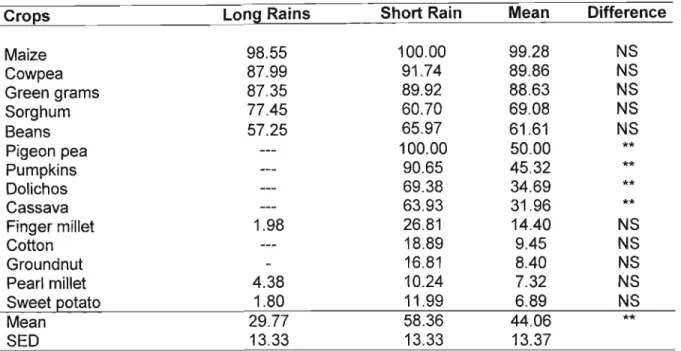
TO GROW ANY CROP IN THE KITENGEI AND NZAMBANI AREAS--- 46 TABLE 2.5: PERCENTAGE OF FARMERS THAT ARE GROWING EACH CROP IN THE LONG AND. HIGHEST YIELDING HYBRID AND KENYA PARENT (OPV LINE) IN FOUR TEST ENVIRONMENTS ---146 TABLE 6.8: AVERAGE PERFORMANCE OF HYBRIDS AND PARENTS (OPV LINES) FOR.
Introduction
General plant traits and responses to environmental stimuli
- Sorghum plant parts and traits
- Plant height------------------------------------------- -----------------------------------__ 8
- The sorghum grain traits and genetics
- Grain quality
- Grain yield and yield components
- Maturity period in sorghum
- Photoperiod response in sorghum
- Panicle traits and choice of good parents for hybrids
- Development of hybrid sorghum
- The origin of sorghum and early cultivars and land races
- Classification and races of sorghum
- Cytoplasm male sterility in sorghum
- Appraisal of sterility types in sorghum
- Application of different types of sterility
- Genetic variability in male sterile cytoplasms
- Development of cytoplasmic male sterile and male fertile lines
- Effect of cytoplasmic male sterility
- Hybrid vigour (heterosis)
- Basis for hybrid vigour (heterosis)
- Heterotic groups
- Characteristics of good hybrid parents
- Characteristics of good sorghum hybrids
According to Andrews et al. 1996), when lines of the Kafir breed cross with lines of the durra (milo) breed, the hybrid is male sterile. The Milo race carries nuclear genes that restore male fertility in a Kafir core (Andrews et al., 1996).
Selection of parents and hybrids
- Field establishment
- Mating designs
- Choice of parents by morphological traits
- Choice of parent populations by genetic distance
- Selection of hybrids by yield and heterosis
- The concept of combining ability
- Selection of parents by combining ability
- Selection of hybrids and OPV parents by stress tolerance
- Selection of hybrids and OPV lines by participatory methods
In a factorial design, AB can represent a sample or the full number of possible crosses (Dupont-Nivet et al., 2000). According to Andrew et al. 1996), anthers in male sterile lines are sterile; therefore, hybrid seed production must rely on cross-pollination.
Synthesis of literature review
Effect of tropical photoperiod on growth of sorghum grown in 12-month plots Crop Sci. Impact of genetic improvement on productivity of sorghum in India. In: Proceedings of the International Conference on Genetic Improvement of Sorghum and Pearl Millet, Lubbock, Texas.
Abstract
Introduction
Participatory plant breeding methodologies have been used to select and promote crop varieties (Witcombe et al., 1999; Kitch et al., 1998; Joshi et al., 1997). Collaborative plant breeding was not limited by replication, number of environments, or type of selection groups (Kitch et al., 1998).
Materials and methods
Description of study area
The objective of the PRA meetings was to determine whether hybrid technology would be viable in the farming system and the role of farmers in a sorghum hybrid development process to ensure that the developed hybrid technology was appropriate for their needs. Find out the value of sorghum in a semi-arid multi-crop farming system and identify the potential to expand sorghum production.
Participatory rural appraisal setting
Because part of Kambu covers both agroecological zones IV and V, Nzambani was chosen to represent Zone IV and Kitengei Zone V. The Kambu area falls in agroecological Zones IV and V, with small portions falling in Zone VI, the driest frontier of crop production in Kenya (Mololo, 2004).
Participatory Rural Appraisal (PRA) meetings
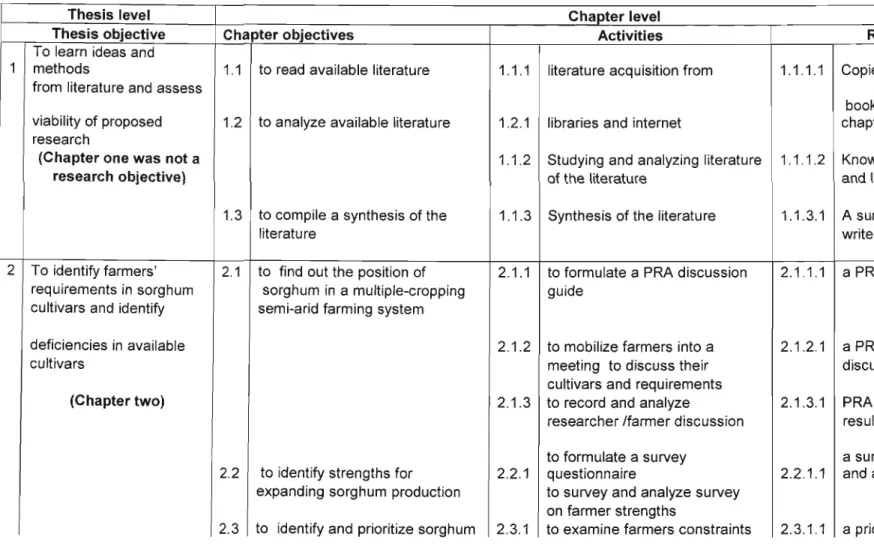
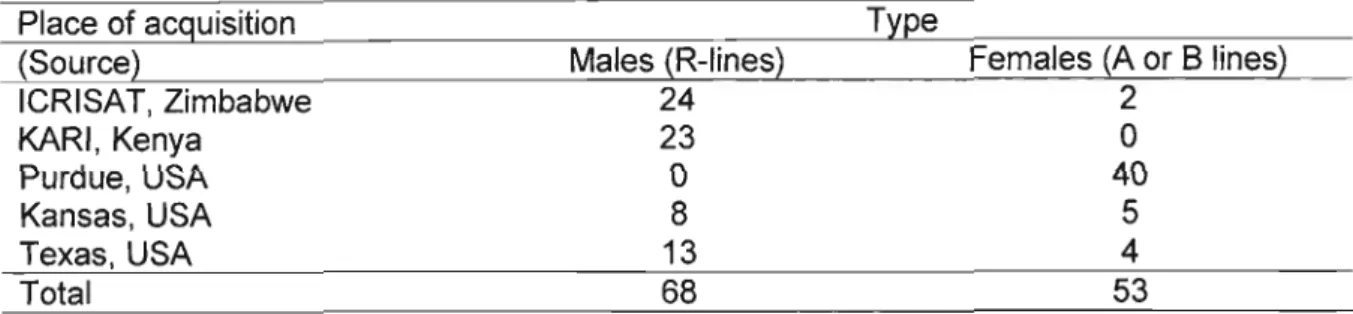
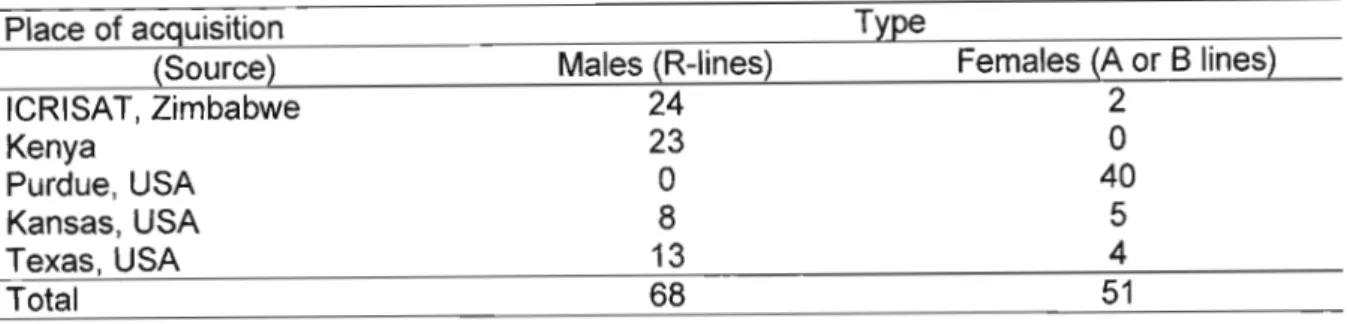
Source parent populations were analyzed for head weight potential (Table 3.9), in Kenya (Ken) and South Africa (RSA). There was a significant linear relationship (p In addition, densities had significant (p<0.05) effects on head weight per plant (Table 5.3) in both hybrids and OPV lines (parents). Individual plant yield potential and sensitivity to plant density estimates (Table 5.4) showed significant differences between hybrids and parents (Table 5.4). We compared hybrids and parents (Table 6.6) in superiority of head mass based on head weight of hybrids in four environments in the study. The performance of hybrid source combinations was evaluated in four study settings (Table 6.10). ResuIts Pests and diseases have affected sorghum at all stages (Table 2.8), which is in agreement with Teete and Pendleton (2000). Drought negatively affected all growth stages (Table 2.8), which is in line with Rosenowet al. Analysis of preferences for the different sorghum varieties grown on the farm revealed significant differences (p<0.05) ( Table 2.11). The most remote populations were identified (Table 3.6). The Purdue female source was the furthest from most male sources. Estimates of single plant yield potential (Table 5.4) showed significant differences (p<0.05) in single plant potential among hybrids and parents. Introducti 0 n Materials and methods ResuIts Discussion and con cIus ions Combining ability estimates are required for efficient identification of good parents for the production of hybrid varieties. The average head weight of the hybrid and the male and female GCAs were used to estimate specific combining ability (SCA) effects of the hybrids. General combining ability and SCA tended to be compensatory, suggesting the existence of an optimal balance between them. High yielding hybrids generally had high SCA. Estimates of heritability and combined ability are necessary for effective identification of good parents (Kambal and Webster, 1965; Falconer and Mackay, 1996). General combining ability (GCA) was more important in sorghum hybrid yield than SCA (Niehaus and Pickett, 1966; Kambal and Webster, 1965; Beil and Atkins, 1967). General combining ability and SCA increased with parental diversity (Niehaus and Pickett, 1966) and were stable across years and sites (Kambal and Webster, 1965; Beil and Atkins, 1967). The relationship between harvested head weight (g·m") and expected yield was examined using regression procedures (Table 4.14). The overall combining ability of the remaining parents is shown (Table 4.10) and that of their hybrids (Table 4.11). Correlation between hybrids' realized head weights and sensitivity to plant density (Table 5.6 vs. Table 5.5), realized head weight increased as sensitivity to plant density decreased. ResuIts Examination of environments' yield patterns of the hybrids (Table 4.11) in light of parental GCA patterns revealed the following; inconsistent x inconsistent generally resulted in inconsistent hybrids that had homeostatic stability. Consistent x consistent pattern hybrids were relatively high yielders in both high potential and low potential environments (Table 4.11). Superimposition of the list on high SCA hybrids list showed striking agreement with the highest three SCA values occurring in the top three hybrids (Table 4.12). Abstract According to Henderson et al. (2000) and Sprinqer et al. (2003) there is an optimal plant density for maximum productivity. Findings of Krishnareddy and Stewart (2004) suggested that optimal plant density depends on the availability of growing moisture. The potential yield of a single plant and its sensitivity to plant density can be used to identify optimal plant density, potential crop yield and average yield over a range of densities. Intermediate (60–70%) regression values (Table 5.3) indicated that the regression did not account for all variation in individual plant potential and plant density between hybrids and OPV parents. Significant differences (p<0.05) in individual plant potential between hybrids and parents (Table 5.4) indicate that there was a difference in individual plant potential. Subtracting the superiority of the best Kenyan variety based on the hybrid average (Table 6.7) from the best hybrid (Table 6.7), the best hybrids in the LDLP environment were about 212% better than the best Kenyan variety (Table 6.7). A comparison of hybrids and parents in terms of performance in agronomic traits (Table 6.8), revealed a significant (p<0.05) difference between hybrids and parents in all traits tested in the study (Table 6.8), except in the number of leaves per plant and percentage of root retention. The parent population combinations with a large genetic distance also had high GCA and SCA values (Table 6.12). ResuIts There was significant variation in the potential single-plant response to planting density between sorghum hybrids and OPV lines. Also, planting density had a significantly different effect on the potential of hybrids and OPV lines in terms of individual plants. Thus, the weight of hybrid single plant heads was more adaptive to plant density than OPV lines. Abstract Commercial sorghum hybrids are based on the male sterile A1 cytoplasm (Kafir and milo cytoplasm) (Stephens and Holland, 1954; Andrews et al., 1996). They have higher yields than the best of their parents (Collins and Pickett, 1972). They gave higher yields than OPV lines and hybrid-OPV line mixtures (Ross, 1966; Reich and Atkins, 1970; Haussmann et al., 2000). It is not entirely clear whether the test environment has any effect on heterosis (Haussmann et al., 1998 vs. Kirby and Atkins, 1968). The environments were significantly different (p<0.05) in hybrid head weights. The highest hybrid head weight was produced in the high density high potential (HDHP) environment followed by high density low potential (HDLP) followed by low density high potential (LDHP) and the least was in the low density low potential (LDLP) environment . The highest yielding (main weight) hybrid and the highest yielding OPV Kenyan variety were analyzed for main weight performance across the four environments of the study. The highest yielding hybrid and the highest yielding OPV Kenyan variety main weights were significantly different (p On average, hybrids were superior to OPV parents by 16.12% in all study environments (Table 6.6). The best hybrid was 29.7% superior to the best variety OPV Kenya in head weight in all environments and in hybrid stressful environments (LDLP). were 212% superior to the best Kenya OPV variety (Table 6.7). There was also a significant correlation (p<0.05) between genetic distance and head weight in LDLP environment. ResuIts Significant heterotic differences (p<0.01) between hybrids (Table 6.3) indicated that the hybrids could be classified by heterosis. Because sometimes the trait is favorable when it is large and sometimes when it is small, the symbols (+ plus) were used when the hybrids were favorable, (- minus) when they were unfavorable, and (0 zero) when they were not neither hybrids nor OPV parental lines were favorable (Table 6.8). The hybrids had more advantages than the OPV of the parental line (Table 6.8). It was found that the hybrids were not only superior to the OPV parent lines in head weight yield but also in other agronomic traits. In summary, this research has shown that the heterotic response of sorghum hybrids in Kenya is as good as elsewhere. The study left no doubt that sorghum hybrids outperformed pure-line varieties in terms of yield and other agronomic traits in multiple environments. Contrary to popular belief, hybrids outperform OPV cultivars only in a high-potential environment, the best hybrid outperformed the best Kenyan cultivars by 210% in a low-density, low-potential environment. 2 To identify the position of farmers 2.1 to identify the position of 2.1.1 to formulate a PRA discussion 2.1.1.1 a PRA discussion guide requirements for sorghum sorghum in a multiple crop guide. 3 Characterize male and 3.1 Examine variation in parents 3.1.1 Test parents for yield and 3.1.1.1 Test data and results from female parents and find and conclude variation in offspring and other traits in field trials. 4 variance 4.1 to identify good OPV parents 4.1.1 Yield trials in multiple simulated 4.1.1.1 High GCA parents SCA components of parents based on general and specific environments and computer hybrids.
Discussion and conclusions
Abstract
Abstract
INTRODUCTION
Materials and methods
Discussion and conclusions -----------------------------------------------------_
Introduction
Materials and methods
Discussion and conclusions
Introduction
Materials and methods
Discussion and conclusions
INTRODUCTION