Cape "Town
SECOND CARNEGIE INQUIRY INTO POVERTY AND DEVELOPMENT IN SOUTHERN AFRICA
Citizens, the state and employment:
Public w:>rks as the rore of a rural deve10pnent strategy
by Nonnan Reynolds
Canlegie o:mference Paper No. 234
13 - 19 April 1984
I
.\J
I
·1'
"A man must eat and drink. He should enjoy the fruHs of all his labour. I t is the Will 'of
Ecclesiastes
".\
"The
man
who can talk about the honour of his country, at a time when its millions are in a st'ate tittle. short of famine; and when that is too, apparel:\tly, their permanent state,must be'·an oppressor in his heart."
,.
.. \ ..
~!atthew Cobbett.
, i ,j
.,.
iI.
. ,.
.,
i
. i
CORE "OF A RURAL DEVELOPJI!ENT STRATEX:;Y , INTRODUCTION
Public Works Programmes have been used for centuries in time of famine and disaster to provide work and income to the destitute. Often
" items of conspicuous consumption were built,- palaces and tombs, particularly
e . "
when there existed a close identity between the state exchequer, and the person of the ruler. In modern times'public, works have emerged as large national programmes building economic and social infrastructure.
The programmes have other explicit aims; rural welfare, labour mobilization and income distri~ution; administrative decentralization, and as ,part of an anti-cyclical pol~cy to 'stabilize aggregate demand.
This paper examines some of the theoretical arguments that lie behind a , ,concezn for labour mobilization in the countryside, i t reviews differing
philosophies that have governed the purpose and design of public works
programmes; and it concludes with ,an assessment of the potential role and cost of public works in Zimbabwe and in South Africa. The latter exercise
illustrates the awesome backlog and 'concentration of povertll' buH t up in South Africa and compares that to the manageable eradication of po~erty possi.ble in Zimbabwe, within an economic development strategy that has at its' core a fUlly developed public works programme.
THE CENTRAL ISSUE
There is a need to confront the fact of rural poverty. New roles, , new activities, new sources of income and of security need to be realised ,quickly. National programmes that together act upon the underlying'long
term issues of -low human" and agricultural producti vi ty, of improper land ,use, of inefficient access to resources, of the threat posed by growing 'umimpioymen~, and of equity and security must be seen to be in place.
Moreover, in this and the next few decades, policy and practice must accommodate the new fact that most developing country populations are not only growing at an,historically rapid rate, but that the number and proportion of l'0ung people has caused high dependency ratios. In Africa some 44%
of the population is under 15·years and th~ a8Ticultural population of developing countries is expected to double in the next twenty~five years.
2/ ...
~~.-~~~---~---~---
. f
- 2 -
Malnutrition, poverty and' the pressure on poorly funded social services are closely linked to these facts.
Poverty and unemployment, and the press of a desperate humanity upon the formal economic sector and the urba~ areas are political and economic issues. The issue therefore is whether we can bring together the need to 'underwrite human welfare in the, countryside in terms of economic security and the dignity of family independence through work ,with an efficient economic development strategy. And what, we must ask, if we cannot?
In Zimbabwe the conditions exist to explore and to act upon solutions to rural poverty. The recent exaggeration of urban first policies i~ now being rapidly rethought, under the exigencies of drought and recession, to accord . the countryside a primary place in a productive rural/urban development
strategy.
South African has institutionalized an amazing panoply of controls over the rights of her people to participate fully in the nationaI economic and Bocial space. As we know, that system has become the worm that threatens all, largely because it offers no moral, political, social or economic solution to an enormous and an official concentration of poverty and wasted human lives in the countryside.
Public works tend to be highly - visible programmes, usually administered in a decentralized fashion, and can command significant resources in relation to i GDP. They are therefore capable of having a marked and potentially constructive political impact.
TYP~S OF PUBLIC WORKS
Public works are aimed at redressing unemployment and at infrastructure creation using labour intensive methods of construction, invariably in the countryside.
Unerr.ployment and underemployment are difficul t to define and to measure satisfactorily. The usual difficulties are compounded by the nature and seasonality of agric~ltural production, by extended family relations and by urban migration and urban - rural money transfers.
3/ •••
---
.1 I
I
I •
have influenced the design of,' public works programmes:
:].1 .
recurrent crises: instability in agriculture caused by extreme weather patterns as 'drought and flood. In Maharashtra State in India, -in the last year,of a three year drought period,1971 - 1973, over
4.9 million people worked on public works in 'the peak off-season month, May; or some 26% of the labour force and 9,~ of the' total
p~:Pulation
of the state.Y "
Longterm structural unemployment: often associated with monoculture agriculture, as with sugar, on islands like'~!auritius .. combined with land shortage. Mauritius has a persistently high rate of unemployMent calculated at '16% in'the 1972 census.
Seasonal unemployment: found where land shortage ana small holdings cause people to share lim! ted work and output. This leads to low productivity pel:' capita (though often higb~utput per unit of land) and extremely high rates of -underemployment during agricultural 'slack seasons.
Agriculture, under those circumstances, may not be able to absorb all new reCruits to, the labour market~
Pub).i,c works consequently address:-
reiief reouirements for the ahnual cycle following poor crop seasons preparatory to a fuli successor season;
the absorbtion of lon~ term structural unemployment;
the augmentation of low agricultural incomes, usually by mobilizing the.
seasonally underemployed;
low cost infrastructure creation by material rather than wage Bupport to self help type activities.
In' time of prolonged drought, relief merges into the two main categories, struc':tural unemployment and seasonal underemployment. The latter two typify 1. World Bank Staff Working Paper 224, Public Works Programmes in Developing
Countries: A Comparative AnalYSiS, Washington D.C.! 1976.- P. 11.
2. ibid
4/ ...
- 4 -
the problem in Zimbabwe and in South Africa with the distinction between one and the other varying from region to regi~n and Irom time to time.
Public works programmes in the countryside cOTmonly undertake:-
land development: reclamation, conservation, small 'irrigation, afforestatior Road works; maintenance and construction of feed~r roads and tracks,
culverts, light weight bridges;
irrigation; maintenance and construction of dams, canals, drainage ditches, land levelling;
economic infrastructure; markets, brick making for public buildings or for local sale;
, Social infrastructure; building material for bousing, clinics, schools.
Often public works form part Of a regional spatial strategy, including creation of rural service centres within a ,national urbanization strategy.
THEORSl'ICAL UN1);;;RPU,J'ITNGS
The history 'and evolution of public works follows the movement aHa':! from the interest in the 1960s with capit'al investment, not job creation, to the current concern that a large unemployed labour force has arisen in many ,developing countries. The resulting poverty, inecficiency and instability , now threaten orderly economic growth and need direct attention.
I '
The contemporary theory and practice of public >lorks is not much older than one generation. The well-known works of R. Nurkse artd W.A. Lewis in the early fiftie~, examining the use of large rural labour surpluses as an investment medium, though challenged, remai~ the basis and insp,iration for many plru-~ers in developing countries. No doubt they in turn'were influenced by the Great Depression, by iKeynes and by public works under Roosevelt a generation before, through the concerns differ.
5/ ••• /
~ '"'
,
Nurkse pointed out that under conditions of small family f~s with underemployed labour, it would be possible, at least seasonally, to
divert labour to infrastructure 'creation without increasing thecopsumption ' requirement'of that population.
1/
In other words, 'underemployment'concealed,
, a potential source of savings which could be turned into investment. In 'practice, Nurkse admitted, all would not "remain equal". Those left behind
on the land would likely increase their consumption, as may tho~e transferred to infrastructure projects. Other costs, in the form of leakages, would arise: for instance transportin8 food from farm to work site and the costs of establishing those sites.
The earlier concern in developed societies was to stal)ilize aggregate demand 'around an equilibrium realising full employment and the full use of capital. Nurkse sought a.means to create,' as quickly as possible, 'despite ,the capital scarcity of developing countries, a productive' capacity able
to abso'rb the available labour. Labour intensive public works are designed ,to create the, infrastructure for development, at the'least opportunity cost,
of the scarce resource, capital.
Lewis, in somewhat s,im!l~r vein, 'd~veloped' a model of unUm! ted labour ' which acc~rds with the reality of developing count~ies in so far,as unskilled labour is concerned.
Y
The supply of unskilled labour to, the modern sector from the countryside is perfectly elastic because the relative f!ize and growth of the formal sector cannot absorb the growth in population. At the same time, the marginal productivity of labour in the countrysideis
below a sub~i~tEmce standard of living. Conse~uently, rural surplus manpower can be' used to make capital goods with little recourse'to the scarce factors, land and capital.
1. Nurkse, Ragnar, Problems of Capital Formation in Underdeveloped Countrie's, Oxford, Basil .. Blackwood, 1963. "
2. Lewis" w~ Arthur, "Economic Development with Unlimited Suppiies of Labour", the Manchester School' of Economic and Social Studies, May ,1954,
PP.
139-1916/ ••
~6 -
Myrdal, 1amongst others, has challenged these views. He, believes that a larger and more intensive labour input will always improve income and levels of living 2 and that the rural labour market is not so fluid as supposed; that unemployment and undererr.ployment are involuntary. 3
The extraordinary Chinese labour market of the 1960s and 1970s is the only experiel\ce that believes Nyrdal' s first concern'. There an already intensive agriculture was intensified by massive construction and
~aintenance activities of a public works nature. In the 1960s some 1~/c and during the 1970s sorre 3~/o of the rural labour force was involved in ,winter, or off-season, public works. 4
An
average of 40 days employment per person per year was created.The absorbtion between 1957 and 1975 of 100 million workers into an already intensive agriculture faced with an unfavourable man/land 'ratio without reducing average annual labour pr~ductivity is China's 'great development achievement. However, output per man-day fell sharply,' from 15 to 26 percent depending on the indices used. Average annual works days climbed from 190 to 275, removing most of the seasonal idleness common in the 1950s. Restrictions on urban migration and on private plots left increased collective labour'as the only means for rural Chinese to protect or improve existing living st~~dards. Since the mid - 1970s a shortage of consumer goods has undermined the popular acceptance of increased labour input and led to reversals in policy.
Myrdal's second proposition is belied' in a host'of countries by a common phenomenon, the voluntary participation of hundreds of thousands and, in India and China, of millions of people in public works programrr.es.
A substantial mobilization of the labour force is possible,
1. l1yrdal, Gunnar, Asian Drama, An Inauiry into the Poverty of Nations"
Pantheon, New York, 2.
3.
4.
ibid, vol II P. 1092.
, ibid, vol II P. 962 Rawski Thoman G. Econorr.ic for the World Bank, 1979,
Growth and Employment in China, O.U.P.
'llashint;ton D.C. pp. 71 - 122.
7/ •••
I
•I
, I ,
-7-
Although not ruled out by either Nurkse's or Lewis' arguments,
· wage payments have become part.~d parcel. of"all ~public.works programmes • . MyNal' s
caption~
the' "real waste of labour"!I
adds t1)eSOCi~
"concem of human development ~o economic imperatives, and broadens theoretical'concem'to include income distribution and the'costs of poverty.
The Potential of Public Works ProBTammes' to Alleviate Unemnloyment and Poverty
The' ability of public works programmes to absorb ~employment is
,significant, though each pr~gramme has to be judged in relation to .the nature of unemployme'lt in that country and to the resources cODUl1i tted to it. Earlier we refe=edto China. '. The. Employment Guarantee Scheme started in Maharashtra State in India absorb~d'15% of available mandays in the countryside in 1977; that is three years after it wa~ launched as a reformulation of the conventional relief programmes ~esigned to mobilize .rural labour in construction activities on a .
· regular basis.
Y
Maharashtra.State finances the'Ernployment.Gtiarantee Scheme in two ways.
Halris taken from the. normal Capital B~dget and half is raised special
·taxes aimed at those most likely to benefit from less crowded cities, from thriving rUral demand for. manufactured goods and from a greater supply of agricultural surpluses. Items taxed include entertainment, professional
~egistration, property and luxury goods. The total cost of the Scheme comes
· to <Ji(, of the State's Capital Bud€et. The Scheme represents a socially and ' . , .
'politically acceptable additional mobilization.of resources for investment. Aboul one third of the outlay is r~couped in the form of loan repayments and
betterment leVies from identified beneficiaries of economic investment, .such as i=igation and land levelling •. A recent paper by the Indian Plannin~ . Commission calculates an all-India programme as costing 12"fo-13%. of the combined Central and State Capital Budgets.
Public works absorbed 21% and 38";6 of the unemployed in Tunisia and Mauri tiu and between 3% to ~;6 in Morocco, Korea·and East Pakistan respectively. Tunisia
arid Mauri'l;iusfpent 2,4% and 3,6%.of GDPrespectively and the other three countrie:
between 0,4% andO,6% • . Tunisia and. Mauritius faced high unemployment rates, 1~) and 16% respectively, with seasonal underemployment 'ar~und
40%
in Tunisia. The latter three countries have a mix of unemployment of between 9'/0-15% and seasonal underemployment .of25~5b%
depending on cropProdu~~~on.':
,1. G. Nyrdal, op cit Vol. II. P. 999 3. IBRD op cit, pp. ·20 - 25.
2. Calculated by Sirr.on Maxwell ,Food Aid, Food for Work and Public Works, IDS, Sussex, 1978, p 30, from data presen~ed in Reynolds N. and Sunder f, Maharashtra's Employment Guarantee Scheme: a Frograrr.me to Emulat?" in
Economic and Political Weekly XII:29, Bombay 16 July 1977. 8/ •• ·•
- 8'-
One mu!3t conclude that, unlike China, India, Tunisia and ~lauritius, the latter three countries ran partial public works programmes.
In poorer regions and amongst poorer groups wages from public works have contributed upto two-thirds of family incomes
!/.
While the average is .clearly much less, it must be remembered ,that the extra family income comesin the slack agricultural season and can therefore have a greater value than is suggested by its prop~rtional increase over a year.
Other benefits include habituation to regular and sustained work, improved nutrition and health levels (the two ~learly connected), an upward push on agricultural wages, which can be linked'to a more productive labour force, and an opportunity to renegotiate from greater strength inksome and degrading social contracts with employers, money lenders and landlords. A furthe, plus is the creation of ,a forum for effective local participation and decision mak " l.ng.-
2/
Annual programme expenditure figures should vary, reflecting, as would
b~ expected, the instability of agricultural production. Yet most programmes are budgeted with little accoUnt 'taken of present rural conditioris. The ability to avoid socially inefficient tags in expenditure is one criteria for programme design: public works progr~~es should respond qui~kly to depleted income and activity levels in the countryside, thus underwriting agricultural risk and providing a modicum of economic security. Not all public works programmes have been so designed. Host have been isolated capital projects;
appendages to unchanged development policies and programmes. Consequently any concern with labour intensive construction and with the redistribution of income and of assets has usually lived at variance with general policy which favoured capital ag~inst labour absorbtion. A set of policies consistent with the thrust of a public works programme, poverty and unemployment, would fnclude:
- Care, not to undervalue capital and over price labour. In many
1. See IBRD; ibid 1976; p6, Naxwell op cit, pp 30 31, 2. N~ Reynolds and P. (Sundar, 1977 op cit, p 1155,
V.M. Dandekar and N Rath, Poverty in Ind~a, Ford Foundation, New Dehli, 1976, P. 131.,
9/ •.•
---~
I
I ! ( ..
9-
countries, at least until the recent round of historically high interest rates, capital was undervalued and incentives to mechanise
j . •
agricul ture, construction and industry existed. l'dnimum wages tend to cause labour. to be shed from simple agricultural and. construction tasks .in favour of crops that can be machine managed and of construction equipment.
- Foreign exchange rates have been consistently overvalued during the 1960's and. 1970's in many developing. countries, attracting capital ~ntensive investment and the importation of labour. replacing technology and- equipment.
- The terms of trade have often favoured industrY and commerce against the ·interest of a dynamic, labour absorbing·~iculture, leading to
.
.the adoption of a capital intensive agriculture.
- Until recently few developing countries could boast of effective·
. re~earch; extension, marketing ·and credit ·systems that served the ~ass . -of small farm.ers, and of sensi tivity10 pricing policies aimed at .'"
keeping the urban-rural terms of trade favourable to rising rural , living standards.
".\
The Roie of Public· Works In Zimbabwe and in South Africa
Large scale on-going public ·works programmes are little ·know in southern Africa. The oldest is in Lesotho; Supported by the World Food Programme for over a decade, i t has a strong itinerant character so that, in a broken topography, families cannot predict whether· work will be available in their vacini ty from one year to the next. Consequently i thas been .unable to . reduce the. reliance of men on migrant work. Some 95% of the participants
are women.
Families in the communal Areas of Zimbabwe enjoy average incomes roughly half that· of workers on the lowest minimum W8£escale (agricultural labour and domestic workers) or about $20 per month. Most Communal Areas
10/ •••
~---~---
- 10 -
are poorly served with physical, economic and Bocial infrastructure though new initiatives have followed Independence. They are characterised by low human and land productivity and in many areas by physical degradation from overstocking and land pressure under existing technologies" The
Co~unal Areas have proven their abilit~ to compete with the large commercial farms on crops when services, climatic conditions and prices are favourable. The. prolonged drought has worsened degradation, has placed many families in dire financial and physical straits and the accompanying recession has added a significant component of the unemployed waiting to secure' jobs in the formal sector. A backlog of fo~al job creation of 117,000 has arisen over the last several years.
Surveys exist for a few parts of the country giving family incom~ and labour profiles. Those surveys indicate how much free labour families have and in what time blocks, sometimes with reference to family size. They cannot predict likely participation levels in a public works programme since those are
essentially a response to a new labour and income opportunity not previously provided. A variety of factors, not least of which is confidence that work is indeed available, which can only be gained by experience, will affect
participation.
Zimbabwe's 800 000 plus rural families have a slack labour period of roughly fow: and a half months, or a period of 90 week days between t1ay and mid-September. Based on other country experience, an estimate of 40 mandays sought on public works per year for half the rural families appears to be a basis for initial planning. This is because labour, albeit operating as a group under piece rate management, should be reqUired tq commit itself to project cOffipletion, usually designed to take from 30 - 60 working days.
The wage component should claim
60%
of total cost,. with materials and engineering and supervisory costs forming the balance. At a presumed average wage earned of Z1,50 per day, that is below the legal minimum wage of roughly Z~2,OO per day, an annual programme would cost Z$ 40 million, or 1%of GDP in 1982/83, The loan component should form 3~/o, reducing the cost on the budget,' at least over time as repayments are made.
11/ ...
!!i
I.
The initial cost equals about 4~ of Zimbabwe'~ Capital Budget compared to
9Yo
for thl1 Employm~!!J;)t~:;:~tee. Scheme.in Maharashtr~ State •. The _.•. - . . may
comparison suggests that a fully developed scheme in ZimbabwE¥' rr.ove up an'other
$10 'million or so per alJIlum but given the fact of easier access to land and Zimb~bwe's greater relative wealth ahould 40t go much higher exce~t in years of severe drought •.
Translated into income, on average the. 490,000 participating families would earnZ$60 per annum from a pro~e of the size envisioned. In practice that would mean that ~ome families; a .minority, might earn ¢onsiderably
more •. Z$60 .equals one month's legal minimum wage but. three month's average 'ruZal income'.
In Zimbabwe the.re is' a concentration of thl3 poor in the Communal Areas • . They are for the ·greatest part .active agriculturalists. enjoying the freedom
to optimize family well-being between employment in town and an increaSingly . well .serviced countrYSide. Nonetheless, there are disturbing trends caused
by rapid population growth and ~al tered land tenure· systems •. Roughly half the families have no cattle, a'figure which relates' closely with the 20% of fBm!lies _ who do not have access 'to crop land!. The present .three year drought has driven' many more small cattle owing families to the wall, worsening the supply of oxen for traction. At the same time, unreformed comreunal grazing systems contain the threat of rapid herd build up beyond carrying capacities, leading to further rounds of families dropping out of cattle ownership in drought years and the~eby being impaired as crop producers because of their inability to control the supply of traction. Skewed. cattle ownershi.p is leading to marked inequalities within once relatively egalitarian· communities. This is .,:, in turn leading to the underutiliZation of crop land when families··cannot mu~te~'!
all the resources needed. Ne~ co~ity based approaches to grazing .and land use are seeking to optimize
produc~ion
andinv~stment l~vels. Y
With a public works prtigramree ·funding people's participation in the further development' of on-going economic and social pro~mes and services, the Communal'Areas can bec~me a vibrant component of the national economy and society. There is ~till a chance that poverty c~ be banished in quite short order. By 2010AD there is a chance' that the modem, largely urban sector, will be a significant net importer of labour from the countryside: a position China hopes to achieve by 1995. When that happens, real rural incomes will tend to improve as man/land ratios start to rise.
1. See for instance: The Nat'ion~l Land Use Programme and the Communal Areas Indigenous Resource l~anagement programme
7 '.
. . 12 •••
r~~--7"""'~---~''-' ~--
i
- 12 -
::'= 1
In South Africa, on the other hand, there 1s an astonishing concentration of poverty in the cou.."ltryside. This 1s so not only in the "Black" areas but also on white farms. Around the world some 8~/o of the poor live in the . countryside.
~I
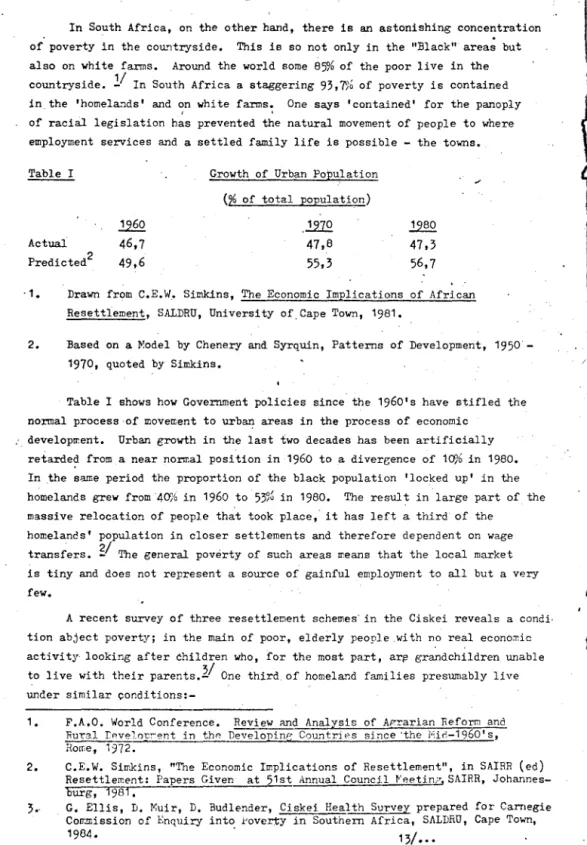
In Sout.h Africa a staggering 93,7% of poverty is contained in. the 'homel~~ds' and on white farms. One says 'contained' for the panoply of racial legislation has prevented the natural movement of people to where employment services and a settled family life is possible - the towns.Table I Growth of Urban Population
Actual Predicted2
1960 46,7 49,6
(% of total population) . .!21Q
47,8 55,3
1980 47,3 56,7 '1. Drawn from C.E. W. Simkins, The Economic Implications of African
Resettlement, SALDRU, University of. Cape Town, 1981.
2. Based on a !o!odel by Chenery and Syrquin, Patterns of Development, 1950- 1970, quoted by Simkins.
Table I shows how Government poliCies since the 1960's have stifled the normal process·of movement to urb~ areas in the process of economic
development. Urban growth in the last two decades has been artificially retarded from a near normal position in 1960 to a diver~ence of 1~b in 1980.
In .the same period the proportion of the black population 'locked up' in the homelands grew from4a;~ in 1960 to 539~ in 1980. The result in large part of the massive relocation of people that took place,- it has left a third of the
homelands' population in closer settlements and therefore dependent on wage transfers.
g/
The general poverty of such areas lI'.eans that the local market is tiny and does not represent a source of gainful employment to all but a very few.A recent survey of three resettlement schemes' in the Ciskei reveals a condi·
tion abject povertJ'; in the main of poor, elderly people .with no real econo~ic
activity looking after children who, for the most part, ar~ grandchildren unable to live with their parents)/ One third. of homeland families presumably live under similar conditions:-
1. F.A.O. World Conference. Review and Analysis of A~rarian Reform and RUT::!.l r"vel.ot,ent in th" Developinr; CQuntrjps sjnce ·the j"irl-1960's, Rome, 1972.
2. C.E.W. Sill'~ins, "The Economic Implications of Resettlement", in SAlER (ed) Resettlement: Papers Given at 51st Annual Council r."eUn;.', SAIRR, Johannes- burg, 1981.
G. ElliS, D. V.uir, D. Budlender, Ciskei Health CoU'.mission of Enquiry int~ l'overt',f in Southern 1984.
Survey prepared Africa, SALDRU,
13/ •..
for Carnegie Cape Town,
• • ---~ . . - - - " ... ....".,...----~---.----.--• • ' - • • • -• • , ' - - . - - " - -- - - _ •• > _ • • - - -" " _ . _ - - ' - - " - - , . - - - . . - .
t.
I
,i91% of the children cared· for are not the respondent's own children: 7W~ of those are grandchildren;
Ali average of six children are cared for in a patte~ that is highly variable over time;
5~ of the adults are over 50 years old;
Only 29% of households have. a worker who works in the area;'
18% of households rely on migrant, remittances;
49r~ of households rely on pensions of , merely R22 per month paid
bi-monthly; .
The mean household income is mereiy
R55
per month;Only .6Yo of .families have an income greater than R100 p.m.;
7')(, of households have no identifiable source ·of income; ._
H8J.f·l1ave a vegetable garden, but, of these, more than half have. Ifo water source throughout the year; . Only 4% have ¢rop land;.
Only 7%
have access to common land and own between 1 -. 3· cattle Conversely 9~~ own no cattle.Half have no wood for fuel, ·and have to· purchase paraffin· wi th which
to cook; •
. The great majority have iilalfficient foqd; hunger i s a daily companion;
. 80% of children are malnourished at some stage in their . . lives and roughly.66% were deemed to be malnourished at
the time of the sUrvey. .
' ..
~~)--.---.---
.. -- --14 -
Not surprisingly, recent research has discovered a new ·phenomenon, a form of enforced aparthy.2/ People have become socially ·isolated, have lost contact with kin through relocation. Dependence on external wage earners has left many conununities without the material or org<l.\li zational base to work together, to beco~e actors exploring and developing local
re~ources and markets. The old cement of mutual insurance, in which cattle played an i~portant role, has broken down. Few can join into any mutual commitment as few have the wherewithal to provide. the premium. Instead, short term acts of reCiprocity and of chai"ity occur, much as between·
prisoners denied a larger canvas of exchange beyond Cigarette and soap
rations~
Large parts of the homelands are rural slums. That means that t..l-jeir conditions is more analagous to urban, not rural poverty. This is important· for, unlike the normal countryside wi th its seasonal unemployment, urban unemployment is open and year round., The need'is primarily for full-time, jobs which are harder to· create than additional part-time work under public works programmes •
. Under urban conditions the unemployed tend .to be a heterogenous population making it difficult.to design·a works programme able to incorporate many. In South Africa's rural slums that may $lt be
the case. Rather, the complication is likely t9 be the majority 6f children and of the aged, weakened community organization and young people beset wi th an increasing cynicism about official action.g/
1. See, for instance (i) John Sharp and Andrew Spiegel, "Vulberabili ty to Improverishment in South Africa Rural Areas: Locating the Failure of Kinship" in papers submitted to Annual Conference of South African Authropologists, University of Port Elizabeth, 1983
2. only 14,5% of women aged 15-64 worked in the homelands in 1980. C.E.lv.
Simkins, The Economic Implications of the R~khoto Judgement, SALDRU Cape Town, 1983, ,P7.
15/ ...
(
d
f
.-15 -
Simkins 'has calculated, that the ~ of the unempla.red in South Africa has risen, in full-time job equivalents, from 11.8'}6
. 11
in 1970. to,20,&}b in 1980 of the labour force. One must presume'
th&t; if applied to blacks only, the percent~~ unemployed would exceed 22%, . a figure of catastrophic proportions and intolerable in any op.en society oil
. ' . .
welfare and social stabiljty grounds. The number'of unemployed ,persons vas ,1,925,000 in 1980. If we as~e thatB<1)6
were
blacks, or 1, 540,000, that , , figure can be compared wnt{ ~umber of black fami;ties below the poverty line,2,181,000 (see Table III). It suggests that some 30}6 of poor facilies would not benefit,di~ctly froiD the full -employment of '
all
blacks. In ,other wo~s.that for many pres'ent employment or meagre pensionpaymel1ts provide less than a
min~
standard of living. In fact the bulk of the poorf~lies;
rnDhbering"'approximatelY 1,546,000, live in the homeiands where' the real level of employment in
agricultur~
is pathetically low, 228,400 in 1980.Y ,', , , '
. . i . '
One must 'further, presume that the 'majority
ot
the 645,000 young bl~k",entrants to the labo= market who failed to find employment between 1970-76 live in the homelands. By 1980' the figure 'of young unemployed may have risen to near 1~000,000 of which,600,000 may have lived in the h~lands.
. . ' . . .
,A hypothetical table ~s presented below vnich attempts ,to capt=e the character of poverty and or labo= available in the homelands and on white 'f81'llls.
I
Table'It:- Character of Black Povertl and of ManEoweri 1280 , White
Urieml!loled Tot8.l' ~ ~ Homelands'
New entrants
to labo= 1,009,000 200,000 200',000. 600,000 ,market
Older workers 500,000 100,000
.
100,000 ' 400,000 Total 1,500,000 ~00,000 300,000 1,000,000 Familie's inPoverty 2,161 ,000 242,000 39'3,000 1,546,000 1.
G.E.W.
Simkins, Structural UnemEloyment Revisited,SALDRU Fact Sheet No.1, Cape Town, 198~; P5.
2. Simkins, ibid.
16/ •••
- 16 -
, The table suggests that, as unemployment has risen, so the number of active people imprisoned in the homelands has risen rapidly in, recent years. One must presume that, despite removals and the effects of influx control, many work seekers are 'in the urban areas and on white farms because they have legal rights ,to reside but no job, or are willing to take risks to jump the official employment queue, or simply to gain part-time work.
The position in South Africa would appeal to be one of massive open unemployment in the countryside. Life at home for many workseekers can offer little to most except a sense of being an additional burden to the family. If statistical evidence is weak as to th~ residence, age and sex of the unemployed, that would not be surpriSing as many young male and some young female unemployed are likelY to adopt near itinerant life styles within the homelands and between town and country. What it'does
sa~ to the analyst is tha~ a large component of training under a public works programme is highly desirable and would bring high rates of return to the
progr~e, the individual and SOCiety. Several models exist. A suitable model would be a right extended under the programme to one or more free days of training for those who complete, preferably as a group, 'four or eight consequetive work days or maintain an agreed schedule under piece wOrk.
Peripatetic training teams can use the group 0;rganization achieved under public works to reach trainees effiCiently. Group mUtual assistance, with local teachers aSSisting, would help ensure that' 'homework' wa13 done.
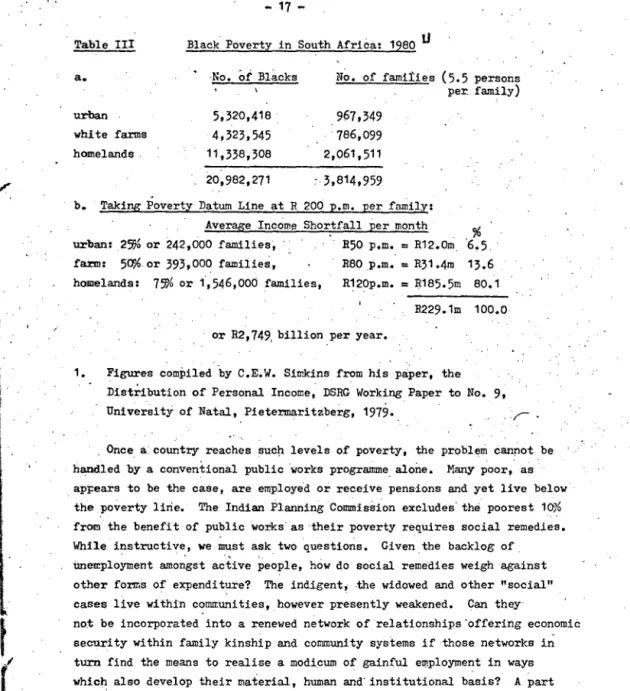
Table III estimates the shortfall of income amongst black South ,Africans. It shows the rough ~istribution of families and of the income
shortfall in urban areas, on white fa~s, and in the homelands. The table illustrates the concentration of poverty in the countryside and the large total income shortfall per year. The shortfall in the homelands~ R185 million per month, ,if provided through wages on' a public works programme with wages at
6CP;6 of total cost, would ~equire a programme expenditure of R3.7 billion in
1980. That equals 6.1}6of GDP, or roughly 32"/0 of the Gross Domestic Fixed Investment of Public Authorities and of Public Corporations in that year. The latter can be compared to the Capital Budgets of ~aharashtra and of Zimbabwe.
17/ •••
t
ITable III a.
white farms homelands,
Black Poverty in South Africa: 1980
U
No.
of
Blacks5,320,418 4,323,545 11,338,308 20,982,271
N~. of famities (5.5 persons per. family) 967,349
'786,099 2,061,511 3,814,959 b. Taking Poverty Datum Line at R 200 p.m. per family:
Average Income Shortfall per month urban: ,25% or 242,000 families, R50 p.m. ,%
R80p.m.
= R12.0m 6.5 farm: 50';6 or 393,000 families,
homelands: 7']';6 or 1',546,000 families,
=
R31.4m 13.6 R120p.m.=
R185.5m 80.1R229.1m 100.0 or R2,749, billion ,per year.
1. Figures compiled by C.E.W. Si~kins from his paper, the Dist~ibution of Personal Income, DSRG Working Paper to No.9, University of Natal, Pietermaritzberg, 1 9 7 9 . / . Once a country reaches sucll levels of poverty, the problem cannot be handled by a conventional public 'works programme, alone. ~any poor, as appears to be the case, are employed or receive pensions and yet live below the poverty lirie. The Indian Planning Commission excludes' the poorest 1~~
from the benefit of public works' as 'their poverty requires social remedies.
While instructi~~, we ~st a~k two questions. Given,the backlog of, Unereployment amongst active people, how do social remedies weigh against other forms of expenditure? The indigent, ,the widowed and other "social"
cases live within comn:unities, however presently weakened. Can they
not be incorporated into a renewed network of , relationships' offering economic
se~xrity within family kinship and community systems if those networks in turn find the means to realise a modi,cum of gainful eD)ployment in ways which also develop their material, human and'institutional basis? A part of that question would ask if the number of dependants in the country side is not artificially high because of restrictions on movement to town, what
benefits an easing of those restrictions would bring, and what local arrangements would help - for instance the
that coincided with peak work developed infrastructure and , Bctivi ties.
provision of meals at school, school-holidays
, I
periods in the fields, and the effect of services on opporttinitie-s for-part and full-time
1el •••
- 18 -
The role of training has been highliehted earlier. Designing a public works programme that promises to handle much of the unemployment and poverty requires a willingness to rethink many other areas of policy and programme. The same holds for all countries if large sums of money are not to be wasted •. Finding sufficient useful resources to develop capable, under public worksjof handling the potential labour mobilization in the ho~elands would quite quickly demand consideration.
of resourc~s now deemed white.-
A picture is emerging of social breakdown in the homelands.. Desperate people, beyond a viable system of social incorporation and support,. resort to petty and serious crime against neighbours. At least 707b. of black
families are now members of or exposed to membership in a pool of structurally unemployed people in the homelands to which no effective economic policy is addressed. The magnitude of the human and economic crisis in South Africa recalls the words of Lord Byron addressing the House of Lords on the Luddities,
"Are we aware of our obligation to·a mob? It i~ the mob that labour~
in your fields and serve in your houses - that man YOPT navy and recruit your army - that have enabled you to defy the world, and can also defy you when neglect and calamity have driven them to despair. You may call the people a mob; but do not forget that a mob often speaks the sentiments of
the people.
y
1. quoted by Christopher Hampton in his A Radical Reader: The
Strup,gle for Chan~e in ~ngland, 1381 1914, Penguin, London, 1984.
/lj
The Design of a Public Works Programme
The' World Bank has concluded that public works programmes ' 1 ' . '
have yielded good rates of return. ,If shadow wage rates are applied that reflect the value of mobilizing labour, as should be done' in Zimbabwe and in South Africa, economic efficiency improves further.
The Bank adds that labour inte'nsiveprogrammes can ,be as efficient as other forms of construction of the same ·types of assets~ The same report stresses the vital point that returns rise when public works compliment other dynamic forces. The concomitant of the, latter is that well designed and "run public works' programmes have benefits, that cannot be captured by cost benefit analysis. Soil and water conservation works n:a:r have, quantitiable benefit streams in', the' form of enhanced crop 'production and 'the' extended li fe of dams before siltation occurs. Not easily identified and 'beyond
quantification are the savings of top soil before irreversible so+l depletion occurs or the slow build up ina region of resistance tOe the
)
effects,~f drought.
As important as' the physicaI' resul ts are the elements of programn:e design that build people and communities. It is possible to translate constitutional and other society provisions around the right ~o wor~
and the dignity Of labour into a programme in which the ijecision for more work and income than is ordinarily available in the countryside rests largely upon individuals and ~ups' operating within programme rules. Appendix I contains brief'model rules' for a public works programme drawn in large part from Maharashtra's Employment, Guarantee Scheme,~ In effect the rules setout a form of "social contract" between citizen and' state which promotes,individual
and
group economic s,ecttrity...-the basis of djnamic local development processes.1. ,IBRD, op cit', p 37
I
- 20 -
The World Employment Programme (W.E.P.) of the International Labour Organization has adopted "special labour-intensive works progrrur.mes" as of particular value in many .third world countries. It has helped to design, manage and elicit international financial support for such
progranm.es in several countries in the last decade. The W.E.P.
guidelines~/
place considerable weight on· the prior collection of i~formation upon which to design a works proerarrJr.e. The aim is to "target"the progrrur.me, to
select eligible workers. While a fascinating and. problematic conceptional and survey field, the demand for prior information contains within it serious weaknesses • . Firstly, it presumes too much for the efficacy of survey data and analysis. SecO!ldly, and more seriOUS, it leads ·to a position in which the main point of a well designed works programme is missed; that social and economic conditions in the countryside will only alter for the better when rural people gain a sense of control over wOrk offered. The key variable is not the quantity of labour demanded (ex-ante through survey data) or budgeted for in the programme. It is the
evolution of a ','social contract' which varies. In other words the elements of such a contract; the terms of the agreement reached with groups and communities as to the loan/subsidy ratio, provisions for the managem~nt and the maintenance of the assets, the effect of investment on asset
distribution, the ratio of savines to be committed, and the terms of training to be provided.
·The W.E.P. approach presumes to choose between people, to deny them a means to predict their total family income and savings over a year as weather patterns change, and for communities to find that they are thereby invited to look closely at their phYSical and institutional environm~nt and to presume to join with Government in becoming actors upon it.
Unfortunately, the lessons of the Ernploymen~ Guarantee Scheme in Maharashtra appear to have been ignored although the W.E.P. regard it highly. Proposals to run a partial programme under ex-ante analysis are bound to lead to disappointment as many important secondary benefits fall away.
1. Guideline, for the Organization of Special La.bour- Intensive Works Programrr.es, I.L.O. Geneva, 1979.
The Employment ,Guarantee Scheme produces regular and useful information from the field. It documents those who seek work and for how long. It matches demand for work with the resource characteristics of 'local areas. And it provides ,the basis,for .more careful analysis of, family" farm and community- functioning;
One early result in Maharashtra'was the preparation of a special programme to move people from a rain shadow area with a poor resource base, to a near~ degraded coastal belt with high rainfall which could prOVide them not only with seasonal work but with permanent jobs as the new forests and plantations they helped to create developed. Training and other details followed the initial decisioh to 'relocate people in'order to keep the worksprogTamme efficient. ,The PopUlation itiyolvedplayed a major role in decision making. Similar approaches can be forseen in
both Zimbabwe and South Africa. Resettlement in the former ~ould gain from, an ,outgrowth of local community building and participation. In the latter, while raising: the land issue, it Would e;able that issue to be looke~ at more dispassionately, in human 'and development terms rather than, racial and provide a scale against which to measure agricultural
technology. " ' .-/
International experience suggests that expenditure on public works leads to a multiplier effect of 'between 5 and 8 times. One' quarter or
so of the final demand created would be for basic food items and up -, ' 'to 60)6 for. all food items.!! Some two-thirds of the derived demand would
o'ccur in the first year.
3,1
I f food aid firiances much of th'e expenditure and meets all the additional food dell'.and~ as has often been the 'case and could' be' the pattern' in Zimb~bwe this year, then the multiplier can bed~ened
markedly, from 1,.2 to 1.9.Y
In Zimbapwe high levels of sales, I
tax on non-essentfals and a large Government deficit to fund recurrent consumption would act as further dampeners on the, 'multiplier.
In normal years, when Zimbabwe and South Africa are not exporters of foodgrain, the multiplier would be, up around 5 or 6. That poses the question of inflation, a question dealt with in'the literature. If inflat'ion pressures, are not seriOUS,' then a large on-going self-financed ,public works programme becomes possible and desirable.
Inflation arises to the degree that the demarid for food, other commodities and services cannot ~e met.
1. N. Reynolds and P. Sundar, op cit, pp 2~-25
2. S. Maxwell, op ?it, pp 6-9 ,
~., ibid p 11
II---~---:---,-"-,.---,
- 22 -
In both countries, enjoying developed agricultural and indutrial sectors, the'multiplier should act to stimulate the economy by taking up the present under-utilized capacity. The use of credit or betterment levies on economic investments, the judicious use of taxes on luxury goods and as a means of part funding the progrrunrne, as in Haharashtra, and the
introduction of a compulsory saving element to wage payments of perhaps
10%
in three year bonds or into blocked accounts with local savings societies would be prudent, and have beneficial effects within the programme and upon the economy.A related and a thorny African issue is how to 'avoid wage income from public works being channelled into the purchase of cattle, exacerbating the tendency to overgrazing under traditional management systems.
In Zimbabwe the National Land Use Programme, clothing the concern that communities in the Communal Areas become asset managing rather than largely
.
asset using, is addressed to defining individual rights within a communally managed system. Upward pressure on livestock prices, alreadY ruling after the severe depletion of numbers in the drought years, should help gain voluntary community aeree~ent to reworked grazing rights and rules and to group quest for economic efficiency. Sustained technical and-institutional servicing will be vital, as is intended under the Land Use Programme. The same programme, and otheISlisted earlier, should e~sure that not only income is redistributed in the short run, but that assets and benefit streams are held and distributed within renewed egalitarian community systems.
Kept close to its aims, a public works programz,e should not cause much 'le'akage' to other economies, thereby having little direct a..'1Q a manageable indirect impact on the foreign exchange account.
I '
As an investment programme, particularly if on-going and theref:ore amenable to constant revie~1 and upgradinG of investrr:ent choice, rules and procedlrres, public works would lead to increases in supply, ~otablY of agricultural commodities and even help to lower prices. Moreover, by placing wa;ces into peoplef' pockets where they live, it can boost local market activity, giving-rise to many part-time production and trade
activities (in contrast to Southern Africa's presently sterile local markets).
That is a usually inescapable step on the way to regional srecialization, regional exports and full-time job creation. An easing of present monopoly marketing and transport licence systems, is highly desirable.
The literature supports an expectation that, on average, for every 4.to 5 days worked under public works 1 day of full-time employment will follow~ On irrigation and drainage reconstruction·
. in Bangladesh, 1 day invested led to 2.2 days of annual employment~
!/
There is clearly room to improve the internationai average on
employment· creation by a·willingness to develop the programme capacity .to identify and-develop economic rather than social ·resources within efficient operating rules· for users and communities. If that is pursued for a number of years, as now appears possible in Zimbabwe,. then a .public works programme could have a.sustained impact on employment and
poverty. A commitment to a fully evolved public works programme is
the prime requirement. That issue remains an open questiop in South Africa.
Few of the by: now conventional public works programmes had an :impact , on cOlllImlni ty functioning.. However in several countries it has been instrumental. For instance, in the early days of the East Pakistan programme people did become involved and,
"The Thana leve,l oreanization which has evolved through the· works
. '
programme has prOVided the East Paldstan Government wi.th.a means of influencing arid involving its rural inhabitants in the proces's.../
of
·de~elopment."g/
Similar statements exist related to Colombia, China and Maharashtra.
Oth~rs, "relat'ed to a centrally budgeted and determined progr~e which , extend no 'right of work' resulted in such negative effects as, in
Morocco,
"The prime example df an undertaking which stifles, the spirit of . democracy in ~ational planning. IIZ/
Policy on wage levels has varied considerably as have pro~amme aims and size. The evidence appears to support a single recOll'llJendation, ·that works be executed under pie·ce rate conditions w:hich utilize community and :group managerial skills and that normative wage rates be real but below gov~rning or legal minimum wages for full-time e~ployment (see Annex'I).
1.' see IBRD, op cit, pp 27-~1
2. Thomas, 1971 quoted.by Maxwell, op cit, p.~6
~" Oualalou (1969), quoted }!axwell, ibid, p ~~
- 24 -
Daily wages pose enorrr:ous supervision problems over hundreds o'f local works. If the daily wage set is deemed to be mean it can lead to low output and even corruption between workers and supervisors. Too low wages represent a regressive tax on the p.o0r. Table III above suggests that'to meet the minimum cash needs of poor families in the homelands of , South Africa would require a daily wage of R6 for 20 working days per
rronth for 12 months.
There must be a programme expectation that work seekers can aim at' a considerable additional family income per annum. Levels of saving above subsisten~e needs are often high. Consequently savings can match programme, market, transport ,and other infrastructure and service improve- ments and, by oiling offical expenditure, raise the returns to it. Savings are, moreover, the means to build family and community strength.
a real While self-help is admirable, there is ample evidence to suggest/danger;
that is that those who work for little or no pay have been subject to unwanted pressure from the more powerful who will usually reap the benefits generated. Credits, user taxes and reconstituted community systems help to redistribute benefits and' achieve equity. The payment of a discounted wage for work done is capable of eliciting individual and group self-help by accepting responsibility for loan-repayments, internal re-ordering of grazing rights, and the like. Self-help appears to be a wasting asset unless defined within a broader public works context.
Many public works programmes, because they pay a daily wage, exclude the elderly, the weak and the young. This places them in an inactive dependent state and is as Unfortunate as it is unnecessary. Under piece rate
management, groups can undertake units of,construction and be paid accordingly. In the theory of diminishing marginal returns, at point X when 10 men dig a hole, the marginal return equals the wage rate and no more are hired. Under group management by piece rates that constraint can be broken by the group rewarding other non-active people to fetch water, cook and supervise oabies. In that way the group is strengthened, everyone is incorporated and given a valued role and the expense is born by greater productivity and income. In the same way simple tools, spades and wheelbarrows, can pay for themselves in a short period, making it possible to fully equip the countryside. The programme or local stores should extend credit for the same.
.(
- 25 - ~~In countries, in which public wor~s programmes are supported by
_~ ~ '.~ '1 ~ ~ . ' ~ =- r~~ "-
food aid, food-for-work·schemes have developed. Payments in food alone are not liked ,as. alr work ',seekers~havil'food arid cash ~eeds. 'How, for ins~ance, is a worker to carry home many kgs of,food and 'dispose of some of it for cash if his neighbours are in the same boat?
Payment by food raises administrative costs considerably, from 25% - 50%. I t al~o places an additional strain on' of rica 1 tr~sport', storage and distribution whilst ignoring and undermining exIsting cl]anpels:.
Lewis captures the issue\perfectly; it
. , • .i,.
"clutters up the attempt to monetize and
~ationalizemarkets."Y
Public works 'should ,be seen as
a
flexible, responsive financing mechanism capable of enhancing 'local decision making and of reinforcing'I ...: J . t . ' f ' ' ' ' ' " , ; . •
national programmes of rural rene,wal, soil conservation and improved , production and market syste~.s. By mobilizing', communities it, turns them into actors~ expressi~g and "organizing themselvE's, bringtng local,_
knowledge int'o play •. Central gov~rnment partakes as a partner, holding
"\ ~ ~ . - -
the rules and improving them through negotiation backed by monitoring'
"
and evaluation exercises. 'Local management flows withi~ broad p7:'inciples.
When these do not ri t the need, quick con'sul tation with and decision inaking
;by the centre is needed. No special agency is required. R~ther an officer;
perhaps termed COlIllllis,sioner, with suitable powers to keep the responsive T ,
\' nature, of management ,ali ,!e, and, to ,oversee agreements reached' wi th beneficiaries is needed situated'in the heart of Central Government.
The national political leadership must espouse the importance of the, programme and ·the rights it, extends. ,That same,leadership must also realise that programme operat~on is essentially created by a series of locally drawn social and financial contracts. They should not interfer in programme operat~ons, 'only partake in the review process.
As a diverse locally implemented programme' information flows are as important horizontally between communiti,es seek,i.ng shared experience. as
between field and centre.
1. John Lewis,
:The ~biiC
Works Answer to Low-end Poverty Problems:The New Potentialities of an Old Answer, in Journal of Development
Plannin~, No.5, 1972.
: - - - - ' - - - -
.. ' -, ..- 28 -
Government will investigate the legal, institutional, social and economic aspects of the traditional communal system with a view to its modification to achieve the following:
(i) membership of a local community expressed principally in terms of management of common assets; the individual right to a share in the communal assets, separated from individual, group or communal exploitation of· them;
(ii) (iii)
establishment of equal membership rights for men and women;
a control system, overseen by Government but managed by the members, ·to prevent over-exploitation and misuse of natural assets; and
(iv) realization of an agrarian system able to optimize land use patterns and maximize group and individual investment and effort.
1. AIM: to provide additional employment opportunities in the country- side to those seeking temporary work in order to augment family income.
The programme is to respond to demand for work wi thin programne rules.
2. THE STRUCTURAL ROLE OF PUBLIC ',ORl}S:
i. underwrite rural incomes;
ii. raise average incomes by affecting particularly families with little or no access to pro,<l.uctive resources;
iii. raise rural savings and investment, thereby easing the . processes of change in the countryside and raising
returns to other public investment;
Iv. remove the basic source of malnourishment-low and variable incomes;
v. create conditions conducive to holding active family members' in the countrJside, reducing pressure on the cities;
vi. realise an organic "minimum wage" in the countryside that eases themanagernent of the legal minimum wace for the formal wage sector if not actually removing its raison d' etre;
vii. strengthen community and local government functioning within strong technical control and accountability systems held by the central Government and Parliament;
---
---~