i
UNIVERSITY OF KWAZULU-NATAL
A COMPARATIVE STUDY ON THE USE OF COUNTRY’S IMPORT CIF/FOB RATIOS TO MEASURE INTERNATIONAL TRANSPORT COSTS.
By
Anieto Anthony Francis Tochukwu 208511193
A dissertation submitted in fulfilment of the requirements for the degree of Masters of Commerce
Graduate School of Business and Leadership College of Law and Management Studies
Supervisor: Dr. Mihalis Chasomeris
December 2015
ii
DECLARATION
I Anieto Anthony Francis Tochukwu declare that this master dissertation titled: a comparative study on the use of country’s import cif/fob ratios to measure international transport costs.
(a) Is my original and independent research work, except where otherwise indicated.
(b) This dissertation has not been submitted for any degree or examination at any other university.
(c) This dissertation does not contain other persons’ data, pictures, graphs or other information, unless specifically acknowledged as being sourced from other persons.
(d) This dissertation does not contain other persons’ writing, unless specifically acknowledged as being sourced from other researchers. Where other written sources have been quoted, then:
i) Their words have been re-written but the general information attributed to them has been referenced;
ii) Where their exact words have been used, their writing has been placed inside quotation marks, and referenced.
(e) Where I have reproduced a publication of which I am an author, co-author or editor, I have indicated in detail which part of the publication was actually written by myself alone and have fully referenced such publications.
(f) This dissertation does not contain text, graphics or tables copied and pasted from the Internet, unless specifically acknowledged, and the source being detailed in the dissertation and in the References sections.
Signed
---
Anieto Anthony F.T.
iii
DEDICATION
(i) To Almighty God, for His infinite blessings and Our Blessed mother Mary, (ii) To my brothers Mr. Frank Anieto and Family and Mr. Levi Anieto
(iii) To my parents Mrs. Josephine and Late Mr. Bartholomew Anieto (iv) To my siblings
iv
ACKNOWLEDGEMENTS
I wish to show my sincere appreciation and unalloyed gratitude to the following individuals, without whose assistance, this study would not have been possible:
My Brother Mr. Frank Anieto, for all his sacrifice, efforts and financial support throughout my studies.
To my Mother Mrs. Josephine Anieto, whose prayers and motivations has kept me moving.
To my Supervisor, Dr. Mihalis Chasomeris, for his continuous effort and assistance academically, mentally and spiritually, which helped me a lot through this study.
To my siblings for all their support.
To Charles Chibikem, friends and administrators at Graduate School of Business and Leadership, UKZN whom had motivated me in so many ways.
v
ABSTRACT
This study examines the use of a country’s import cif/fob ratios (import ad valorem shipping costs) as a measure for international transport costs. The study seeks to source, compile, calculate and compare the country cif/fob ratios for South Africa, the United States of America, Germany, Venezuela, and Australia from the year 1980 to 2012. The study seeks to establish whether there is a relationship between a country’s import cif/fob ratio and a country’s composition of imports, as measured by the standard international trade classification (SITC) data. Empirical evidence is provided that the cif/fob ratios, are frequently misused, incorrectly recorded and miscalculated.
They are therefore not reliable and they misrepresent the actual direct shipping and international transport costs of countries. The import cif/fob ratios of each country studied were correlated with each country’s composition of imports. The results for the United States of America, Germany and Australia show that when a country’s trade data are correct and reliable, a country’s imports composition of trade has a substantial and statistically significant effect on the level and variation of that country’s imports cif/fob ratios. Hence, the ratio cannot be relied on or be used as a measure of a country’s direct shipping costs (ad valorem shipping costs) without the context of the country’s imports composition. Furthermore, the results for South Africa and Venezuela show that import cif/fob ratios are inaccurate and unreliable indicators of shipping costs and should not be used as a direct measure of international transport costs.
vi
TABLE OF CONTENTS
DECLARATION ... ii
DEDICATION ... iii
ACKNOWLEDGEMENTS ... iv
ABSTRACT ... v
TABLE OF CONTENTS ... vi
LISTS OF TABLES ... ix
LISTS OF FIGURES ... x
CHAPTER 1 ... 1
INTRODUCTION AND BACKGROUND ... 1
1.1. INTRODUCTION ... 1
1.2. BACKGROUND AND CONTEXT ... 3
1.3. PROBLEM ... 6
1.4. RESEARCH AIMS AND OBJECTIVES ... 6
1.5. RESEARCH METHODOLOGY ... 7
1.6. OVERVIEW OF THE RESEARCH ... 8
CHAPTER 2 ... 9
LITERATURE REVIEW ... 9
2.1. INTRODUCTION ... 10
2.2. THEORETICAL CONTEXT ... 10
2.3. INTERNATIONAL TRADE ... 12
2.3.1. INTERNATIONAL TRADE AND ITS ROLE IN THE ECONOMY ... 14
2.4. INTERNATIONAL TRANSPORTATION ... 20
2.4.1. THE INTERNATIONAL TRANSPORT INDUSTRY ... 22
2.4.1.1. MARITIME TRANSPORT ... 25
2.4.2. INTERNATIONAL TRANSPORT AND TRADE ... 30
2.4.3. INTERNATIONAL TRANSPORT COSTS ... 32
2.4.3.1. INTERNATIONAL TRANSPORT COSTS RELEVANCE TO TRADE ... 34
2.5. INTERNATIONAL TRANSPORT COST MEASUREMENT. ... 35
2.5.1. DIRECT AND INDIRECT MEASURES OF TRANSPORT COSTS. ... 37
2.5.2. EMPIRICAL DETERMINANTS OF INTERNATIONAL TRANSPORT COSTS .. 38
vii
2.5.3. THE IMPORT CIF/FOB RATIOS AS A MEASURE OF INTERNATIONAL
TRANSPORT COST ... 42
2.5.3.1. DEFINITION ... 42
2.5.3.2. NATURE AND COMPOSITION... 47
2.5.3.3. ERRORS, PERSPECTIVES AND PERCEPTIONS. ... 49
2.6. THE PERCEPTION OF TRANSFER PRICING IN OVERVALUATION OF IMPORTS. ... 51
2.7. CONCLUSION ... 53
CHAPTER 3 ... 54
RESEARCH DESIGN AND METHODOLOGY ... 54
3.1. INTRODUCTION ... 54
3.2. THEORETICAL FRAMEWORK ... 55
3.3. THE NATURE OF STUDY AND RESEARCH DESIGN ... 55
3.4. VARIABLES ... 57
3.4.1 TYPES OF VARIABLES ... 58
3.4.1.1. INDEPENDENT VARIABLES... 58
3.4.1.2. DEPENDENT VARIABLE ... 58
3.4.1.3. EXTRANEOUS VARIABLES ... 59
3.5. DATA COLLECTION ... 59
3.6. SAMPLING THEORY AND CHOICE OF SAMPLE ... 61
3.6.1. REASONS FOR SAMPLING ... 63
3.6.2. CHOICE OF SAMPLE ... 63
3.7. LIMITATIONS ... 63
3.8. THE RESEARCH MEASURES AND PROCEDURE ... 64
3.8.1. THE MEASURE ... 64
3.8.2. PROCEDURES ... 65
3.9. DATA ANALYSIS PROCESS ... 65
3.9.1. PREPARING DATA FOR ANALYSIS ... 66
3.9.2. FEEL FOR THE DATA ... 67
3.9.3. TESTING THE GOODNESS OF THE DATA ... 67
3.9.3.2. VALIDITY ... 68
3.9.4. DATA INTERPRETATION ... 68
3.9.4.1. PEARSON CORRELATION ... 68
3.9.4.2 t- TEST ... 70
viii
3.10. SUMMARY ... 70
CHAPTER 4 ... 71
DATA PRESENTATION, ANALYSIS AND DISCUSSION OF RESULTS... 71
4.1. INTRODUCTION ... 71
4.2. PRESENTATION OF DATA ... 72
4.3. DESCRIPTIVE ANALYSIS OF CIF/FOB DATA ... 74
4.4. COUNTRY ANALYSIS ... 78
4.4.1. UNITED STATES OF AMERICA ... 78
4.4.1.1. Overview ... 78
4.4.1.2. Data Presentation for United States ... 79
4.4.2. GERMANY ... 83
4.4.2.1. Overview ... 83
4.4.2.2. Germany’s SITC Imports ... 83
4.4.3. SOUTH AFRICA ... 88
4.4.3.1. Overview ... 88
4.4.3.2. South Africa SITC data Application ... 89
4.4.4. AUSTRALIA... 94
4.4.4.1. Overview ... 94
4.4.4.2. Australia’s SITC Data ... 95
4.4.5. VENEZUELA ... 99
4.4.5.1. Overview ... 99
4.4.5.2. SITC data for Venezuela ... 100
4.5. CORRELATION ANALYSIS AND STATISTICAL SIGNIFICANCE ... 104
4.6. CONCLUSION ... 110
CHAPTER 5 ... 110
CONCLUSIONS AND RECOMMENDATIONS ... 110
5.1. CONCLUSION ... 111
5.2. RECOMMENDATIONS AND FUTURE RESEARCH ... 115
References ... 116
Appendix A ... 144
Appendix B Ethical Clearance Certificate ... 155
ix
LISTS OF TABLES
Table 2. 1. International Transport Zones and Available Transport Modes ... 25
Table 2. 2. . World Fleet by principal Vessel Type, 2013–2014 (Beginning of year figures, thousands of dwt, percentage share in Italics) ... 29
Table 2. 3. Conditions Affecting Transport Costs ... 41
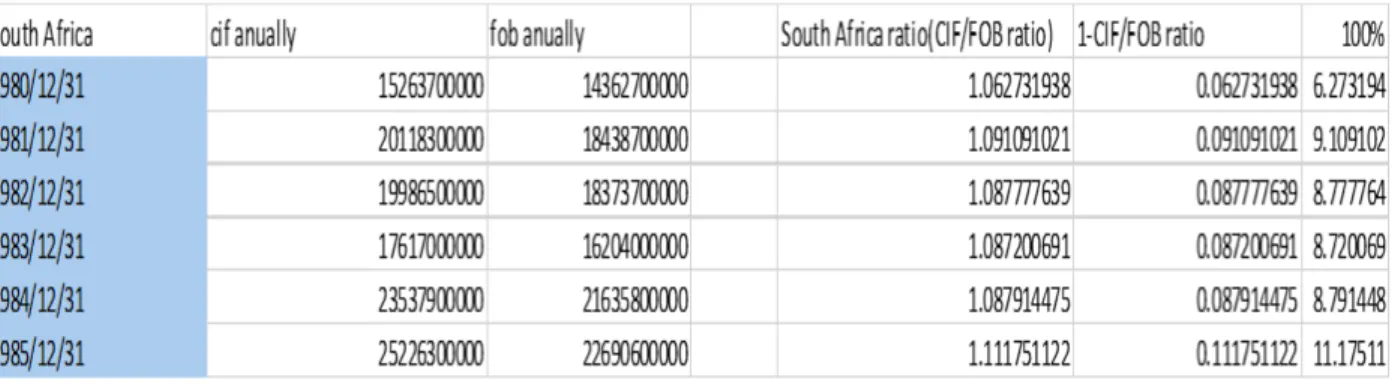
Table 3. 1. South Africa’s Annual Import Cif and Import Fob from 1980-1985 ... 61
Table 3. 2. United States SITC data from 1980-1990... 61
Table 4. 1. SITC Classification Structure after Revision... 73
Table 4. 2. Selected Countries cif/fob Ratios as a Proportion of Total Imports, 1980-2012 ... 74
Table 4. 3 Mean and Standard Deviation of Country’s cif/fob Ratios 1980 -2012 ... 77
Table 4. 4. Cross Correlation Analysis Results of Countries Imports cif/fob Ratios and their SITC Imports as a Proportion of Total Imports. ... 106
x
LISTS OF FIGURES
Figure 2. 1. Economic Rationale of Trade ... 16
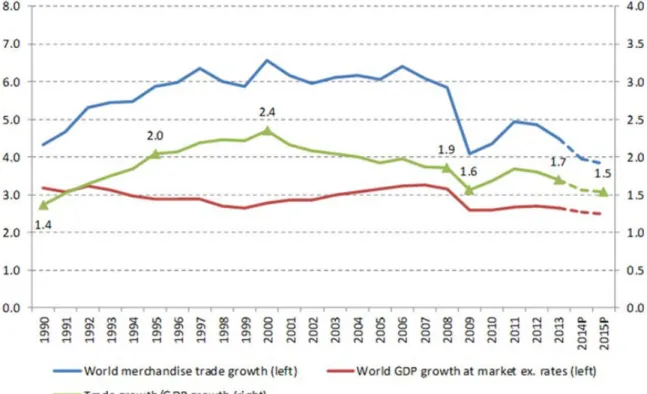
Figure 2. 2. 10 Year Moving Average of World Trade, GDP and Their Ratios, 1990-2015 ... 17
Figure 2. 3. The main maritime shipping route ... 20
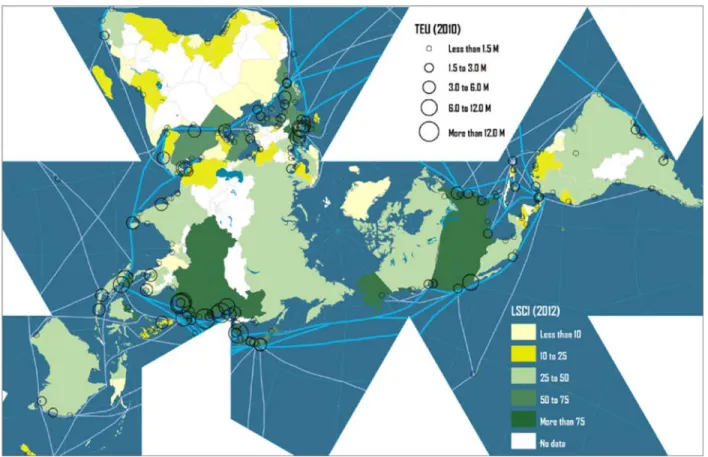
Figure 2. 4. The Liner Shipping Connectivity Index (LSCI) ... 24
Figure 2. 5. The OECD Industrial Production Index and indices for the world: Gross domestic product, merchandise trade and seaborne shipments, 1975–2013 (1990 = 100) ... 27
Figure 2. 6. International seaborne Trade and Export of goods, 1955 - 2013 ... 28
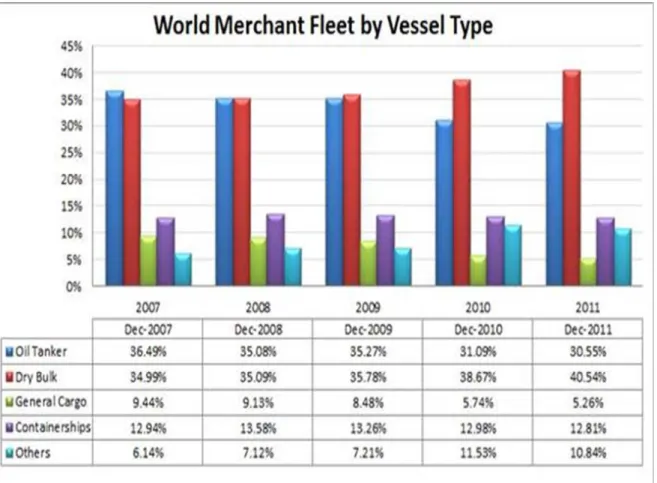
Figure 2. 7. World Merchant Fleet (2007–2011) and Percentage Capacity ... 29
Figure 3. 1. Flow Diagram of Data Analysis process ... 66
Figure 3. 2. Testing Goodness of Measures: Form of Reliability and Validity ... 68
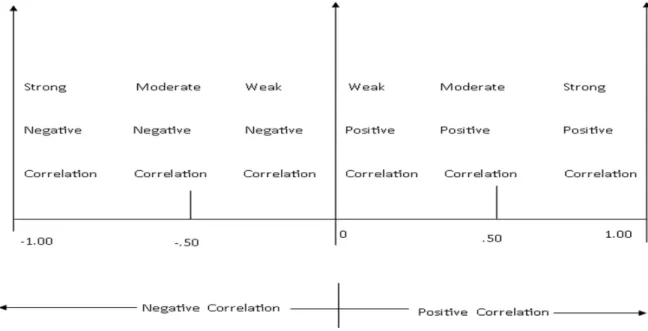
Figure 3. 3. The Strength, Weakness and Direction of Coefficient of Correlation ... 69
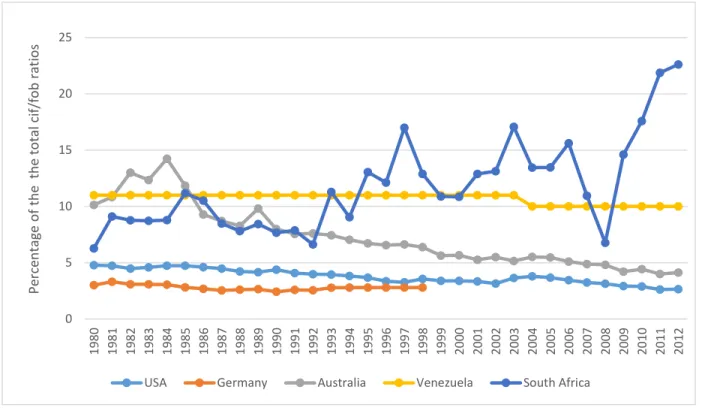
Figure 4. 1. Countries cif/fob ratios as percentage of total imports 1980- 2012 ... 76
Figure 4. 2. . United States, Imports cif/fob Ratio (1980- 2012) and Manufactured Import (1980 – 2014). ... 80
Figure 4. 3. Germany’s SITC 7 and SITC 3 category as a Percentage of Total Imports, 1980- 2014... 85
Figure 4. 4. Germany’s SITC Imports as a Percentage of Total Imports, 1980-2014 ... 86
Figure 4. 5. Germany’s cif/fob Ratio (1980- 1998) and Manufactured Import from 1980 – 2014 ... 87
Figure 4. 6. South Africa’s cif/fob Ratio (1980-2012) and Manufactured Imports (SITC7) from (1980 -2013)... 90
Figure 4. 7. South Africa’s SITC Imports as a Percentage of Total Imports, 1980 to 2013... 92
Figure 4. 8. Australia’s SITC Imports as a Percentage of Total Imports, 1980-2014. ... 96
Figure 4. 9. Australia’s cif/fob Ratio (1980-2012) and Manufactured Imports (SITC 7) from (1980 -2014)... 98
Figure 4. 10. Venezuela’s cif/fob Ratio (1980-2012) and Manufactured Imports ( SITC 7) from (1982 -2013)... 102
Figure 4. 11. Venezuela’s SITC Imports as a Percentage of Total Imports, 1982-2013. ... 103
1
CHAPTER 1
INTRODUCTION AND BACKGROUND
1.1. INTRODUCTION
Globalization refers to the increasing interdependence of world economies resulting from the growth of cross-border trade in commodities and services, the flow of international capital, and the wide and rapid spread of technologies. Globalization reflects the continuing expansion, and mutual integration, of market frontiers and is an irreversible trend for the economic development of the whole world, at the turn of the millennium (Shangquan, 2000). Invariably, no nation is self- sufficient. Each is involved in levels of trade: to sell what it produces, in order to acquire what it lacks; and to produce more efficiently, in some economic sectors, than its trade partners (Rodrigue, Comtois and Slack, 2013d). Rodrigue et al. (2013d) further emphasised that the globalization of production is linked to the globalization of trade, as one cannot effectively function without the other. “In 2008, the world produced goods and services worth about $50 trillion, at current prices.
Of this total, more than 30 percent was sold across national borders” (Krugman, Obstfeld and Melitz, 2013:12). The volume of world trade has increased over the half century since the establishment of the General Agreement on Tariffs and Trade (GATT). Trade has been rising faster than the value of world gross domestic product (GDP), for the past fifty years, thereby confirming the increasing internationalisation of business (Woods, 2000). Pugel (2007) explains that international trade is very important and its effects on the economic life of people in a country are significant.
The World Trade Organisation (WTO) is not the only forum through which trade and investment restrictions have been reduced. Many countries chose to liberalize their barriers unilaterally, recognizing that by doing so they could achieve significant gains in economic efficiency, improve the welfare of consumers, and the prospects for growth. Krugman et al. (2013) stressed there have been two great waves of globalization, with the first wave relying not only on jets and the internet, but also on railroads, steamships, and the telegraph. Globalization has become such a phenomena that it is perceived as a means of ensuring not only efficiency of growth, but also of equity, and
2
development for countries that join the global system, while bringing economic deprivation to countries that do not (Shaw, 2003).
Transportation costs are a vital factor in the economy of a nation, a region, or a city. Low costs give a competitive advantage to a business. Therefore, it is necessary to calculate the total transportation costs accurately and try to minimize them (Sahin, Yilmaz, Ust, Guneri, and Gulsum, 2009). Manufactured goods are the largest and most rapidly growing portion of world trade, compared to bulk cargoes, which constitute the majority of international trade when measured in terms of weight, but are a much smaller and shrinking share of trade when measured in value terms (Hummels, 2007).
As the global economy is growing fast, and many borders are now open for trade, transportation costs remain a factor for competitiveness and for the survival of many businesses in different countries. The accuracy and interpretation of international transportation costs and direct shipping costs, by measurement in particular, has become vital, as it is now a tool for the anticipation of trade and economic development. Jacks, Meissner and Novy (2008) argued that many companies use imported inputs when producing goods that are exported and that bulky and heavy inputs, that are difficult to transport, will decrease in demand. Jacks et al. (2008) stated that transportation costs play an important role in economic development, and Kurmanalieva (2006) agrees that transport costs act as a major determinant in location choice and clustering of economic activity, he went on to say that transport costs depend on many factors such as modes of transportation, infrastructure and geographical location. Hummels (2007) was of the view that transportation costs drive a wedge between the price at the place of origin and the price at the destination. Jacks, Meissner and Novy, (2006) agree that trade costs are a key obstacle to international economic integration.
Transportation, and its value for countries, has become an indispensable means for nations to reach out to one another in the international market, and as a way of strengthening their economy to attract foreign direct investment. Ultimately, the measurement (presentation and interpretation) of international transportation costs, relating to nations and their trading partners, are a major concern in the global market. Venables and Behar (2010) found that econometric studies suggest that freight costs have a statistically significant and a quantitatively important impact on trade flows.
3
Kleinert and Spies (2011) suggest that trade and transport costs are mutually interdependent.
Transportation costs directly affect trade costs and are significant in determining what goods should be shipped in order to be competitive. Hummels (2007) suggests that transport costs are sensitive to distance. Kurmanalieva (2006) stated that the cost of transportation, in international trade, can be defined as all shipping expenses of internationally traded goods from origin point to destination point. Direct shipping costs, over many decades, are cited as the primary source for most international transport costings. Transportation of the most high-value cargoes, however, is airborne as it is faster and more costly (Hummels and Schaur, 2012). Hummels and Schaur (2012) were of the view that moving goods by ocean borne freight takes a longer time; ocean borne cargo leaving European ports takes at least an average of 20 days to reach a port in the United States of America, and about 30 days to reach Japan.
In the absence of accurate direct measures (primary sources) for transportation costs, a country’s import cif/fob ratios have been used, over the years, in the depiction and measurement of international transport costs.
This paper investigates the measurement of international transport costs, using the import cif/fob ratios as a measure (direct proxy) for a country’s ad valorem shipping, or international transport costs, and its impact on trade.
1.2. BACKGROUND AND CONTEXT
International transport costs, by its very nature, is linked and motivated by the need for effective and efficient trade. Transport costs are one of the major components of trade costs along with tariffs, non-tariff measures and distribution costs. Before the advent of modern trade, trade anticipation and motivation might have emerged, necessitating the need for freight forwarders in local and international movement of goods. However, it was the needs, specialization and competiveness among countries within the international market, that brought importance to the representation of international transport costs.
Ad valorem shipping costs and trade tariffs directly and indirectly impact on productivity and competitiveness of nations within international markets, which also affects the nation’s cost of
4
delivered goods and investments, and subsequently, its economic growth. As a result, analysing transport costs, and its impact on international trade, has increasingly become a major concern. It is of interest to many researchers, forming a body of literature explaining the development of these costs, their impact on economic development, and the measuring of trade patterns and transportation costs correctly (Oguledo and Macphee 1994, Radelet and Sachs 1998, Baier and Bergstrand 2001, Hummels 2001, and Limao and Venables 2001).
Direct shipping costs is defined as the way of determining the cost of moving goods between nations, which is used in part in pre-determining the market price of those goods. In the same manner, the cif/fob ratios are articulated as the unconventional way of determining the cost of moving goods. Unfortunately, very few countries report detailed information on direct shipping costs. Ma, Miao, Lim and Rodrigues (2011), while trying to understand the transportation problem in cross-docking distribution networks, suggest that transportation costs incurred by shippers are typically dependent on variable costs per unit product shipped per unit distance travelled.
Transportation costs are costs incurred while moving goods from one destination to another, suggesting distance means that the gravity trade model could play an important role in transport costs. Rahman (2003) in his panel data analysis of Bangladesh’s trade, using a gravity model approach, noticed that transportation costs have a negative impact on Bangladesh’s economy. He suggests that the country will do well if they trade more with their neighbouring countries. An empirical principal of trade economics shows that exporting nations report trade transactions exclusive of freight and insurance (fob), while on the other hand, importing nations report trade transactions inclusive of freight and insurance (cif) (Hummels and Lugovskyy, 2006). Import cif/fob ratios, as a measure for international transport costs, is being questioned by many researchers, but the focus of the controversy is on its exactness when being used to reveal international transport costs of nations. These ratios are an indirect measure of international transport costs, which capture transportation costs, but fail to take the variability in transportation modes, and efficiency in the transportation services of imports, into account.
Chasomeris (2009a), stated that the import cif/fob ratio has been used by many researchers as a measure (direct shipping cost) for international transport costs; and used by the African Development Bank, International Monetary Funds (IMF), World Bank and United Nations in several publications on international trade and transport. Most users and analysts assume that a
5
country’s composition of imports is constant and does not vary when using these ratios, and that these ratios reflect a country’s actual cost of transport without taking into account the inconsistencies that could be present in data used while computing the ratios. Hummels and Lugovskyy (2006) agree that data collection relies on independent reports of the same trade flow gathered for reasons other than shipping costs. Notwithstanding the shortfalls, the ratio is still an accepted measure for international transport costs and is widely used.
Chasomeris (2010) warned that those who use cif/fob ratios must be careful and aware of what they are using, in particular, an aggregated and weighted average ratio, where the weightings are in large part, determined by the composition of imports that are not the same across countries and regions. Chasomeris (2010) noticed that ad valorem transportation costs applied by the IMF cif/fob ratios are notably different from the explicitly collected data on South Africa’s direct shipping costs. In principle, exports from country A to country B should be identical to imports from country B to country A, for any given product in a particular year, except for the CIF additional cost.
Firstly, identifying the actual trading partners might be difficult. Mostly the attention of the customs officials is drawn to the actual origin of an imported product because this determines the level of tariff to be levied. Secondly, details of reported values of commodities do not necessarily sum up to the total trade value of a given country. However, direct transport costs at the product- level are rarely available. In the absence of direct measures, indirect measures of freight cost, drawing on ratios of mirror trade reports (cif/fob ratio), turns out to be the alternative estimates for trade costs. In principle, the valuation and comparing of the same flow reported by both importer (in cif) and exporter (in fob) would yield a difference equal to freight cost. However, in reality, there are important measurement problems. Hence, the huge discrepancies observed between mirror flows cannot be substituted directly as measures of transport costs (Gaulier and Zignago, 2010). Nevertheless, Hummels and Lugovskyy (2006) still believe that IMF cif/fob ratios reveal meaningful cross-exporter variation that could be useful to researchers.
6
1.3. PROBLEM
This study investigates the complexity and inaccuracy associated with the use of cif/fob ratios as a measure of direct transportation costs, and its impact on trade flows in countries. As trade costs are increasingly becoming an area of interest, it is surprising to note that decreasing cross border transaction costs have undoubtedly increased volumes of trade between countries, which is instrumental to investment in infrastructure, and a further reduction in transport cost. Kleinert and Spies (2011), state that transport costs differ in accordance with the market structure of the transport sector, with bilateral trade imbalances, and with port efficiencies. The growing interest in international transport costs has led many researchers to seek more accurate data that reflects the difference in transportation costs of bilateral trade between countries. The widely used and most recognised measures of the import cif/fob ratios for international transport costs have sparked controversies regarding their use among different researchers. It is perceived as an impairment to true and accurate measuring of international transport costs. Cif/fob ratios, which make use of data extracted from the IMF database, have not portrayed accurately the true composition of trade and transport costs (Chasomeris, 2010). Therefore, one should ask whether this measure is a misrepresentation of international transport costs.
1.4. RESEARCH AIMS AND OBJECTIVES
This dissertation is a comparative study on the use of a country’s import cif/fob ratios to measure international transport costs in terms of definition, use, presentation and interpretation as a measure for direct international transportation costs. The main aim is to examine the measurement of international transport costs as measured by the country’s import cif/fob ratios. The following specific objectives have been identified for the study:
• To source, compile, calculate and compare the country cif/fob ratios for South Africa, the United States of America, Germany, Venezuela and Australia from the year 1980 to 2012.
• To establish, using correlation analysis, the relationship between a country’s cif/fob ratio and a country’s standard international trade classification (SITC) data at HS (Harmonized System) revision 2-digit code 1
7
• To examine the use of import cif/fob ratios as a measurement for international transport costs. This will involve extensive data collection and information on the characteristics, patterns and perceptions of the use of import cif/fob ratios as a measure of international transport costs.
1.5. RESEARCH METHODOLOGY
This study follows a quantitative based method of research, using the inductive approach, to draw an observation on the flaws and irregularities in the use of import cif/fob ratios as a measurement of transportation costs. Secondary data is the data that has already been collected by researchers and are readily available as sources. The secondary data that will be used in this study will be collected from the World Integrated Trade Solution (WITS) database of the World Bank, Easy data by Quantec, the IMF databases, International Financial Statistics (IFS), Direction of Trade Statistics (DOTS), and the United Nations’ Comtrade. Specifically, this study will first calculate the sample cif and fob data for South Africa, the United States of America, Germany, Venezuela and Australia from the year 1980 to 2012; and second, the SITC data of all five countries mentioned above.
Third, the study will use correlation analysis to analyse the relationship between a country’s standard international trade classification (SITC) data and that country’s import cif/fob ratios. This analysis will be for South Africa, the United States of America, Germany, Venezuela and Australia from the year 1980 to 2012. The findings in the correlation analysis will be used to draw conclusions and recommendations from the information gathered through critical evaluation against the findings of the studies in the literature review. The study will also make use of descriptive statistics, which will include distribution (histograms), measures of central tendencies (mean), and dispersion (standard deviation) where applicable.
This study deepens the understanding of, and makes additional contribution to, the growing body of knowledge on international transport cost measurement, and arguably its impact on trade between countries. It is hoped that this study will contribute to greater understanding when using import cif/fob ratios in the measurement of transport costs.
8
1.6. OVERVIEW OF THE RESEARCH
The structure of this dissertation is as follows.
Chapter One (Introduction): This section will consist of an epigrammatic prologue about what will be discussed in the dissertation. It will analyse the different areas mentioned above and illustrate why they are imperative for this research. It will finally outline the structure of this dissertation.
Chapter Two (Literature Review): This section provides an overview of international transport costs. It examines perspectives and perceptions of import cif/fob ratios as a measure of international transport costs, from a theoretical viewpoint, by different researchers who have contributed to this research field and what concepts and theories have been applied to the field.
This chapter will also try to understand what research methods have been applied to the topic and what controversies there are regarding the topic. The review will examine the international trade and transport costs concepts, the assessment and the use of import cif/fob ratios, and the use of the ratios as a measurement of transportation costs for trade.
Chapter Three (Research Methodology and Design): This chapter will start with an introduction of the methodology used. Correlation analysis will be run with the cif/fob ratios of the selected countries using secondary data collected from the World Integrated Trade Solution (WITS) database of the World Bank, Easy data by Quantec, the IMF databases, International Financial Statistics (IFS), Direction of Trade Statistics (DOTS), and the United Nations’ Comtrade. It will continue with a discussion of the data collection and analysis techniques used for this research.
Chapter Four (Data Presentation, Analysis and Discussion of Results): This chapter presents an extensive analysis and discussion of the empirical data. Firstly, the section introduces and deduces the viability and reliability of the sourced data. It then provides the descriptive analysis of the data used in the examples of this study. The chapter concludes with application and discussion of information derived from extracted data, providing comparisons between the freight rates
9
measured using IMF and national source data, taking into consideration the measurement of transportation costs for Germany, South Africa, Venezuela, the United States of America, and Australia of trade composition of imports. Correlation and comparative analysis will then be used to clarify the relationship that exists from the data analysed.
Chapter Five (Conclusion and Recommendations): The significance of this research will be portrayed in this chapter, which sums up the findings by presenting the main conclusion and recommendations for improvement in the measurement of international transport costs. The chapter will conclude with the implications and limitations of the study and identify future research area.
CHAPTER 2
LITERATURE REVIEW
10
2.1. INTRODUCTION
The purpose of this chapter is to provide a compendium of the literature that was reviewed in order to have a better understanding, and to provide a concise base for analysing the measurement of international transport costs. The chapter will explore the theoretical context surrounding the study before providing a review that briefly explores international trade, transport, transport costs, transfer pricing, incoterms and cost measurement, and other relevant and related concepts. The chapter then examines empirical evidence on transportation and international transport costs. This is followed by an exploration of the role, perceptions and determinants of transport costs. The measurement of international transport costs will then be reviewed in view of the perspectives and perception of the use of cif/fob ratios as a measure for direct shipping costs, followed by a review of the definition, source, nature and composition of the ratios as a measurement for international transportation costs. The chapter concludes with a review of the impact of the use of these ratios as a measure for international transport costs and provides some concluding remarks.
2.2. THEORETICAL CONTEXT
In this study, international transport costs or transportation costs could be defined as costs incurred in moving mass or freight across national borders. These costs comprise of direct and indirect elements. Freight charges and insurance of those goods, mass or freight makes up the direct element of the cost, while the indirect elements include those incurred by the transport operator.
For the purpose of this chapter, we will focus on the direct elements rather than the indirect elements, as the former are more constant in transport costs.
Over the past decades, many researchers have conducted various studies on the subject of international trade and international transportation costs with the import cif/fob ratios at the forefront of studies on transport costs. Nevertheless, some studies justify the use of import cif/fob ratios as a measure for international transport costs, while others have discredited the use of the ratios as direct measures, due to observed inconsistencies and complexities surrounding cost interpretation of freight rates measured using IMF and national source trade data (Chasomeris, 2009a).
11
Myers (2014) explained that individuals of the same country buy and sell from each other far more than they do with individuals of a different country. A cost is associated with exchanging goods and services across national boundaries. The amount which two countries trade with each other is an amalgamation of the actual cost of trade and the elasticity of trade with respect to trade costs (Myer, 2014). In a study by Hummels (2007), transport costs were analysed relative to the value of the goods being moved and relative to other known barriers to trade, such as tariffs. Geographic separation creates price differentials across regions because of transport costs, even in the absence of institutional differences such as tariffs, taxes, and national borders. Accordingly, if the locations of production and markets are geographically distant, transport costs will be high, and hence there will be large price differentials across regions (Kazuko, Takashi and Kazutaka, 2015). Hummels (2007) believes that transport costs can alter relative prices. Anderson and Van Wincoop (2004) try to measure transport costs using price differential data, which calculates the difference between market prices and the price at the point of production. Kazuko, Takashi and Kazutaka (2015) see price data as a correct way to measure transport costs. Clark, Dollar and Alejandro (2004) argued that transport costs may be an important barrier to trade and could have an important effect on income. They went on to show that if distance between the United States and an export country increases by 100%, maritime transport costs increase by about 20%. An important determinant of transport costs is geography, distances in particular. Lugovskky and Skiba (2014) believed that distance significantly lowers volumes of trade between countries. While the exact reasons for this effect are not completely understood, it is commonly believed that distance lowers trade through the cost of transportation. Martin (2012) finds that firms charge higher fob unit values on exports to more remote countries. Chasomeris (2009a) argues in his paper on the (mis)measurement of international transport costs, that there is a degree of misunderstanding and misuse of import cif/fob ratios as a direct measure of shipping cost. His studies highlighted the erroneous assumptions made on the composition of trade when using cif/fob ratios (Chasomeris 2009a, 2009b).
Trade liberalization has been seen as a reason for increased border trade. Novy (2013); and Sánchez, Hoffmann, Micco, Pizzolitto, Sgut, and Wilmsmeier (2003) argue that trade liberalization over the past decade has seen a reduction in customs tariffs and ultimately has increased trans-border trade. Conconi, Legros, and Newman (2012) argue that not only has trade liberalization caused reduction in barriers of commodities traded, and falling transport costs, but
12
also has contributed significantly to organisational restructuring. Many countries have opened their borders to trade and this has benefits for firms, for mass productivity, and for increasing firms’
efficiency and competitiveness. De (2007) argued that infrastructure and related services plays an important role in the flow of international trade and can have a significant effect on costs of transportation. Rothenberg (2012) agrees with De (2007) in that in many developing countries, investments in transport infrastructure are growing at an astonishing pace. China’s total spending on transport projects increased from $9.2 billion in 2000-2004 to $26.4 billion in 2005-2009, while India’s spending increased from $2.9 billion to $29.4 billion between the same periods. The goal of these projects was to lower transport costs between different regions. Faber (2014) was aware of the impact that development of transport infrastructure has on transport costs.
However, it seems that trade liberalization and global integration has eluded some countries, who fail to embrace it, causing them to miss beneficial gains from such trade opportunities. Offshoring, which is a product of trade liberalization, enables firms to allocate resources to developing countries, to benefit from low wages and labour productivity, thereby increasing economic growth and employment (Zhou and Zeng, 2015). Winters (2004) was of the view that trade liberalization has been a prominent component of policy advice to developing countries for the last two decades, and among the benefits claimed to arise from it - economic growth is the most important.
2.3. INTERNATIONAL TRADE
International trade is usually defined as the exchange of goods and services across international borders or territories. Goods and services that are bought outside the national borders are called imports; the import industry offers the residents of a country a large variety of goods. It also increases the number and quality of options available in the domestic market (Economy Watch, 2010a). Dollar and Kraay (2004) believed in the well-known literature that openness to international trade accelerates development. The link between nations and trade between nations
13
and economic growth are neither recent nor novel developments. The Amber route and the Silk route crossing, boundaries and continents, is enough evidence that international trade is not a novel phenomenon (Carr and Stone, 2013). Since the latter years of the twentieth century, developing countries have become increasingly integrated in international trade (Manger and Shadlen, 2015).
Since World War II, international trade has grown almost twice as fast as world income (Dollar and Kraay, 2001; and Behar and Venables 2011). Furthermore, there was an increase in trade to GDP ratio from 24% in 1960 to 48% in 2003 (Lavallée and Vicard, 2013). Thirlwall (2000) highlighted that exports have tended to grow fastest in countries with more liberal trade regimes, and these countries have experienced the fastest growth of GDP. What could have been the driving force for this tremendous increase of international trade? Hummel (2007) attributes much of this great increase in global trade to decreasing transport costs. Kaukiainen (2014), among other things, identifies a reduction in ocean transport costs as having an effect on rapid growth of international trade. Econometric studies suggest that freight costs have a statistical and quantitatively significant impact on the flow of trade (Behar and Venables, 2011). Manger and Shadlen (2015) were of the view that there is near consensus that international trade is a necessary condition for economic development, for reduction in poverty, and for improved living standards. The globalization of markets is evident in several related trends. Firstly is the unprecedented growth of international trade, a trend which accounts for a substantial proportion of the world economy, amounting to US
$14 trillion annually (Cavusgil, Knight, Riesenberger, Rammal and Rose, 2014).
Economy Watch (2010a) acknowledges a mixed debate on who gains as far as the impact of international trade on economic growth is concerned, the economists and policy makers of the developed and developing economies are divided into two nonconforming groups.
“One group of economists is of the view that international trade has brought about unfavourable changes in the economic and financial scenarios of the developing countries. According to them, the gains from trade have gone mostly to the developed nations of the world. Liberalization of trade policies, reduction of tariffs and globalization have adversely affected the industrial setups of the less developed and developing economies. The other group, which speaks in favour of globalization and international trade, come with a brighter view of the international trade and its impact on economic growth of the developing nations. According to them developing countries, which have followed trade liberalization policies, have experienced all favourable effects of
14
globalization and international trade. China and India are regarded as the trend setters in this case”
(Economy Watch, 2010a).
If properly practised, there is no denying that international trade is beneficial for the countries involved in trade. International trade policy opens up opportunities in global markets to the entrepreneurs of developing nations. Technology and knowledge capital, that is readily available, is shared with the businesses operating in these countries, ensuring competitiveness of domestic firms in global fronts.
Although there is no single theory that can substantially and completely explain international trade or its pattern: Dettmer (2014); Simonovska and Waugh (2014); Baltagi, Egger and Pfaffermayr (2014); and Kahouli and Maktouf (2015) all used Gravity Models of trade to study international trade and its patterns. According to Krisztin and Fischer (2015), Gravity Models have become a popular way to model international trade flow. The Gravity Model provides a crucial explanation on international trade. The models assume that these bilateral relationships can be modelled as a multiplicative function of the economic size of two economies (incomes, expenditures, or endowments = GDP), the inverse of economic distance and some constant, similar to Isaac Newton's law of gravity. However, the model fails to explain the changing nature of today’s trade pattern and model, as distance seems not to deter countries from trading further afield, significantly more than with their neighbouring countries.
2.3.1. INTERNATIONAL TRADE AND ITS ROLE IN THE ECONOMY
International trade has long been hailed as an engine for growth and economic development because it enhances domestic firm competitiveness, and increases profits and sales of a country by increasing its share in the global market, while providing expansion opportunities for its local business and reducing the country’s dependence on existing markets. In short, international trade has gone beyond what we can imagine as firms seek international market opportunities more today than ever before, impacting and touching billions of people’s lives around the globe.
15
Some of the logical questions being asked today of international trade and its role in the economy are:
• Why do countries trade?
• What determines with whom and where to trade in this modern world?
• Why do countries close to each other trade more with each other?
• Shouldn’t developed nations such as the likes of Germany and Australia produce all their nation’s needs and demands rather than resort to the importation of certain goods and services that their residents need from countries like China, Singapore and other trading partners?
• Why do these trading partners equally depend on other nations to facilitate their own needs?
(Krugman, Obstfeld and Melitz, 2011) It is hoped that the literature review will help answer some of these questions so as to gain a better understanding of international trade and transport costs.
Krugman et al. (2011: 10) explains that: “Countries engage in international trade for two reasons, each which contributes to their gains from trade. First, countries trade because they are different from each other. Nations, like individuals, can benefit from their difference by reaching an arrangement in which each does the things it does relatively well. Second, countries trade to achieve economies of scale in production. That is, if each country produces only a limited range of goods, it can produce each of these goods at a larger scale and hence more efficiently than if it tried to produce everything”.
David Ricardo’s principle of comparative advantage helps to understand how international trade works: a country will export the goods and services that it can produce at a low opportunity cost and will import the goods and services that it would produce at a high opportunity cost (Economy Watch, 2010a). Ingham (2004) agrees with what Adam Smith said, that a country should specialise in and export goods and services in which they have an absolute advantage. When a country can produce a commodity with less labour per unit than could its trading partner, they are said to have an absolute advantage in production of that commodity. Assuming that the United States has an absolute advantage in producing cotton, and South Africa has an absolute advantage in producing wine, both will be better off if they specialize and trade with each other: with the United States
16
exporting cotton to South Africa and importing wine, and with South Africa exporting wine to the United States and importing cotton from them. Helpman (2014) believed that both, Ricardo, Ohlin and Heckscher comparative advantage model emphasized cross-country differences as drivers of international trade flows.
Figure 2. 1. Economic Rationale of Trade
Source: Rodrigue, Comtois and Slack (2006:145)
Figure 2.1 shows four countries. Without trade, each country produces all four mixtures of goods given limited resources. Rodrigue, Comtois and Slack (2013d) argue that without international trade, only a few nations can maintain a moderate standard of living. With only domestic resources, each country could only produce limited amounts of goods and shortcomings would be prevalent.
With trade, competition increases and redistribution of production normally takes place as comparative advantages are exploited. In figure 2.1, the outcome of trade liberalization involves specialization of production of one good in each country and trade of other goods between them.
17
As a result, the greater economies of scale that is achieved through specialization, results in lower prices (Rodrigue et al., 2013d).
As international trade is expressed as an exchange of goods and services and capital across international territories, then international trade can been seen as an economy where prices, and supply and demand affect global events. In most countries, trade represents a share of its gross domestic product (GDP), especially in developing and underdeveloped countries.
Figure 2. 2. 10 Year Moving Average of World Trade, GDP and Their Ratios, 1990-2015 Source: WTO (2014b)
Figure 2.2 shows that world trade growth has been on the increase, with the highest peak of a 6.7%
growth rate recorded in year 2000, and through to about 4% in 2009 due to a recession. Most developing countries support trade expansion in anticipation of improving their market status and GDP, both of which indicate economic development and growth in that nation. Although international trade was in existence for centuries, its social, economic and political importance has just begun emanating in the past century, and this could explain why economic sanctions are implemented as a punitive measure to try to correct political errors of nations.
18
The results of a regenerated trading system and trade expansion, such as globalization, industrialization, multinational corporations, advanced transportation and outsourcing have all been judged to play a significant role in impacting on modern day international trade. However, without the adequate infrastructural support and enabling macroeconomic policy to operate upon, international trade expectations are neither attainable nor sustainable by mere trade expansion alone, they could be rather disruptive and abrasive on economic growth.
In principle, international trade does not differ from domestic trade because the motivation of the parties involved do not change regardless of whether trade is across a border or not (Nawaz, Aziz and Zaman, 2014). However, the main discrepancy is that international trade involves the movement of goods and services, and capital over a long distance with imposed costs arising from tariffs, distance (transport) and costs associated with time, cultural differences, language and legal systems (Mundra, 2010). However, without international trade, residents of nations will be limited to the goods and services produced within their own borders. Arguing thus, transport costs are an impeding factor to be considered when embarking on global trade.
According to the United Nations Conference on Trade and Development (UNCTAD) (2013), liner shipping services form a global maritime transport network which moves most of the international trade in manufactured goods. Several empirical studies have found that there is a strong correlation between liner shipping connectivity and trade costs, transport costs in particular.
OECD/EUROSTAT (2014), believe that containerization has made globalization possible, container trade and major dry bulks are the main drivers in the development of seaborne trade. As economists unanimously forecast increases in international trade, international transportation is now becoming an integral part of international trade as rising demand puts pressure on all transportation nodes and links, like ports, ships, trucks, trains, airports and roadway systems (Ioannou, 2008).
Development and economic growth is being piloted by international trade, providing the policy measures and economic infrastructure are accommodative and accurate to cope with the changes in the social and financial scenario that result from it. Transport costs are justified as a major element of overall trade costs, while international trade might be motivated, influenced and predetermined by specialization needs and costs. They are more of an important component of trade than tariff barriers (Hummels, 1999).
19
Helpman and Razin (2014) argue that in the absence of international trade in equities, a tariff may provide protection to an exporting firm of a small country, but this paradoxically does not arise in the presence of equities in international trade. Transport cost drivers differ between foreign and domestic goods prices and therefore play a significant role in economic growth and development (Chasomeris, 2010).
20 Figure 2. 3. The main maritime shipping route Source: Rodrigue, Comtois and Slack (2013:21c)
2.4. INTERNATIONAL TRANSPORTATION
Freight Transportation is a key supply chain component to ensure the efficient movement of goods and timely availability of raw materials needed (Steadie, Seifi, Delleart, Nuijten, van Woensel and Raoufi, 2014). It has an important macroeconomic and microeconomic role to play in any nation and society alike. Steadie et al. (2014) believe that in many parts of the world, freight transportation has witnessed several trends as new markets are rising and growing based on the customers’
demands. As consumer tastes and preferences grow, accessing goods and services that lie outside
21
of the immediate vicinity of the society is dominant and, for this to be achieved, transportation is required. From a macroeconomic point of view, transportation has been noted in India to be a critical infrastructure requirement for economic growth (Pradhan and Bagchi, 2013). Sinha and Labi (2011) are of the view that economic vitality and global competitiveness of a country influence the quality and quantity of its transportation infrastructure. Understandably, despite the major changes that have been experienced in society, transportation issues continue to be an epicentre of importance in our day-to-day lives.
Transportation is still being appraised primarily in terms of mobility, but the growing importance of transportation in our day-to-day existence lies in the fact that it creates valuable links between regions and economic activities, between people and rest of the world. As the world evolves, transportation still remains critical and has undergone large scale changes over time (Redding and Turner, 2014).
The A380 Airbus Project represents one of the highest challenges, leading to a new quay and lifting platform being built in Hamburg terminal (Morales, 2006). A failed project it would have been, if not for transportation, bringing different component parts of the A380 airbus from different European countries. Rodrigue et.al. (2013d), and Redding and Turner (2014) stated that transportation involves the physical movement of goods and service. Rodrigue et.al. (2013:12d) refer to “transportation as the dominant outcome of derived demand, which its purpose is to fulfil demand for mobility, since transportation can only exist if it moves people, freight and information around, otherwise it has no purpose”.
According to Novianti, Panjaitan and Nugraheni (2015), transportation costs are one aspect of logistics costs, other than administrative and handling costs. They believe that a good state of logistics costs is a very crucial prerequisite for a country to be able to compete strongly in the international market, as well as to maintain a good supply of goods in its domestic market. Balsas (2015) believes that transport and transportation costs are an integral part of any society’s development, functioning and communal integration. Limao and Venables (2001) found that increased transport costs would reduce the volume of imports to the United States. While a study by Baier and Bergstrand (2001) showed that a rise in transport costs will reduce the volume of imports and exports in most countries.
22
Olsen and Granzin (2015) define international transportation as subsumes of those objects and activities necessary to move the consumer to the point of acquisition, or the consumption of goods (locally or internationally), as well as those elements required to move the goods from the point of acquisition to the place of consumption or other disposition. Granzin and Valentin (2015); and Timotheou, Panayiotou and Polycarpou (2015) all acknowledge that transportation involves an element of movement of not only goods, but people as well. The demand for transportation is an indirect or derived demand resulting from demand for international trade itself (Hummels, 2009).
Therefore, a growth in demand of international trade will concurrently result in a growth in demand for international transport (Ola, 2011). Rodrigue (2010), in his paper “Maritime Transportation:
Drivers for Shipping and Port Industries”, stated that economic growth and international trade (global trade) have been significant vectors for the growth of transportation (mobility).
The liner connectivity of countries within the market is through the global transport system measured by the liner shipping connectivity index (LSCI) which is considered a proxy of the accessibility to global trade. The higher the connectivity index of a country, the easier it is to access a high capacity and frequency global maritime freight transport system and thus participate effectively in international trade (Rodrigue et al., 2013d). The lack of this connectivity in landlocked countries has made them the least connected countries in the world due to the complexity of achieving connectivity to the liner shipping network. This lack of connectivity in a landlocked country often affects average development levels and GDP more than their maritime neighbours (Faye, McArthur, Sachs and Snow, 2004). Arvis, Raballand and Marteau (2007) indicated that a large proportion of the least developed countries are landlocked. Due to this, their access to the world market depends largely on the availability of trade corridors and transit systems.
In order to reach a definitive conclusion about the level and measurement of international transport cost, the factors which determine their level, and their effects on national economies, greater knowledge of the state of global transport industry and of international transportation cost is needed.
2.4.1. THE INTERNATIONAL TRANSPORT INDUSTRY
23
The global transportation industry is a complex, challenging and rapidly changing sector in the global market. The global economy is competitive and practitioners are faced with diverse market challenges. The transport industry has become an increasingly important contributor worldwide to countries’ trade exports and gross domestic product as countries integrate ways to use the transportation system to contribute more to their national economic development. Although efficiency in transport may have increased appreciably because of innovations and improvements in infrastructure and modes of transport, organisations in the global transportation sector still face challenges to achieve a competitive advantage.
The modern global transport system consists of five major transportation modes (Air; Maritime - coastal-sea and deep-sea shipping; Rail; River and Canal; and Road) which it uses to foster effective and efficient trade through the cohesion (intermodal) of these modes. Transport connectivity recently has been considered in gravity studies of trade. Limao and Venables (2001);
Micco and Serebrisky (2004); and Alamá-Sabater, Márquez-Ramos, Suárez-Burguet and Navarro- Azorín (2013) were of the view that transport connectivity increases trade flows between trading partners. Jacks and Pendakur (2010:746) stated that a “most commonly-held perception is that the growth of world trade is strongly associated with technological improvement in the communication and transport sectors.”
Of the modes of transport mentioned above, the maritime, with deep sea (sea ports) in particular, has become of major significance to global transportation, trade flows and trade efficiency. Branch and Stopford (2013) believe that the idea of shipping as a catalyst to economic development is not new. These five main modes of transportation have advantages and disadvantages, and when selecting a particular mode all the advantages and disadvantages related to the concerned mode of transportation have to be considered. Tuzkaya and Önüt (2008) acknowledge the main criteria for transportation mode selection depends on the type and volume of freight and the distance to be covered, other criteria might include speed, availability, capacity, reliability, security and frequency of delivery.
The maritime shipping networks are assessed through the LSCI which can be considered as a measure of connectivity to maritime shipping and also a measure of trade facilitation (see figure 2.4) (Rodrigue 2010). This is acknowledged to have altered the world movement of goods from what it was known.
24
Figure 2. 4. The Liner Shipping Connectivity Index (LSCI) Source: Rodrigue, Comtois, and Slacks (2013:33b)
According to Branch and Stopford (2013), Adam Smith saw shipping as a primary source of cheap transport which can open up markets wider to greater specialization by offering transport at low prices for the most everyday products, those that cannot be achieved by other modes. Turnbull (2014) hailed multimodal freight transportation systems as a key to the global competitiveness of the United States. No doubt, freight transportation systems are necessary for an efficient international transport industry, integrating different modes of transport with the ultimate aim of creating a seamless service that facilitates greater flows of cargo to strategic points. These different modes of transport used in modern international transport system in affecting trading, both at a domestic level and international level. The modes of transport are: roads, inland waterways, shipping lines, railways and air freight (Branch and Stopford, 2013). Branch and Stopford (2013) believe that trade competition still exists between different modes, as rail competes with road;
short sea shipping competes with rail and road; and deep sea shipping with air freight transportation for higher value cargo.
25
The transport system can be categorised into three zones based on operations. Table 2.1 presents this with inter-regional transport, short-sea shipping and land.
Table 2. 1. International Transport Zones and Available Transport Modes
Source: Adopted from Branch and Stopford (2013: 08)
Inter-regional comprising of: deep-sea shipping and air freight catering for long distance trade and transportation, short sea shipping catering for cargo transport over short distances, usually on a national scale or redistributing cargoes brought in by deep-sea shipping or transporting to landlocked countries without access to deep-sea shipping and land which comprises road, rail, river and canal (in land-waterways) (Branch and Stopford, 2013). For the purpose of this study, the deep sea inter-regional transportation (maritime) will be the only transportation mode to be analysed.
2.4.1.1. MARITIME TRANSPORT
Talley and Ng (2013) define maritime transport as a network over which carriers, ports and shippers are involved in the movement of cargo. It is an essential means of transportation for the
Zone Area Transport Sector Vehicle
1 Inter-regional
Air freight Plane
Deep sea Shipping Ship
2 Short sea Coastal seas Ship/ferry boat
3 Inland (Land)
Rivers and canal Barge
Road Truck
Rail Train
26
prosperity of a nation. It plays an important role in meeting a nation’s needs and essentially affects the rate of development of the nation. Undoubtedly, maritime transport is often seen as the most cost efficient means of transportation as it is able to transport a bulk (heavy) and large number of goods over a longer distance, at a lesser or moderate cost, compared to other means of transport.
It is therefore regarded as being crucially important to the modern society and also the backbone and lifeblood of global trade flows (Griffiths and Jenks, 2012). According to Martinez-Zarzoso and Nowak-Lehmann (2007), maritime and road transportation costs are important determinants of trade flows.
According to IMO (2013), maritime transportation is the backbone of world trade and globalization. Historically hailed as main freight transportation, Meng, Wang and Lee (2015) believed that it is one of the most effective ways of transporting large volumes of cargos across continents. UNCTAD (2013) reported that approximately eight billion tons of cargoes are carried each year by sea or maritime transportation. Alizadeh and Muradoglu (2014) in a paper titled
“Stock Market Efficiency and International Shipping-Market Information” try to find out whether maritime freight transport rates are able to predict movements in the US stock market. They believed that maritime transport freight rate carries information about economic activity worldwide. The development and growth of modern international trade can be credited to the significant contribution of maritime transport. Though maritime transport has not singlehandedly catered for the demands of internationally traded goods movement without the concomitant interface of one or two of the other modes of transport. As the world economy strives amidst peaks and troughs, containerization and bulk cargo is still the most carried commodities, maritime transport, along with the rail and road transport sector are jointly credited with the effective movement of goods to accommodate the growing demands of international transport in international trade.
The growing demand for world seaborne shipping is evidenced in the increase of the world traded merchandise as well as the world’s GDP (see figure 2.5 and 2.6).
27
Figure 2. 5. The OECD Industrial Production Index and indices for the world: Gross domestic product, merchandise trade and seaborne shipments, 1975–2013 (1990 = 100)
Source: Adopted from UNCTAD (2014: 3)
(Billions tons loaded)
28
Figure 2. 6. International seaborne Trade and Export of goods, 1955 - 2013 Source: Rodrigue et al. (2013a)
According to UNCTAD (2014), the world sea-borne trade performance in 2013 was shaped by various trends, including a more balanced growth in demand (trade), a continued persistent oversupply in the world fleet across the various market segments (see figure 2.7 and table 2.2.
below).
UNCTAD (2012:15) asserted that “after the economic and financial crisis in 2008 the world fleet continued to expand during 2011 with an annual growth of almost 10%. In December 2001, a total tonnage of 1.534 million dwt was recorded for the world fleet. Dry bulk carriers, having the largest growth in tonnage of 13.9% in 2011, accounted for 40.5% of the world total capacity.
Containerships increased by 7.2%, and comprised 12.8% of the world fleet”.
Singh, Asmath, Chee and Darsan (2015) believed that throughout history, maritime activities have been instrumental in bridging civilization, promoting development and affording humanity a form of mobility whether for trade, transport or fishing among others. IMO (2013) and Singh et al.
(2015) believe that maritime activities in the twenty first century have evolved into a vibrant economic sector substantially linking economies worldwide and by way of maritime transport, which accounts for about 90% (sea-borne) of the global trade. Of all different modes of transportation, deep-sea shipping is the highest volume. Stevens (2014) stated that world sea-borne
29
trade grew by 4.0% in 2011, bringing in total the volume of goods loaded worldwide to 8.7 billion tonnes.
Figure 2. 7. World Merchant Fleet (2007–2011) and Percentage Capacity Source: Adopted from CEIC, 2013
Table 2. 2. . World Fleet by principal Vessel Type, 2013–2014 (Beginning of year figures, thousands of dwt, percentage share in Italics)
Principal Type 2013 2014 Percentage change
2014/2013
30
Source: UNCTAD Review of Maritime Transport (2014)
2.4.2. INTERNATIONAL TRANSPORT AND TRADE
From the 19th century Industrial Revolution, to globalization and the economic integration process of the late 20th and early 21st centuries, regions of the world have been affected in different ways by economic development. Jack, Meissner and Novy (2008:529) stated that “international trade costs are the costs of transactions and transport associated exchange of goods across national borders and thus, impede international economic integration”. Trade and transportation have become vital components of economic growth and development with a growing share of the world’s wealth being linked to world trade and its distribution protocols (Rodrigue et al., 2013d).
Fujita and Thisse (2013) believed that transport by its very nature, is linked to trade, which as an act, may be characterised as being one of the oldest human activities, the transport of commodities
Oil tanker 472 890 482 017 1.9%
29.1% 28.5%
Bulk carrier 686 635 726 319 5.8%
42.2% 42.9%
General cargo ships 77 589 77 552 0.0%
4.8% 4.6%
Container ship 206 547 216 345 4.7%
12.7% 12.8%
Other types 182 092 189 395 4.0%
11.2% 11.2%
Gas carriers 44 346 46 247 4.7%
2.7% 2.7%
Chemical tankers 41 359 42 009 1.6%
2.5% 2.5%
Offshore 68 413 71 924 5.1%
4.2% 4.3%
Ferries and passengers 5 353 5 601 4.6%
0.3% 0.3%
Other/n.a. 22 621 23 434 3.6%
1.4% 1.4%
World total 1 625 750 1 691 628 4.1
100.0% 100.0%