ACID-BASE CHEMISTRY
by
SHEELAGH EDITH HALSTEAD
Submitted in fulfilment of the academic requirements for the degree of Master of Science,
in the School of Biochemistry, Genetics and Microbiology University of KwaZulu-Natal. Pietermaritzburg
April, 2009
As the candidate’s supervisor I have approved this dissertation for submission.
Signed: ______________________ Name: __________________ Date: ________
The research described in this dissertation was carried out in the Science Education Research Group (SERG), Discipline of Biochemistry, School of Biochemistry, Genetics and Microbiology, University of KwaZulu-Natal (Pietermaritzburg campus), from April 2001 to April, 2009 under the supervision of Professor Trevor R. Anderson.
These studies represent the original work by the author and have not otherwise been submitted in any form for any degree or diploma to any other university. Where use has been made of the work of others, it has been duly acknowledged in the text.
_____________________________
Sheelagh Edith Halstead (Candidate)
______________________________
Prof Trevor R. Anderson (Supervisor)
April 2009
DECLARATION 1 – PLAGIARISM
I, Sheelagh Edith Halstead, declare that
1. The research reported in this dissertation, except where otherwise indicated, is my original research.
2. This dissertation has not been submitted for any degree or examination at any other university.
3. This dissertation does not contain other persons’ data, pictures, graphs or other information unless specifically acknowledged as being sourced from other persons.
4. This dissertation does not contain other person’s writing, unless specifically acknowledged as being sourced from other researchers. Where other written sources have been quoted, then:
a. Their words have been re-written but general information attributed to them has been referenced,
b. Where their exact words have been used, then their writing has been placed in quotation marks or indented and referenced.
5. This dissertation does not contain text, graphics or tables copied and pasted from the internet, unless specifically acknowledged, and the source being detailed in the dissertation and in the References section.
Signed: _____________________________ Date: ____________
DECLARATION 2 – PUBLICATIONS
Details of contributions to publications that form part and include research presented in this dissertation: The research presented in the following three papers was conceptualized, planned, executed and written-up by the candidate, Sheelagh E. Halstead, who in each case is reflected as the first author. Anderson (Supervisor) and Spankie (Co-supervisor for the initial part of the study) performed the expected supervisory duties which included facilitating the performance of the research, engaging in regular discussion and deep conceptual debate with the candidate about the work and assisting in the editing of the final manuscripts.
Publication 1:
Halstead, S. E., Anderson, T.R. & Spankie, S. (2002). Student difficulties with different models in acid-base chemistry. In C. Malcolm & C. Lubisi (Eds) Proceedings of the South African Association for Research into Mathematics, Science and Technology Education Annual Conference, January 2002 Durban, South Africa.
Publication 2:
Halstead, S. E., Anderson, T.R. & Spankie, S. A. A. (2003). Formulation of statements of propositional knowledge and corresponding student difficulties for the Brønsted-Lowry acid- base model: A reciprocal matching and honing process. In D. Fisher & T. Marsh (Eds), Proc.
3rd Conference on Science, Mathematics and Technology Education (Vol. 1, pp 377-388). East London, South Africa: Curtin University
Publication 3:
Halstead, S. E. & Anderson, T. R. (2009) What can we learn from studies on students’
conceptual difficulties? The case of propositional knowledge of acid-base models. In Press to 17th Annual Conference of the South African Association for Research into Mathematics, Science and Technology Education, Grahamstown, South Africa 2009
Signed: ____________________________
For Stewart
This has been an important part of the healing process.
“We sometimes hear ... that this viewpoint is perhaps not correct, but only a useful working, substituting working hypothesis. This objection is in fact not an objection at all, for we can never be certain that we have found the ultimate truth.” Arrhenius (1903)
“Perfection is rare in the science of chemistry. Our scientific theories do not spring full-armed from the brow of the creator. They are subject to slow and gradual growth.” (Lewis, 1906)
ABSTRACT
The literature review shows that student alternative conceptions or misconceptions are important for teaching and learning. Causes of such student difficulties may include the counter-intuitive nature of some chemistry concepts or to instruction itself. However, over 30 years research into student conceptual difficulties has had little impact on teaching and learning chemistry. In this study, a critical analysis and synthesis of published research into student conceptions in acid-base chemistry was carried out in the naturalist nomothetic paradigm using a constructivist framework. Historical models which were included were an operational macroscopic model and the theoretical Arrhenius and Brønsted models. Firstly, a comprehensive search strategy with defined inclusion/exclusion criteria identified 42 suitable reports which were mostly peer-reviewed. The identified research was not limited to Anglophone countries although Africa and South America were underrepresented and research among secondary students predominated. Then a critique of the research showed it was of variable quality and often poorly reported. An outcome was a set of guidelines for research into student conceptions. The variable quality and reporting of research then also necessitated a four-level framework to reflect the stability of descriptions of student difficulties. A new method for synthesis of descriptions of student conceptual difficulties was developed which entailed mapping qualitative data on the difficulties, which had been extracted from research publications, to propositional knowledge statements derived in this study. This was an iterative process which simultaneously honed descriptions of difficulties and illuminated propositional knowledge implicated in them. The second major outcome was synthesized descriptions of 10 student difficulties with acid-base species, 26 difficulties with acid-base properties and 17 difficulties concerning terminology and symbolism particular to acid-base chemistry. Some conceptions were also found to have been mis-reported as ‘misconceptions’. The difficulties could be broadly due to student conceptions concerning acid-base models, or students not relating empirical observations to theoretical models or their poor understanding of underlying chemical principles. Some difficulties were found to have been over-researched, while further work was needed to clarify the nature some difficulties with conceptions of bases, acid-base reactions, and symbolism used in acid-base chemistry. The third major outcome from the synthesis was 218 propositional knowledge statements which were shown to be suitable for teaching high-school students, avoided hybrid historical models and were acceptable to expert chemists. These propositional statements were integrated as a set of 11 concept maps. The maps showed the hierarchy and interconnectedness of concepts as well as the propositional links which had been implicated in the difficulties. Furthermore the concept maps indicated critical concepts where teaching in each topic should focus as well as cross-linked concepts that can be used to integrate different aspects of the topic. Accordingly they contribute to PCK in the acid- base topic as they represent the fine-grained yet well integrated conceptual knowledge characteristic of a teacher with highly developed PCK.
ACKNOWLEDGEMENTS
I had been teaching high school science for some years when in the course of teaching a Grade 8 class about ‘being a scientist’, one girl asked “but when do you get a chance to do your experiments?” This set me to question myself about how I could call myself a scientist if I didn’t actually do science. Tarryn, you will never know what a life-changing process you started. From that conversation I realised that I wanted to progress into chemistry education research. When shortly afterwards an opportunity arose to study towards a higher degree in this field, I jumped at it.
Firstly, acknowledgement must go to my supervisor, Professor Trevor Anderson for his drive in putting in place the chance for me to undertake the research. Trevor, your patience and unwavering belief in my ability, as you mentored me through the minefield of unfamiliar terminology and formal academic writing, has kept me going. The enthusiasm you showed for my work is contagious; I would not have found the stamina to continue through ill-health and other setbacks without this. It is hard to express adequate appreciation.
I also extend thanks to Dr Sally Spankie for her input concerning early parts of the project. I am so sorry you were unable to continue in this role. More latterly I acknowledge the valuable input from Drs Colin Southway and Jennifer McKenzie. The work was also made possible through a research grant from the National Research Foundation (NRF: GUN Number 2053218) in South Africa.
Many colleagues have also been an integral part of my work. Those in the Science Education Research Group (SERG) may not realise how much the stimulation of working with them has meant to me. I vividly recall my excitement after the first meeting, and the realisation of how happy this had made me. Added to this are the lifelong friendships formed. To Lynn du Plessis in particular, thank you for being my shoulder to lean on when needed; we have shared so many joys and frustrations in the process of working towards higher degrees. My other friends and colleagues, firstly at Epworth School and more latterly in the Centre for Science Access, have also given me unwavering support and understanding. Thank you all.
It is impossible to thank my family enough for the way they have constantly bolstered me up, practically and emotionally. You have made so many sacrifices as you allowed me to complete
this research project. To Mum, your tacit acknowledgement of how important this undertaking was for me and so taking responsibility for practical details in daily life which I was unable to fulfil, is so appreciated. To my sisters, you have all kept me going by email and phone, and then in the latter stages, helping with editing, checking and numerous cups of tea. To my daughter Avril, I have loved talking through some of the academic issues with you, and my infinite thanks for teaching me how to format with styles.
Finally to my husband Dave, you have made the most sacrifices, taking on so much of the housekeeping, cooking so many meals, and calming me down over technical hitches with computers. But more than anything, thank you for your patience and kindness, reminding me to keep focused, and allowing me to put my needs ahead of your own on so many occasions.
Maybe now we can get back to normality.
TABLE OF CONTENTS
CHAPTER 1 INTRODUCTION AND AIMS OF THE STUDY ... 1
CHAPTER 2 LITERATURE REVIEW AND MOTIVATION FOR THE STUDY... 6
2.1 CONSTRUCTS OF SCIENCE KNOWLEDGE ... 6
2.1.1 Scientific Concepts ... 6
2.1.2 Conceptions... 7
2.1.3 Models ... 8
2.2 THE NATURE OF STUDENT CONCEPTUAL DIFFICULTIES... 8
2.3 SOURCES OF STUDENT CONCEPTUAL DIFFICULTIES ... 12
2.3.1 The Nature of Science... 12
2.3.2 The Language of Science... 13
2.3.3 The Nature of Chemistry ... 14
2.3.4 The Nature of Instruction... 15
2.3.5 The nature of students... 17
2.4 MOTIVATION FOR A REVIEW OF CONCEPTUAL DIFFICULTIES ... 18
2.4.1 Research has to move its focus away from misconceptions ... 18
2.4.2 Research should drive changes in teaching... 19
2.4.3 Pedagogical Content Knowledge ... 20
2.4.4 Teachers should become aware of research... 21
2.4.5 The nature of research already conducted... 23
2.4.6 Propositional knowledge in conceptions research ... 24
2.5 A SUITABLE TOPIC FOR REVIEW... 24
2.5.1 The Importance of acid-base chemistry ... 24
2.5.2 The potential of acid-base chemistry for misconceptions and difficulties... 25
2.5.3 Acid-base presentation in textbooks. ... 26
2.6 CONCLUSION ... 27
CHAPTER 3 THEORETICAL FRAMEWORK AND CONTEXT OF THE STUDY.. 30
3.1 INTRODUCTION – THE NATURALISTIC PARADIGM ... 30
3.2 SCIENCE EDUCATION CONTEXT... 31
3.2.1 Constructing science knowledge... 31
3.2.2 Meaningful Learning ... 33
3.2.3 Propositional knowledge... 34
3.2.4 Models ... 34
3.2.5 Expert – Novice Knowledge ... 36
3.3 CHEMISTRY CONTEXT ... 36
3.3.1 An Operational Model ... 37
3.3.2 The Arrhenius Model ... 37
3.3.2.1 Acid-base strength in the Arrhenius model... 38
3.3.2.2 Aspects of the protective belt for the Arrhenius model ... 39
3.3.2.3 Terminology: dissociation and ionization in the Arrhenius model... 40
3.3.3 The Brønsted Model ... 40
3.3.3.1 Acid-base species are particles in the Brønsted model ... 41
3.3.3.2 Neutralization in the Brønsted model ... 42
3.3.3.3 Acid-base strength in the Brønsted model ... 42
3.3.3.4 Terminology: dissociation and ionization in the Brønsted model ... 43
3.3.3.5 Hydrolysis of salts according to the Brønsted model... 44
3.3.3.6 Aspects of the protective belt for the Brønsted model... 44
3.3.4 The Lewis model... 45
3.3.5 A comparison of acid-base models ... 46
3.3.6 The pH concept ... 48
3.4 RESEARCHER CONTEXT ... 50
3.5 STUDENT AND COURSE CONTEXT... 51
3.6 SUMMARY ... 52
CHAPTER 4 METHOD DEVELOPMENT AND RATIONALE ... 53
4.1 INTRODUCTION... 53
4.2 EXISTING RESEARCH METHODS ... 53
4.3 MAIN PHASES IN THE RESEARCH PROTOCOL ... 55
4.4 RESEARCH REPORTS SUITABLE FOR CRITICAL ANALYSIS... 57
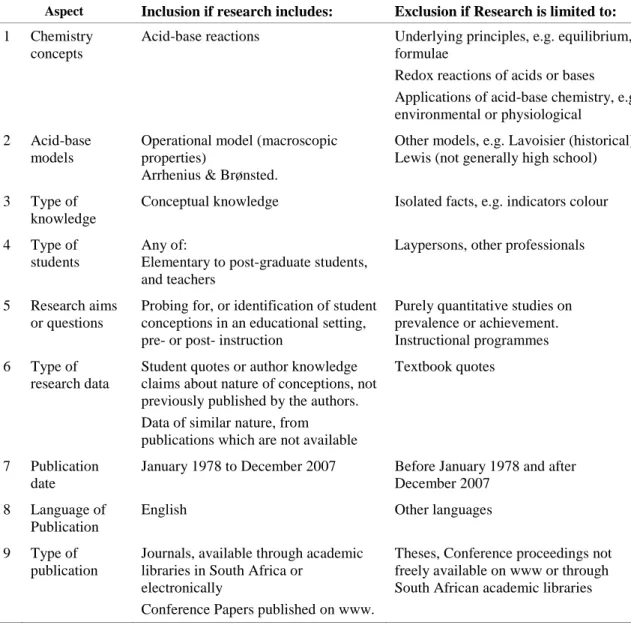
4.4.1 Developing a search strategy and inclusion/exclusion criteria ... 57
4.4.2 Categorising data on the research reports. ... 61
4.5 SYNTHESIS OF DESCRIPTIONS OF STUDENT DIFFICULTIES... 62
4.5.1 Selecting data on student difficulties ... 62
4.5.2 Categorising data on student difficulties... 63
4.5.3 Comparing data to synthesis descriptions of student difficulties... 65
4.5.4 Interpreting difficulty descriptions... 67
4.5.5 Quality of reported research... 68
4.5.5.1 Descriptions of student conceptions, some validity threats. ... 69
4.5.5.2 A four-level framework to classify difficulty descriptions ... 70
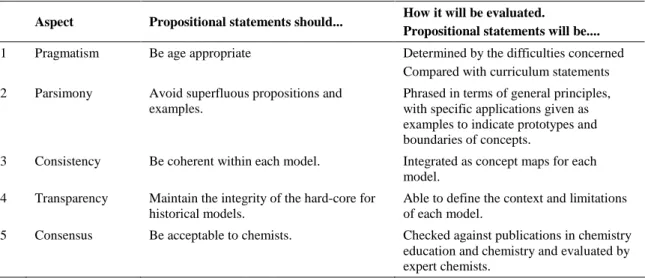
4.6 DERIVATION OF PROPOSITIONAL KNOWLDGE STATEMENTS 74 4.6.1 Criteria for propositional statements... 74
4.6.2 Selecting the propositional knowledge statements ... 79
4.6.3 Using student difficulties to make missing propositional knowledge overt ... 81
4.7 ANALYSING IMPLICATIONS OF PROPOSITIONAL KNOWLEDGE STATEMENTS ... 83
4.8 SUMMARY ... 85
CHAPTER 5 RESULTS SHOWING SCOPE AND QUALITY OF RESEARCH ON ACID-BASE DIFFICULTIES ... 86
5.1 INTRODUCTON ... 86
5.2 SEARCHING AND SCREENING THE REPORTS... 89
5.3 THE SCOPE OF RESEARCH DONE... 93
5.4 QUALITY OF THE RESEARCH... 96
5.4.1 High Quality Research... 96
5.4.2 Problems with reported research... 99
5.4.2.1 Analysis of types of data collection instruments ... 100
5.4.2.2 Nature of research probes ... 101
5.4.2.3 Data interpretation and propositional knowledge ... 102
5.5 SUMMARY AND CONCLUSIONS ... 103
CHAPTER 6 SYNTHESIS OF STUDENT DIFFICULTIES AND PROPOSITIONAL
KNOWLEDGE REGARDING SPECIES IN ACID-BASE CHEMISTRY ... 107
6.1 INTRODUCTION... 107
6.2 DIFFICULTIES WITH ACID-BASE MODELS... 110
6.2.1 Difficulty in accommodating more than an operational model ... 110
6.2.1.1 Difficulty S1: Acid-base definitions are limited to operational definitions. . 110
6.2.1.2 Sub-difficulty S1.3 Ionic compounds have no ions in solution ... 111
6.2.2 Difficulties with the Brønsted model ... 112
6.2.2.1 Difficulty S2: Acids and bases are substances not particles ... 112
6.2.2.2 Sub-difficulties of S2: Examples of acids and bases are limited to the Arrhenius model... 113
6.2.2.3 Specific contexts of Difficulty S2... 114
6.2.2.4 Sub-Difficulty S2.5: Neutralization is limited to and always occurs between compounds having H and OH in the formula ... 115
6.2.3 Difficulty S3: One model can explain all acid-base phenomena. ... 116
6.3 DIFFICULTIES WITH GENERAL DEFINITIONS... 117
6.3.1 Difficulty S4: Acid and base definitions are not distinguished... 117
6.3.2 Difficulty S5: Alkali is another word for base ... 118
6.3.3 Difficulty S6: Amphoteric species are neither acid nor base... 119
6.4 DIFFICULTIES WITH EVERYDAY ACID-BASE EXAMPLES ... 121
6.4.1 Difficulty S7: Acidic and basic substances are not relevant in everyday life. .... ... 121
6.4.2 Sub-difficulty S7.1 Antacids are substances that do not react with acids... 122
6.5 DIFFICULTIES WITH NEUTRAL SOLUTIONS AND SALTS... 123
6.5.1 Macroscopic aspects of neutral solutions and salts... 123
6.5.1.1 Difficulty S8: Neutrality is not understood... 123
6.5.1.2 Difficulty S9 Salts are not a class of compounds... 124
6.5.2 Sub-microscopic aspects of neutral solutions ... 124
6.5.2.1 Difficulty S10: Neutral solutions have neither H+ (or H3O+) nor OH– ions. . 124
6.6 INAPPROPRIATELY REPORTED DIFFICULTIES ... 125
6.7 SUMMARY AND CONCLUSIONS ... 126
CHAPTER 7 SYNTHESIS OF STUDENT DIFFICULTIES AND PROPOSITIONAL
KNOWLEDGE REGARDING ACID-BASE PROPERTIES... 130
7.1 INTRODUCTION... 130
7.2 DIFFICULTIES WITH PHYSICAL PROPERTIES OF ACIDS AND BASES... 134
7.2.1 Conceptions of the danger of acids and bases... 134
7.2.1.1 Difficulty P1: All acids, pure or in solution, are corrosive or can “burn”. ... 134
7.2.1.2 Difficulty P2: Acids are poisonous or toxic... 135
7.2.1.3 Are difficulties P1 and P2 distinct difficulties? ... 135
7.2.1.4 Difficulty P3: Bases are dangerous... 136
7.2.2 The acid-base dichotomy ... 136
7.2.2.1 Difficulty P4: Acids and bases have dichotomous properties... 136
7.2.2.2 Sub-difficulty P4.1: All substances are either acid or base... 137
7.2.2.3 Sub-difficulty P4.2: Bases are not dangerous. ... 137
7.2.3 Difficulties concerning sensory properties of acidic or basic solutions... 138
7.3 DIFFICULTIES WITH ACID-BASE CHEMICAL CHARACTERISTICS... 139
7.3.1 Difficulties with characterising properties of acid-base substances... 139
7.3.1.1 Difficulty P8: Acidic or basic solutions do not have characteristic properties. .. ... 139
7.3.1.2 Difficulty P9: Acids and bases have their own characteristic colours ... 140
7.3.1.3 Difficulty P10: pH applies only to acidity ... 140
7.3.1.4 Difficulty P10.1: Salt solutions do not have a pH... 141
7.3.1.5 Difficulty P11: Acids contain bubbles ... 141
7.3.1.6 Difficulty P11.1: All acid reactions produce gases... 142
7.3.2 Difficulties interpreting empirical observations to identify acids and bases 142 7.3.2.1 Difficulty P12: Higher pH shows greater acidity – Lower pH shows greater alkalinity ... 142
7.3.2.2 Difficulty P12.3: Acidic pH is less than 7, but higher pH shows greater acidity ... 143
7.3.2.3 Difficulty P13: An indicator can test whether an acid is strong or weak... 144
7.3.2.4 Difficulty P14: All indicators change colour at the same pH value... 144
7.4 DIFFICULTIES WITH ASPECTS OF NEUTRALIZATION
REACTIONS... 144
7.4.1 Difficulties with macroscopic aspects of neutralization reactions ... 144
7.4.1.1 Difficulty P15 Neutralization reactions between alkalis and acids produce insoluble salts... 145
7.4.1.2 Difficulty P16: Every neutralization reaction produces a neutral solution ... 145
7.4.1.3 Difficulty P17 No heat is evolved (OR Heat is absorbed) during neutralization reactions ... 146
7.4.2 Difficulty interpreting observations of neutralization reactions ... 147
7.4.2.1 Difficulty P18: Strong acids perform better than weak acids. ... 147
7.4.3 Difficulties with the nature of reactions in acid-base chemistry... 148
7.4.3.1 Difficulty P19: Neutralization is mixing, not a chemical reaction... 148
7.4.3.2 Difficulty P20: Acid-base reactions are additive ... 149
7.4.3.3 Sub-Difficulty P20.1: Indicators are necessary for or assist with neutralization ... 149
7.4.3.4 Sub-difficulty P20.2: Acid-base neutralization is neutralization of oppositely charged ions. ... 150
7.4.3.5 Difficulty P21: Acids are stronger than bases... 151
7.4.3.6 Sub-difficulty P21.1: The product of neutralization is acidic ... 151
7.4.3.7 Difficulty P22: Acid-base reactions proceed to completion ... 152
7.5 DIFFICULTIES WITH OTHER ACID-BASE REACTIONS... 153
7.5.1 Difficulties with acid-base strength ... 153
7.5.1.1 Difficulty P23: Conjugate acid-base pairs are both strong or both weak... 153
7.5.1.2 Difficulty P24: The Arrhenius model is for strong acids and the Brønsted model is for weak acids... 153
7.5.1.3 A salt is not a product – inappropriately reported as a misconception ... 153
7.5.2 Difficulties with hydrolysis... 154
7.5.2.1 Difficulty P25 concerning macroscopic aspects of hydrolysis ... 154
7.5.2.2 Difficulty P26: There is no acid-base reaction between water and the ions from a salt. ... 155
7.6 SUMMARY AND DISCUSSION ... 156
CHAPTER 8 SYNTHESIS OF STUDENT DIFFICULTIES AND PROPOSITIONAL KNOWLEDGE REGARDING TERMINOLOGY AND SYMBOLISM IN ACID-BASE
CHEMISTRY ... 159
8.1 INTRODUCTION... 159
8.2 DIFFICULTIES WITH TECHNICAL LANGUAGE IN ACID-BASE CHEMISTRY... 162
8.2.1 Difficulties with the term ‘strength’... 162
8.2.1.1 Difficulty R1: Acid strength is acid concentration ... 162
8.2.1.2 Sub-difficulty R1.1: Acid strength is shown by more hydrogen in a chemical formula... 163
8.2.1.3 Difficulty R2: Strong acids have strong bonds ... 163
8.2.2 Difficulty with acid-base pairs... 165
8.2.2.1 Difficulty R3: acid-base conjugate pairs are reactant pairs ... 165
8.2.3 Difficulties with ionization, dissociation and decomposition ... 165
8.2.3.1 Difficulty: R4: Ionization and dissociation are not distinguished... 165
8.2.3.2 Difficulty R5: Dissociation is decomposition... 167
8.2.3.3 Summary of difficulties with acid-base terminology... 167
8.3 DIFFICULTIES WITH CHEMICAL FORMULAE AND EQUATIONS ... 167
8.3.1 Difficulties with formulae for acids and bases... 168
8.3.1.1 Difficulty R6: All formulae with hydrogen indicate acids... 168
8.3.1.2 Sub-Difficulty R6.1 Bases have formulae with no hydrogen ... 169
8.3.1.3 Difficulty R7: All formulae with an OH group indicate bases. ... 169
8.3.1.4 Discussion of difficulties with formulae for acids and bases... 170
8.3.2 Difficulties with formulae and equations in acid-base reactions ... 171
8.3.2.1 Difficulty R8: When an acid molecule dissociates it divides in two. ... 172
8.3.2.2 Difficulty R9: The equation showing formulae for substances is suitable to explain neutralization reactions. ... 172
8.3.2.3 Difficulty R10: The general Brønsted reaction scheme shows neutralization. ... ... 173
8.3.2.4 Summary of difficulties with chemical symbolism ... 174
8.4 DIFFICULTIES WITH SYMBOLIC AND MATHEMATICAL REPRESENTATIONS IN pH CALCULATIONS ... 175
8.4.1 Difficulties concerning pH and concentration ... 175
8.4.1.1 Difficulty R11: pH = – log10[H+] suggests pH is directly proportional to [H+] ..
... 175
8.4.1.2 Difficulty R12: pH is a measure of acid or base strength. ... 175
8.4.2 Difficulties concerning limits to pH... 177
8.4.2.1 Difficulty R13: The function pH = – log10[H+] has upper and lower limits.. 177
8.4.2.2 Difficulty R14: pH has discrete integer values ... 178
8.4.3 Difficulties concerning the effect of equilibrium systems on pH ... 179
8.4.3.1 Difficulty R15: pH = –log [H+] means using [H+] only due to acid or base. 179 8.4.3.2 Difficulty R16: Formulae for diprotic acids can be treated as monoprotic acids ... 181
8.4.3.3 Difficulty R17: Neutral and pH = 7 are equivalent at all temperatures ... 181
8.5 SUMMARY AND DISCUSSION ... 183
CHAPTER 9 THE SUITABILITY OF THE DERIVED PROPOSITIONAL KNOWLEDGE FOR TEACHING AND LEARNING ACID-BASE MODELS ... 186
9.1 INTRODUCTION... 186
9.2 EVALUATION OF PROPOSITIONAL KNOWLEDGE STATEMENTS ... 205
9.2.1 Evaluation for pragmatism... 205
9.2.2 Evaluation for parsimony... 207
9.2.2.1 Examination of Brønsted definitions ... 207
9.2.2.2 Evaluation of the acid-base examples... 207
9.2.2.3 Evaluation of the set of propositions... 209
9.2.3 Evaluation for consistency... 209
9.2.4 Evaluation for transparency ... 210
9.2.5 Evaluation for acceptability by consensus ... 211
9.2.6 Summary of evaluation of propositional statements... 211
9.3 IMPLICATIONS FOR TEACHING AND LEARNING ... 212
9.3.1 Implications of the propositional knowledge statements ... 212
9.3.2 Implications of the concept maps for acid-base models ... 214
9.3.2.1 Analysis of critical nodes on concept maps ... 215
9.3.2.2 Analysis of cross-links between concept maps... 218
9.3.2.3 The distribution of difficulty categories on the concept maps ... 220
9.4 SUMMARY AND DISCUSSION ... 223
CHAPTER 10 CONCLUSIONS AND DISCUSSION... 226
10.1 INTRODUCTION... 226
10.2 SCOPE OF THE RESEARCH ALREADY CONDUCTED... 226
10.2.1 Introduction... 226
10.2.2 Main findings ... 226
10.3 THE DIFFICULTIES DESCRIBED IN ACID-BASE CHEMISTRY... 227
10.3.1 Introduction... 227
10.3.2 Main findings ... 228
10.3.2.1 Everyday applications... 228
10.3.2.2 Theoretical models lack an empirical base ... 229
10.3.2.3 Student difficulties with models ... 230
10.4 THE DEPTH OF RESEARCH IN CATEGORIES OF DIFFICULTIES ... 232
10.4.1 Introduction... 232
10.4.2 Difficulties which have been under-researched ... 233
10.4.3 Difficulties which have been adequately or over-researched ... 234
10.5 PROPOSITIONAL KNOWLEDGE ... 236
10.5.1 Introduction... 236
10.5.2 The value of the propositional knowledge statements ... 237
10.5.3 The nature of the propositional knowledge statements... 237
10.6 THE SUITABILITY OF THE PROPOSITIONAL STATEMENTS FOR TEACHING AND LEARNING... 240
10.7 IMPLICATIONS OF THE RESEARCH ... 242
10.7.1 Implications for Practitioner Pedagogical Content Knowledge (PCK) ... 242
10.7.2 Educational implications of threshold concepts... 243
10.7.3 Cognitive development and the Brønsted model ... 244
10.8 IMPLICATIONS FOR FURTHER RESEARCH ... 244
10.8.1 Acid-base topics to research ... 244
10.8.2 Concept inventories ... 246
10.8.3 Implications for research methods in conceptions research... 246
REFERENCES ... 248
APPENDIX 1 LIST OF REPORTS USED IN CRITICAL ANALYSIS... 272
APPENDIX 2 PREVIOUS PAPERS ... 276
LIST OF TABLES
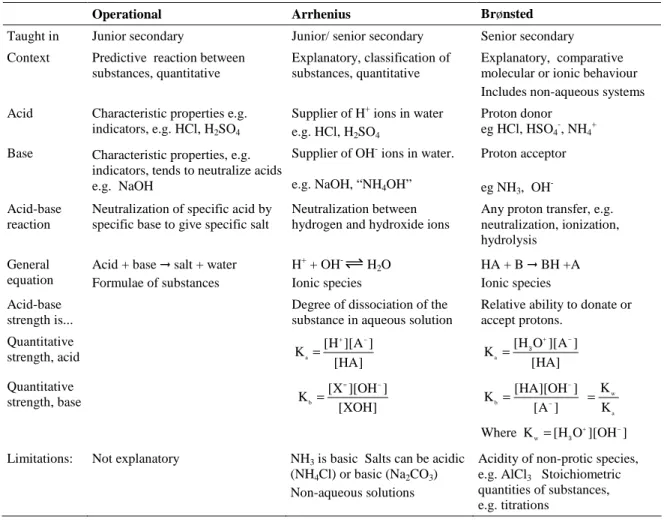
Table 3.1 Summary of three acid-base models used in this dissertation (flip-out) ... 46
Table 4.1 Inclusion and exclusion criteria for research publications (flip-out)... 58
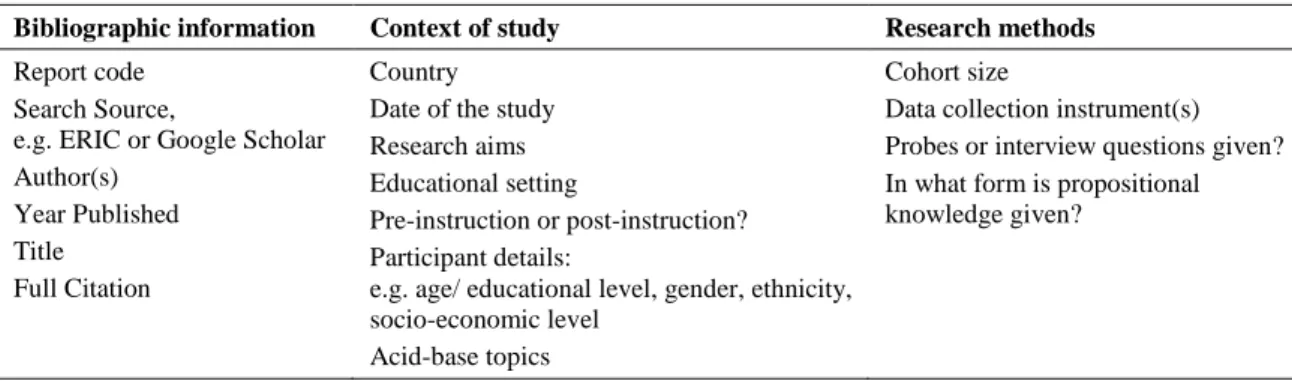
Table 4.2 Contextual information extracted from suitable reports... 61
Table 4.3 Initial categories for difficulty data segments ... 64
Table 4.4 Hierarchical Classification Framework for Difficulty Descriptions (based on Grayson, et al. (2001) (flip-out) ... 72
Table 4.5 Criteria for acceptable propositional statements (flip-out)... 77
Table 5.1 Analysis of research studies used for critical analysis (flip-out)... 87-88 Table 5.2 Showing results of the screening process... 89
Table 5.3 Effectiveness of various means of search strategies ... 91
Table 5.4 Distribution of reports across journals ... 92
Table 5.5 Worldwide distributions of research cohorts ... 93
Table 5.6 Educational levels of student cohorts... 94
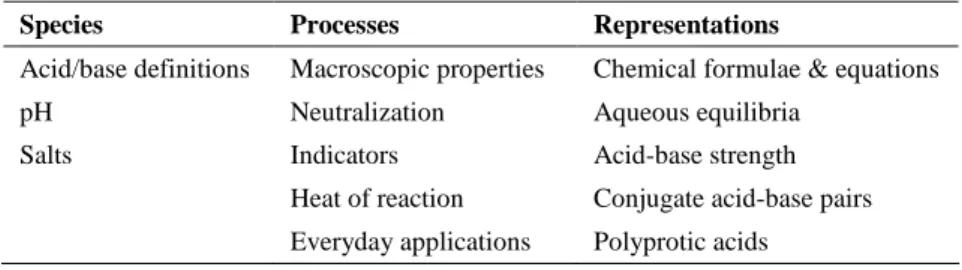
Table 5.7 Acid-base topics included in research on student conceptions ... 95
Table 5.8 Guidelines for investigating the nature of student difficulties ... 106
Table 6.1 Student difficulties with acid-base species with coded propositional statements ... ... 108-109 Table 6.2 The formulae for species not recognised as Brønsted bases or acids by students... 113
Table 6.3 Some of the reaction equations investigated by Furió-Más et al. (2007)... 115
Table 6.4 Summary of research on interchanged acid-base definitions... 117
Table 6.5 Student conceptions of everyday acid-base examples ... 121
Table 7.1 Student difficulties and propositional knowledge regarding acid-base reactions ... ... 131-134 Table 7.2 Summary of research on acid-base sensory properties ... 138
Table 7.3 Research into student conception of pH limitation to acids... 140
Table 7.4 Research concerning heat of reaction for acid-base reaction ... 146
Table 7.5 Research information on conceptions of performance of strong and weak acids ... 147
Table 7.6 Summary of research on sub-microscopic understanding of hydrolysis... 155
Table 8.1 Student difficulties with acid-base representations with propositional statements ...
... 160-162
Table 8.2 Summary of research concerning formulae incorrectly classified as acids... 168
Table 8.3 Summary of research concerning formulae incorrectly classified as bases ... 169
Table 8.4 Student conceptions of limits for pH... 177
Table 8.5 Summary of research into student conceptions of pH for very dilute solutions ... 179
Table 8.6 Summary of some research into conceptions of temperature effect on pH... 182
Table 9.1 Composite List of all Propositional Statements ... 188-193 Table 9.2 Showing typical high school topics not included in Table 9.1... 206
Table 9.3 Examples of acids and bases with reasons for their inclusion ... 208
Table 9.4 Revision of propositional statements to fit the Brønsted model ... 210
Table 9.5 Numbers of propositional statements according to category of difficulties... 212
Table 9.6 Critical nodes identified in concept maps ... 216
Table 9.7 Prevalence of cross-linked concepts and propositions ... 218
Table 9.8 Numbers of propositions implicated in each category of difficulty ... 220
Table 10.1 Numbers of Difficulties or Sub-difficulties classified for each Category. ... 233
LIST OF FIGURES
Figure 1.1 Flow diagram to show structure of the dissertation ... 3
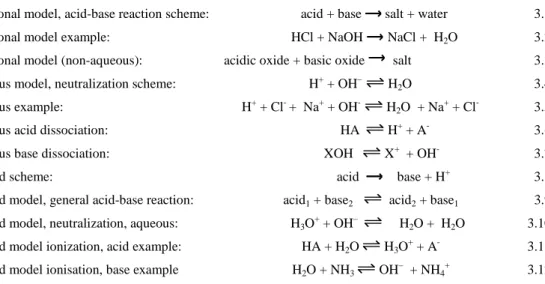
Figure 3.1 Summary of acid-base equations used in this dissertation (flip-out) ... 47
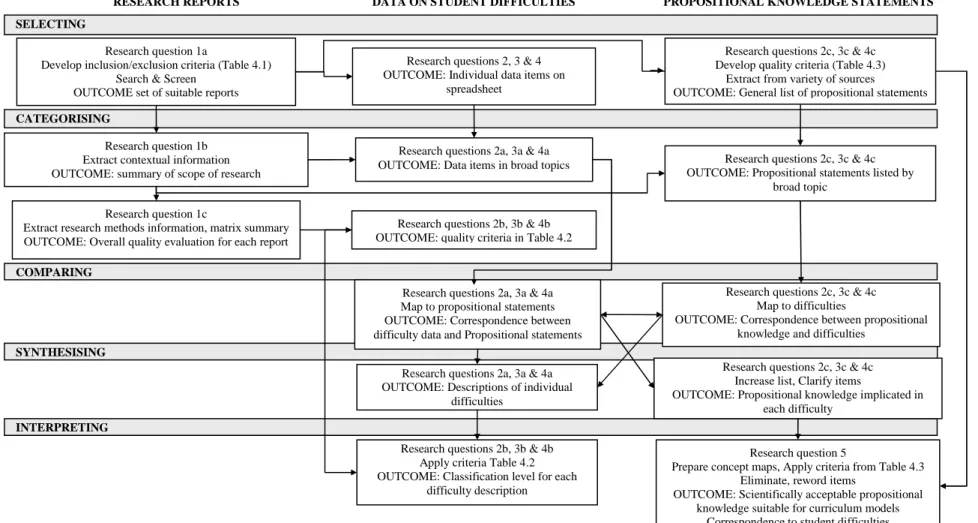
Figure 4.1 Flow diagram to show the overall research protocol (flip-out)... 56
Figure 4.2 A ‘many-to-many’ mapping of student difficulties to propositional statements ... 66
Figure 4.3 Flow Diagram to show derivation of propositional statements ... 79
Figure 6.1 The relationship between species classified as acid, base or amphoteric ... 120
Figure 8.1 Classification of examples of acids and bases ... 171
Figure 9.1 Concept map for Scientific Understanding (flip-out) ... 194
Figure 9.2 Concept map for Operational model of acid-base species (flip-out)... 195
Figure 9.3 Concept map for Operational model of acid-base reactions (flip-out)... 196
Figure 9.4 Concept map for Arrhenius model of acid-base species (flip-out) ... 197
Figure 9.5 Concept map for Arrhenius model of acid-base reactions (flip-out) ... 198
Figure 9.6 Concept map for Brønsted model of acid-base species (flip-out) ... 199
Figure 9.7 Concept map for Brønsted model of acid-base reactions (flip-out)... 200
Figure 9.8 Concept map for Arrhenius model of acid-base strength (flip-out) ... 201
Figure 9.9 Concept map for Brønsted model of acid-base strength (flip-out)... 202
Figure 9.10 Concept map for qualitative aspects of pH (flip-out)... Figure 9.11 Concept map for quantitative aspects of pH (flip-out)... 204
Figure 9.12 Showing the many-to-one mapping between propositions and difficulties ... 213
Figure 10.1 The role of tacit knowledge in making connections between concepts ... 238 203
CHAPTER 1
INTRODUCTION AND AIMS OF THE STUDY
Student difficulties with learning science have produced a considerable body of research spawned by Driver and Easley’s seminal work in 1978 (Driver & Easley, 1978). Early studies focused on student preconceptions in physics leading to a concept inventory test (Hestenes et al., 1992), with later work in biology (e.g. Lawson & Thompson, 1988), chemistry (Taber, 2002) and latterly biochemistry (Grayson et al., 2001). However, this research has not yet effected substantially improved teaching and learning of science (Osborne, 1996; Erickson, 2000) although various causes for conceptual difficulties have been cited. These include naïve preconceptions (Benson et al., 1993), ‘misconceptions’ relating to ideas that contradict empirical facts (Herron, 1996), student reasoning strategies (Stavy & Tirosh, 2000; Talanquer, 2006) and even instruction itself (Taber, 2001a). Furthermore, difficulties in chemistry have been attributed to three levels of representation, namely macroscopic, sub-microscopic and chemical symbolism, which students need to understand and distinguish but simultaneously integrate (Johnstone, 2002). Different models of representations abound in theoretical chemistry (Hoffman & Laszlo, 1999) and incorrect teaching of scientific models has been implicated in student conceptual difficulties (Justi & Gilbert, 1999; Taber, 2001a).
Furthermore, textbooks have been implicated in this problem, particularly in acid-base chemistry (e.g. Furió-Más et al., 2005), but they remain a primary resource for teachers (Costa et al., 2000; Drechsler & Schmidt, 2005a). Despite a need for textbook revision, few reviews of research into student conceptual difficulties in chemistry have been published; some have been general (Garnett et al., 1995; Kind, 2004) while others are topic specific (e.g. Çalyk et al., 2005a), but acid-base chemistry has received little attention. Moreover, there has been little method development for this type of synthesis (Liu, 2001).
I knew from ten years experience in high school teaching that acid-base chemistry was a challenging topic. I thought it was due to student confusion over acid-base definitions as well as poor understanding of sub-microscopic processes. When an opportunity arose for research, I wanted to contribute something useful for teachers which would increase their pedagogical content knowledge or PCK. PCK involves transforming content of a discipline to make it suitable for teaching. It includes knowledge of ways to represent and organise ideas and potential cognitive challenges for students (Shulman, 1986). Accordingly I hypothesized that critical analysis (as review and synthesis) of existing research on conceptual difficulties in acid- base chemistry would also highlight corresponding conceptual knowledge that should be made
explicit for students. This led to the following specific research questions and sub-questions, designed to review, critique and synthesise published research.
1) What is the nature of research published on student difficulties with acid-base chemistry?
a) Which reports give suitable research data on student conceptual difficulties in acid- base chemistry?
b) What is the scope of this research?
c) What is the overall quality of this research?
2) What difficulties do students experience with species in acid-base chemistry?
a) What descriptions of difficulties with acid-base species can be synthesised from existing research data?
b) How stable are these difficulty descriptions across different contexts?
c) What statements of propositional knowledge are needed to address difficulties with species in acid-base chemistry?
3) What difficulties do students experience with acid-base properties?
a) What descriptions of difficulties with acid-base properties can be synthesised from existing research data?
b) How stable are these difficulty descriptions across different contexts?
c) What statements of propositional knowledge are needed to address difficulties with acid-base properties?
4) What difficulties do students experience with terminology and symbolism in acid-base chemistry?
a) What descriptions of difficulties with acid-base terminology and symbolism can be synthesised from existing research data?
b) How stable are these difficulty descriptions across different contexts?
c) What statements of propositional knowledge are needed to address difficulties with acid-base terminology and symbolism?
5) Does the set of propositional knowledge statements derived through analysis of student difficulties reflect appropriate knowledge for teaching and learning acid-base models?
a) How well do the propositional statements reflect curriculum models for acid-base chemistry?
b) What are the implications of the propositional knowledge for teaching and learning acid-base chemistry?
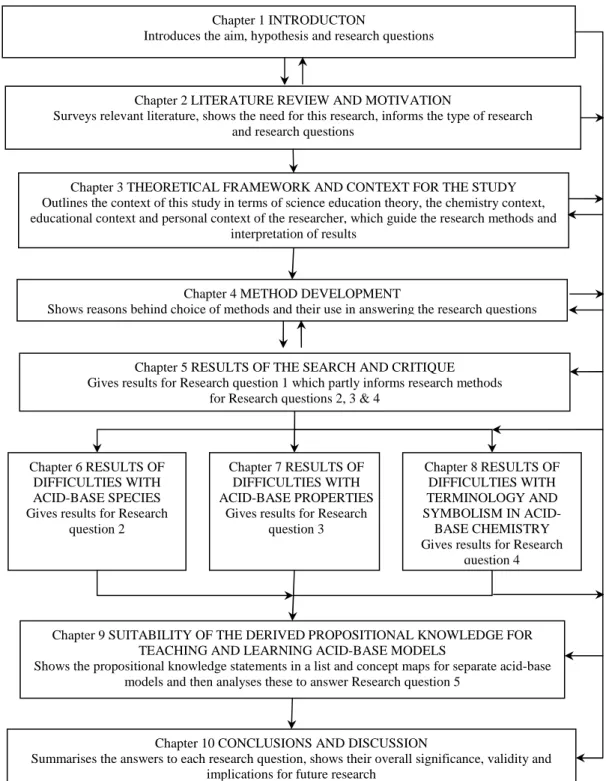
The structure of this dissertation in addressing these research questions is outlined in Figure 1.1 and then described briefly.
Figure 1.1 Flow diagram to show structure of the dissertation
The first research question asked What is the nature of research published on student difficulties with acid-base chemistry? It was addressed through a process of comprehensively searching and rigorously screening relevant literature against a set of criteria which I had previously developed (sub-question 1a). Then the overall scope of the research was analysed according to different variables (sub-question 1b). Finally there was a critique of the research (sub-question 1c). The
Chapter 1 INTRODUCTON
Introduces the aim, hypothesis and research questions
Chapter 3 THEORETICAL FRAMEWORK AND CONTEXT FOR THE STUDY Outlines the context of this study in terms of science education theory, the chemistry context, educational context and personal context of the researcher, which guide the research methods and
interpretation of results
Chapter 2 LITERATURE REVIEW AND MOTIVATION
Surveys relevant literature, shows the need for this research, informs the type of research and research questions
Chapter 4 METHOD DEVELOPMENT
Shows reasons behind choice of methods and their use in answering the research questions
Chapter 5 RESULTS OF THE SEARCH AND CRITIQUE
Gives results for Research question 1 which partly informs research methods for Research questions 2, 3 & 4
Chapter 6 RESULTS OF DIFFICULTIES WITH ACID-BASE SPECIES Gives results for Research
question 2
Chapter 7 RESULTS OF DIFFICULTIES WITH ACID-BASE PROPERTIES
Gives results for Research question 3
Chapter 8 RESULTS OF DIFFICULTIES WITH TERMINOLOGY AND SYMBOLISM IN ACID- BASE CHEMISTRY Gives results for Research
question 4
Chapter 9 SUITABILITY OF THE DERIVED PROPOSITIONAL KNOWLEDGE FOR TEACHING AND LEARNING ACID-BASE MODELS
Shows the propositional knowledge statements in a list and concept maps for separate acid-base models and then analyses these to answer Research question 5
Chapter 10 CONCLUSIONS AND DISCUSSION
Summarises the answers to each research question, shows their overall significance, validity and implications for future research
methods by which these were carried out are given in Chapter 4, with results of this process being given in Chapter 5.
Three parallel questions were asked in Research questions 2, 3 and 4. Firstly, Research question 2 asked What difficulties do students experience with species in acid-base chemistry? It was addressed by synthesising descriptions indicating commonalities behind evidence from independent research projects – this was Research question 2a. Sub-question 2b necessitated evaluating the stability of each difficulty description across different educational and chemistry contexts according to a four-level framework. To this end, results from the critique of original research according to Research question 1 were used. The method used for synthesising descriptions simultaneously revealed propositional knowledge necessary to answer sub-question 2c. Individual propositional statements were extracted from publications by experts in chemistry and chemistry education; textbooks were a minor source. The need for each propositional statement was largely intuitive, according to my teaching experience. The applicable method for each sub-question is described in Chapter 4 with results being given in Chapter 6. This chapter starts with a table showing relevant difficulties together with propositional statements implicated in each. The difficulties are then discussed individually to show how the descriptions and propositional statements were derived.
Answering Research questions 3 and 4 entailed parallel research processes to those used for Research question 2. Respectively, the two questions were What difficulties do students experience with acid-base properties? and What difficulties do students experience with terminology and symbolism in acid-base chemistry? Results for these questions are presented in Chapters 7 and 8 respectively, using a similar format to Chapter 6.
The last research question was Does the set of propositional knowledge statements derived through analysis of student difficulties reflect appropriate knowledge for teaching and learning acid-base models? To answer this question, criteria for acceptable propositional statements had first been developed before deriving the propositional statements used to answer to Research questions 2, 3 and 4. Then a composite list of all the propositional statements was arranged in a conceptual hierarchy derived from a set of concept maps. The propositional statements and concept maps were examined together against criteria to ensure their suitability for teaching and learning in order to consider their appropriateness for high school teaching, consistency with acid-base models and acceptability to expert chemists (sub-question 5a). Further analysis of
the propositional statements and concept maps alongside the difficulties addressed sub-question 5b. Criteria for propositional statements and methods used for constructing concept maps are outlined in Chapter 4 Results, including a table of all propositional statements and concept maps, are given in Chapter 9.
In the last chapter findings from all five research questions are summarised, their limitations evaluated and implications discussed. Finally the implications of all the findings for both educational practitioners and researchers are considered with a view to future research.
The research process involved much cross referencing between three tables of criteria, critique of original research reports and the theoretical framework for the chemistry context, so relevant tables have been presented in a flip-out out form, enabling a reader to consult several aspects at the same time. A list of research reports used in the synthesis is given in Appendix 1, page 272, in addition to their citation as general references.
CHAPTER 2
LITERATURE REVIEW AND MOTIVATION FOR THE STUDY
Learning a body of knowledge accepted by scientists can present difficulties for novices. This chapter looks initially at the nature of such knowledge. It then gives some possible sources for conceptual difficulties that students may experience when they come to learn this body of knowledge. Next this chapter gives some criticisms of research into student difficulties and why this body of work has not effected significant changes in teaching and learning science.
Some research deficiencies are identified and recommendations made for the type of analysis that is needed. This literature review does not focus on acid-base literature because this literature is the focus of the main research study.
2.1 CONSTRUCTS OF SCIENCE KNOWLEDGE 2.1.1 Scientific Concepts
Rule-governed scientific concepts may be “deliberately and consciously invented or adopted for a special scientific purpose” (Kerlinger, 1986, p 27). Scientific concepts always include a definition; this statement of critical attributes of a concept tells us which characteristics are individually necessary and jointly sufficient to classify instances as examples or non-examples (Smith & Medin, 1981; Herron, 1996). Thagard (1996, p 60) terms critical attributes “default expectations”. Several definitions may pertain to one concept, and in a physics context, Galili and Lehavi (2006) include both operational and instrumental definitions (indicating how to measure a quantity) alongside theoretical definitions. However, definitions are only one aspect of the set of knowledge that should be associated with a concept label and overemphasising them could suggest erroneously that concepts are single units of knowledge, rather than networks (Pines, 1985; Herron, 1996).
Networks of knowledge can be organised around concepts (Novak, 2002). Concepts are abstractions or generalizations linked by a particular label, which could be its name or a symbol (Kerlinger, 1986; Novak, 1996). White and Gunstone (1992, p 85) advance an idea of a concept being the “total set of knowledge associated with a label”. Pines (1985, p108) terms it a “locus of meaning” associated with a concept label – a meeting place of all relationships associated with the concept label. Concepts may derive from events or objects with perceived shared characteristics, which are then generalized as a class or set of examples (Novak, 1985). The context or framework in which a concept is used may determine which relationships are
indicated by its label (Pines, 1985; Kellogg, 2003); for example, a concept of matter as a continuous matrix of grains or drops (as a finite element) would be quite acceptable in materials science, whereas chemists conceive matter to be made up of discrete atoms and molecules (Andersson, 1990). Furthermore, an everyday concept and a scientific concept may share a label, which is a possible source of confusion for students (Pines & West, 1986).
Concepts bring order to the world (Smith & Medin, 1981) as they may be organised hierarchically (Thagard, 1996). A concept’s position in a hierarchy of associated concepts (super-ordinate, co-ordinate or supra-ordinate) is part of the set of knowledge associated with a concept (Herron, 1996). In addition to critical attributes given in a concept definition, Herron also includes attributes that may vary across examples of concepts. While limited examples, as stereotypes or prototypes, may be adequate for everyday concepts, a wider range of examples and non-examples need to be associated with a scientific concept in order to indicate both its fullness and limitations. Accordingly, the context specific and hierarchical nature of concepts will influence the manner of presenting propositional knowledge arising from Research sub- questions 2c, 3c and 4c and Research question 5.
2.1.2 Conceptions
Each person’s mental representation of a concept is unique and is constantly evolving, through increased variety of examples and an enriched knowledge network. These idiosyncratic personal mental representations of a concept are termed conceptions (Duit & Treagust, 1995). Johansson et al. (1985) describe conceptions as a qualitative relationship between an individual and a phenomenon. As part of a conception, White and Gunstone (1992) include propositional knowledge (knowing that), procedural knowledge (knowing how), verbatim learning, images and memories of events, all as parts of conceptual understanding. However, understanding a concept does not necessarily include knowing its label and definition, provided other aspects are present (Herron, 1996; Clerk & Rutherford, 2000). Furthermore, Pines (1985) emphasises that, while a concept itself cannot be judged true or false, the relationships around it may be so judged. Thus a person’s conception may differ from consensus ideas of a concept and may include relationships that are at odds with those accepted in a science community. This premise is central to studies on student conceptual difficulties in science. Propositional knowledge is one aspect of a conception that can be compared with consensus scientific knowledge. A proposition’s role in linking two concepts is shown by Novak and Gowan (1984), who use a metaphor of concepts being ‘atoms’ with propositions being ‘molecules’ from which meaning
is built. This study makes use of propositional knowledge indicating a discrete relationship between concepts, which can be compared to student conceptions.
2.1.3 Models
Complementing propositional knowledge, meaningful learning of science involves constructing mental models (Johnson-Laird, 1983; Glynn et al., 1991). These mental models, or inner mental replicas, appear to make use of images (Johnson-Laird, 1983) and have explanatory power. Because they are personal representations (Gilbert et al., 2000), it is possible that, like propositional knowledge, mental models may differ from accepted understanding, thus giving rise to misconceptions (Clerk & Rutherford, 2000). Taber (2001a, p 125) argues that, in chemistry, concepts are often not learned hierarchically, because much of the “theoretical content of chemistry is best seen as a set of models.”
Models may be classified according to a typology given by Gilbert et al. (2000, pp 12-13). A consensus model arises by agreement between different social groups following discussion and experimentation. Once this has “gained acceptance by a community of scientists following formal experimental testing, as manifest by its publication in a refereed journal” it is termed a scientific model. If a “consensus model produced in specific historical contexts” is “later superseded for many research purposes” it is called a historical model. Students are not yet experts, and a simplified version of an historical or scientific model may be included as a curriculum model. Models combining characteristics from individual historical models, using them as a “coherent whole”, are termed Hybrid models. The present study makes use of this typology of models with regard to student conceptions.
2.2 THE NATURE OF STUDENT CONCEPTUAL DIFFICULTIES
When individuals construct knowledge they do so through a filter of prior knowledge and experience and within their social milieu. The conceptions that students find useful and those reinforced by society will be retained (Mintzes & Novak, 2000; Duit & Treagust, 1995).
Student conceptions that differ from those accepted by a community of scientists have generated considerable research in what is known as the Alternative Conceptions Movement (ACM) due to their possible value in planning science instruction (Smith et al., 1993). Early research investigated student naïve preconceptions in mechanics (Lythcott, 1985) and heat (Erickson, 1979). Other disciplines have followed suit, such as research into conceptions of the shape of the Earth (Nussbaum, 1979), of the particle nature of matter (Gabel, et al., 1987) or
stoichiometry and chemical equilibrium (Huddle & Pillay, 1996). By 1994, Wandersee et al.
reported over 700 publications on student conceptions in physics and estimated there were 200 investigations of biology conceptions. Research into student biochemical conceptions has been only more recently explored (Grayson et al., 2001).
These student conceptions show surprising commonality around the world (Driver, 1995;
Solomon, 1993b), being “robust with respect to such factors as age, ability, gender, and culture”
(Wandersee et al., 1994, p 185). Furthermore, these student conceptions are tenacious – students hold firmly to ideas that appear sensible, unlike simple mistakes (Abimbola, 1988) – and these ideas may persist despite a university education (Pyramid Film & Video, 1988; Evans, 2006). Tenacity of these alternative conceptions has prompted research into specific conceptual change strategies in order to address them (Strike & Posner, 1982; Hewson & Hewson, 1983).
The ACM has spawned much literature but a “plethora of terms” (Wandersee et al., 1994, p 178) and lack of uniformity in terminology of the movement are seen as weaknesses in this field of research (Solomon, 1994). In particular, Clerk and Rutherford (2000) criticize some authors for outright failure to define their intended meaning for terms, or for vague generalizations passed off as definitions or for coining yet another new term. Nevertheless, careful choice of terms may indicate two aspects: firstly, it may show an individual research framework – idiographic or nomothetic – and the way in which authors view student conceptions; or it may reflect the type of conception being investigated. These aspects are discussed next.
Within an idiographic framework, researchers may record student conceptions in an ethnographic manner – much as would an anthropologist studying a particular culture. Such work focuses on personal knowledge – what students actually believe – and thus accords respect to these individual conceptions (Lincoln & Guba, 1985; Wandersee et al., 1994). This group of researchers would probably use such terms as children’s science (Duit & Treagust, 1995), intuitive conceptions (Lewis & Linn, 1994), alternative conceptions (Hewson, 1985) or alternative frameworks (Taber, 2001b).
By contrast, research in a nomothetic (science-centred) framework compares student conceptions with consensus scientific understanding. As a result, there is a hint of judgment that students may be ‘wrong’ (Wandersee et al., 1994). Workers from this paradigm are more likely to use the term misconception or pre-conceptions (Kousathana et al., 2005) to describe
conceptions or mental models at variance with currently held scientific theory (Clerk &
Rutherford, 2000). Such erroneous conceptions could be due to science instruction itself (Duit
& Treagust, 1995; Kousathana et al., 2005) or despite good instruction (Driver & Easley, 1978;
Kousathana et al., 2005). Focusing on missing or faulty connections between concepts resulting in false propositional knowledge, Novak and Gowan (1984) propose the term Limited or Inappropriate Propositional Hierarchy (LIPH). Being based on the theory of meaningful learning, this term indicates structural weakness in student’s mental representations.
Accordingly, searching for research published in the field of student conceptions requires an awareness of the variety of terms and, hence, keywords by which authors might describe student conceptions. It also shows that not all authors will be comparing these conceptions to scientifically accepted understanding.
While endorsing the term LIPH, Wandersee et al. (1994) suggest that the term misconception has merits as it is more generally known outside of science education. Furthermore, they are concerned that mainstream scientists, focused on a body of knowledge accepted by consensus, may see little legitimacy in alternative conceptions. Mainstream scientists could thus become alienated from work on student conceptions, despite the attention these deserve when teaching.
While Herron (1996) acknowledges a negative connotation of the word misconception, he maintains that misconceptions are a legitimate and necessary part of intellectual growth.
Moreover, he warns: “it is a matter of time before other labels are tainted” (Herron, 1996, footnote p 110). In the same vein, Terry (1993, p 65) had already noted a common view that alternative conceptions are “rather embarrassing ideas conceived on the wrong side of the blackboard.” From this can be seen that, when publicising research on student conceptions to mainstream scientists and teachers (essentially lay-people in the research field), researchers need to be aware of audience perceptions of labels used.
A different approach to terminology is to consider the subject of student conceptions. Are they conceptions of phenomena, explanations of phenomena or scientifically defined concepts?
Herron (1996) used misconception for student beliefs about phenomena that are contrary to empirical facts; for example, ‘heavier objects will sink in water’. Unlike this example, much early work in the ACM concerned “experience based explanations constructed by a learner to make a range of natural phenomena and objects intelligible”, which Wandersee et al. (1994, p 178) term alternative conceptions. Examples include conceptions of evaporation (Osborne &
Cosgrove, 1983), dissolving (Longden et al., 1991) or force (Hestenes, et al., 1992). As von
Glasersfeld (1995b) points out, many current textbook explanations may be considered misconceptions in the future. This is shown in the history of science where different models have been proposed to explain or represent the same phenomenon; for instance, Carnot’s theory of heat engines in 1824 supposed that ‘heat’ was conserved, but 40 years later William Thompson proposed that ‘energy’ was conserved, not heat (Cropper, 2001). These two models might be seen as alternative explanations for the same phenomenon. More recently, in the relatively new field of biochemistry, tertiary and quaternary protein structures remain contentious (Mbewe, 2000). Furthermore, even such a seemingly simple and well-known chemical reaction as the combustion of magnesium in air can provoke disagreement. In this regard, Lee (1999) found only partial consensus among ten university chemistry lecturers over the mechanism by which the reaction occurred – only eight depicted formation of intermediate complexes. So various student generated explanations, which make sense to them, could rightly be termed alternative conceptions rather than misconceptions.
Scientific concepts are different. Unlike explanations, which may be contentious, scientific concepts are usually agreed on by a community of scientists and defined according to a particular context (see Section 2.1.1). As each concept involves a network of relationships, and a student’s conception of a concept may lack some of these or have included them inappropriately, Novak and Gowan’s (1984) idea of a Limited or Inappropriate Propositional Hierarchy (LIPH) will be used in this study to determine particular network links that might be troublesome. However, some authors claim to have identified ‘misconceptions’ simply because students could not give an appropriate conceptual label. Clerk and Rutherford (2000) rather classify this as a language difficulty. Similarly, Taber (2001a) distinguishes a situation where a student is not sufficiently familiar with two concepts to be able to distinguish them (a conceptual difficulty) from that where a student merely confuses two labels (a linguistic difficulty). Knowing a concept label does not imply understanding concept and, conversely, not-knowing the label does not imply a misconception. Concept labels are is not the conception of a concept.
Different research positions as indicated by terminology discussed above (alternative conceptions, misconceptions and LIPH) can be seen as complementary features allowing a more inclusive view of the complex process of learning (Duit & Treagust, 1995). In this vein, and avoiding semantic issues, Grayson et al. (2001) use the term student difficulties to refer to problems that students exhibit in understanding and application of scientific concepts and
reasoning skills. This encompasses a broad range of other terms such as alternative conceptions, preconceptions, and incorrect ways of reasoning. This inclusion of reasoning difficulties has since been confirmed by a secondary analysis of published misconceptions in chemistry, which attributed many misconceptions to students’ faulty heuristic reasoning (Talanquer, 2006) and confirms the multifaceted nature of learning.
Thus, a student could have a misconception in thinking aluminium foil will keep a drink cold, could have an alternative conception concerning an explanation for wool keeping drinks warm, and could show a LIPH or misconception about the scientific meaning of heat capacity. A student may have well-differentiated conceptions of temperature and internal energy of a body without giving these linguistic labels; or might be unable to use proportional reasoning to calculate the final temperature of a mixture. All of these could be described as student difficulties but the distinction in labels is not trivial. Each requires a different didactic means of addressing the problem. The term, student difficulties, reflecting a multi-faceted nature of learning science has been adopted in the current project. It will, however, focus on student conceptual difficulties, rather than linguistic.
2.3 SOURCES OF STUDENT CONCEPTUAL DIFFICULTIES
Numerous causes have been put forward for student conceptions which are contrary to accepted science. Wandersee et al. (1994) warn that tracing the origins of alternative conceptions is largely speculative, as each learner is individual. Nevertheless, the universality of these conceptions among different cultures and ages suggests several common experiences that can cause difficulties. These include the nature of science (and more particularly chemistry) and the language of science, informal and formal instruction, as well as sources within a student, which are discussed below.
2.3.1 The Nature of Science
Students may misunderstand the nature of science (Kousathana et al., 2005). In this way, they may consider scientific conceptions or theories as “a kind of privileged truth” instead of being viable within a historical or practical context (von Glasersfeld, 1995b, p 15). Furthermore, students sometimes believe scientific models have direct correspondence with reality (Oversby, 2000a; Talanquer, 2006). They could be confused between models (Carr, 1984; Hawkes, 1992, Drechsler & Schmidt, 2005b)) and may even attempt to integrate several distinct models into
one composite model (Justi, 2000), as do many textbooks (Justi & Gilbert, 1999; 2002a).
Teaching a simplified curriculum model may itself introduce difficulties (Glynn et al., 1991).
2.3.2 The Language of Science
The language of science also presents difficulties (Özmen, 2004). Scientific texts often introduce more new vocabulary words per page than do foreign language texts (Glynn et al., 1991). Non-technical words like ‘pungent’ or ‘aqueous’ or ‘excess’ may also be beyond a school pupil’s ordinary vocabulary or not understood within a science context (Cassells &
Johnstone, 1983; Johnstone, 1991). Further language difficulties may arise when students superimpose their everyday word associations onto scientific terms with restricted meanings (Pines & West, 1986; Chiu, 2007). Another difficulty may arise when the scientific meaning for a concept label has changed historically, yet the label still invokes the original concept for students (Schmidt & Volke, 2003). Kuhn (1970) argues that this confusion is also found among scientists when a paradigm shift occurs. When students are not learning in their mother tongue, as happens for many in South Africa, these difficulties may be compounded (Moji, 1998). In this matter, Clerk and Rutherford (2000) investigated so called wrong answers to multiple- choice probes published by other authors. They showed these answers had been too readily ascribed to misconceptions (as incorrectly assimilated mental models) rather than language difficulties. They differentiate clearly between these two categories because each requires specific remedial strategies.
Nevertheless, while poor understanding of the language of science may in itself not be a misconception, it can give rise to inappropriate mental models. Herron (1979) believes that when chemistry teachers themselves misuse or permit misuse of scientific language they could contribute to student conceptual difficulties; for instance, allowing students to refer to all of H2, H+ and H simply as ‘hydrogen’ suggests erroneously that there is no difference between molecules, ions and atoms. Moreover, knowing the distinctive and limited meanings for explicit terms that are appropriate to specific situations is part of acculturation into chemistry (Oversby, 2000a). Language is one essential level on which to understand and communicate chemistry (Laing, 1999). This language aspect, together with the argument about concept labels from the previous section, is relevant in three ways for the current project; it necessitated a careful analysis of the language used in research instruments and claims of misconceptions but it also informed one of the categories of difficulties.