A description of mathematical proficiency, in number skills, of grade ten learners in both the Mathematics and Mathematics
Literacy cohorts at a North Durban school
by
Vivendren Govindarajaloo Moodley
Submitted in partial fulfilment of the academic requirements for the degree of
Master of Education in the School of Mathematics Education Faculty of Education
University of KwaZulu-Natal
January 2008
ABSTRACT
The main objective of this study was to determine the progress made in the development of mathematical proficiency, in the domain of number skills, by learners in the two cohorts (namely: Mathematics and Mathematical Literacy) during Grade ten. The research was conducted at Temple Valley Secondary School, which is situated at Verulam, north of Durban in KwaZulu-Natal. Furthermore, this research study was questionnaire-based employing basic descriptive statistics as well as qualitative analyses. Data was collected through numeracy (number) skill tests, a questionnaire and focus group interview responses of grade ten mathematics learners. A total of two skill tests were administered and 3 focused group interviews were conducted with six grade ten learners each. The first test and first attitudinal questionnaire was administered in May 2006 when learners had branched off into the two paths of mathematics. Thereafter, a second test and second attitudinal questionnaire was administered, during October 2006; when learners had completed most of the school year. The October-test was followed by the focus group interviews. A convenient sample was used in selecting the learners for this research study and a purposeful sampling technique was used for the focus group interviews. All grade ten learners at Temple Valley Secondary School were selected as the sample. The results showed that the mathematics learners slightly outperformed the mathematical literacy learners in the development of mathematical proficiency for number skills. The findings from this research could inform: Teachers of grade ten learners with an interest in improving the mathematical proficiency, in number skills, of learners and; curriculum developers and materials development specialists who prepare mathematical material for grade ten classrooms. The results showed that none of the grade ten learners, from either cohort, were mathematically proficient in May or October. From the study, it was noted that the female grade ten learners generally outperformed their male counterparts. The focus group interviews revealed that learners had a positive attitude to the learning of the subject mathematics, despite the poor test results of this study.
ABBREVIATIONS
LO: Learning outcome
GET: General Education and Training FET: Further Education and Training ML: Mathematical literacy
RQ: Research question
TABLE OF CONTENTS
PREFACE III
ABBREVIATIONS IV
TABLE OF CONTENTS IV
LIST OF TABLES VII
LIST OF FIGURES VIII
ACKNOWLEDGEMENT IX
CHAPTER 1 INTRODUCTION 1
1.1 Motivation for study 1
1.2 Background to the study 1
1.3 Deriving the research topic 2
1.4 Outline of the research 4
1.5 Concept clarification 5
1.6 Overview of the thesis 6
CHAPTER 2 LITERATURE REVIEW AND THEORETICAL FRAMEWORK FOR THE
STUDY 8
2.1 Understanding mathematical learning 8
2.2 The mathematics/mathematical literacy debate 17
2.3 Contextualising number skills within the South African school
curriculum 24
2.4 Factors influencing the achievement of mathematical proficiency 27
2.5 Conclusion 30
CHAPTER 3 RESEARCH DESIGN AND METHODOLOGY 31
3.1 Research method 31
3.2 Philisophical orientation of the study 32
3.3 Case studies 32
3.4 Research context and sampling 33
3.5 Research Design and fit to research questions 34
3.6 Data generation and analysis 35
3.7 Ethical considerations 45
3.8 Conclusion 45
CHAPTER 4 RESULTS: PRESENTATION AND DISCUSSIONS 46 4.1 The mathematical proficiency of grade ten mathematics literacy learners in the
domain of numbers 46
4.2 The mathematical proficiency of the grade ten mathematics literacy cohort compared with the mathematical proficiency of grade ten mathematics cohort 55
4.3 The mathematical proficiency changing over the course of the Grade ten year 62
4.4 Factors influencing the achievement of mathematical proficiency 71 4.5 Summary and conclusion 83 CHAPTER 5 CONCLUSIONS AND RECOMMENDATIONS 84 5.1 Summary of study 84 5.2 Recommendations 87 References 90 APPENDICES 95 A May-test and scoring guide 96
B October-test and scoring guide 112
C Questionnaire 129
D Consent form 132
E Clearance letter 133
F Fit of questions to curriculum 134
G Production disposition tables 138
H Interview questions 142
I Summary table of percentage correct for May/Oct-tests 144
J Summary t-tables 146
LIST OF TABLES
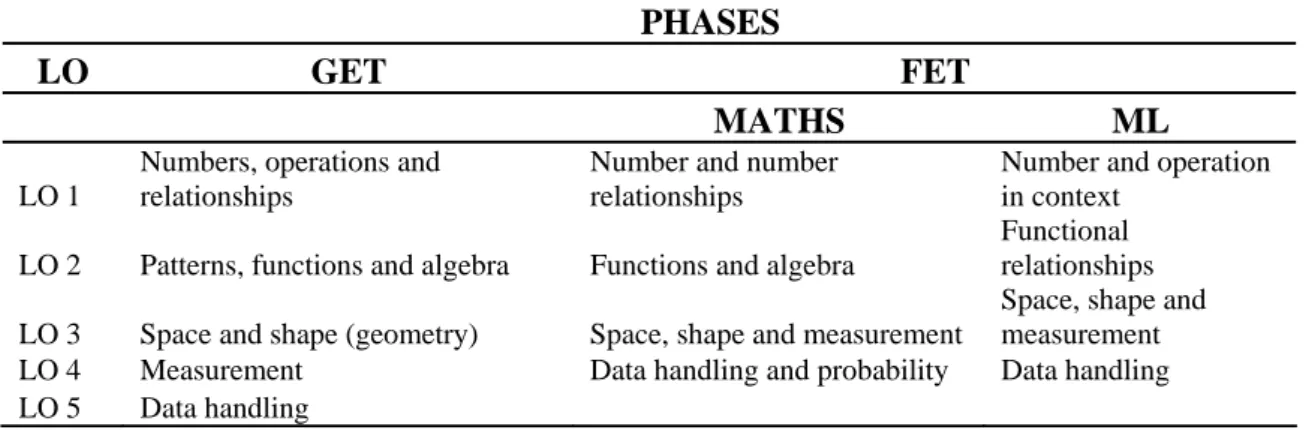
Table 2.1 Classification of the characteristics of learners having proficiency in each strand 13 Table 2.2 Learning outcomes in GET and FET phases 27
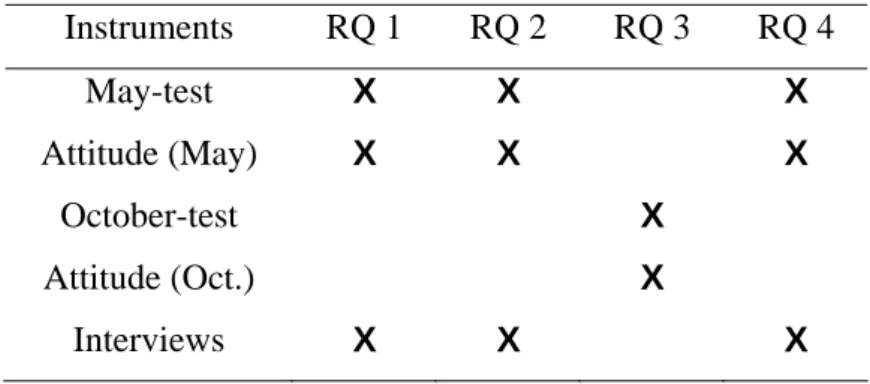
Table 3.1 Match of data collection instruments to Research Questions 34 Table 3.2 Classification rules for questions for May and October-tests 37 Table 4.1 Gender comparisons of both cohorts for question 11 in the May and
October-tests 78
LIST OF FIGURES
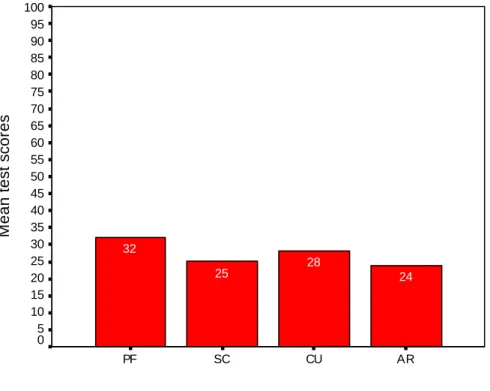
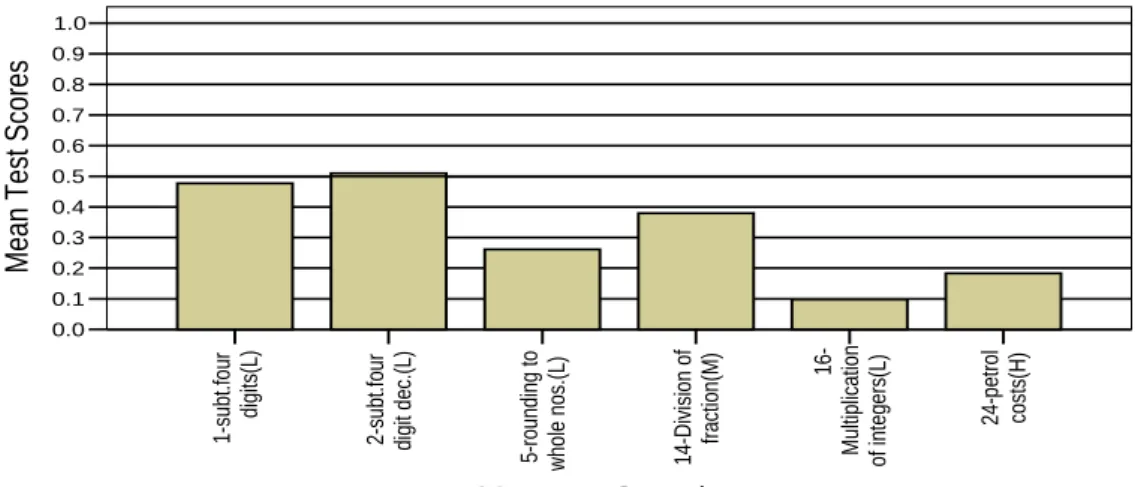
Figure 4.1 Mathematical proficiency of Grade ten mathematical literacy learners in all four content strands 47 Figure 4.2 Mathematical proficiency of Grade ten mathematics literacy learners in
procedural fluency 48 Figure 4.3 Mathematical proficiency of Grade ten mathematics literacy learners in adaptive
reasoning 49 Figure 4.4 Mathematical proficiency of Grade ten mathematics literacy learners in
conceptual understanding 50
Figure 4.5 Mathematical proficiency of Grade ten mathematics literacy learners in
strategic competence 52
Figure 4.6 Comparison of mathematical proficiency of Grade ten mathematical literacy and Mathematics learners in the May-test 56
Figure 4.7 Mathematical proficiency of Grade ten mathematical literacy and
mathematics learners in conceptual understanding 59 Figure 4.8 May-test question 9 60 Figure 4.9 Mathematical proficiency of Grade ten mathematical literacy and
mathematics learners in strategic competence 60 Figure 4.10 Comparison of mathematical proficiency between Grade ten mathematics and
mathematical literacy learners over the course of the year 62 Figure 4.11 Comparison of mathematical proficiency between the two cohorts with respect to
multiple-choice and contextual questions 67 Figure 4.12 Gender comparisons of Grade ten mathematics learners for May-test
question 1 76 Figure 4.13 Gender comparisons of Grade ten mathematics learners for October-test
question 1 77
Figure 4.14 Gender comparisons of the mathematical proficiency of Grade ten learners in conceptual understanding (May-test) 79 Figure 4.15 Gender comparisons of the mathematical proficiency of Grade ten learners in strategic competence (May-test) 80 Figure 4.16 Gender comparisons of the mathematical proficiency of Grade ten learners in
strategic competence (October-test) 81
ACKNOWLEDGEMENT
I express my heartfelt appreciation and gratitude to the following:
God Almighty for the power and mental strength He gave me to undertake this arduous task.
Mrs. Sally Hobden for her professional contribution, support, being a constant source of encouragement, and offering welcome guidance and advice any time I asked for it.
Mr. P. Maharaj, the principal of Temple Valley Secondary, mathematics teachers and all grade ten learners, for their willingness and cooperation, and also for making this research study a success.
Last but by no means least, my wife and two children, Zelda, Tyra and Tyler;
for their support, commitment and patience with my mental and physical preoccupation during the months of writing this dissertation.
Dedication
This thesis is dedicated to my loving family and the 2006 grade ten learners of Temple Valley Secondary.
CHAPTER 1
In this chapter, I will outline the research process. First, I will discuss what motivated this research study leading to the discussion of the purpose of this study. I will then state the research questions which I will attempt to answer through the research
process. Further, I will clarify the concepts of the critical question being researched and briefly describe the methodology used in this study. Finally, I will indicate what occurs in the following chapters of this dissertation.
1.1 MOTIVATION FOR STUDY
I am currently a mathematics educator at a secondary school in Verulam. This research grew out of the concern for the poor performance of learners in the General Education and Training phase (grade seven-nine) of mathematics education. In recent years, I have met many mathematics teachers, mathematics examiners and mathematics subject advisors from different parts of Durban in workshops and seminars; who echoed my sentiments exactly, about the poor performance of learners especially in senior
mathematics. My concern was that if learners performed very poorly at the end of grade nine, they cannot drop mathematics but are forced to continue with it. Both the pure mathematics and mathematical literacy learners who have been promoted to grade ten, have the same starting point, a pass in grade nine, but are exposed to different content and context during the course of their grade ten year therefore I wanted to see whether they were adequately prepared for pure mathematics and mathematical literacy. There was a need to examine what lies behind the difficulty experienced by my learners in coping with the study of mathematics.
1.2 BACKGROUND TO THE STUDY
In the past, successful mathematics learning meant fluency in the computational skills of arithmetic (Kilpatrick, Swafford and Findell, 2001). Recently, there has been a debate about what success in mathematics really means. Today, many educators and curriculum developers (Government) agree that skills are needed, but in addition agree that there should be more emphasis on students learning procedures with understanding (Ibid). All stakeholders; including parents, teachers, state and community leaders; need
to create a coherent vision of what it means to be mathematically literate both in a world that relies on calculators and computers to carry out mathematical procedures and in a world where mathematics is rapidly growing and is extensively being applied in diverse fields (Ibid).
One of the major questions that needed an answer was whether learners in South African (S.A) schools became sufficiently mathematically proficient by the end of the compulsory phase of schooling. The Department of Education (DoE) in South Africa believed that this was not the case and therefore introduced the new FET curriculum for senior secondary learners, where learners chose either formal mathematics or
mathematical literacy (ML) to help improve their mathematical proficiency
(Department of Education, 2003). South Africa was one of fifty countries participating in the Third International Mathematics and Science Study (TIMSS) 2003, with 255 schools and 8952 learners. What was shocking was that South Africa had the lowest performance score for mathematics and science of the fifty TIMSS participants.
According to Reddy (2006), South Africa had the largest variation in scores, ranging from mostly very low, to a few very high scores, meaning this score distribution was not normal but skewed to the left. This implies that certain learners performed above the average and others far below. TIMSS results sets the foundation for my study in that the majority of South African learners are not mathematically proficient. My research wants to determine whether the introduction of the new curriculum (FET) will make a difference to these learners proficiency in mathematics. Therefore, my research was based on whether these two paths of mathematics actually improved the
mathematical proficiency (number skills) of grade ten learners.
1.3 DERIVING THE RESEARCH TOPIC
Mathematical Literacy, a new subject in the South African FET curriculum, was introduced for the first time in 2006. Mathematics was divided into two paths, namely:
mathematical literacy and mathematics. Learners had a choice of either path. Through my eleven years of teaching mathematics, I have noticed that the development of mathematical proficiency in number skills; which incorporate Learning Outcome One (LO), Number and Operations in Context and Number and Number Relationships, in Mathematical Literacy and Mathematics respectively; was seriously lacking in learners
at this senior level. Therefore, I have decided to describe the development of
mathematical proficiency (in LO 1) of the grade ten learners in both the mathematics and mathematical literacy cohorts.
Why did I choose the number domain? Kilpatrick et al (2001) suggests that number sense is the foundation of all later number work. Familiarity and fluency with numbers, number sequences and estimation can be developed from a very early age. Number is fundamental to describing and understanding the world in which we live and yet we take it for granted that children will unravel its complexities. The mathematics curriculum during the preschool, primary school, and high school years has many components. However, at the heart of mathematics in these years is the mathematical domain of number. Furthermore, the domain of number both supports and is supported by other branches of mathematics, including algebra, measure, space, data, and chance (Ibid).
Some reasons for choosing the particular questions
This study is framed by the following four research questions:
1. What is the mathematical proficiency of grade ten Mathematical Literacy learners in the domain of numbers?
2. How does the mathematical proficiency of the grade ten Mathematical Literacy learners compare with the mathematical proficiency of the grade ten Pure
Mathematics learners?
3. How did the mathematical proficiency change over a four-month period in both cohorts for these grade ten learners?
4. How did gender and misconceptions influence the achievements of the mathematical proficiency of these grade ten learners?
Research question one is included to determine the initial mathematical proficiency with which the mathematical literacy learners will enter grade ten. In research question two, I found it useful to compare the mathematical literacy learners with the pure mathematics learners in terms of their mathematical proficiency at entry into grade ten so that I could gauge which cohort performed better. In question three it is important and necessary to this research study to assess whether there was a change in
mathematical proficiency over a period of about four months in both cohorts. Finally, I wanted to determine what factors may influence the development of mathematical proficiency of these grade ten learners, namely gender and misconceptions.
1.4 OUTLINE OF THE RESEARCH
This research study involved both quantitative and qualitative methods of data analysis.
According to Denzin and Lincoln (2003), quantitative studies have their emphasis on the measurement and analysis of causal relationships between variables, where the researcher is objective and the participant’s responses are value-free. Qualitative studies involve the researcher locating her/himself, as a part, in the participant’s world (Ibid).
Furthermore, they argue that qualitative researchers study things in their natural settings, attempting to interpret the results in terms of the meanings people (learners) bring to them. For the purpose of this study, qualitative data was collected in focus group interviews, reflective writings, and questionnaires; whereas quantitative data was collected in two tests.
The following tools were used for data collection:
1) A May-test and October-test to assess mathematical knowledge and skills 2) A May and October questionnaire to assess attitudes to mathematics 3) Reflective writing, and
4) Semi-structured focus group interviews.
This research represented an analysis of the numeracy (number) skill tests, questionnaires and interview responses of grade ten learners.
A May-test was administered shortly after learners had branched off into the two paths of mathematics. Thereafter, the October-test was administered towards the end of the year, while learners were undertaking either mathematics or mathematical literacy. The May-test and October-test were followed by a piece of reflective writing.
Focus group interviews were conducted in between the May-test and October-test.
A convenience sampling technique was used in selecting grade ten learners for this study. In addition, three focus groups were interviewed in order to obtain rich data.
Each group consisted of six learners either from the mathematical literacy and/or from mathematics class. I selected the learners according to their performance scores in the May-test.
This research applied the five strands for mathematical proficiency (Kilpatrick et al, 2001) in analyzing the data collected. The data were analysed using the theoretical framework of mathematical proficiency, which is fully described in Chapter 2.
1.5 CONCEPT CLARIFICATION
At the outset, it is helpful to clarify some key concepts, and meaning they have in the context of this study.
1.5.1 Mathematical proficiency
Kilpatrick et al (2001) suggests that mathematical proficiency empowers learners with the competence, expertise, knowledge, and facility in mathematics; which is
necessary for any learner to learn mathematics successfully. It is also believed that this proficiency enables learners to cope with mathematical challenges in everyday life. Mathematical Proficiency has five strands, namely conceptual understanding, procedural fluency, strategic competence, adaptive reasoning and productive disposition. These five strands are interdependent and interwoven, which has implications for how learners acquire mathematical proficiency.
1.5.2 Mathematics
For the purpose of this study, mathematics refers to a knowledge constructed through the establishment of numerical, descriptive and symbolic relationships. The
Department of Education (2003b), states that mathematics encourages logical and creative reasoning in the real world.
1.5.3 Mathematical literacy
For the purpose of this study, mathematical literacy refers to the learner relating mathematics to real life applications. The Department of Education (2003a) defines mathematical literacy as being “… driven by life-related applications of mathematics.
It enables learners to develop the ability and confidence to think numerically and spatially in order to interpret and critically analyse everyday situations and to solve problems” (p. 10).
1.5.4 Number skills
For the purpose of this study, number skills refers to the ability of learners to recognise, describe, represent, estimate, calculate, check solutions, and confidently investigate a range of different contexts; which included financial aspects
(Department of Education, 2003b; Department of Education, 2003a).
According to Department of Education (2003b), “The focus of this learning outcome is on the investigation and solution of problems that require a sound understanding of numbers and their use in calculations, especially in financial contexts, ranging from personal to international issues…. Learners should develop sound estimation and mental calculation skills and a facility in using equivalent forms to simplify
calculations. Proper conceptual understanding will be required to enable learners to use calculators appropriately and effectively” (p. 11). In the above, I refer to Learning Outcome One: Number and Number Relationships.
1.6 OVERVIEW OF THE THESIS
In Chapter 1, I introduce the research study. It highlights the reasons why I chose this topic and gives a brief background to the study. This chapter also explains from whence the research topic was derived and gives an outline of the tools and time-line for this study. I conclude this chapter with some concept clarification to help readers better understand the content of this research.
Chapter 2 in which I discuss the literature pertaining to my research topic from an international and local perspective follows this introductory chapter; and in particular Mathematical Proficiency, which provides a theoretical framework for this study.
In Chapter 3, I document the research design and methodology followed during the fieldwork. This chapter will begin with the design of the study. This will be followed by a discussion of the research methodology, including the research instruments, structured tests, questionnaires, semi-structured interviews, and pilot study. Next, the
ethical issues, administration of instruments, limitations of design and methodology, and data analysis will be discussed.
I include the presentation and discussion of the results for this research in Chapter 4.
The main trends and patterns in the data will be discussed with reference to the four research questions. Furthermore, the results will be interpreted in terms of the literature/theory reviewed in Chapter 2.
In the final chapter, I include the conclusions and recommendations arising from this study. This chapter will firstly provide a summary of this study. Secondly, the conclusions for each proficiency strand will be discussed. Thirdly, the larger significance and value of the study will be shown. This chapter will conclude with recommendations regarding further research, the implementation of the findings and the possible policy implications.
CHAPTER 2
This study has attempted to describe mathematical proficiency, in number skills, of grade ten learners in both the Maths and Maths Literacy cohorts (within the NCS) at a school. In order to provide answers for the above statement, I have read many local and international authors who presented different or various perspectives about the links between mathematical proficiency, mathematics and mathematical literacy. The five strands of mathematical proficiency namely, Procedural fluency, Adaptive reasoning, Conceptual understanding, Strategic competence and Productive disposition have been used in trying to explain and understand the role of mathematics and mathematical literacy in promoting mathematical proficiency amongst school learners. It was decided that the literature would be demarcated into local and international literature.
2.1 UNDERSTANDING MATHEMATICAL LEARNING
I will describe two theoretical perspectives from which mathematical learning can be viewed. The first is the more recent notion of mathematical proficiency, which offers a means to describe the understanding of mathematics learning and the second, the constructivist perspective, which is a theory that describes how learning takes place. I will then discuss how the two perspectives can be linked to create a theoretical framework for the analysis of the research data.
2.1.1 Mathematical proficiency
The mathematical proficiency of South African citizens, in the past apartheid era, was of a very low level due to the poor quality or lack of education (HSRC, 2000). In addition, many learners who found mathematics difficult in their junior secondary level of schooling usually terminated their studying in mathematics; thus decreasing the levels of mathematical proficiency in South African schools and society. The TIMSS (2003) indicated that learners in South Africa have performed very poorly as compared to learners from developed or developing countries. In order to remedy this problem of innumeracy, the Department of Education (2003a) has included Mathematical Literacy as a subject in the Further Education and Training curriculum to ensure that the citizens
of the future are highly proficient in mathematics. Furthermore, they state that Mathematical Literacy will help develop the basic mathematical skills and ability to solve everyday problems in various realistic situations.
In this study, I have assessed the development of numeracy skills through the
framework of mathematical proficiency. This framework comprises five components or strands. The five strands of mathematical proficiency are conceptual understanding, procedural fluency, strategic competence, adaptive reasoning and productive
disposition (Kilpatrick et al, 2001). Conceptual understanding is the learners understanding of mathematical concepts and operations. Procedural fluency is the learner carrying out skills (practice) accurately, efficiently and appropriately. However
“… practice on computational procedures should be designed to build on and extend understanding.” (Kilpatrick, Swafford, and Findell, 2001, p. 423). As mentioned above, understanding of procedures is of vital importance for the success of the learner in mathematics. Strategic competence is the learners’ ability to formulate and solve problems. It must also be noted, “Problem solving should be the site in which all of the strands of mathematics proficiency converge.” (Kilpatrick et al, 2001, p. 421). On the contrary, too much emphasis is placed on problem solving in mathematics and as a result, the skills and knowledge components are lagging behind. The new curriculum needs to find a balance between context, skills and knowledge. Adaptive reasoning is the learners’ capacity for logical thinking, explanation and justification of action.
Lastly, productive disposition is the learners’ attitude to see mathematics as sensible, useful and worthwhile in and outside of school. From my teaching experience, this aspect was seriously lacking in the past educational system.
Conceptual understanding
The first strand is conceptual understanding where learners’ comprehension of mathematical concepts, operations and relations are determined. Conceptual understanding refers to an interconnected and functional comprehension of
mathematical ideas. A learner with conceptual understanding does not learn facts or methods in isolation because they understand why these mathematical ideas are
important and how it is useful in different contexts. Milgram (2004) states that a student should not simply memorize concepts and repeat it verbatim but should understand why it is stated the way it is. In order to verify whether students understand the concepts, the
following three questions should be asked: What does the statement include?; what does the statement exclude?; and what would happen if the concepts were changed and why is the changed concept not used? (Ibid). In contrast, primary and secondary students generally learn mathematics without any understanding and then expect to apply their knowledge in solving problems. As a result, I believe the performance is dismal for these primary and secondary learners in mathematics as compared to other subjects. Therefore, these learners must organize their new knowledge into existing schemas in a meaningful way, which enables them to retain, use, remember and reconstruct mathematical ideas when forgotten. In addition, students demonstrate conceptual understanding in mathematics when they provide evidence that they can recognize, label, and generate examples of concepts; use and interrelate models, diagrams, manipulatives, and varied representations of concepts; identify and apply principles; know and apply facts and definitions; compare, contrast, and integrate related concepts and principles; recognize, interpret, and apply the signs, symbols, and terms used to represent concepts. According to the NCTM (1989) and Department of Education (2003a) conceptual understanding reflects a student's ability to reason in settings involving the careful application of concept definitions, relations, or representations of either.
Procedural fluency
The second strand is called procedural fluency where the learners’ skill in carrying out procedures flexibly, accurately, efficiently and appropriately is assessed. Students demonstrate procedural knowledge in mathematics when they select and apply
appropriate procedures correctly; verify or justify the correctness of a procedure using concrete models or symbolic methods; or extend or modify procedures to deal with factors inherent in problem settings. Procedural knowledge encompasses the abilities to read and produce graphs and tables, execute geometric constructions, and perform non- computational skills such as rounding and ordering. Procedural knowledge is often reflected in a student's ability to connect an algorithmic process with a given problem situation, to employ that algorithm correctly, and to communicate the results of the algorithm in the context of the problem setting (NAGB, 2005).
Many tasks involving mathematics in everyday life require general procedures for performing calculations either mentally or in writing. In addition, some procedures are important as concepts, which show the link between conceptual understanding and
procedural fluency. Moreover, a certain level of skill is required to learn many mathematical concepts with understanding and using procedures can help strengthen and develop that understanding. When learners’ practice procedures they do not understand, there is a danger they will practice incorrect procedures, thereby making it more difficult to learn correct ones. Another major danger of children learning without understanding is that they separate what happens in school from what happens outside.
In other words, these learners have different sets of procedures for solving problems in and outside of school. This separation limits the learners’ ability to apply what they learn in school to solve real-life problems.
Strategic competence
The third strand of mathematical proficiency is strategic competence where the learners’ ability to formulate; represent and solve mathematical problems are
considered. Strategic competence involves students learning how to formulate mental pictures of the problems, detect mathematical relationships and then devise a
mathematical solution when needed. Strategic competence is mutually interwoven with both conceptual understanding and procedural fluency. For example, the development of strategy for the solving of non-routine problems depends on the learners
understanding the quantities involved and fluency in solving routine problems.
According to the NCTM (1989) and Department of Education (2003a), students demonstrate problem solving in mathematics when they determine the consistency of data; use strategies, data, models; generate, extend, and modify procedures; use reasoning in new settings; and judge the reasonableness and correctness of solutions.
Moreover, strategic competence comes into play at every step in developing procedural fluency in calculations.
Adaptive reasoning
The fourth component is adaptive reasoning where the learners’ capacity for logical thought, reflection, explanation and justification is determined. In mathematics,
adaptive reasoning is the central core to learning. Adaptive reasoning includes informal explanations, justification, intuition and inductive reasoning. Learners’ are able to display reasoning ability when three conditions are met: They have a sufficient
knowledge base, the task is understandable and motivating and the context is familiar.
One of the functions for adaptive reasoning should be to determine whether the procedure is appropriate.
Another component of adaptive reasoning includes knowledge of ways to estimate the result of a procedure. Estimation problems utilized in adaptive reasoning require a judgement to be made or a justification for a certain procedure. Kilpatrick et al (2001) states that estimation is another neglected area of the development of number sense.
When children first arrive at school, they make many informal guesses and estimates of quantity. They do not seem too concerned about 'right answers'. This state of affairs does not persist though as all too often children begin to seek the exact answer and will often be seen rubbing out an incorrect estimate and replacing it with the actual answer arrived at after the estimate. In real life, estimations are frequently used. When
shopping for instance it is quite a common practice to round prices up and down as items are added to the shopping trolley. A precise total is not needed but keeping within a budget or being able to know that the prices have been entered correctly is.
Sometimes when cooking, estimation is important too, for instance knowing how many potatoes to chop for French Fries or how many carrots to chop is not usually treated as a precise mathematical activity. The important thing is that everyone has sufficient food without too much waste. Estimation develops with practice and experience. Only after concrete experiences do the judgements about quantity, size or chance develop. These experiences can be built into the mental routines. If from an early age children, expect to estimate a ballpark figure before actually computing mentally, with paper and pencil or a calculator they will begin to expect to find realistic solutions to those computations and will spot any errors that occur and hopefully stop and look for reasons for the differences between the estimates and the computed answers.
Productive disposition
The final strand of mathematical proficiency is called productive disposition where learners are inclined to see mathematics as sensible, useful and worthwhile. If the learners are to develop conceptual understanding, procedural fluency, strategic competence and adaptive reasoning abilities, they must believe that mathematics is understandable, not arbitrary; that, with great effort, it can be learned and used; and that they are capable of figuring it out. There are three aspects to productive disposition.
First, the usefulness of the subject mathematics, where the learner appreciates the
usefulness of mathematics in their lives. Second, the attitude to the subject
mathematics, that is whether the learner has a positive or negative attitude to the subject and lastly, the ability to do mathematics, where the learner believes that he/she has the ability to do mathematics. The teacher of mathematics also plays a critical role in encouraging learners’ to maintain positive attitudes towards mathematics. In summary, Table 2.1 provides the characteristics of a learner having proficiency in each strand.
Table 2.1: Classification of the characteristics of learners having proficiency in each strand.
Strand A proficient learner possesses:
Procedural A knowledge of procedures; knowledge when and how Fluency to use them appropriately; and skill in performing
them flexibly, accurately and efficiently.
The ability to estimate the result of a procedure.
Conceptual Knowledge of isolated facts and methods.
Understanding
An understanding of why a mathematical idea is important and the kinds of contexts in which it is useful.
The ability to represent mathematical situations in different ways, of knowing that different
Representations can be useful for different purpose Strategic The ability to:
Competence Formulate mathematical problems, Represent them, and
Solve them.
The ability to solve non-routine problems.
Adaptive The capacity to think logically about the relationships Reasoning Among concepts and situations.
The knowledge of how to justify the conclusions.
The knowledge to include deductive reasoning; inductive reasoning and intuitive reasoning based on pattern, analogy and metaphor.
The understanding to determine whether the procedure is
appropriate.
Productive The tendency to see mathematics as a coherent subject.
The tendency to perceive mathematics as both useful Disposition and worthwhile.
The tendency to perceive their ability to do mathematics positively.
Relationship between strands
It is important to note that these five strands are not independent but are interwoven and interdependent in the development of proficiency in mathematics. The framework seeks to describe successful mathematics learning. As a result, this proficiency should help them to cope with the mathematical challenges of daily life and help them to continue their study of mathematics in high school and beyond. These five strands will provide me with a framework for discussing the knowledge, skills, attitudes and values that make up mathematical proficiency in the learners. Furthermore, ideas contributing to this framework are supported by research and theories in the cognitive sciences
(Olivier, 1989). Mental representation is fundamental in understanding the theory of the five strands. In other words, how learners represent and connect pieces of knowledge is a key factor in whether they will understand it deeply and can use it in problem solving.
According to cognitive scientists, ability in an area of learning depends not only on how that knowledge is stored but more importantly on how it is connected and structured that will aid appropriate retrieval and application (Constructivism). Therefore, “learning with understanding is more powerful than simply memorizing because the organization improves retention, promotes fluency, and facilitates learning related materials.”
(Kilpatrick et al, 2001, p. 118) When learners possess deep understanding, they are able to connect pieces of knowledge, which is necessary for competent problem solving.
This highlights the need for the strands to be interwoven. If one or more strands are undeveloped, then learners should not be thought of as having proficiency.
2.1.2 Constructivist perspective
Literature on the constructivist theory
The development of the above strands for mathematical proficiency is best understood through the constructivist perspective. According to this learning theory, concepts are not taken directly from experience, but rather a person’s ability to learn from and what he/she learns from an experience depends on the quality of the ideas that he/she is able to bring to that experience (Piaget, 1970 and Skemp, 1979). Therefore, knowledge does not simply arise from experience but it arises from the interaction between experience and the learner’s current knowledge structures. As a result, a learner is not a passive recipient of knowledge from the environment and knowledge cannot be transferred intact from one person to another. Therefore, although instruction clearly affects what
children learn, it does not determine it, because the child is an active participant in the construction of his/her own knowledge (Olivier, 1989). Here construction takes place through the interaction of a learner’s existing ideas and new ideas. The new ideas are also interpreted and understood in the light of the learner’s own current knowledge, which is constructed from his/her previous experiences. Thus, the challenge is how to create classroom experiences so that a student’s understanding grows over time. As stated in Donovan, M., Bransford, J., and Pellegrino, J. (1999), “students come to the classroom with preconceptions about how the world works. If their initial
understanding is not engaged, they may fail to grasp the new concepts and information that are taught, or they may learn them for purposes of a test but revert to their
preconceptions outside the classrooms” (p. 10)
Assimilation and Accommodation
Learners do not only interpret knowledge, but they also organize and structure this knowledge into larger units of interrelated concepts (schemas) (Olivier, 1989).
Therefore, learning is simply the interaction between the child’s existing schemas and the new ideas. This interaction involves two processes: Assimilation and
Accommodation. Assimilation is the direct incorporation of new ideas encountered into the child’s existing schema (Ibid). Through this process, the new idea contributes to the schemas by expanding existing concepts. Accommodation, is when a new idea is very different from the existing schemas; therefore, there is a need for the child to re- organize/restructure her/his existing schemas. It is important to note that this process leaves the previous knowledge intact, that is, previous knowledge is not erased.
Rote versus understanding
Understanding is vital for learners to become proficient in mathematics. According to the constructivist theory understanding an idea means to incorporate it into an
appropriate existing schema. The problem arises in mathematics when the new idea may be so different from any available schema, that it is impossible to link it to any existing schemas, that is assimilation or accommodation is impossible. As a result, the learner creates a new “schema” and tries to memorize the idea. This is rote learning because it is not linked to any previous knowledge, it is not understood; it is isolated knowledge therefore it is difficult to remember (Olivier, 1989). This rote learning is the cause of many mistakes in mathematics as learners try to recall partially remembered
and distorted rules. Because knowledge cannot be transferred intact and to support a learner to construct his/her own knowledge; communication, discussion, reflection and negotiation should be an essential components of our mathematics curriculum in South Africa. In this way, it is envisaged that our learners can become more proficient
mathematically. How learners represent and connect pieces of knowledge is also a key in whether they will understand it deeply and can use it in problem solving. According to the constructivist theory, competency in mathematics depends upon knowledge that is not merely stored but represented mentally (schemas) and organized (assimilation or accommodation) in ways that facilitate appropriate retrieval and application. Therefore, learning with understanding is more powerful than simply memorizing because the organization improves retention, promotes fluency, and facilitates learning related material (Kilpatrick al, 2001).
Link between strands
The conceptual understanding strand is the most important of all strands because without proper understanding the link to the other strands will be flawed, thus resulting in misconceptions, which lead to errors in mathematics. According to research,
misconceptions generate errors (Olivier, 1989). This is crucial to the learning and teaching of mathematics because misconceptions form part of a learner’s conceptual structure that will interact with new concepts and definitely influence new learning, mostly in a negative way. In order for the five strands of mathematical proficiency to be useful/effective, they must be interwoven. Thus, a deep understanding is required to connect pieces of knowledge, and this connection is vital in whether learners can use what they know effectively in solving problems. “Metacognition can be defined as the knowledge about one’s own thinking and ability to monitor one’s own understanding and problem-solving activity” (Kilpatrick et al, 2001, p. 118) The preceding quote supports the two strands, Strategic Competence and Adaptive Reasoning. Lastly, learning is also influenced by motivation, which is a component of Productive
Disposition (Hiebert and Carpenter, 1992). The above learning theory (constructivist) supports the kinds of cognitive changes necessary in mathematics learners so they can be successful (proficient) in learning mathematics.
As can be seen from the above constructivism is consistent with mathematical
proficiency as opposed to other learning theories such as Behaviourists. This research is
concerned with the end product of learning in the classroom where learners make their own knowledge therefore the constructivists theory best explains this type of learning.
2.2 THE MATHEMATICS/ MATHEMATICAL LITERACY DEBATE
In the next section, I will define and describe a key component of my research study namely number skills. This will be followed by a brief discussion on the two types of mathematics (that is pure mathematics and mathematical literacy) within the South African curriculum framework. Lastly, this section will focus on the international and local perspectives of mathematical literacy.
2.2.1 Terminology
Stoesigger (2003) defines number skills as the type of mathematical skills needed to function in everyday life, in the home, workplace and community. It is also interesting to note that internationally, Mathematical Literacy is referred to as Quantitative Literacy (in the United States) and Numeracy (in the England). Numeracy has similar definitions all around the world, but Stoesigger (2003) terms it as critical numeracy, which he claims is politically loaded. In other words, it is not only about numbers but also is culturally based and socially constructed. In the South African context,
numeracy is often related to Adult Basic Education necessary for coping with
workplace demands, for further formal training and handling practical tasks (at home;
shopping; etc.). However, today mathematical literacy has a much broader application including all forms of mathematics relating to real-life.
In this regard, it is also important to note that numeracy and numeracy skills are not one and the same thing. Numeracy (ML) is a subject/course that one can study, whereas numeracy (number) skills are the procedures that one can achieve within the subject of Numeracy (Stoesigger, 2003).
2.2.2 Pure mathematics and mathematical literacy
According to Madison (2004), there are two types of mathematics, that is, the rigorous mathematics that real mathematicians study, appreciate and extend and the
contextualized mathematics of everyday life. He believes that mathematical literacy (ML) is the combination of arithmetic within a social context. ML is different from mathematics in that in mathematics students learn abstract concepts before learning to apply them, whereas in ML the learner looks at a number of applications and then extracts the abstractions, something that is common in business and engineering.
Within the South African context, learners undertake the school subject mathematics for nine formal years. Thereafter, learners have a choice in either choosing pure mathematics or mathematics literacy in their final phase of schooling. This final phase is known as the Further Education and Training phase in South Africa.
The literature on mathematical literacy supports the idea that this discipline focuses on the functional use of mathematics in real life (Madison, 2004). In the following section, I have decided to discuss mathematical literacy, using international and local literature.
2.2.3 International and local researchers’ perspectives on mathematical literacy
In this section, the first four aspects are arguments for the introduction of mathematical literacy and the fifth is an argument for assessment reform in mathematics. Firstly, there is a need for curriculum transformation, in order to help learners cope with their ever-changing environment. Secondly, there needs to be a new way learners are taught mathematics at school. Thirdly, mathematical literacy is necessary for all South African citizens and not just an elect few. Fourthly, school mathematics must help learners solve non-routine everyday problems and lastly, if a new mathematics curriculum is introduced, then it is necessary to also introduce a new assessment strategy.
The need for curricular reform
The mathematics students need to learn today is not the same mathematics that their parents and grandparents needed to learn. When today’s students become adults, they will face new demands for mathematical proficiency that school mathematics should attempt to anticipate. Brombacher (2001), a South African scholar, does not see mathematical literacy as developing a lot of new mathematical knowledge, but rather applying and analyzing General Education and Training (GET) mathematics in different contexts. However, mathematics is a subject no longer restricted to a select few. All students, young and old, must learn to think mathematically; and they must think mathematically to learn (Kilpatrick et al, 2001). In primary school, the
mathematics curriculum should prepare students for the study of senior algebra, so it should also include attention to other domains of mathematics. Students need to learn to make and interpret measurements and to engage in geometric reasoning. They also need to gather, describe, analyze, and interpret data and to use elementary concepts from probability. Instruction that emphasizes more than a single strand of proficiency has been shown to enhance students’ learning about space and measure and shows considerable promise for helping students learn about data and chance (Ibid).
According to Schoenfield (2001), formal mathematics provided him an impoverished education because it has excluded real-life concerns. As opposed to formal
mathematics, ML must be practiced within a variety of contexts that will aid repetition and experience, which eventually leads learners to develop habits rather than rote learning or application with no meaning. He further states that on tests of conceptual understanding and problem solving, students who learn from reform curricula
consistently outperform students who learn from traditional curricula by a wide margin.
On tests of basic skills, there are generally no significant differences between students who learn from traditional or reform curricula. (Schoenfeld, 2001). The following extracts support Schoenfield argument:
Students who memorize facts or procedures without understanding often are not sure when and how to use what they know and such learning is often quite fragile. (Bransford, Brown, and Cocking, 1999, cited in NCTM, 2000, p. 20)
There is a long history of research, going back to the 1940s and the work of William Brownell, on the effects of teaching for meaning and understanding in mathematics.
Investigations have consistently shown that an emphasis on teaching for meaning has positive effects on student learning, including better initial learning, greater retention, and an increased likelihood that the ideas will be used in new situations. These results have also been found in studies conducted in high-poverty areas (Grouws and Cebulla, 2000, p. 13)
Instructional programs that emphasize conceptual development, with the goal of understanding, can facilitate significant mathematics learning without sacrificing skill proficiency. (Hiebert, 2003, p. 16)
Students who develop conceptual understanding early perform best on procedural knowledge later. (Grouws and Cebulla, 2000, p. 15)
From my experience, some teachers do not see the distinction between the two types of mathematics. As a result, there is much debate about the compatibility or
incompatibility of mathematics and mathematical literacy. Therefore, as a solution, Madison (2004) proposes that these two cohorts can be integrated, where the
mathematics taught can be contextual and apparently more relevant to the learners’ real life society.
According to Labaree (1999), during the past century calls for reform have had remarkably little effect on the character of teaching and learning in American classrooms. Furthermore, in traditional classrooms the mathematical
content is separated from practical problem situations and taught in isolation from other subjects where students are differentiated by ability and sequenced by age and instruction is grounded in textbooks and delivered in a teacher-centred
environment. Therefore, the quality of student performance should be judged in terms of whether students are mathematically literate. This means information should be gathered about what concepts and procedures students know with understanding and how students can use such knowledge to mathematize a variety of problem situations.
Only then can one judge whether student performance meet society’s needs.
The need for effective teaching
Teaching that fosters the development of mathematical proficiency over time—has a variety of forms, each with its own possibilities and risks. All forms of instruction can best be examined from the perspective of how teachers, students, and content interact in contexts to produce teaching and learning (Kilpatrick et al, 2001). The effectiveness of mathematics teaching and learning is a function of teachers’ knowledge and use of mathematical content, of teachers’ attention to and work with students, and of students’
engagement in and use of mathematical tasks. Furthermore, effective programs of teacher preparation and professional development help teachers understand the
mathematics they teach, how their students learn that mathematics, and how to facilitate that learning. In these programmes, teachers are not given prescriptions for practice or readymade solutions to teaching problems. Instead, they adapt what they are learning to
deal with problems that arise in their own teaching. Unfortunately, schools offering the Further Education and Training band might not be ready to cope with the teaching of Mathematical Literacy because the teaching of mathematics (both cohorts) is
compulsory; therefore, the majority will probably choose Mathematical Literacy (Brombacher, 2001). This is a cause for concern because there are unlikely to be enough qualified mathematics teachers available to teach Mathematical Literacy and as a result the majority of these schools might employ the services of under or unqualified mathematics teachers. This will definitely have an adverse effect on the progress of these learners.
Mathematical literacy for all
Schields (2002) notes that learners/citizens that lack this literacy (ML) are in fact illiterate and thus not productive and informed workers. When the mathematics is based on the context, students are stimulated to think in a complex manner, expand their understanding and link content to practice in the real world. Students (both primary and secondary) are lacking proficiency in “number sense” skills, that is, attaching meaning to numbers. The majority of adults need skills to be able to plan and handle the use of resources (such as money, supplies or time). Kilpatrick et al (2001) argues that even from the youngest age children should be encouraged to enjoy playing with numbers, exploring how they work in a variety of situations, and developing fluency and flexibility in their use. It is likely for instance that some difficulties with place value and subtraction may have their roots in lack of fluency with counting on and counting back and with number sequences and patterns. Many children when asked to perform a subtraction, such as, "I had six lollies and I gave 2 to my friends. How many lollies do I have left?" will solve the problem by counting on from 4 rather than counting back from 6. Most early subtraction is done by counting on and adding and for some students the understanding of take away is very difficult to carry out. If we relate this back to number and number sense, it seems likely that more time needs to be spent exploring counting on and back from different starting numbers and in different amounts so that fluency and flexibility is achieved. Mental routines can target these areas effectively and with fun and understanding. Unfortunately, these skills greatly differ from those needed to solve word problems, which simulate real-world issues.
In this regard, The Programme for International Student Assessment (PISA) document defines mathematical literacy as “… the capacity to identify, understand and engage in
mathematics, and to make well founded judgements about the role that mathematics plays in an individual’s current and future private life, occupational life, social life with peers and relatives, and life as a constructive, concerned and reflective citizen (OECD, 2001, p. 22). Therefore, the PISA document is proposing that mathematical literacy not only involves solving problems but is also a subject that will help learners comprehend their world. This idea is supported by another international scholar, Wallace (2000), who states that for adequate knowledge and skills in mathematics, “it is necessary for nearly everybody to be able to read, do basic arithmetic, and even understand what a function is and how it can express information” (p. 31). However, it is unreasonable to state that almost everybody must understand the complexities of logarithms or calculus.
In other words, South Africa does not need everybody proficient/literate in pure mathematics, but rather only in contextual mathematics called mathematical literacy.
However, mathematical literacy that involves a non-routine pattern of instruction that allows students to become mathematically literate is not easy to create. According to Brombacher (2001), the majority of learners, completing grade nine (NQF 1) in South African schools, are not proficient enough to enter mathematical literacy. In this regard, he states that mathematical literacy could be interpreted by the public as the new
mathematics standard grade. He is emphatic about this. It is not! Mathematical literacy is a different kind of mathematics, not a different, lower level of mathematics.
Mathematical literacy will be at least as demanding as mathematics to teach and certainly as challenging for pupils to learn. The above misconception of mathematical literacy will thus compromise the successful implementation of this subject.
Nevertheless, it is possible, and with appropriate guidance from teachers, students can learn to mathematize. Unfortunately, the problem with the vision of school mathematics is that they are ideas put forward by educational leaders, policymakers, and professors about what mathematical content, pedagogy, and assessments should be. Therefore, according to Brombacher (2001), one of the most significant concerns regarding mathematical literacy is that the DoE (in South Africa) assumes that learners beginning at the grade ten level are proficient in the mathematics at NQF level 1.
A number of factors can undermine implementation of such ideals. For example, not everyone agrees with the goal of mathematical literacy for all; some influential persons believe that the traditional course of study for school mathematics works reasonably well (Romberg, 2001).
Social function of mathematical literacy – mathematising
According to Romberg (2001), in mathematical literacy the emphasis is on the use of contexts in varied, reflective and creative ways. However, for such use to be possible and viable, a great deal of fundamental mathematical knowledge and skills are needed.
In a broader sense, the term “literacy” refers to the human use of language. In fact, one’s ability to read, write, listen, and speak a language is the most important tool we have through which human social activity is mediated. In this regard, mathematics as a language implies that students not only must learn the concepts and procedures of mathematics, but they must learn to use such ideas to solve non-routine problems and learn to mathematize in a variety of situations (its social functions). The above was well illustrated by this example put forward by Organization for Economic Co-operation and Development, (2001 p.3):
The Town Council has decided to construct a streetlight in a small triangular park so that it illuminates the whole park. Where should it be placed? This social problem can be solved following general strategy used by mathematicians, mathematizing, that can be characterized as having five aspects:
1. Starting with a problem situated in reality (Locating where a street light is to be placed in a park).
2. Organizing it according to mathematical concepts (The park can be represented as a triangle and equal illumination from a light as a circle with the street light at its centre).
3. Gradually trimming away the reality through processes such as making assumptions about what are the important features of the problem, generalizing and formalizing (in this case the problem is transformed to locating the centre of a circle that circumscribes the triangle).
4. Solving the mathematical problem (Using the fact that the centre of a circle that circumscribes a triangle lies at the point of intersection of the perpendicular bisectors of the triangle’s sides, construct the perpendicular bisectors of two sides of the triangle. The point of intersection of the bisectors is the centre of the circle).
5. And, making sense of the mathematical solution in terms of the real situation
(Relating this finding to the real park. Reflecting on this solution and recognizing that if one of the three corners of the park was an obtuse angle, this solution would not be reasonable since the location of the light would be outside the park).
It is these processes that characterize how mathematicians often do mathematics, how people use mathematics in a variety of current and potential occupations, and how informed and reflective citizens should use mathematics to fully and competently engage with the real world (Romberg, 2001). In fact, learning to mathematize should be the primary educational goal for all students.
New assessments required
The current instruments, in America, commonly used to assess student performances in mathematics were not designed to assess mathematical literacy (Kilpatrick et al, 2001).
This also holds true for the new South African mathematics curriculum (NCS) because the tests used by schools typically measure the number of correct answers “a student can give to questions about knowledge of facts, representing and recognizing
equivalents, recalling mathematical objects and properties, performing routine procedures, applying standard algorithms, manipulating expressions containing
symbols and formulae in standard form, and doing calculations.” (Romberg, 2001, p. 8) At best, these tests measure a student’s knowledge of some of the procedures associated with mathematical literacy. It is questionable as to whether such instruments measure understanding of such procedures. Moreover, the majority fail to make any serious attempt to assess student capability to mathematize. Thus, to assess the intended impact of these tests in mathematics a new assessment system will need to be developed.
2.3 CONTEXTUALISING NUMBER SKILLS WITHIN THE SOUTH AFRICAN SCHOOL CURRICULUM
In this section, I will briefly discuss the historical background, post democratic initiatives and the curriculum: Learning Outcomes for mathematics and mathematical literacy as stipulated in the South African National Curriculum Statement (Department of Education, 2003a, 2003b) with particular focus on the assessment standards related to number skills.
2.3.1 Historical background
One source of information about mathematical learner performance in S.A is the Third International Mathematics and Science Study (TIMSS), an assessment of learners’
knowledge and skills in mathematics. TIMSS 1995 and 1999 included surveys on the
mathematical proficiency of Grade seven/eight pupils from 28 countries. This survey was repeated in 2003 in 50 countries, which included two developing African countries.
Disappointingly, South Africa was ranked last in both studies (HSRC, 2000). This is a serious problem for S.A. because fewer pupils choose mathematics than mathematical literacy and in addition, there is a decrease in mathematically proficient pupils entering the workplace (Ibid). Furthermore, the TIMSS study revealed that our pupils had trouble with the interpretation of tables and figures, and were unable to express themselves in writing. Pupils also found difficulty in comprehending word problems and to solve problems in writing because the majority of learners writing the test in English would be attending African schools and English would not be their first language. In addition, pupils struggled in communicating the answers in the language of the test and they lacked the basic mathematical knowledge expected at the Grade 8 level (HSRC, 2000).
The HSRC (2000) also revealed that significant gender differences were found only at school leaving age, at which point males outperformed females. Furthermore, while females achieved at higher levels than boys at grade six did, males achieved to a slightly higher level in mathematics literacy at school leaving age.
South African pupils performed poorly when compared to other participating countries.
The mean score of 275 is well below the international mean of 487. The result is significantly below the mean scores of all other participating countries, including the two other African countries of Morocco and Tunisia. Only 1% of South African pupils reached the International Upper Quarter benchmark – the average score achieved by the top 25% of pupils internationally – which corresponds to a score of 555 points. This is a great contrast to the Asian countries where the benchmark was reached by more than 60% of pupils from Japan, Hong Kong, Korea and Chinese Taipei and 75% of
Singapore pupils. The top 25% of South Africa's pupils achieved 337 out of 800 (42%).
Overall, the South African results appear very low in comparison to all the other countries participating. South African pupils' performance was relatively low in every content area. A detailed analysis shows that pupils have trouble with the interpretation of tables, figure and illustrations. They struggle with complex questions requiring more than one-step and appear unable to express themselves in writing. Difficulties were noted where pupils were required to comprehend word problems and to articulate and solve problems in writing. Pupils also had considerable difficulty dealing with fractions
and with geometry questions regarding calculating "area". In general, when faced with multiple-choice questions pupils resorted to guessing the answer and in some cases were successfully distracted by questions testing misconceptions.
2.3.2 Post democracy iniatives
One of the issues the first democratic government in South Africa had to tackle was to transform the racially based school education system. The new system should reflect the values being striven for by the new society and should prepare the students to graduate from schools better prepared to participate in the economic development of the country. Through a series of consultations and negotiations with a variety of stakeholders ranging from school student organizations to the labour movement, it was concluded that the best way to realise the goals of the “new” society was to organise the curriculum around outcomes-based education (OBE). It is important to note that the Learning Outcomes of OBE were used in order to improve on the past educational outcomes. The traditional system in the apartheid era was replaced by the Outcomes Based Education (OBE) system, which was criticised for containing too many
outcomes (Brombacher, 2001). As a result, OBE failed leading to the development of the National Curriculum Statement. This research on mathematical proficiency is at a different time (as compared to ten years ago), where context supersedes
content/knowledge and rote learning of skills is underplayed. From my experience, the new curriculum tends to concentrate on high skills, knowledge, attitudes and values but to varying degrees. Therefore, we need to investigate whether our learners will become mathematically proficient. This is what this research will try to answer.
2.3.3 The curriculum
For the purpose of this research, I focused on the development of mathematical proficiency of grade ten learners in LO1 (number senses), for both cohorts. Table 2.2 displays the Learning Outcomes in both the GET and FET phases. In this research, I have considered just four outcomes.