RESISTANCE IN THE REPUBLIC OF SOUTH AFRICA
By
J.J.
SmitSubmitted in partial fulfillment of the requirements for the degree of
MASTER OF SCIENCE IN AGRICULTURE
In the School of Agricultural Sciences and Agribusiness Faculty of Agriculture·
University of Natal Pietermaritzburg
November 2001
LIST OF TABLES& FIGURES
INTRODUCTION
CHAPTER I
HERBICIDE RESISTANCE IN PERSPECTIVE 1.1 Plant responses
1.2 Susceptibility 1.3 Tolerance 1.4 Resistance
1.4.1 Herbicide resistance 1.4.2 Cross-resistance 1.4.3 Multiple resistance
1.5 Gene-factors controlling the rate of evolution 1.5.1 Target-site resistance
1.5.2 Creeping resistance
1.6 Worldwide occurrence of herbicide resistance 1.7 Herbicide resistance in South Africa
1.8 References
vi
1
4 4 4 4 5 5 6 6 7 8 8 9 10 12 16
CHAPTER 11
22CLASSIFICATION OF HERBICIDES 22
2.1 Introduction 22
2.2 Herbicide classification according to physiological characteristics 22 2.3 Herbicide classification according to mode of action 26
2.4 Mode of action of ACC-ase inhibitors 28
2.5 Mode of action of ALS inhibitors 32
2.6 References 37
CHAPTER III 39 LOLlUM SPP. RESISTANCE TO ACC-ASE INHIBITORS IN WHEAT (TRITICUM AESTIVUML.)WITHIN THE RSA: A PRELIMINARY
STUDY 39
3.1 Abstract 39
3.2 Introduction 40
3.3 Materials&Methods 41
3.3.1 Herbicide application 42
3.3.2 Statistical analysis 42
3.3.3 Results and discussion 43
3.3.4 Conclusions 44
3.4 References 45
CHAPTER IV 48
DIFFERENTIAL EFFICACY OF TRALKOXYDlM AND DICLOFOP- METHYL ON A SUSPECTED RESISTANT RYEGRASS
(LOLlUM RlGIDUMGAUD.) BIOTYPE 48
4.1 Abstract 48
4.2 Introduction 49
4.3 Materials&methods 50
4.3.1 Herbicide application 50
4.3.2 Evaluation 50
4.3.3 Statistical analysis 50
4.3.4 Results 51
4.3.5 Discussion 52
4.4 References 54
CHAPTER V 56
RESISTANCE OF RAPHANUS RAPHANISTRUM TO
CHLORSULFURON IN THE REPUBLIC OF SOUTH AFRICA 56
5. 1 Abstract 56
5.2 Introduction 57
5.3 Materials & Methods 58
5.3.1 Plant culture 58
5.3.2 5.3.3 5.3.4 5.3.5 5.3.6 5.4
Herbicide application Evaluation
Statistical analysis Results
Discussion References
59 59 59 60 63 65
CHAPTER VI 68
LITTLE SEEDED CANARY GRASS(PHALARIS MINOR RETZ.)
RESISTANT TO ACC-ASE INHIBITORS 68
6.1 Abstract 68
6.2 Introduction 69
6.3 Materials & methods 70
6.3.1 Plant culture 70
6.3.2 Herbicide application 71
6.3.3 Evaluation 72
6.3.4 Statistical analysis 72
6.3.5 Results 73
6.3.6 Discussion 76
6.4 References 78
CHAPTER VII 80
OCCURENCE OF RESISTANT WILD OATS(AVENA FATUA L.)
BIOTYPES IN THE WINTER RAINFALL REGION OF SOUTH AFRICA 80
7.1 Abstract 80
7.2 Introduction 82
7.3 Materials& methods 84
7.3.1 Plant culture 84
7.3.2 Herbicide application 85
7.3.3 Evaluation 86
7.3.4 Statistical analysis 86
7.3.5 Results 87
7.3.6 Discussion 92
7.4 References 94
CHAPTER VIII 98
SUMMARY 98
CHAPTER IX 104
ANEXURE A: ANOVA'S FOR EXPERIMENTS DONE DURING STUDY 104
Ai: Chapter 3: Loliumspp. resistance to ACC-ase inhibitors in wheat (Triticum aestivumL.) within the RSA: a preliminary
~~ 1M
A2: Chapter 4: Differential efficacy of tralkoxydim and diclofop- methyl on a suspected resistant ryegrass (Lolium rigidumGaud.)
biotype 104
A3: Chapter 5: Resistance ofRaphanus raphanistrumto
Chlorsulfuron in the Republic of South Africa 105 A3.1: Survival (%) of WR1, WR2 and S Biotypes of R. raphanistrum
30 days after treatment with chlorsulfuron (Figure 1) 105 A3.2: Survival (%) ofWR1, WR2 and S Biotypes of R. raphanistrum
30 days after treatment with bromoxynil (Figure 2) 105 A3.3: Survival (%) of WR1, WR2 and S Biotypes of R. raphanistrum
30 days after treatment with MCPA (Figure 3) 106
A4: Chapter 6: Little seeded canary grass(Pha/aris minorRetz.)
resistant to ACC-ase inhibitors 107
A4.1: Survival (%) of resistant biotypes (PMR1, PMR2, PMR3&
PMR4) and a susceptible biotype (S) of P. minor28 days after
treatment with diclofop-methyl (Figure 1) 107 A4.2: Survival(%)of resistant biotypes (PMR1, PMR2, PMR3 &
PMR4) and a susceptible biotype (S) of P. minor28 days after
treatment with clodinafop-propargyl (Figure 2) 107 A4.3: Survival (%) of resistant biotypes (PMR1, PMR2, PMR3 &
PMR4) and a susceptible biotype (S) ofP. minor28 days after
treatment with iodosulfuron (Figure 3) 108
A5: Chapter 7:Evolution of resistant wild oats(Avena fatua L.) biotypes in the winter rainfall region of the Republic of
South Africa 108
A5.1: Survival (%) of A. fatua biotypes (R & S) when treated with
tralkoxydim at different rates (Figure 3a) 108 A5.2: Survival (%) of A. fatua biotypes (R & S) when treated with
tralkoxydim at different rates (Figure 3b) 109 A5.3: Survival (%) of A. fatuabiotypes (R & S) when treated with
diclofop-methyl at different rates (Figure 4a) 110 A5.4: Survival (%) of A. fatuabiotypes (R & S) when treated with
diclofop-methyl at different rates (Figure 4b) 110 A5.5: Survival (%) of A. fatua biotypes (R & S) when treated with
fenoxaprop-P-ethyl at different rates (Figure 5a) 111 A5.6: Survival (%) of A. fatua biotypes (R & S) when treated with
fenoxaprop-P-ethyl at different rates (Figure 5b) 112 A5.?: Survival (%) of A. fatuabiotypes (R & S) when treated with
clodinafop-propargyl at different rates (Figure 6a) 112 A5.8: Survival (%) of A. fatuabiotypes (R & S) when treated with
clodinafop-propargyl at different rates (Figure 6b) 113
LIST OF TABLE AND FIGURES
CHAPTER 1
Table 1 Worldwide occurrence of herbicide resistance 11
Plate 1 Avena fatua 12
Plate 2 Amaranthus hybridus 12
Plate 3 Loliumspp. 13
Plate 4 Phalaris minor 13
Plate 5 Raphanus raphanistrum 14
Table 2 Herbicide sales in wheat production in South Africa 14 Table 3 Percentage herbicides used in respective areas 14
CHAPTER 11
Table 1 Soil applied herbicides 23
Table 2 Foliar applied herbicides, symplastically translocated 24 Table 3 Foliar applied herbicides, apoplastically translocated 25
Table 4 Non-translocated herbicides 25
Figure 1 Herbicides classification regarding mode of action 27 Figure 2 Chemical structure of aryloxyphenoxypropionates 29 Figure 3 Chemical structure of cyclohexanediones 29
Figure 4 Fatty acid biosynthesis in plants 30
Figure 5 Acetyl CoA carboxylase 31
Figure 6 Structure of sulphonylureas 33
Figure 7 Structure of imidazoliones 33
Figure 8 Structure of triazolopyrimidine 33
Figure 9 General structure of ALS inhibitors 34
Figure 10 Biosynthesis of branched-chain amino acids 35
CHAPTER III
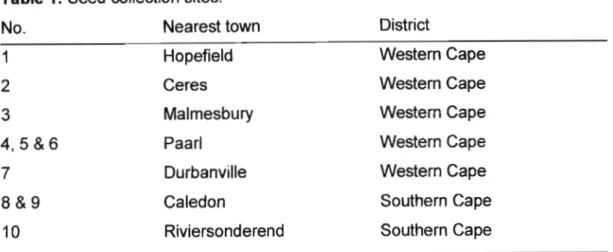
Table 1 Seed collection sites 42
Table 2 Control achieved by treading seed ofLoliumspp. from
10 different locations with different herbicides 43 Figure 1 Loliumspp. survival (%) at 10 localities 44
CHAPTER IV
Figure 1 Percentage control of ryegrass achieved with tralkoxydim
(Se, Ec & Wg) formulations 51
Figure 2 Percentage control of ryegrass achieved with diclofop-
methyl 52
Plate 1 Control achieved with minimum rates of tralkoxydim and
diclofop-methyl 53
Plate 2 Control achieved with rates up to seven times
registration requirements 53
CHAPTER V
Figure 1 Survival (%) of WR1, WR2 and S biotypes of R.
raphanistrum 30 days after treatment with chlorsulfuron 60 Figure 2 Survival (%) of WR 1, WR2 and S biotypes of R.
raphanistrum 30 days after treatment with MCPA 61 Figure 3 Survival (%) ofWR1, WR2 and S biotypes of R.
raphanistrum 30 days after treatment with bromoxynil 62
CHAPTER VI
Table 1 Origin of suspected resistant P. minorpopulations from the Western Cape and history of herbicides 70 Table 2 Herbicide rates (g a.i. ha-1) used in experiments 72 Figure 1 Survival (%) of resistant biotypes (PMR1, PMR2, PMR3
& PMR4) and a susceptible biotype (S) of P. minor28
days with treatment with diclofop-methyl 74 Figure 2 Survival (%) of resistant biotypes (PMR1, PMR2, PMR3
& PMR4) and a susceptible biotype (S) of P. minor 28
days with treatment with clodinafop-propargyl 75 Figure 3 Survival (%) of resistant biotypes (PMR1, PMR2, PMR3
& PMR4) and a susceptible biotype (S) ofP. minor 28
days with treatment with iodosulfuron 76
CHAPTER VII
Figure 1 Structure of aryloxyphenoxypropionates 82
Figure 2 Structure of cyclohexanediones 83
Table 1 Origin of suspectedA. fatua populations from the winter rainfall region in South Africa and the history of herbicides
used 85
Figure 3(a&b) Survival (%)ofA. fatua biotypes(R& S) when treated
with tralkoxydim at different rates 88 Figure 4(a&b) Survival (%)ofA. fatua biotypes (R & S) when treated
with diclofop-methyl at different rates 89 Figure 5(a&b) Survival (%)ofA. fatua biotypes (R & S) when treated
with fenoxaprop-P-ethyl at different rates 90 Figure 6(a&b) Survival (%)ofA. fatua biotypes (R & S) when treated
with clodinafop-propargyl at different rates 91 Table 2 GRsovalues of 10A. fatua biotypes as well as the
susceptible biotype performed over a period of 16 months
using exponential regression 92
INTRODUCTION
Weeds constitute a serious and continuing limitation to crop production in all agricultural systems (Devine, Duke &Fedtke, 1993). It is a well-known fact that effective weed control is of utmost importance in order to produce wheat (Triticum aestivum L.) economically. Weeds such as wild oats (Avena fatua L.) reduce yield quantity and seed quality of wheat (Prize Jones, 1976). Friezen (1961) confirmed that the protein content of wheat increases when weed control is effective.
Chancellor & Peters (1972) found that a yield reduction of 30% could be expected when the plant density ofA. fatuaexceeds 40 plants per m2 during wheat production.
The effect of ryegrass(Lolium spp.) on wheat grain yield is directly proportional to the square root of its density. Levick (1969) concluded that the most important result of ryegrass competition was a reduction in the number of grain-bearing ears of wheat.
According to Lemerle, Verbeek & Coombes (1995) Lolium spp. are a very competitive weed during wheat production and yield losses can be as much as 75%
depending on various factors. In addition, Lumb &McPherson (1964) and Reeves &
Tuohey (1972) have reported increased wheat grain yields resulting from ryegrass control measures. Little seeded canary grass (Phalaris minor Retz.) is a common and troublesome grassweed in winter cereals (Afentouli & Eleftherohorinos, 1999).
The most likely reasons for its prevalence are its similar growth period to winter
,
cereals, early seed dispersal, and ability of seeds to remain dormant in the soil for several years. Several studies indicate 30 to 60% wheat yield reduction from P.
minor competition related to species, plant density, timing of emergence, wheat density as well as environmental factors (Afentouli & Eleftherohorinos, 1996; Cudney
& Hill, 1979). Taking the above-mentioned effects of different weed species on crop production into mind one must come to the conclusion that weeds need to be controlled by one way or another.
According to Gressel (1991) chemical weed control is a practice invented by man.
Our predecessors were not conscious of weeds in the modern sense, but as the human population multiplied, the pressure for producing crops with higher yields became the order of the day. The result of such pressur~ led to the optimization of cropping practices, including chemical weed control. Herbicide usage is far cheaper than cultivation, uses less fuel and usually does less damage to the crop roots and soil structure. According to Cobb (1992) the post-emergent alaninopropionates were introduced between 1969 and 1972 for the control of wild oats, and the introduction
of the aryloxyphenoxypropionates and the cyclohexanediones in the mid 1970s has enabled the control of certain annual grasses during cereal production.
Although the future of chemical weed control seems bright, a new element namely herbicide resistance, has been thrust into the agricultural sector. Resistance must be defined for uniform use worldwide, and can be described as the inherited ability of a plant to survive a herbicide treatment, which under normal spraying conditions would effectively kill the plant (Anonymous, 1997 & Gressel, 1991). The recent advent of herbicide resistant weeds increasing in significant numbers and broad distributions, has compelled mankind to remember that such genetic and ecological adaptability is almost universally present in all classes of living organisms. Even though the appearance of resistance to pesticides in previously susceptible insects and diseases has become quite common, the industry had assumed that in the case of weeds it would be different (LeBaron & Gressel, 1982). In reality the appearance of herbicide resistance had been long predicted and should have been expected. Interspecific resistance or selectivity of plant species to survive herbicide treatments has always existed, and is the very reason for the phenomenal success and value of modern weed control chemicals in crop production. According to LeBaron (1991) screening methods for new herbicides are designed for selecting new chemicals that will kill weeds to which crops will survive. Therefor one can assume that natural resistance against herbicides does occur in each and every plant.
The recognition of herbicide resistance in weeds is relatively recent, despite the widespread use of selective herbicides for over 40 years (Moss & Rubin, 1993, &
Purba, Preston &Powles, 1995). Herbicide resistance tends to occur when a similar mode of action is used repeatedly, or when herbicides are very effective in killing the weed. The latter implies that the herbicide imposes a greater selection pressure on weeds and allows only the truly resistant plants to pass on their genes to the next generation, resulting in the survival of the specie if a herbicide with a similar mode of action is used the following season. Once herbicide resistance is established, the elimination thereof is hardly possible due to genetic inheritance and should therefore be taken in a very serious light (Martin, Kelly & Gill, 1993).
The main aim of this study is to provide the agricultural industry with a complete summary regarding herbicide resistance in the Republic of South Africa. Such a summary will empower the industry to target resistance with a thorough knowledge regarding herbicide resistance as well as to develop effective strategies to prevent
and/or to retard the development and spreading of herbicide resistance in South Africa. To be effective in this regard, weeds and herbicides should be better understood than present, and certain practices to manage herbicide resistance should be implemented to control the situation (Gressel, 1991).
Herbicide resistance is a relatively new aspect in South Africa and certain actions should be taken to ensure effective weed control in the long-term future of this country and should involve steps such as:
o Classification of herbicides according to their mode of action in order to be efficient in herbicide rotation.
o Testing of suspected resistant weed seed to be able to advise the producer to ensure efficient weed control.
o To complete a national survey to monitor the development and distribution of the situation.
o To monitor weed control strategies throughout the country to ensure that herbicides are applied correctly to obtain optimum efficacy.
o To advise the producer regarding effective management strategies to prevent further development of herbicide resistant weeds.
Herbicides are important for effective weed management during crop production and one can assume that they will still be as important in the future. However, to ensure the efficacy of herbicides in the future, one must obtain thorough knowledge of these products to ensure their continuous efficacy. To conclude, the future of herbicides depends greatly on how they are used at present.
CHAPTER 1
HERBICIDE RESISTANCE IN PERSPECTIVE
1.1 Plant responses
The repeated use of herbicides with similar modes of action on the same site over a period of years has resulted in weed biotypes that are resistant to such herbicides.
Since the discovery of herbicide-resistant weeds (Ryan, 1970) the phenomenon has become well known in scientific and agricultural communities around the world (Anderson, 1997). There is no evidence that any herbicide resistant weed biotype has occurred through mutations caused by a particular herbicide, nor is there evidence to show whether or not these resistant biotypes were already present prior to herbicide treatment at the site where they were detected. Herbicide-resistant weed biotypes are presumed to arise through naturally occurring mutations, from small pre-existing populations of the specie. Therefore, resistance becomes apparent when selection eliminates the susceptible biotypes, leaving the resistant biotypes. Therefor, one can conclude that relying on chemical weed control rather than utilizing a combination of weed control practices brought resistance of weed biotypes in croplands forward.
Herbicides are major technological tools that are used successfully throughout the world. An adverse consequence of their use has been the emergence of herbicide resistance among certain weed species. The differential response of plants to herbicides has generally been attributed to differences in morphological and physiological factors between and within species that affect the accumulation of the herbicide in toxic amounts at their site of action. The failure of a herbicide to provide anticipated control is often first attributed to misapplication or unsuitable environmental conditions. When these factors are successfully eliminated, herbicide resistance is often the reason for poor weed control. There are three types of plant responses to applied herbicides and they can be characterized as susceptibility, tolerance and resistance.
1.2 Susceptibility
Plant susceptibility can be identified as a positive response to an applied herbicide.
The degree of response is a measure of a plant's susceptibility to the applied herbicide, under the conditions involved. The degree of susceptibility may range from an imperceptible response, to a marked growth abnormality or to total death of the plant. Susceptibility is influenced by factors such as:
• stage of plant growth when treated
• herbicide concentration absorbed by plant
• inherent toxicity of applied herbicide and
• environmental factors such as light, moisture and temperature.
Plants are most susceptible when rapid growth is taking place and when rapid growth has ended and food reserves are temporarily depleted or exhausted. Plants growing in subdued light are generally more susceptible to foliar-applied herbicides than those growing in high light intensity, apparently due to the formation of a thinner, more permeable cuticle. Also, water-stressed plants are less susceptible to foliar- applied herbicides than those not water stressed, due to a less expanded and therefore less permeable cuticle (Anderson, 1997).
In general, plants are less susceptible to herbicides applied when temperatures are below or above those favoring growth. Annual plants are most susceptible to herbicides in their seedling stage, while perennial plants are most susceptible to herbicides in their flowering stage.
1.3 Tolerance
Tolerance and resistance both describe a condition whereby a plant withstands a herbicide treatment, but their use often results in confusion. Until the occurrence of what is now termed "herbicide resistance," the term tolerance was often used to designate crop response to a herbicide. According to Anderson (1997) a tolerant crop was a crop that was not significantly injured by a herbicide applied at a recommended rate. A workable definition of tolerance is the ability of a crop plant to withstand a predetermined dosage of a herbicide, which may be overcome by higher dosages. Thus, tolerance is rate dependent. And it is largely attributed to differential factors such as absorption, translocation and I or detoxification. All these factors can be morphological or physiological.
As stated by Anderson (1997) it would appear desirable, in view of recent developments, to restrict the use of the term tolerance to crop plants only.
1.4 Resistance
Many definitions describing herbicide resistance are noted throughout the world in scientific papers, journals, books ecl. However, a workable definition of resistance is the ability of a biotype to survive treatment with a given herbicide to which the weed
specie is normally susceptible (Anderson, 1997). There appear to be three types of resistance, namely (1) herbicide resistance, (2) cross-resistance and (3) multiple resistance.
1.4.1 Herbicide resistance
This type of resistance refers to a weed biotype that is resistant to only one specified herbicide, as in the case of resistance to amitrole or glyphosate. However, the term may also be used in a general sense to denote the phenomenon of herbicide resistance in weed biotypes (Anderson, 1997).
1.4.2 Cross-resistance
To add a second phenomenon, cross-resistance also occurs and it is well- documented (Burnet, Loveys, Holtum & Powles, 1993; Bumet, Hildebrand, Holtum &
Powles, 1991 & Burnet, Barr & Powles, 1994a).
Cross-resistance may be defined as resistance to two or more herbicides from different chemical groups resulting from the presence of a single resistance mechanism (Gressel, 1988). As stated by Burnet, Hart, Holtum & Powles (1994b), cross-resistance is a phenomenon whereby weed biotypes become resistant to distinct classes of herbicides as a consequence of selection by a chemically unrelated herbicide. This phenomenon has been observed in many different instances, with the best example being that of cross-resistance to chlorsulfuron in a biotype of Lolium rigidum (Gaud.) exposed mainly to diclofop and trifluralin (Heap &
Knight, 1986; Heap & Knight, 1990). According to Preston, Tardif & Powles (1996), cross-resistance frequently occurs to herbicide groups to which the population has never been exposed. Currently populations of L. rigidum demonstrate resistance across 16 different herbicide chemical classes with 11 different modes of action.
As cited by Kudsk, Mathaissen &Cotterman (1995) sulfonylurea resistance has also been reported as a result of metabolic cross-resistance. Biotypes of rigid ryegrass (L. rigidum) and blackgrass (Alopecurus Myosuroides Huds.), selected by the continuous use of diclofop-methyl and chlorotoluron/isoproturon, respectively, have been found to be resistant to a number of chemically unrelated herbicides, including sUlfonylurea herbicides. According to Burnet et al., (1994b) cross-resistance is of considerable practical importance because it may render alternative herbicides ineffective. With the advent of widespread herbicide resistance in Lolium spp. more attention is being given to developing alternative herbicides to be used with different
crops to vary herbicide regimes. The success of such development would depend on the absence of cross-resistance to new herbicides.
One of the implications of cross-resistance in rigid ryegrass is that the selection pressure of a previous herbicide can also alter susceptibility of a biotype to an unrelated herbicide (Burnet et aI., 1994b). According to Preston et aI., (1996) L.
rigidum is an obligate out-crossing specie, and any survivors of herbicide application must cross with another survivor to produce offspring. This out-crossing means that all mechanisms of herbicide resistance present will tend to be mixed and distributed within the progeny of these individuals.
1.4.3 Multiple-resistance
Over the past two decades, herbicide usage exposed huge weed populations to strong selection pressures for herbicide resistant traits (Tardif & Powles, 1994).
According to Christopher et al., (1991) and Holt, Holtum & Powles (1993) herbicide resistant populations within more than 100 weed species have been documented. In most cases resistance developed following exposure to one chemical, or chemicals which are similar in structure and mode of action. They were not resistant to chemicals of a different structure, which have different modes of action. At present, there is a relatively new phenomenon, called multiple resistance and the most dramatic commercially significant example has been documented by Heap & Knight (1990) and Powles&Mathews (1992).
Multiple resistance occurs when resistance to several herbicides results from two or more distinct resistance mechanisms affecting different target sites in the same plant (Tardif & Powles, 1994). The term "multiple resistance" describes a situation where a weed population has been subject to selection by a range of herbicides to which it eventually becomes resistant. Multiple resistance refers therefore to the accumulation of resistance to particular herbicides within a population as a consequence of selection pressure by those herbicides (Powles & Mathews, 1992).
LeBaron (1991) pointed out the danger if weeds develop cross- and multiple resistance during crop production. Not only is herbicide resistance appearing after fewer repeated annual applications of some of these newer herbicides, but also there seem to be more species that have potential to resistance.
According to Tardif, Preston & Powles (1997), in order to understand multiple resistance it is important to know that two mechanisms, viz. target site- and non-
target site modifications can be responsible for the development of multiple resistance. Non target site mechanisms can be subdivided into mechanisms of resistance not involving modification of the herbicide get-site and include enhanced metabolism, reduced retention or absorption reduced translocation, and differential sequestration.
As cited by Holt et al., (1993) both multiple- and cross-resistance can occur in a single population and to identify the correct phenomenon, accurate records of herbicide exposure are required. According to LeBaron (1991) the evolution of populations resistant to other herbicides, and especially biotypes with multiple resistance to different classes of herbicides, poses a great threat. The agricultural practices most conclusive to the occurrence of the cross- and multiple-resistance are those that rely exclusively on one or a few herbicides for a high level of weed control (Burnet et al., 1994b). Morrison & Bourgeois's (1995) answer to this problem is to establish glyphosate resistant crops and to kill the weeds with glyphosate treatments.
If resistance develop against glyphosate, however, the problem would start all over again.
1.5 GENE-FACTORS CONTROLLING THE RATE OF EVOLUTION
The factors controlling the rates of evolution vary and can be a function of the genetic systems controlling resistance. Resistance to herbicides can develop in two ways, viz. target site resistance and creeping resistance (Gressel, 1991).
1.5.1 Target-site resistance
Usually, target-site resistance develops under a regime of high herbicide dosage rates, confers a high degree of resistance and is usually controlled by a single or relatively few genes and has up to date received by far the greater attention by the herbicide industry (Gressel, 1991). According to Devine (1997), the enzyme acetyl- coenzyme A carboxylase (ACCase) is the target site of two major groups of synthetic herbicides, the aryloxyph~noxypropionates and cyclohexanediones. As cited by Devine, Duke & Fedtke (1993) the target site is usually the site to which the herbicide binds, or with which it interferes in some manner, resulting in death of the plant.
It's important to keep in mind that by using chemicals new genes are not produced, although chemical enrichment may occur. The use of herbicides can however increase resistance in a population (Reinhardt, 1997). Single-gene resistance was the first to appear and is also the simplest to understand. Although genetic
modification occurs in the target sites of the key enzymes, the herbicide is still able to function. The mutant enzyme often acts with reduced efficacy, leading to reduced fitness of the mutant when it competes with the wild biotype. In the case of paraquat, metabolic resistance seems to be offered by a single dominant major gene (Gressel, 1993). There are two ways of lowering selection pressure and delaying resistance.
The first is to reduce the rate of herbicide application and secondly, a less persistent herbicide from the same group may be used, so that the more susceptible individuals are able to survive. Furthermore, the rate of herbicide enrichment can be reduced when the resistant individual is less fit than the wild type. The resistant and susceptible weed are able to compete during the season when applying the herbicide. Herbicide rotation is a major resistance-preventing strategy where competitive fitness is low (Gressel&Segal, 1990).
Another resistance mitigating factor is the seed soil bank. If the seeds of a given specie germinate over many years, the susceptible plants in the seed bank slowing the rate of evolution will buffer resistant seeds. Resistance evolves more quickly in no-till situations than where tillage is practiced. Seeds on the soil surface usually germinate within a year or die without entering the seed bank (Gressel, 1993).
1.5.2Creeping-resistance
Creeping-resistance develops mainly due to the use of herbicides with a similar mode of action, and in areas subjected to low dosages of a herbicide and may therefore confer a lower degree of resistance to a greater number of individuals in a population. Creeping-resistance can develop as a result of the presence of more than one resistant gene (Gressel, 1991). Low threshold levels of many herbicides can be degraded by weeds, even though the amount applied can inhibit the target enzyme while the herbicide is being degraded. Added gene doses could result from amplification of the present genes, mutations in promoter genes, or mutations in structural genes conferring changes in substrate specificity. There may be different genes that can mutate to give one more gene dose for resistance (Gressel, 1993).
Continuous herbicide use will result in continued selection for resistant biotypes, thereby further increasing the levels of resistance. Both seed bank and any fitness differentials should affect the rate of creeping-resistance in the same way that target- site resistance is affected (Gressel, 1993).
1.6 Worldwide occurrence of herbicide resistance
When the first cases of evolution of newly resistant weeds appeared, the weeds were either qUietly rouged without saving material for study, or ignored as being unimportant. Because of the occurrence on a single farm or two, resistance seemed unimportant, especially in a different state or country from one's own. The spread of herbicide resistance from farm to farm was due to co-evolution and usually not by the spreading of pollen or seed (Gressel, 1993).
The extent of the area affected by herbicide-resistance is poorly documented due to a lack of comprehensive survey data. The fact that resistant seed is spreading in unlimited quantities during each season, makes it more difficult to keep track of the problem. There have been relatively few reports of herbicide resistance prior to the late 1960s, and was first observed during 1968 when Ryan (1970) reported that Scenecio vulgaris developed resistance to both atrazine and simazine. However, since the detection of the triazine-resistant weed (S. vulgaris) there has been a steady increase in the number of resistant weed species throughout the world (Moss
&Rubin, 1993). According to LeBaron (1991) it has been estimated that triazine-
resistant weeds infest about one million ha in the United States of America and at least two million ha in other countries. A survey of L. rigidum infestations within cropped fields in an intensively cropped area of about 250 km2 in South Australia in 1994 revealed that 40% of all fields surveyed contained diclofop-methyl resistant populations (Nietschke, L1ewellyn, Mathews, Powles & Reeves, 1996). Jutsum and Graham (1995) stated that resistance is found in over 100 grass and broad-leaved species, occurring in more than 40 countries. LeBaron (1991) reported that by the year 1990, 113 herbicide-resistant weed biotypes had evolved in various locations worldwide. This total included 58 species (41 dicotyledonous and 19 grass weeds) resistant to 14 classes of herbicides. There are now resistant weeds present in all but 10 of the 50 States of the USA, all but two provinces of Canada, 18 countries of Europe and 10 other countries (LeBaron, 1991). According to Clay (1989) and Van Oorschot (1991) a total of 15 different modes of action is involved and occurs in 62 countries.
In Australia, wild oats (A. fatua) and ryegrass (Lolium spp.) infest millions of hectares, which are resistant to aryloxyphenoxypropionates and cyclohexanediones (Morrison
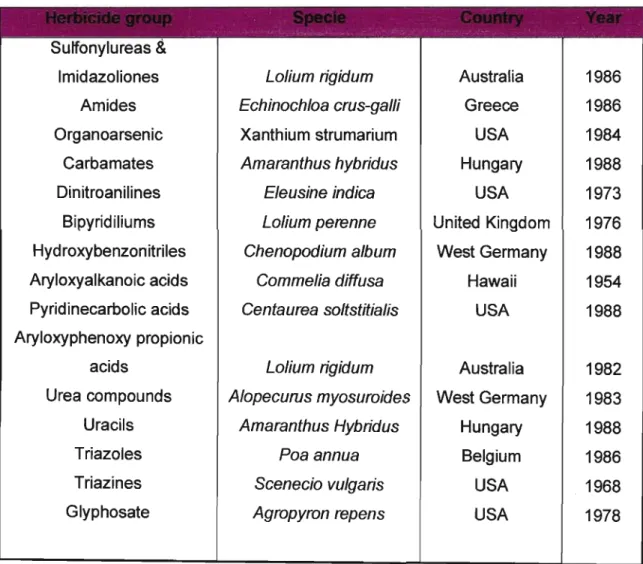
& Bourgeois, 1995). As cited by Christopher, Powles, Liljegran & Holtum (1991) the first report of resistance to diclofop-methyl was found in L. rigidum during 1982, (Heap & Knight, 1982). Table 1 presents combined statistics of resistance found for
the first time for distinguish chemical groups of herbicides (LeBaron, 1991, LeBaron
& Gressel, 1982).
Table 1: Worldwide occurrence of herbicide resistance (LeBaron, 1991; LeBaron &
Gressel, 1982)
Sulfonylureas
&
Imidazoliones Lolium rigidum Australia 1986
Amides Echinochloa crus-galli Greece 1986
Organoarsenic Xanthium strumarium USA 1984
Carbamates Amaranthus hybridus Hungary 1988
Dinitroanilines Eleusine indica USA 1973
Bipyridiliums Lolium perenne United Kingdom 1976 Hydroxybenzon itriles Chenopodium album West Germany 1988 Aryloxyalkanoic acids Commelia diffusa Hawaii 1954 Pyridinecarbolic acids Centaurea soltstitialis USA 1988 Aryloxyphenoxy propionic
acids Lolium rigidum Australia 1982
Urea compounds Alopecurus myosuroides West Germany 1983
Uracils Amaranthus Hybridus Hungary 1988
Triazoles Poa annua Belgium 1986
Triazines Scenecio vulgaris USA 1968
Glyphosate Agropyron repens USA 1978
1.7 Herbicide resistance in South Africa
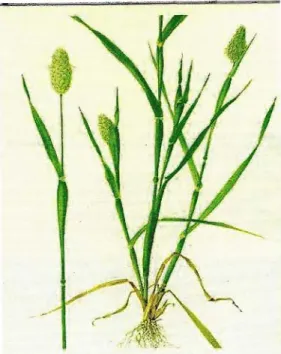
Cairns & Hugo (1986) reported the first confirmed case of herbicide resistance to diclofop-methyl in the Western Cape on A. fatua, -while Smit (1993) confirmed herbicide tolerance of different biotypes of A. fatua (Plate 1). Up to date, only one broad-leaved weed specie, viz. smooth pigweed (Amaranthus hybridus L.), (Plate 2) was confirmed to be resistant to triazine treatments (Sereda, Erasmus & Coetzer, 1996). Experiments done at the ARC-Plant Protection Institute (Republic of South Africa) indicated that a herbicide rate 20 times higher than registered, still did not provide satisfactory results on the specific A. hybridus biotype.
Plate 1:Avena fatua (Grabandt, 1985) Plate 2: Amaranthus hybridus (Grabandt, 1985)
At a conference held during 1997 in the Western Cape, a total area of 6000 ha was speculated as being herbicide resistant to ACC-ase inhibitors. In the Western Cape three grass species are of economical importance regarding herbicide resistance, namely L. rigidum (Plate 3), A. fatua and Phalaris minor (Retz.), (Plate 4) all suspected to be resistant to grass weed herbicides.
Plate 3: LoJium spp. (Grabandt, 1985) Plate 4:Pha/aris minor(Grabandt, 1985)
To stress the importance of effective weed control regarding above-mentioned weed species, one could refer to literature. As cited by Lemerle, Verbeek &Coombes (1995), LoJium spp. is a very competitive weed during wheat production and yield losses of wheat in competition with LoJium spp. can be as much as 75%, depending on sowing date, cultivar and seeding rate. Afentouli &Eleftherohorinos (1996) found a reduction of up to 60% of wheat yield ifP. minorcompetition occurs and Carlson &
Hill (1985) stated that wheat yield declined rapidly as the density of A. fatua increases. At this stage only one broad-leaved weed, viz. wild radish (Raphanus raphanistrum L.) appears to be resistant to sulfonylureas (Plate 5). Currently, herbicide resistance in wheat production has only been observed in the winter rainfall area. The occurrence of resistance goes hand in hand with herbicide usage and crop production systems. By investigating herbicide sales during 1996, certain conclusions can be made regarding the announcement of resistance for the future.
Table 2 summarizes the percentage sales of herbicides for the winter and summer rainfall areas, while Table 3 indicates the percentage of herbicides sold in the two respective main wheat producing areas in South Africa.
Plate 5: Raphanus raphanistrum (Grabandt, 1985)
Table 2: Herbicide sales in wheat production in South Africa (Senekal, 1996)
~~~~-'~~~~:)~~,~;jif£E~EZ!~j.o:,:';13J
Winter 1,156,476.00 11,484,989.00 22,464,523.00 7,637,493.00 42,743,481.00 Summer 23,405.00 5,665,710.00 1,848,847.00 15,762,171.00 23,300,133.00 Total 1,179,881.00 17,150,699.00 24,313,370.00 23,399,664.00 66,043,614.00 SummerWinter
-962350 ha - 400800 ha
Table 3: Percentage herbicides used in respective areas (Senekal, 1996)
Summer Winter
7.9%
52.5%
24.3%
26.8%
67.6%
17.8%
0.1%
2.7%
35.3%
64.7%
Conclusions made from tables two and three:
• A total of 64.7% of the herbicide sales occurred in the winter rainfall area. The intensity of use of herbicides is much higher than that of the summer rainfall area (35.3%) and therefore resistance should develop much faster in the winter rainfall area.
• Over fifty percent (52.5%) of the herbicides sold in the winter rainfall area are grass weed herbicides. According to the Herbicide Reaction Committee (HRAC) , it is possible for resistance to develop against grass weed herbicides within 5-7 years of consecutive use.
• A total of 79.3% of the sales in the winter rainfall area belongs to grass weed herbicides and sulfonylureas. Both classes of herbicides are most likely to develop resistance if frequent use occur.
• Because of the low percentage (7.9%) of grass weed herbicides sold in the summer rainfall area, chances for developing resistance to ACCase inhibitors are less likely than those of the winter rainfall area.
• The more liberal use of hormone based herbicides & bromoxynil (67.6%) in the summer rainfall area reduces the possibility for development of resistance against sulfonylureas.
1.8 References
AFENTOULI, G.C. & ELEFTHEROHORINOS, I.G., 1996. Littleseed canarygrass (Phalaris minor) and short-spiked canarygrass (Phalaris brachystachys) interference in wheat and barley. Weed Science 44,560-565.
AFENTOULI, C.G. & ELEFTHEROHORINOS, I.G., 1999. Competition between wheat and canary grass biotypes and their response to herbicides. Weed Science. 47, 55-61.
ANDERSON, W.P., 1997. Weed resistance and transgenic crop tolerance. In: Weed Science, principles and applications. West Publishing Company, 125-137.
ANONYMOUS, 1997 Classification of Herbicides according to their Mode of Action.
Herbicide Resistance Action Committee, 1-5.
BURNET, M.W.M., BARR, AR. & POWLES, S.8., 1994a. Chloroacetamide resistance in Rigid Ryegrass(Lolium rigidum). Weed Science 42, 153-157.
BURNET, M.W.M., HART, Q., HOLTUM, J.AM. & POWLES, S.8., 1994b.
Resistance to nine herbicide classes in a population of Rigid Ryegrass (Lolium rigidllm). Weed Science 42, 369-377.
BURNET, M.W.M., HILDEBRAND, O.B., HOLTUM, J.AM. & POWLES, S.B., 1991.
Amitrole, triazine substituted urea, and metribuzin resistance in a biotype of rigid ryegrass(Lolium rigidum). Weed Science 39,317-323.
BURNET, M.W.M., LOVEYS, B.R., HOLTUM, J.AM. & POWLES, S.B., 1993. A mechanism of chlorotoluron resistance in Lolium rigidum. Planta 190, 182- 189.
CAIRNS, AL.P. &HUGO, K.J., 1986. Differential tolerance of Western Cape wild oat biotypes to diclofop-methyl and mixtures containing diclofop-methyl.
Combined Meeting of the Crop Production Society of South Africa, Pretoria.
CARLSON, H.L. & HILL, J.E., 1985. Wild oat (Avena fatua) competition with spring wheat: Plant density effects. Weed Science 33, 176-181.
CHANCELLOR, R.J. & PETERS, N.C.B., 1972. Seed production of Avena fatua populations in various crops. In: Proc.
1d
hBritish Weed Conference, 7, 11.CHRISTOPHER, J.T., POWLES, S.B., L1LJEGRAN, D.R. & HOLTUM, J.AM., 1991.
Cross-resistance to herbicides in annual Ryegrass (Lolium rigidum). Plant Physiology 95, 1036-1043.
CLAY, D.V., 1989. New developments in triazine and paraquat resistance and co- resistance in weed species in England. In: Proceedings of the 1989 Brighton Crop Protection Conference, Weeds, 317-324.
COBB, A, 1992. Graminicides: Inhibitors of lipid biosynthesis. In: Herbicides and Plant Physiology. A Chapman&Hall Publication, 107-125.
CUDNEY, D.W. & HILL, J.E., 1979. The response of wheat grown with tree population levels of canarygrass to various herbicide treatments. Weed Science 32, 55-56.
DEVINE, M.D., 1997. Target-site based resistance to ACCase inhibitors. In: Weed and crop resistance to herbicides (Eds De Prado, Jorrin &Garcia-Torres), Kluwer Academic publishers, 61-69.
DEVINE, M.D., DUKE, S.O., & FEDTKE, C., 1993.
Carboxylase. In: Physiology of Herbicide Action.
New Yersey, 230 - 242.
Inhibition of Acetyl-COA P T R Prentice-Hall, Inc.,
FRIEZEN, H.A, 1961, Some factors affecting the control of wild oats with barban.
Weeds 9, 186-194.
GRABANDT, K., 1985. Onkruide in gewasse en tuine in Suidelike Afrika. 'n Ciba- Geigy Publikasie, 4-76.
GRESSEL, J., 1988. Multiple resistance to wheat selective herbicides: new challenges for molecular biology. In: Oxford sUNeys of Plant Molecular and Cell Biology,S, 195-203.
GRESSEl, J., 1991. Why get resistance? It can be prevented or delayed. In:
Herbicide resistance in weeds and crops (Eds J.G. Gaseley, G.W. Gussans, and RK. Atkin). Butterworth-Heinemann Ltd, Oxford, 1-66.
GRESSEl, J., 1993. Management of herbicide resistant weeds in crop production.
Crop Science1,121-126.
GRESSEl, J. & SEGAl, L.A, 1990. Modeling the effectiveness of herbicide rotations and mixtures as strategies to delay or prelude resistance. Weed Technology4, 186-198.
HEAP, I.M. &KNIGHT, R, 1982. A population of ryegrass tolerant to the herbicide diclofop-methyl. Australian Journalof Agricultural Research 48, 156-157
HEAP, I.M. &KNIGHT, R, 1986. The occurrence of herbicide cross-resistance in a population of annual ryegrass (Lolium rigidum) resistant to diclofop-methyl.
Australian Journalof Agricultural Research 37,149-156.
HEAP, I.M. & KNIGHT, R, 1990. Variation in herbicide cross-resistance among populations of annual ryegrass (Lolium rigidum) resistant to diclofop-methyl.
Australian Journalof Agricultural Research 41, 121-128.
HOlT, J.S., HOlTUM, J.AM. & POWlES, S.B., 1993. Mechanisms and agronomic aspects of herbicide resistance. Annual Review of Plant Physiology&Plant Molecular Biology44, 203-229.
JUTSUM, AR, &GRAHAM, J.G., 1995. Managing weed resistance: Activities ofthe herbicide resistance action committee. Pest Outlook 6, 30-33.
KUDSK, P., MATHIASSEN, S.K., & GOTTERMAN, J.G., 1995. SUlfonylurea resistance in Stellaria medis [L.] ViiI. We~dResearch 35, 19-24.
leBARON, H.M., 1991. Distribution and seriousness of herbicide resistant weed infestations worldwide. In: Herbicide resistance in weeds and crops (Eds J.G.Gaseley, G.W. Gussans and RK. Atkin), Butterworth-Heinemann Ltd, Oxford,27-43.
LeBARON, H.M. &GRESSEL, J., 1982. Herbicide resistance in plants. A Wiley- Interscience Publication, New York, 2-32.
LEMERLE, D., VERBEEK, B. &COOMBES, N., 1995. Losses in grain yield of winter crops from Lolium rigidum competition depend on crop species, cultivar and season. Weed Research 35,503-509.
LEVICK, G.RT., 1969. The effect of competition of Wimmera ryegrass on the grain yield of wheat. MSc. Agric. Thesis, University of Melbourne, Australia, 9-13.
LUMB, J.M. &McPHERSON, J.B., 1964. Chemical control of Wimmera ryegrass in wheat. Journal of Agriculture 62, 239.
MARTIN, RJ., KELLEY, R &GILL, G.S., 1993. Herbicide Resistance, coordination and communication in Western Australia. Dept. of Agriculture. Miscellaneous Publication 10/93, 3-17.
MORRISON, I.N. & BOURGEOIS, L., 1995. Approaches to managing ACCase resistance in wild oat on the Canadian Prairies. Proceedings, Brighton Crop Protection Conference, Weeds 95,567-576.
MOSS, S.R & RUBIN, 8., 1993. Herbicide-resistant weeds: a Worldwide perspective. Journal of Agricultural Science, Cambridge, 120, 141-146.
NIETSCHKE, B., LLEWELLYN, R MATHEWS, J.M., POWLES, S.B. & REEVES, T.G., 1996. A survey of herbicide resistant Lolium and Avena species in South Australia. University of Southern Queensland. In: The 18th Australian Agronomy Conference, 691-692.
POWLES, S.B. & MATTHEWS, J.M., 1992. Multiple herbicide resistance in annual ryegrass (Lolium rigidum): a driving force for the adoption of integrated weed management. In: Resistance '91: Achievements and Developments in Combating Pesticide Resistance. (Eds I. Denholm, A.L. Devonshire and D.W.
Holloman,), 75-87.
PRESTON, C., TARDIF, F.J. & POWLES, S.B., 1996. Multiple Mechanisms and Multiple Herbicide Resistance in Lolium rigidum. In: Molecular Genetics and
Evolution of Pesticide Resistance, ACS Symposium Series645 (Ed. Thomas M. Brown), 117-129.
PRIZE JONES, D., 1976. Wild oats in world agriculture. Agricultural research Counsel, Her Majesty's Stationary Office, 6-115.
PURBA, E., PRESTON, C. & POWLES, S.B., 1995. Growth and competitiveness of Paraquat-resistant and susceptible biotypes of Hordeum leprous. Weed Research36,311-317.
REEVES, T.G. & TUOHEY, C.L., 1972. Selective chemical control of Wimmera ryegrass in wheat with di-allate and tri-allate. Australian Journal of experimental Agricultural Husbandry12, 55-59.
REINHARDT, C.F., 1997. Meganismes van onkruidweerstand teenoor onkruiddoders. Departement Plantproduksie en Grondkunde, Universiteit Pretoria, Pretoria 0002, 1-6.
RYAN, C.F., 1970. Resistance of common groundsel to simazine and atrazine.
Weed Science18, 614-616.
SENEKAL, 0.0., 1996. 1996 Crop protection survey. DOS research (PTY) LTD, Agricultural marketing research, 13-15.
SEREDA, 8., ERASMUS, D.J. &R.L.J., 1996. Resistance of Amaranthus hybridus to atrazine. Weed Research 36,21-30.
SMIT, H.A., 1993. Die verdraagsaamheid van wildehawer vir onkruiddoders. Dept.
Agronomie en Hortologie, PhD Thesis, Universiteit van Oranje Vrystaat, Bloemfontein, 1-103.
TARDIF, J. & POWLES, S.B., 1994. Herbicide multiple resistance in a Lolium rigidum biotype is endowed by multiple mechanisms: isolation of a subset with resistant acetyl-CoA carboxylase. Physiologia Plantarium 91, 488-494.
TARDIF, F.J., PRESTON, C. & POWLES, S.B., 1997. Mechanisms of herbicide multiple resistance in Lolium rigidum. In: Weed and Crop Resistance to
Herbicides (Eds R. De Prado, J. Jorrin &L. Garcia-Torres), Kluwer Academic Publishers, 117-123.
VAN OORSCHOT, J.L.P., 1991. Chloroplastic resistance of weeds to triazines in Europe. In: Herbicide resistance in weeds and crops (Eds J.C. Caseley, G.W.Cussans & R.K. Atkin), Oxford: Butterworth-Heinemann, 87-101.
CHAPTER 11
CLASSIFICATION OF HERBICIDES
2.1 Introduction
Herbicides may be classified in several ways. For example, Vermeulen, Dreyer, Grobler &Van Zyl (1996) classified herbicides according to physiological grouping.
Knowledge of the mode of action is basic to understand the principles of herbicide synthesis. According to Asthon & Crafts (1981) the term "mode of action" refers to the entire sequence of events from introduction of a herbicide into the environment to the death of plant and "mechanism of action" refers to the primary biochemical or biophysical lesion leading to death. As cited by Devine, Duke & Fedtke (1993), herbicide action might be described as the physiological and biochemical interaction of a herbicide with a plant.
Herbicide action may be thought of as compnslng two phases; the first phase involves movement of the herbicide to the target site, while the second phase involves the metabolic consequences resulting from interaction at that site. Phase 1 starts with the application of the herbicide to the plant, the herbicide then enters the plant through foliar absorption or via the roots. Entry into the plant is quickly followed by a series of steps that precede the arrival of the herbicide at its site of action. The interaction of the herbicide at the target site can be viewed as the first step in phase 2 and is followed by a series of toxic consequences that result in death of the plant (Devine,et a/,. 1993).
The primary aim of this chapter is twofold: (a) to classify the different herbicides according to their physiological characteristics, as well as to the distinguish modes of action and (b) to summarize a study on the modes of action of the two most widely applied herbicides (ACC-ase and ALS inhibitors) in wheat production.
2.2 Herbicide classification according to physiological characteristics
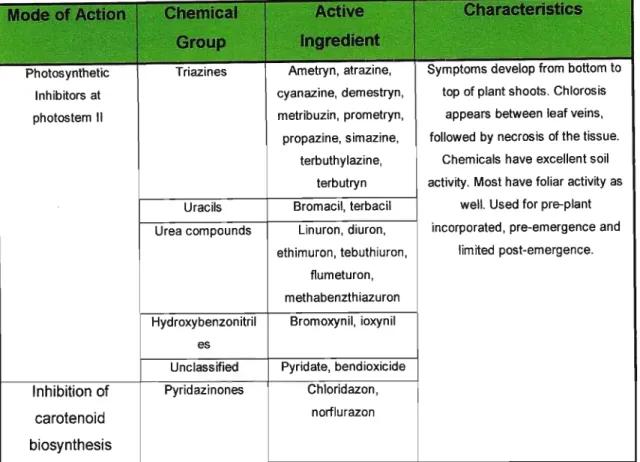
The first classification system in this chapter organizes herbicides into those, which are applied to foliage, and those herbicides, which are applied almost strictly to the soil (Table 1). The foliar applied groups are divided into three categories according to movement through the plant, which are:
1. Symplastic translocated (Table 2) 2. Apoplastic translocated (Table 3)
3. Those which do not move appreciably (Table 4).
According to Senekal (1996) approximately 98.2% of the herbicides used during wheat production belongs to the Aryloxyalkanoic acids, the Aryloxyphenoxy propionic acids, the Cyclohexanediones and to the Hydroxybenzonitriles. It is therefore of utmost importance to understand the mode of action of each of these chemical groups to be able to address the resistance phenomonem.
Table 1: Soil Applied herbicides (Anonymous, 1997; Retzinger & Mallory-Smith, 1997 ;Ross& Childs, 1998; Vermeulen et al., 1996)
Inhibition of lipid synthesis - not ACCase inhibition
Inhibition of cell division
Inhibition of cell wall (cellulose) synthesis
Dinitroanilines
Th iocarbam ates
Ch loroacetan i1ides
Am ides Am ides
Pendimethalin, trifluralin, oryzalin
EPTC, pebulate
Acetachlor, alachlor, metazachlor, metolachlor, propachlor
Propyzamide Isoxaben
Root inhibitors, little or no foliar activity. Applied mostly preplant incorporated. Inhibit the steps in plant cell division, and responsible
for chromosome separation.
Relatively few roots. Bind to soil colloids and unlikely to leach.
Losses occur through volatilization and photodegradation.
Incorporation into soil is suggested.
Shoot inhibitors. Soil applied. Injury appears as malformed dark green shoots. Very volatile herbicides and
is preplant incorporated.
Pre-emergence herbicides, incorporated
Shoot and root inhibitors. Preplant incorporated, pre-emergence and
early post-emergence grass control.
Table 2: Foliar applied herbicides, symplastically translocated (Anonymous, 1997;
Retzinger & Mallory-Smith, 1997; Ross & Childs, 1998; Vermeulen et al., 1996)
Auxin Growth Aryloxyalkanoic 2,4-0; 2,4-0B; MCPA; Moving from leaves with sugar to Regulators acids Triclopyr; Fluroxypyr sites of metabolic activity. Potential
Benzoic acids Oicamba; chlorthal- to kill perennial weeds. Symptoms dimethyl are pigment loss, growth stoppage Microtuble assembly Pyridinecarbolic Clopyralid; Picloram; and malformed new growth. Most
inhibition acids Thiazopyr injury appears after several days.
Inhibition of EPSP Unclassified Glyphosate; Sulfosate Usage is limited for foliar use,
synthase because chemicals are rapidly
inactivated in soil. Symptoms are yellowing of new growth. It is a
non-selective herbicide.
Inhibition of Imidazoliones Imazapyr; Shoot meristems cease growth,
acetolactate synthase Imazethapyr; Yellow to purple symptoms appear,
Imazamox roots develop poorly. Symptom Triazolopyrimides Metosulam development requires up to three
Sulfonylureas Chlorsulfuron, weeks
chlorimuron-ethyl, ethoxsulfuron, metsulfuron-methyl,
nicosulfuron, primisulfuron, prosulfuron, sulfosulfuron,
rimsulfuron, thifensulfuron, triasulfuron, tribenuron
Inhibition of Triazoles Amitrole
carotenoid Unclassified Clomazone
biosynthesis
Pyridazinones Norflurazon
Inhibition of acetyl Aryloxyalkanoic Oiclofop-methyl, Symptoms are discoloration and CoA carboxylase acids fluazifop-P-butyl, disintegration of meristematic
Quiazlofop-P-butyl, tissue. Leaves turn yellow and red.
fenoxaprop-P-ethyl, Usage for selective grass control.
propaq uizafop, Use early postemergence on clodinafop-propargyl, seedling grasses.
haloxyfop Cyclohexanedione Tralkoxydim,
sethoxydim, cycloxydim
Table 3: Foliar applied herbicides, apoplastically translocated (Anonymous, 1997;
Retzinger & Mallory-Smith, 1977; Ross & Childs, 1998; Vermeulen et al., 1996)
~,zx~::;cs:~'~;;,;;~~r~'~~~~~~~,~Xlf!~~
Photosynthetic Triazines Ametryn, atrazine, Symptoms deve op romb tto om 0 Inhibitors at cyanazine, demestryn, top of plant shoots. Chlorosisphotostem 11 metribuzin, prom etryn, appears between leaf veins, propazine, simazine, followed by necrosis of the tissue.
terbuthylazine, Chemicals have excellent soil terbutryn activity. Most have foliar activity as Uracils Bromacil, terbacil well. Used for pre-plant Urea compounds Linuron, diuron, incorporated, pre-emergence and
ethimuron, tebuthiuron, limited post-emergence.
f1umeturon, methabenzthiazuron Hydroxybenzonitril Bromoxynil, ioxynil
es
Unclassified Pyridate, bendioxicide
Inhibition of Pyridazinones Chloridazon,
carotenoid norflurazon
biosynthesis
Table 4: Non-translocated herbicides (Anonymous, 1997; Retzinger & Mallory- Smith, 1997; Ross &Childs, 1998; Vermeulenet al., 1996)
~~n~~2:Q~"'l;::~~~~m~~J":t:;2;2::?~J
Photosystem-I- Bipyridylium Paraquat, diquat Result in rapid disruption of cell
electron diversion membranes. Herbicide penetrates
Inhibition of glutamine Unclassified Glyfosinate-ammonium into cytoplasm, cause formation of
syntheses peroxides and free electrons, which
destroy cell membranes.
Destruction prevents translocation.
Postemergence use only, can expect only shoot kill.
Inhibition of Diphenyl esters Bifenox, fluroglycofen, Have foliar and soil activity. Control protopophyrinogen fomesafen, oxyfluorfen broadleaf weeds. Relatively
oxydase unaffected by soil texture and
organic matter
2.3Herbicide classification according to mode of action
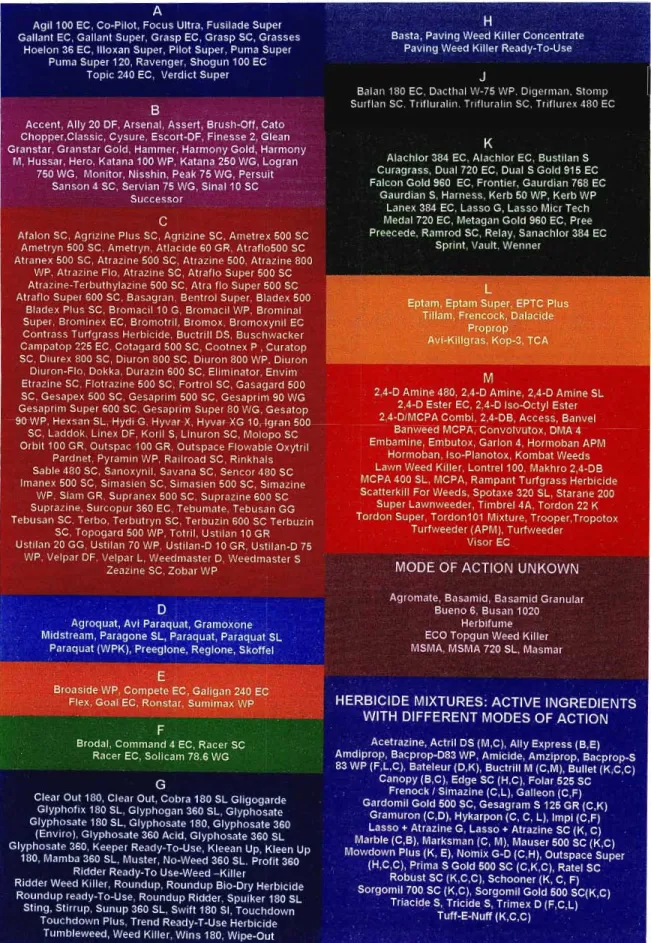
Awareness of herbicide resistant weeds prompted Universities and agro-chemical personnel to develop guidelines to minimize the risk of selecting herbicide resistant weeds. One of these guidelines is to provide the industry with a tool to enable the farmer to rotate the herbicides used on a specific land. According to Ross & Childs (1998) the mode of action is the overall manner in which a herbicide affects a plant at the tissue or cellular level. Herbicides with the same mode of action will have the same translocation pattern and produce similar injury symptoms. To succeed, herbicides had to be classified according to their mode of action and therefore a classification system was developed as illustrated in Figure 1 (Smit, 1997).
Figure 1: Herbicide classification regarding mode of action (Smit, 1997)
2.4 Mode of action of ACCase inhibitors
Since the discovery of the first synthetic organic herbicides in the late 1940s, there has been great interest in understanding the mechanisms by which herpicides interfere with plant growth. Among the herbicides with mechanisms that are currently understood, there are about 100 herbicides that inhibit photosystem 11 electron transport, 37 that inhibit branched chain amino acid synthesis, 32 that are active auxins, and 28 that interfere with microtubular synthesis or function (Devine et al., 1993).
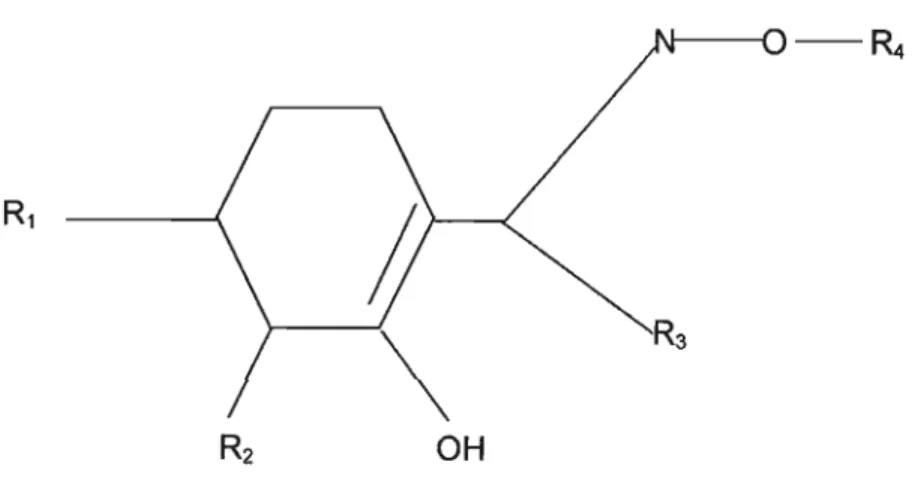
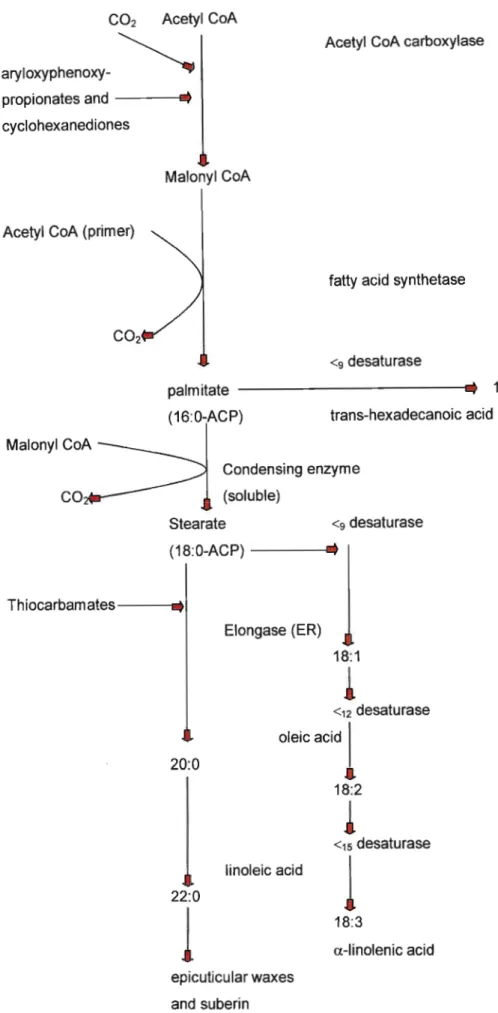
Both aryloxypropanoic acid (Figure 2) and cyclohexanedione (Figure 3) herbicides are selective post-emergence graminicides and produce similar effects on grass weeds and acetyl-CoA carboxylase (ACCase) is the site of inhibition. ACCase is a complex enzyme that contains three functional sites: a biotin carboxyl carrier site, an ATP-dependent biotin carboxylase, and a carboxyltransferase (Dekker & Duke, 1995). According to Hoppe (1980) as stated by Cobb (1992) diclofop-methyl does not interfere with photosynthesis, respiration, protein synthesis, nor nucleic acid synthesis, but the inhibition of acetate incorporation into fatty acids could be demonstrated in susceptible species (Harwood 1989). The first definitive evidence that aryl-propanoic acid herbicides are potent lipid synthesis inhibitors, was the inhibition of 14C-acetate incorporation into the free fatty acids. It is clear that the free fatty acids are the herbicidally active structures (Dekker & Duke, 1995). Cobb (1992) stated that plant membranes contain unique fatty acids that have crucial structural and biochemical roles and the activity of the enzyme is strongly enhanced by light (Dekker &Duke, 1995). At least 70% of the total leaf fatty acids consist of the unsaturated a-linolenic acid, which itself makes up between 40 and 80% of the lipid fraction in the chloroplast. According to Cobb (1992) trans-.63-hexadecanoic acid and linoleic acid are synthesized both in the chloroplast stroma and the cytoplasm (Figure 4). Essentially malonyl CoA is formed from acetyl CoA and converted to saturated palmitate by the action of soluble stromal enzyme·complex, termed as fatty acid synthetase. This complex contains seven enzymes covalently bound to an acyl carrier protein (ACP), which transfers intermediates between the seven enzymes.
The seven enzyme cycles are needed for the condensation of seven additional C2 units into one palamite.
- - - 0
COOR2
I
1 - - - O--C*--H
I
Figure 2: Chemical structure of aryloxyphenoxypropionates (Cobb, 1992).
Figure 3: Chemical structure of cyclohexanediones (Cobb, 1992).
CO2 Acetyl CoA
aryloxyphenoxy-
~
propionates and ..
cyclohexanediones
Acetyl CoA carboxylase
Malonyl CoA
Acetyl CoA (primer)
fatty acid synthetase
<9desaturase
palmitate
---t...
16:1(16:0-ACP) trans-hexadecanoic acid Malonyl CoA
co-...---
Condensing enzyme (soluble)
Stearate <9desaturase (18:0-ACP) - - -....
Thiocarbamates ..
Elongase (ER) 18:1
1
a-linolenic acid 18:3
<12 desaturase oleic acid
I
•
18:2
<15
1
desaturase1
linoleic acid 20:0
22:0
epicuticular waxes
1
and suberin
Figure 4: Fatty acid biosynthesis in plants (Cobb, 1992).
According to Harwood (1988) two metabolic routes are now possible from palamite.
Firstly, a soluble condensing enzyme and elongase bound to the endoplasmic reticulum are able to add further C2 units in the cytoplasm to yield the long-chain saturated fatty acids found in suberin and the epicuticular waxes of plant surfaces.
Secondly, desaturases are present in the chloroplast to form the unsaturated fatty acids.
Acetyl CoA carboxylase (ACC-ase) is the first step for fatty acid biosynthesis and catalyses the formation malonyl CoA (Harwood 1988). ACC-ase is a high molecular weight, multifunctional protein with three distinct enzyme functions that involve biotin as an essential cofactor that functions as CO2 carrier (Figure 5). A carboxyl group is donated from a bicarbonate anion and ATP hydrolysis is used to allow the formation of carboxybiotin intermediate by biotin carboxylase. Carboxybiotin is attached to an P,>o-amino group of lysine residue on the biotin carboxyl carrier protein (BCCP).
Carboxybiotin then functions as a CO2donor in malonyl CoA formation.
Acetyl CoA Carboxylase
---~---
r-
~biotin carboxylase biotin carboxyl
carrier protein (BCCP)
BCCP:acetyl CoA transcarboxylase
Biotin
MgATP JADP+Pi
\ . .. Carboxybiotin- - - 1...Malonyl CoA-r
I
Biotin-co! \
HC03 Acetyl CoA Biotin
fatty acid biosynthesis, fatty acid elongation, synthesis of flavonoids, qinoes and cuticular waxes
Figure 5: AcetylCoA carboxylase (Cobb, 1992).
Rendina, Graig-Kennard, Beudion & Breen (1990) have found that the transcarboxylase is inhibited rather than the biotin carboxylase. They suggest that both aryloxyphenoxypropionates and cyclohexanediones compete for the same site on the enzyme and that the inhibition is reversible. According to Cobb (1992) ACC- ase is not the only site of graminicide action. The substituted pyridazinones have been found to inhibit lipid biosynthesis in addition to their known inhibition of carotenoid biosynthesis. Weisshaar, Retzlaff & Bager (1988) demonstrated that micromolar concentrations of the chloroacetamides may also inhibit inhibit fatty acid biosynthesis by preventing the elongation of palmitate and the desaturation of oleate in green microalge Scenedesmus acutus. A direct effect on membrane function has been proposed as a site of action of these herbicides (Shimabukuro &Hoffer, 1992) however, the action at this site does not appear to kill plants at herbicidal doses (DiTomaso, Brown, Stowe, Linscott &Kochian, 1991). Cobb (1992) stated that the foliar uptake of aryloxyphenoxypropionates are very rapid and de-esterification occurs in the leaf tissues. The next step is that of when phytotoxic acid accumulates at the apical meristem which becomes necrotic. Also, interference with lipid biosynthesis causes an irreversible disruption in membrane synthesis resulting in a drastically altered metabolism. These processes are encouraged by active plant growth and warm temperatures. Plant growth will also stop within two days as meristems cease to function and chlorotic symptoms will appear on younger leaves.
2.5 Mode of action of ALS inhibitors
During the 1980s three new herbicidal classes emerged that were potent, selective, broad-spectrum inhibitors of plant growth at field rates measured in grams rather than kilograms per hectare. The sUlphonylureas (Figure 6), imidazoliones (Figure 7) and the triazolopyrimidine (Figure 8) are chemically different, yet they share the same mode of action, known as acetohydroxyacid synthase. All three classes of ALS inhibitors possess remarkable herbicidal properties. They are able to control a wide spectrum of troublesome grass and broadleaf weeds at very low doses.
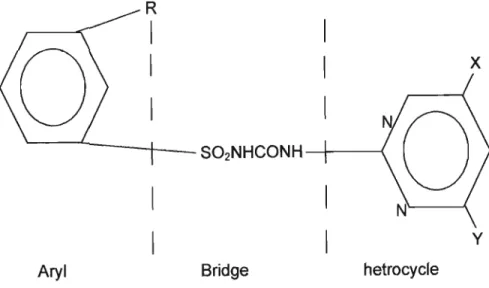
Furthermore, formulations have proved to be both foliar- and soil-active with very low mammalian toxicity (Cobb, 1992). According to Beyer, Duffy, Hay & Schlueter (1987), sulfonylurea herbicides are composed of three moieties: An aryl group, a nitrogen-containing hetrocycle portion and a sulfonylurea bridge that links the other two moieties (Figure 9).
o
11
Figure 6: Structure of sulphonylureas (Cobb, 1992).
R
N 0
H
Figure 7: Structure of imidazoliones (Cobb, 1992).
N
Figure 8: Structure of triazolopyrimidine (Cobb, 1992).
R
I I I
'---'---+--
S02NHCONH- - I - - - {x
y
Aryl Bridge hetrocycle
Figure9: General structure of an ALS inhibitor (Beyer et al., 1987).
When the aryl portion is a phenyl group, the highest herbicidal activity occurs when this group contains a substituent ortho to the bridge. Small substitution differences in each part of the molecule can give rise to large shifts in biological activity and selectivity. Beyer et al., (1987) stated that sulphonylureas are potent inhibitors of plant growth. These compounds can be considered growth inhibitors that cause plant death within a period ranging from several days to more than a week.
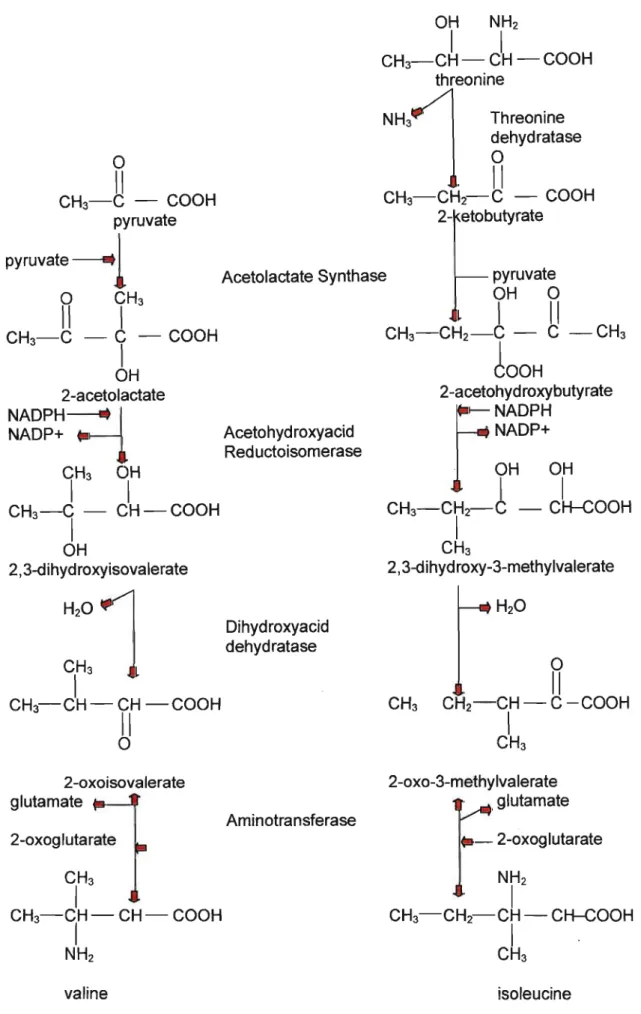
Depending on the plant specie, dose, and environmental conditions, a variety of secondary plant responses often develop. These include enhanced anthocyanin formation, loss of leaf nyctinasty, vein discoloration, necroses and chlorosis. The amino acids valine, leucine and isoleucine are products of the branched-chain amino acid pathway. Four of the enzymes of the pathway are common to synthesis of all three branched-chained amino acids. In the past decade, it had been found that sulfonylureas act on acetolactate synthase (ALS), the first enzyme in this pathway.
ALS is a nuclear-encoded, chloroplast-Iocalized enzyme in higher plants, and also occupies a strategic location in the biosynthetic pathway of essential amino acids.
Essentially, synthesis occurs in the stroma from threonine and pyruvate in a common series of reactions (Figure 10). In isoleucine synthesis threonine is first deaminated to 2-oxybutyrate by valine and isoleucine. ALS catalyses the first common step of branched-chain amino acid biosynthesis to yield acetohydroxy acids which undergo oxidation and isomerization to yield derivatives of valeric acid. Dehydration and transamination then produces isoleucine and valine. 2-0xoisovalerate reacts with acetyl CoA to form a.-isopropylmaleate which is then isomerized, reduced, and transaminated to yield leucine (Cobb, 1992).
OH NH