This phenomenon has created an opportunity for international parts suppliers to supply genuine and alternative parts to the South African market for in-warranty and out-of-warranty repairs. His valuable criticism, guidance, direction, support and supervision have been indispensable throughout the various stages to the completion of this thesis.
B ACKGROUND
R ESEARCH FOCUS
R ESEARCH O BJECTIVES
V ALUE OF R ESEARCH
O VERVIEW OF THE STUDY
O BJECTIVES
L IMITATIONS OF THE STUDY
I NTRODUCTION
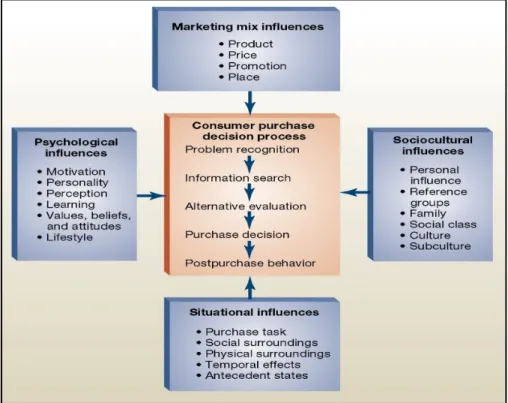
F ACTORS INFLUENCING C USTOMER ’ S B UYING D ECISIONS
M ARKET CHANGES
The shift in the global economy has created a new dimension in international trade, with emerging countries playing a leading role. By the early 2000s, auto sales in the Triad had reached saturation and they began looking for global growth opportunities (Lang, Loeser, & Nettesheim, 2008).
C OMPETITIVE FORCES IN S OUTH A FRICAN INDUSTRY
- Suppliers (intermediaries)
- Buyers
- Potential new entrants
- Substitutes
Similarly, cheap clothes and electronic products imported from China have become popular in South Africa (Yang, 2014). Bizuneh, et al., (2012) also support this view when they say that the lack of engineers and scientists is a major constraint in South Africa's R&D efforts.
I NTERNATIONAL TRADE
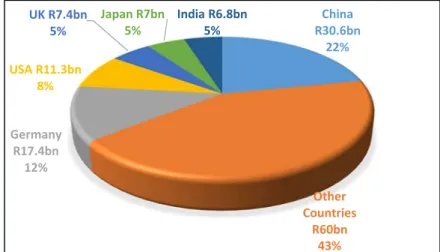
As a result, some countries have implemented localization barriers to trade, forcing foreign companies to transfer their intellectual property by localizing production activities in markets (Ezell, Atkinson, & Wein, 2013). This has also been seen in the glass industry, with PFG Building Glass (Pty) Ltd filing an application with the International Trade Commission (ITAC) in 2008 to impose anti-dumping duties on importers of clear drawn and float glass from China and India.
E STABLISH THE SOURCE OR COUNTRY OF ORIGIN OF THE PRODUCTS BOUGHT BY
Parts localization
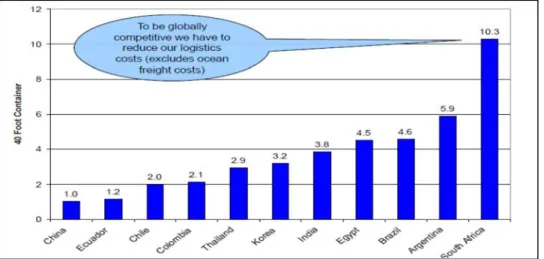
A faster mode of transportation, such as air freight, will provide a high response rate, but has costs that increase the cost of landing the product. They further explain that logistics costs for transporting imported material represent 10% of landing costs, which increases the total product by 3.5%.
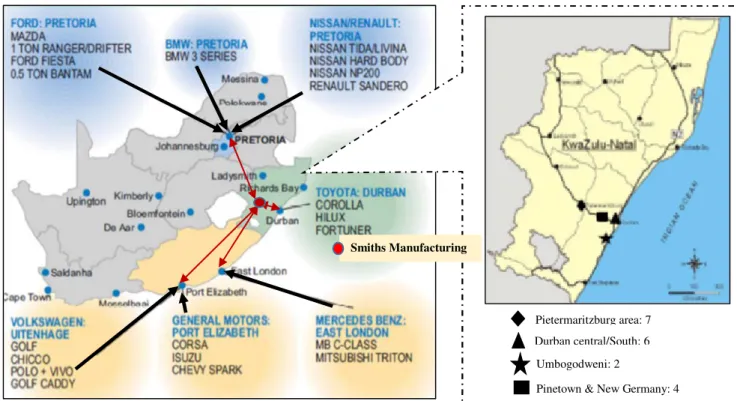
Durban Automotive Cluster (DAC)
The supply of products depends on the price competitiveness and improved delivery times of regular suppliers (Ambe & Badenhorst-Wess, 2013). Due to low volumes and extreme pressure from OEMs on suppliers to reduce costs, it is extremely difficult to remain competitive.
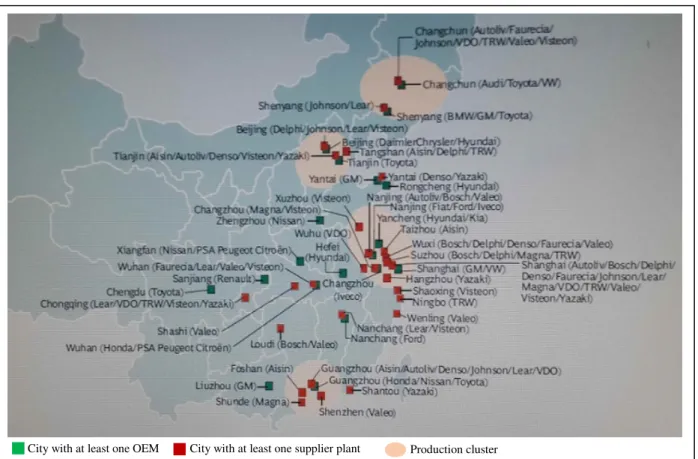
China Automotive Cluster
In the defense of the Congress of South African Trade Unions (COSATU), the adoption of a minimum or living wage will balance the injustices of the past (Cosatu, 2011). Pooe (2012) further highlighted the rising cost of electricity and logistics costs as some of the reasons why South African suppliers are losing their competitive edge.

I MPACT OF I NTERMEDIARIES B UYING D ECISIONS
Socio-Economic Factors – Human Capital
Komo et al. (2014) also highlighted the impact of strikes in the industry with a 75% drop in vehicle production in the last quarter of 2013. 25 Figure 10: Comparison of hourly rates in the manufacturing industry including forecast to 2015 (South African trade policy and the future global trade environment, (2012).
C HAPTER S UMMARY
26 It is quite difficult for OEM and tier suppliers to combat the direct importation of alternative products due to new laws introduced in South Africa such as the Right to Redress and Consumer Protection Act (CPA). The Right to Repair campaign forces the OEM to share their technical information with customers and CPA has given customers the right to use alternative products, provided they are of similar or better quality than genuine products. This was evident with BMW losing a case (Case no:722/12) to Grandmark International (PTY) LTD on 18 September 2013 for supplying alternative parts that were in conflict with BMW's trademark.
I NTRODUCTION
A IM AND OBJECTIVES OF THE STUDY
P ARTICIPANTS AND LOCATION OF THE STUDY
R ESEARCH D ESIGN
29 research is descriptive in nature, which aims to depict the characteristics of individuals, situations and the frequency of events using statistics to analyze and summarize data for complete reports (Polit & Hungler, 2013). The use of mixed research will provide complementary strengths of using these different methods of data collection to reduce limitations of using one method (Hesse-Biber & Leavy, 2008). The study will use the nested mixed design method which will use the qualitative data to provide supporting findings to enhance quantitative data.
I NSTRUMENTS
Questionnaires
30 Siniscalco & Auriat (2005) describe a research hypothesis as an intermediate response to a research problem that emphasizes the relationship between a dependent variable (effect) and an independent variable (cause). There are two essential aspects of questionnaire design: the question structure and the type of response format for each question. Due to the nature of the sample used, the research uses contingent questions and closed questions.
According to Siniscalco & Auriat (2005), the contingency question approach is applied to the subgroup of respondents who will help with the research by categorizing the two different level groups (service dealers and distributors). The closed questions will give the respondent the best possible answer that most closely represents their point of view.
Questionnaire Construction
The design of corresponding questionnaires can begin after the variables and indicators are identified. A majority of service dealers purchase products to service customers who need their air conditioners repaired. Questionnaire arrangement, design and quantity were carefully selected to enable distributors and service dealers to make a meaningful contribution in less than fifteen minutes to reduce delays.
November through March are the busy times of year in the air conditioning industry, so fewer interruptions will increase productivity.
D ATA C OLLECTION
To achieve the above, a good sampling technique must be used which will define the population of interest. The quantitative method will use a purposive sampling method called the non-proportional quota sampling technique, which focuses on obtaining the number of the population in each group, specifically eight distributors and 47 service dealers. This method will provide a broader understanding of the problem at hand, ensure completeness, precision and reduce selection bias that will affect data quality (Peersman, 2014).
Quantitative data will be collected using the web-based tool QuestionPro through open-ended mail and self-administered questionnaires. Mail and self-administered questionnaires are the cheapest form of survey and can cover a larger geographical area.
D ATA ANALYSIS
Qualitative data will be collected through the researcher's product experience report, market information and internal company sales reports. Morrison & Smit (2003) suggest that the goal of research is to make a significant contribution to scientific knowledge. The researcher wants to analyze the nature and behavior of after-sales customers and business dynamics, to understand the effect of alternative products for the formulation of short-term and long-term strategies.
Use qualitative data to identify problems or obtain information about variables that cannot be obtained with quantitative approaches. Generating hypotheses from qualitative data to be tested through the quantitative data (such as identifying subgroups to be analyzed separately in the quantitative data, for example to explore differential impact).

I NTRODUCTION
Q UANTITATIVE D ATA P RESENTATION
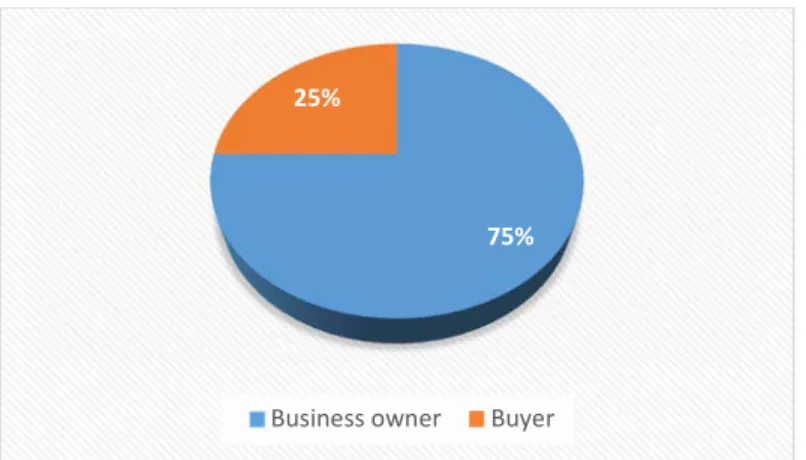
The second factor that influences the buying decision of the customers is the price at 40%. According to the survey, 43% of suppliers consist of the parts distributors followed by others and direct importers. 54% of respondents disagree that imported products are of poor quality, with 30% agreeing and 15% disagreeing.
62% of respondents agree to use Chinese copier products, while 38% do not use Chinese copier products. 54% of survey respondents agree with this notion, 31% strongly agree and 15% disagree.
Q UALITATIVE D ATA P RESENTATION
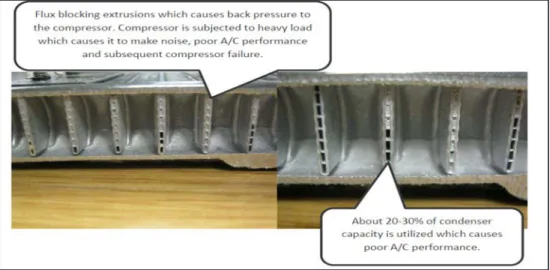
The back pressure test results performed on the Chinese copy heat exchanger and cross section of the defective parts. Baffle plates are inserted in each tank, which will provide the channel flow of coolant, which determines the cooling capacity of the heat exchanger. Flux residue seen on the ends of the extrusion shows that there was a height discrepancy in the slots in the side tanks, which will allow the flux to leak through.
This was evident with the increase in China Malls bringing in products and dumping them at a fraction of the normal price. It is quite difficult for some of the global customers to exercise their rights to return unwanted, defective or inferior products.
S UMMARY
I NTRODUCTION
D ISCUSSION OF RESULTS
Some of the automaker's dealers offer better discounts to workshops, which is another incentive for them. It is the customer's right to have a product delivered that has a warranty of at least six months. This has created a market for remanufactured products to capture a smaller percentage of market share.
Customers often opt for superior quality products, but the deciding factor is the price of the product. Insurance companies pay panel beaters a percentage of the part they will use on a vehicle.
I NTRODUCTION
R ESEARCH PROBLEM
F INDINGS AND I MPLICATIONS OF THE S TUDY
South African government agencies can draw on the research to devise strategies to curb the flow of imports that are causing a trade deficit. Like the poultry industry, local farmers highlighted their problems, leading to government intervention by introducing an anti-dumping policy for chickens from Brazil. This research, like the poultry sector, could help the independent aftermarket sector seek assistance from the South African government to protect the vulnerable aftermarket automotive industry.
This can help the industry grow local parts suppliers and support the industry's projection to produce 1.2 million units of vehicles per year by 2020 (Pooe, 2012). This will also help Smiths management develop innovative short- and long-term strategies to ensure sustainable growth in the aftermarket sector.
R ECOMMENDATIONS TO RESOLVE THE PROBLEM
Similar findings were also evident with domestic fastener manufacturers losing market share to Chinese fastener importers (Booyens, 2014). Local manufacturing must protect its industry in order to be competitive and grow. The South African Revenue Service (SARS) and the customs department may intensify control over the quality of products and the tariff codes used for products entering the South African market.
C HAPTER S UMMARY
ILO Automotive Study Prepared by the Benchmarking and Manufacturing Analysts South Africa for the International Labor Organization. Recent Trends in Manufacturing Innovation Policy for the Automotive Sector: A Survey of the USA, Mexico, EU, Germany and Spain. Interrogating the impact of industrial clustering on firm-level employment growth: A case of the Duran Automotive Cluster (DAC).
Dissertation submitted for Masters in Development Studies, School of Development Studies, University of KwaZulu-Natal. The export performance of the South African Automotive Industry: New Stimuli through the EU-South Africa Free Trade Agreement. An analysis of African automotive supplier parks from a supply chain perspective with specific reference to the Rosslyn automotive supplier park.